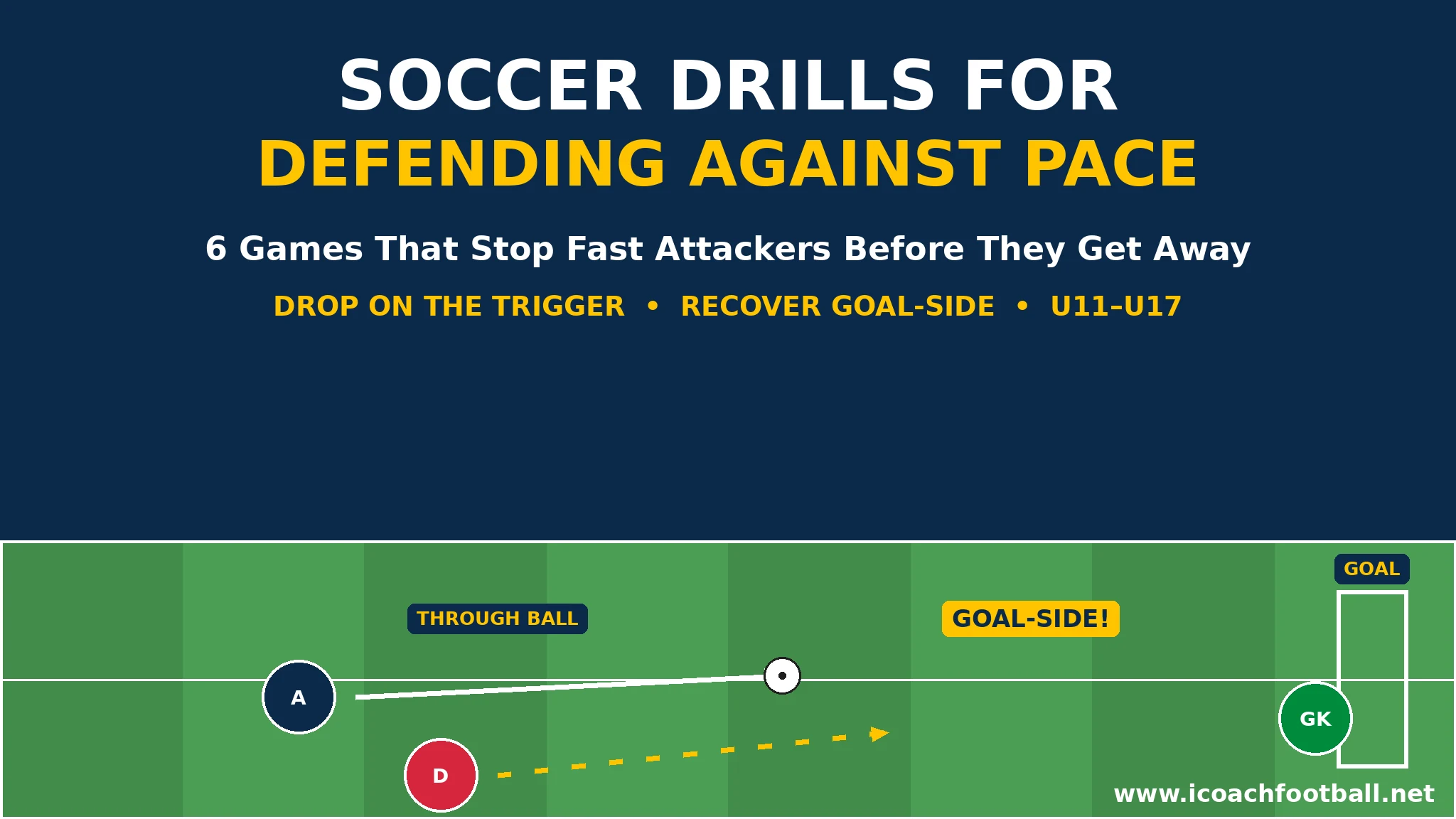
Soccer Drills for Improving Defending Against Pace: 6 Games That Stop Fast Attackers Before They Get Away (U11–U17)
Quick answer
Pace is not beaten with pace. A defender who reads the trigger and drops five yards before the ball is played is already goal-side when the fast attacker receives it — and a fast attacker who is shown wide, with a covering team-mate behind, has nowhere dangerous to go. These six soccer drills for improving defending against pace train that race step by step: reading the passer’s head and body, dropping early, channelling the attacker outside, sprinting back goal-side when beaten, delaying instead of diving in, and covering as a unit — then a full game where stopping the break scores.
Suitable for: U11–U17 (ages 10–17)
Session snapshot
- Players: 8–16, including 1 goalkeeper
- Age: U11–U17 (ages 10–17)
- Area: Half a pitch, with wide channels marked
- Duration: 60 minutes
- Focus: Defending against pace — reading the trigger, dropping early, recovery runs, channelling fast attackers wide, delaying, and team cover
- Equipment: 10 balls, 16 cones, bibs, 1 full goal (2 for the final game)
Why these six games work
Most goals against pace are conceded before the fast attacker touches the ball. The defender who stands flat and waits for the pass is already beaten — the through ball is played behind them, the attacker is running onto it at full speed, and no recovery run can close that gap. The defender who drops on the trigger — the passer’s head going down, the body opening up, the weight shifting onto the passing foot — is five yards goal-side before the ball is played, and the race is already won.
The first two drills build the read: dropping on the trigger so the defender is never caught flat, then standing side-on and showing the fast attacker outside, where the touchline becomes a second defender. The next two drills build the recovery: sprinting back goal-side on a curve inside the attacker’s line when beaten, then delaying with small steps instead of diving in at a faster dribbler. The last two drills build the team skill: one presses while one covers, with a clear handover call, then a full game where the attackers get a head start and stopping the break scores.
The drills are grounded in the FIFA/UEFA coaching community. Drills 2, 3 and 4 are based on / in line with the FIFA Training Centre session “Building the foundations of collective defending” (FIFA Talent Coach Conor Marlin), which trains players to apply immediate pressure before the attacker gathers momentum, to delay the attacker once in close proximity and prevent forward progression, to force attackers away from central areas and onto their weaker foot, to block the inside route and show play down the touchline, to apply pressure quickly when recovering from behind, and to stay patient when defending from the side and avoid overcommitting beyond the ball. Drills 1, 5 and 6 are based on / in line with the England Football Learning “Press and cover to defend” session programme for 12–16s, which trains players to look for triggers to press — an opponent facing their own goal, taking a heavy touch, or about to receive a longer, slower pass — to recover as quickly as possible once they have lost possession or been beaten, to keep the right distance so they can offer covering support and still engage, and to decelerate when approaching an opponent, slowing down, staying side-on and bending their knees when close. In the UK the same session is football drills for defending against pace — the trigger, the drop and the recovery run are identical.
This post is the pace half of the site’s 1v1 defending pair. The duel skill itself — jockeying, body shape and the tackle — is our 1v1 defending drills jockeying — this post trains what happens when the attacker is faster than the defender, which is a different problem with a different answer.
Six rules of defending against pace
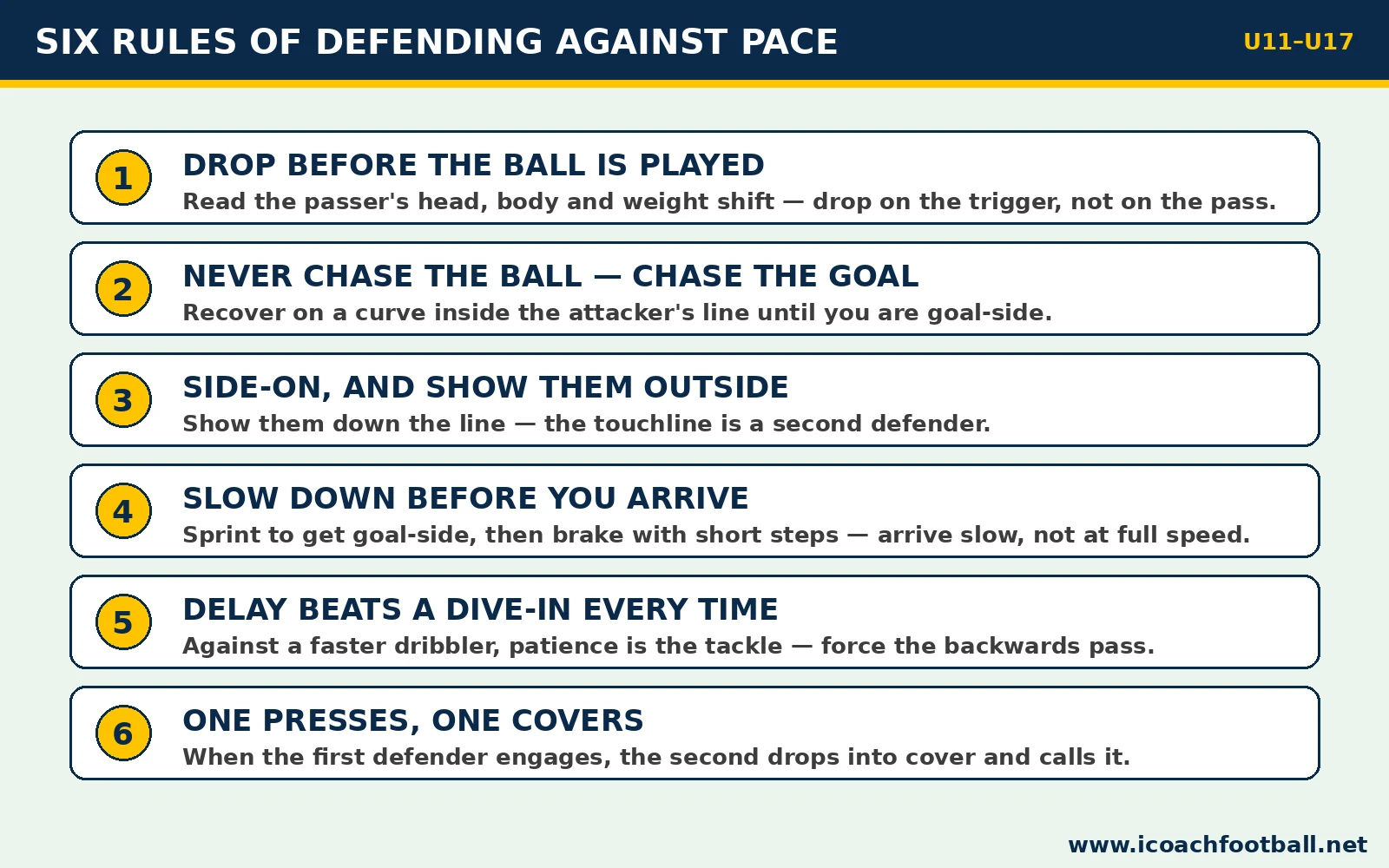
- Drop before the ball is played, not after it. Read the passer’s head, body and weight shift — the defender who drops on the trigger is goal-side before the race starts.
- Never chase the ball — chase the goal. A recovery run goes on a curve inside the attacker’s line, towards your own goal, until you are between the ball and the goal.
- Side-on, and show them outside. Stand angled so the only way on is down the line — the touchline is a second defender, and the inside route is closed.
- Slow down before you arrive. Sprint to get goal-side, then brake with short steps — a defender who arrives at full speed is beaten by one touch.
- Delay beats a dive-in every time. Against a faster dribbler, patience is the tackle — force the backwards pass and let help arrive.
- One presses, one covers. When the first defender engages, the second defender drops into cover and calls it — nobody presses alone against pace.
Drill 1 — Drop on the Trigger
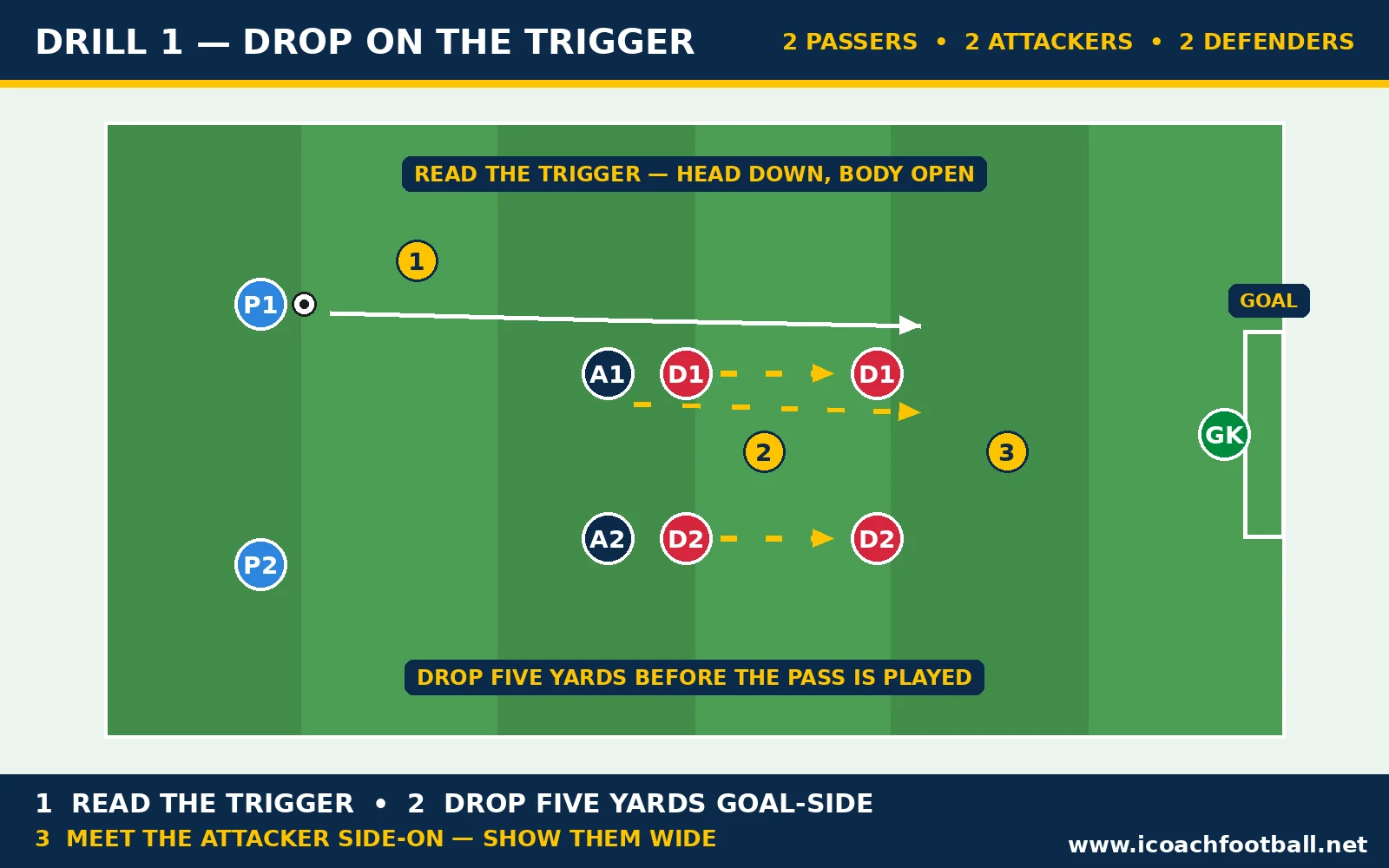
The reading drill — the defender learns to drop five yards the moment the passer’s body says the through ball is coming, so they are goal-side before the fast attacker even moves.
Setup
- Half a pitch, 1 full goal, 1 keeper, 2 passers, 2 attackers, 2 defenders.
- 8 minutes, then swap sides.
How to Play
- The passers stand in midfield with balls, facing the goal the defenders protect.
- The attackers start on the halfway line, level with the defenders, five yards apart.
- The passer shapes to play — head down, body open, weight on the passing foot.
- The moment the trigger shows, both defenders drop five yards towards their own goal.
- The passer plays the through ball and the attacker sprints onto it at full speed.
- The defender, already goal-side, meets the attacker side-on and shows them wide.
Coach’s note: “Do not watch the ball — watch the passer. The head goes down, the body opens, and you drop before the pass is played.”
Progressions: The passer may fake the through ball and play sideways, so defenders must read, not guess; the attacker starts two yards behind the defender, so the drop must be earlier; the passer plays first time, so the trigger is the body shape alone.
Drill 2 — Side-On, Show Them Outside
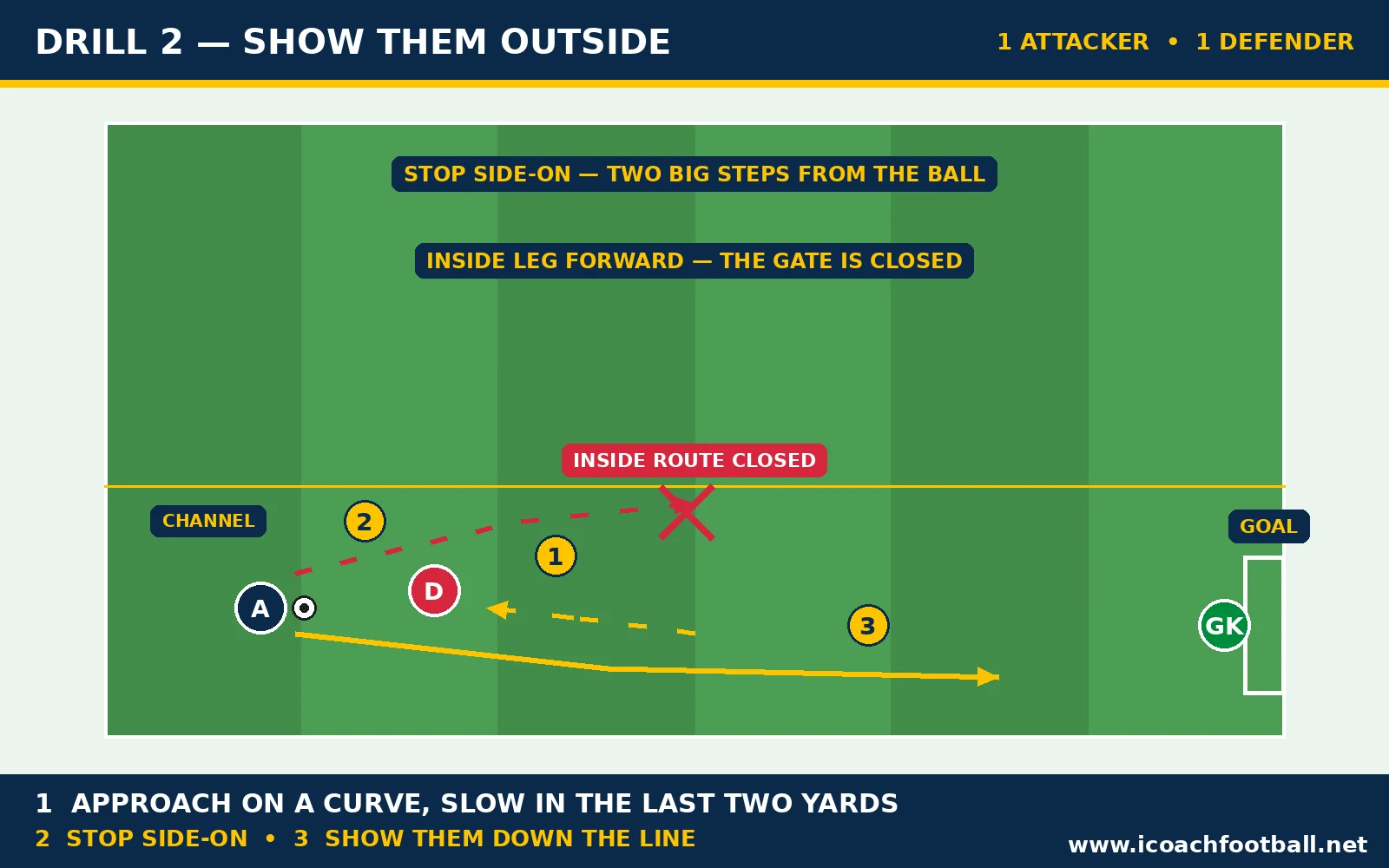
The channelling drill — the defender meets a fast attacker in the wide channel, stands side-on at the right distance, and closes the inside route so the only way on is down the line.
Setup
- Wide channel 20 yards long and 12 yards wide, 1 mini-goal at the far end, 1 attacker, 1 defender.
- 10 minutes, then swap sides.
How to Play
- The attacker starts at the near end of the channel with the ball, facing the mini-goal.
- The defender starts three yards in front of the attacker, slightly inside the ball.
- The defender approaches on a curve, slowing with short steps in the last two yards.
- The defender stops side-on, two big steps from the ball, with the inside leg forward.
- The attacker tries to beat the defender — the defender blocks the inside route and shows them down the line.
- If the defender wins the ball, they dribble out of the channel; if the attacker reaches the mini-goal, they score.
Coach’s note: “Your inside leg is the gate. Close it, and the only road left is the touchline — and the touchline is on our side.”
Progressions: The attacker may start with a five-yard head start, so the defender must close the space faster; the channel narrows to 8 yards, so the show-outside angle is tighter; add a second attacker, and the defender must show the first wide while watching the second.
Drill 3 — The Recovery Race
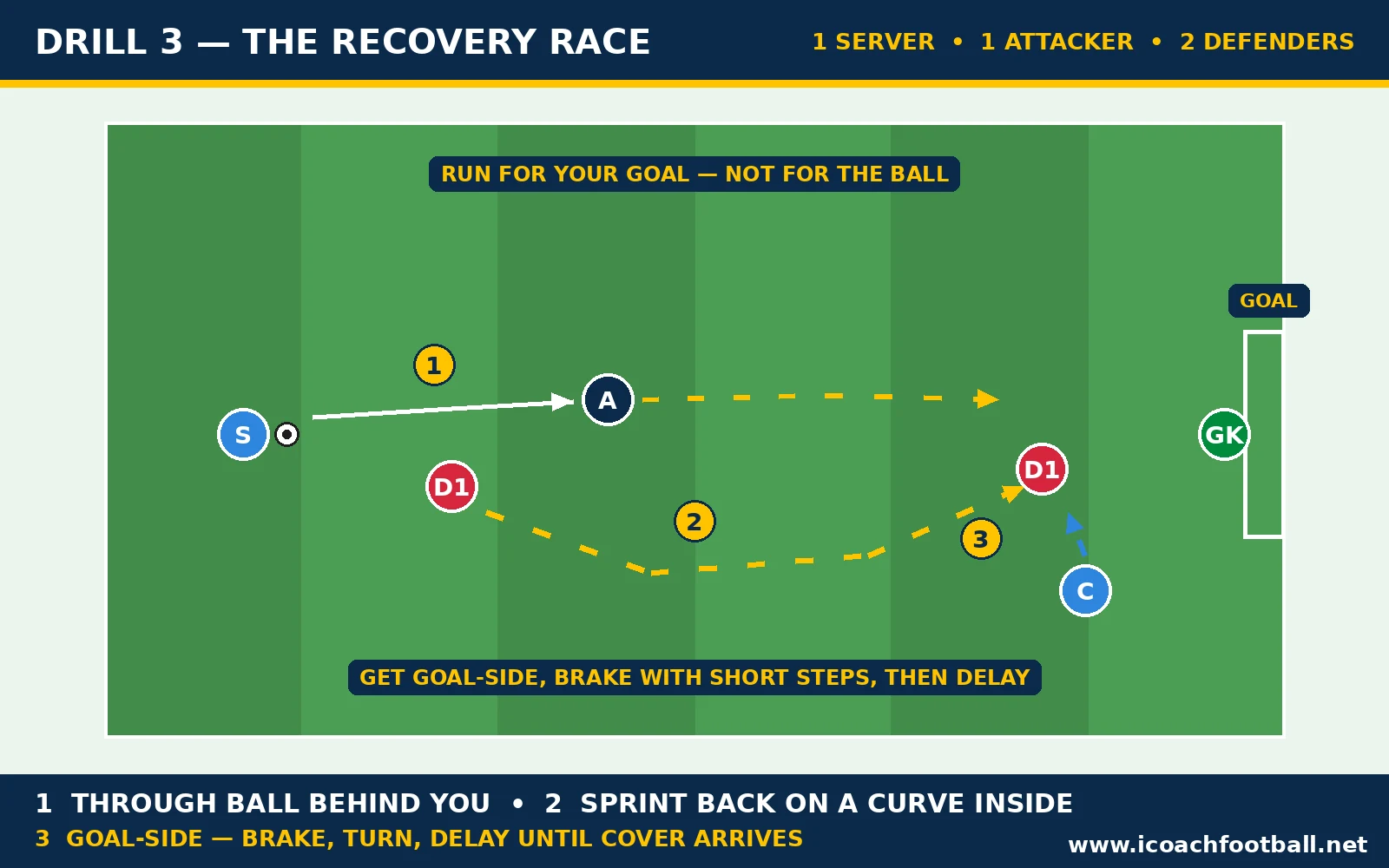
The recovery drill — the defender is beaten by a through ball, sprints back goal-side on a curve inside the attacker’s line, then brakes and delays until help arrives.
Setup
- Half a pitch, 1 full goal, 1 keeper, 1 server, 1 attacker, 1 defender, 1 covering defender.
- 10 minutes, then swap roles.
How to Play
- The attacker starts five yards ahead of the defender, level with the halfway line.
- The server, in midfield, plays a through ball into the space behind the defender.
- The attacker sprints onto the ball at full speed, running at goal.
- The defender sprints back on a curve inside the attacker’s line, towards their own goal.
- The defender gets goal-side, brakes with short steps, and turns to face the attacker.
- The defender delays side-on, showing the attacker wide, until the covering defender arrives.
Coach’s note: “Run for your goal, not for the ball. Get between the ball and the goal first — then you can defend. Chase the ball and you defend nothing.”
Progressions: The defender starts eight yards behind the attacker, so the recovery run is longer; the server plays the ball earlier, so the defender must react to the pass, not the sprint; the covering defender starts further away, so the first defender must delay for five seconds alone.
Drill 4 — Delay, Don’t Dive In
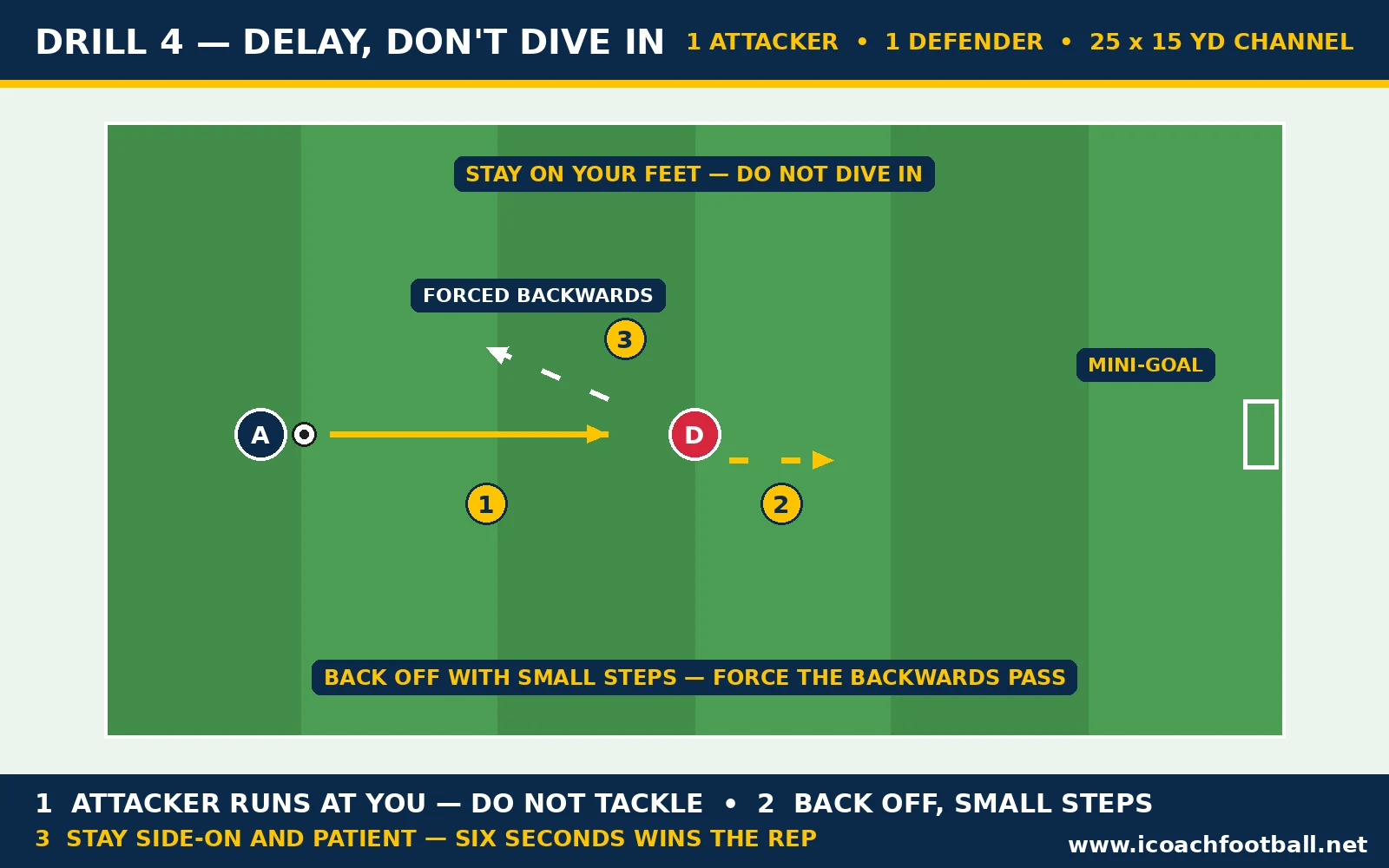
The patience drill — a faster dribbler runs at the defender, and the defender must stay on their feet, back off with small steps, and force the backwards pass instead of diving in and being beaten.
Setup
- Channel 25 yards long and 15 yards wide, 1 mini-goal at the defender’s end, 1 attacker, 1 defender.
- 10 minutes, then swap roles.
How to Play
- The attacker starts at the far end of the channel with the ball, facing the mini-goal.
- The defender starts in the middle of the channel, goal-side of the attacker.
- The attacker dribbles at the defender at full speed — the defender must not tackle.
- The defender backs off with short, quick steps, staying two big steps from the ball.
- The defender stays side-on and patient, showing the attacker towards the touchline.
- The rep ends when the attacker plays backwards, the defender wins the ball, or six seconds pass.
Coach’s note: “Stay on your feet and make them play backwards. A tackle you miss is a goal — a delay you hold is a win.”
Progressions: The attacker gets eight seconds instead of six, so the defender must stay patient longer; the defender starts two yards closer, so the braking distance is shorter; add a recovering team-mate, and the defender must delay until the team-mate is goal-side.
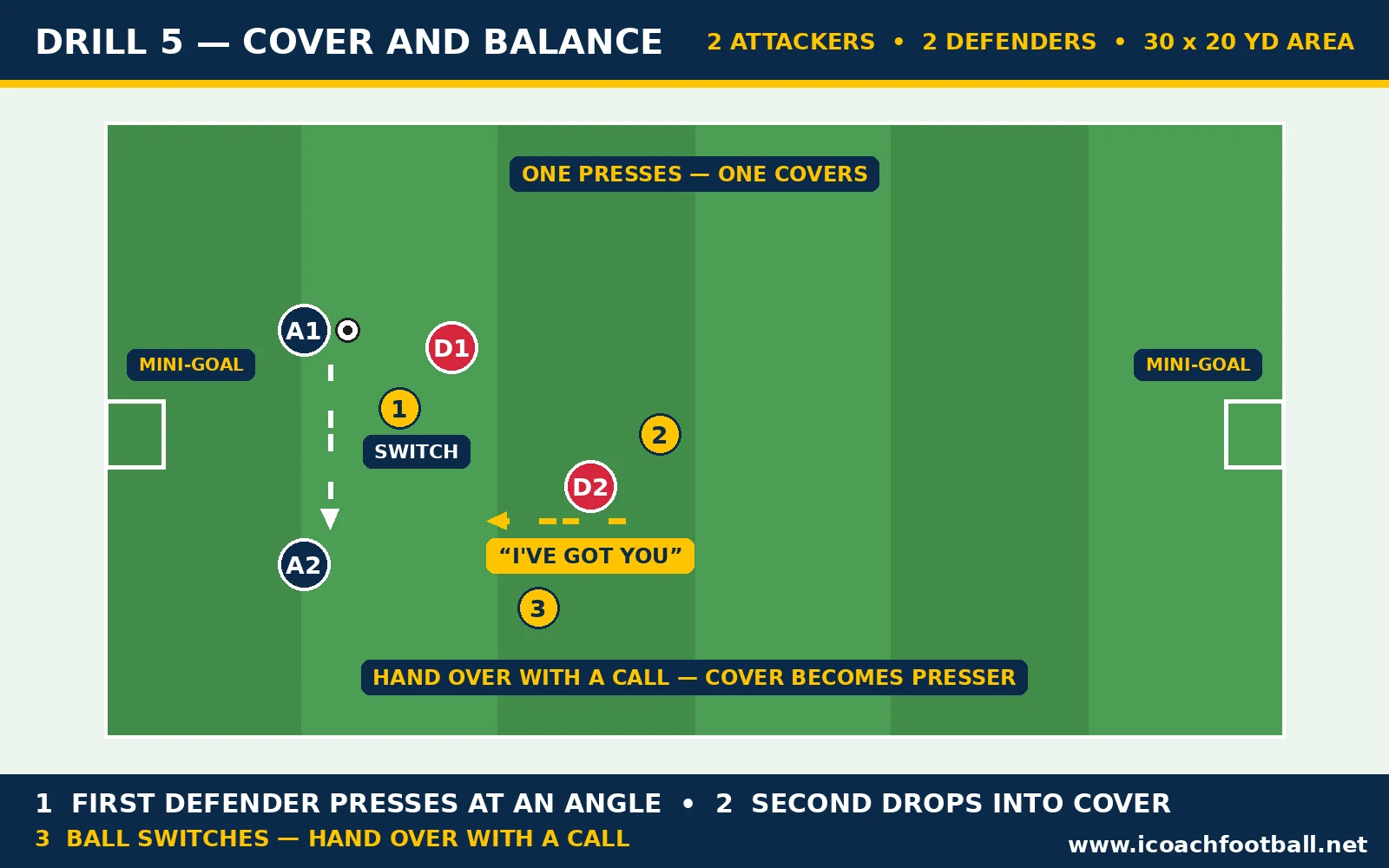
Drill 5 — Cover and Balance
The team drill — two defenders face two attackers, one presses the ball while the other drops into cover, and they hand over with a clear call when the attacker switches sides.
Setup
- Area 30 yards by 20 yards, 2 mini-goals at each end, 2 attackers, 2 defenders.
- 10 minutes, then swap roles.
How to Play
- The two attackers start with the ball at one end, the two defenders goal-side of them.
- The first defender presses the ball carrier, closing the space quickly at an angle.
- The second defender drops five yards behind and inside, into a covering position.
- The covering defender calls “I’ve got you” so the presser knows help is there.
- If the ball is switched to the other attacker, the defenders hand over — cover becomes presser.
- The rep ends when the defenders win the ball or the attackers score in a mini-goal.
Coach’s note: “One presses, one covers — and the cover talks. If I cannot hear you, I am pressing alone, and alone against pace is a goal.”
Progressions: Add a third attacker, so the cover must also watch the spare player; the attackers switch the ball every three seconds, so the handover must be instant; the defenders must win the ball in the attacking half to score, so the press starts higher.
Drill 6 — Pace-Proof Game
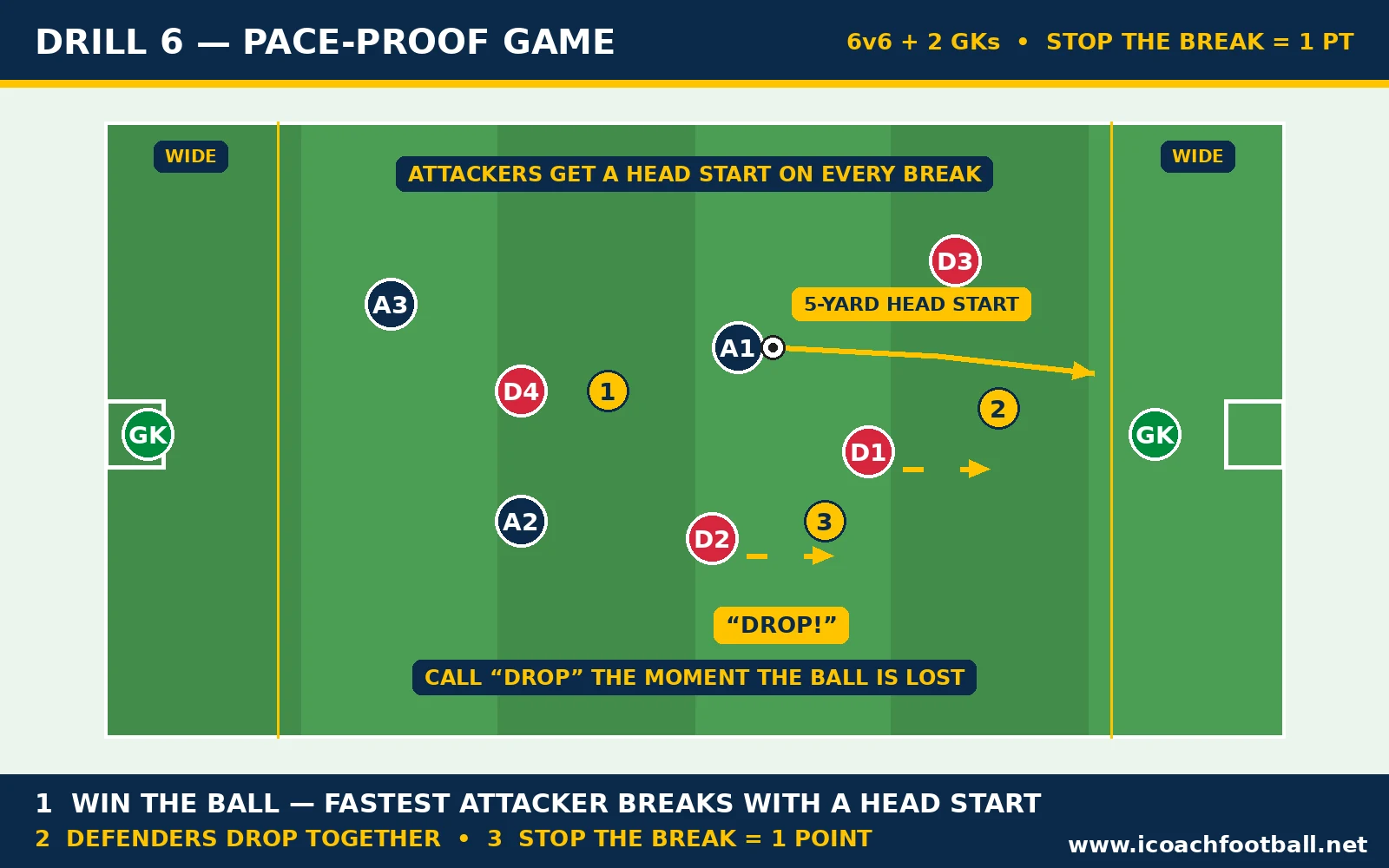
The full game. A 6v6 where the attackers get a head start on every break — and the defending team scores a point every time they stop the break without conceding, so the whole team starts defending pace together.
Setup
- Half a pitch, 6v6 plus 2 goalkeepers, 2 full goals, wide channels marked with cones.
- 12 minutes.
How to Play
- Two teams of 6 play 6v6 with goalkeepers — normal goals count 1 point.
- Every time a team wins the ball, their fastest attacker gets a five-yard head start on the break.
- The defending team scores 1 point every time they stop the break without conceding.
- A goal conceded on the break costs the defending team their point — so the drop matters.
- Defenders must call “drop” the moment the ball is lost, so the whole unit moves together.
- The team with the most points after 12 minutes wins — then play again with new teams.
Coach’s note: “Watch the trigger, not the runner. The moment the group starts shouting ‘drop’ before the pass is played, pace stops hurting us.”
Progressions: The head start grows to eight yards; the break must be stopped within six seconds to score; a recovery tackle that wins the ball cleanly counts double.
Coaching points
- Drop on the trigger, not on the pass. The passer’s head going down and body opening up is the signal — the defender who waits for the ball to be played is already five yards behind the race.
- Run for your goal, not for the ball. A recovery run goes on a curve inside the attacker’s line, towards your own goal, until you are between the ball and the goal — then you can defend.
- Side-on, and close the inside gate. Approach at an angle, stop two big steps from the ball with the inside leg forward, and show the attacker down the line — the touchline is a second defender.
- Brake before you arrive. Sprint to get goal-side, then slow down with short steps — a defender who arrives at full speed is beaten by one touch.
- Delay is a tackle. Against a faster dribbler, staying on your feet and forcing the backwards pass wins the duel — a dive-in that misses is a goal.
- One presses, one covers — and the cover talks. The second defender drops five yards behind and inside, and calls “I’ve got you” — nobody presses alone against pace.
Common mistakes
| Mistake | Fix |
|---|---|
| Standing flat and waiting for the pass to be played | Drop on the trigger — Drill 1 stops the rep if the defender has not dropped before the through ball is played |
| Chasing the ball on a recovery run instead of running for the goal | Run on a curve inside the attacker’s line, towards your own goal — Drill 3 only scores the recovery if the defender is goal-side before they turn |
| Approaching straight on, so the attacker can go either side | Approach at an angle and stop side-on — Drill 2 only scores the channel if the inside route stayed closed |
| Arriving at the attacker at full speed and being beaten by one touch | Brake with short steps in the last two yards — Drill 3 stops the rep if the defender overruns the attacker |
| Diving in at a faster dribbler and being beaten | Stay on your feet and force the backwards pass — Drill 4 only scores the rep if the defender is still on their feet at six seconds |
| Both defenders pressing the ball at the same time | One presses, one covers — Drill 5 stops the rep if the covering defender has not dropped five yards behind and called “I’ve got you” |
Age adaptations
| Age | Format | What changes |
|---|---|---|
| U11–U13 (ages 10–13) | Small areas, size 4 ball, coach serves the through ball | All six drills run at walking pace first, so the drop, the side-on shape and the recovery line are learned before speed is added. Drill 3 uses a five-yard head start for the defender, so the recovery is always winnable. Drill 6 plays with no scoreboard for goals — only stopped breaks are counted, so the group learns what good defending against pace looks like |
| U14–U15 (ages 13–15) | Full areas, size 4 ball, through balls played live from the first rep | All six drills run as written, with the covering defender added from the second round. Drill 1 adds the passer’s fake, so defenders must read the trigger, not guess it. Drill 4 adds the recovering team-mate, and Drill 5 adds the third attacker. Defenders keep a simple count — “six breaks, five stopped” is the habit that sticks |
| U16–U17 (ages 15–17) | Full areas, size 5 ball, attackers at full speed from the first rep | Full pressure from the start. Drill 2 narrows the channel to 8 yards, Drill 3 starts the defender eight yards behind the attacker, and Drill 6 grows the head start to eight yards. Defenders are asked to call their decision before each rep — “drop”, “show outside”, “delay” — so the read becomes a conscious skill, not a lucky guess |
60-minute session plan
| Block | Time | Content |
|---|---|---|
| Arrival game | 0:00–0:05 | Free 3v3 in the channels — every stopped break counts double |
| Drop on the trigger | 0:05–0:13 | Drill 1 — Drop on the Trigger |
| Side-on, show them outside | 0:13–0:23 | Drill 2 — Side-On, Show Them Outside |
| The recovery race | 0:23–0:33 | Drill 3 — The Recovery Race |
| Delay, don’t dive in | 0:33–0:43 | Drill 4 — Delay, Don’t Dive In |
| Cover and balance | 0:43–0:51 | Drill 5 — Cover and Balance |
| Pace-proof game | 0:51–1:00 | Drill 6 — Pace-Proof Game |
Keep building from here
The duel skill itself — jockeying, body shape and the tackle — is our 1v1 defending drills jockeying, and the two-player game that follows a beaten defender is our soccer defending 2v1 drills. The transition that creates the break in the first place is our football defensive transition drills, and the six-second counter-press that stops it at source is our counter-pressing soccer drills 6-second rule. The marking that keeps a fast attacker from receiving the ball at all is our soccer drills for improving marking, and the interception that cuts the through ball out before the race starts is our soccer drills for improving interceptions. The anticipation that tells a defender when the through ball is coming is our soccer drills for improving anticipation, and the zonal shape that protects the space behind the back line is our soccer drills for improving zonal marking. The compact block that denies fast attackers the space to run into is our the defensive block to teach compactness, and the back-post cover that saves the team when the fast winger does get a cross away is our soccer drills for improving defending the back post. The aerial duel that decides the long ball over the top is our soccer drills for improving aerial duels. Defending against pace is high-intensity — plan the week’s load with our training load calculator.
How do you defend against a faster attacker in soccer?
Drop early, stand side-on, and show them outside. Read the passer’s body and drop five yards before the through ball is played, so you are goal-side when the attacker receives it — then approach at an angle, stop two big steps from the ball with your inside leg forward, and close the inside route. The touchline becomes a second defender, and the attacker has nowhere dangerous to go. Drill 1 trains the drop, and Drill 2 trains the side-on show.
Should a defender drop off or press a fast winger?
It depends on the trigger and the distance. Press when the attacker faces their own goal, takes a heavy touch, or is about to receive a longer, slower pass — those are the triggers England Football’s press-and-cover programme teaches. Drop when the attacker is facing forward at full speed with space behind you, because a press from there is a race you will lose. Drill 1 trains reading the trigger, and Drill 4 trains the drop-and-delay decision.
What is a recovery run in soccer defending?
A recovery run is the sprint back towards your own goal after an attacker has beaten you, run on a curve inside the attacker’s line until you are between the ball and the goal — then you brake with short steps, turn, and delay. Never chase the ball itself: chasing the ball leaves you behind the attacker, and a tackle from behind is a foul. FIFA’s collective defending session trains defenders to apply pressure quickly when recovering from behind. Drill 3 trains the recovery race.
How do you stop a fast attacker from cutting inside?
Close the inside gate. Approach at an angle towards the attacker’s inside thigh, stop side-on with your inside leg forward, and use your hips and arms to get in front of them if they try the take-on. FIFA’s collective defending session trains defenders to block the inside route and force play towards the outside, protecting central areas. Drill 2 trains the show-outside shape, and Drill 4 trains holding it under pressure.
At what age should players start training defending against pace?
From U11, at walking pace first, so the drop, the side-on shape and the recovery line become habits before speed is added. The read itself can be trained young — what must wait is the full-speed recovery against a faster attacker closing in. Add live through balls and opposed attackers gradually from U13, and full-pressure defending against pace from U15, once the defender drops on the trigger every time.
Sources
- FIFA Training Centre. “Building the foundations of collective defending” — the FIFA Training Centre zonal defending methodology, presented by FIFA Talent Coach Conor Marlin, trains players to apply immediate pressure before the attacker gathers momentum, to delay the attacker once in close proximity and prevent forward progression, to force attackers away from central areas and onto their weaker foot, to block the inside route and show play down the touchline, to apply pressure quickly when recovering from behind, and to stay patient when defending from the side and avoid overcommitting beyond the ball. Verified live 2026-11-21 (HTTP 200, full text read). Drills 2, 3 and 4 are based on / in line with this session’s direct, delay and deny principles.
- England Football Learning. “Press and cover to defend — session programme” — the England Football Learning six-week session programme for 12–16s trains players to look for triggers to press (an opponent facing their own goal, taking a heavy touch, or about to receive a longer, slower pass), to recover as quickly as possible once they have lost possession or been beaten, to keep the right distance so they can offer covering support and still engage, and to decelerate when approaching an opponent, slowing down, staying side-on and bending their knees when close. Verified live 2026-11-21 (HTTP 200, full text read). Drills 1, 5 and 6 are based on / in line with this programme’s trigger, cover-and-recover and deceleration principles.