Soccer Defending Long Balls Drills: 6 Games to Drop, Win the First Ball and Clear With Distance
Quick answer
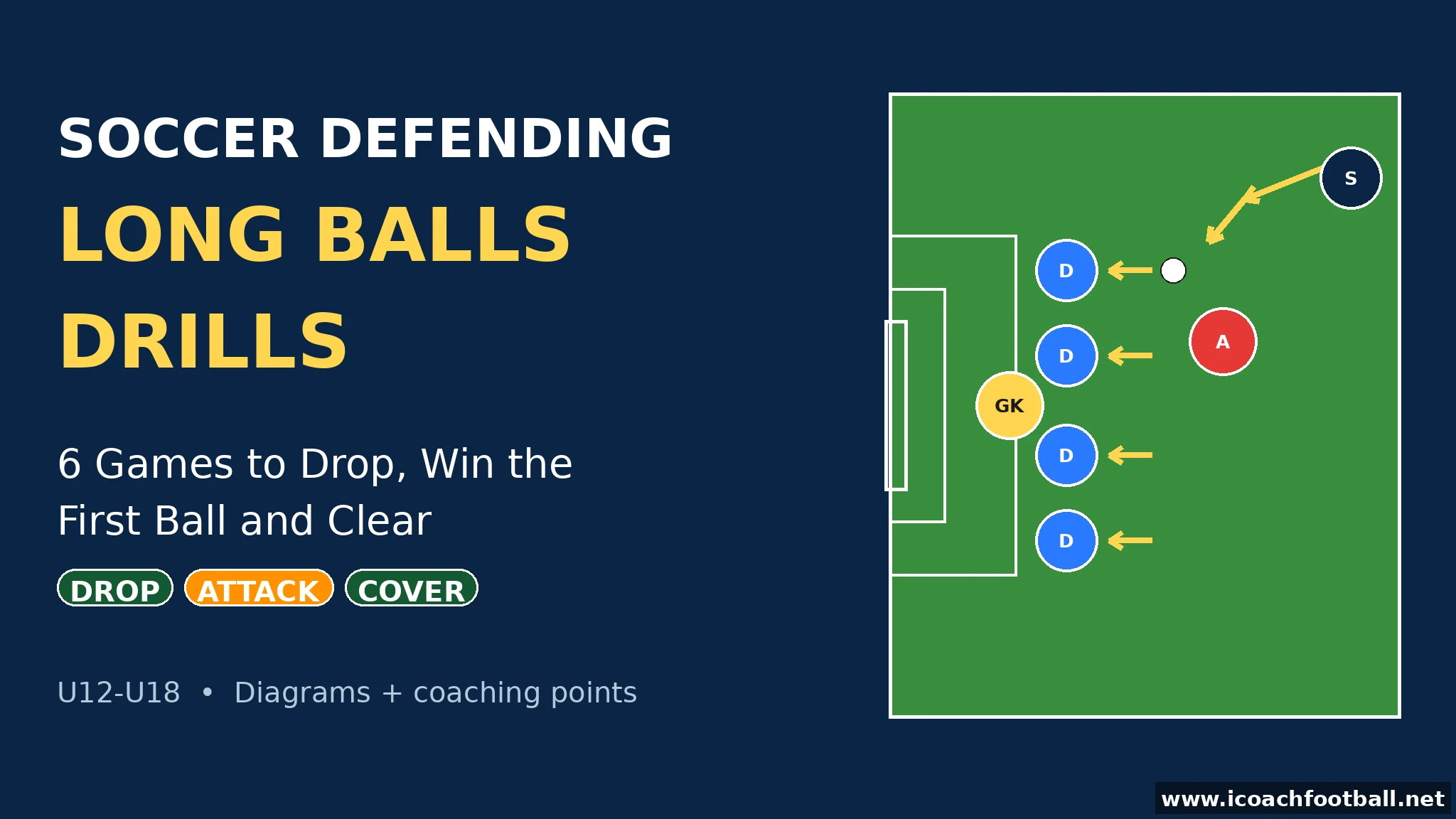
One defender attacks the long ball. The rest drop and cover. These six soccer defending long balls drills teach your back line that rule — and the timing, the call and the clearance that make it work.
Suitable for: U12–U18
Every youth coach knows the team: big striker, long ball over the top, your back line caught square and flat. The ball bounces once in your box and suddenly it is a goal. The problem is the same in soccer and football alike — and it is trainable. A long ball is only dangerous when the back line is caught in two minds: one defender steps up while the rest stand still, or nobody attacks the flight at all. These six games fix that, one habit at a time.
Session snapshot
- Players: 4 defenders plus a goalkeeper, servers and attackers as needed
- Area: Half a pitch, one goal
- Duration: 60 minutes
- Focus: Dropping as a unit, attacking the first ball, covering the flick-on
- Age: U12–U18 (see Age adaptations)
Drop, attack or cover — the decision
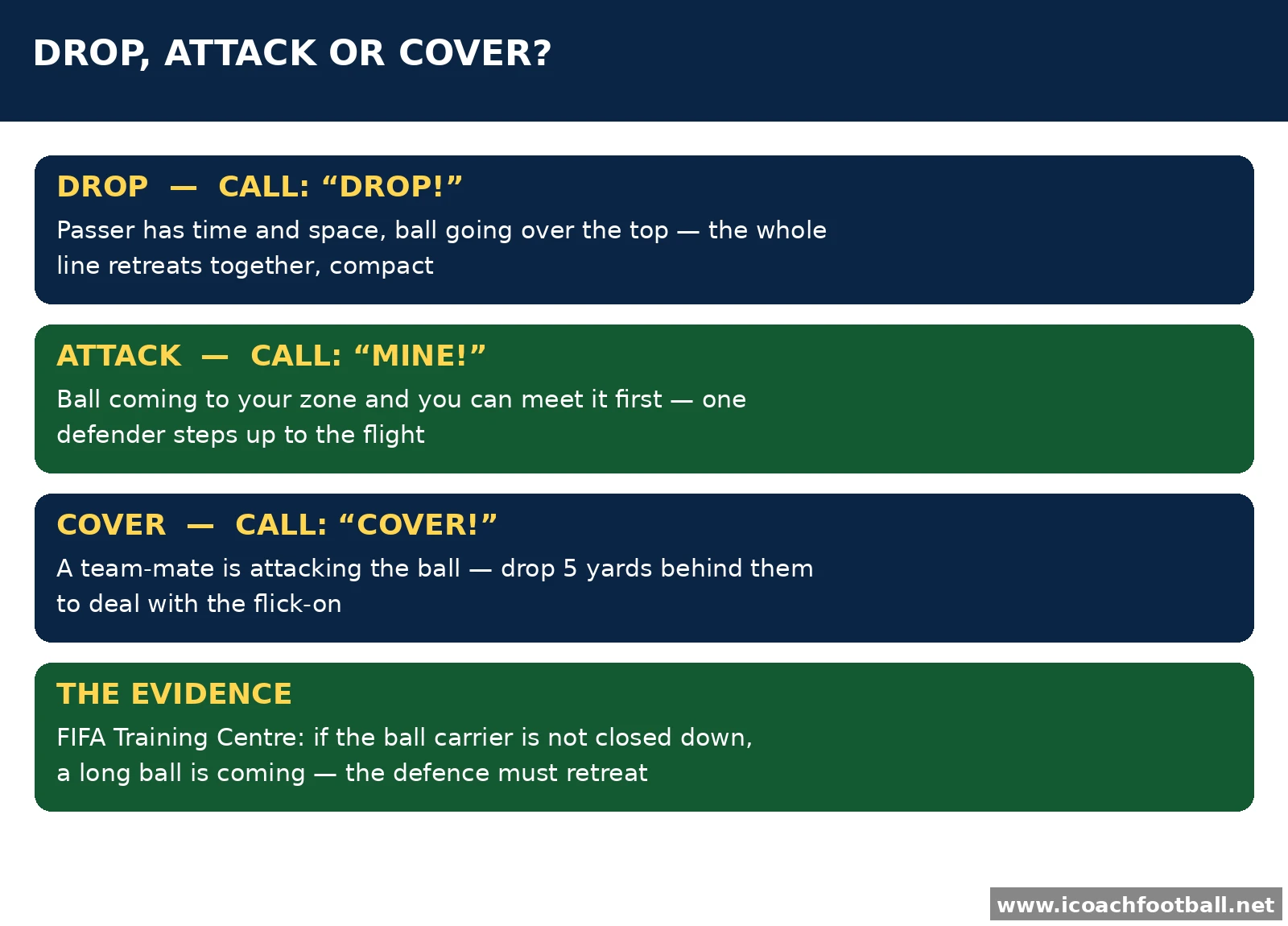
Every long ball asks your back line the same three questions, in the same order. This framework is in line with the FIFA Training Centre’s zonal defending methodology: players continually adjust to apply pressure, provide cover and balance, protect space and keep compact distances — and when the player in possession is not closed down, there is a danger of a long ball, so the defence must be ready to retreat.
| Decision | When to choose it | The call |
|---|---|---|
| DROP | The passer has time and space and the ball is going over the top — the whole line retreats together, compact | “DROP!” |
| ATTACK | The ball is coming to your zone and you can meet it first — one defender steps up to the flight | “MINE!” |
| COVER | A team-mate is attacking the ball — you drop 5 yards behind them to deal with the flick-on | “COVER!” |
Drill 1: Drop as a Unit
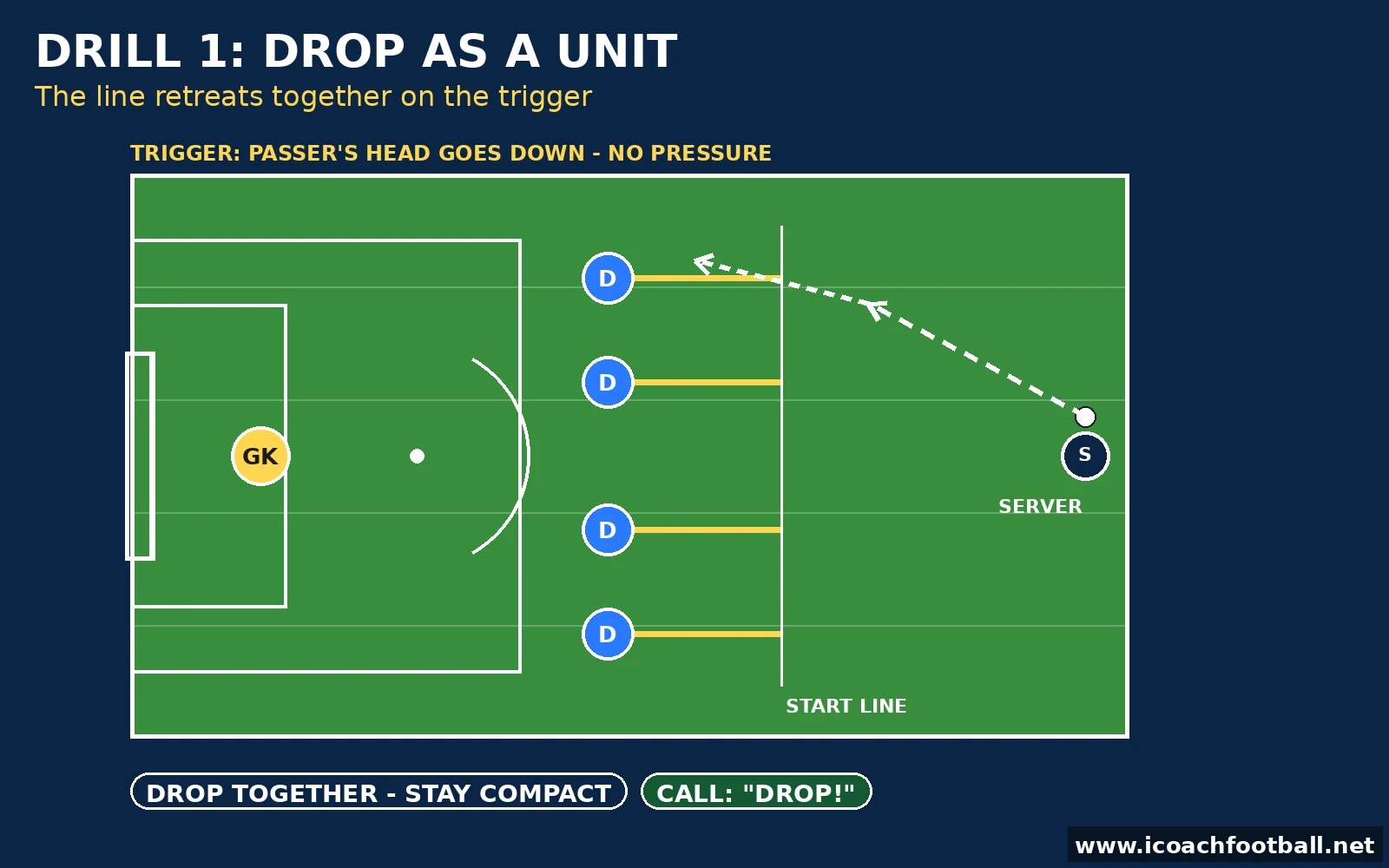
Before anyone attacks a ball, the line must move together. This drill builds the retreat — four defenders dropping as one the moment the trigger appears.
Setup
- Half a pitch, one goal, 1 goalkeeper, back four, coach as server 40 yards out
- 2 cones marking the line’s starting position; 4 x 3-minute blocks
- 10 minutes; no attackers at first
How to Play
- The back four start on the halfway line, compact, side-on and on their toes.
- The coach receives the ball with time and space — head down, no pressure on the passer.
- On that trigger, the whole line drops together toward the goal, staying flat and connected.
- The coach plays the long ball over the top; the line must already be goal-side of it.
- The nearest defender attacks the ball while the other three hold the line and squeeze up.
Coach’s note: Watch the far-side full-back. They are the one who stays high while the rest drop, and that gap is where the second ball lands. Shout “DROP!” until all four move on the same step. The trigger is the passer’s head going down — if nobody is pressing the ball, the long ball is coming, so the line goes early. This is the FIFA zonal defending point in practice: when the ball carrier is not closed down, the defence must be ready to retreat.
Progressions: Add a pressing forward, so the line must read whether the passer is under pressure or free; the server varies the ball — over the top, into the channel, or to feet — so the line must read and react, not guess.
Drill 2: Attack the First Ball
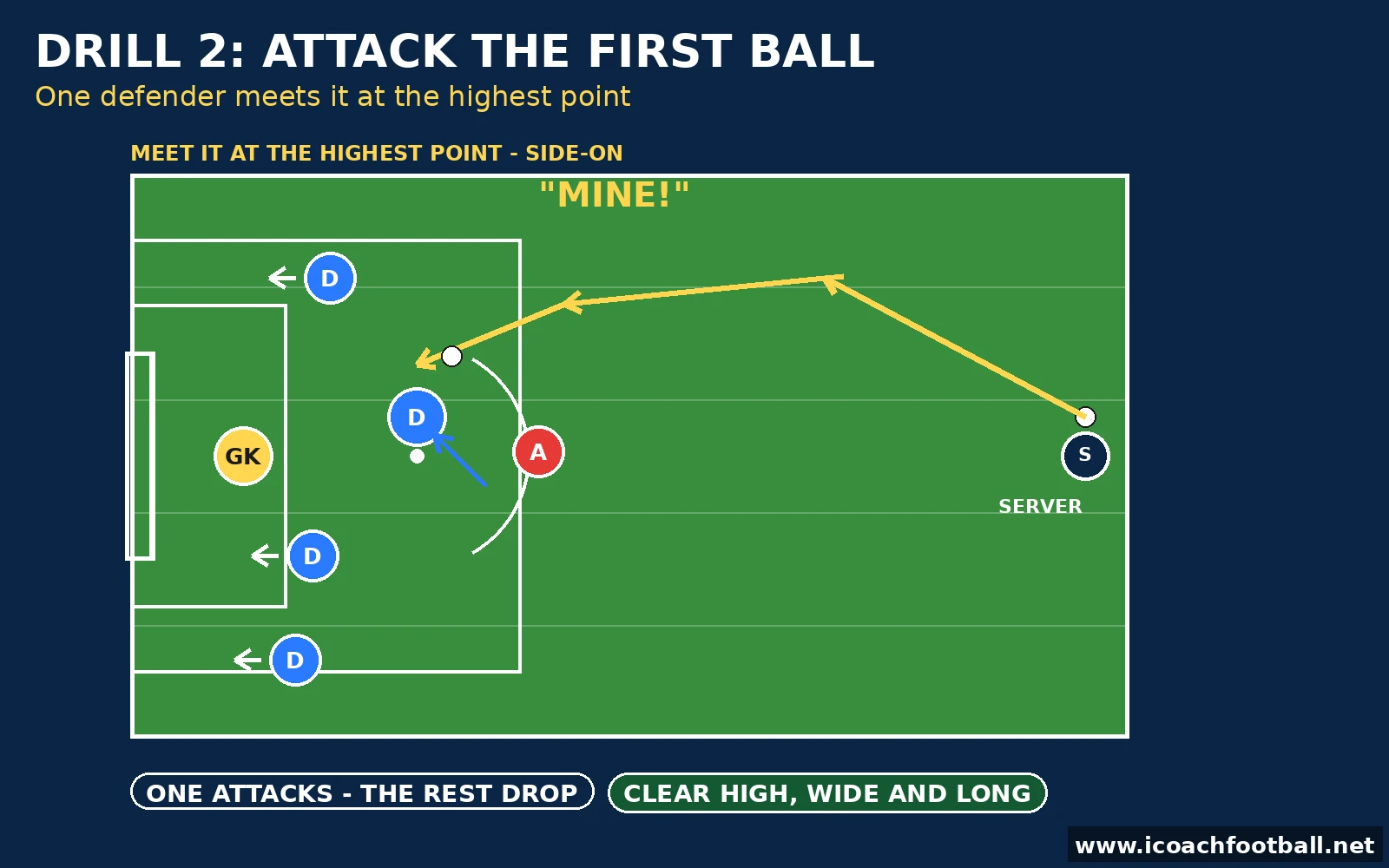
The header that wins the long ball is won before the ball arrives. This drill teaches one defender to read the flight, step up side-on and meet the ball at its highest point.
Setup
- Penalty area, one goal, 1 goalkeeper, 4 defenders, coach as server 30 yards out
- 2 attackers making runs; 8 serves per defender, then rotate
- 10 minutes
How to Play
- The back four start compact, 25 yards from goal, with the goalkeeper behind them.
- The coach plays a long ball toward the penalty area — the nearest defender calls “MINE!” early.
- That defender steps up side-on, eyes on the ball, and meets it at the highest point.
- The header goes high, wide and long — up and out of the box, never across the face of goal.
- The other three defenders drop 5 yards behind, ready for the flick-on.
Coach’s note: The mistake to watch is the defender jumping under the ball instead of meeting it. Make them take two short steps toward the flight first — the jump should meet the ball at its peak, not chase it after it has passed. Side-on body shape matters too: a defender facing the ball square cannot adjust if the flight changes. The 1v1 body shape that keeps a defender balanced here is the same side-on stance trained in our 1v1 defending drills jockeying. And never let the ball bounce — a bouncing ball in your box is a goal waiting to happen.
Progressions: Attackers are allowed to challenge for the header; the server varies the flight — high and looping, flat and driven, or into the channel; score the defender 2 points for a header that clears the area, 1 for a header won but kept in play.
Drill 3: Cover the Flick-On
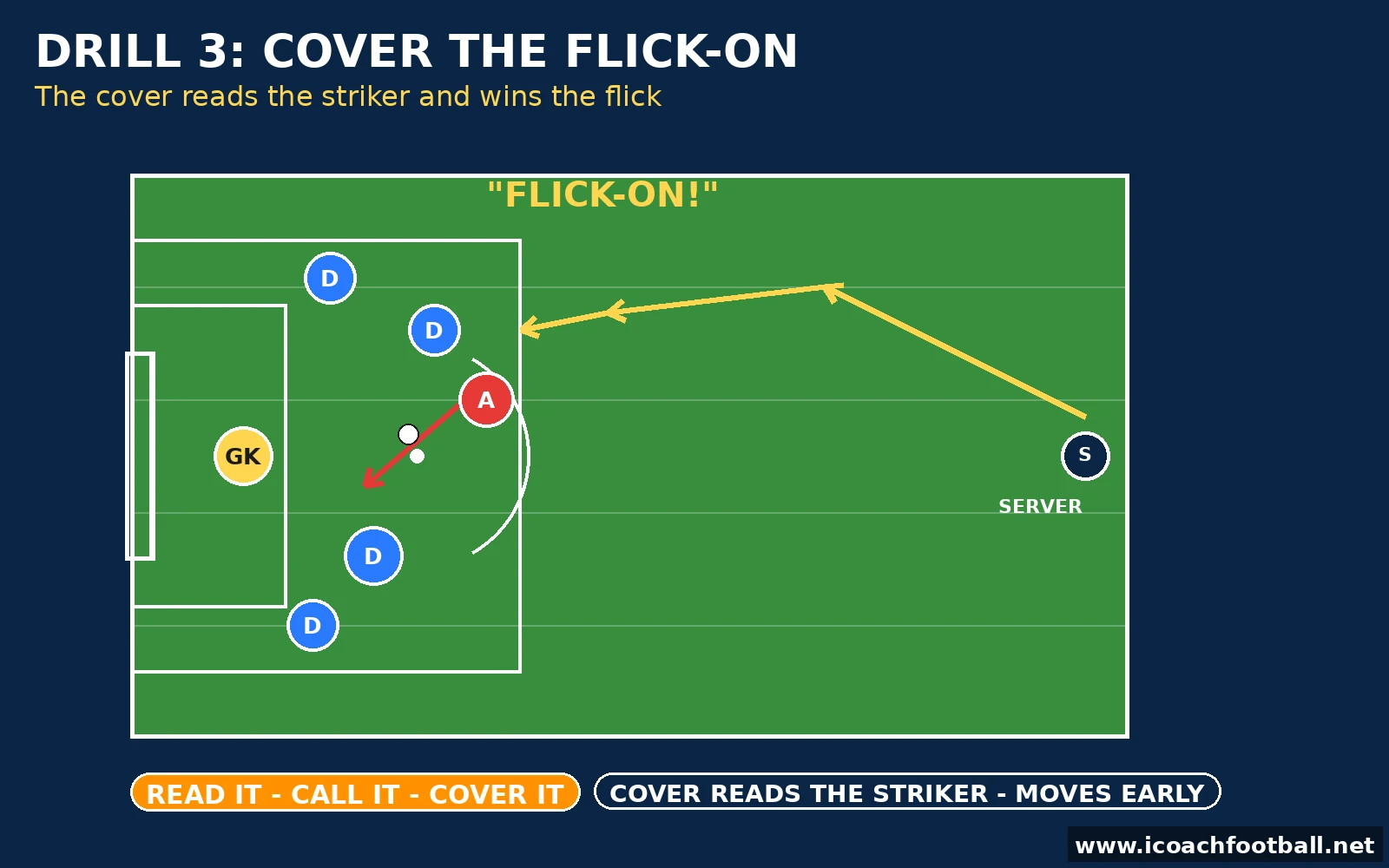
The header is only half the job. When the striker wins the flick-on, the covering defender is the one who saves the goal. Watch the animation below the diagram: the flick, the cover’s move and the clearance happen in that order.
Setup
- Penalty area, one goal, 1 goalkeeper, 4 defenders, 2 attackers, coach as server
- The server plays long balls to the near striker, who must flick it on
- 8 serves per pair, then rotate; 12 minutes
How to Play
- The server plays a long ball to the near striker, who is marked by the nearest defender.
- The striker flicks the ball on toward goal — the covering defender must already be moving.
- The covering defender, 5 yards behind, reads the flick and steps in to win the second ball.
- The cover wins it with a header or a volley, and clears it high, wide and long.
- The line squeezes up together the moment the clearance is made.
Coach’s note: The covering defender is the one who wins this drill, and they win it by moving before the flick. If they wait to see where the flick goes, they are beaten. Teach them to read the striker’s body — head down and chest over the ball means the flick is coming — and to start their run on the server’s touch, not on the flick. The goalkeeper’s job here is to shout the danger early: FIFA’s work on dealing with long aerial balls has the keeper reading the restart and deciding how far to come off the line, and that call — “DROP! COVER!” — is what sets the line. The duel after a flick that drops behind the line is trained in our soccer goalkeeper cross handling drills.
Progressions: The flick can go anywhere — near post, far post or back across the box — so the cover must read it live; add a second attacker arriving late for the drop, so the cover must win it cleanly or the second ball is live.
Drill 4: Head Tennis
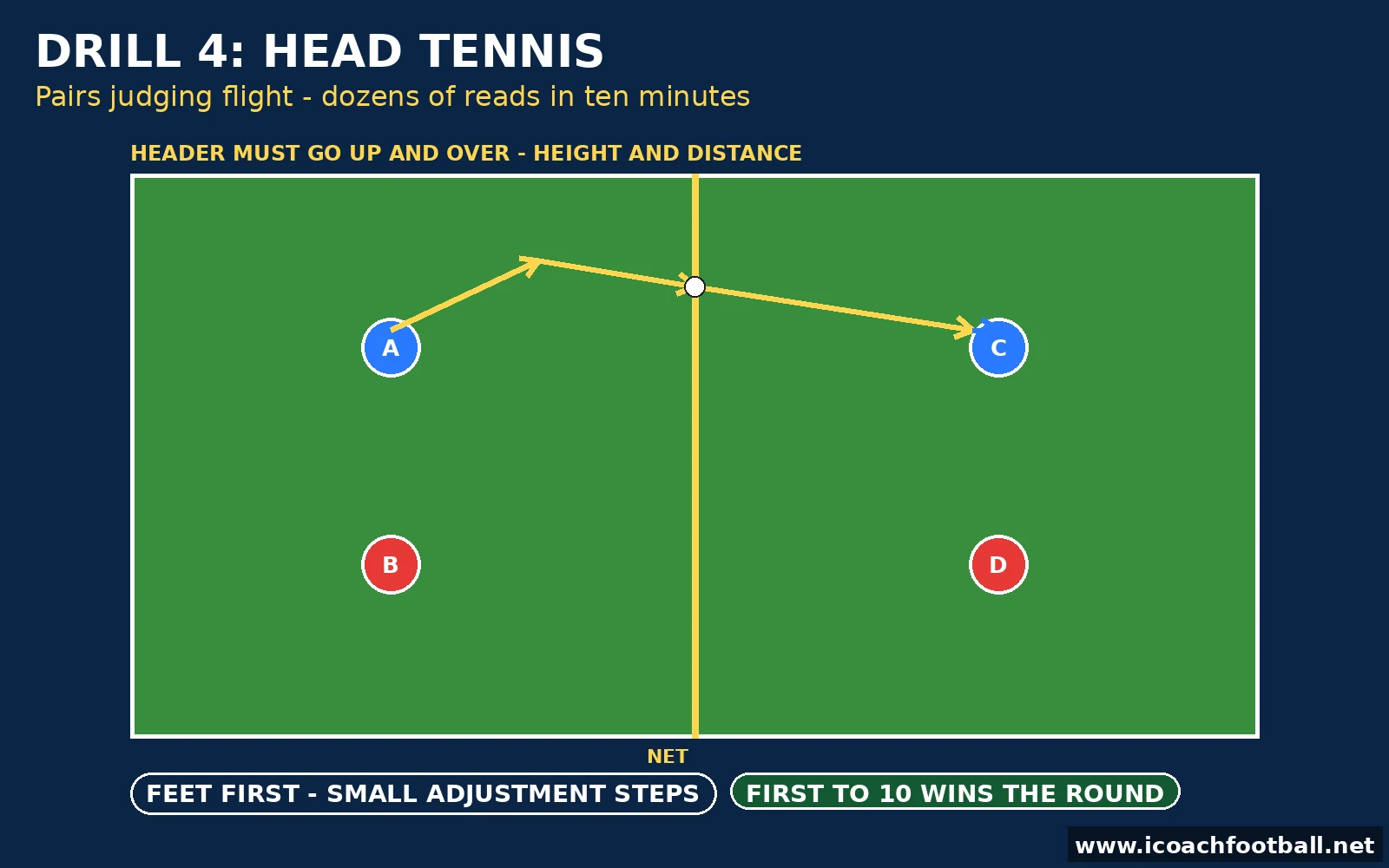
Judging flight is a skill, and it is trained by repetition. This paired game gives every defender dozens of flight reads in ten minutes — no queue, no standing around.
Setup
- 20 x 15 yard grid, a line of cones or a low net across the middle, 1 ball per pair
- Players in pairs, one each side of the line; 4 x 2-minute rounds
- 10 minutes
How to Play
- One player serves a high ball over the line; the partner must head it back over the line.
- The header must go up and over — height and distance, not a flat nod.
- Every clean header back over the line scores 1 point; a dropped ball scores 0.
- After each header, both players take one step back, so the flight gets longer.
- First to 10 points wins the round; pairs swap partners every round.
Coach’s note: Watch the feet, not the head. A player who stands flat-footed under a high ball will misjudge it every time — the read starts with small adjustment steps while the ball is still rising. Shout “feet first” until the adjustment steps are automatic. This is the flight-reading base that makes Drills 2 and 3 work: a defender who cannot judge a flight cannot time a header.
Progressions: Serve with the hands, then with a volley, then with a driven kick; add a second ball so the pair must track two flights at once; play 2v2, so one player heads while the other covers the space behind.
Drill 5: Win the Second Ball
The first header is won — now the drop decides the game. This drill trains the midfielders to hunt the second ball before the attackers do.
Setup
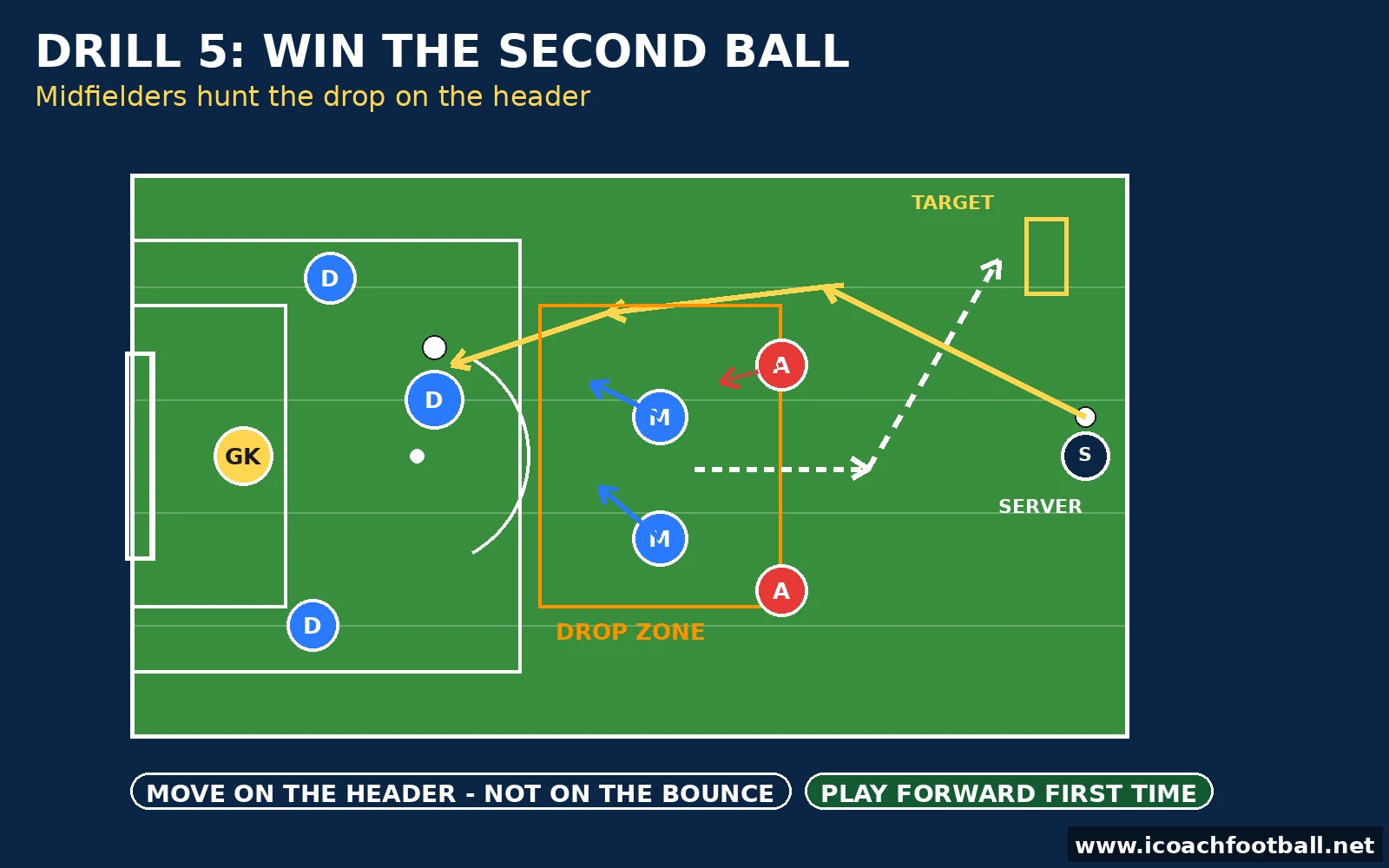
- 30 x 25 yard area, 4 defenders, 2 midfielders, 3 attackers, coach as server
- A marked “drop zone” 10 yards in front of the back line
- 4 x 3-minute blocks; 12 minutes
How to Play
- The coach plays a long ball toward the back line; a defender attacks it and heads it away.
- The ball drops into the marked zone — the two midfielders must already be moving toward it.
- The first midfielder to the drop plays it forward first time, to a target or into space.
- Attackers try to win the drop and score in a mini-goal; defenders score by playing out to the targets.
- If the first header is won cleanly out of the area, the defending team scores 2 points.
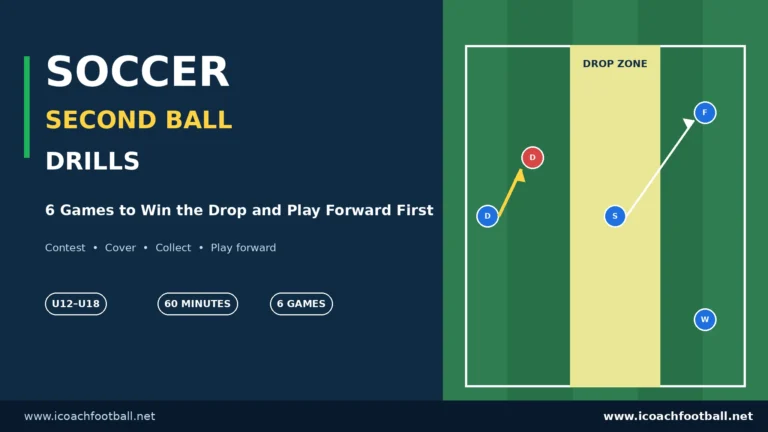
Coach’s note: The second ball is won by the player who moves on the header, not on the bounce. Midfielders who watch the header and then react are always second — they must start their run the moment the defender’s head meets the ball. The full framework for what happens after the drop — the 5-second rule, the jobs of each player — is in our soccer second ball drills. Here, the single habit to build is the early move: “on the header, go.”
Progressions: The header can be flicked on instead of won, so the midfielders must read which way the ball is going; add a second drop zone wide, so the midfielders must cover both; play the long ball from a moving passer instead of a static coach.
Drill 6: The Long-Ball Game
The full test. A conditioned game where every restart is a long ball, so the back line must defend it again and again — and play out when they win it.
Setup
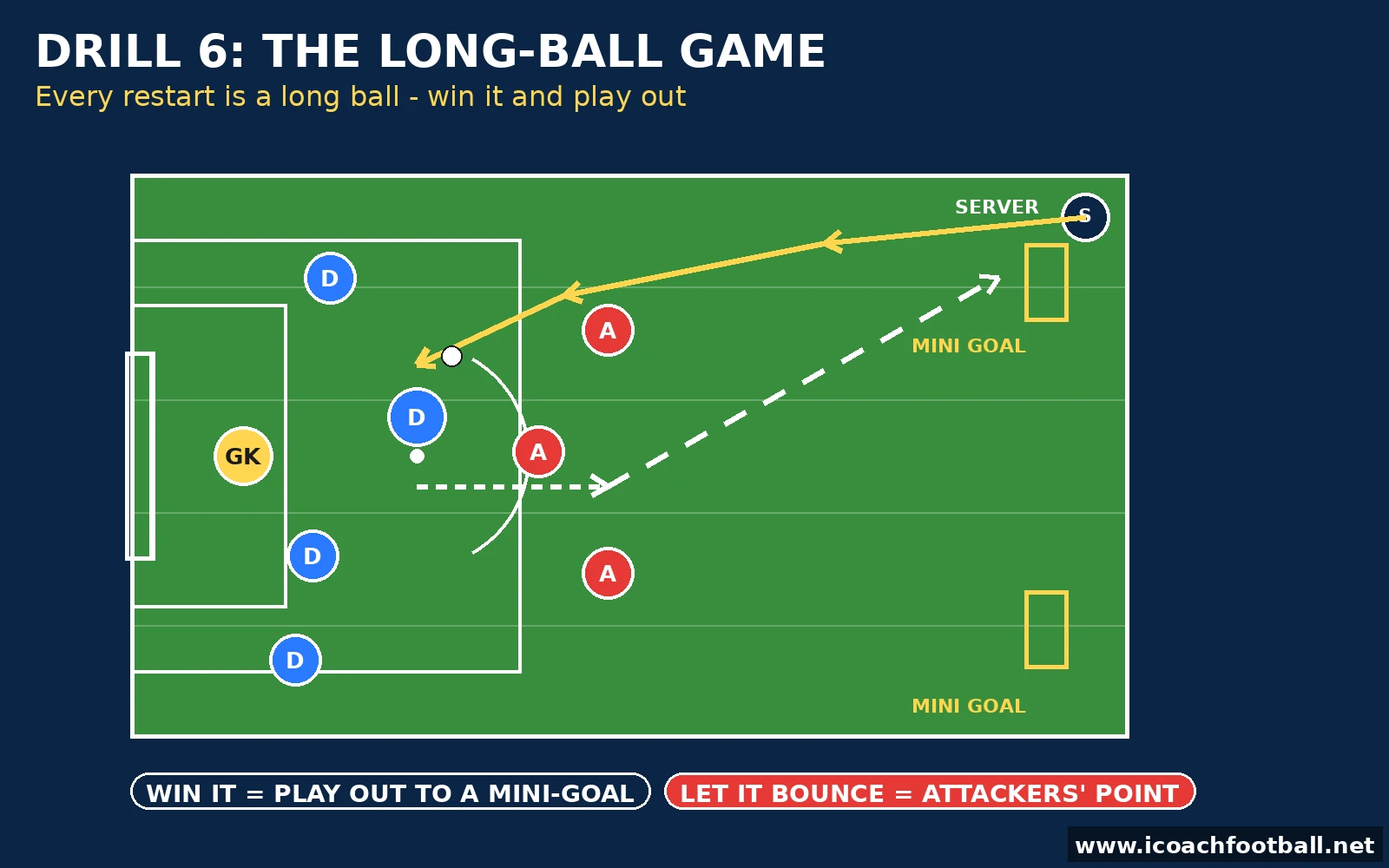
- Half a pitch, one goal, 2 mini-goals 30 yards out, 8 defenders vs 7 attackers
- Every dead ball restarts with a long ball from the coach or the goalkeeper
- 4 x 4-minute games; 16 minutes
How to Play
- The coach or goalkeeper plays a long ball over the top to start every phase.
- Defenders must drop together, attack the first ball and cover the flick-on.
- When the defenders win it, they score by playing out to a mini-goal within 10 seconds.
- Attackers score by winning the first ball, the flick-on or the second ball and finishing in the big goal.
- After each phase, the line resets to its starting position and the next long ball comes in.
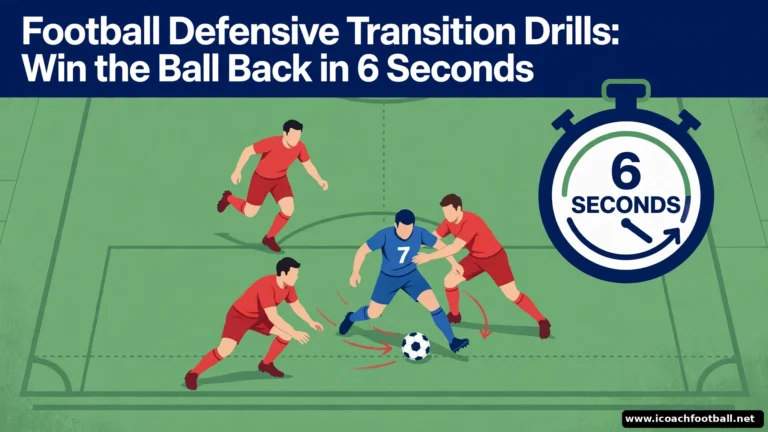
Coach’s note: Count the 10 seconds out loud — “one, two, THREE” — until the play-out is automatic. A back line that wins the long ball and then holds it has given the opposition time to reorganise, and the next long ball is already coming. The win and the play-out are one action, not two. The same transition thinking runs through our football defensive transition drills: win it, then play forward at once. If the line holds its shape for four phases in a row, let them push up 5 yards — the reward for defending well is defending higher.
Progressions: The long ball can come from either side, or from a goal kick, so the line must read the angle; attackers get a point for every long ball the defence lets bounce; play 11v11 in the last block with the same restart rule.
Coaching points
- Drop on the trigger, not on the ball. The line moves when the passer’s head goes down and nobody is pressing them — not when the ball is already in the air. A late drop is a lost race.
- One attacks, the rest drop. Only one defender goes to the ball. Two defenders jumping for the same header leave the space behind them empty — and that is where the flick-on lands.
- Call it early and loud. “MINE!” for the header, “COVER!” for the second defender, “DROP!” for the line. A silent back line is a back line that guesses.
- Meet it at the highest point. Two short steps toward the flight, jump off one leg, head the ball at its peak. A header won on the way down is a header lost.
- Height and distance on every clearance. Up and out — high, wide and long. A header across the face of goal is a pass to the opposition; a header that drops at the edge of the box is a second ball for them.
- Never let it bounce. A bouncing ball in your own box is the most dangerous ball in the game. Attack the flight, or drop goal-side of the bounce — never stand and watch it.
- Cover reads the striker, not the ball. The covering defender watches the attacker’s body — head down, chest over the ball — and moves on the server’s touch. Waiting for the flick means arriving late.
- Win the second ball on the header. Midfielders move the moment the defender’s head meets the ball. The drop is won by the player already running.
- The keeper is the loudest defender. The goalkeeper sees the whole picture and must call the drop and the cover early — our soccer goalkeeper cross handling drills train the same commanding habit for crosses.
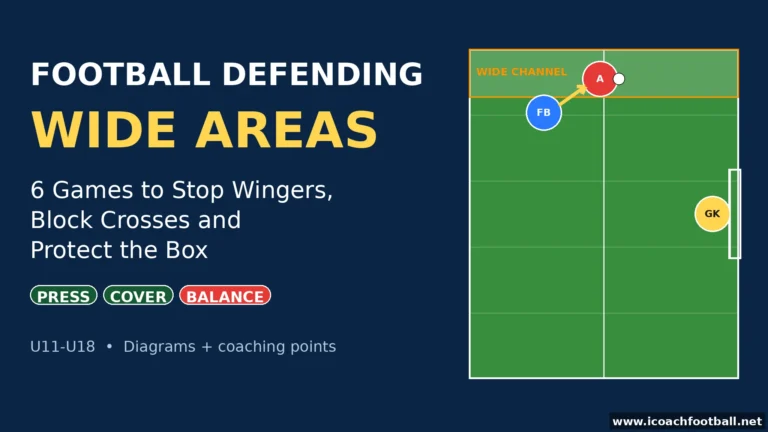
- Wide long balls are the same drill. A long diagonal into the channel follows the same rule — one attacks, the rest drop — and the wide-area version is trained in our football defending wide areas drills.
Common mistakes
- Standing square and flat. A back line that holds its height while the passer has time is beaten by the first long ball. Drop early, together.
- Two defenders going for the same ball. The header is won and the flick-on is conceded, because nobody covered. One attacks, the rest drop — every time.
- Jumping under the ball. The defender who jumps without moving toward the flight meets the ball after it has passed. Two steps first, then jump.
- Silent defending. No call means two defenders go for the same ball, or nobody goes at all. Call it before you move.
- Clearing across the face of goal. A header that stays in the box is a second chance for the attackers. High, wide and long — every time.
- Watching the header, then reacting. Midfielders who wait for the bounce lose the second ball. Move on the header.
- Training only the first ball. If every rep ends with the header, the team never learns the flick-on or the drop — and the first game they play, the goal comes from the second ball.
Age adaptations
| Age group | How the session changes |
|---|---|
| U12–U13 | Drills 1, 4 and 5 only; serves are throws and gentle volleys, no driven long balls; heading is limited and light — the drop, the call and the cover matter more than the contact; no jumping into traffic |
| U14–U15 | Full Drills 1–3; introduce one challenging attacker, then two; driven balls from 30 yards; keep the clearance technique in front of the decision — a clean header out beats a dropped catch |
| U16–U18 | Full speed throughout; Drill 3 with full flick-on challenges, Drill 6 with the 10-second play-out rule; defenders organise their own line and call the drop before the ball is struck |
60-minute session plan
This is the full session, built on our 60-minute plan structure — warm-up, two drill blocks, game, cool-down.
| Block | Time | Content |
|---|---|---|
| Warm-up | 0–10 min | Head Tennis in pairs (Drill 4, short flights) |
| Drill 1 + 2 | 10–25 min | Drop as a Unit, then Attack the First Ball |
| Drill 3 + 5 | 25–40 min | Cover the Flick-On (with animation), then Win the Second Ball |
| Drill 6 | 40–55 min | The Long-Ball Game |
| Cool-down | 55–60 min | Light jog, stretch, one-line review: “Which long balls were ours today — and which did we let bounce?” |
Sources
- FIFA Training Centre — Zonal defending: From principles to practice using a progressive methodology. The drills above are based on and in line with its methodology: zonal defending as a dynamic process of pressure, cover and balance with compact distances; the second defender providing cover at the right distance and angle; the defensive triangle adding balance; and the trigger to retreat when the player in possession is not closed down — they are not FIFA-approved sessions. Link: https://www.fifatrainingcentre.com/en/practice/talent-coach-programme/zonal-defending/from-principles-to-practice-using-a-progressive-methodology.php
- FIFA Training Centre — Restarts, keeping play going and aerial balls. Used in line with its work on goalkeepers defending long aerial passes: a goalkeeper positioned to intercept the aerial ball, and the keeper taking the type of restart into account when deciding how far to come off the line. Link: https://www.fifatrainingcentre.com/en/practice/futsal/block-6/restarts-keeping-play-going-and-aerial-balls.php
FAQ
How do you defend against a team that plays long balls all game?
Press the passer first — a rushed long ball is a bad long ball. When the passer does have time, drop the whole line together on the trigger, attack the first ball with one defender, and cover the flick-on with the rest. Teams that play long balls rely on your line standing flat; a line that drops early takes the space behind it away.
Should defenders head every long ball, or let it bounce?
Head it — never let a long ball bounce in your own box. A bouncing ball is unpredictable, and it is the one the striker reads first. Meet the ball at its highest point, side-on, and clear it high, wide and long. The only exception is a ball dropping to your goalkeeper, who should claim it.
What age can players start heading long balls in training?
Unopposed flight-reading and light heading from U12, when players can judge a flight and jump safely. Full contested headers in traffic belong at U14 and above. Players U11 and under should not head the ball in training — use throws, volleys and the drop-and-cover habits instead, and the decision and the call matter more than the contact at that age.
Who should win the first header — centre-back or full-back?
Whoever is nearest to the ball’s line, and they must call “MINE!” early. Usually that is a centre-back, but a long ball into the channel belongs to the full-back. The rule is the same either way: one attacks, the rest drop 5 yards behind to cover the flick-on.
What do you do when the striker wins the flick-on?
That is the covering defender’s ball. They should already be moving on the server’s touch, reading the striker’s body, and they step in to win the flick or the drop that follows. If the flick beats the cover too, the midfielders must win the second ball — which is why the drop is trained as its own habit, not left to chance.