Soccer Drills for Improving Defensive Positioning: 6 Games That Teach Players Where to Stand (U10–U16)
Quick answer
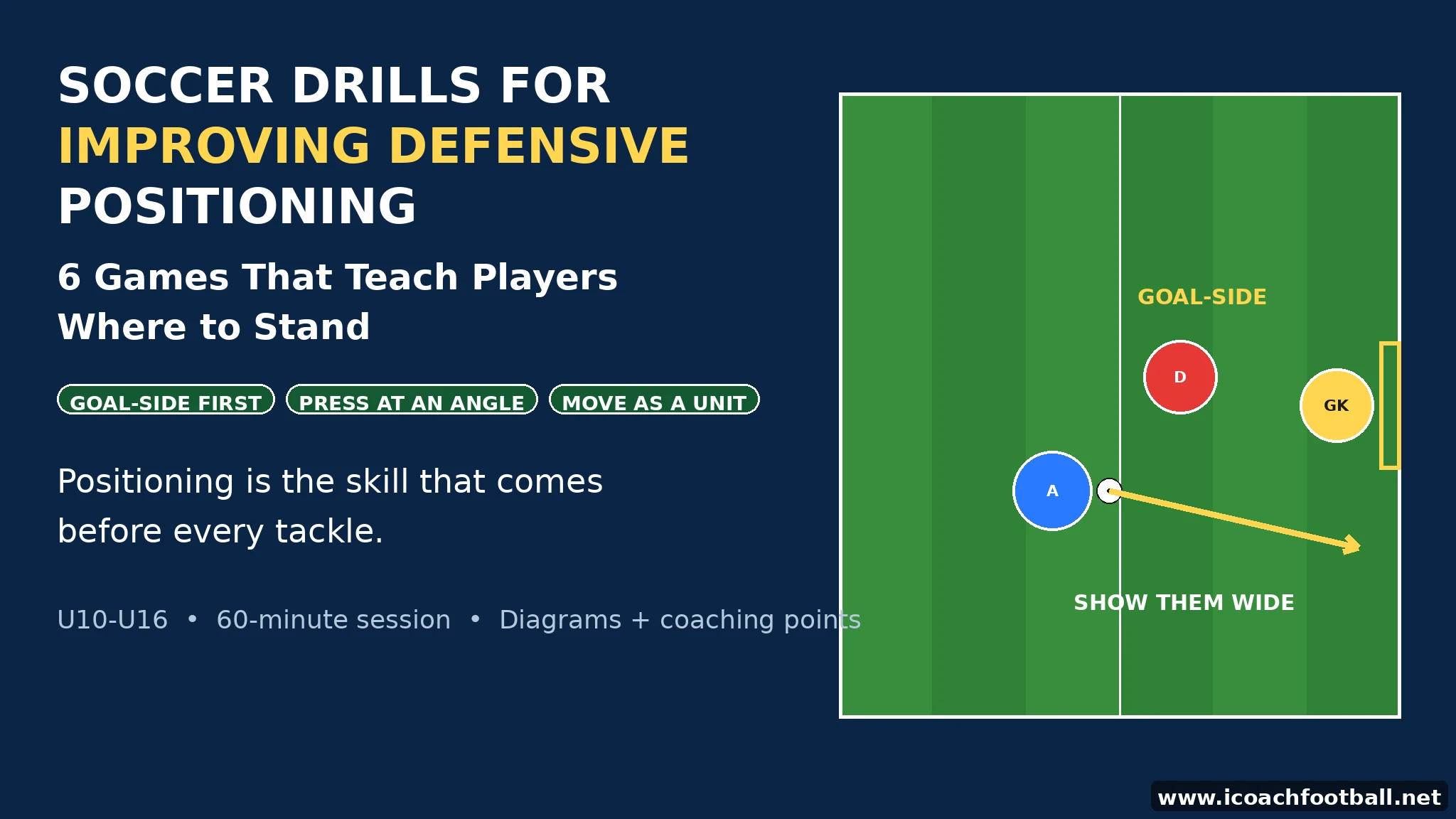
Defensive positioning is where a player stands before anything happens — goal-side of the attacker, at the right distance, at the right angle. Most goals youth teams concede are not lost tackles; they are lost positions: a defender caught the wrong side of the run, two players jumping on the same ball, or a line that leaves a gap between its defenders. Six games — one 60-minute session — teach players to get goal-side first, press at an angle, cover a teammate, shift as a unit, cut the passing lane, and recover on a curve.
Suitable for: U10–U16 (ages 9–16)
Session snapshot
- Players: 12–16 (U10–U16)
- Area: 25 x 20-yard area expanding to a 40 x 30-yard game pitch
- Duration: 60 minutes
- Focus: Standing goal-side, at the right distance and angle, before the tackle
- Equipment: 12–14 balls, 20 cones, 2 full goals, bibs
Why these six games work
Watch a youth game for five minutes and you will see it. A defender chases the ball, the attacker turns, and suddenly the defender is behind the play — beaten without a tackle being made. The tackle was never the problem. The position was.
Positioning is the skill that comes before every defensive action. FIFA’s Training Centre puts it plainly in its back-four session with Jens Lehmann: a successful defensive line must be aware of its positioning, both individually and as a group, and its players must maintain a distance of 6–8 metres between one another so opponents cannot find spaces. Drills 3 and 6 below are based on / in line with that FIFA material. England Football’s press-and-cover programme for 12–16s teaches the same idea from the other end: press at an angle so you dictate where the attacker goes, one presses while one covers, and recover as quickly as possible when you are beaten. The framing of this post and Drills 1, 2 and 5 are based on / in line with that England Football material. In the UK the same session is football drills for improving defensive positioning — the distances, the angles and the coaching points are identical.
This post fills the gap in our defending cluster: our 1v1 defending drills train the duel itself, our defensive block trains the team shape, and our defensive transition drills train the first six seconds after losing the ball. This session adds the missing piece — where each player stands in the first place.
Six rules of defensive positioning
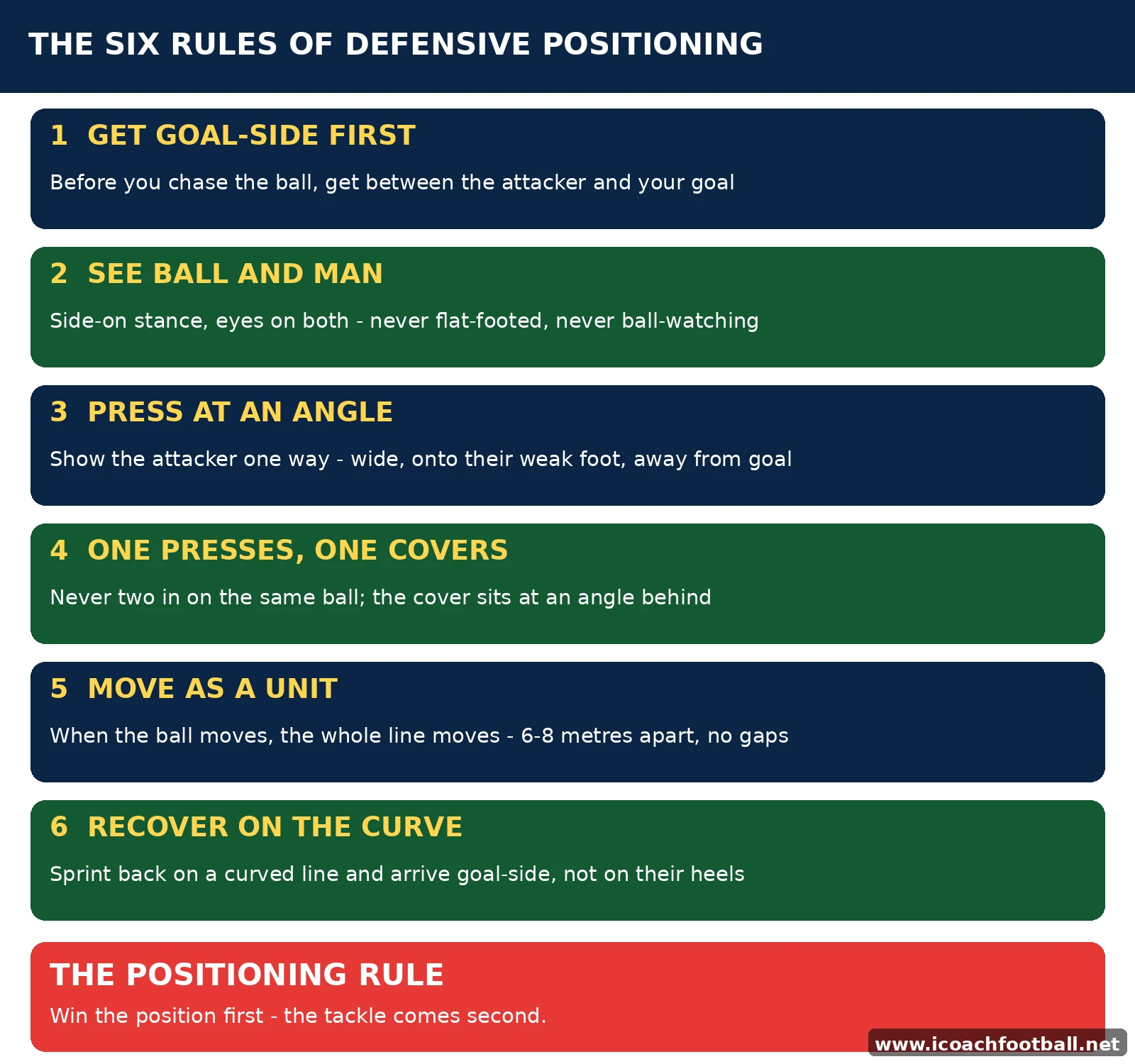
- Get goal-side first. Before you chase the ball, get between the attacker and your goal.
- See ball and man. Side-on stance, eyes on both — never flat-footed, never ball-watching.
- Press at an angle. Show the attacker one way — wide, onto their weak foot, away from goal.
- One presses, one covers. Never two in on the same ball; the cover sits at an angle behind.
- Move as a unit. When the ball moves, the whole line moves — 6–8 metres apart, no gaps.
- Recover on the curve. Sprint back on a curved line and arrive goal-side, not on the attacker’s heels.
Drill 1 — Goal-Side Gates
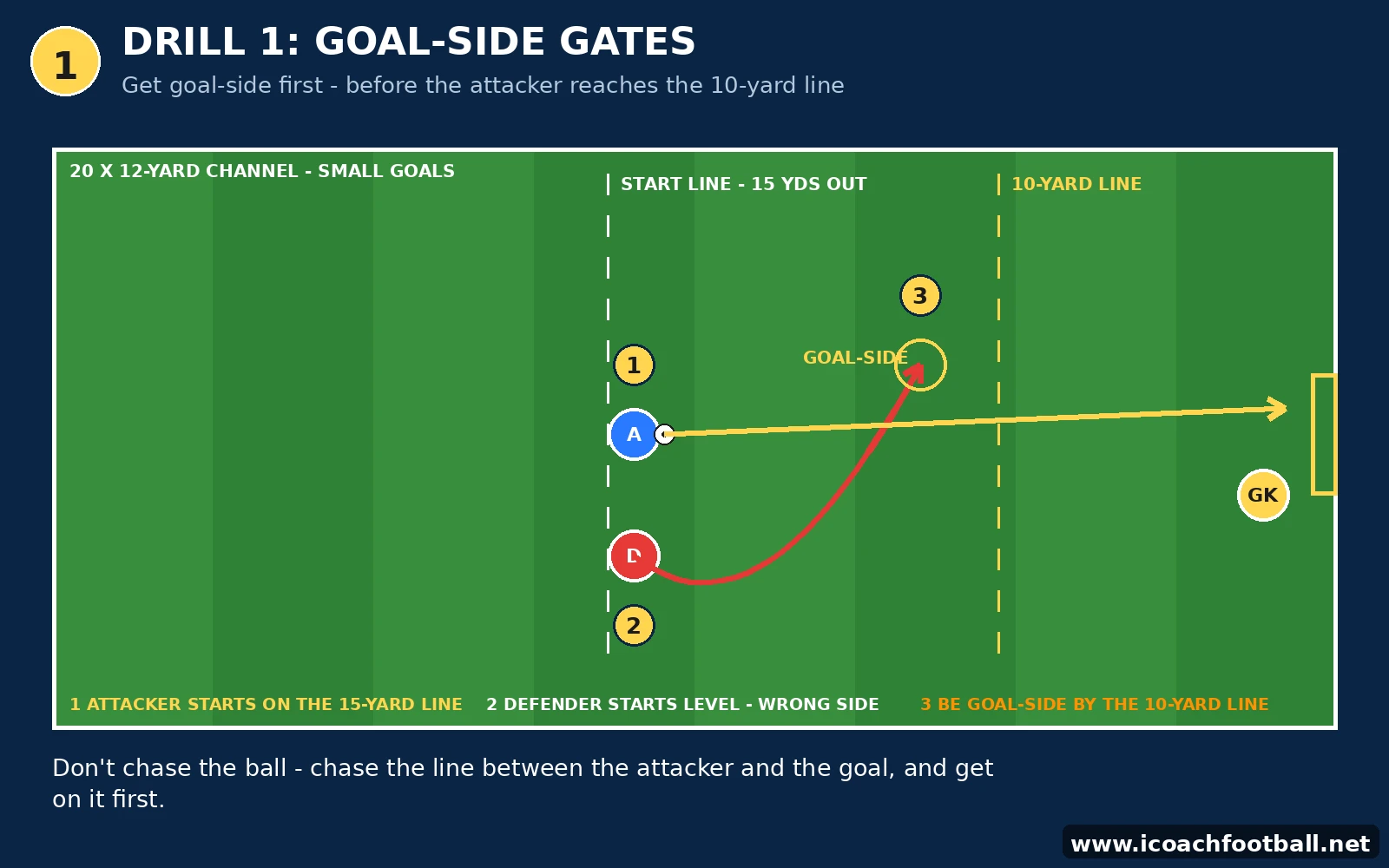
The starting point. A defender against an attacker in a channel, and the only rule that matters: the defender must be goal-side before the attacker is allowed to shoot — a defender caught the wrong side loses the point before a touch is made.
Setup
- 20 x 12-yard channel, two small goals at the defending end, cones marking a start line 15 yards out.
- 10 players: 5 attackers, 5 defenders, in pairs. 8 minutes.
How to Play
- The attacker starts on the line 15 yards from goal, ball at their feet.
- The defender starts beside the attacker — on the wrong side, level with them.
- On the coach’s whistle, the attacker drives toward goal and the defender sprints to get goal-side.
- The defender must be goal-side, side-on, before the attacker reaches the 10-yard line.
- A goal conceded while the defender is goal-side costs the defender 1 point; a goal conceded while the defender is the wrong side costs 3.
- After 4 minutes, swap attackers and defenders so everyone chases the goal-side position.
Coach’s note: “Don’t chase the ball — chase the line between the attacker and the goal, and get on it first.”
Progressions: The defender starts 2 yards behind the attacker; the attacker must finish within 5 seconds; the defender must show the attacker wide onto their weak foot.
Drill 2 — Press and Cover Pairs
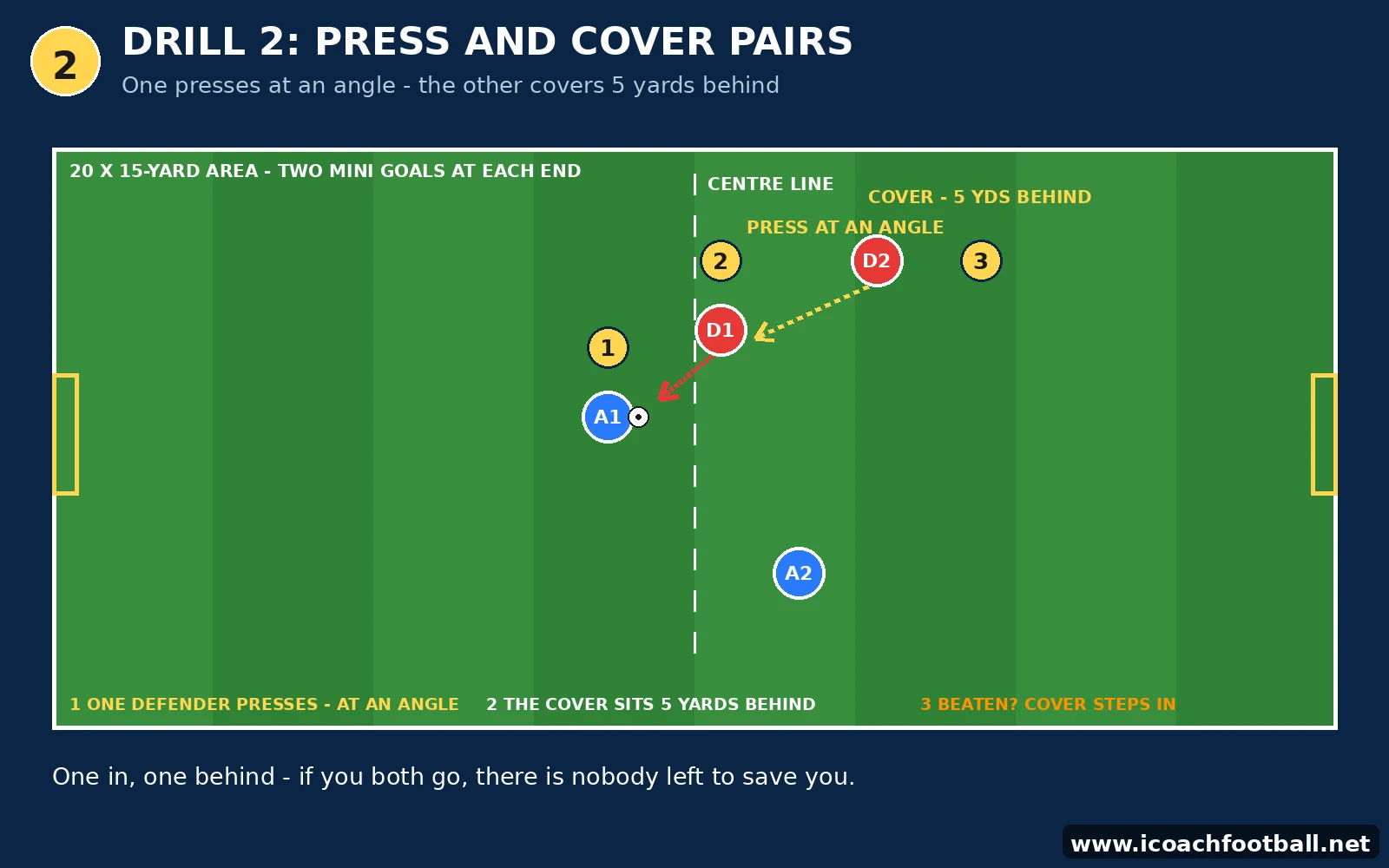
The partnership. Two defenders against two attackers, and only one defender is allowed to press — the other must hold a covering position at an angle behind. Two players jumping on the same ball is the mistake this drill removes.
Setup
- 20 x 15-yard area, two mini goals at each end, cones marking a centre line.
- 10 players: 4 defenders in two pairs, 4 attackers in two pairs, 2 neutral servers. 8 minutes.
How to Play
- The attackers start with the ball and try to score in either mini goal.
- One defender presses the ball carrier — fast, then slow, side-on, at an angle.
- The second defender holds a covering position 5 yards behind and to the side of the presser.
- If the presser is beaten, the cover steps in and the presser recovers behind them.
- A goal conceded while both defenders pressed the same ball costs the pair 2 points; a clean win of the ball scores the pair 1.
- After 4 minutes, swap the pairs so everyone presses and everyone covers.
Coach’s note: “One in, one behind — if you both go, there is nobody left to save you.”
Progressions: The cover must call “I’ve got you!” before the presser engages; the attackers get a third player, so the cover must also track a run; the presser must force the ball backwards or sideways, never forward.
Drill 3 — Shift Together
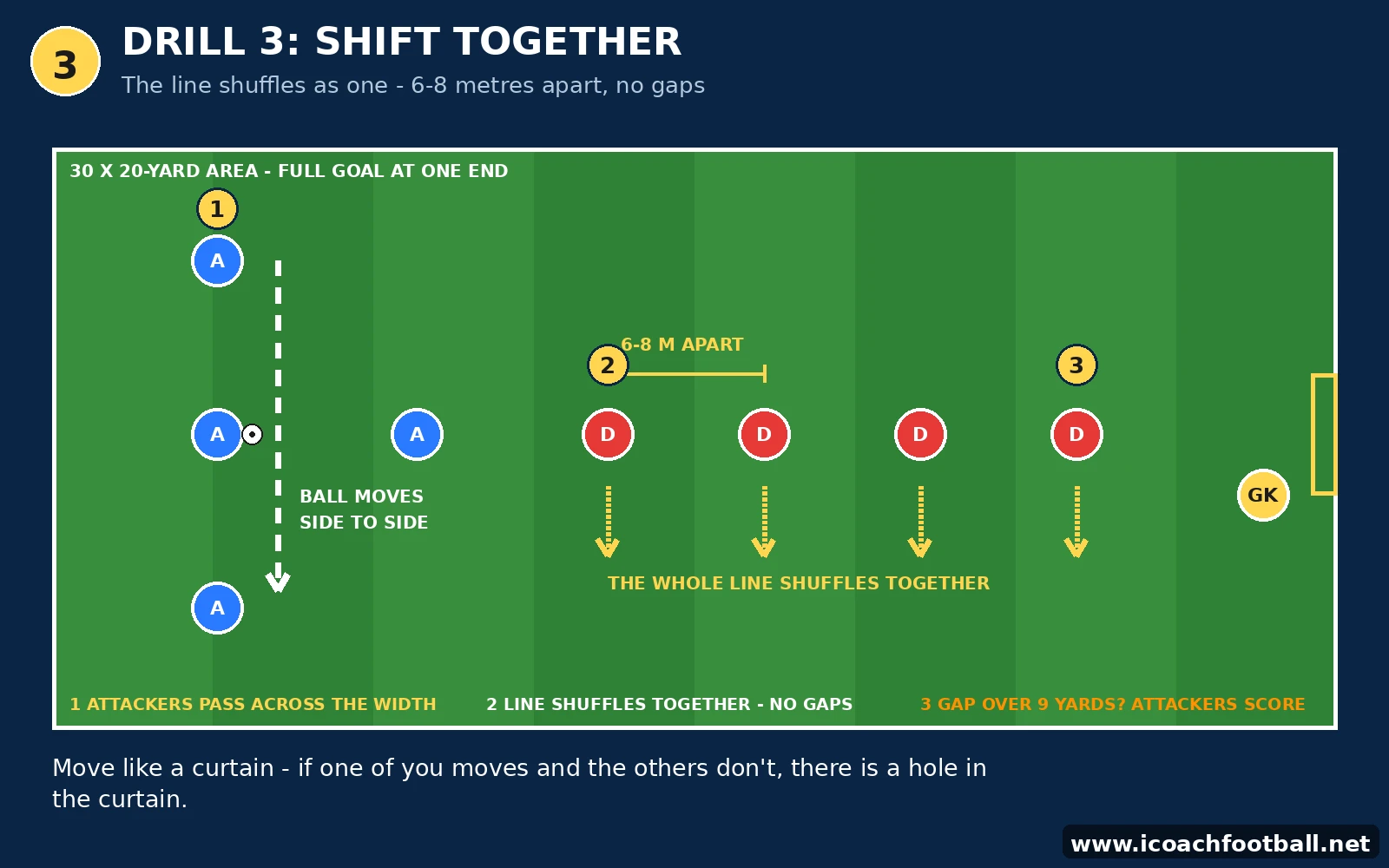
The line. Four defenders in a line against four attackers who move the ball from side to side — the line must shuffle together, stay 6–8 metres apart, and never leave a gap. The ball moves; the line moves.
Setup
- 30 x 20-yard area, full goal at one end, cones marking the defensive line’s starting spots.
- 10 players: 4 defenders, 4 attackers, 1 goalkeeper, 1 server. 8 minutes.
How to Play
- The defenders set up in a line, 6–8 metres apart, goal-side of the attackers.
- The attackers pass the ball across the width of the area — no forward passes yet.
- Every time the ball moves, the whole defensive line shuffles with it — together, in a straight line.
- If any two defenders are more than 9 yards apart, or the line bends, the coach stops play and the attackers score a point.
- After 2 minutes, the attackers may pass forward — the line must still shift together and squeeze up on a backward pass.
- After 4 minutes, rotate the defenders so everyone holds each spot in the line.
Coach’s note: “Move like a curtain — if one of you moves and the others don’t, there is a hole in the curtain.”
Progressions: The attackers may switch play quickly with a long pass, so the line must shift in under 3 seconds; remove one defender, so the line of three must cover more ground; the line must push up together whenever the attackers play backwards.
Drill 4 — Cut the Lane
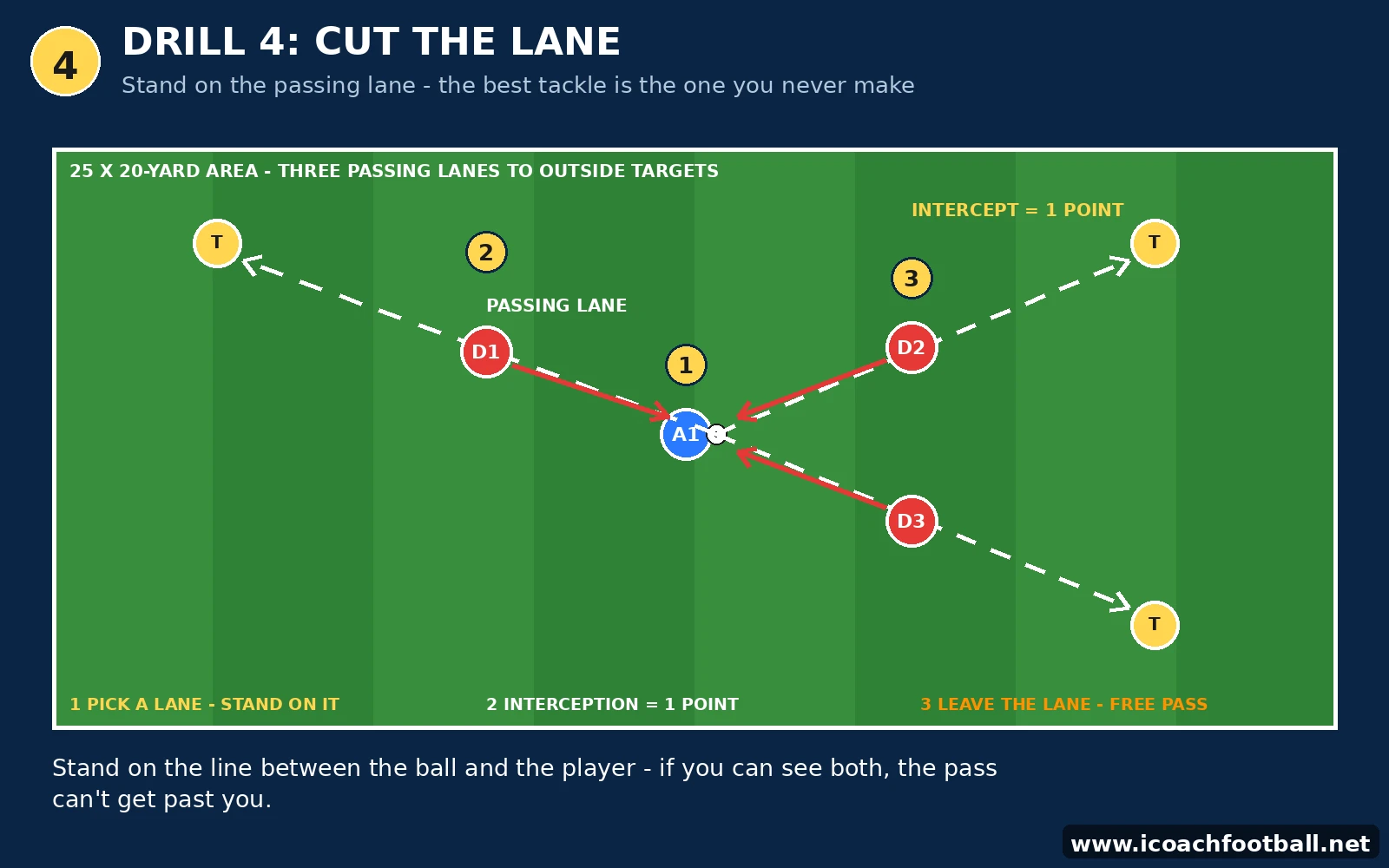
The interception. Defenders score not by tackling but by stepping into the passing lane — standing on the line between the ball and the receiver so the pass never arrives. The best tackle is the one you never have to make.
Setup
- 25 x 20-yard area, two small goals at each end, cones marking three passing lanes.
- 10 players: 4 defenders, 4 attackers, 2 neutral targets on the outside. 8 minutes.
How to Play
- The attackers keep the ball and try to play it to a neutral target on the outside.
- Each defender picks a passing lane and stands on it — between the ball and the receiver.
- A defender who intercepts a pass scores 1 point for their team; a completed pass to a target scores the attackers 1.
- If a defender leaves their lane to chase the ball, the attackers get a free pass to the nearest target.
- Every interception must be followed by a first-time pass out of the area, or the point does not count.
- After 4 minutes, swap attackers and defenders so everyone learns to read the lane.
Coach’s note: “Stand on the line between the ball and the player — if you can see both, the pass can’t get past you.”
Progressions: The attackers may use one-touch passes only, so the lanes change faster; the neutral targets move, so defenders must re-pick their lane every pass; a defender who intercepts must start the counter-attack with a forward pass.
Drill 5 — The Recovery Curve
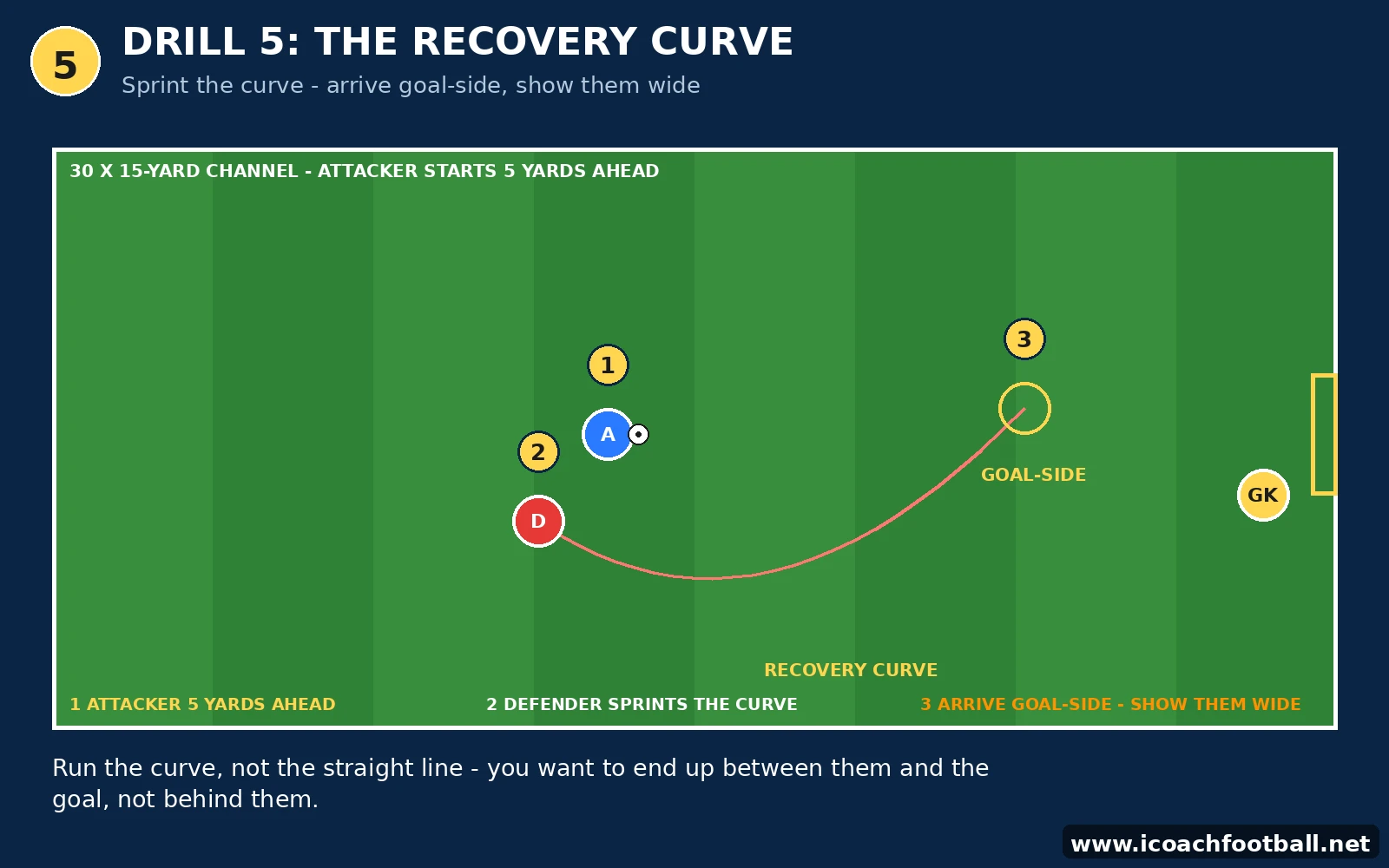
The chase back. A defender starts behind the attacker and must sprint back on a curved line, arriving goal-side — never chasing straight at the attacker’s heels, where a turn leaves them beaten twice.
Setup
- 30 x 15-yard channel, full goal at one end, cones marking a curved recovery lane.
- 10 players: 5 attackers, 5 defenders, 1 goalkeeper. 8 minutes.
How to Play
- The attacker starts 5 yards ahead of the defender, both facing the goal.
- On the coach’s whistle, the attacker dribbles toward goal and the defender sprints to recover.
- The defender must run a curve — bending wide, then in — to arrive goal-side of the attacker.
- A defender who arrives goal-side and forces the attacker wide scores 2 points; a defender who chases straight and is turned scores nothing.
- If the defender cannot catch up, they must delay the shot and guide the attacker wide until help arrives.
- After 4 minutes, swap attackers and defenders so everyone runs the curve.
Coach’s note: “Run the curve, not the straight line — you want to end up between them and the goal, not behind them.”
Progressions: The attacker starts 8 yards ahead, so the recovery is longer; the attacker may cut inside, so the defender must read the turn; add a second defender recovering from the far side, so the two must communicate who takes the ball and who covers.
Drill 6 — Positioning 6v6
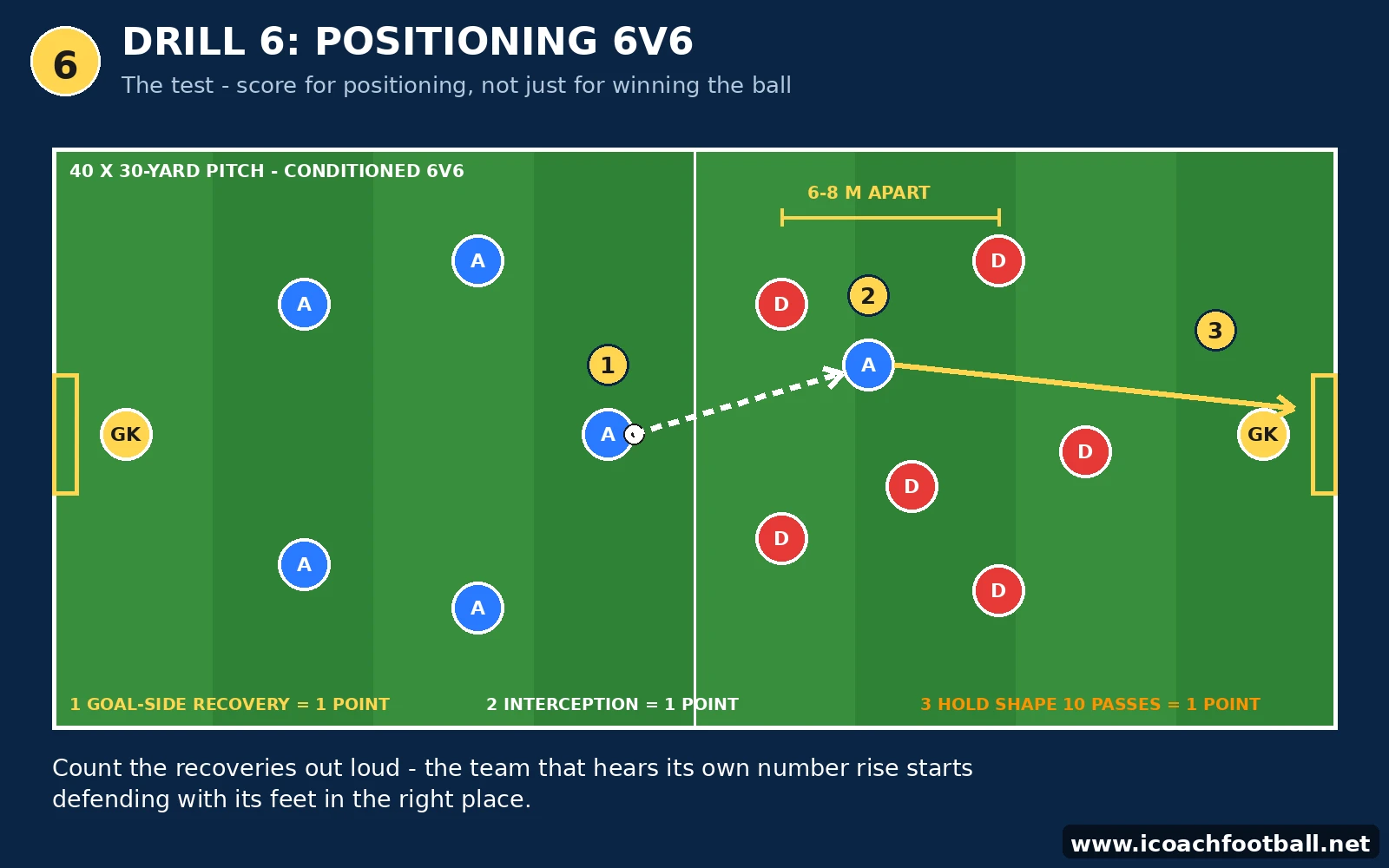
The test. A conditioned 6v6 where the defending team scores for good positioning, not just for winning the ball — a goal-side recovery, a lane cut, or a line that holds its shape for 10 passes all score points.
Setup
- 40 x 30-yard pitch, 2 full goals, bibs.
- 12 players: 6v6. 15 minutes.
How to Play
- The game starts with a pass-in from the coach — no kick-offs, no corners.
- A normal goal counts 1 point; a goal conceded while the defending line held its 6–8 metre spacing counts double for the attackers.
- A goal-side recovery that stops an attack scores the defending team 1 point; an interception scores 1 point.
- If the defending line holds its shape for 10 consecutive opposition passes without a gap opening, the defending team scores 1 point.
- Play 3-minute games, then swap the teams and play again.
- The coach calls out the spacing — “too wide!” or “too deep!” — every time the line breaks shape.
Coach’s note: “Count the recoveries out loud — the team that hears its own number rise starts defending with its feet in the right place.”
Progressions: Goals only count if the attacking team played through the middle; the defending team must keep a high line and squeeze up on every backward pass; add a neutral player who must be marked goal-side at all times.
Common mistakes
| Mistake | What you see | Fix |
|---|---|---|
| Chasing the ball | The defender sprints at the ball, the attacker turns, and the defender is beaten | Get goal-side first — chase the line between the attacker and the goal |
| Ball-watching | The defender stares at the ball and loses their man | Side-on stance — see ball and man at the same time |
| Two pressing the same ball | Both defenders jump in, the attacker plays round them, and nobody is left behind | One presses, one covers — the cover calls “I’ve got you!” before the press |
| A line that does not move | One defender steps, the others stay, and a gap opens between them | Move as a unit — when the ball moves, the whole line moves |
| Recovering in a straight line | The defender chases the attacker’s heels and is turned twice | Run the curve — bend wide, arrive goal-side, then show them wide |
| Standing too far off | The defender gives the attacker time and space to pick a pass | Get within arm’s length — close the space, then slow down and stay side-on |
Age adaptations
| Age | Format | What changes |
|---|---|---|
| U10–U12 (ages 9–12) | 15 x 10-yard areas, size 3–4 ball, mini goals | Positioning is taught one idea at a time — goal-side first, then cover. Drills 3 and 4 run as walk-throughs: the coach stops play and asks “where should you be?” before the ball moves again. The recovery curve in Drill 5 starts with the defender only 3 yards behind. See our U11 soccer practice plan for the session shape at this age, and our U12 soccer practice plan for the next step |
| U13–U14 (ages 13–14) | 25 x 20-yard areas, size 4 ball | All six rules run together — the line shifts in Drill 3 at full speed, and the cover in Drill 2 must call before the press. The 6–8 metre spacing is measured and coached out loud. The recovery curve in Drill 5 starts 5 yards behind, and Drill 4 adds moving targets. See soccer drills for U13 and soccer drills for U14 |
| U15–U16 (ages 14–16) | Full areas, size 5 ball | The line in Drill 3 must shift in under 3 seconds on a switch of play, and Drill 6 requires a high line that squeezes up on every backward pass. The recovery curve in Drill 5 starts 8 yards behind with a second recovering defender to organise. See soccer drills for U15 and soccer drills for U16 |
60-minute session plan
| Time | Block | Drill |
|---|---|---|
| 0:00–0:05 | Arrival game | Free 2v2 — a goal only counts if the defender was goal-side when the shot was taken |
| 0:05–0:13 | Goal-side | Drill 1 — Goal-Side Gates |
| 0:13–0:21 | Press and cover | Drill 2 — Press and Cover Pairs |
| 0:21–0:29 | The line | Drill 3 — Shift Together |
| 0:29–0:37 | The lane | Drill 4 — Cut the Lane |
| 0:37–0:45 | The recovery | Drill 5 — The Recovery Curve |
| 0:45–1:00 | The game | Drill 6 — Positioning 6v6 |
New to coaching this age? Stretch the arrival game to 8 minutes and cut Drill 6 to 12 minutes and you have the same session with more settling-in time — see our 60-minute plan for the structure (the same shape, shortened where you need it).
Keep building from here
Defensive positioning sits underneath every defensive skill — the tackle, the interception and the recovery all start from where the player is standing. The duel that follows a good position is trained in our 1v1 defending drills, and the team shape that a good line holds is our defensive block. The first six seconds after the ball is lost are our defensive transition drills, and the trigger that tells a player when to step out of position and press is trained in our coaching soccer pressing triggers. The press itself, once it is won, is our counter-pressing drills. The read that tells a defender where the pass is going is our soccer drills for improving anticipation, and the turn a beaten defender needs to recover is trained in our soccer drills for improving turning. The picture before the press is our soccer scanning drills, and the calls that hold the line together are our soccer communication drills. The switch of play that tests a shifting line is trained in our switching play drills, and the pass the lane-cutter is trying to stop is our soccer passing drills — under pressure it becomes our soccer drills for improving passing under pressure. The attacker who beats the position and shoots is the problem in our soccer drills for improving finishing under pressure, and the keeper behind the line needs our soccer goalkeeper communication drills. The movement the defenders are tracking is trained in our soccer drills for improving off the ball movement. Warm up with our 10 soccer warm-up drills.
Once your players know where to stand, the next question is who they mark — our soccer drills for improving marking teach them to stay tight and track every runner.
FAQ
What is defensive positioning in soccer?
Defensive positioning is where a player stands before anything happens: goal-side of the attacker, at the right distance from teammates and opponents, and at an angle that shows the attacker one way. FIFA’s Training Centre describes it as being aware of your positioning individually and as a group — a back four that holds 6–8 metres between its defenders and moves as a unit leaves opponents no spaces to play through.
How do you teach defensive positioning to youth players?
One idea at a time, in order. Start with goal-side in a 1v1 — Drill 1 in this session — until every player can get between the attacker and the goal before the shot. Then add a partner, so one presses and one covers. Only then teach the line to shift together. England Football’s press-and-cover programme for 12–16s follows the same order: read and react first, then pressing, then cover and recover.
What is the correct distance between defenders?
FIFA’s Training Centre back-four session with Jens Lehmann puts it at 6–8 metres (about 7–9 yards) between defenders in a line, maintained at all times so opponents cannot find spaces. England Football’s guidance is the same idea in different words: the right distance to offer good covering support, but still close enough to engage the opponent. If the gap is wider than 9 yards, a pass through it is on.
What does goal-side mean in soccer?
Goal-side means standing between the attacker and the goal you are defending. If you are behind the attacker — closer to the ball than to your own goal — a simple turn leaves you beaten, and the attacker has a free run at goal. Get goal-side first, then deal with the ball: that is the first rule of this session, and the mistake Drill 1 is built to remove.
How do you coach recovery runs in soccer?
Teach the curve, not the straight line. A defender chasing straight at an attacker’s heels is beaten twice by one turn. The recovery run should bend wide and arrive goal-side, then show the attacker wide — Drill 5 in this session. England Football’s press-and-cover programme makes the same point: recover as quickly as possible once you have lost possession, and stay in the duel even if the attacker gets past you.
Sources
- FIFA Training Centre, “Defending with a back four (Lehmann)” — former Arsenal goalkeeper and assistant coach Jens Lehmann’s session on the foundations of a functional back four: shuffle across quickly as a unit, maintain 6–8 metres between defenders, stay compact, force the opposition wide, and push up on backward passes. Verified live 2026-11-18 (HTTP 200, full text read). Drills 3 and 6 are based on / in line with this FIFA material.
- England Football Learning, “Session programme: press and cover to defend” — a six-week football session programme to help 12–16s press and cover: press at an angle to dictate where the attacker goes, one presses while one covers, protect the middle, move across together as a unit, and recover as quickly as possible once possession is lost. Verified live 2026-11-18 (HTTP 200, full text read). The framing of this post and Drills 1, 2 and 5 are based on / in line with this England Football material.