Soccer Drills for Improving Recovery Runs: 6 Games That Get Players Back Goal-Side Before the Shot (U11–U17)
Soccer Drills for Improving Recovery Runs: 6 Games That Get Players Back Goal-Side Before the Shot (U11–U17)
Quick answer
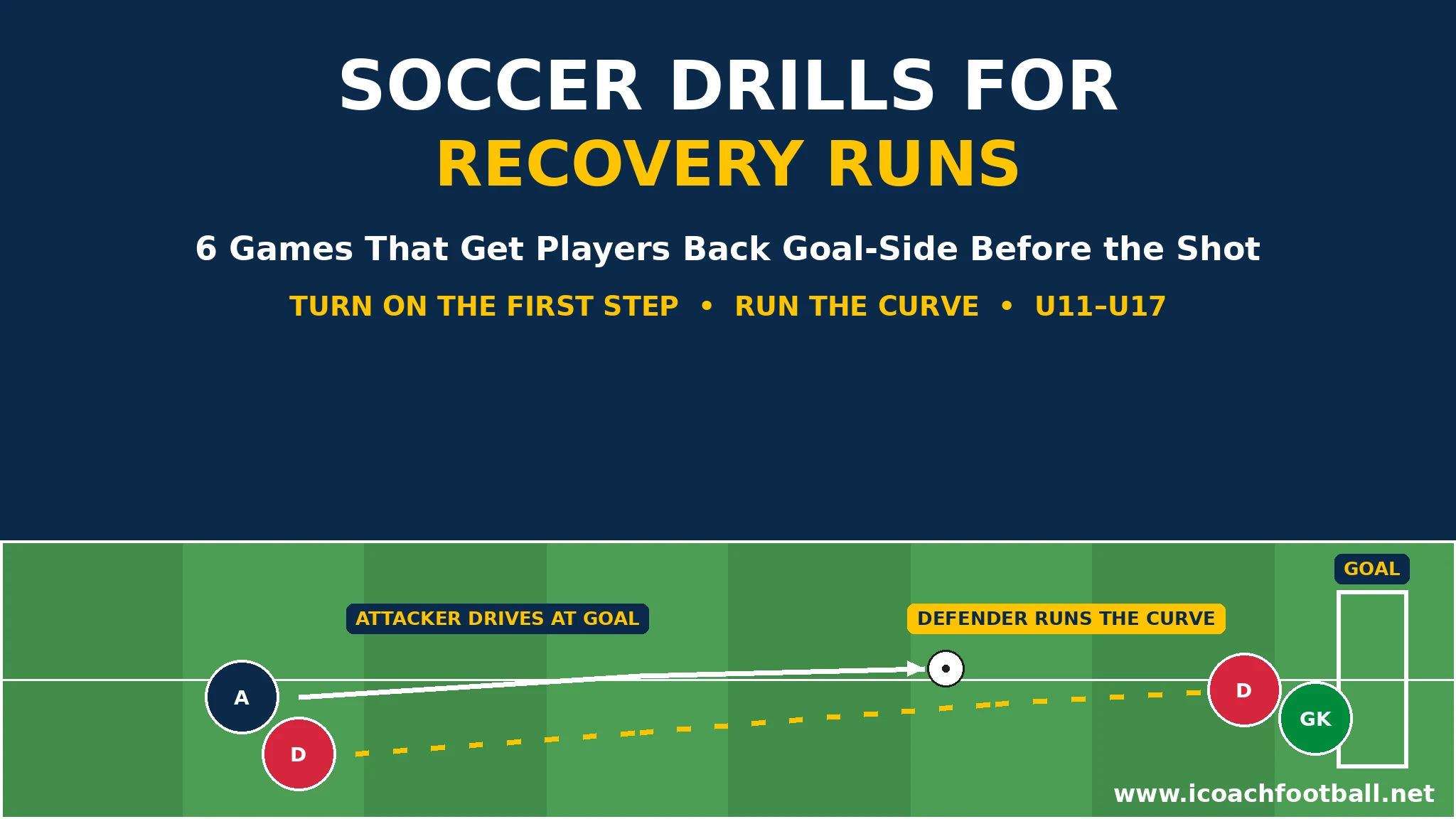
A recovery run is won or lost in the first three steps. The defender who turns on the very first step after the ball is lost, sprints back on a curve through the centre, and arrives goal-side and set — side-on, knees bent, ready to defend — stops the attack. The defender who takes two more strides forward, runs straight at the ball, or arrives at full speed and flies past the attacker, is beaten twice. These six soccer drills for improving recovery runs train that sequence step by step: turning on the first step, running the curve to arrive goal-side, recovering after your own shot, catching the attacker from different distances, recovering into an overload, and winning the ball back in a real game where a recovery goal counts double.
Suitable for: U11–U17 (ages 10–17)
Session snapshot
- Players: 10–16, including 1 goalkeeper
- Age: U11–U17 (ages 10–17)
- Area: Half a pitch, with a full goal and 2 mini goals
- Duration: 60 minutes
- Focus: Recovery runs — turning on the first step, sprinting back goal-side on a curve, slowing down before contact, delaying until help arrives, and recovering into shape
- Equipment: 10 balls, 16 cones, bibs, 1 full goal, 2 mini goals
Why these six games work
Most goals conceded on the counter are not caused by a lack of pace. They are caused by a late turn, a straight run, and a wild tackle. The defender jogs forward for two more strides after the ball is lost, then runs in a straight line directly behind the attacker, then dives in from behind — and the attacker is through on goal with the defender on the wrong side of the ball. The defender who turns on the first step, bends their run so they finish between the attacker and the goal, and then slows down, side-on, to delay the attack, gives their team the seconds it needs to get back into shape.
The first two drills build the run itself: turning on the first step instead of taking two more strides forward, then running the curve so the defender arrives goal-side rather than alongside. The next two drills build the recovery duel: the shooter who must touch the post and sprint back to win the ball again, and the defender who starts from different distances and must catch the attacker before they score. The last two drills build the team recovery: the overload that becomes even when the recovery runner arrives, then a full game where a goal scored after winning the ball back counts double, so the whole team starts sprinting back the moment possession is lost.
The drills are grounded in the FIFA/UEFA coaching community. Drills 1, 3 and 5 are based on / in line with the FIFA Training Centre session “29) Defensive transitions (Abdallah)” (Morocco U-15 national-team coach Abdallah Idrissi), which trains players to recover their shape once they lose possession — its two approaches are to win the ball back immediately or recover into shape, its Part 1 warms up with 1v2 scenarios including recovery from the front, from the side and from behind, its Part 2 possession game moves from 5v3 to 5v7 as players recover to create an overload, and its closing match asks players who are not close to the ball to make every effort to run back and help their team maintain a compact defensive block. Drills 2, 4 and 6 are based on / in line with England Football Learning’s “Challenging session: 1v1 recovery”, which exists to help players make effective recovery runs — its progression asks the shooter to touch the post of the mini-goal they have just shot into, then make an effective recovery run to win the ball and score again, with a recovery goal worth two points, and its coaching tips ask defenders to read the triggers for when to challenge and to be patient and delay the attack until the right moment. In the UK the same session is football drills for recovery runs — the turn, the curve and the delay are identical.
This post is the recovery half of the site’s transition pair. The full defensive transition — the press-or-drop decision, the six-second swarm and the rondo regain — is our football defensive transition drills — this post trains the run back itself, the curved sprint that gets a player goal-side before the shot.
Six rules of recovery runs
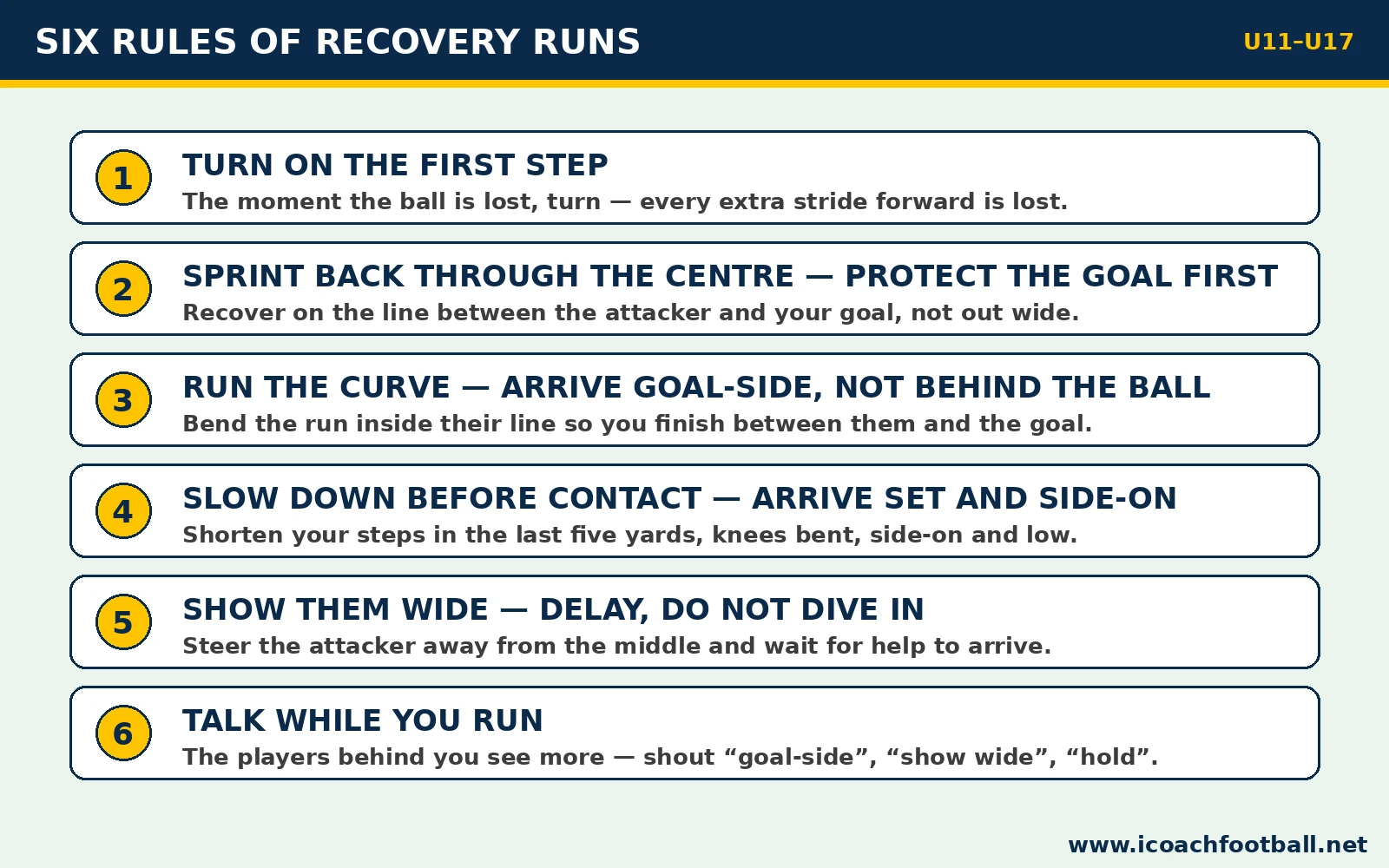
- Turn on the first step. The moment the ball is lost, turn — every extra stride forward is a stride the attacker gains.
- Sprint back through the centre — protect the goal first. Recover on the line between the attacker and your goal, not out wide where the danger is not.
- Run the curve — arrive goal-side, not behind the ball. Bend the run so you finish between the attacker and the goal; a straight chase leaves you on the wrong side.
- Slow down before contact — arrive set and side-on. Shorten your steps in the last five yards, knees bent, side-on — a defender who sprints past the attacker has to turn again and is beaten.
- Show them wide — delay, do not dive in. Steer the attacker away from the middle and wait for help; a wild tackle concedes the chance the run was meant to stop.
- Talk while you run. The players behind you see more than you do — shout “goal-side”, “show wide” and “hold” so the recovery is organised, not silent.
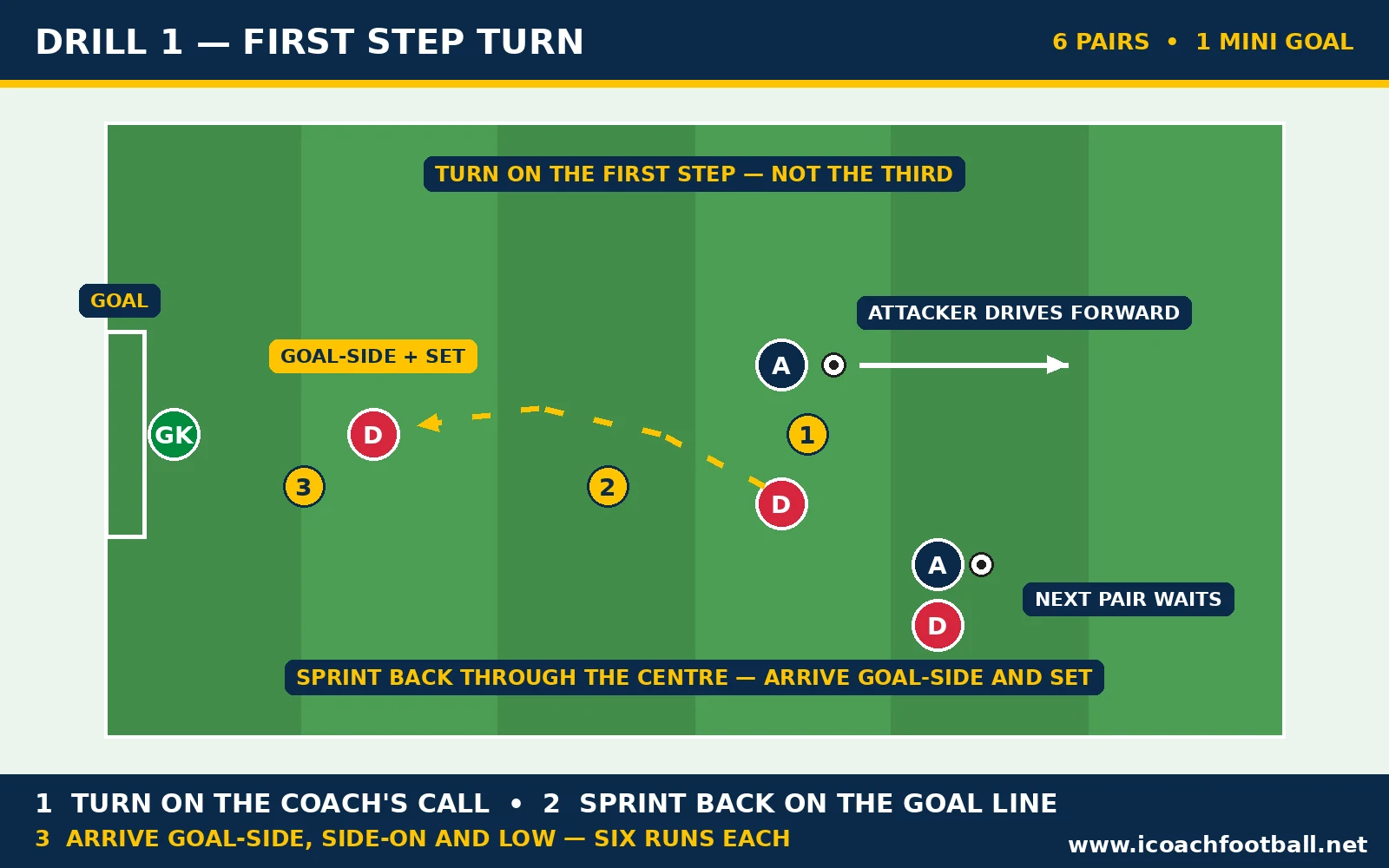
Drill 1 — First Step Turn
The reaction drill — the defender learns to turn on the very first step after the ball is lost, instead of taking two more strides forward and losing the race before it starts.
Setup
- Area 30 yards by 20 yards, 1 mini goal, 2 cones, 6 defenders and 6 attackers in pairs.
- 8 minutes, then swap roles.
How to Play
- Each pair stands side by side, back to the mini goal, ten yards from it, with the attacker holding the ball.
- The attacker drops the ball and takes two touches forward, away from the goal.
- On the coach’s call of “Turn!”, the defender turns on the very next step and sprints back towards the goal.
- The defender sprints on the line between the attacker and the goal, not straight at the ball.
- The defender must arrive goal-side of the attacker and set, side-on and low, before the attacker reaches the ten-yard line.
- The pair walks back, swaps who holds the ball, and goes again — six runs each, with a full walk back between each.
Coach’s note: “Turn on the first step, not the third. Two more strides forward after the ball is lost is two strides the attacker will never give back.”
Progressions: The coach varies the call — “Turn!” comes on the first, second or third touch, so the defender must react, not anticipate; the attacker starts one yard ahead, so the defender must turn faster; the defender must finish the run by jockeying the attacker for five seconds, so the turn becomes a duel.
Drill 2 — Run the Curve
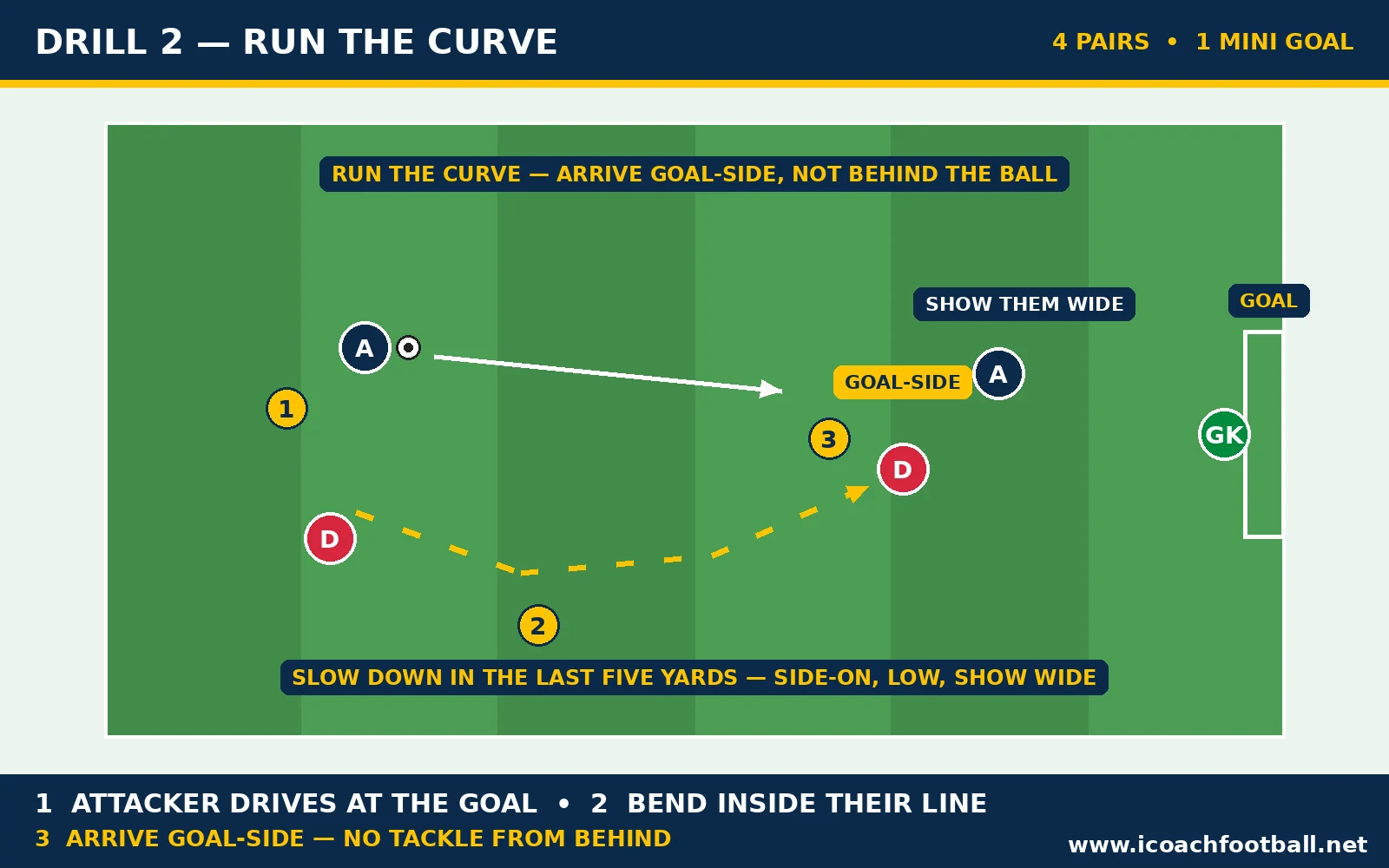
The angle drill — the defender learns to bend their recovery run so they arrive goal-side of the attacker, instead of chasing in a straight line and finishing alongside with nothing to defend.
Setup
- Channel 30 yards long by 15 yards wide, 1 mini goal at one end, 4 cones marking the curve, 4 defenders and 4 attackers in pairs.
- 10 minutes, then swap roles.
How to Play
- The attacker starts at the far end of the channel with the ball, facing the mini goal.
- The defender starts five yards behind the attacker, in the middle of the channel, also facing away from the goal.
- On the coach’s call, the attacker dribbles towards the mini goal at three-quarter pace.
- The defender sprints immediately — full speed for the first five steps, no hesitation.
- The defender bends their run on a curve, inside the attacker’s line, towards the goal, until they are between the ball and the goal.
- The defender slows down with short steps, gets side-on, and shows the attacker wide — no tackle from behind, and the rep only counts if the defender arrives goal-side without fouling.
Coach’s note: “Run the curve, not the straight line. Straight at their back means you arrive level and can do nothing — bend inside their line and you arrive between them and the goal.”
Progressions: The attacker goes at full pace, so the curve must be run at full speed; the defender starts seven yards behind, so the curve is longer and the finish must be later; the defender must win the ball cleanly after arriving goal-side, so the recovery becomes a tackle.
Drill 3 — Shoot, Touch the Post, Recover
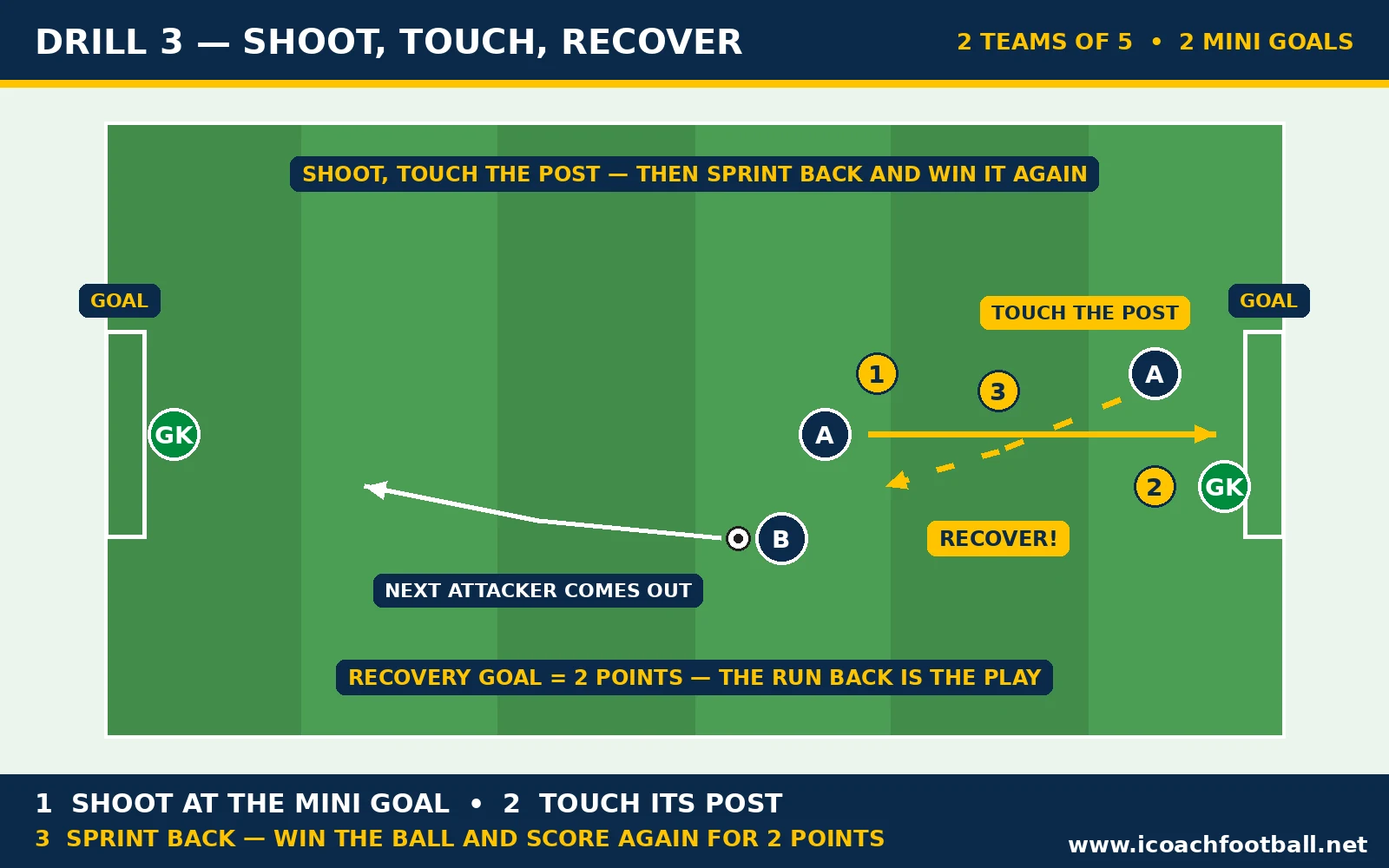
The recovery duel — the shooter scores, touches the post, then must sprint back and win the ball again before the next attacker scores, exactly as England Football Learning’s 1v1 recovery session teaches it.
Setup
- Area 20 yards by 10 yards, 2 mini goals at opposite ends, halfway line marked, 10 players in two teams of 5.
- 10 minutes, then swap ends.
How to Play
- The two teams line up behind their own mini goal, and the front player of each team holds a ball.
- The first player runs into the opposition half and has a shot at the mini goal.
- After shooting, the player must run on and touch a post of the mini goal they have just shot into.
- Once the post is touched, the front player of the other team comes out onto the pitch and attacks the opposite mini goal.
- The shooter sprints back and aims to make an effective recovery run, win the ball, and score again in the other mini goal.
- A normal goal is worth 1 point, but a goal scored after winning the ball back on a recovery run is worth 2 — the team with the most points after 10 minutes wins.
Coach’s note: “Your shot is not the end of the play — it is the start of your recovery. Touch the post, turn, and sprint: the next goal is won by the player who runs back fastest.”
Progressions: The shooter must touch the far post, so the recovery run is longer; the attacker starts the moment the shot is taken, so the recovery must begin before the post is touched; the recovery goal is worth 3 points, so the whole team starts shouting the runner back.
Drill 4 — Recovery Royale
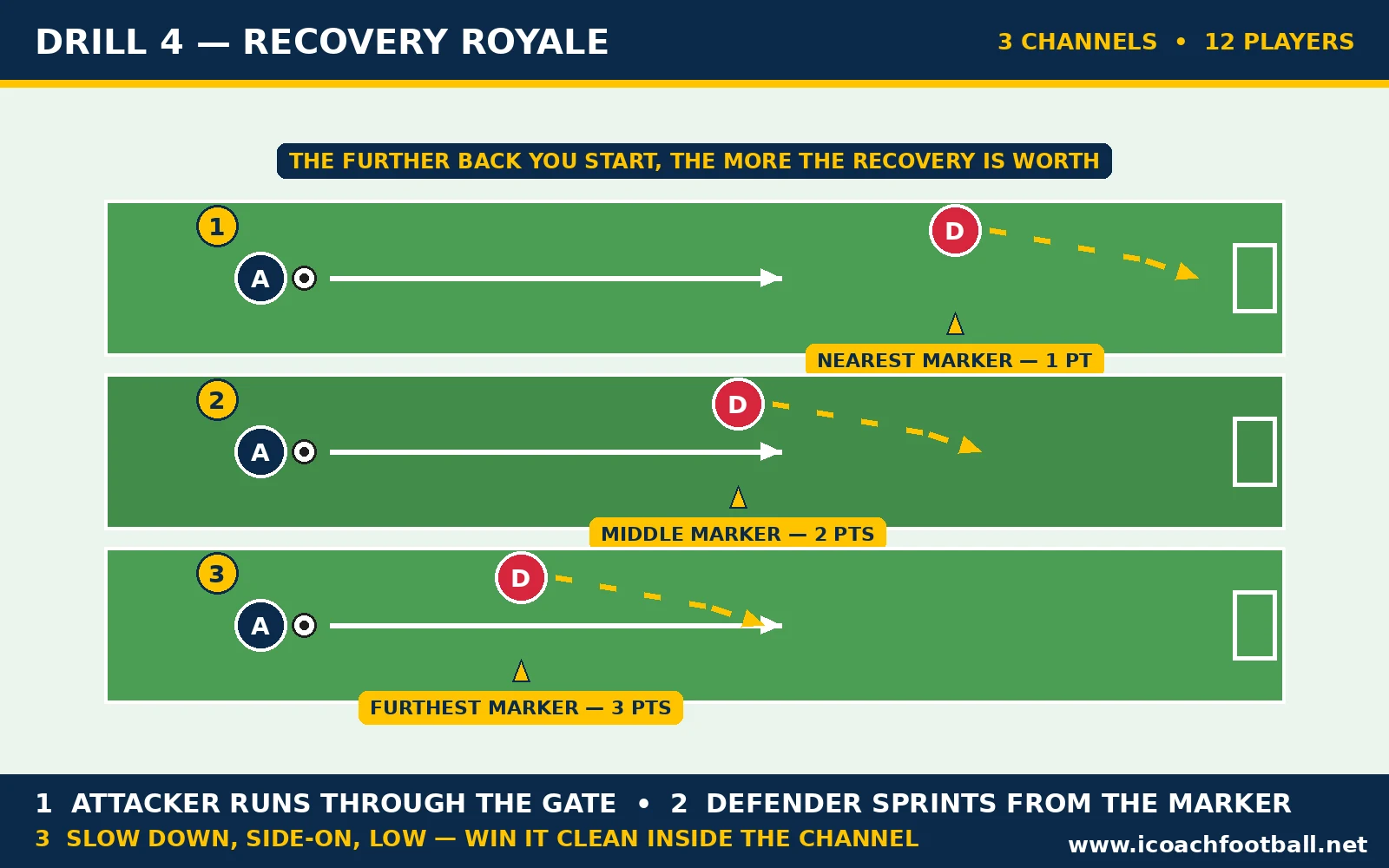
The distance drill — the defender starts from a flat marker further and further from goal and must catch the attacker before they score, learning when to sprint, when to slow down, and when to challenge.
Setup
- Three channels, each 25 yards long by 10 yards wide, 1 mini goal at the end of each, 3 flat markers in each channel at increasing distances from goal, 12 players in pairs.
- 10 minutes, then rotate channels.
How to Play
- Each pair takes a channel, with the attacker starting with the ball at the far end and the defender on a flat marker of their choice.
- The attacker runs through a gate, then travels towards the mini goal to shoot.
- The defender sprints to catch the attacker before they score — the further the marker from goal, the more points the recovery is worth.
- The defender must slow down in the last five yards, get side-on and low, and win the ball inside the channel to score the points.
- If the attacker scores, the pair swaps roles; if the defender wins it, the defender keeps the points and the pair goes again.
- After three minutes the pairs rotate to the next channel, so every defender recovers from both sides of the attacker.
Coach’s note: “The further back you start, the harder the recovery — and the more it is worth. But the finish is always the same: slow down, side-on, low, and win it clean.”
Progressions: The defender starts from the furthest marker every time, so the recovery is always at full stretch; the attacker may cut inside or go outside, so the defender must read the first touch; the defender must win the ball in the square and score in the opposite mini goal, so the recovery becomes a counter-attack.
Drill 5 — 3v2 to 3v3
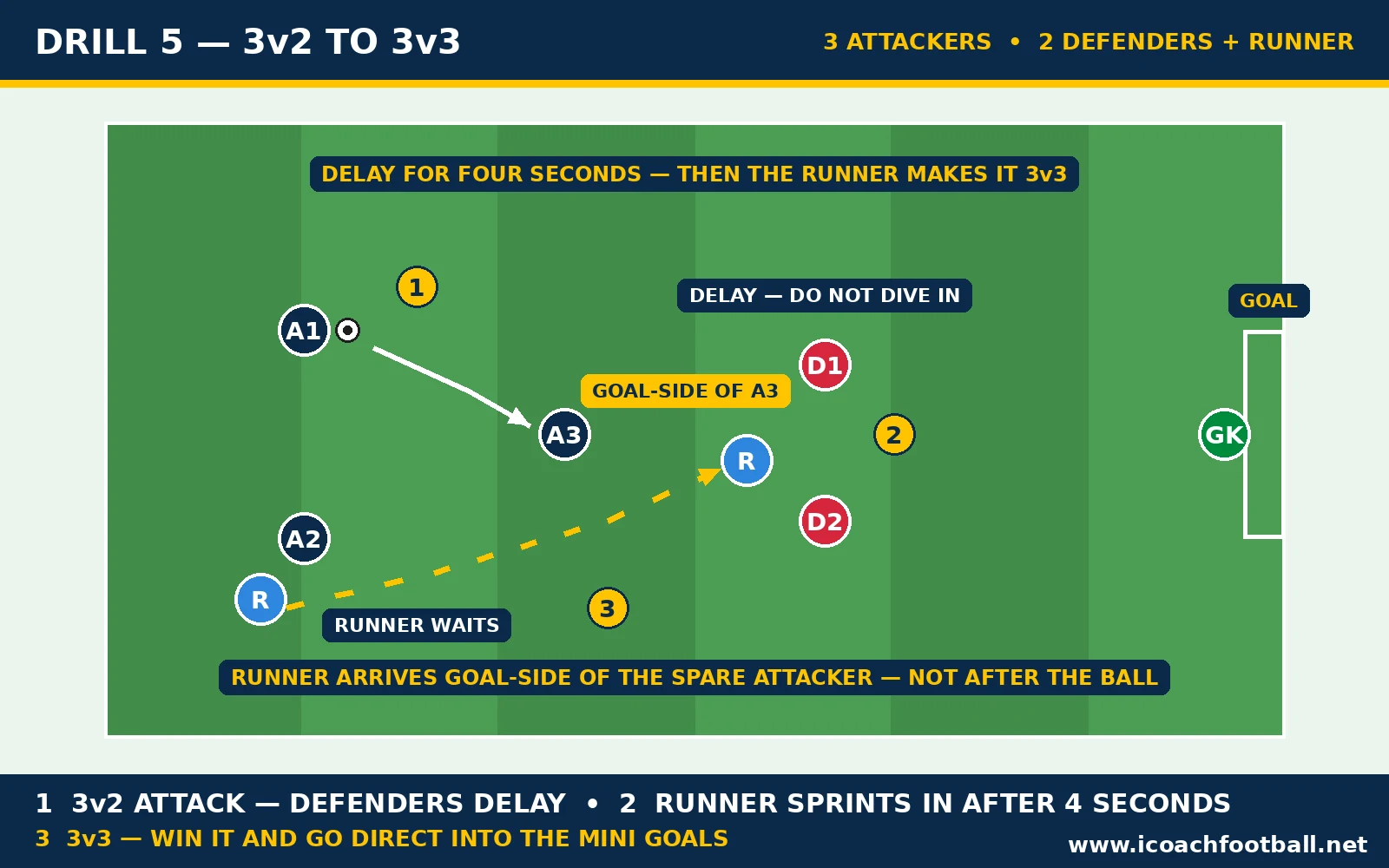
The overload drill — the attack starts 3v2, and the recovery runner joins after four seconds to make it 3v3, so the team learns to delay until help arrives and the runner learns to recover into the right place.
Setup
- Area 30 yards by 25 yards, 1 full goal with a goalkeeper, 1 recovery runner waiting on the halfway line, 3 attackers, 2 defenders.
- 10 minutes, then swap roles.
How to Play
- The goalkeeper serves the ball into the three attackers, who attack the full goal 3v2.
- The two defenders try to delay the attack and protect the centre — they must not dive in while outnumbered.
- Four seconds after the serve, the recovery runner sprints in from the halfway line to join the defenders and make it 3v3.
- The recovery runner must sprint back through the centre and arrive goal-side of the spare attacker, not chase the ball.
- If the defenders win the ball, they go direct and score into the two mini goals on the halfway line.
- Rotate the recovery runner every two minutes, so every player learns the run from behind play.
Coach’s note: “Delay first, recover second. The two defenders buy four seconds — the runner uses them to get goal-side of the spare man, and suddenly it is 3v3, not 3v2.”
Progressions: The recovery runner starts further back, so the delay must last six seconds; the attackers are limited to two touches, so the recovery must be faster still; play 4v3 to 4v4, so the runner must choose which attacker to cover.
Drill 6 — The Recovery Game
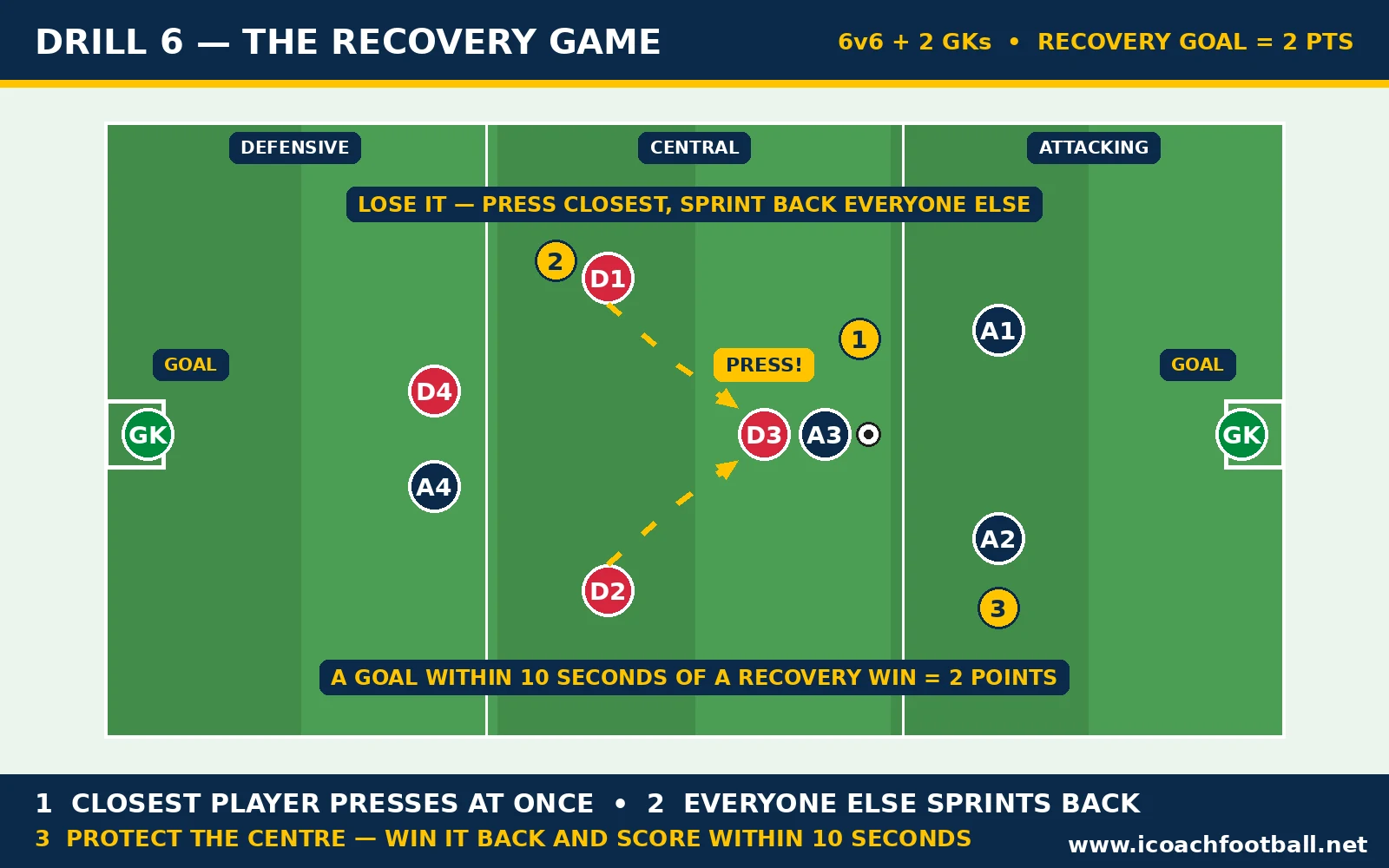
The full game. A 6v6 game where a goal scored after winning the ball back on a recovery run counts double — so the whole team sprints back the moment possession is lost.
Setup
- Area 40 yards by 30 yards, 2 full goals, 2 goalkeepers, 6 attackers, 6 defenders.
- 12 minutes.
How to Play
- Two teams play 6v6 plus goalkeepers, with the pitch split into three zones — defensive, central and attacking.
- A normal goal is worth 1 point, but a goal scored within ten seconds of winning the ball back on a recovery run is worth 2.
- When a team loses the ball, the closest player presses the ball carrier immediately to slow the attack down.
- Every other player must sprint back into their defensive shape as quickly as possible, protecting the centre of the pitch first.
- If the ball goes out or a goal is scored, the goalkeeper restarts quickly and the team in possession must build through the zones to score.
- The team with the most points after 12 minutes wins — then play again with new teams.
Coach’s note: “The moment we lose it, we run. The press buys us three seconds and the recovery buys us the rest — a team that recovers together never defends alone.”
Progressions: The recovery goal is worth 3 points, so the sprint back becomes the whole team’s habit; the zones are removed, so players must recover into shape without lines to guide them; only goals scored after a recovery win count, so the team must win the ball back to score at all.
Coaching points
- Turn on the first step. The recovery starts the instant possession is lost — two more strides forward is two strides the attacker will never give back.
- Sprint back through the centre. Recover on the line between the attacker and your goal, protecting the middle first — the wide areas can wait.
- Run the curve, not the straight line. Bend the run inside the attacker’s line so you finish between them and the goal; a straight chase leaves you alongside with nothing to defend.
- Slow down before contact. Shorten your steps in the last five yards, arrive side-on and low — a defender who sprints past the attacker has to turn again and is beaten.
- Delay, do not dive in. Show the attacker wide, stay on your feet, and wait for help — a wild tackle concedes the chance the recovery was meant to stop.
- Talk while you run. The players behind the ball see more than the runner does — shout “goal-side”, “show wide” and “hold” so the recovery is organised.
Common mistakes
| Mistake | Fix |
|---|---|
| Taking two or three more strides forward before turning | Turn on the first step — Drill 1 stops the rep if the defender has not turned by the second stride |
| Running in a straight line directly behind the attacker | Run the curve inside their line — Drill 2 only counts the rep if the defender arrives goal-side |
| Sprinting past the attacker at full speed and having to turn again | Slow down with short steps in the last five yards — Drill 2 stops the rep if the defender runs past the attacker |
| Diving in from behind and giving away a foul or a free run at goal | Show them wide and delay — Drill 4 only awards the points if the ball is won cleanly inside the channel |
| Chasing the ball instead of recovering goal-side of the spare attacker | Sprint through the centre to the spare man — Drill 5 only counts the recovery if the runner arrives goal-side of the spare attacker |
| Jogging back while the team is outnumbered, waiting for someone else to recover | Recovery goals count double — Drill 6 only awards the double point if the goal follows a recovery win |
Age adaptations
| Age | Format | What changes |
|---|---|---|
| U11–U13 (ages 10–13) | Small areas, size 4 ball, coach calls every turn | All six drills run at three-quarter pace with the turn called by the coach, so the habit of turning on the first step is learned before speed is added. Drill 2 uses a five-yard head start for the attacker, so the curve is always winnable. Drill 3 uses mini goals only, with the post-touch kept — the recovery is the lesson, not the finish. Drill 5 runs 3v2 to 3v3 with a six-second delay before the runner joins, so the defenders have time to organise |
| U14–U15 (ages 13–15) | Full areas, size 4 ball, turn called by the coach on alternate reps | All six drills run as written, with the attacker going at full pace in Drill 2 from the second round. Drill 1 adds the five-second jockey after the turn, Drill 4 adds the cut inside or outside, and Drill 6 adds the ten-second recovery-goal window. Players keep a simple count — “seven recoveries, five arriving goal-side and set” is the habit that sticks |
| U16–U17 (ages 15–17) | Full areas, size 5 ball, full speed from the first rep | Full pressure from the start. Drill 1 uses an attacker one yard ahead, Drill 3 starts the attacker the moment the shot is taken, and Drill 5 starts the runner further back with a six-second delay. Players are asked to call their recovery line before each rep — “curve inside, show wide” — so the run becomes a conscious skill, not a lucky chase |
60-minute session plan
| Block | Time | Content |
|---|---|---|
| Arrival game | 0:00–0:05 | Free 3v3 in the channel — every recovery goal counts double |
| First step turn | 0:05–0:13 | Drill 1 — First Step Turn |
| Run the curve | 0:13–0:23 | Drill 2 — Run the Curve |
| Shoot, touch the post, recover | 0:23–0:33 | Drill 3 — Shoot, Touch the Post, Recover |
| Recovery royale | 0:33–0:43 | Drill 4 — Recovery Royale |
| 3v2 to 3v3 | 0:43–0:51 | Drill 5 — 3v2 to 3v3 |
| The recovery game | 0:51–1:00 | Drill 6 — The Recovery Game |
Keep building from here
The full defensive transition — the press-or-drop decision, the six-second swarm and the rondo regain — is our football defensive transition drills, and the pace that forces the recovery in the first place is our soccer drills for improving defending against pace. The position the runner is recovering into is trained in our soccer drills for improving defensive positioning, and the duel that follows the recovery is our 1v1 defending drills jockeying. The runner who arrives late must still mark, so work through our soccer drills for improving marking, and the pass the runner is trying to cut out is our soccer drills for improving interceptions. The overload the runner joins is our soccer defending 2v1 drills, and the far-post run the recovery must also cover is our soccer drills for improving defending the back post. The header the runner may have to win after recovering is our soccer drills for improving aerial duels, and the trigger that decides press or drop is our coaching soccer pressing triggers. The immediate win-the-ball-back option is our counter-pressing soccer drills 6 second rule, and the shape the team recovers into is our football rest defence drills. The reading of the game that starts the recovery earlier is our soccer drills for improving anticipation. Recovery runs are high-intensity — plan the week’s load with our training load calculator.
How do you coach a recovery run?
Start with the turn, not the sprint. Teach the defender to turn on the very first step after the ball is lost, then to bend their run on a curve so they arrive goal-side of the attacker, then to slow down with short steps and arrive side-on and low. Begin with the turn called by the coach and the attacker at three-quarter pace, and only add full pace, a longer head start and a live duel once the turn and the curve are habits. Drill 1 trains the turn, and Drill 2 trains the curve.
What is the correct angle for a recovery run?
Run on a curve inside the attacker’s line, towards your goal — not in a straight line directly behind them. The curve puts you between the attacker and the goal, so you arrive goal-side; a straight chase leaves you alongside the attacker with nothing to defend and invites a foul from behind. Slow down in the last five yards, get side-on, and show the attacker wide. Drill 2 trains the curved run.
When should a defender sprint back and when should they press?
It depends on distance from the ball. The player closest to the ball carrier presses immediately to slow the attack down, exactly as the FIFA Training Centre’s defensive transitions session teaches — everyone else sprints back into the team’s defensive shape, protecting the centre first. If you are the closest player, press; if you are behind the ball, recover. Drill 5 trains the split: two defenders delay while the runner recovers goal-side.
How do you stop players jogging back after losing the ball?
Make the recovery worth points. Score recovery goals double, as in Drill 3 and Drill 6, so the player who sprints back and wins the ball is the one who scores. Shout the runner back by name, and stop the session the first time a player jogs — the recovery is a habit, and habits are built by stopping the wrong one. Drill 6 makes the whole team recover, because only a goal after a recovery win counts double.
At what age should players start training recovery runs?
From U11, with the turn called by the coach and the attacker at three-quarter pace, so turning on the first step and running the curve become habits before speed is added. The turn and the angle can be trained young — what must wait is the full-speed recovery duel against a live attacker. Add full pace and opposed attackers gradually from U13, and full-pressure recovery runs from U15, once the defender turns on the first step and arrives goal-side every time.
Sources
- FIFA Training Centre. “29) Defensive transitions (Abdallah)” — the FIFA Training Centre session led by Morocco U-15 national-team coach Abdallah Idrissi trains players to recover their shape once they lose possession: its two approaches are to win the ball back immediately or recover into shape, its Part 1 warms up with 1v2 scenarios including recovery from the front, from the side and from behind, its Part 2 possession game moves from 5v3 to 5v7 as players recover to create an overload, and its closing match asks players who are not close to the ball to make every effort to run back and help their team maintain a compact defensive block. Verified live 2026-11-21 (HTTP 200, full text read). Drills 1, 3 and 5 are based on / in line with this session’s recovery principles.
- England Football Learning. “Challenging session: 1v1 recovery” — England Football Learning’s 1v1 recovery session exists to help players make effective recovery runs: its progression asks the shooter to touch the post of the mini-goal they have just shot into, then make an effective recovery run to win the ball and score again, with a goal scored after winning the ball back worth two points, and its coaching tips ask defenders to read the triggers for when to challenge and to be patient and delay the attack until the right moment. Verified live 2026-11-21 (HTTP 200, full text read). Drills 2, 4 and 6 are based on / in line with this session’s recovery-run principles.