Soccer Drills for Improving Reaction Time: 6 Games That Make Players React Faster (U9–U15)
Quick answer
Reaction time is how fast a player responds to something they could not predict — a colour call, a dropped ball, a deflection, a whistle. These six games train exactly that: perceive the cue, decide in a split second, then execute. One 60-minute session takes players from a simple colour call to a full game where the rules change mid-play.
Suitable for: U9–U15 (ages 8–15)
Session snapshot
- Players: 12–16 (U9–U15)
- Area: 20 x 15-yard area expanding to a 30 x 20-yard game pitch
- Duration: 60 minutes
- Focus: Perceiving an unpredictable cue, deciding fast, and executing the first action at full speed
- Equipment: 10–12 balls, 20 cones (4 colours), 4 mini goals, bibs, 1 rebounder board or wall
Why these six games work
Reaction time and anticipation are cousins, not twins. Anticipation is reading a pattern before it happens — the passer’s hips opening, the runner starting early. Reaction time is the opposite skill: responding to an unpredictable cue as fast as possible. Perceive, decide, execute — in that order, with no time to plan.
These soccer drills for improving reaction time work because every drill in this session is cue-based. The player never knows what is coming next. A colour is called, a ball is dropped, a number is shouted, a rule changes mid-game. The cue comes first and the movement follows — never the other way round.
The research backs the order of work. A 2025 study of 35 Under-12 and Under-13 players found an 8-week football-specific vision-training programme, built into normal training twice a week, significantly improved visuomotor reaction time and eye-movement precision. Drills 1, 2 and 4 below are based on / in line with that study: train the eyes first, then the feet. A second 2025 study of 89 soccer-playing boys aged 6 to 12 found agility and core strength were the physical qualities most closely linked to faster reaction times. Drills 3, 5 and 6 below are based on / in line with that finding: every reaction here ends in a short, sharp change of direction or a strong, balanced first action.
The visual input comes first. Scanning is the skill that puts a player’s eyes in the right place before the cue arrives, and our soccer decision-making drills train the choice that follows the reaction. Reaction time sits between the two: see it, react to it, then decide what to do with it. In the UK the same session is football drills to improve reaction time — the cues, the games and the coaching points are identical.
Six rules of reaction training
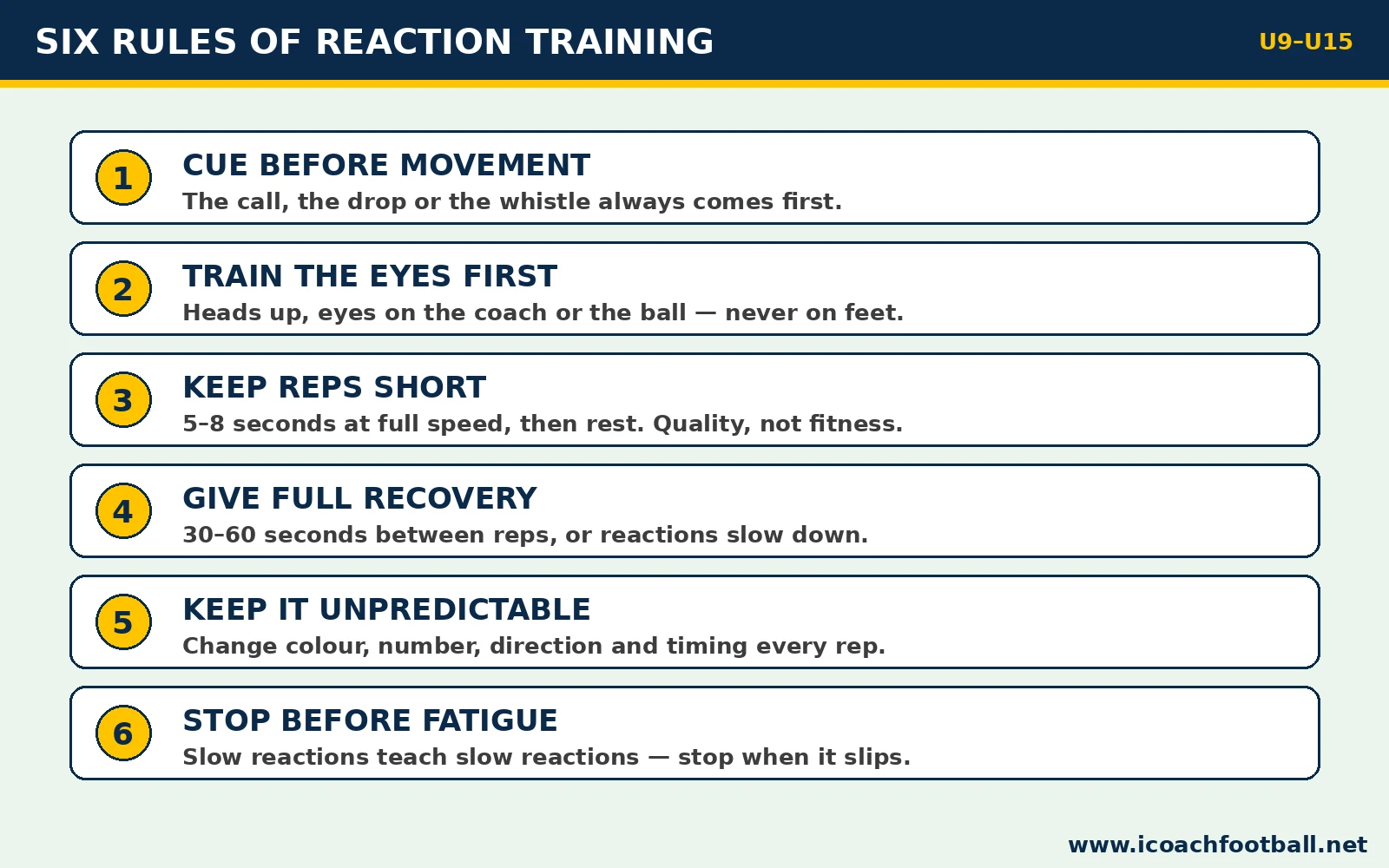
- Cue before movement. The call, the drop or the whistle always comes first — never let players move before the cue.
- Train the eyes first. Heads up, eyes on the coach or the ball — a player looking at their feet cannot react to anything.
- Keep reps short. 5–8 seconds of full-speed reaction, then rest — reaction work is quality work, not fitness work.
- Give full recovery. 30–60 seconds between reps, or the reactions slow down and players practise being slow.
- Keep it unpredictable. Change the colour, the number, the direction and the timing every rep — a pattern players can guess is not reaction training.
- Stop before fatigue. The moment reactions get sloppy, stop the drill — slow reactions teach slow reactions.
Drill 1 — Colour Call Gates
Four coloured gates, one call, one split-second decision. The coach calls a colour and the player must dribble through that gate before anyone else gets there.
Setup
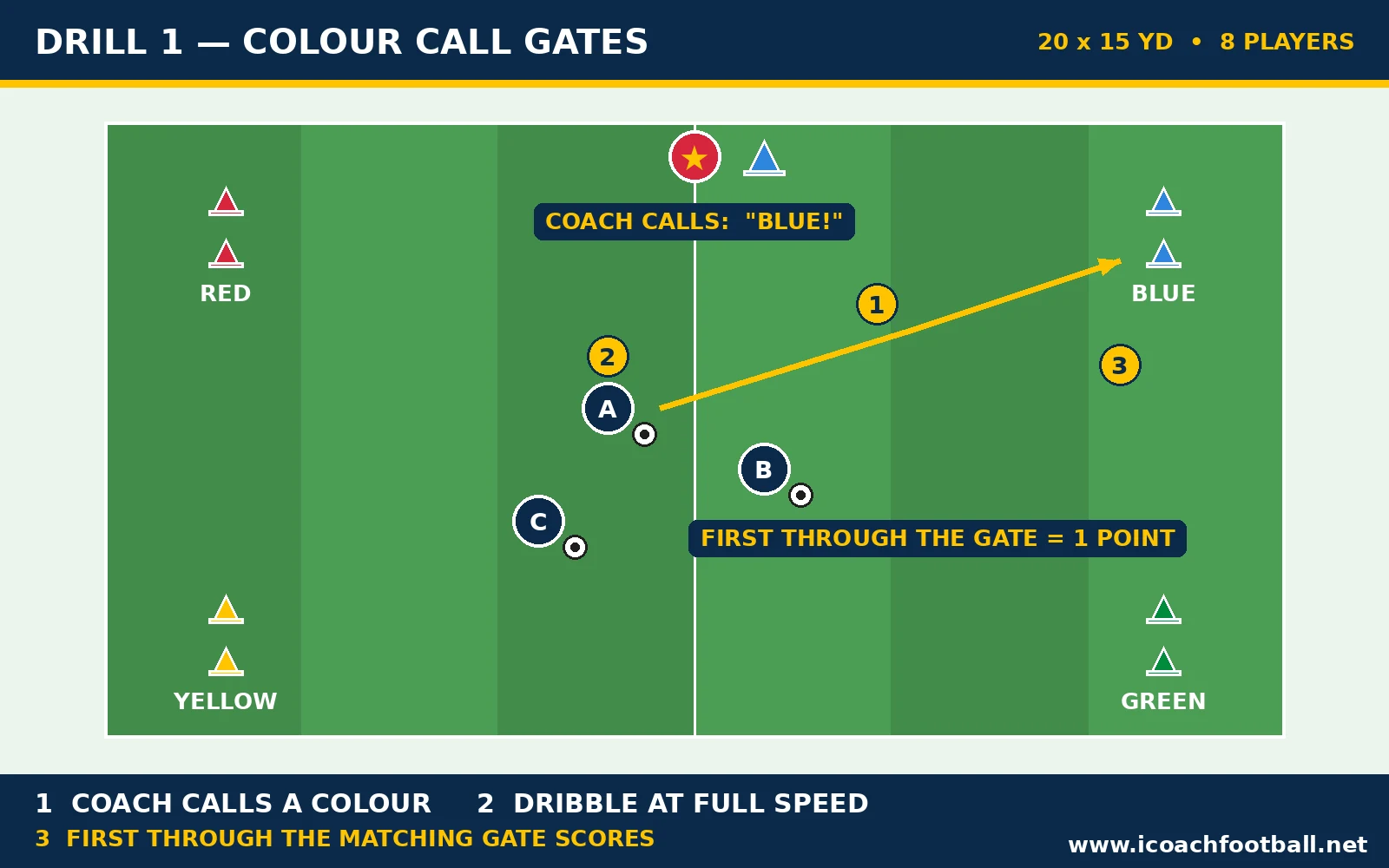
- 20 x 15-yard area, four 2-yard gates in the corners — red, blue, yellow, green.
- 8 players, 1 ball each, coach on the side with a coloured cone in each hand. 8 minutes.
How to Play
- Each player dribbles slowly inside the area, head up, ball close.
- The coach holds up one coloured cone and shouts the colour — “Blue!”
- Every player dribbles at full speed through the matching gate.
- The first player through their gate scores 1 point and jogs back to the middle.
- The coach waits 5 seconds, then calls a different colour without warning.
- After 4 minutes, the slowest player each round does 5 toe taps before rejoining.
Coach’s note: “Eyes up before I call — if you are looking at the ball when I shout, you have already lost.”
Progressions: The coach calls two colours in a row, so players change gate mid-run; the gates shrink to 1 yard wide; the coach calls a colour and holds up a different one — players follow the shout, not the cone.
Drill 2 — Ball Drop Reaction
The coach drops the ball from shoulder height. The player must react, control it before the second bounce, and turn into space — the purest reaction drill in the session.

Setup
- 10 x 10-yard square, coach at the top edge, player 3 yards in front of them.
- 8 players in pairs, 1 ball per pair, 2 mini goals at the far corners. 8 minutes.
How to Play
- The player stands side-on, 3 yards from the coach, knees bent, on their toes.
- The coach holds the ball at shoulder height and drops it without warning.
- The player sprints the 3 yards and controls the ball before its second bounce.
- On the first touch, the player turns toward the nearest mini goal.
- The player passes into the mini goal for 1 point, then jogs back to the start.
- After 1 minute, partners swap — the dropper becomes the reactor.
Coach’s note: “Go on the drop, not on my hand moving — if you wait to see the ball fall, it has already bounced twice.”
Progressions: The coach drops the ball from head height so it bounces higher and the player must chest it down; the coach fakes a drop twice before the real one; the player must turn to the far goal instead of the near one.
Drill 3 — Mirror Tag
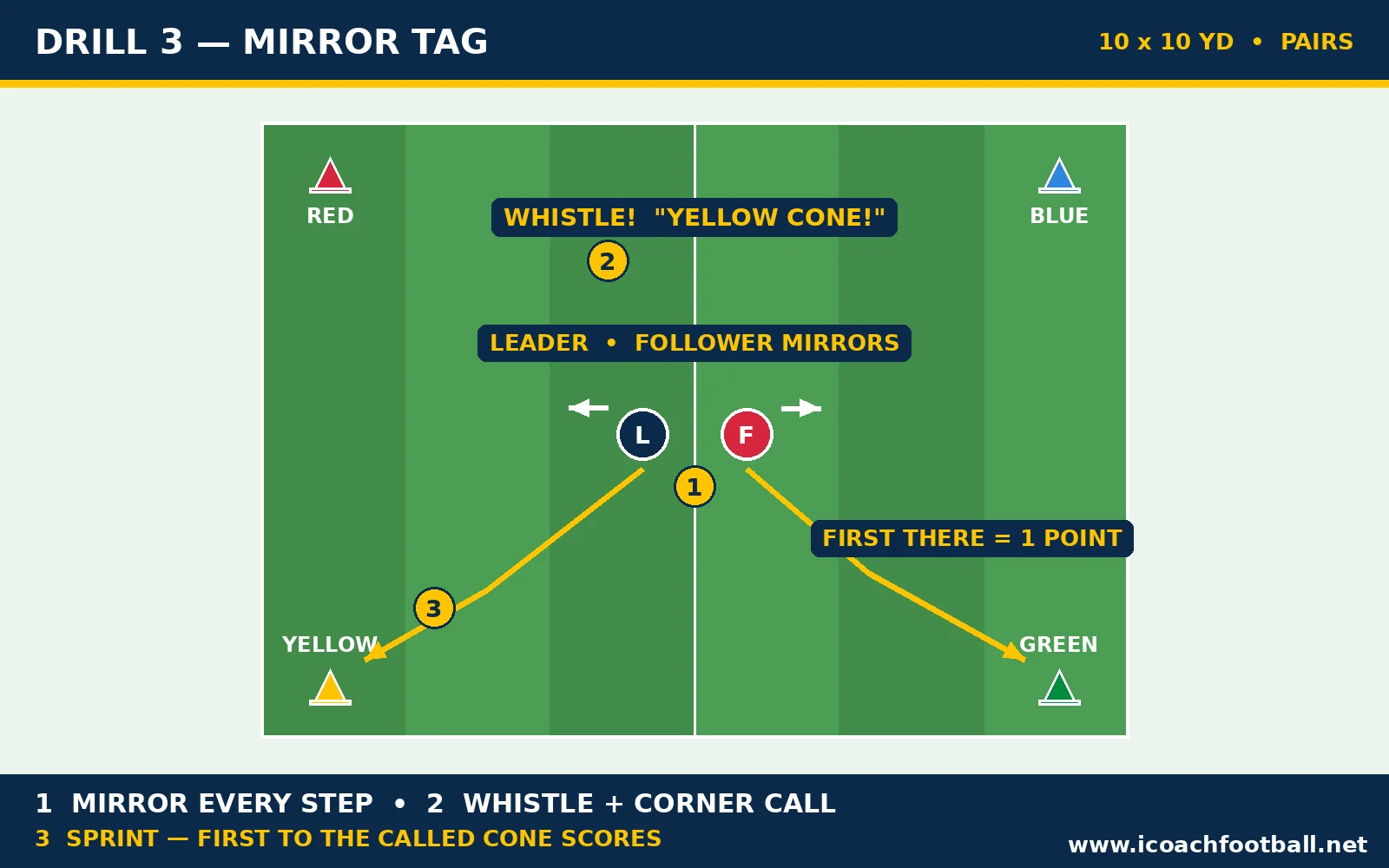
Pairs face to face. One leads, one mirrors — then the whistle blows and the follower must beat the leader to a cone. Eyes, feet and brain all working at once.
Setup
- 10 x 10-yard square, one cone on each corner, whistle in the coach’s hand.
- 8 players in pairs, no ball. 8 minutes.
How to Play
- Partners face each other 2 yards apart in the middle of the square.
- The leader moves side to side and the follower mirrors every step.
- The leader tries to lose the follower with a quick feint left, then right.
- The coach blows the whistle and shouts a corner — “Yellow cone!”
- Both players sprint to that corner and the first one there scores 1 point.
- After 1 minute, swap roles so both players lead and follow.
Coach’s note: “Stay on your toes and watch their hips — flat feet and ball-watching make you a full second slow.”
Progressions: The coach blows the whistle with no corner call, so players must look for the coach’s pointed arm; the leader holds a ball and must keep it under control while mirroring; the square shrinks to 8 x 8 yards so the sprints are shorter and sharper.
Drill 4 — Number Call 1v1
Two lines, one ball, one number. The coach calls a number and two players race to the ball — the winner attacks, the loser defends, and the duel starts at full speed.

Setup
- 20 x 15-yard area, two lines of 4 players facing each other, 1 ball in the middle.
- 8 players, 1 ball, 2 mini goals at opposite ends. 8 minutes.
How to Play
- Each line numbers its players 1 to 4, standing 10 yards from the ball.
- The coach shouts a number — “Three!” — and both number 3s sprint to the ball.
- The first player to the ball attacks the mini goal at the far end.
- The second player becomes the defender and must win it back within 5 seconds.
- The duel ends on a goal, a tackle, or when the ball leaves the area.
- After each duel, both players rejoin their lines and the coach calls a new number.
Coach’s note: “Sprint to the ball like it is the only ball in the world — the duel is decided in the first three steps.”
Progressions: The coach calls two numbers at once for a 2v2; the ball is rolled in from the side instead of sitting still; the attacker must score within 6 seconds or the point goes to the defender.
Drill 5 — Deflection Rebound
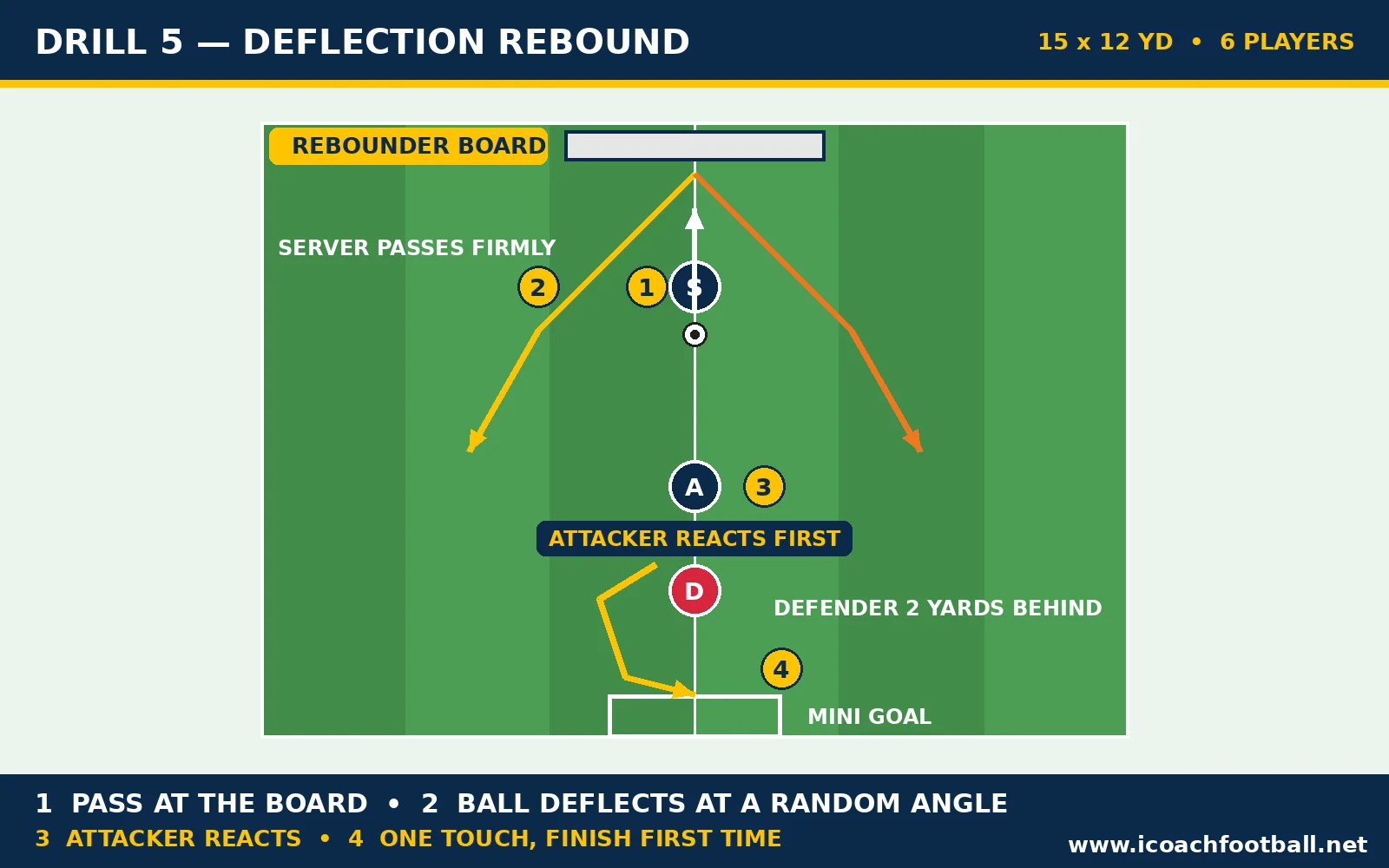
The ball comes back off the board at a random angle. The attacker must read the deflection, adjust in a split second, and finish — the closest thing to a match deflection you can train.
Setup
- 15 x 12-yard area, rebounder board or wall at the top edge, mini goal at the bottom.
- 6 players: 1 server, 1 attacker, 1 defender, 3 waiting, 2 balls. 8 minutes.
How to Play
- The server passes firmly at the rebounder board from 8 yards away.
- The ball deflects off the board at a random angle into the area.
- The attacker reacts to the deflection and moves to meet the ball first.
- The defender starts 2 yards behind the attacker and reacts a heartbeat later.
- The attacker takes one touch, then finishes first time into the mini goal.
- After each rep, the next attacker steps in and the server changes the pass angle.
Coach’s note: “Watch the ball off the board, not the server’s foot — the deflection is the cue, and it comes at you fast.”
Progressions: The server passes at the board with the outside of the foot so the deflection spins wider; the defender starts level with the attacker; the attacker must finish with their weak foot.
Drill 6 — Rule Change 4v4
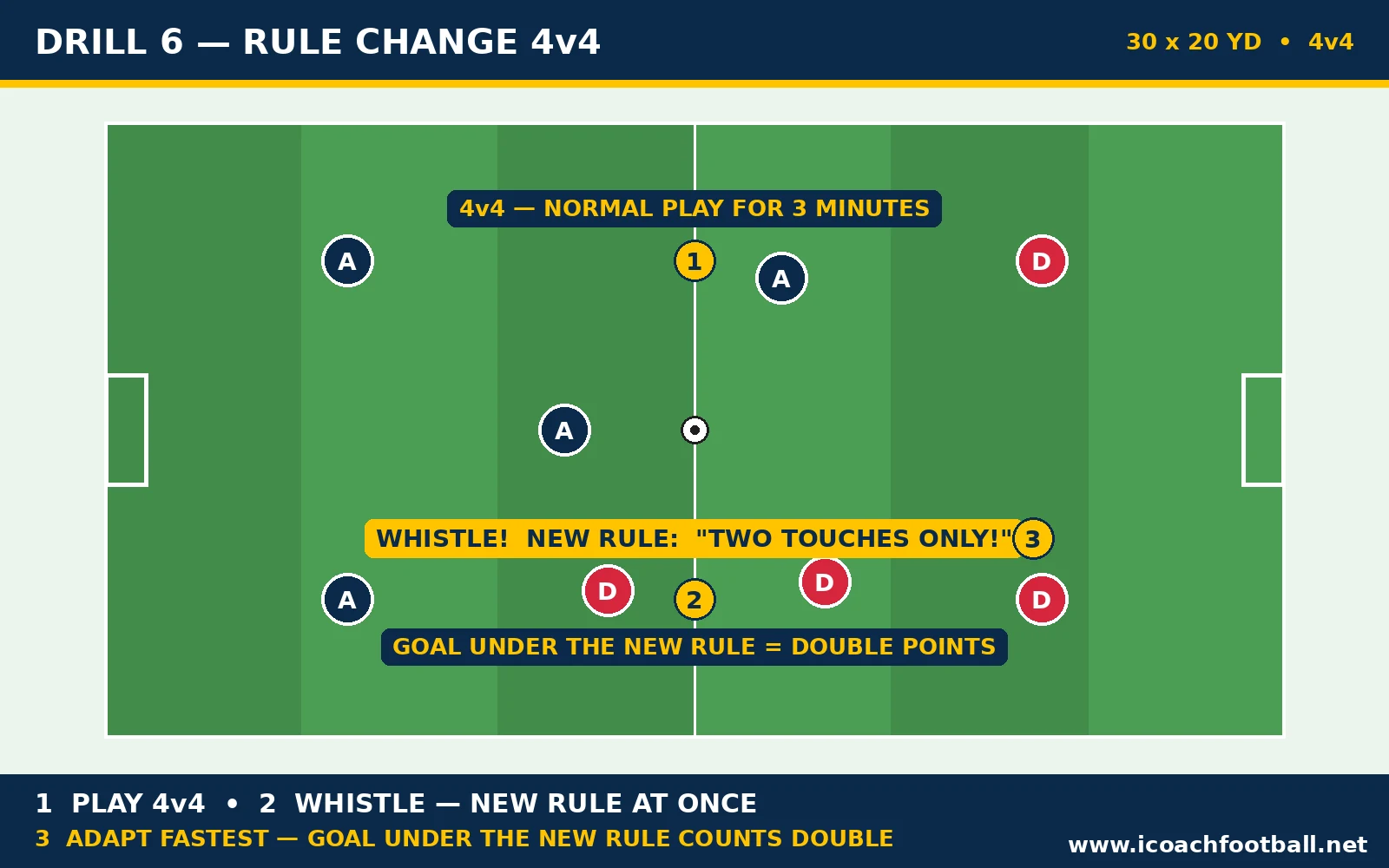
The game. A 4v4 where the coach changes a rule on the whistle — two touches only, goals only from inside the area, one-touch finish — and every player must react instantly or lose the ball.
Setup
- 30 x 20-yard pitch, 2 mini goals, bibs, whistle.
- 8 players: 4v4, 1 ball. 15 minutes.
How to Play
- The game starts with a pass-in from the coach — no kick-offs, no corners.
- Play 3 minutes of normal 4v4, then the coach blows the whistle and shouts a new rule.
- The new rule applies at once — for example, “Two touches only!” or “Score only inside the area!”
- The team that adapts fastest wins the next goal — a goal under the new rule counts double.
- Every 3 minutes, the coach blows the whistle and changes the rule again.
- The coach freezes play twice per game and asks one player: “What changed, and what did you do?”
Coach’s note: “Listen for the whistle with your ears and play with your eyes — the team that hears the rule first wins the next goal.”
Progressions: The coach changes the rule without a whistle, using only a coloured cone held high; goals only count after a one-touch pass; add a neutral player who always plays one touch and must be reacted to, not marked.
Common mistakes
| Mistake | What you see | Fix |
|---|---|---|
| Moving before the cue | Players guess the colour or number and start early | Hold them with a fake call — praise the player who waits for the real cue |
| Head down on the ball | The player never sees the colour, the drop or the deflection | “Eyes up before the cue” — stop the drill and restart it if heads drop |
| Flat feet at the start | The player takes two steps just to get moving | Side-on stance, knees bent, weight on the toes, ready to go either way |
| Long reps with no rest | Reactions slow down and players practise being slow | 5–8 seconds of work, 30–60 seconds of rest — stop before fatigue |
| Same cue every time | Players learn the pattern and stop reacting | Change the colour, number, direction and timing on every single rep |
| No call after the reaction | One player reacts and nobody else knows what happened | Shout the cue — “Blue!” — the reaction belongs to the whole team |
Age adaptations
| Age | Format | What changes |
|---|---|---|
| U9–U11 (ages 8–11) | 15 x 12-yard areas, size 3–4 ball | One cue at a time — colour first, then the drop. Drill 2 uses a waist-height drop so the ball bounces slowly, and Drill 4 starts with the ball rolled, not still. Two touches allowed in Drill 6 until the rule changes are clean. See our U9 soccer practice plan for the session shape at this age, and soccer drills for U13 for the next step |
| U12–U13 (ages 11–13) | 20 x 15-yard areas, size 4 ball | All six cues run together, and the fake drop in Drill 2 appears. Drill 5 uses the rebounder board at full pace, and the rule in Drill 6 changes every 2 minutes. See soccer drills for U14 for the next step up |
| U14–U15 (ages 13–15) | Full areas, size 5 ball | The ball in Drill 2 is dropped from head height, the gates in Drill 1 shrink to 1 yard, and Drill 6 adds the no-whistle rule change with a coloured cone. Drill 4 becomes a 2v2 on the coach’s double call. See soccer drills for U15 |
60-minute session plan
| Time | Block | Drill |
|---|---|---|
| 0:00–0:05 | Arrival game | Free 3v3 — coach calls a colour every 30 seconds and players must touch that cone |
| 0:05–0:13 | Eyes first | Drill 1 — Colour Call Gates |
| 0:13–0:21 | React to the drop | Drill 2 — Ball Drop Reaction |
| 0:21–0:29 | Mirror and sprint | Drill 3 — Mirror Tag |
| 0:29–0:37 | Race to the ball | Drill 4 — Number Call 1v1 |
| 0:37–0:45 | Read the deflection | Drill 5 — Deflection Rebound |
| 0:45–1:00 | The game | Drill 6 — Rule Change 4v4 |
New to coaching this age? Stretch the arrival game to 8 minutes and cut Drill 6 to 12 minutes and you have the same session with more settling-in time — see our 60-minute plan for the structure (the same shape, shortened where you need it).
Keep building from here
Reaction time sits between scanning and decision-making — the scan puts the eyes in the right place, the reaction answers the cue, and our soccer decision-making drills train the choice that follows. The companion skill is our soccer drills for improving anticipation — anticipation reads the pattern before it happens, reaction answers the cue nobody could predict, so train both and your players are early and fast. The first-step speed in every duel here is our SAQ speed, agility and quickness manual, and the physical base under it is our soccer drills for improving balance and coordination. The turn a player needs after reacting in Drill 2 is trained in our football half-turn drills, and the receiving technique that makes the first touch count is our soccer passing drills. The 1v1 duel in Drill 4 is the same duel as our soccer dribbling drills and our soccer drills for improving turning, and the finish under pressure in Drill 5 is our soccer drills for improving passing under pressure and our soccer one-touch passing drills. The small-sided game in Drill 6 is built on our soccer possession drills and our soccer drills for improving off the ball movement. The calls that turn one player’s reaction into the team’s move are our soccer communication drills, and the confidence to react without fear of getting it wrong is built in our soccer drills for improving confidence. For goalkeepers, the same cue-based reaction work is our youth goalkeeper shot-stopping drills — reaction saves from close range. The rondo version of a reaction game is our rondo pairs game, and the pro-level version of Drill 5’s reaction finishing is our reaction speed with passes finishing drill. Warm up with our 10 soccer warm-up drills.
FAQ
Can reaction time be improved with soccer drills?
Yes. A 2025 study of 35 Under-12 and Under-13 players found an 8-week football-specific vision-training programme, built into normal training twice a week, significantly improved visuomotor reaction time and eye-movement precision. The key is cue-based training: the player must react to something they could not predict, not repeat a pattern they already know.
What is the difference between reaction time and anticipation in football?
Anticipation is reading a pattern before it happens — the passer’s hips opening, the runner starting early. Reaction time is responding to an unpredictable cue as fast as possible — a colour call, a dropped ball, a deflection. Anticipation makes a player early, reaction makes a player fast, and good players need both.
What age should players start reaction time drills?
From U9, one cue at a time — colour first, then the ball drop. Younger players need a waist-height drop in Drill 2 so the ball bounces slowly, and the ball rolled in Drill 4 rather than sitting still. By U12–U13 all six cues can run together, and by U14–U15 the drops come from head height and the rule in Drill 6 changes without a whistle.
How long does it take to improve reaction time?
Expect visible improvement in 6–8 weeks of one session a week — the vision-training study that supports this session ran for 8 weeks, twice a week, with Under-12 and Under-13 players. Players start beating their partner to the ball in Drill 4, then the reactions show up in games. Keep the reps short and the cues unpredictable, or the gains stop.
What are the best football drills to improve reaction time?
The best football drills to improve reaction time are cue-based: a colour call that sends players to a gate, a ball dropped without warning, a number call that starts a 1v1 race, and a small-sided game where the rules change mid-play. Drill 2 — Ball Drop Reaction — is the purest of the six: control the ball before its second bounce, turn, and finish. Drill 6 — Rule Change 4v4 — is the best test, because the reaction has to happen inside a real game.
Sources
- Piva T, Zerbini V, Barducco A, Mancioppi S, Raisi A, Vassali M, Bianchini G, Laporta M, Menegatti E, Grazzi G, Mazzoni G, Mandini S (2025). “Reduction in reaction time and improved oculomotor function following football-specific vision training in young players“, BMC Sports Science, Medicine and Rehabilitation, 17(1), 298 — 35 Under-12 and Under-13 players; an 8-week field-based sport vision training protocol, twice weekly inside normal football training, significantly improved visuomotor reaction time for upper-limb tasks (p < 0.001) and saccadic precision (p = 0.02). Drills 1, 2 and 4 are based on / in line with this study: train the eyes first, then the feet.
- Santos V, Casanova N, Marconcin P, Willig R, Vidal-Conti J, Soares D, et al. (2025). “Physical fitness as a predictor of reaction time in soccer-playing children“, PLOS ONE, 20(3), e0320147 — 89 soccer-playing boys (mean age 8.7 ± 2.2 years); abdominal strength and agility were negatively correlated with reaction time, meaning stronger core stability and higher agility were linked to faster reaction times. Drills 3, 5 and 6 are based on / in line with this study: every reaction here ends in a short, sharp change of direction or a strong, balanced first action.