Soccer Drills for Improving Balance and Coordination: 6 Games That Build Steady, Coordinated Players (U7–U12)
Quick answer
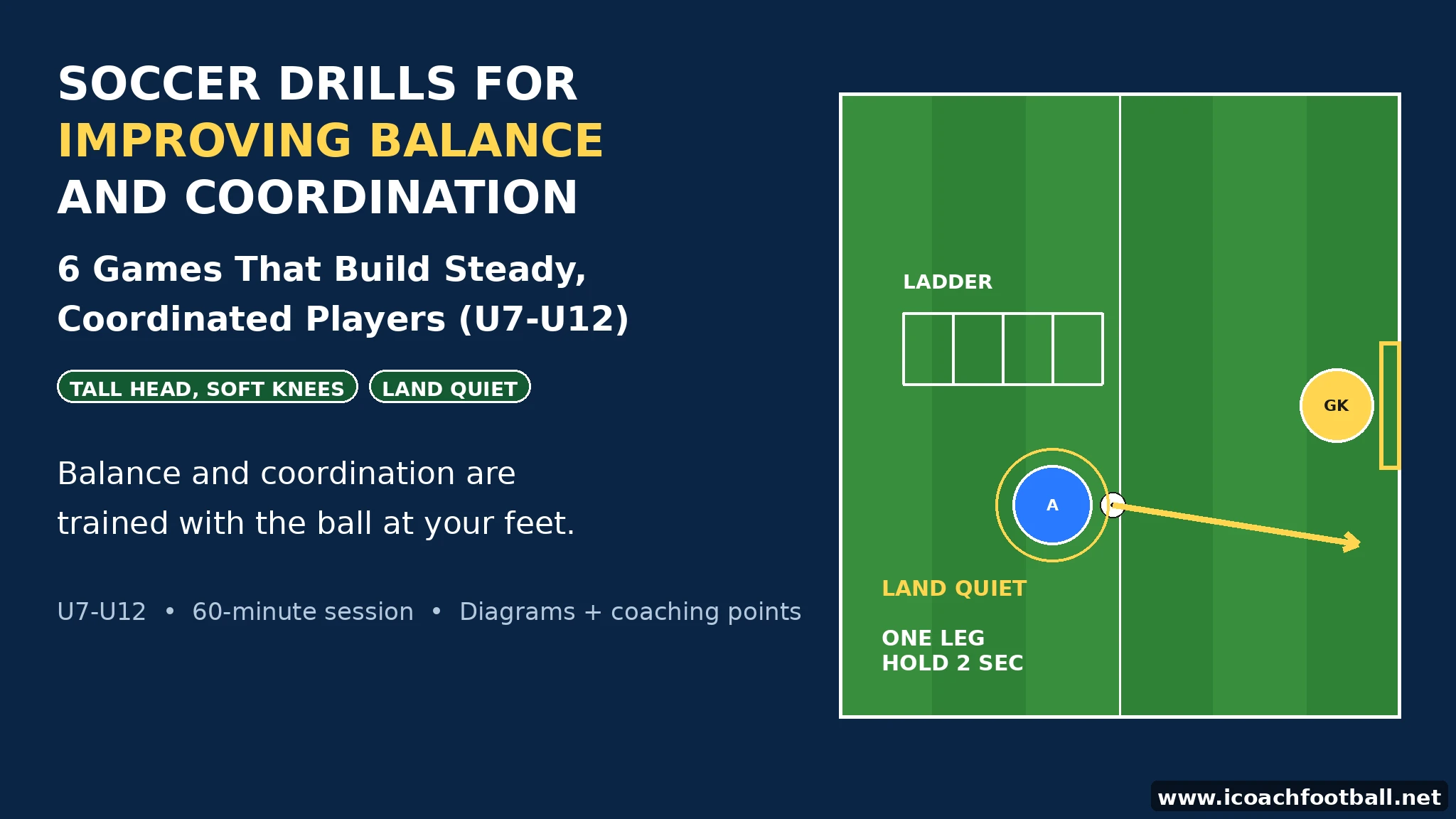
Balance is staying upright and in control of your body. Coordination is moving two or more body parts under control, smoothly and in the right order. These soccer drills for improving balance and coordination train both at once — with the ball at the player’s feet, never as dry gym work. Six games — one 60-minute session — teach players to receive on one leg, land quietly after a jump, turn without wobbling, move their feet in a set pattern and then play the ball, and stop before they shoot.
Suitable for: U7–U12 (ages 6–12)
Session snapshot
- Players: 12–16 (U7–U12)
- Area: 20 x 15-yard area expanding to a 30 x 20-yard game pitch
- Duration: 60 minutes
- Focus: Single-leg balance, quiet landings, coordinated turns with the ball
- Equipment: 12–14 balls, 20 cones, 1 coordination ladder, 2 mini goals, bibs
Safety first: All six games are done on firm ground. No balance boards, no wobble cushions, no unstable surfaces — especially for U7–U8. Jumps are low, landings are soft, and any player who feels pain stops straight away.
Why these six games work
Watch a youth game for five minutes and you will see it. A player receives the ball, takes a heavy touch, and falls over their own feet. The touch was never the problem. The balance underneath it was.
Balance and coordination are the foundation under every soccer skill. England Football Learning calls agility, balance and coordination the ABCs — the fundamental movement skills that are the basis for all other movement skills — and says players aged 5 to 11 should focus on exactly those ABCs, built through game-like activities and competitions. The framing of this post and Drills 1, 2 and 4 are based on / in line with that material. Coaches in the UK call these football balance and coordination drills — the games are identical.
The research backs the same order of work. A 2022 systematic review and meta-analysis of 16 studies with 3,121 children found soccer practice had a strong positive effect on object control and on the closed-eye single-leg balance test, with bigger gains when total practice time passed 1,800 minutes. Drills 1, 2 and 6 below are based on / in line with that review: single-leg holds, landings and ball control trained together, repeated week after week.
This post fills the gap in our movement cluster: our SAQ manual trains speed, agility and quickness, and our dribbling drills train the ball at the feet. This session adds the missing piece — the balance and coordination underneath both.
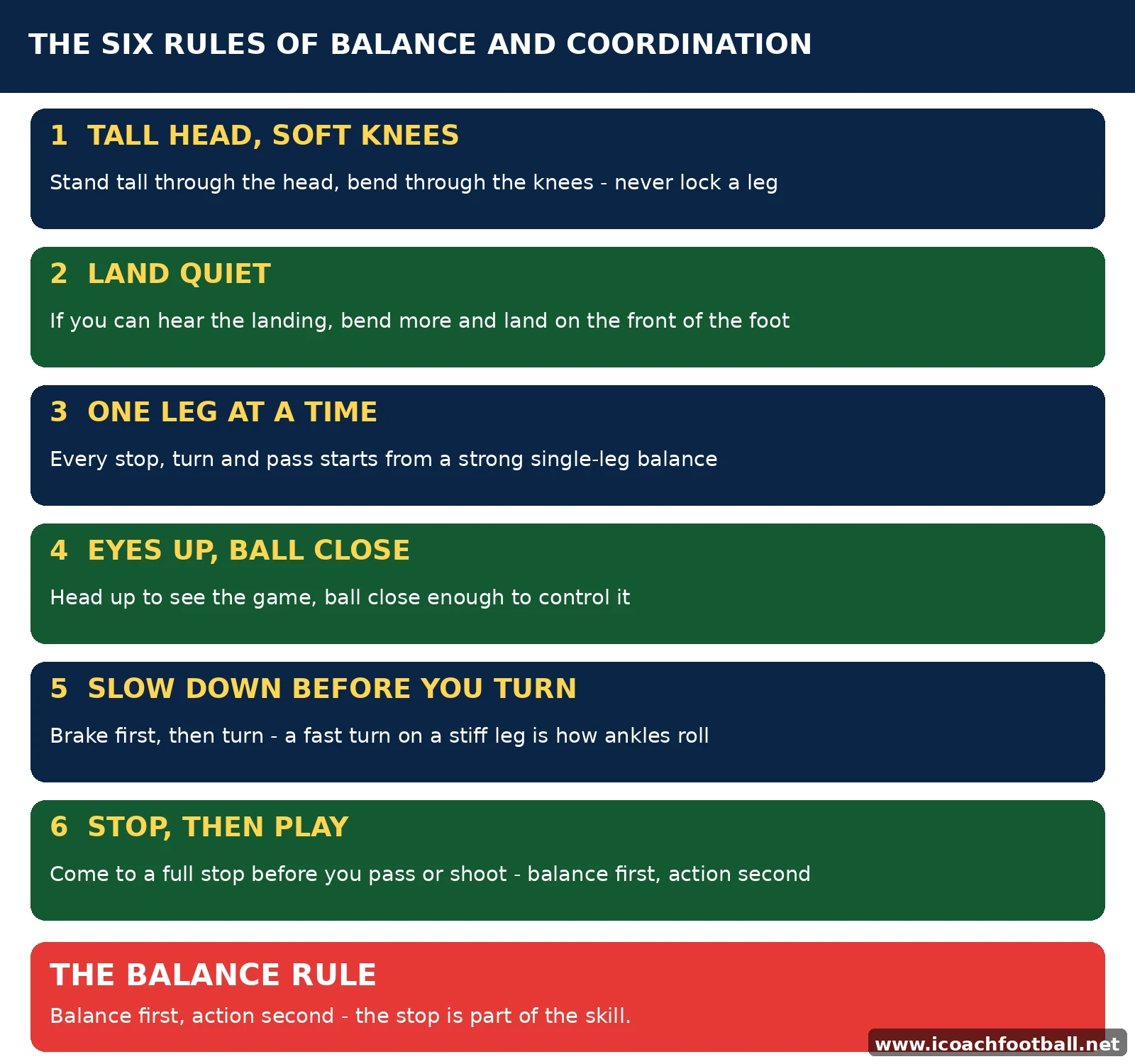
Six rules of balance and coordination
- Tall head, soft knees. Stand tall through the head, bend through the knees — never lock a leg.
- Land quiet. If you can hear the landing, bend more and land on the front of the foot.
- One leg at a time. Every stop, turn and pass starts from a strong single-leg balance.
- Eyes up, ball close. Head up to see the game, ball close enough to control it.
- Slow down before you turn. Brake first, then turn — a fast turn on a stiff leg is how ankles roll.
- Stop, then play. Come to a full stop before you pass or shoot — balance first, action second.
Drill 1 — One-Leg Pass
The starting point. Two players pass to each other, and every receive must be taken standing on one leg and held for 2 seconds before the pass goes back.
Setup
- Pairs 6 yards apart, one ball per pair, in a 20 x 15-yard area.
- 12 players: 6 pairs. 8 minutes.
How to Play
- Player A passes to Player B, on the ground, at a comfortable pace.
- Player B receives the ball standing on one leg — the other foot off the ground.
- Player B holds the balance for 2 seconds, ball under control, head up.
- Player B passes the ball back, still balanced, and resets to two feet.
- After 4 passes, both players swap to the other standing leg.
- After 4 minutes, the pairs move 2 yards further apart and repeat.
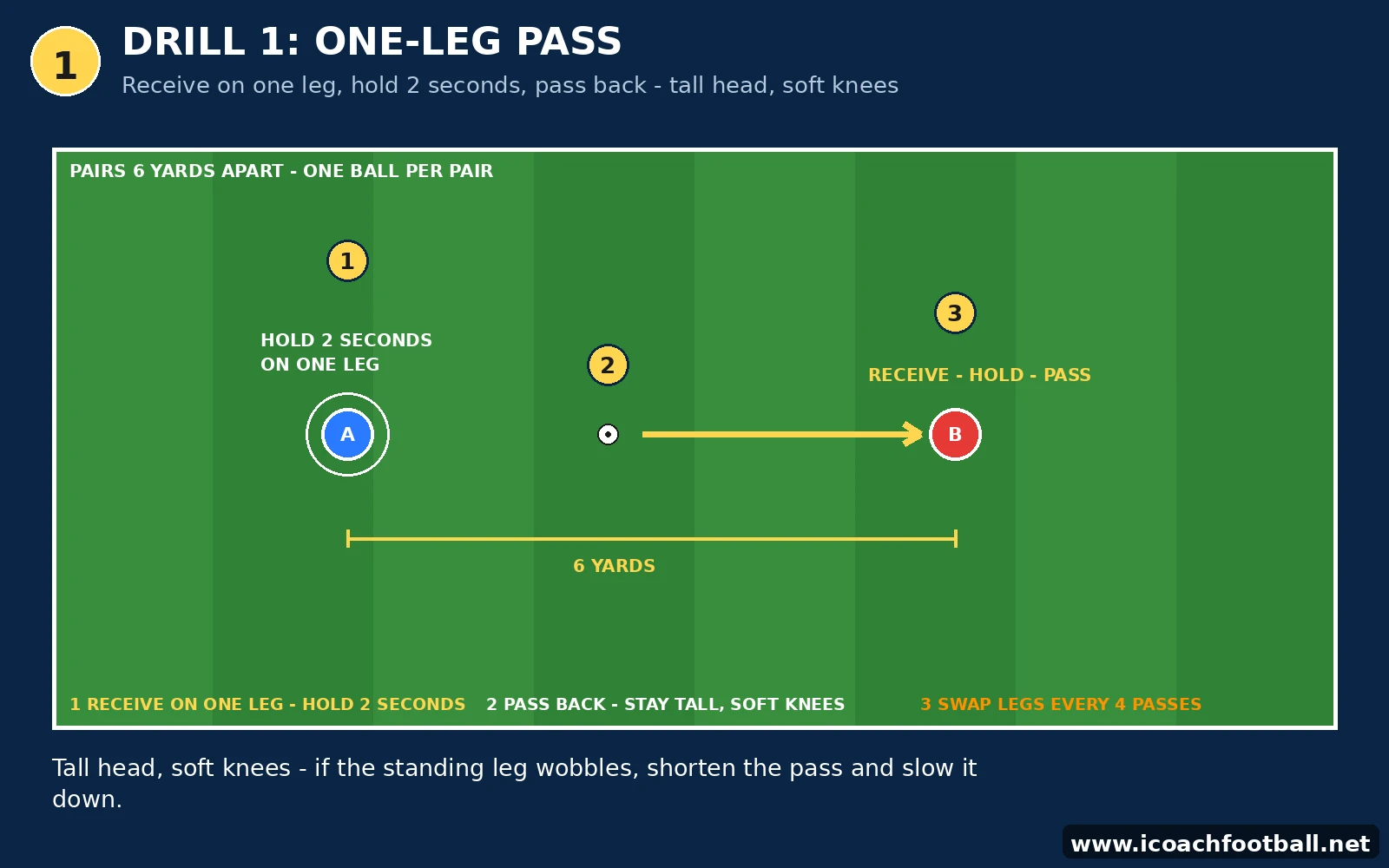
Coach’s note: “Tall head, soft knees — if the standing leg wobbles, shorten the pass and slow it down.”
Progressions: The receiver must hold for 3 seconds; the passer plays the ball slightly to the receiver’s weak side, so the hold starts from a stretch; the receiver must call out a colour the coach holds up before passing back.
Drill 2 — Land and Turn
The landing. A player jumps a low hurdle, lands quietly on one leg, holds for 2 seconds, then turns through a gate and passes back to a server.
Setup
- 18-yard lane: start line, low hurdle 5 yards in, landing spot 3 yards past the hurdle, turn gate 5 yards past the landing spot, server 5 yards beyond the gate.
- 12 players: 6 jumpers, 6 servers, in pairs. 8 minutes.
How to Play
- The player starts two feet behind the start line, facing the hurdle.
- On the coach’s call, the player jumps the hurdle with two feet.
- The player lands on one leg, quiet, knees bent — and holds for 2 seconds.
- The player turns through the gate, head up, ball-side foot ready.
- The server passes the ball in as the player comes through the gate.
- The player receives on the front foot and passes back first time, then jogs to the back of the line.
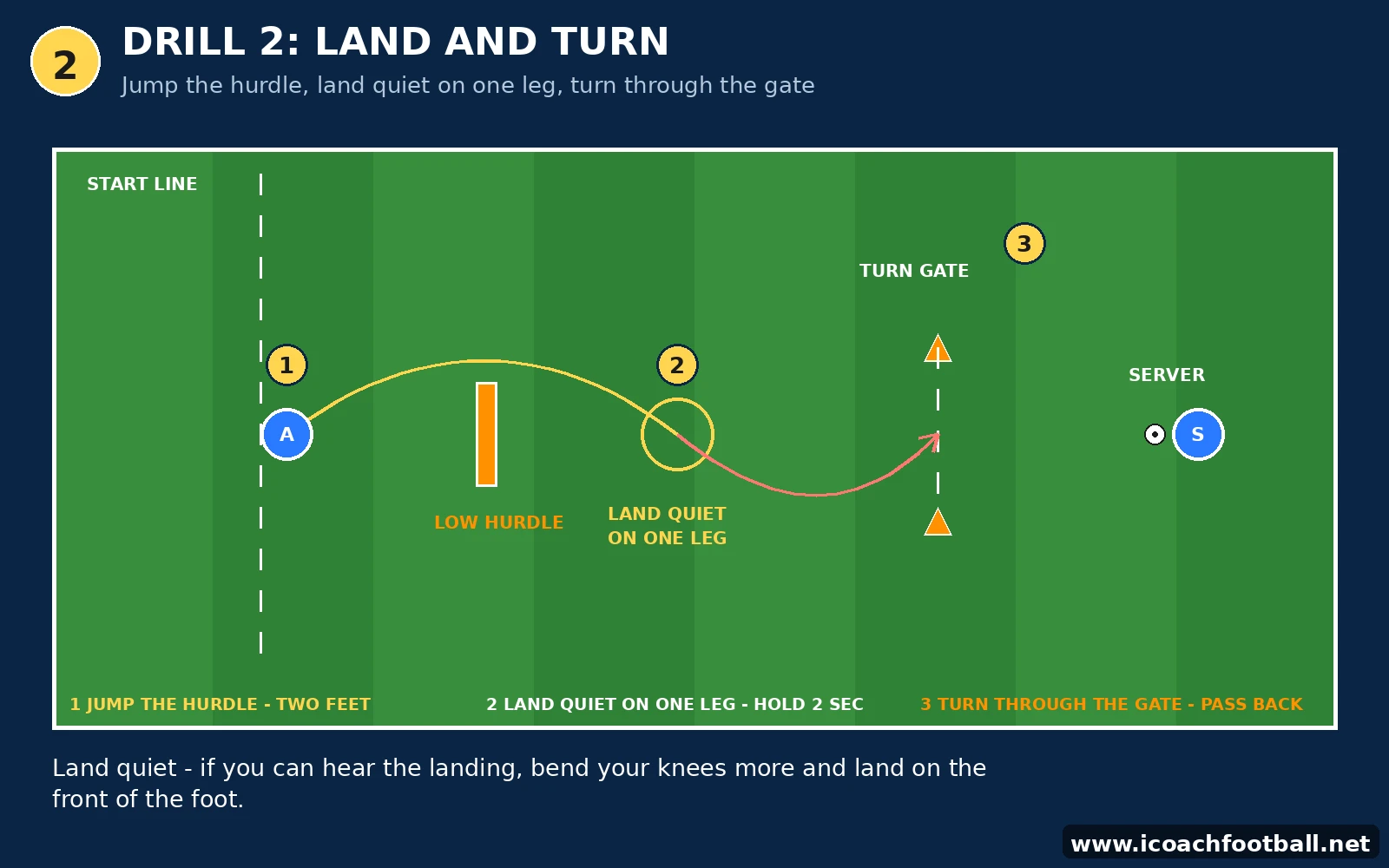
Coach’s note: “Land quiet! If I can hear you land, bend your knees more and land on the front of the foot.”
Progressions: The hurdle goes up one notch for U11–U12 only; the server passes to the player’s weak side; the player must turn the other way through the gate on the coach’s call.
Drill 3 — Ladder to Ball
The feet. Quick feet through a coordination ladder — in, in, out, out — then the player exits, receives a pass, and passes it straight back first time.
Setup
- One coordination ladder (6 rungs, about 5 yards long) with a server 5 yards past the end of the ladder.
- 12 players: 6 runners, 6 servers, in pairs. 8 minutes.
How to Play
- The player starts at the end of the ladder, facing down its length.
- The player runs the ladder — in, in, out, out — two feet in each square, then two feet out.
- The player keeps their head up and their steps short and quick.
- As the player exits the ladder, the server passes the ball in.
- The player receives the pass on the front foot, balanced.
- The player passes the ball back first time, then jogs round to the back of the line.
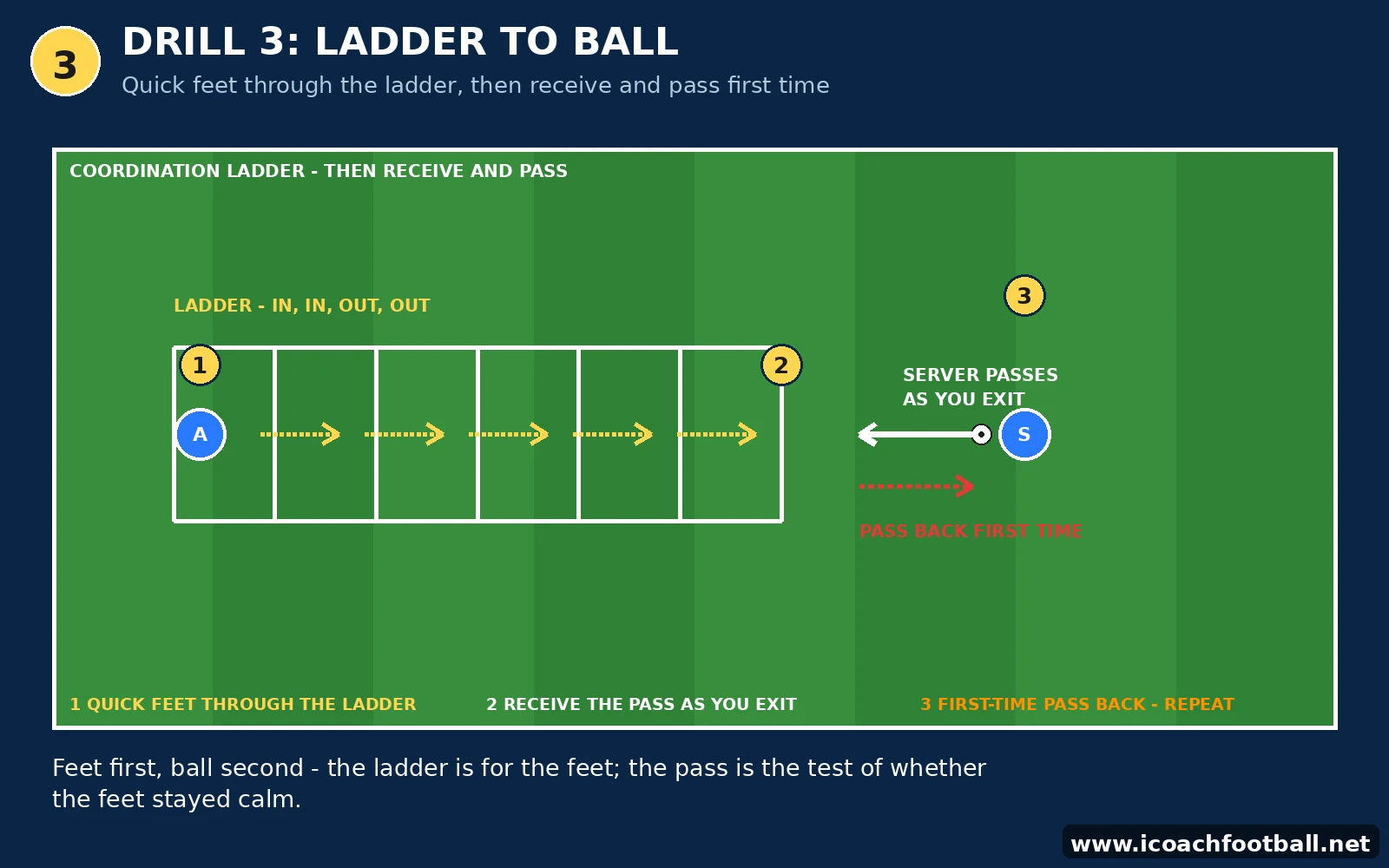
Coach’s note: “Feet first, ball second — the ladder is for the feet; the pass is the test of whether the feet stayed calm.”
Progressions: The pattern changes to one foot in each square, then to a sideways shuffle through the ladder; the server passes to the player’s weak foot; the player must take a touch to the side before passing back.
Drill 4 — Mirror Moves
The copy. Two partners face each other in a square. The leader turns or feints with the ball, and the follower must mirror the move — same foot, same turn, same timing.
Setup
- 6 x 6-yard square per pair, one ball per pair, in a 20 x 15-yard area.
- 12 players: 6 pairs. 8 minutes.
How to Play
- The leader stands with the ball, the follower stands 3 yards away, facing them.
- The leader turns with the ball — a drag-back, a hook turn, or a feint — and holds the finish for 2 seconds.
- The follower copies the move exactly, with their own ball, on the same foot.
- The follower must finish balanced, on one leg, head up.
- The leader does 4 moves in a row, then the pair swaps leader.
- After 4 minutes, the square shrinks to 4 x 4 yards and the moves get faster.
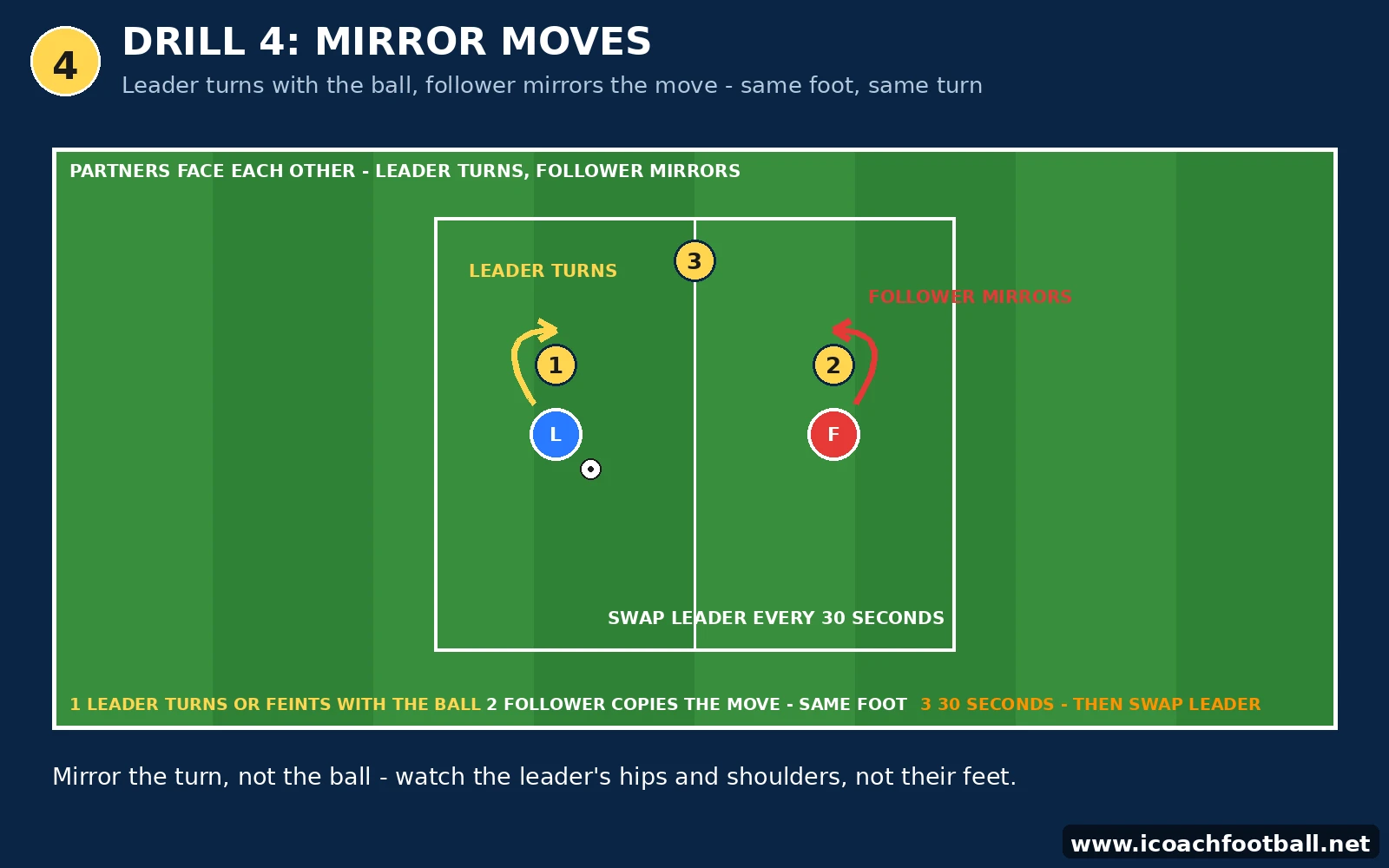
Coach’s note: “Mirror the turn, not the ball — watch the leader’s hips and shoulders, not their feet.”
Progressions: The leader may combine two moves in a row; the follower must call out the move before copying it; the leader finishes with a pass to the follower, who must control it on one leg.
Drill 5 — Hopscotch Dribble
The course. A player hops a hopscotch of squares — one foot, two feet — turns at a cone, then dribbles and finishes in a mini goal. The cone work here builds on our cone drills for coordination and dribbling.
Setup
- 15-yard course: 5 hopscotch squares, a turn cone 5 yards past the squares, a mini goal 8 yards past the cone.
- 12 players: 6 runners, 6 waiting, in two lines. 8 minutes.
How to Play
- The player hops the squares — one foot in the single squares, two feet in the double square.
- Every landing is quiet, knees bent, on the front of the foot.
- The player turns at the cone — slow down first, then turn.
- The player dribbles to the mini goal, ball close, head up.
- The player finishes in the mini goal and jogs back to the line.
- The next player starts as soon as the player ahead clears the turn cone.
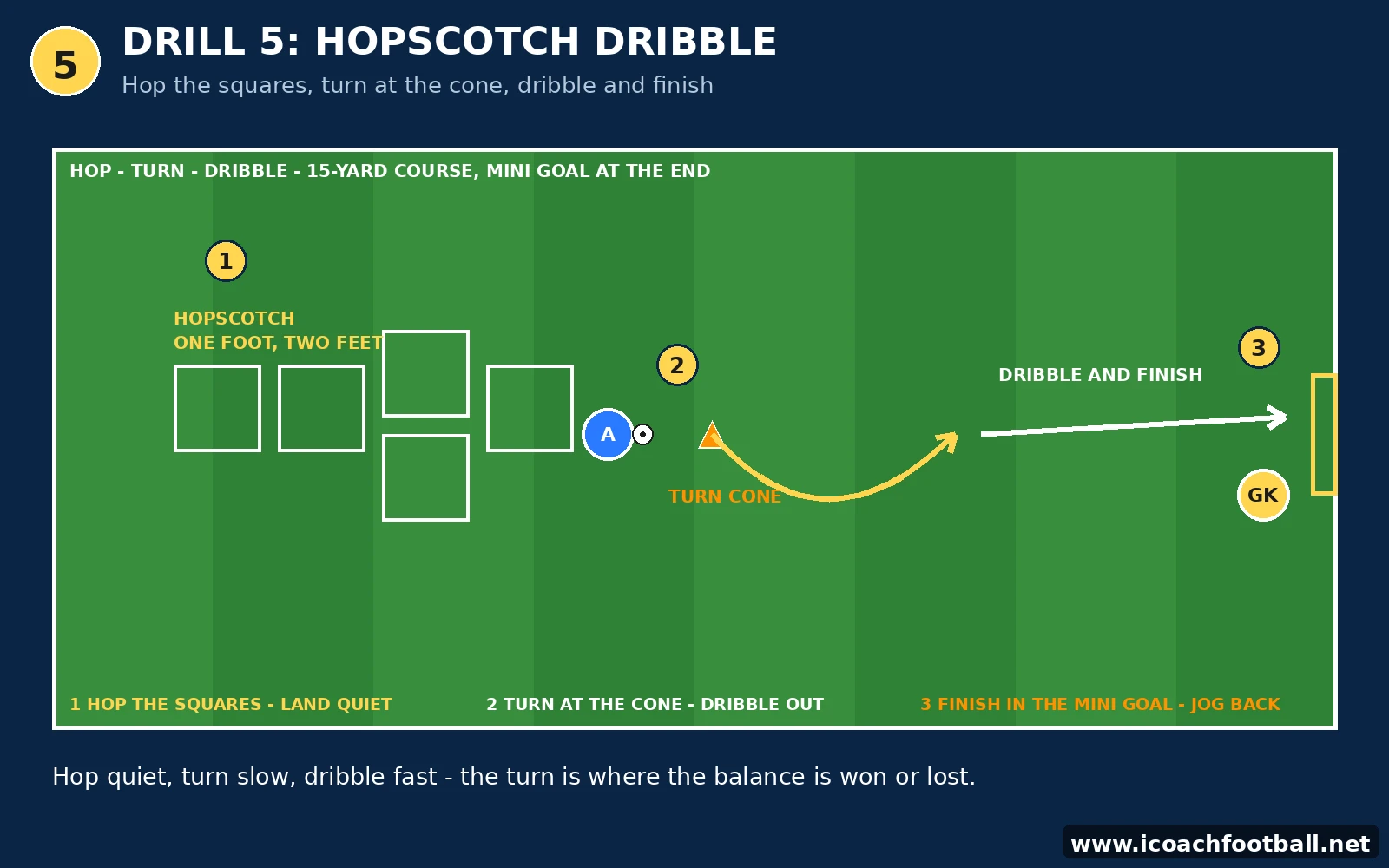
Coach’s note: “Hop quiet, turn slow, dribble fast — the turn is where the balance is won or lost.”
Progressions: The squares get smaller for U11–U12; the player must finish with their weak foot; a defender stands at the turn cone and the player must turn away from them.
Drill 6 — Balance and Coordination Game
The test. A conditioned 4v4 where a goal only counts if the scorer stopped on one leg for 2 seconds inside the balance-check zone before shooting.
Setup
- 30 x 20-yard pitch, 2 mini goals, bibs, a marked balance-check zone in front of each goal.
- 12 players: 4v4 plus 2 goalkeepers and 2 rotating substitutes. 15 minutes.
How to Play
- The game starts with a pass-in from the coach — no kick-offs, no corners.
- Normal 4v4 rules apply — the ball is live everywhere on the pitch.
- Before shooting, the shooter must stop on one leg for 2 seconds inside the balance-check zone.
- A goal scored without the stop does not count — play restarts with the goalkeeper’s ball.
- A clean landing after a jump — two feet, quiet, knees bent — scores the team a bonus point.
- Play 3-minute games, then swap the teams and play again.
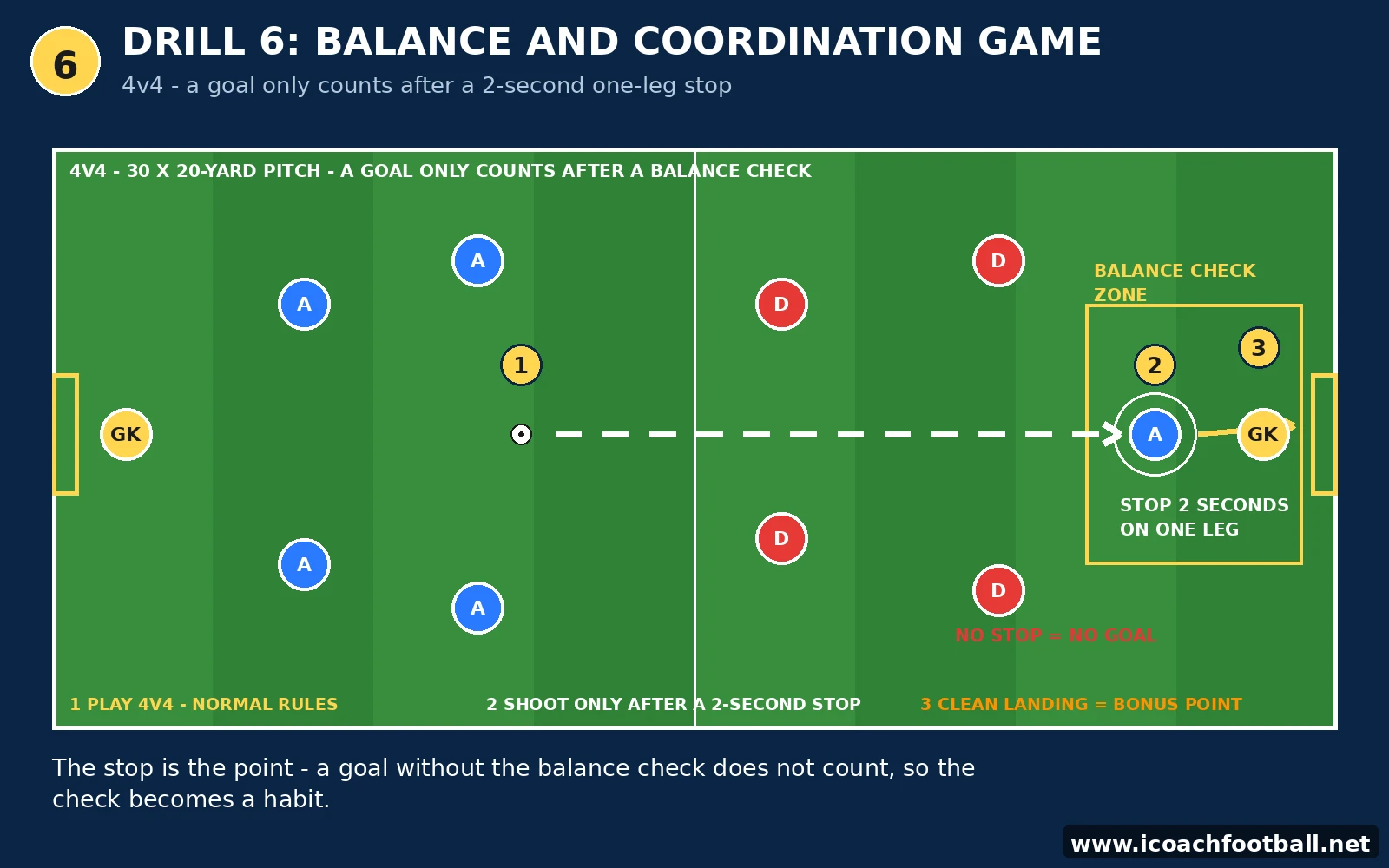
Coach’s note: “The stop is the point — a goal without the balance check does not count, so the check becomes a habit.”
Progressions: The stop must be on the weak leg; the shooter must receive a pass inside the zone before stopping; the bonus point needs a clean landing followed by a first-time finish.
Common mistakes
| Mistake | What you see | Fix |
|---|---|---|
| Landing stiff-legged | The player lands with straight legs and a loud thud, then stumbles | Land on the front of the foot, knees bent — “Land quiet!” |
| Watching the feet | The player’s head drops to watch the ladder or the squares | Eyes up — call out a colour or a number while they move |
| Rushing the turn | The player turns at full speed on a stiff leg and spins out | Slow down before you turn — brake first, then turn |
| Arms pinned to the sides | The player holds their arms tight and wobbles on every stop | Arms out wide for balance, like a tightrope walker |
| Hopping too high | The player jumps high over the hurdle and lands hard | Jump low and land soft — height is not the point |
| Skipping the stop in the game | The player shoots straight away in Drill 6 and the goal does not count | Stop first, then play — the stop is part of the skill |
Age adaptations
| Age | Format | What changes |
|---|---|---|
| U7–U8 (ages 6–8) | 10 x 8-yard areas, size 3 ball, mini goals | No hurdle — players jump a flat line on the ground. Holds are 1 second, not 2. The ladder is walked, not run. Every game is a race or a competition, and the coach demonstrates each move first. See our U7 soccer practice plan for the session shape at this age, and our U7 dribbling drills for the next step |
| U9–U10 (ages 8–10) | 15 x 12-yard areas, size 3–4 ball, mini goals | The low hurdle comes in, and holds are a full 2 seconds. The ladder is jogged, and the server passes to the player’s weak side in Drill 3. Drill 4 adds a second move in a row. See our U9 soccer practice plan and our U11 soccer practice plan for the next steps |
| U11–U12 (ages 10–12) | Full areas, size 4 ball | All six rules run together — the hurdle goes up a notch, the gate turn is done at speed, and Drill 3 finishes with a first-time pass. Drill 6 adds the weak-leg stop and the bonus point for a clean landing. See our U12 soccer practice plan for the session shape at this age |
60-minute session plan
| Time | Block | Drill |
|---|---|---|
| 0:00–0:05 | Arrival game | Free 2v2 — a goal only counts if the scorer stopped on one leg first |
| 0:05–0:13 | The hold | Drill 1 — One-Leg Pass |
| 0:13–0:21 | The landing | Drill 2 — Land and Turn |
| 0:21–0:29 | The feet | Drill 3 — Ladder to Ball |
| 0:29–0:37 | The copy | Drill 4 — Mirror Moves |
| 0:37–0:45 | The course | Drill 5 — Hopscotch Dribble |
| 0:45–1:00 | The game | Drill 6 — Balance and Coordination Game |
New to coaching this age? Stretch the arrival game to 8 minutes and cut Drill 6 to 12 minutes and you have the same session with more settling-in time — see our 60-minute plan for the structure (the same shape, shortened where you need it).
Keep building from here
Balance and coordination sit underneath every soccer skill — the touch, the turn and the finish all start from a steady body. The speed and change of direction built on top of this balance are trained in our SAQ manual, and the close control that a steady player keeps is our dribbling drills. The turn a balanced player makes is trained in our turning drills, and the confidence that grows when a player stops falling over is our confidence drills. The pass the receiver plays after a one-leg hold is our passing drills, and the picture a player takes before they move is our scanning drills. The youngest players start with our U7 dribbling drills.
FAQ
What are the best soccer drills for improving balance and coordination?
The best soccer drills for improving balance and coordination train balance and coordination with the ball, not in the gym. Start with One-Leg Pass — receive on one leg and hold for 2 seconds — then add Land and Turn for quiet landings, Ladder to Ball for footwork under control, and a conditioned game where a goal only counts after a one-leg stop. Repeat them weekly; the gains grow with total practice time.
How do you teach balance to a 7-year-old soccer player?
Keep it short, low and fun. Use 1-second holds instead of 2, jump a flat line instead of a hurdle, and walk the ladder instead of running it. Demonstrate every move yourself first, and turn each hold into a game — “who can stand the longest without wobbling?” Never use balance boards or unstable surfaces at this age.
How often should young players train balance and coordination?
Two or three short exposures a week, 5 to 10 minutes inside a normal session, is enough. The systematic review behind this session found bigger gains when total practice time passed 1,800 minutes — steady weekly work over a season, not one big block. Little and often beats one long balance session.
Can balance and coordination be trained with the ball?
Yes — and for soccer players it should be. Every drill in this session trains balance and coordination with the ball at the player’s feet: receiving on one leg, landing and then passing, running a ladder and then receiving. A player who can only balance without a ball has not learned the skill the game actually asks for.
What is the difference between balance and coordination in soccer?
Balance is staying upright and in control of your body — standing on one leg, landing quietly after a jump. Coordination is moving two or more body parts under control, smoothly and in the right order — running a ladder pattern and then playing a pass. Balance is the platform; coordination is what you do on top of it.
Sources
- Mao X, Zhang J, Li Y, Cao Y, Ding M, Li W and Fan L (2022), “The effects of football practice on children’s fundamental movement skills: A systematic review and meta-analysis“, Frontiers in Pediatrics 10:1019150 — a systematic review and meta-analysis of 16 studies with 3,121 children: soccer practice had a strong positive effect on object control and on the closed-eye single-leg balance test, with bigger gains when total practice time passed 1,800 minutes, and children aged 10–13 improved single-leg balance more than children aged 7–9. Verified live 2026-11-18 (HTTP 200, full abstract read). Drills 1, 2 and 6 are based on / in line with this review.
- England Football Learning, “How to develop your players’ movement skills” — agility, balance and coordination (the ABCs) are the fundamental movement skills that form the basis for all other movement skills; players aged 5 to 11 should focus on their ABCs and locomotion through tag, dodge and chase games and ball work, practices on acceleration and deceleration make players more robust, and repetition is essential at any age. Verified live 2026-11-18 (HTTP 200, full text read). The framing of this post and Drills 1, 2 and 4 are based on / in line with this England Football material.