Soccer Drills for Improving Anticipation: 6 Games That Teach Players to Read the Game (U10–U16)
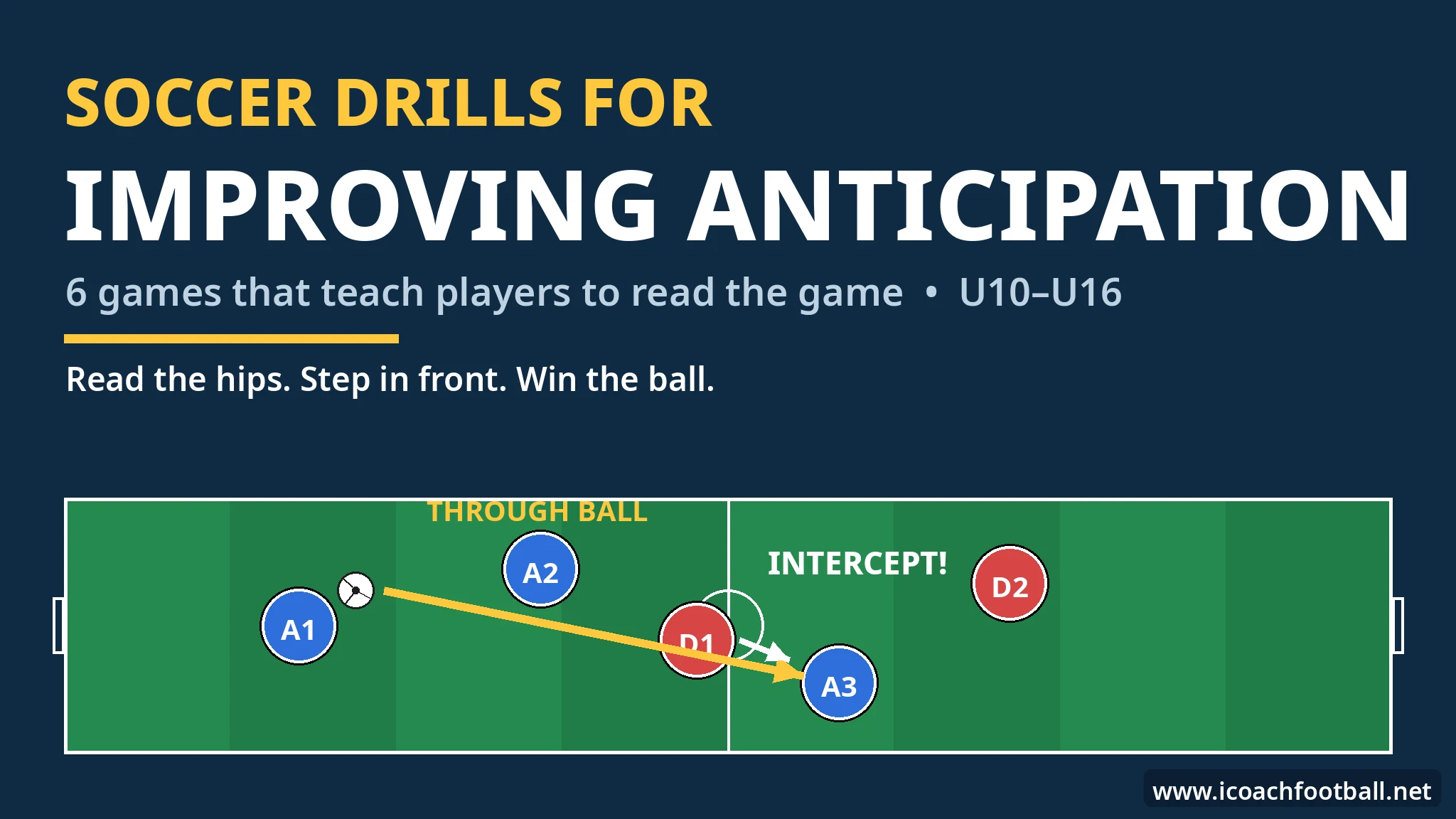
Anticipation is reading the game before it happens — seeing the passer’s hips open, the runner start, the bad touch coming, and moving a second early. It is trained, not born: six games — one 60-minute session — teach players to read body shape, spot press triggers and step in front of the pass, from a pairs mirror game to a conditioned 6v6.
Suitable for: U10–U16 (ages 9–16)
Session Snapshot
- Players: 12–16 (U10–U16)
- Area: 15 x 15-yard square expanding to a 40 x 30-yard game pitch
- Duration: 60 minutes
- Focus: Reading hips and eyes, moving before the pass, press triggers, and stepping in to intercept
- Equipment: 10–12 balls, 20 cones, 4 mini goals, bibs
Why These Six Games Work
The best defenders and midfielders are rarely the fastest. They arrive first because they started first — they read the passer’s hips, the runner’s first step and the ball’s weight, then moved while everyone else was still watching.
Anticipation has a clear input skill: scanning. A player who scans before receiving already knows where the pressure and the space are. These six games build on that picture — they train what to do with it. The research backs the approach: a 2024 systematic review and meta-analysis found perceptual-cognitive training improves anticipation and decision-making in team sports, with the biggest on-field transfer when the training looks like the real game and players must act, not just watch. Drills 2, 3 and 5 below are built on that principle — the player reads a real cue and makes a real movement. FIFA’s Training Centre puts the same idea at the heart of individual defending: in its zonal defending methodology, players must “anticipate the timing of passes and identify opportunities to intercept when opponents receive with their back to goal”. Drills 1, 2 and 4 below are based on / in line with that FIFA material. In the UK the same session is football drills for improving anticipation — the cues, the games and the coaching points are identical.
This post completes the reading-the-game cluster: our soccer decision-making drills train the choice after the read, and our soccer communication drills train the call that turns one player’s read into the whole team’s move.
Six Rules of Anticipation
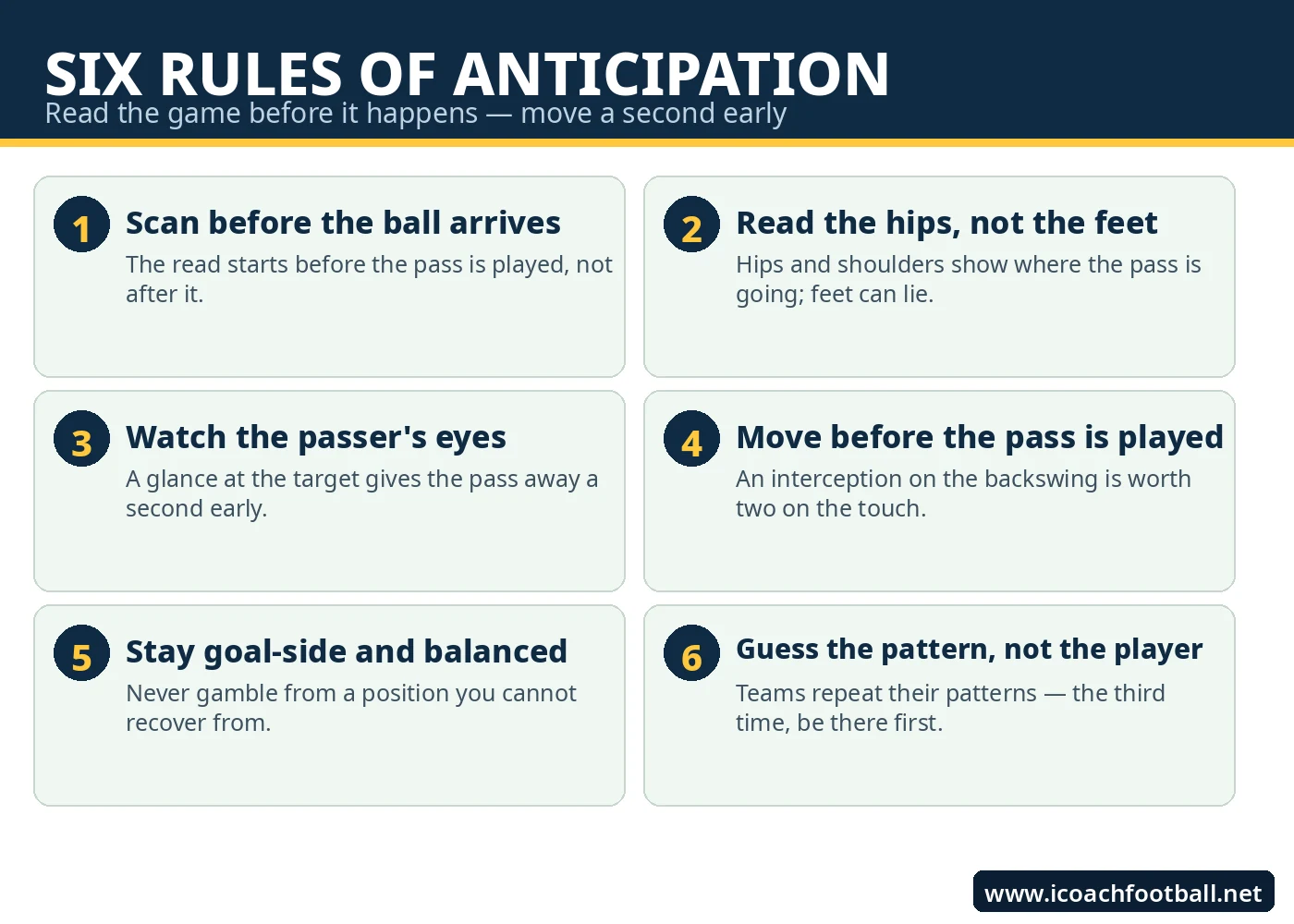
- Scan before the ball arrives. The read starts before the pass is played, not after it.
- Read the hips, not the feet. Hips and shoulders show where the pass is going; feet can lie.
- Watch the passer’s eyes. A glance at the target gives the pass away a second early.
- Move before the pass is played. An interception made on the passer’s backswing is worth two made on the receiver’s touch.
- Stay goal-side and balanced. Never gamble from a position you cannot recover from.
- Guess the pattern, not the player. Teams repeat their patterns — the third time, be there first.
Drill 1 — Read the Hips
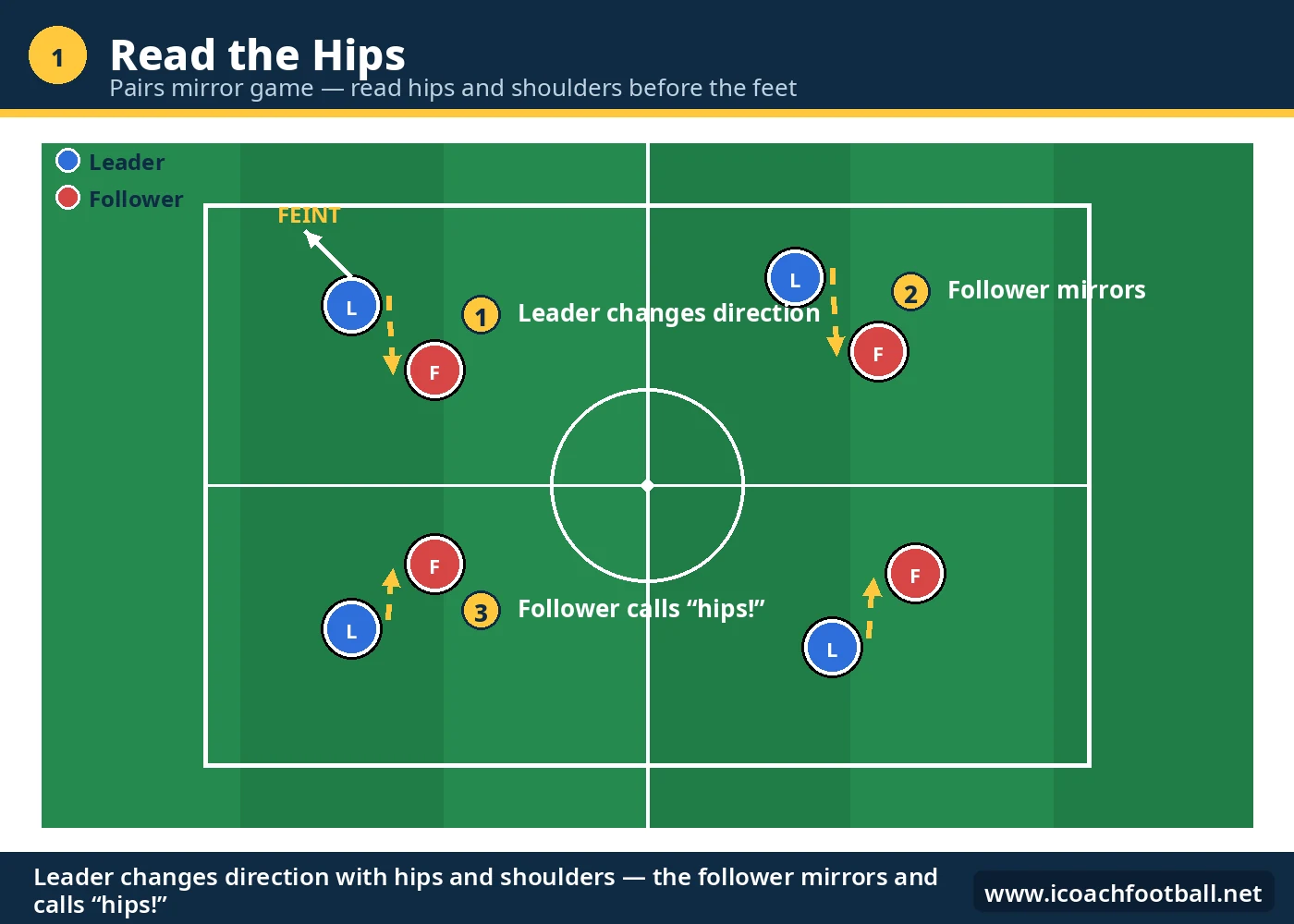
Pairs, face to face. One player leads with their body, the other mirrors — the follower learns that hips and shoulders tell the truth before the feet do.
Setup
- 10 x 10-yard square, cones on each corner.
- 8 players in pairs, 1 ball per pair. 8 minutes.
How to Play
- The leader dribbles slowly inside the square, changing direction with hips and shoulders.
- The follower shadows 2 yards away, mirroring every change of direction.
- The leader tries to lose the follower with a feint — hips one way, feet the other.
- The follower calls “hips!” out loud every time they spot the leader’s hips opening.
- After 1 minute, swap roles so both players lead and follow.
- Finish with a race: the leader dribbles to a corner and the follower must arrive first.
Coach’s note: “Watch the belt buckle, not the ball — the buckle never lies about direction.”
Progressions: The leader adds a pass to a cone target after the feint; the follower must step in and win the ball before the pass; shrink the square to 8 x 8 yards so the reads come faster.
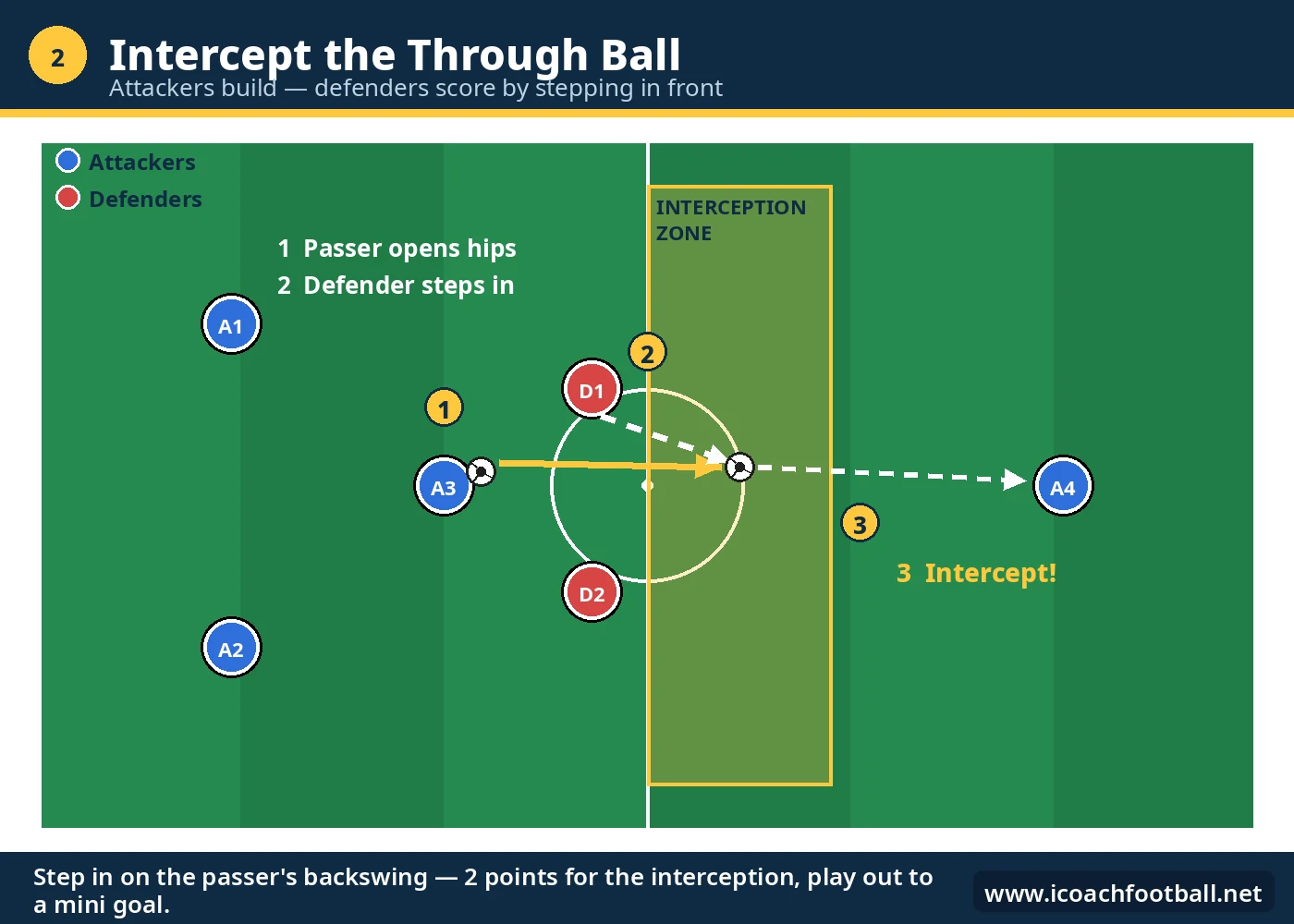
Drill 2 — Intercept the Through Ball
The interception game. Attackers build to play a through ball, defenders score by stepping in front of it — the read that turns defence into attack in one touch.
Setup
- 25 x 20-yard area, 2 mini goals at one end, cones marking a 5-yard interception zone in the middle.
- 10 players: 6 attackers, 4 defenders, 1 ball. 8 minutes.
How to Play
- The attackers keep the ball in their half and look for the through ball into the zone.
- The defenders stay goal-side, 2 yards off their attacker, watching the passer’s hips.
- The moment the passer’s hips open toward the through ball, the nearest defender steps into the lane.
- A defender who intercepts the pass scores 2 points and plays out to a mini goal.
- If the through ball gets through, the attackers score 1 point by finishing into a mini goal.
- After 4 minutes, swap attackers and defenders so everyone defends.
Coach’s note: “Step in on the backswing, not on the touch — if you wait for the receiver’s first touch, you are already beaten.”
Progressions: The attackers get a second ball so the through ball can come from either side; the defender must intercept with their first touch and play forward in one movement; the interception zone shrinks to 3 yards, so the timing has to be exact.
Drill 3 — What Happens Next?
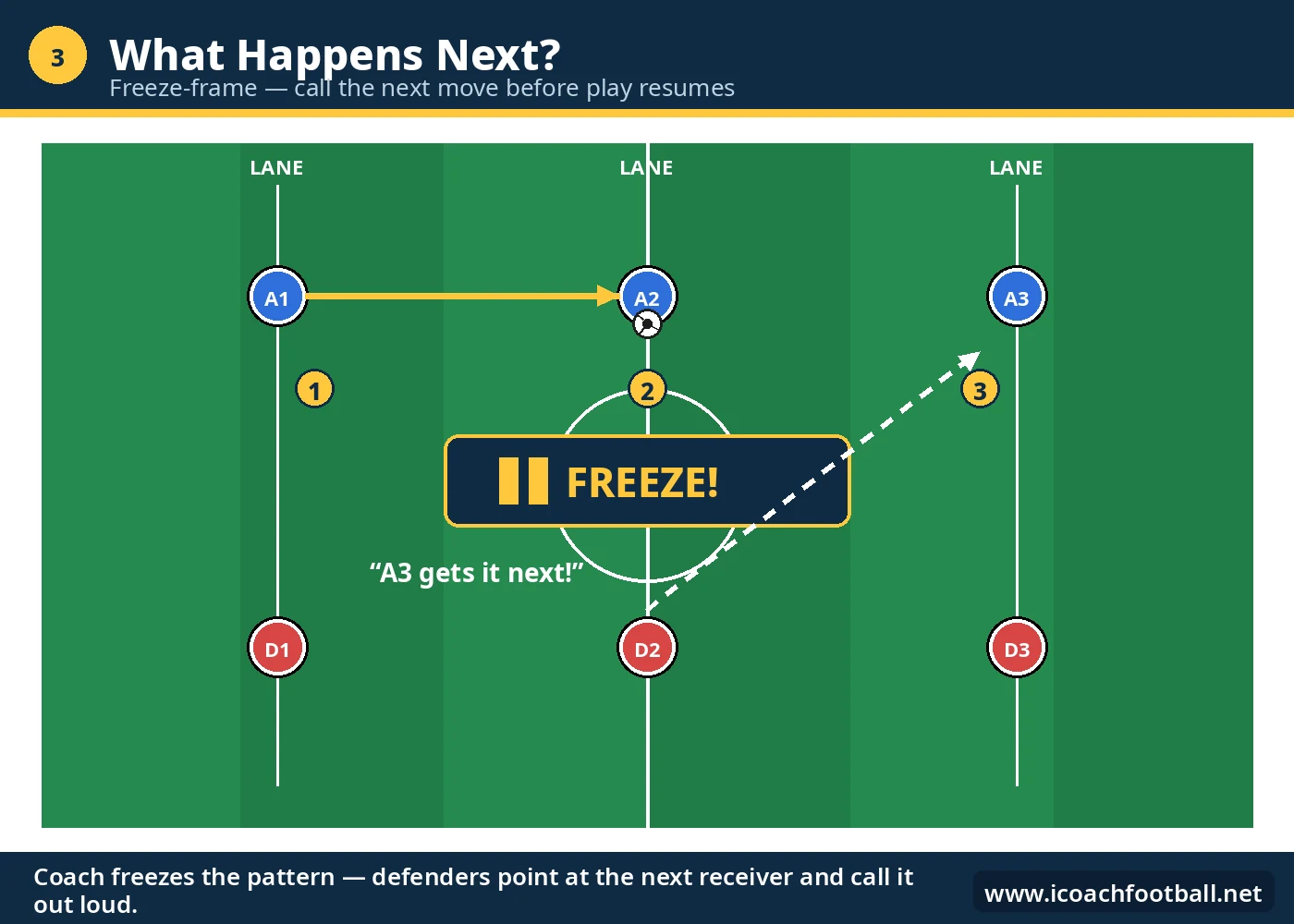
The freeze-frame game. The coach runs a pattern, freezes it mid-play, and the players must call the next move before play resumes — reading the game with the ball stopped.
Setup
- 20 x 15-yard area, cones marking three passing lanes.
- 9 players: 6 attackers, 3 defenders, 1 ball. 8 minutes.
How to Play
- The coach starts a passing pattern between the attackers, moving the ball down the lanes.
- The coach shouts “Freeze!” and every player stops exactly where they are.
- Each defender points at the player they think will receive the next pass.
- The coach asks one defender: “What happens next?” — they answer in one sentence.
- Play resumes, and the defenders get a point if the next pass goes where they predicted.
- After 3 minutes, the coach freezes the pattern from a different lane and the roles swap.
Coach’s note: “If you cannot say what happens next with the ball stopped, you will never see it at full speed.”
Progressions: The freeze lasts 3 seconds, then 1 second, then the coach only claps and play stops for a heartbeat; the attackers add a third-man run the defenders must spot; the defenders must call the next pass before the coach freezes the play.
Drill 4 — Third-Man Run Recognition
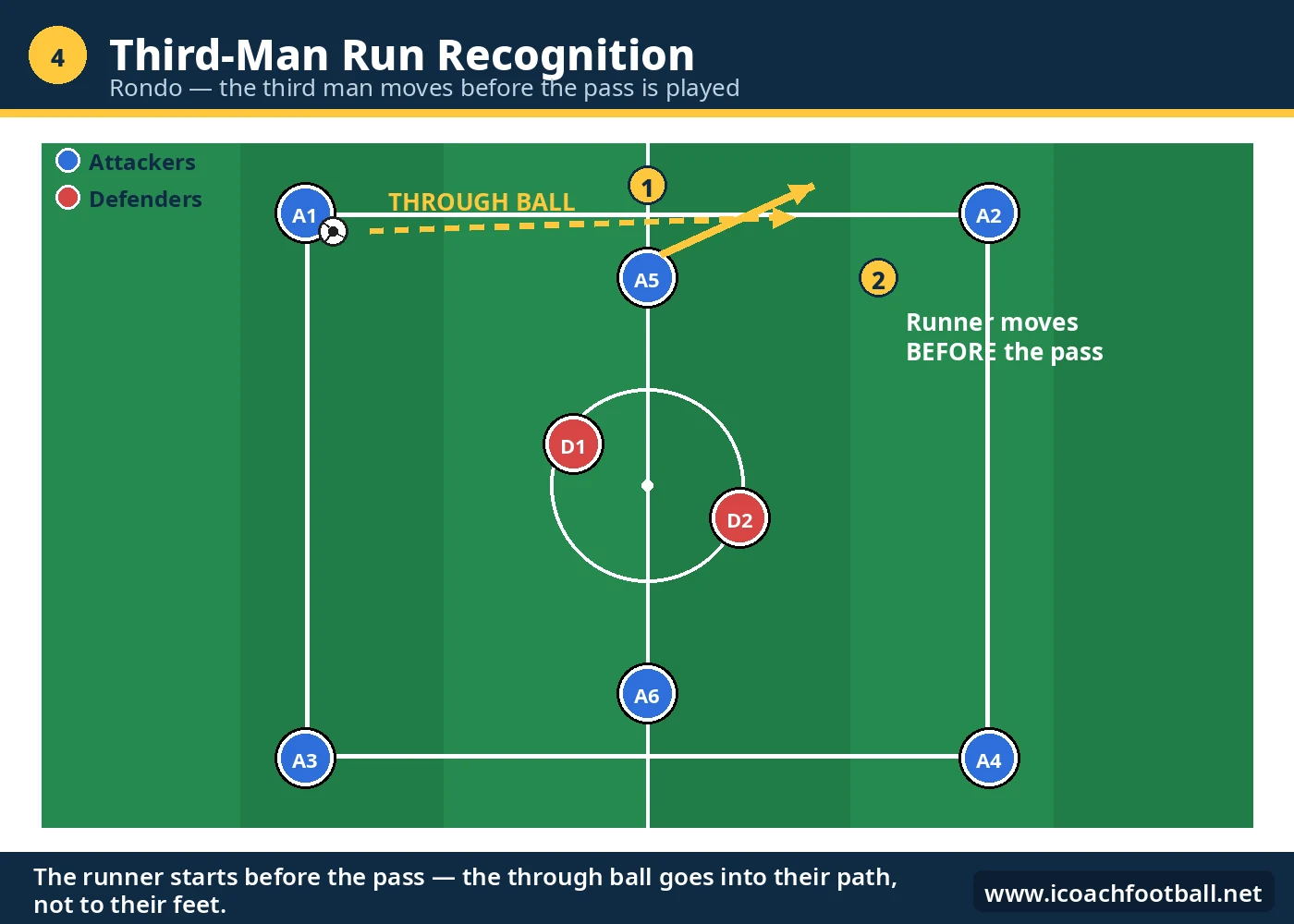
The rondo with a runner. The third man must start their run before the pass is played — the anticipation that turns a safe rondo into a forward pass.
Setup
- 15 x 15-yard square, cones on each corner.
- 8 players: 6 attackers, 2 defenders, 1 ball. 8 minutes.
How to Play
- The attackers keep the ball in the square — two touches maximum.
- The third man watches the passer’s hips and starts their run before the pass is played.
- The passer plays the through ball into the runner’s path, not to their feet.
- The runner takes the ball first time and lays it back to start the pattern again.
- If a defender intercepts, they swap out with the attacker who gave the ball away.
- After 4 minutes, rotate the defenders so everyone defends.
Coach’s note: “The run starts before the pass, not after it — if you wait to see the ball move, the lane is already closed.”
Progressions: The runner must finish first time into a mini goal at the end of the square; a defender presses the passer, so the read has to happen under pressure; the attackers must complete a third-man combination every five passes or lose a point.
Drill 5 — Press Trigger Prediction
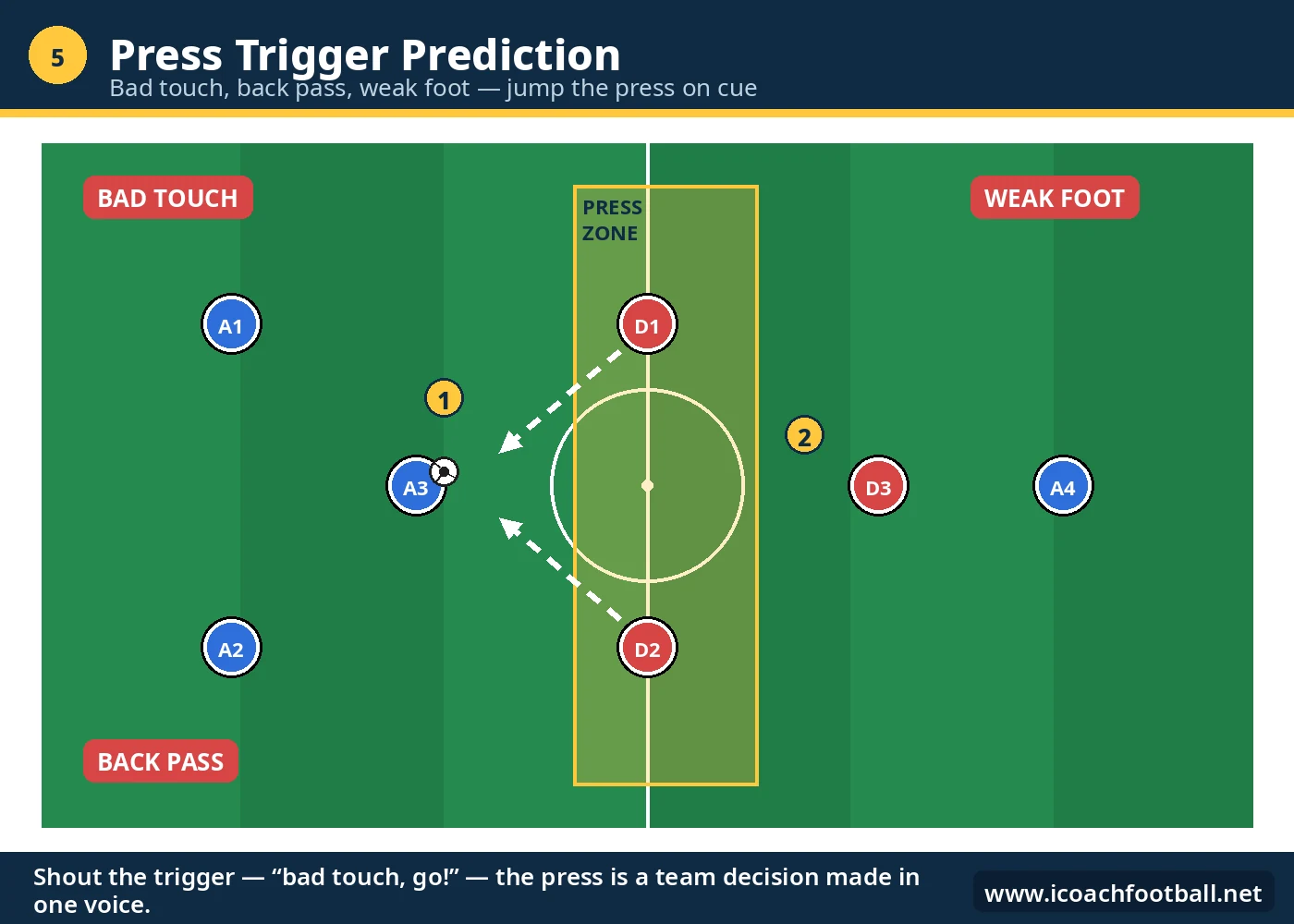
The press on cue. Defenders learn the three triggers that say “jump now” — a bad touch, a back pass, and a weak-foot receive — and hunt the ball the moment they appear.
Setup
- 20 x 15-yard area, cones marking a pressing zone across the middle.
- 10 players: 6 attackers, 4 defenders, 1 ball. 8 minutes.
How to Play
- The attackers keep the ball in their half, passing side to side.
- The defenders hold a compact shape and watch for the three triggers: bad touch, back pass, weak foot.
- The moment a trigger appears, the nearest defender jumps the press and the others follow.
- A defender who wins the ball within 3 seconds of a trigger scores 2 points.
- If the attackers play through the press, they score 1 point by reaching the far end.
- After 4 minutes, swap attackers and defenders so everyone presses.
Coach’s note: “Shout the trigger — ‘bad touch, go!’ — the press is a team decision made in one voice.”
Progressions: The coach calls a trigger word and the defenders must press within 2 seconds; the attackers get one extra player, so the press has to be timed, not just brave; the defenders must win the ball in the pressing zone, not by chasing into the attackers’ half.
Drill 6 — Anticipation 6v6
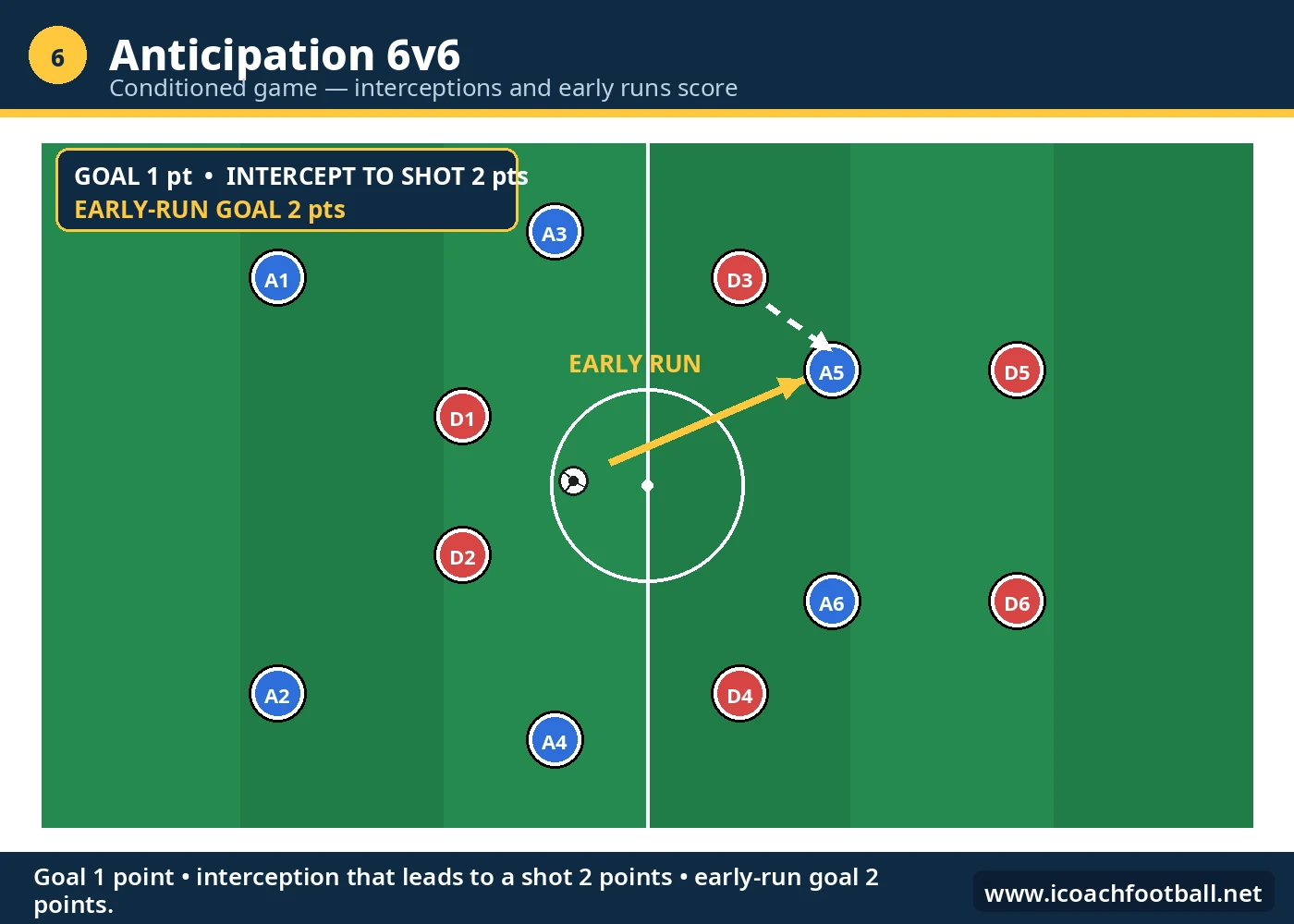
The test. A conditioned 6v6 where interceptions and early runs score — the team that reads the game wins, not the team that runs the most.
Setup
- 40 x 30-yard pitch, 2 mini goals, bibs.
- 12 players: 6v6. 15 minutes.
How to Play
- The game starts with a pass-in from the coach — no kick-offs, no corners.
- A goal counts 1 point, an interception that leads to a shot counts 2 points.
- A run made before the pass that leads to a goal counts double — 2 points for the goal.
- Every player must touch the ball before a goal counts — the team has to use everyone.
- Play 3-minute games, then swap the teams and play again.
- The coach freezes play twice per game and asks one player: “What happens next?”
Coach’s note: “Count the interceptions out loud — the team that hears its own number rise starts hunting the pass instead of chasing the ball.”
Progressions: Goals only count after an interception or a third-man run; the team that concedes a goal from a through ball loses a point; add a neutral player who always plays one touch and must be read, not marked.
Common Mistakes
| Mistake | What you see | Fix |
|---|---|---|
| Watching the ball, not the player | The defender reacts after the pass is already gone | Read the hips and eyes — the pass is given away before the ball moves |
| Guessing every pass | The defender gambles, misses, and leaves space behind | Stay goal-side and balanced — guess the pattern, not the player |
| Stepping in too late | The defender arrives as the receiver takes their first touch | Step in on the passer’s backswing, not on the receiver’s touch |
| Standing flat and square | The defender cannot turn when the play changes direction | Side-on stance, weight on the toes, ready to go either way |
| No call after the read | One player sees the pass coming and nobody else moves | Shout the trigger — “through ball!” — the read belongs to the whole team |
| Chasing the ball | The defender follows the ball and leaves the lane open | Hold your position in the lane — the interception comes to you |
Age Adaptations
| Age | Format | What changes |
|---|---|---|
| U10–U12 (ages 9–12) | 15 x 15-yard squares, size 3–4 ball | The reads are taught one cue at a time — hips first, then eyes. Drill 3 uses a 3-second freeze so players have time to look. Two touches allowed in Drill 4 until the third-man timing is clean. See our U11 soccer practice plan for the session shape at this age, and our U12 soccer practice plan for the next step |
| U13–U14 (ages 13–14) | 20 x 15-yard areas, size 4 ball | All six cues run together, and the freeze in Drill 3 drops to 1 second. The press triggers in Drill 5 are called by the players, not the coach. See soccer drills for U13 and soccer drills for U14 |
| U15–U16 (ages 14–16) | Full areas, size 5 ball | The interception zone in Drill 2 shrinks to 3 yards and the press in Drill 5 must win the ball within 3 seconds. Drill 6 adds the double-points rule for runs made before the pass. See soccer drills for U15 and soccer drills for U16 |
60-Minute Session Plan
| Time | Block | Drill |
|---|---|---|
| 0:00–0:05 | Arrival game | Free 3v3 — every interception scores a point, goals count double after an interception |
| 0:05–0:13 | Read the body | Drill 1 — Read the Hips |
| 0:13–0:21 | Step in front | Drill 2 — Intercept the Through Ball |
| 0:21–0:29 | Freeze and call it | Drill 3 — What Happens Next? |
| 0:29–0:37 | Run before the pass | Drill 4 — Third-Man Run Recognition |
| 0:37–0:45 | Press on cue | Drill 5 — Press Trigger Prediction |
| 0:45–1:00 | The game | Drill 6 — Anticipation 6v6 |
New to coaching this age? Stretch the arrival game to 8 minutes and cut Drill 6 to 12 minutes and you have the same session with more settling-in time — see our 60-minute plan for the structure (the same shape, shortened where you need it).
Keep Building from Here
Anticipation sits between scanning and decision-making — the scan gathers the picture, anticipation reads what happens next, and our soccer decision-making drills train the choice that follows. The interception in Drill 2 is the same skill as our 1v1 defending drills, and the press in Drill 5 is the same hunt as our counter-pressing drills — win it back in six seconds, starting from a trigger. The third-man run in Drill 4 is trained in detail in our soccer third-man runs drills, and the through ball it finishes is the same pass as our soccer drills for improving passing under pressure. The movement before the pass in Drills 4 and 6 is our soccer drills for improving off the ball movement, and the turn a player needs when the read says “no pass on” is trained in our soccer drills for improving turning. The moment the ball is
won, the team must switch — our football defensive transition drills train exactly that. The calls that turn one player’s read into the team’s move are our soccer communication drills, and the confidence to step in and risk the interception is built in our soccer drills for improving confidence. The tackling technique that finishes the interception is our soccer tackling drills, the passing that feeds the through ball is our soccer passing drills, and the possession that creates the patterns to read is our soccer possession drills. Warm up with our 10 soccer warm-up drills.
Anticipation makes players early – reaction makes them fast. For the other half of the skill, try our soccer drills for improving reaction time, six cue-based games from a colour call to a rule-change 4v4.
Can anticipation be trained?
Yes. Anticipation is a perceptual skill, not a talent — a 2024 meta-analysis found perceptual-cognitive training improves anticipation and decision-making in team sports. The transfer is strongest when the training looks like the real game: players must read a real cue and make a real movement, which is exactly how Drills 2, 3 and 5 in this session work.
What age should players start anticipation drills?
From U10, one cue at a time — hips first, then eyes. Younger players need a 3-second freeze in Drill 3 so they have time to look, and two touches in Drill 4 until the third-man timing is clean. By U13–U14 all six cues can run together, and by U15–U16 the timing windows shrink and the press must win the ball within 3 seconds.
How is anticipation different from scanning and decision-making?
Scanning gathers the picture, anticipation reads what happens next, and decision-making chooses the action. They sit in a chain: a player scans before receiving, anticipates the passer’s next move, then decides whether to step in, hold, or press. Train them in that order — scanning first, anticipation second, decision last.
How long does it take for players to improve their anticipation?
Expect visible improvement in 4–6 weeks of one session a week. Players start calling the pass before it is played in Drill 3, then the reads show up in games — an interception here, an early run there. The meta-analysis found laboratory gains transfer best when training stays game-like, so keep the drills live and the cues real.
What is the best anticipation drill for defenders?
Intercept the Through Ball — Drill 2 in this session. Defenders stay goal-side, read the passer’s hips, and step into the lane on the backswing. Score 2 points for an interception and play out to a mini goal, so the read turns straight into attack. For forwards, the best drill is Drill 4 — the third-man run, where the runner must move before the pass is played.
Sources
- FIFA Training Centre, “Building the foundations of collective defending” — FIFA Talent Coach Conor Marlin’s four 1v1 practices; the key coaching points include “anticipate the timing of passes and identify opportunities to intercept when opponents receive with their back to goal”, and Exercise 2 scores a defender 2 points for a direct interception from the coach’s first pass. Drills 1, 2 and 4 are based on / in line with this FIFA material.
- Zhu R, Zheng M, Liu S, Guo J, Cao C (2024). “Effects of Perceptual-Cognitive Training on Anticipation and Decision-Making Skills in Team Sports: A Systematic Review and Meta-Analysis”, Behavioral Sciences, 14(10), 919 — 22 studies, 45 effect sizes; perceptual-cognitive training positively influenced elite athletes’ anticipation and decision-making, with on-court transfer (ES = 0.65) lower than laboratory gains (ES = 1.51), and the best transfer when training stimuli and responses match real-game scenarios. Drills 2, 3 and 5 are based on / in line with this evidence: real cues, real movements, game-like scenarios.