Winter Football Training: Session Plans for When the Pitch Is Unplayable
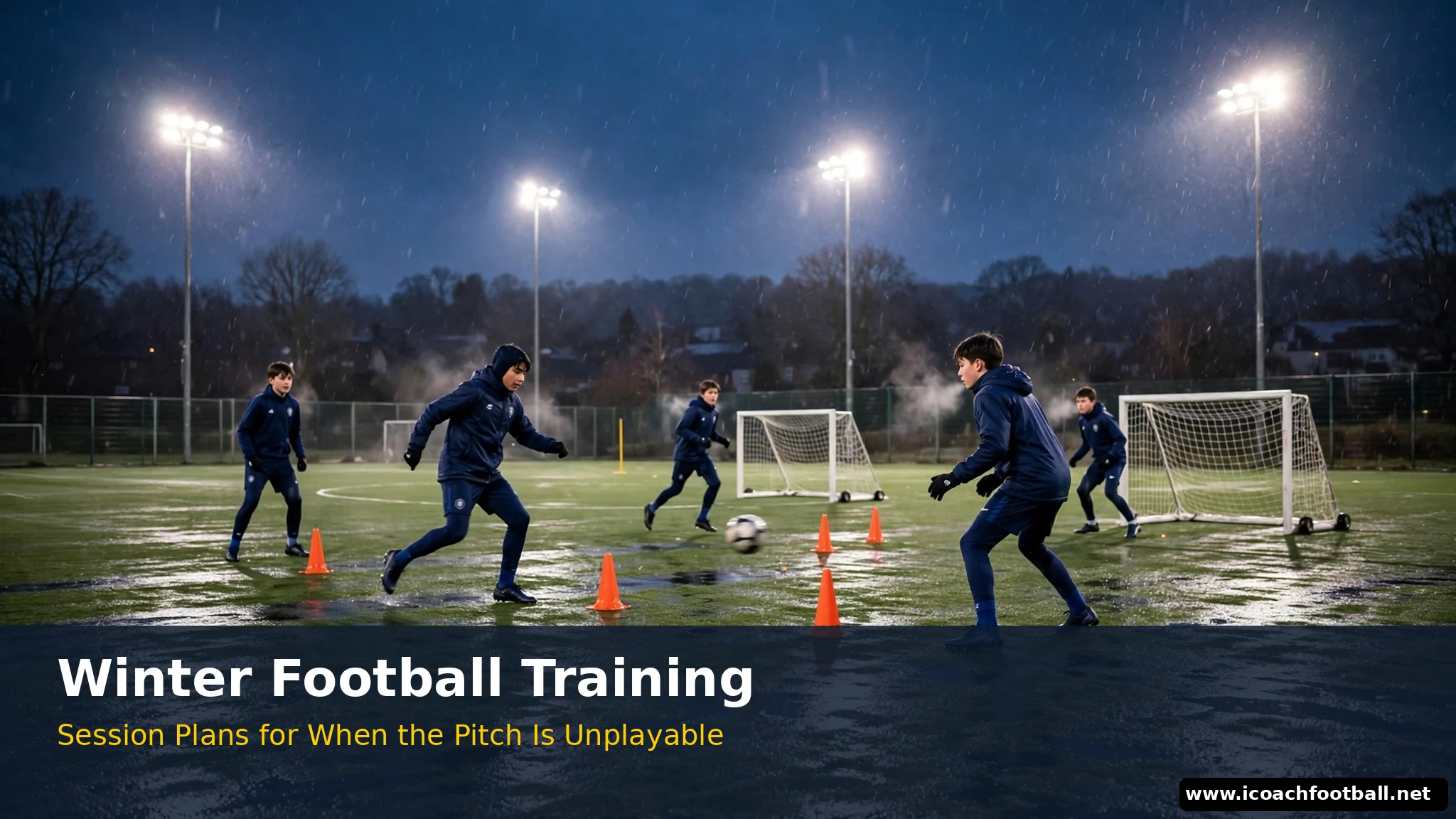
Quick answer: Do not train on a frozen or rutted pitch. Switch to one of three backup plans: a sports-hall session, a third-of-a-pitch session on firm ground, or a futsal session. Keep players moving, keep the ball on the floor, and use the decision table below to pick the plan in two minutes.
A frozen pitch ends the session you planned. A waterlogged pitch ends it more slowly, as the ball stops in puddles and players slip.
The fix is a backup plan you can run without re-planning at the gate. In the US the same backup work is usually called winter soccer training, and the three plans below work in either setting: hall, small space, or futsal court.
- Players: 12–18 (plans scale to 10–22)
- Area: Sports hall, a firm third of a 3G pitch, or a futsal court
- Duration: 60 minutes (hall) or 90 minutes (third of a pitch)
- Focus: First touch, rotation, small-sided games, keeping players warm
- Equipment: Cones, bibs, balls, mini goals or flat cones, one futsal ball if indoors
- Age: U10–U19 (see age adaptations)
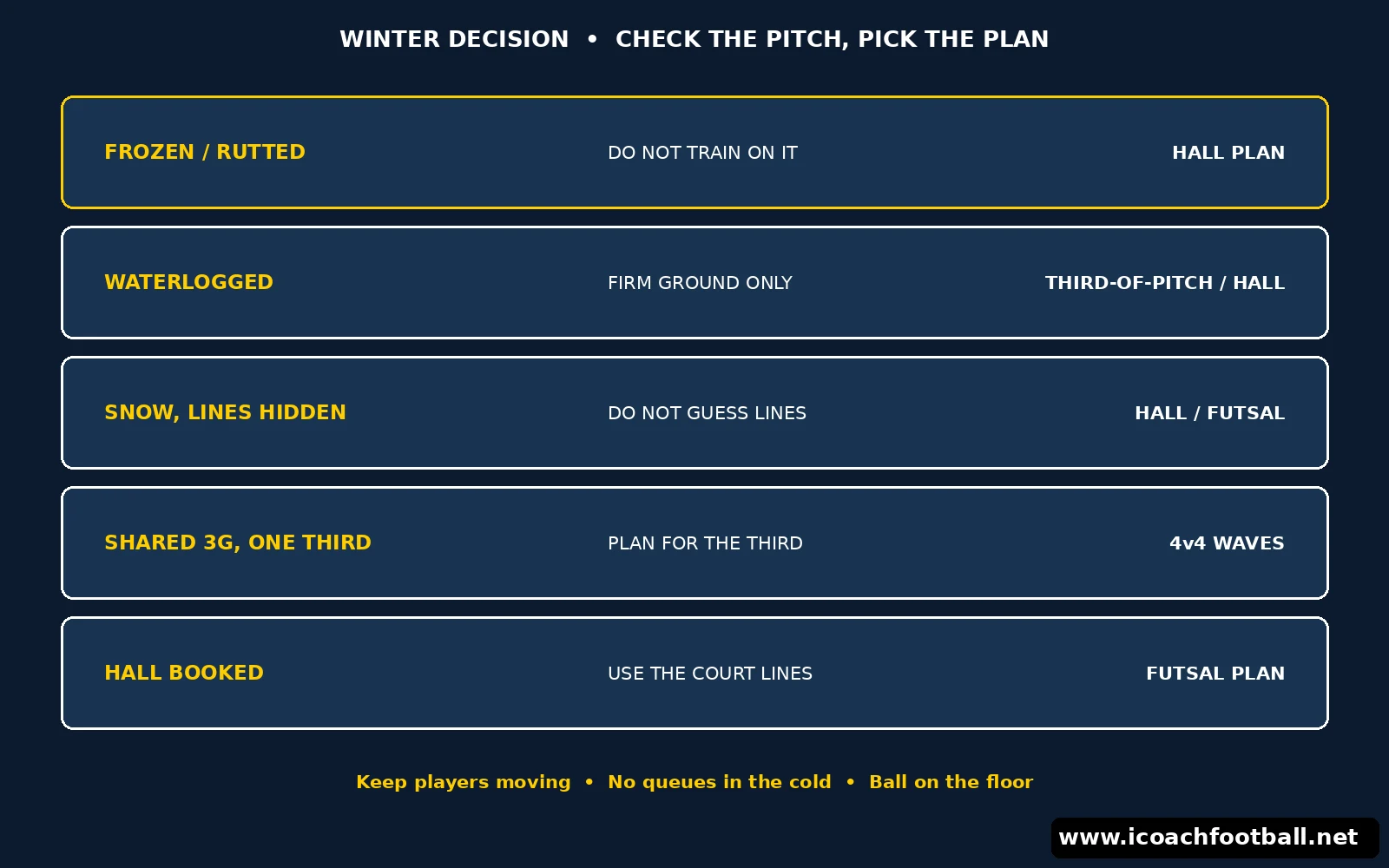
Which backup plan? Decide at the pitch
| Pitch condition | Decision | Plan to run |
|---|---|---|
| Frozen or rutted, hard underfoot | Do not train on it | Hall plan (Drills 1, 2 and 4) |
| Waterlogged, ball stops in puddles | Use firm ground only, or move indoors | Third-of-pitch plan, or hall plan |
| Snow-covered, lines invisible | Do not guess the lines | Hall plan or futsal plan |
| Dark, shared 3G, only a third booked | Plan for the third you have | Third-of-pitch plan (Drill 3) |
| Hall booked, no grass at all | Use the court and its lines | Futsal plan (Drills 1, 2 and 5) |
Winter rules that keep the session safe
- Check first: Walk the goal areas and the middle third before players arrive. Frozen ruts and standing water hide there first.
- Keep players moving: No queues in the cold. Use waves, stations and rolling substitutions so no one stands still.
- Layers and gloves: Players warm up in layers and keep gloves on until the first game. Cold hands drop the ball and cold muscles pull.
- No sliding tackles: Ban them on hard, wet or frozen-adjacent ground. Tackle standing up, or play no-tackle in Drill 4.
- Short sets: Run 2-minute bursts with 30 seconds of coaching between them. Intensity stays high and players stay warm.
Drill 1 — Hall Arrival Rondo
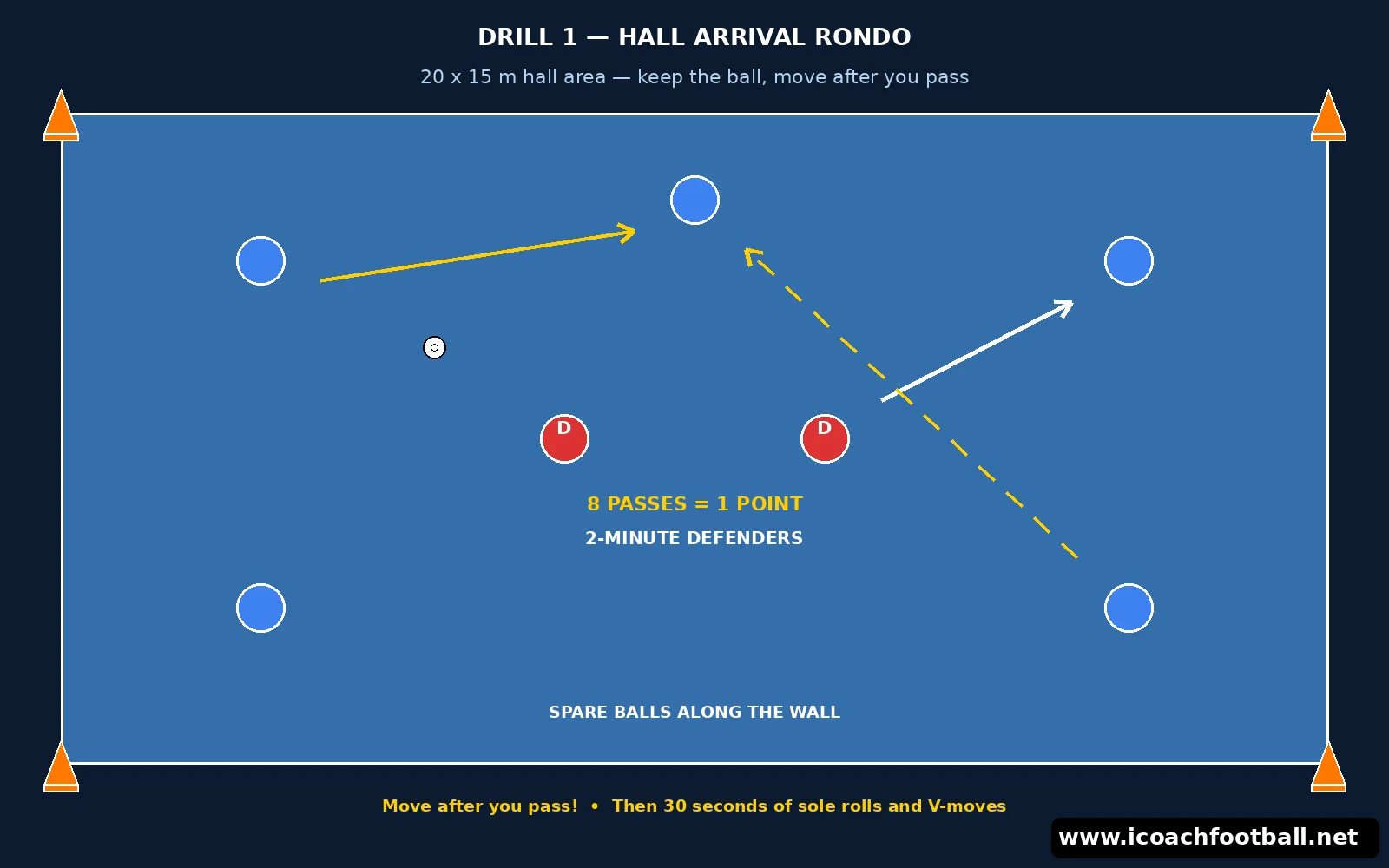
Start the moment players arrive. No waiting, no warm-up lap in the cold.
Setup:
- One 20 x 15 metre hall area, marked with cones.
- Two teams of 5, plus 2 defenders in the middle, one ball.
- Spare balls along the wall, so a ball out restarts at once.
How to Play:
- The team in possession keeps the ball with one- and two-touch passes.
- Defenders press for 2 minutes, then swap with two attackers.
- Award a point for 8 consecutive passes, then change the passing target to 10.
- On the coach’s call, the ball moves to a new square and the rondo restarts at once.
- Finish with 30 seconds of sole rolls and V-moves inside the same area.
Coach’s note: The cue is “Move after you pass!” Players who stand still after a pass let the defenders close the square.
Progressions: Limit touches to one, add a second ball, or shrink the area to 16 x 12 metres.
Drill 2 — Futsal Pivot Game
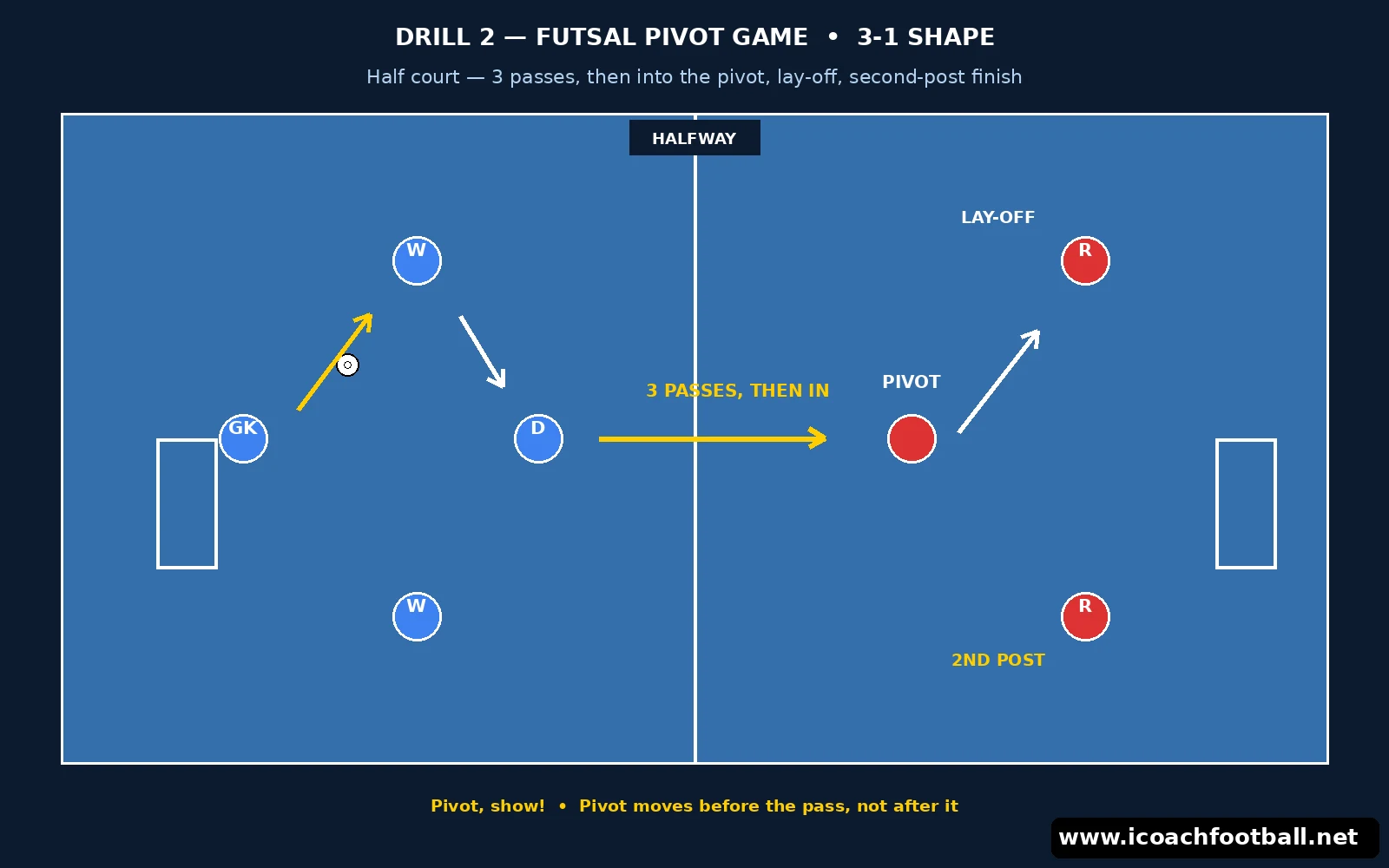
The futsal half of the winter plan. A 3-1 shape, a pivot, and fast restarts.
Setup:
- Half a futsal court, goals at each end, goalkeeper in each.
- One team in a 3-1 shape: goalkeeper, two wide players, one deep player, one pivot.
- A defending team in the same shape, pressing in its own half.
How to Play:
- The goalkeeper plays out short to a wide player.
- The three deep players complete three passes before playing forward.
- A wide player passes firmly into the pivot’s feet.
- The pivot shields, holds, and lays off to a runner at the second post.
- The runner finishes first time, or the pivot spins and shoots low.
Coach’s note: The pivot must move before the pass. The cue is “Pivot, show!” A still pivot receives a marked pass.
Progressions: Allow the pivot one exit from the zone, or add a flying goalkeeper for the last 30 seconds.
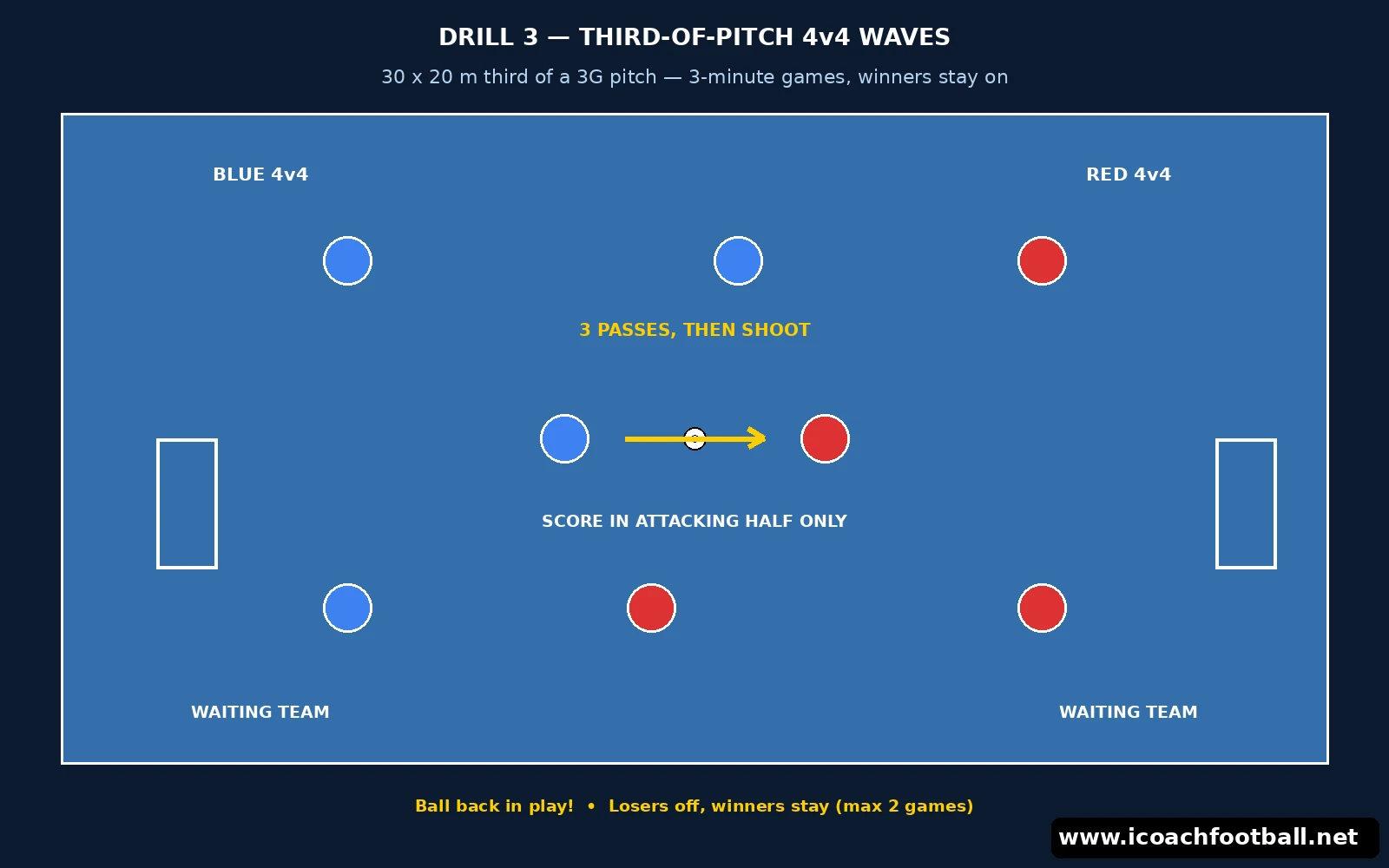
Drill 3 — Third-of-Pitch 4v4 Waves
The plan for a shared 3G pitch. Small area, waves of games, no queues.
Setup:
- One 30 x 20 metre area, a third of a 3G pitch, with mini goals at each end.
- Two teams of 4, plus two spare teams waiting behind the goals.
- Balls behind each goal, so every restart is instant.
How to Play:
- Teams play 4v4 for 3 minutes, scoring only from inside the attacking half.
- When the ball goes out, the nearest player restarts it at once.
- After 3 minutes, the losing team leaves and a waiting team enters.
- The winning team stays on, up to two games in a row, then rotates out.
- Every player gets a 3-minute rest after two games, then returns in a new team.
Coach’s note: The cue is “Ball back in play!” Slow restarts waste the warmest, busiest minutes of a winter session.
Progressions: Require three passes before a shot, or play 5v5 if numbers allow.
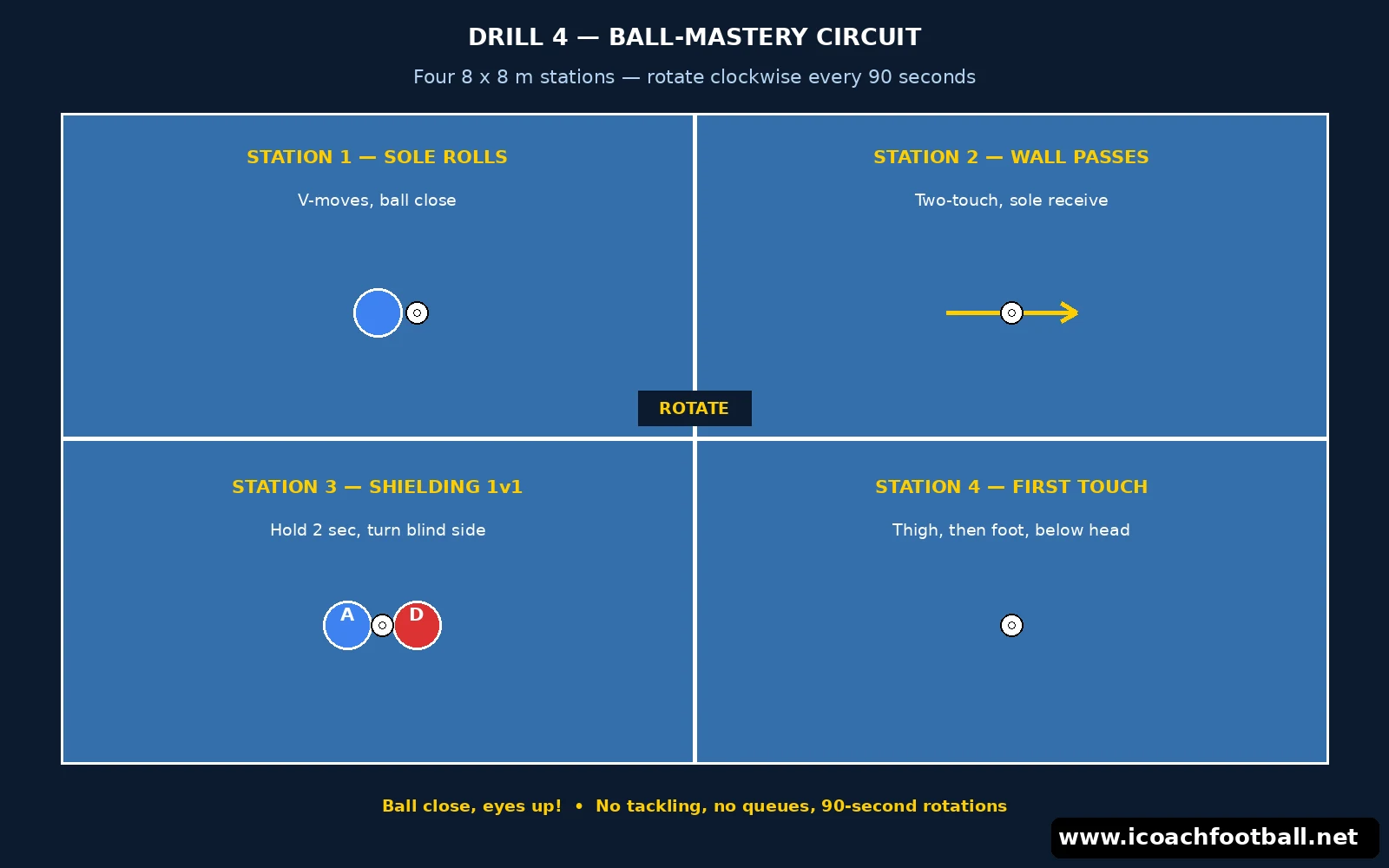
Drill 4 — Ball-Mastery Circuit
Four stations, no goals, no tackling. The plan when space is smallest.
Setup:
- Four stations in a hall or gym, each 8 x 8 metres, marked with cones.
- Groups of 3–4 at each station, one ball per player at Stations 1 and 2.
- A 90-second timer, with the coach calling every rotation.
How to Play:
- Station 1: sole rolls and V-moves, ball within one step, heads up.
- Station 2: wall passes, two-touch, receive with the sole, pass with the inside foot.
- Station 3: 1v1 shielding, attacker holds for two seconds, then turns on the blind side.
- Station 4: juggling and first-touch control, thigh then foot, ball below head height.
- Groups rotate clockwise every 90 seconds until every group has done all four stations.
Coach’s note: The cue is “Ball close, eyes up!” A player staring at the ball at a station will collide at the next one.
Progressions: Add a defender at Station 3, or limit Station 2 to one-touch passing.
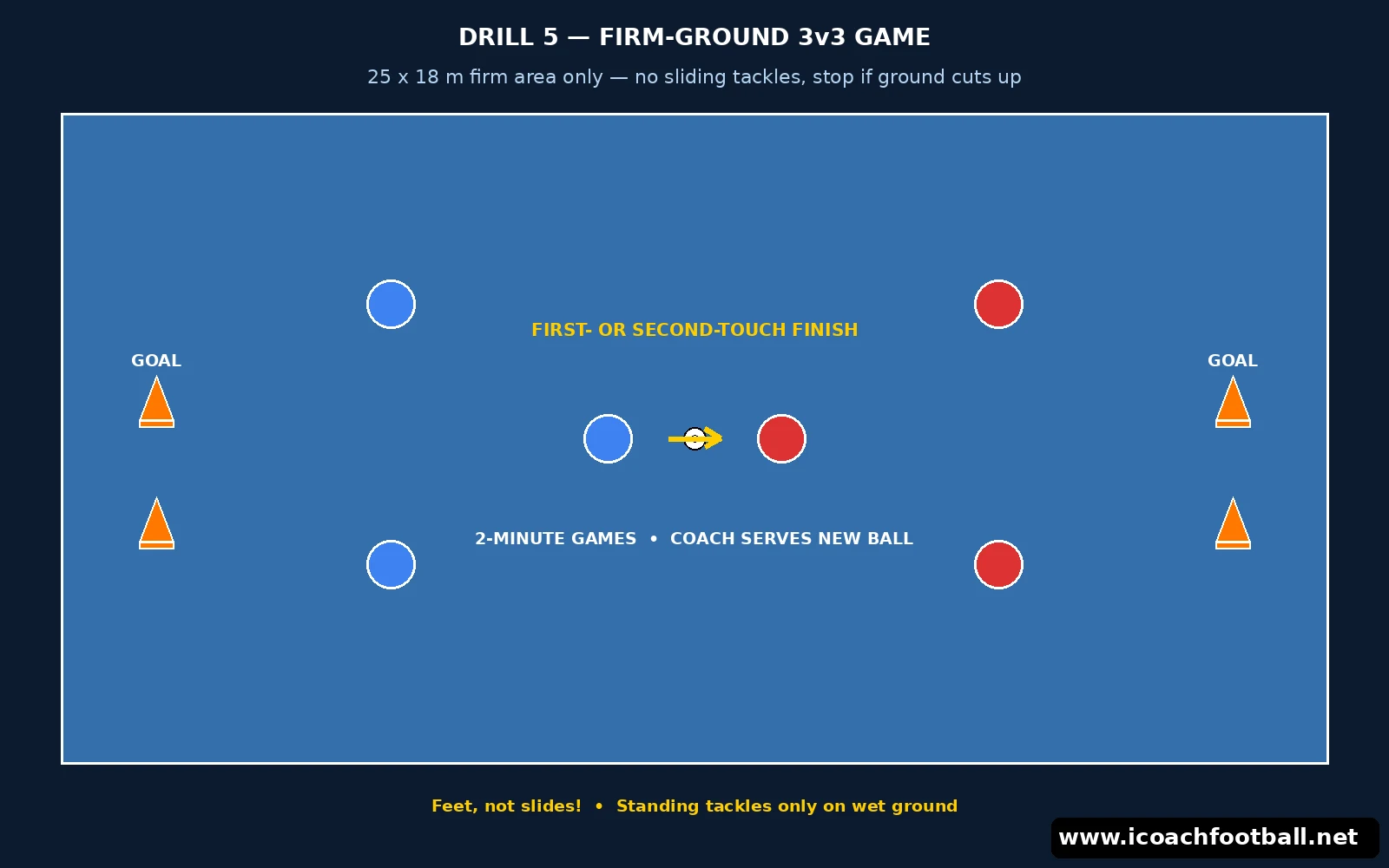
Drill 5 — Firm-Ground 3v3 Game
The only grass game in this post. It runs only on ground you have checked.
Setup:
- One 25 x 18 metre firm area, away from puddles and ruts, with flat cones for goals.
- Two teams of 3, plus a spare team waiting, with bibs for one team.
- Balls with the coach, on the firmest edge of the area.
How to Play:
- Teams play 3v3 for 2 minutes, with no sliding tackles.
- Goals count only from a first-time or second-touch finish.
- When the ball leaves the area, the coach plays a new ball in at once.
- After 2 minutes, the losing team leaves and the waiting team enters.
- Stop the game if the ground cuts up or players start slipping, and move to Drill 4.
Coach’s note: The cue is “Feet, not slides!” Standing tackles keep players on their feet on wet ground.
Progressions: Add a neutral player for a 3v3 plus 1, or require a wide pass before a shot.
60-minute hall session plan
| Time | Block | Drill |
|---|---|---|
| 0–10 min | Arrival | Drill 1 — Hall Arrival Rondo |
| 10–22 min | Technique | Drill 4 — Ball-Mastery Circuit (first two stations, then rotate) |
| 22–40 min | Tactics | Drill 2 — Futsal Pivot Game |
| 40–52 min | Technique | Drill 4 — Ball-Mastery Circuit (last two stations) |
| 52–60 min | Game | Drill 2 — Futsal Pivot Game, winners stay on |
90-minute third-of-pitch session plan
| Time | Block | Drill |
|---|---|---|
| 0–12 min | Arrival | Drill 1 — Hall Arrival Rondo (or the same rondo on the 3G) |
| 12–30 min | Technique | Drill 4 — Ball-Mastery Circuit |
| 30–58 min | Game | Drill 3 — Third-of-Pitch 4v4 Waves |
| 58–72 min | Technique | Drill 2 — Futsal Pivot Game (on the 3G, with flat-cone goals) |
| 72–90 min | Game | Drill 5 — Firm-Ground 3v3 Game, only if the ground stays firm |
Coaching points that make winter sessions work
- Decide early: Tell players the backup plan the night before. A hall session players expect beats a grass session they arrive to find cancelled.
- Warm up longer: Cold muscles need 10–12 minutes of movement before any sprint or shot. Keep the rondo moving for the full 10 minutes.
- Name the transfer: After each drill, name the grass habit: sole control becomes first touch, pivot shielding becomes holding up play, fast restarts become quick free kicks.
- Protect the pitch: Stay off rutted and waterlogged areas even for a warm-up. One session on a frozen pitch can ruin it for weeks.
- Finish warm: End with a game, not a stretch in the cold. Players leave warm, and they come back next week.
Common mistakes — and the fix
- Training on a frozen pitch: Fix: use the decision table. If the ground is hard or rutted, move indoors.
- Long queues in the cold: Fix: waves and stations in Drills 3 and 4. No player stands still for more than 30 seconds.
- Bouncing passes indoors: Fix: ban bouncing passes in Drills 1 and 2. A ball in the air is a lost ball on a hard court.
- Standing after a pass: Fix: Drill 1’s follow-your-pass rule, enforced every rep.
- Slow restarts: Fix: count restarts aloud and keep spare balls behind each goal.
Age adaptations
- U10–U11: Use Drills 1 and 4 only, with a size 3 futsal ball indoors. Keep games to 2 minutes, with frequent rotations and no fixed positions.
- U12–U13: Add Drill 2 with the pivot staying in one zone, and Drill 3 with 3-minute waves. Keep tackling standing up.
- U14–U16: Run the full hall or third-of-pitch plan. Add the flying goalkeeper in Drill 2, and coach pressing triggers in Drill 3.
- U17–U19: Run the 90-minute plan, with video of one pivot rotation to review. Add a pressing trigger on a back pass in Drill 3.
FAQ
Can you train football in winter when the pitch is frozen?
Do not train on a frozen or rutted pitch. Move indoors to the hall plan, or use a firm third of a 3G pitch. Check goal areas and the middle third first, as frozen ruts hide there.
What is the best winter football training session for a small space?
The 60-minute hall plan in this post: an arrival rondo, a ball-mastery circuit, and a futsal pivot game. It needs only a hall, cones, bibs and balls, and it scales from 10 to 22 players.
How do you keep youth players warm at winter training?
Keep every player moving with waves, stations and rolling substitutions. Warm up for 10–12 minutes, run drills in 2-minute bursts, and keep layers and gloves on until the first game.
Can futsal drills replace grass training in winter?
Yes, for the winter weeks. Futsal sharpens first touch, shielding and fast decisions, and the pivot and rotation drills here transfer straight back to grass when the pitch returns.
How many players do I need for winter football training?
Drills 1 and 4 work with 8 or more players. Drills 2 and 3 need 12 or more for the full shape, but both can be run with 8 players and one goal.
Sources and further reading
- FIFA Training Centre, Futsal practice library: https://www.fifatrainingcentre.com/en/practice/futsal.php — The pivot and rotation drills in this post are in line with the FIFA Training Centre futsal practices on playing out under pressure and using the pivot; no approval or affiliation is claimed.
- The FA, Futsal arrival activity (The Boot Room): https://www.thefa.com/bootroom/resources/coaching/futsal-arrival-activity — The small-sided arrival game and ball-control emphasis are in line with The FA’s foundation-phase futsal approach; no approval or affiliation is claimed.
- For hall and small-space versions of these ideas, see our futsal drills for footballers, our indoor soccer drills for kids and our soccer drills for small spaces, linked above.