Soccer Give and Go Drills: 6 Games That Teach the One-Two (U8–U14)
Quick answer
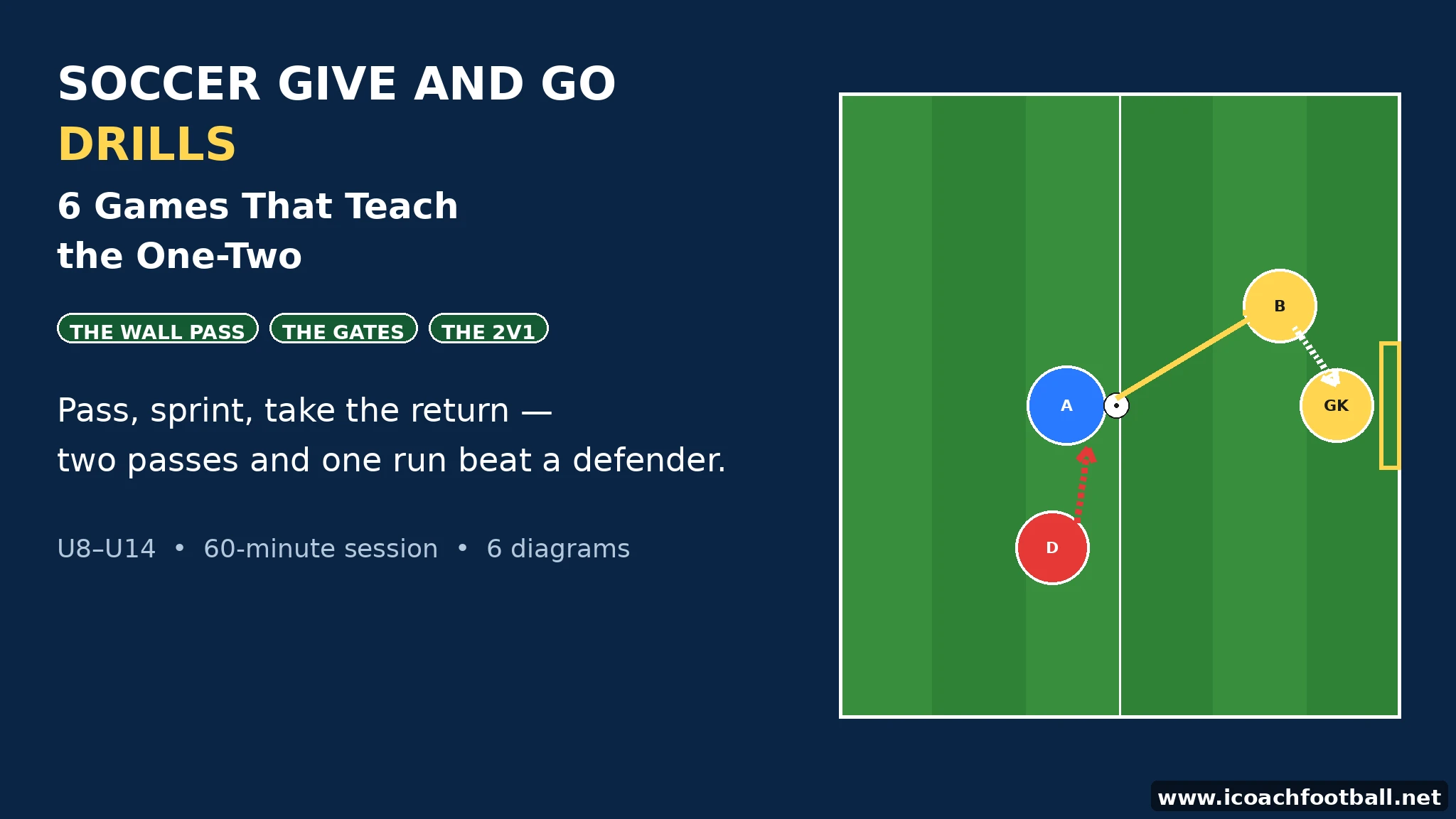
A give-and-go is a two-player wall pass. One player passes to a team-mate, sprints past the defender, and takes the return ball first time. Six games — one 60-minute session — teach it from the simplest pair pattern to a full game: wall-pass pairs, give-and-go gates, beat the defender, wall-pass rondo, give-and-go to finish, and a game where goals only count after a give-and-go.
Suitable for: U8–U14 (ages 7–14)
Session snapshot
- Players: 12–16 (U8–U14)
- Area: 20 x 15-yard channel expanding to a 30 x 20-yard game pitch
- Duration: 60 minutes
- Focus: Pass and sprint, the lay-off into the runner’s path, first-time return, and running past the defender
- Age: U8–U14
- Equipment: 10–12 balls, 20 cones, 2 mini goals, 1 full goal, bibs
Why these six games work
The give-and-go is the first combination pass a player learns — and the one they will use for the rest of their career. It beats a defender with two passes and one sprint, no dribbling required. The wall player never holds the ball: they lay it off first time, into the runner’s path, and the runner is already moving when the return ball arrives.
This post is the two-player wall pass itself — not the three-player combination that comes after it. Our soccer third man runs drills train the three-player move that follows once the give-and-go is secure, and our 2v1 soccer drills attacking overload train the 2v1 situation the give-and-go creates. In the UK the same session is football give and go drills — the drills and the coaching points are identical.
FIFA’s Training Centre circuit “Technical Activation — Part 3: Circuit 1” is built on exactly this pattern: Drill 2 has player B lay the ball back to A, run through the gate at pace, and receive a lay-off before playing a first-time pass on — with the coaching points to scan before receiving, play a quality pass into the path of the next player, and play first time when changing direction. Drills 1, 3 and 5 below are based on / in line with that FIFA circuit. England Football’s six-week “Passing and receiving to score” programme adds the other half: week two trains two-player core moves and 2v1s to score, giving teams a bonus point for using a two-player move, and week five trains combinations to play forward and challenges players to “not let the ball stop”. Drills 2, 4 and 6 below are based on / in line with that England Football programme.
This post completes the passing cluster: our soccer passing drills are the hub for the whole topic, our soccer one-touch passing drills train the first-time return pass the wall player needs, and our soccer drills for improving off the ball movement train the sprint after the pass.
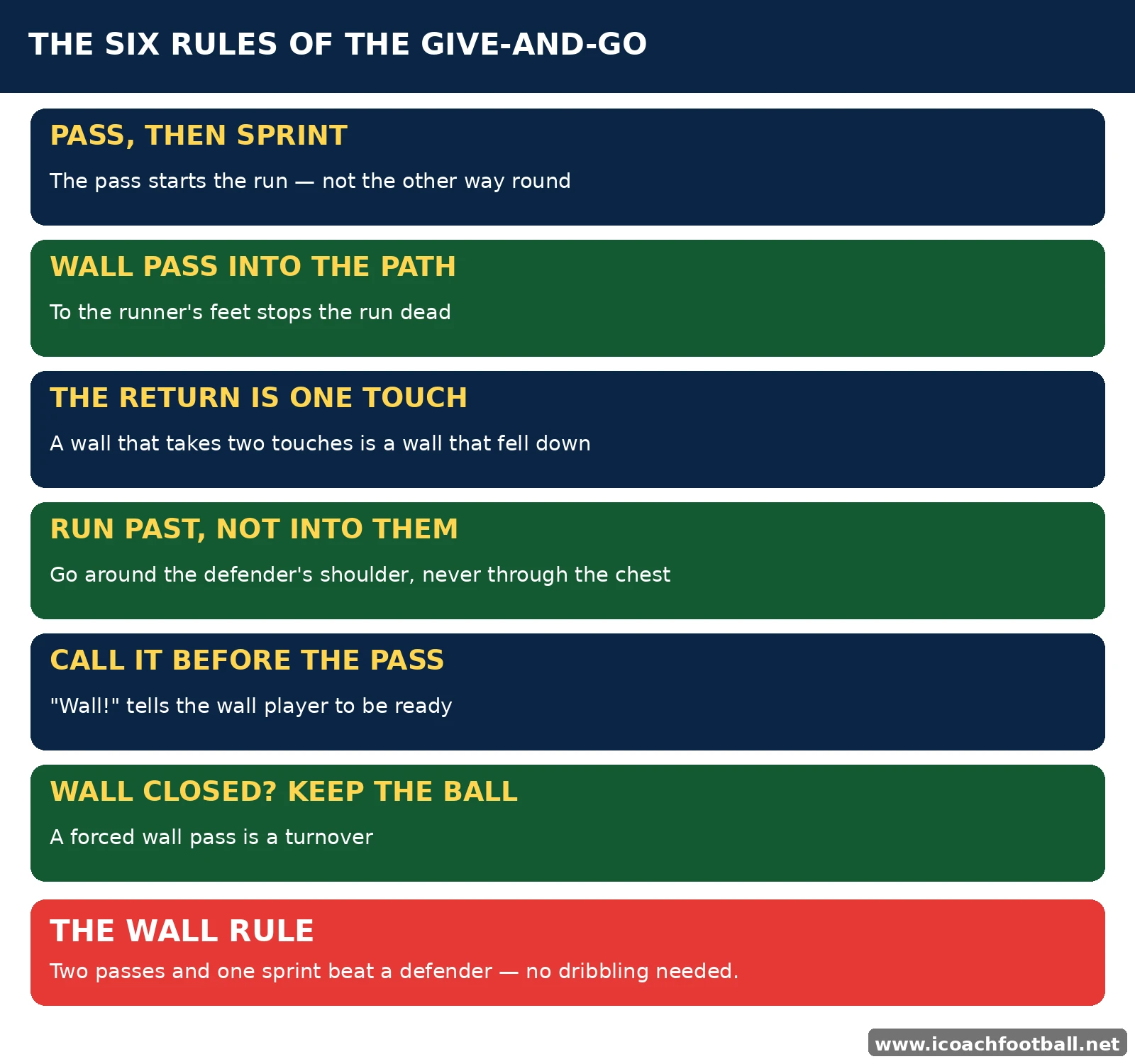
Six rules of the give-and-go
- Pass, then sprint. The pass starts the run — not the other way round.
- The wall pass goes into the runner’s path. To their feet stops the run dead.
- The return ball is one touch. A wall that takes two touches is a wall that fell down.
- Run past the defender, not into them. Go around the shoulder, never through the chest.
- Call it before the pass. “Wall!” tells the wall player to be ready.
- If the wall is closed, keep the ball. A forced wall pass is a turnover.
Drill 1 — Wall Pass Pairs
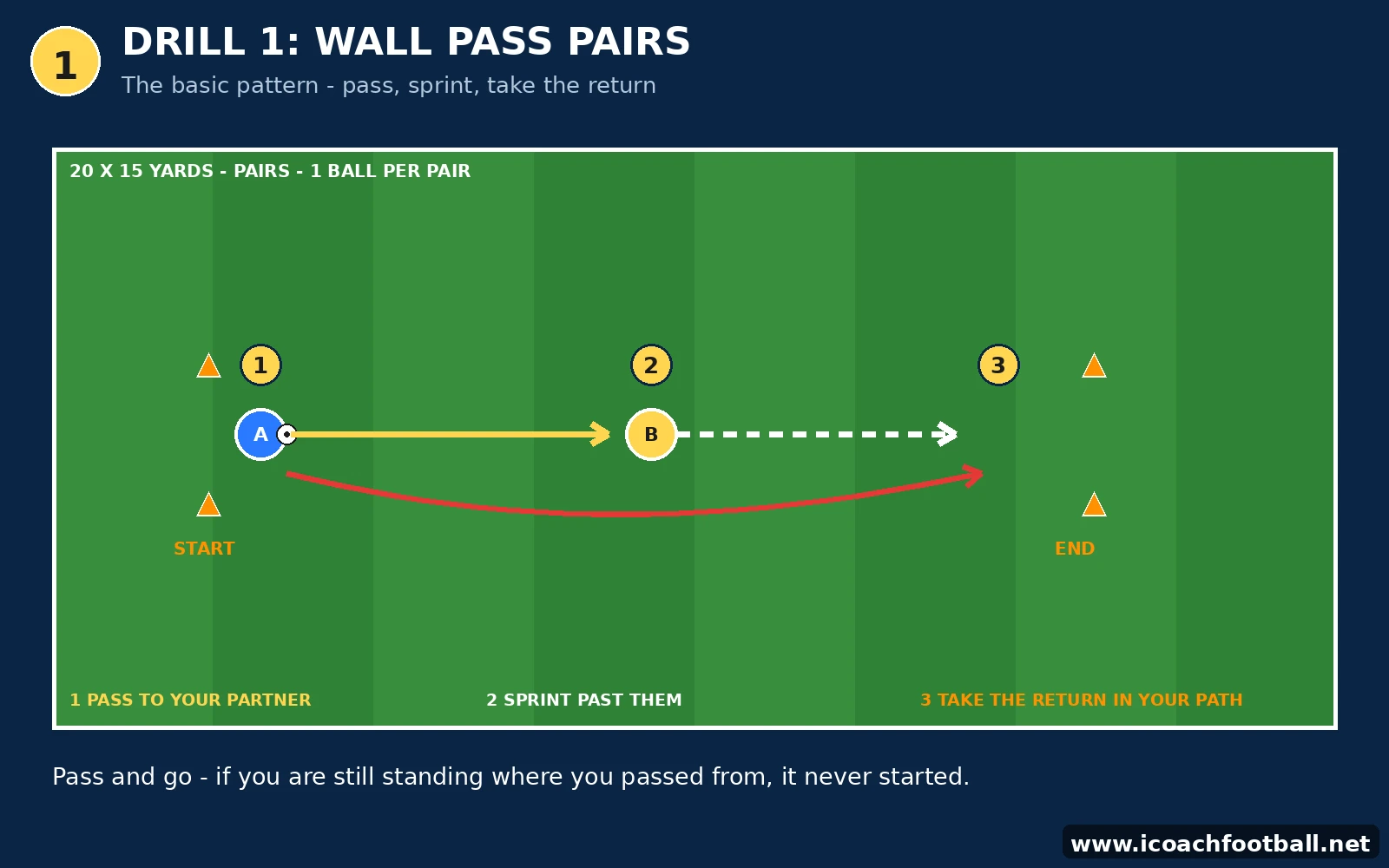
The basic pattern, unopposed. Pass to your partner, sprint past them, and take the return ball in your path — the whole give-and-go in ten yards.
Setup
- 20 x 15-yard area, pairs 10 yards apart, cones marking a start line and an end line.
- 12 players in 6 pairs, 1 ball per pair. 8 minutes.
How to Play
- Player A passes to player B and sprints past B at once.
- Player B lays the ball back first time, into A’s path.
- Player A takes the return ball and stops it at the end cone.
- The pair turns and plays the same pattern back the other way.
- After 2 minutes, the players swap roles — B passes first.
- The pair counts clean give-and-gos — the target is 10 in a row.
Coach’s note: “Pass and go — if you are still standing where you passed from, the give-and-go never started.”
Progressions: The return pass must be first time; the runner must sprint around a cone before taking the return; the pair must finish the pattern in under 8 seconds.
Drill 2 — Give-and-Go Gates
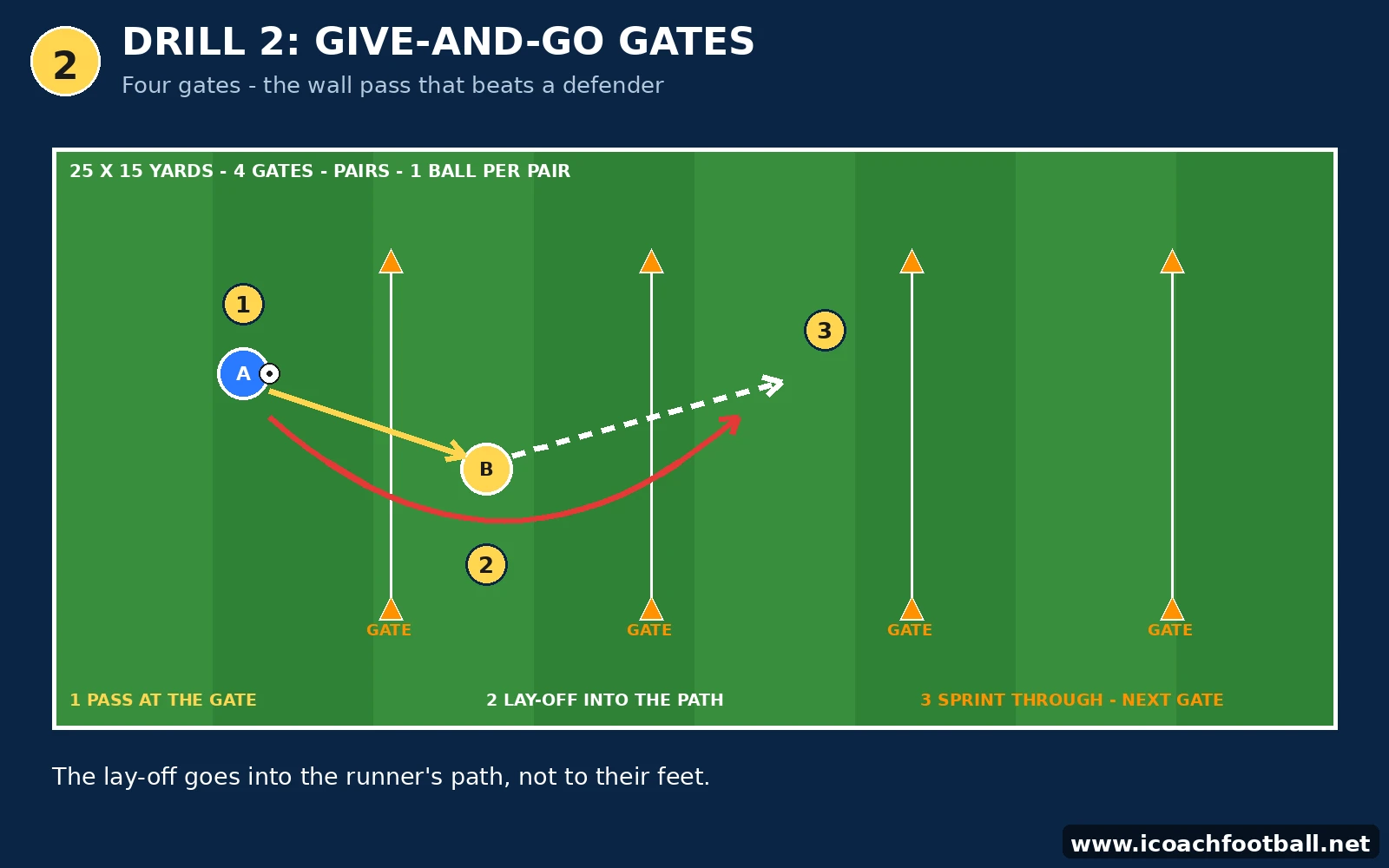
The wall pass, trained through gates. Pass to a team-mate, sprint through the gate, and take the return ball — the one-two that beats a defender, four times down the channel.
Setup
- 25 x 15-yard channel, 4 gates of 2 yards made from cones, down the middle.
- 12 players in 6 pairs, 1 ball per pair. 8 minutes.
How to Play
- Player A passes to player B at the first gate.
- Player B lays the ball back first time, into A’s path.
- Player A sprints through the gate and takes the return ball.
- The pair plays the next give-and-go at the next gate.
- At the last gate, the pair turns and works back the other way.
- After 2 minutes, the pairs swap roles — B passes first at every gate.
Coach’s note: “The lay-off goes into the runner’s path, not to their feet — a wall pass that stops the runner is a wall that fell down.”
Progressions: Narrow the gates from 2 yards to 1.5 yards; the return ball must go through the gate first time; time the channel — the target is under 20 seconds.
Drill 3 — Beat the Defender
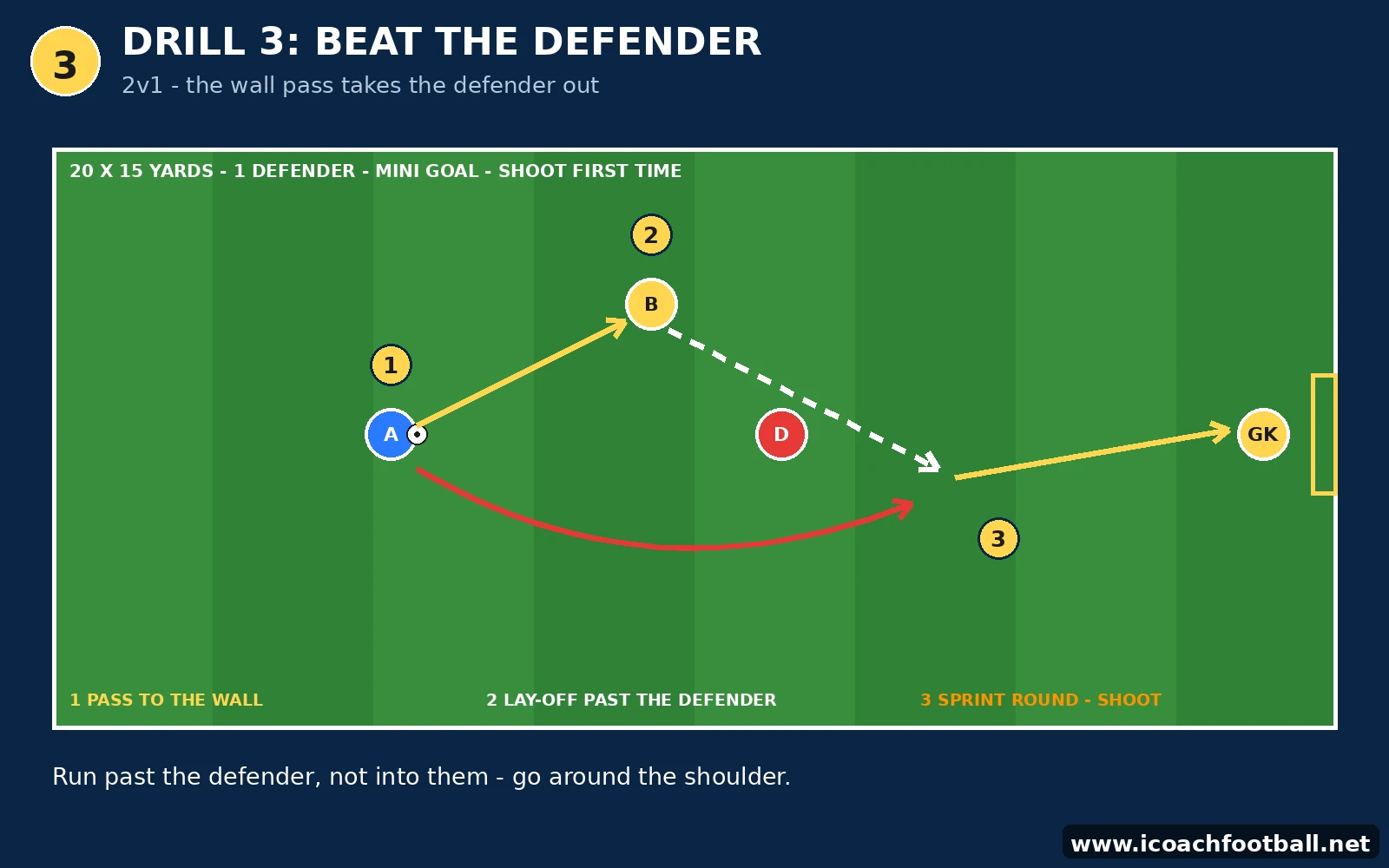
The give-and-go against a real defender. The wall pass takes the defender out of the game — if the runner goes around, not into them.
Setup
- 20 x 15-yard area, 1 mini goal at one end, 1 defender in the middle.
- 12 players in 6 pairs, 1 ball per pair, 1 defender per pair. 9 minutes.
How to Play
- Player A passes to player B with the defender between them.
- Player B lays the ball back first time, past the defender.
- Player A sprints around the defender and takes the return ball.
- Player A drives at the mini goal and shoots first time.
- The defender swaps out after every 3 attempts — everyone defends.
- The pair counts goals — the target is 3 goals from 5 attempts.
Coach’s note: “Run past the defender, not into them — the wall pass only works if the runner goes around.”
Progressions: The defender presses the wall player; the shot must be first time; a second defender recovers from behind after the return pass.
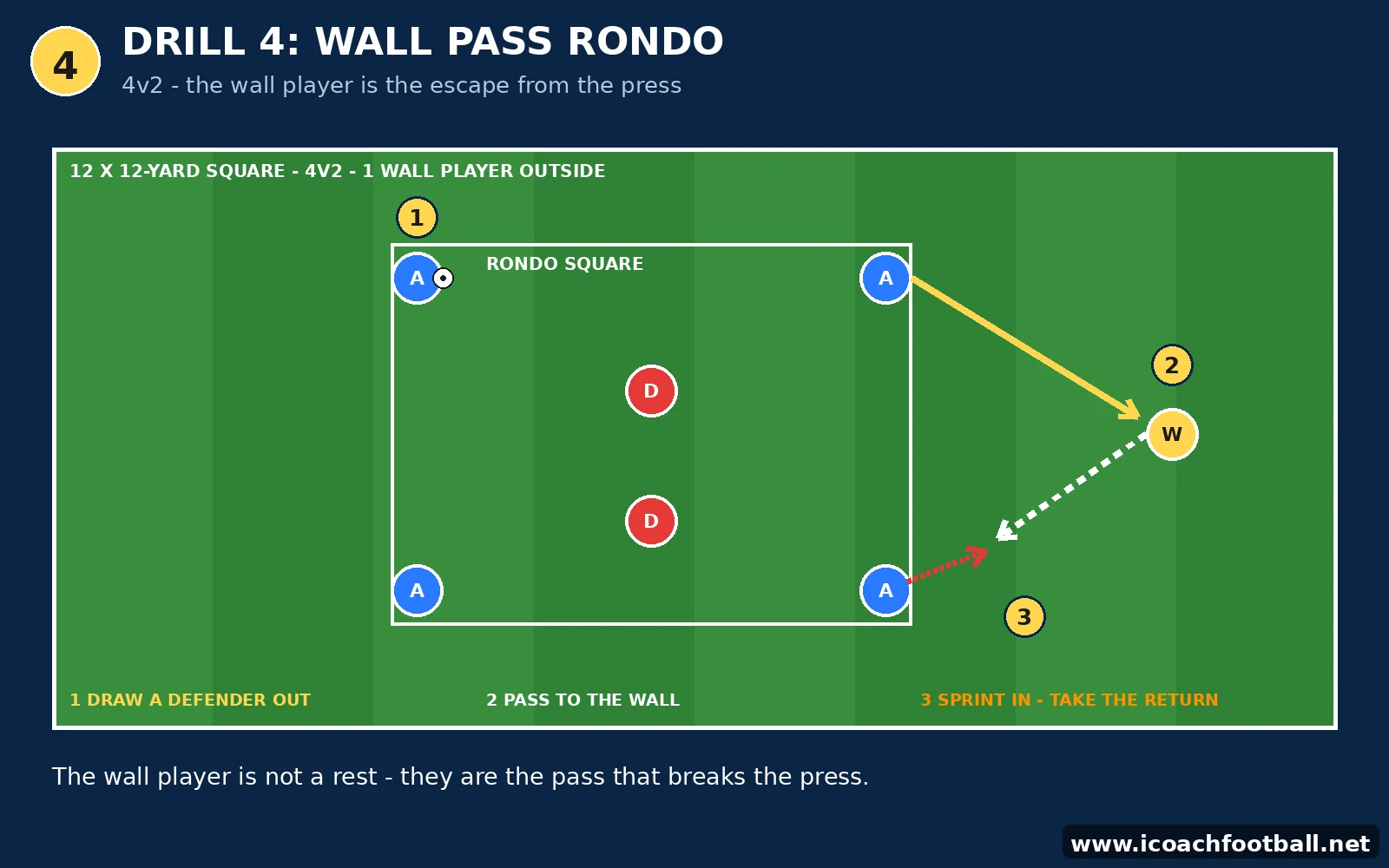
Drill 4 — Wall Pass Rondo
The rondo with a wall player outside. Four attackers keep the ball from two defenders — and the wall pass is the escape when the press closes in.
Setup
- 12 x 12-yard square, 1 wall player outside the square.
- 7 players: 4 attackers in the square, 2 defenders inside, 1 wall player. 9 minutes.
How to Play
- The attackers pass around the square to draw a defender out.
- One attacker passes to the wall player outside the square.
- The wall player lays the ball back first time, into space.
- A different attacker sprints into the space and takes the return ball.
- If a defender touches the ball, they swap out with the player who gave it away.
- The attackers count completed wall passes — the target is 5 before a swap.
Coach’s note: “The wall player is not a rest — they are the pass that breaks the press.”
Progressions: Two wall players, one on each side; the return ball must split the two defenders; shrink the square to 10 x 10 yards.
Drill 5 — Give-and-Go to Finish
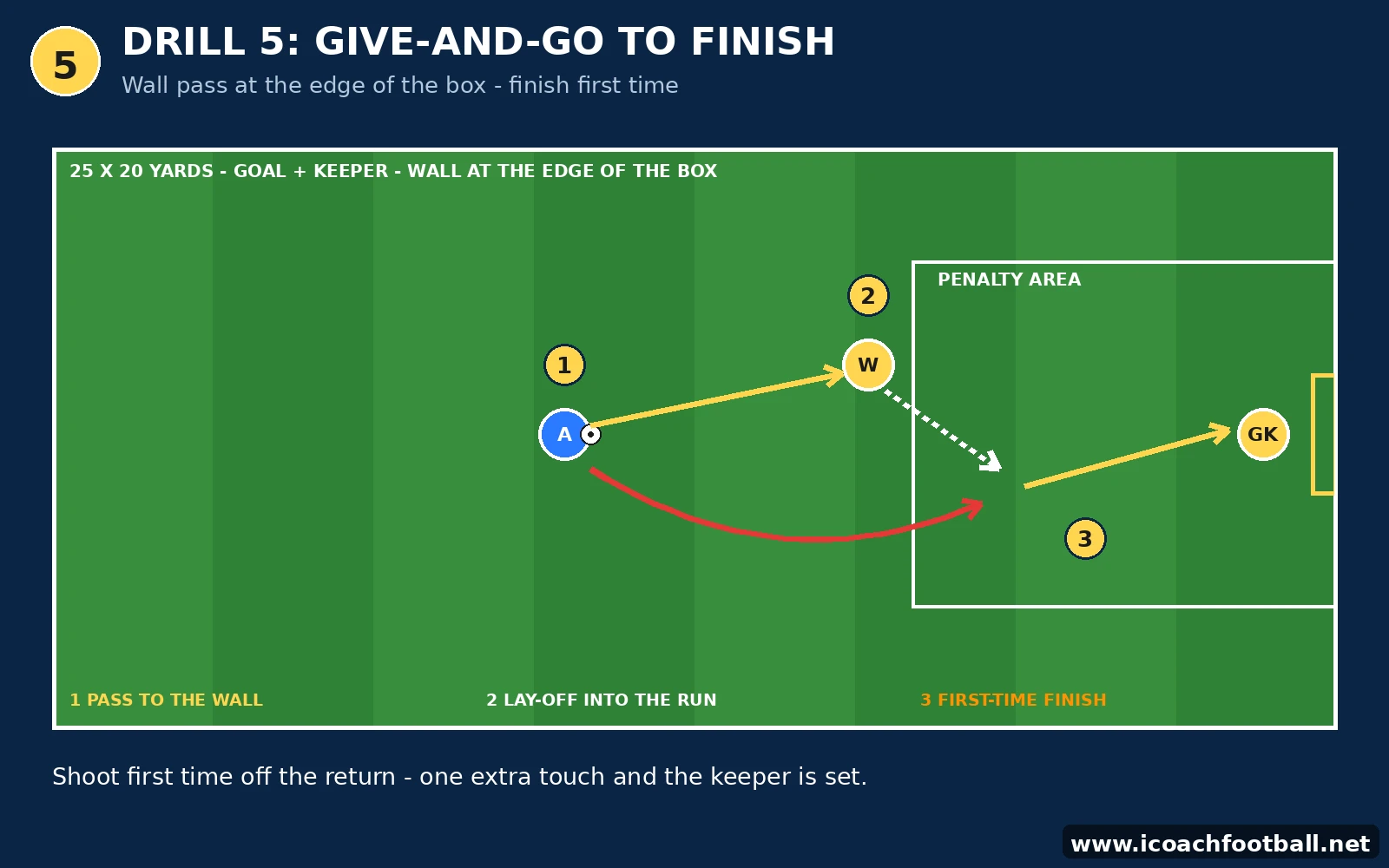
The wall pass that ends in a goal. The runner takes the return ball at full speed and shoots first time — the finish the give-and-go exists for.
Setup
- 25 x 20-yard area, 1 full goal with a keeper, wall player at the edge of the box.
- 12 players in lines, 1 ball per pair, 1 keeper. 9 minutes.
How to Play
- Player A passes to the wall player at the edge of the box.
- The wall player lays the ball back first time, into A’s path.
- Player A sprints past the wall player and takes the return ball.
- Player A shoots first time, low and across the keeper.
- The shooter becomes the wall player and the wall player joins the back of the line.
- Each player takes 5 turns — the target is 3 goals from 5.
Coach’s note: “Shoot first time off the return — one extra touch and the keeper is set.”
Progressions: A defender presses the wall player; the finish must be with the weak foot; the wall player lays off with their weak foot only.
Drill 6 — The Give-and-Go Game
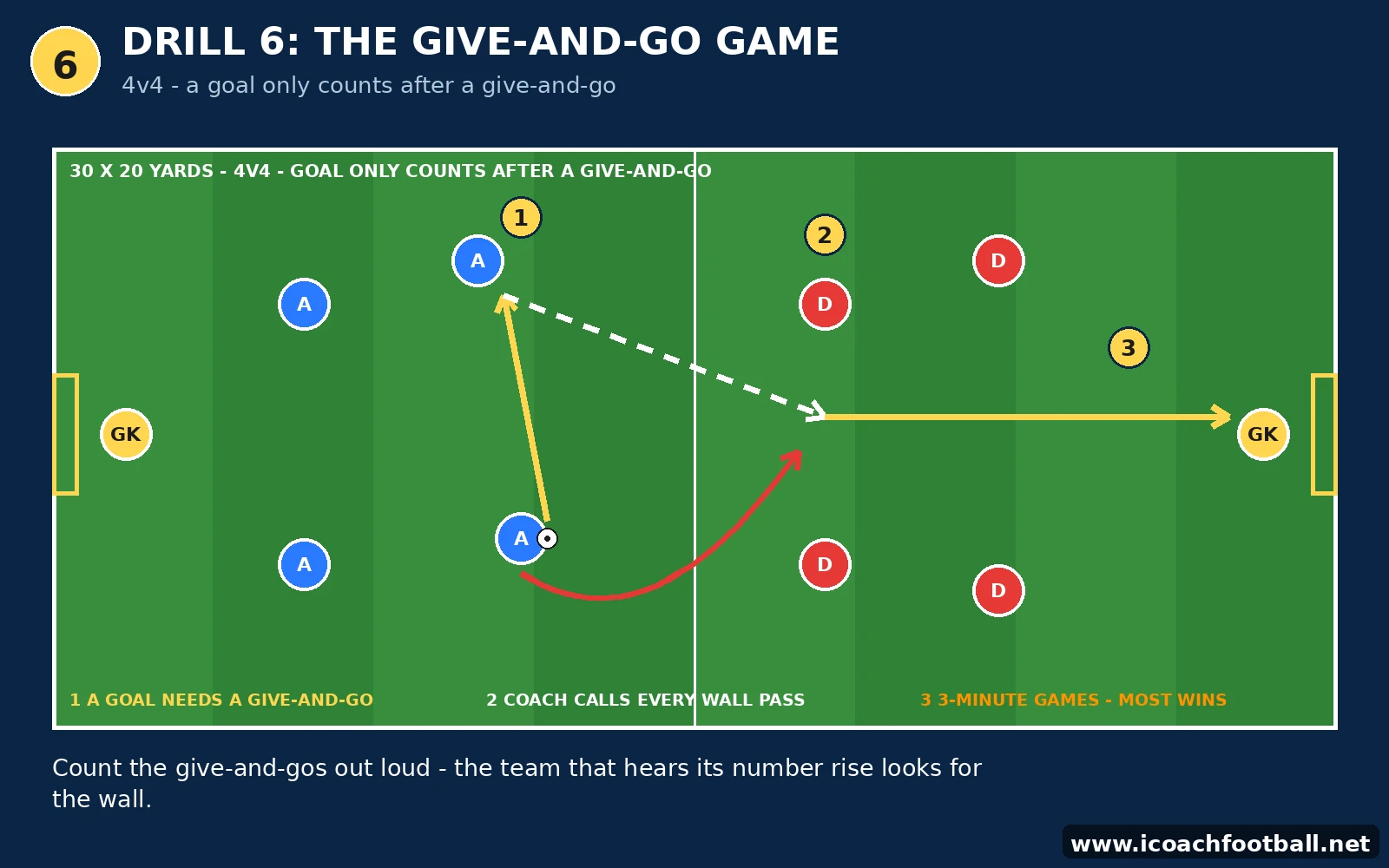
The test. A 4v4 game where a goal only counts if a give-and-go happens in the move that creates it — the team that plays the wall scores, the team that dribbles does not.
Setup
- 30 x 20-yard pitch, 2 mini goals, bibs.
- 8 players: 4v4. 12 minutes.
How to Play
- The game starts with a pass-in from the coach — no kick-offs, no corners.
- A goal only counts if a give-and-go happens in the move that creates it.
- A goal from a dribble or a long shot does not count — play restarts with a pass-in.
- The coach calls out every give-and-go so the whole team hears the pattern.
- Play 3-minute games, then swap the teams and play again.
- The team with the most counting goals after 12 minutes wins.
Coach’s note: “Count the give-and-gos out loud — the team that hears its own number rise starts looking for the wall.”
Progressions: Goals from a give-and-go in the final third count double; limit the whole team to two touches; add a neutral wall player who always plays one touch.
Common mistakes
| Mistake | What you see | Fix |
|---|---|---|
| Passing and standing still | The pattern dies after one pass | Pass and go — the next position is part of the pass |
| Lay-off played to feet | The runner has to stop to collect it | Lay the ball off into the runner’s path, 2 yards ahead |
| Return pass too soft | The defender steps in and takes it | Pass firmly, through the ball, to the runner’s front foot |
| Running into the defender | The runner collides and the ball is lost | Run around the defender’s shoulder, never through the chest |
| No call before the pass | The wall player is not ready and takes a touch | Call “wall!” before the pass — the wall player sets early |
| Forcing the wall when closed | Turnovers into a defender who read it | If the wall is closed, keep the ball and use the pass again |
Age adaptations
| Age | Format | What changes |
|---|---|---|
| U8 (ages 7–8) | 10-yard lanes, size 3 ball | Two touches allowed in Drills 1 and 2 until the pattern is clean — the one-touch return arrives in Drill 3. Gates are 3 yards wide. See our U8 soccer practice plan for the session shape at this age |
| U9–U10 (ages 8–10) | 15 x 12-yard areas, size 3 ball | One touch on the return pass from Drill 2, but the defender in Drill 3 is passive — they shadow, they do not tackle. See our U10 soccer practice plan |
| U11–U12 (ages 10–12) | 20 x 15-yard areas, size 4 ball | Full one-touch return from Drill 1, and the defender presses in Drill 3. The rondo in Drill 4 runs 5v2, not 4v2 — see our U12 soccer practice plan |
| U13–U14 (ages 12–14) | Full areas, size 4 ball | The defender presses the wall player in Drill 5, and the give-and-go game in Drill 6 runs with a two-touch limit for the whole team — see our U13 soccer practice plan and soccer drills for U13 and soccer drills for U14 |
60-minute session plan
| Time | Block | Drill |
|---|---|---|
| 0:00–0:05 | Arrival game | Free 3v3 — every goal must come after a pass to a team-mate, no solo goals |
| 0:05–0:13 | The pattern | Drill 1 — Wall Pass Pairs |
| 0:13–0:21 | The gates | Drill 2 — Give-and-Go Gates |
| 0:21–0:30 | Beat the defender | Drill 3 — Beat the Defender |
| 0:30–0:39 | The rondo | Drill 4 — Wall Pass Rondo |
| 0:39–0:48 | The finish | Drill 5 — Give-and-Go to Finish |
| 0:48–0:60 | The game | Drill 6 — The Give-and-Go Game |
New to coaching this age? Stretch the arrival game to 8 minutes and cut Drill 4 to 6 minutes and you have the same session with more settling-in time — see our 60-minute plan for the structure (the same shape, shortened where you need it).
Keep building from here
The give-and-go is the first combination — the next step is the third man: our soccer third man runs drills train the three-player move that follows once this two-player wall pass is secure, and our soccer drills for improving passing under pressure put the same wall pass under a real press. The 2v1 the give-and-go creates is trained in our 2v1 soccer drills attacking overload, and the finish in Drill 5 is trained in our attacking combination play finishing drill. The first-time return pass is the same skill as our soccer one-touch passing drills, and the sprint after the pass is trained in our soccer drills for improving off the ball movement. The call that makes the wall work is the same skill as our soccer communication drills, and the weak-foot round in every drill is our weak foot soccer drills. Plan the shape on our Football Formation Maker and check the load with our training load calculator. Warm up with our 10 soccer warm-up drills.
FAQ
What is a give and go in soccer?
A give-and-go is a two-player wall pass. One player passes to a team-mate, sprints past the defender, and takes the return ball first time — two passes and one run beat a defender with no dribbling. It is also called a one-two or a wall pass.
What age should players learn the give and go?
From U8. The give-and-go is the first combination pass, so it is teachable as soon as players can pass and move — start unopposed in pairs, with two touches allowed until the pattern is clean, then add the defender from U10. By U13–U14 the wall player should be pressed and the return pass should be first time.
What is the difference between a give-and-go and a third-man run?
A give-and-go uses two players: A passes to B, B lays it back, and A takes the return. A third-man run uses three: A passes to B, B lays it off to C, and C plays the through ball to the runner. Learn the give-and-go first — the third-man run is the same idea with one more player.
How do you coach the give and go?
Start with the pattern, not the press. Drill 1 in this session — wall-pass pairs with no defender — teaches pass, sprint and return in ten yards. Add the gates in Drill 2, then the defender in Drill 3, and only finish with the game in Drill 6. Let players take a touch when the pass is bad rather than forcing a rushed return.
What is the best give and go drill?
Give-and-go gates — pairs playing a wall pass through four gates down a channel. It trains everything at once: the pass, the sprint through the gate, the first-time lay-off into the runner’s path, and the return ball. If a pair can clear all four gates in under 20 seconds, they are ready for the defender in Drill 3 and the game in Drill 6.
Sources
- FIFA Training Centre, “Technical Activation — Part 3: Circuit 1” — nine passing and movement drills that become progressively more complex, seeking to improve technical understanding between players and optimise ball contact time; Drill 2 has player B lay the ball back to A, run through the gate at pace and receive a lay-off before playing a first-time pass on; players should scan the area they are receiving from and the intended destination of their own pass, play a quality pass into the path of the next player, and play a first-time pass wherever possible when changing direction. Drills 1, 3 and 5 are based on / in line with this circuit.
- England Football Learning, “Session programme — Passing and receiving to score” — a six-week programme: week two trains two-player core moves and 2v1s to score, giving teams a bonus point for using a two-player move; week five trains combinations to play forward and challenges players to “not let the ball stop”; the week-six festival only allows goals scored with a one-touch finish. Drills 2, 4 and 6 are based on / in line with this programme.