Soccer Drills for Improving First-Time Shooting: 6 Games That Turn One-Touch Chances into Goals (U11–U17)
Quick answer
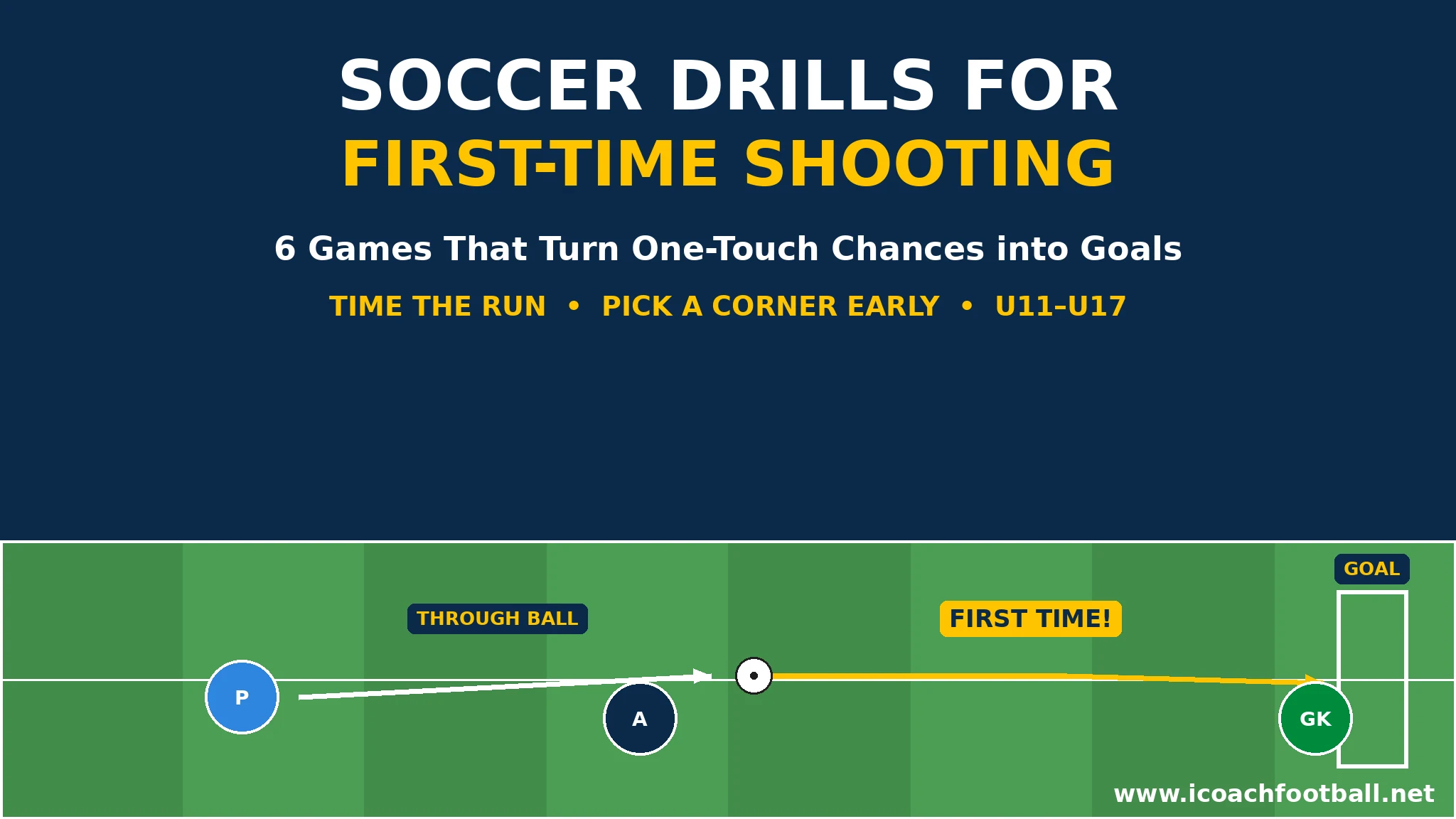
A first-time finish is decided before the ball arrives. The striker who has already picked a corner, is running onto the ball in stride, and has their plant foot ready beside the ball scores — the striker who waits for the ball, stands still, and then decides, snatches at it. These six soccer drills for improving first-time shooting train that sequence step by step: timing the run onto the ball, picking a corner early, using the pace of the pass, finishing the cutback first time, volleying the high ball, and scoring first-time goals in a real game where they count double.
Suitable for: U11–U17 (ages 10–17)
Session snapshot
- Players: 8–16, including 1 goalkeeper
- Age: U11–U17 (ages 10–17)
- Area: Penalty area and the edge of the box, with a full goal
- Duration: 60 minutes
- Focus: First-time shooting — timing the run, picking a corner early, plant foot and body shape, using the pace of the ball, cutbacks, volleys, and first-time finishes in a game
- Equipment: 10 balls, 12 cones, bibs, 1 full goal (2 for the final game)
Why these six games work
Most first-time chances are lost before the shot. The striker arrives late, stands still waiting for the ball, and then has to take a touch — and by the time the touch is taken, the defender has recovered and the keeper is set. The striker who times their run so they meet the ball in stride, with the corner already picked, needs no touch at all — the ball is struck the instant it arrives, and the keeper has no time to set.
The first two drills build the technique: arriving in stride and striking the moving ball first time, then picking a corner before the ball arrives and finishing low with the side foot. The next two drills build the game situations: the cutback rolled across the six-yard box, which is the most common first-time chance in the modern game, and the high ball that must be volleyed or half-volleyed first time. The last two drills build the decision: finishing first time under pressure from a recovering defender, then a full game where a first-time goal counts double, so players start shooting on sight instead of taking the extra touch.
The drills are grounded in the FIFA/UEFA coaching community. Drills 1, 3 and 6 are based on / in line with the FIFA Training Centre session “54) Creating chances and finishing” (FIFA Technical Expert Jonas Urias), which trains players to finish first time — its finishing warm-up asks shooters to finish first time, its high-ball variation asks for a first-time volley or header, its 7v3 exercise asks the only player allowed in the penalty area to finish first time following a through-ball, and its points system rewards spectacular goals and goals scored following an assist. Drills 2, 4 and 5 are based on / in line with England Football Learning’s “How to design a football shooting session”, which teaches coaches to stage shooting practice close to goal — 82% of goals at Euro 2020 were scored from inside the 18-yard box — to use small-number activities such as 3v3 because they increase the likelihood of a first-time finish, to introduce overloads so strikers practise finishing when outnumbered, and to build in assists so players learn to create the chance as well as finish it. In the UK the same session is football drills for first-time shooting — the run, the plant foot and the early corner pick are identical.
This post is the one-touch half of the site’s finishing pair. The finish under pressure — holding the ball, beating the defender and scoring when marked tight — is our soccer drills for improving finishing under pressure — this post trains the chance that must be taken first time, with no touch to spare.
Six rules of first-time shooting
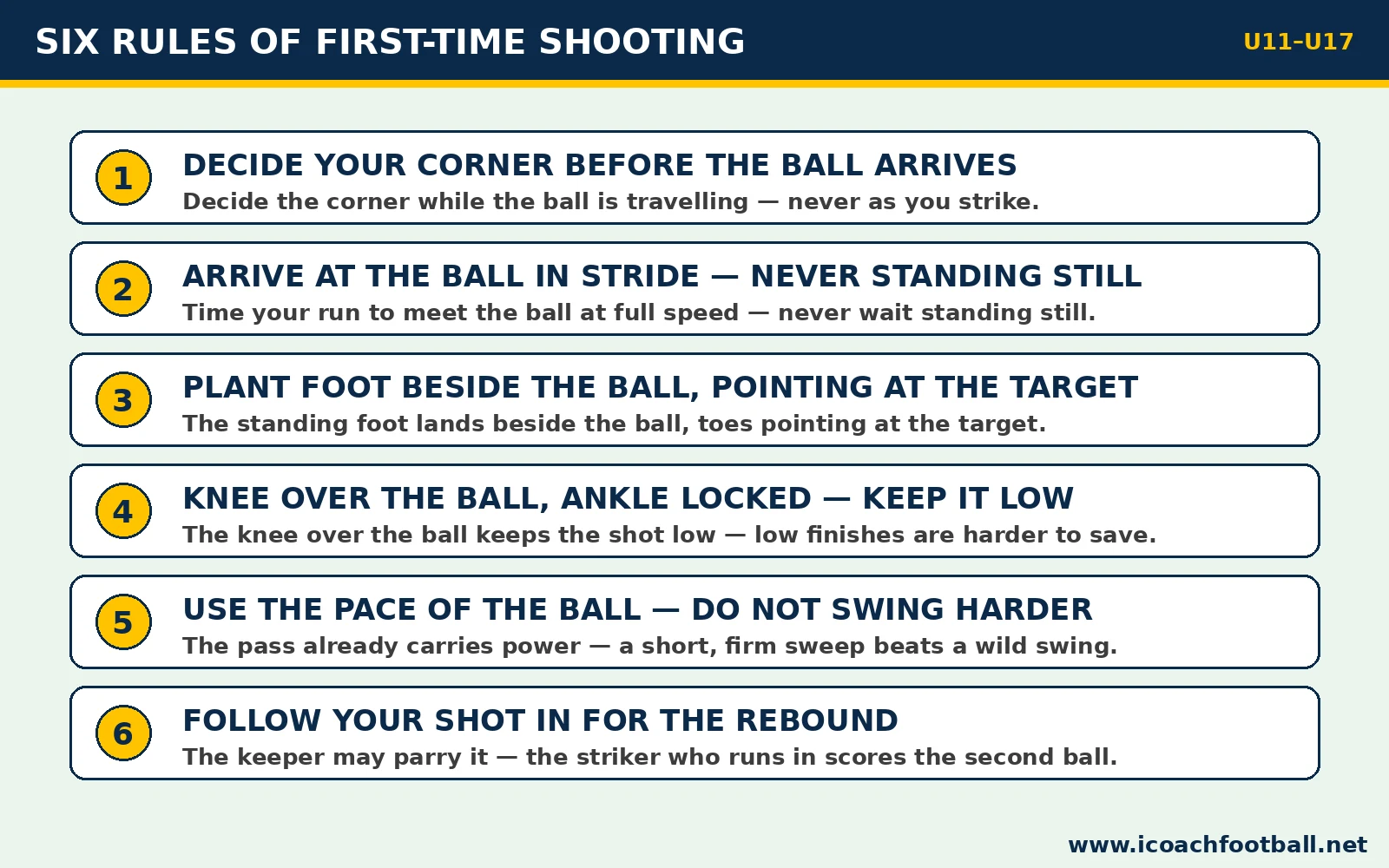
- Decide your corner before the ball arrives. A striker who is still choosing as they strike snatches at it — pick near post or far post while the ball is travelling.
- Arrive at the ball in stride — never standing still. Time the run so you meet the ball at full speed; a standing striker has to take a touch, and the chance is gone.
- Plant foot beside the ball, pointing at the target. The standing foot lands next to the ball, toes pointing where the shot is going — it aims the finish.
- Knee over the ball, ankle locked — keep it low. A low finish is far harder to save than a high one, and the knee over the ball keeps the shot down.
- Use the pace of the ball — do not swing harder. The pass already carries power; a short, firm sweep beats a wild swing, and the ball stays on target.
- Follow your shot in for the rebound. The keeper may parry it — the striker who is already running in scores the second ball.
Drill 1 — First-Time on the Move
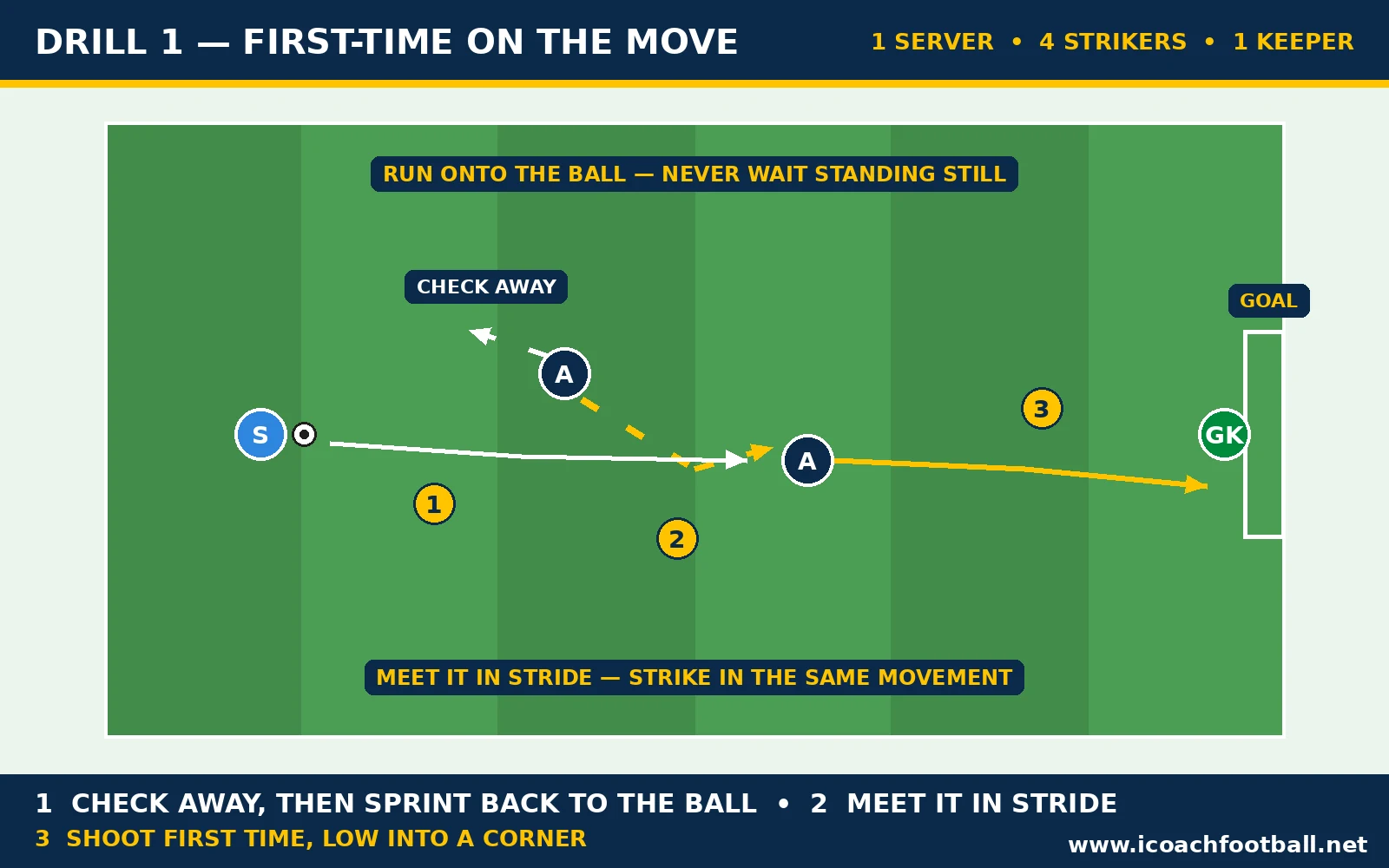
The timing drill — the striker learns to run onto a moving ball and strike it first time, arriving in stride with the corner already picked.
Setup
- Penalty area, 1 full goal, 1 keeper, 1 server, 4 strikers.
- 8 minutes, then swap sides.
How to Play
- The server stands on the edge of the D with a supply of balls, facing the goal.
- The first striker starts on the penalty spot, facing the server.
- The striker checks away from goal, then sprints back towards the ball as the server plays it.
- The server rolls a firm pass along the ground into the striker’s path, ten yards from goal.
- The striker meets the ball in stride and shoots first time, low into a corner.
- The striker collects the ball, joins the back of the line, and the next striker goes.
Coach’s note: “Do not wait for the ball — run onto it. Your last step is your shot; if you are standing still when the ball arrives, you are already too late.”
Progressions: The server plays the ball to the striker’s weaker foot, so both feet learn the timing; the server varies the pace of the pass, so the striker must adjust their stride; the striker must call the corner before the ball is played, so the decision is made early.
Drill 2 — Pick Your Corner
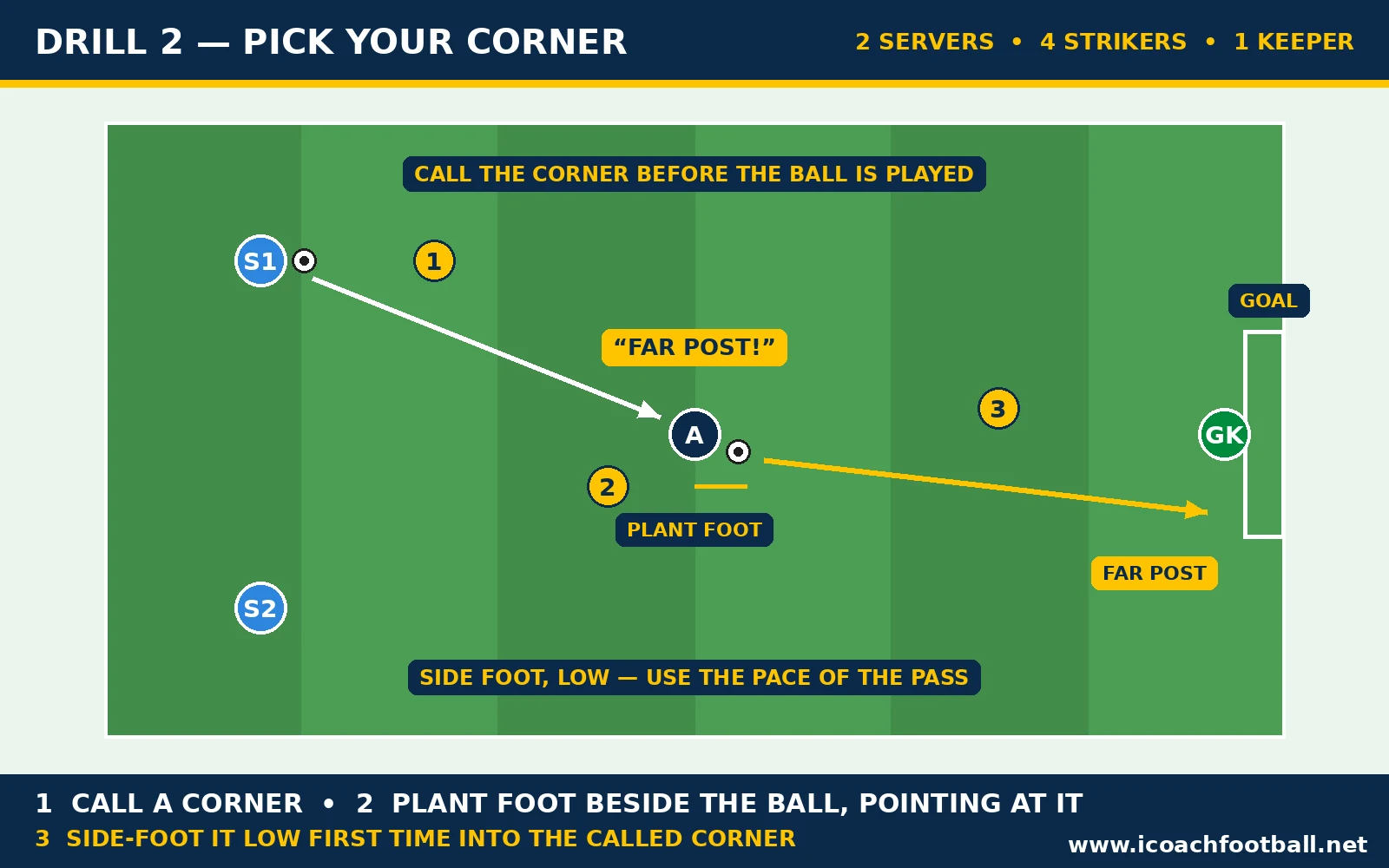
The placement drill — the striker learns to decide the corner before the ball arrives and finish low with the side foot, using the pace of the pass instead of power.
Setup
- Penalty area, 1 full goal, 1 keeper, 2 servers, 4 strikers.
- 10 minutes, then swap sides.
How to Play
- Two servers stand on either edge of the box, each with a supply of balls.
- The first striker starts central on the D, ten yards from goal, facing the servers.
- The striker calls a corner — near post or far post — before the server plays the ball.
- The server drives a firm pass along the ground to the striker’s feet.
- The striker plants their standing foot beside the ball, pointing at the called corner.
- The striker side-foots the ball low into the called corner, first time, and rotates to the back of the line.
Coach’s note: “Call it before the ball moves. The corner is decided while the ball is travelling — the striker who decides as they strike has already missed.”
Progressions: The servers alternate sides without warning, so the striker must set their feet on either foot; the keeper starts a yard off their line, so the placement must be exact; a two-second limit runs from the server’s touch to the shot, so the decision cannot wait.
Drill 3 — The Through-Ball Finish
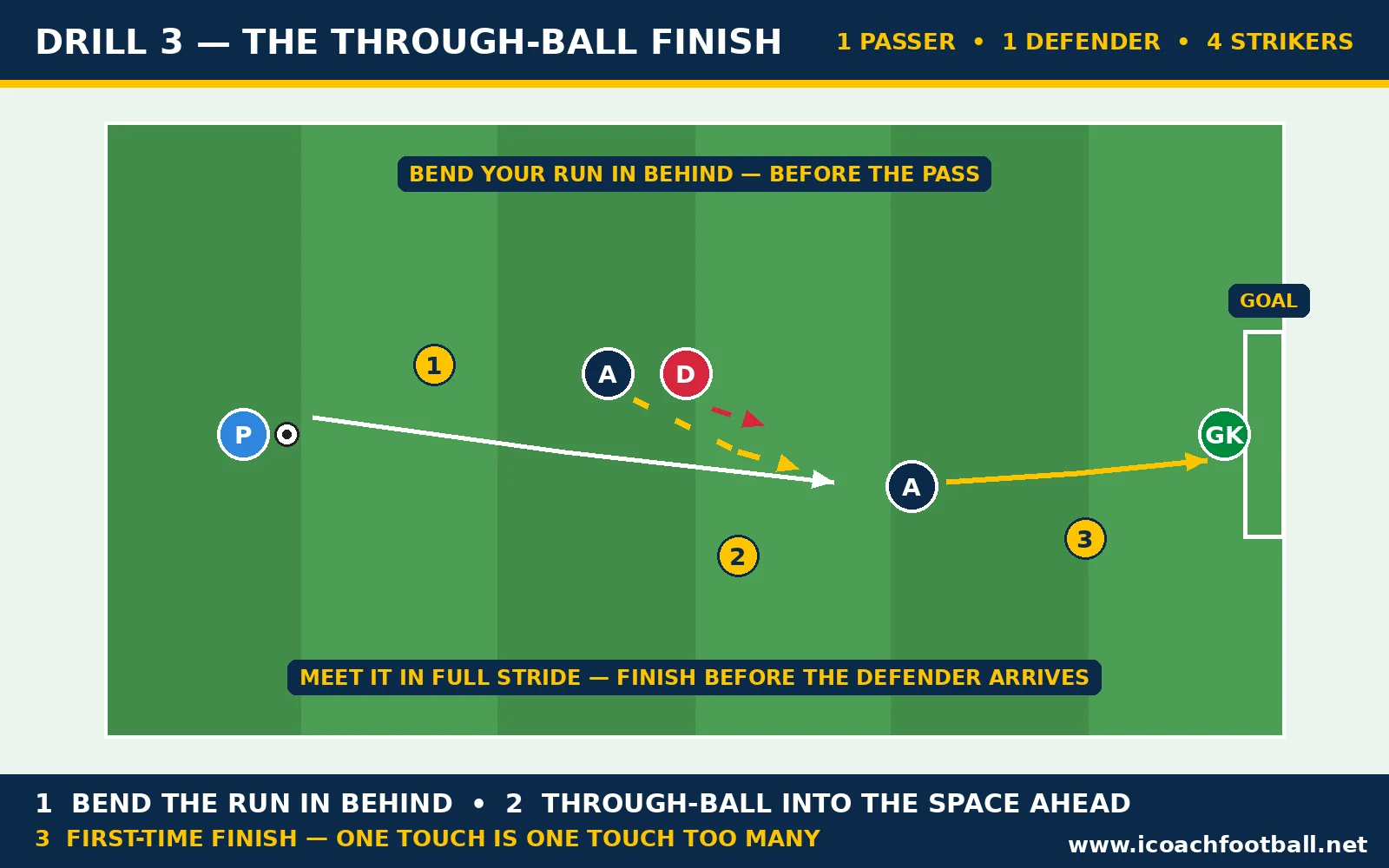
The run drill — the striker times a run in behind the defence, meets the through-ball in full stride, and finishes first time before the recovering defender arrives.
Setup
- Half a pitch, 1 full goal, 1 keeper, 1 passer, 1 defender, 4 strikers.
- 10 minutes, then swap roles.
How to Play
- The passer stands in midfield with balls, facing the goal the strikers attack.
- The first striker starts on the halfway line, level with the defender, five yards apart.
- The striker bends their run in behind the defender, towards the space between the defender and the goal.
- The passer plays a firm through-ball into the space ahead of the striker.
- The striker meets the ball in stride, without breaking their run, and shoots first time.
- The defender sprints back to block the shot — if the finish is first time, the striker scores double.
Coach’s note: “Your run starts before the pass. Bend it early, meet the ball at full speed, and strike in the same movement — one touch is one touch too many.”
Progressions: The defender starts two yards closer, so the striker must time the run later; the passer plays the ball earlier, so the striker must read the body shape, not the pass; the striker must finish with their weaker foot on alternate reps.
Drill 4 — Cutback First Time
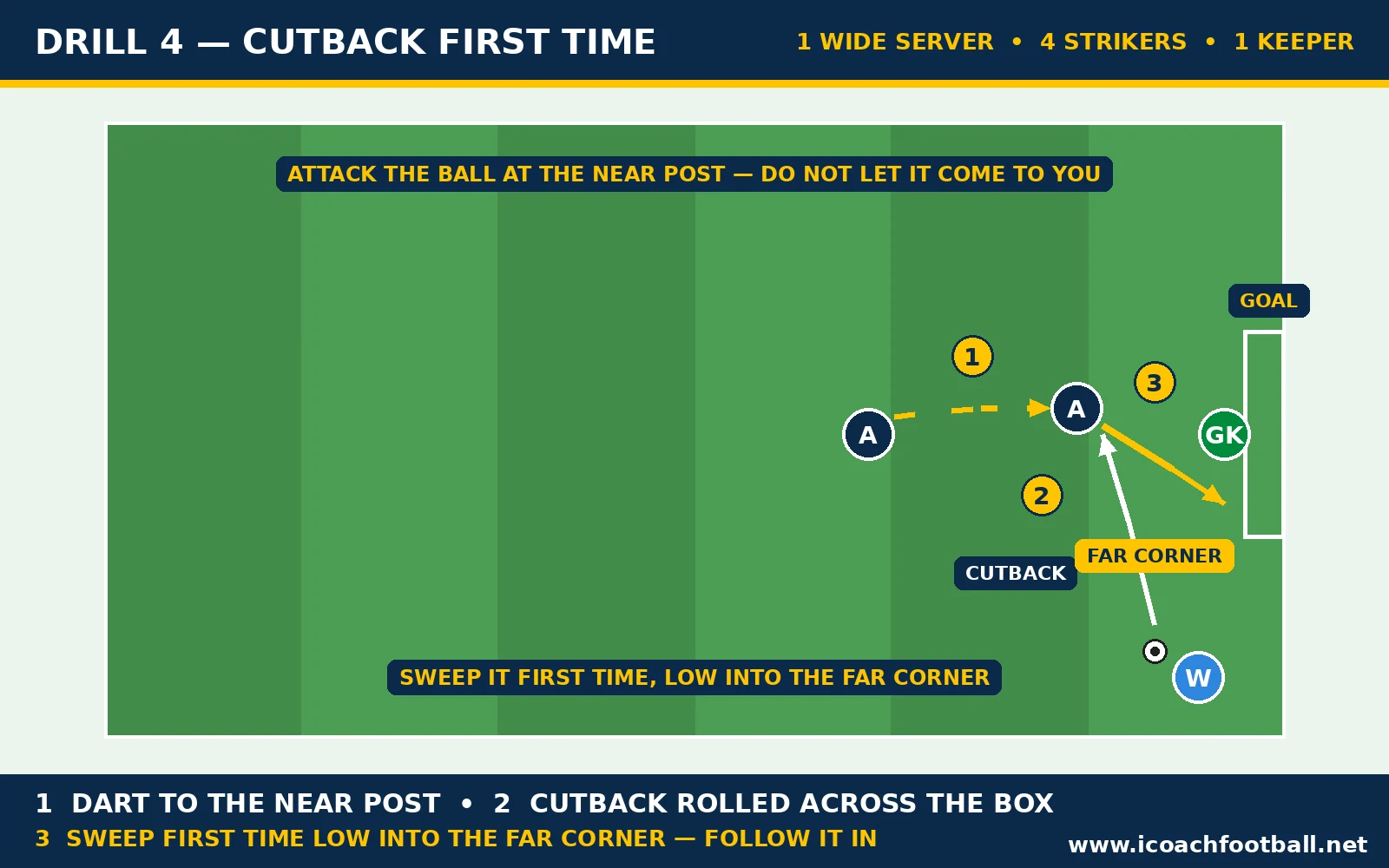
The six-yard-box drill — a wide player rolls the cutback across the face of goal, and the striker attacks the ball and sweeps it first time into the far corner.
Setup
- Penalty area, 1 full goal, 1 keeper, 1 wide server, 4 strikers.
- 10 minutes, then swap sides.
How to Play
- The wide server stands by the byline, level with the six-yard box, with a supply of balls.
- The first striker starts on the penalty spot, facing the server.
- The striker takes two steps away from goal, then darts towards the near post as the server plays.
- The server rolls a firm cutback along the ground across the six-yard box.
- The striker attacks the ball at the near post and side-foots it first time, low into the far corner.
- The striker follows the shot in for the rebound, then joins the back of the line.
Coach’s note: “Attack the ball — do not let it come to you. The cutback is the most common goal in the game, and it is scored by the striker who moves first.”
Progressions: The server varies the cutback — near post, penalty spot or far post — so the striker must read the ball; a defender starts at the far post, so the finish must beat the cover; the striker must score with one touch from a cutback played behind them.
Drill 5 — Volley and Half-Volley
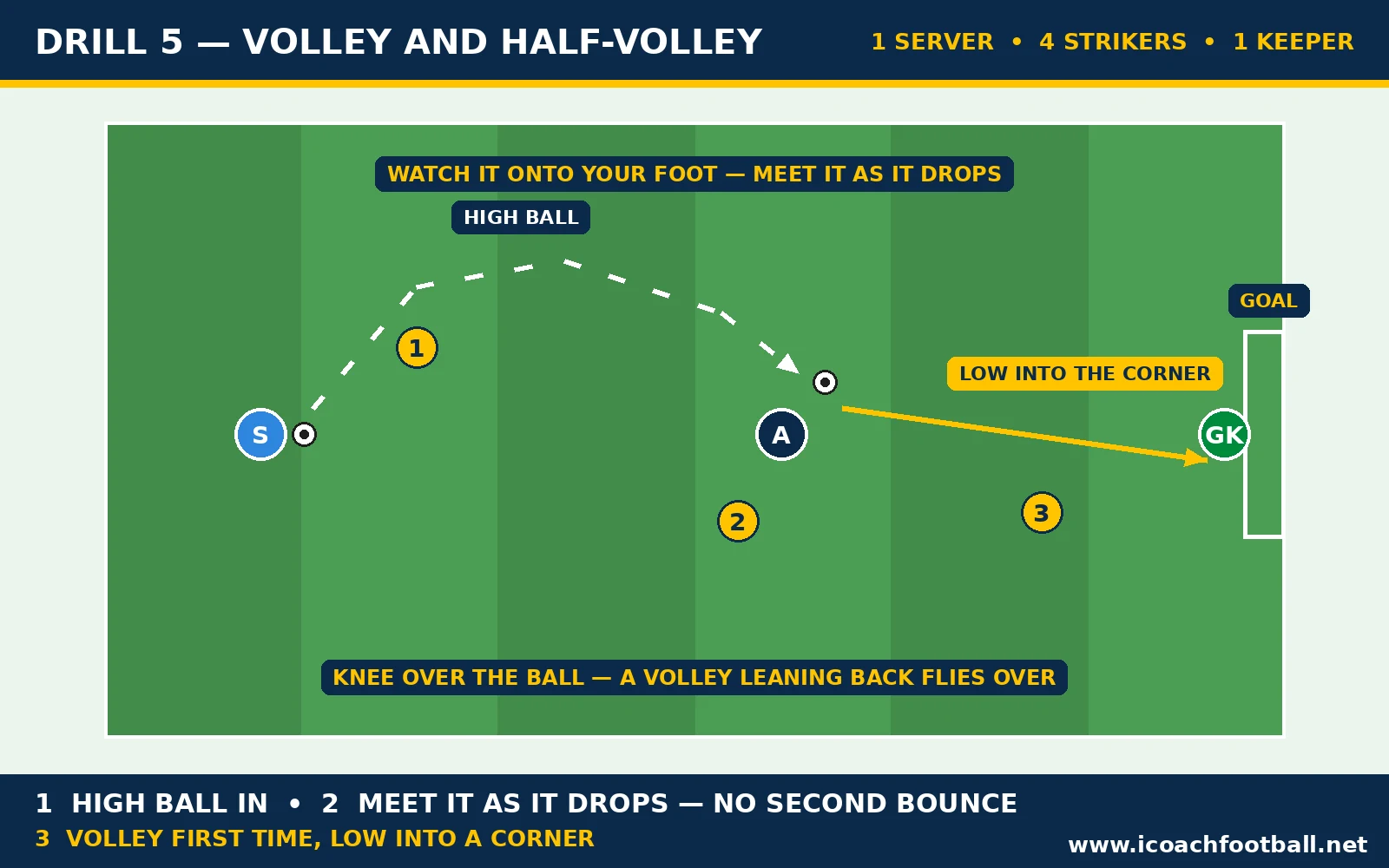
The high-ball drill — the server plays a high ball into the striker, who must volley or half-volley it first time, keeping the knee over the ball so the shot stays low.
Setup
- Edge of the penalty area, 1 full goal, 1 keeper, 1 server, 4 strikers.
- 10 minutes, then swap roles.
How to Play
- The server stands fifteen yards from goal, facing the striker, with a supply of balls.
- The first striker starts on the edge of the box, twelve yards from goal, side-on to the server.
- The server tosses or clips a high ball towards the striker’s chest height.
- The striker watches the ball onto their foot and meets it as it drops, without letting it bounce twice.
- The striker volleys or half-volleys first time, low into a corner, with the knee over the ball.
- The striker collects the ball, returns it to the server, and joins the back of the line.
Coach’s note: “Watch it onto your foot and keep your knee over the ball. A volley struck with the knee over it stays low — a volley struck leaning back flies over the bar.”
Progressions: The server plays the ball higher, so the striker must judge the drop; the server plays the ball to the striker’s weaker foot; the striker must volley from a cross played from the wide channel, so the ball arrives at an angle.
Drill 6 — First-Time Finishes Count Double
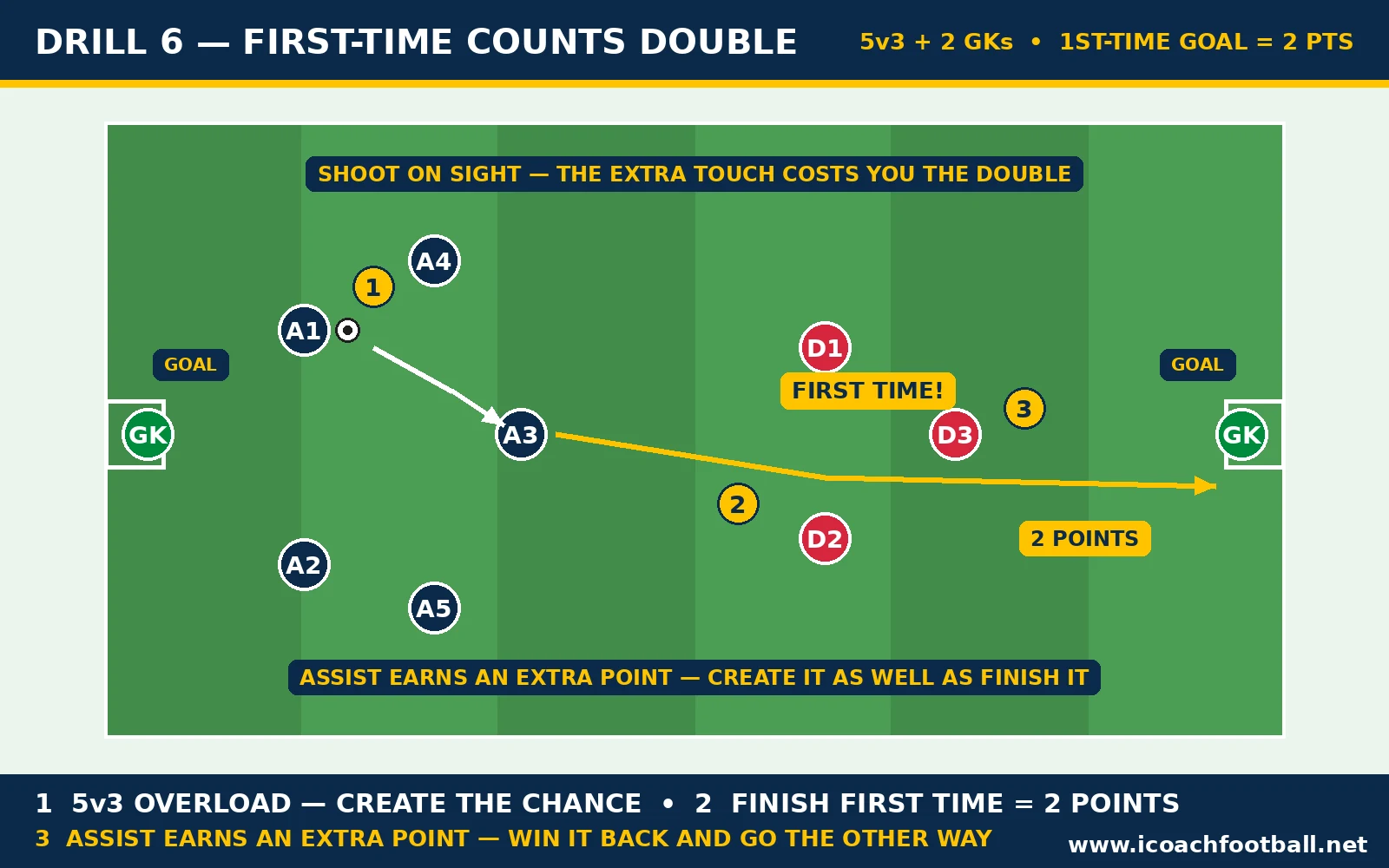
The full game. A 5v3 plus goalkeepers game where a goal scored first time counts double — so the whole team starts creating and taking one-touch chances.
Setup
- Area 30 yards by 20 yards, 2 full goals, 2 goalkeepers, 5 attackers, 3 defenders.
- 12 minutes.
How to Play
- Two teams play 5v3 plus goalkeepers — the attacking team has the overload, the defending team tries to win it back.
- The attacking team scores 1 point for a normal goal and 2 points for a goal scored first time.
- A goal scored following an assist earns an extra point, so creating the chance matters too.
- If the defending team wins the ball, they attack the opposite goal and the teams swap roles.
- After a goal or the ball going out, the attacking team restarts quickly and attacks the other end.
- The team with the most points after 12 minutes wins — then play again with new teams.
Coach’s note: “Shoot on sight. The moment the group starts taking the first-time chance instead of the extra touch, the goals double — and so does the confidence.”
Progressions: The overload shrinks to 4v3, so the first-time chance must be created faster; only goals scored from inside the penalty area count double; a first-time goal scored from a cross counts triple.
Coaching points
- Decide the corner before the ball arrives. The striker who is still choosing as they strike snatches at it — near post or far post is decided while the ball is travelling.
- Arrive in stride, never standing still. Time the run so the striker meets the ball at full speed — a standing striker needs a touch, and the chance is gone.
- Plant foot beside the ball, pointing at the target. The standing foot lands next to the ball with the toes pointing where the shot is going — it aims the finish.
- Knee over the ball, ankle locked. The knee over the ball keeps the shot low, and a low finish is far harder for the keeper to save than a high one.
- Use the pace of the ball. The pass already carries power — a short, firm sweep with the side foot or laces keeps the ball on target where a wild swing sends it over the bar.
- Follow the shot in. The keeper may parry the first attempt — the striker who is already running in scores the rebound, and the second ball is the easiest goal in football.
Common mistakes
| Mistake | Fix |
|---|---|
| Standing still and waiting for the ball, then needing a touch | Time the run to meet the ball in stride — Drill 1 stops the rep if the striker is standing still when the ball arrives |
| Deciding the corner as the foot strikes, and snatching the shot | Call the corner before the ball is played — Drill 2 only scores the rep if the called corner is hit |
| Plant foot landing behind the ball, so the shot balloons over the bar | Plant beside the ball, toes pointing at the target — Drill 2 stops the rep if the plant foot lands behind the ball |
| Swinging hard at the ball instead of using its pace | Short, firm sweep with the side foot — Drill 2 only scores the rep if the finish is low and on target |
| Leaning back on the volley, so the shot flies over | Knee over the ball on every volley — Drill 5 stops the rep if the striker leans back |
| Taking the extra touch in the game instead of shooting first time | First-time goals count double — Drill 6 only awards the double point if the finish is genuinely first time |
Age adaptations
| Age | Format | What changes |
|---|---|---|
| U11–U13 (ages 10–13) | Small areas, size 4 ball, coach serves every ball | All six drills run with the ball served slowly and close to goal, so the timing and the plant foot are learned before pace is added. Drill 3 uses a through-ball played only five yards ahead, so the run is always winnable. Drill 5 uses a half-volley only — no full volleys until the timing is secure. Drill 6 plays with no scoreboard for normal goals — only first-time goals are counted, so the group learns what a one-touch chance looks like |
| U14–U15 (ages 13–15) | Full areas, size 4 ball, passes played live from the first rep | All six drills run as written, with the defender added to Drill 3 from the second round. Drill 2 adds the two-second limit, so the corner decision must be made early. Drill 4 adds the far-post defender, and Drill 5 adds the volley from a wide cross. Strikers keep a simple count — “ten first-time finishes, seven on target” is the habit that sticks |
| U16–U17 (ages 15–17) | Full areas, size 5 ball, full speed from the first rep | Full pressure from the start. Drill 1 uses a faster, bouncing pass, Drill 3 starts the defender two yards closer, and Drill 6 shrinks the overload to 4v3. Strikers are asked to call their corner and their surface — “far post, side foot” — before each rep, so the decision becomes a conscious skill, not a lucky guess |
60-minute session plan
| Block | Time | Content |
|---|---|---|
| Arrival game | 0:00–0:05 | Free 3v3 in the box — every first-time goal counts double |
| First-time on the move | 0:05–0:13 | Drill 1 — First-Time on the Move |
| Pick your corner | 0:13–0:23 | Drill 2 — Pick Your Corner |
| The through-ball finish | 0:23–0:33 | Drill 3 — The Through-Ball Finish |
| Cutback first time | 0:33–0:43 | Drill 4 — Cutback First Time |
| Volley and half-volley | 0:43–0:51 | Drill 5 — Volley and Half-Volley |
| First-time finishes count double | 0:51–1:00 | Drill 6 — First-Time Finishes Count Double |
Keep building from here
The finish under pressure — holding the ball, beating the defender and scoring when marked tight — is our soccer drills for improving finishing under pressure, and the duel that creates the shooting chance in the first place is our 1v1 finishing drills soccer. The shooting library to work through next is our 7 soccer shooting drills, and the full collection is our 51 shooting drills finishing exercises and games PDF. The volley itself, practised on its own, is our soccer volley drills technique, and the cutback that sets up the first-time finish is our soccer cutback drills. The near-post run that meets the low cross first time is our soccer drills for improving attacking the near post, and the far-post arrival is our soccer drills for improving attacking the back post. The late run into the box that creates the one-touch chance is our football late runs into the box drills, and the wide-channel cross that supplies it is our the wide channel game crossing and finishing. The pass that must arrive at the right pace is trained in our soccer drills for improving passing under pressure, and the first touch that sets up the shot when a touch is available is our soccer drills for receiving under pressure. The combination that opens the defence before the finish is our 7 best passing and finishing soccer drills. First-time shooting is high-intensity — plan the week’s load with our training load calculator.
How do you teach first-time shooting?
Start with the run, not the strike. Teach the striker to time their run so they meet the ball in stride, with the corner already picked — then add the plant foot beside the ball and the knee over it. Begin with a slow, rolling pass ten yards from goal and no defender, and only add pace, a bouncing ball and a recovering defender once the timing is secure. Drill 1 trains the run, and Drill 2 trains the early corner pick.
Should young players shoot first time or take a touch?
It depends on their age and the chance. Young players will usually need a touch or two to get ready to score, and England Football Learning advises letting them shoot on their terms — first-time finishes come more often as players get older and as small-number games increase the chances. Reward first-time finishes from short distances first, and let the touch stay an option until the timing is there. Drill 1 starts with a slow serve close to goal for exactly that reason.
What is the correct technique for a first-time finish?
Approach the ball from the side, not head on, and look up to see the keeper’s position before you strike. Plant your standing foot beside the ball, pointing at the target, with your knee over the ball and your ankle locked. Strike with the laces for power or the side foot for placement, keep your head still over the ball, and follow through towards the target. Use the pace of the ball — a short, firm sweep beats a wild swing. Drill 2 trains the side-foot placement, and Drill 5 trains the knee-over-the-ball volley.
How do you finish a cutback first time?
Attack the ball at the near post and sweep it first time, low, into the far corner. Take two steps away from goal, then dart towards the near post as the wide player plays the cutback — the striker who moves first meets the ball in stride, and the side-foot sweep uses the pace of the cross. Do not let the ball run across you, and follow the shot in for the rebound. Drill 4 trains the cutback finish.
At what age should players start training first-time shooting?
From U11, with a slow serve close to goal, so the timing, the plant foot and the early corner pick become habits before pace is added. The run and the decision can be trained young — what must wait is the full-speed through-ball finish against a recovering defender. Add live passes and opposed attackers gradually from U13, and full-pressure first-time shooting from U15, once the striker arrives in stride and picks a corner every time.
Sources
- FIFA Training Centre. “54) Creating chances and finishing (Urias)” — the FIFA Training Centre session delivered by FIFA Technical Expert Jonas Urias trains players to finish first time: its finishing warm-up asks shooters to finish first time, its high-ball variation asks for a first-time volley or header, its 7v3 exercise asks the only player allowed in the penalty area to finish first time following a through-ball, and its points system rewards spectacular goals and goals scored following an assist. Verified live 2026-11-21 (HTTP 200, full text read). Drills 1, 3 and 6 are based on / in line with this session’s first-time finishing and chance-creation principles.
- England Football Learning. “How to design a football shooting session” — England Football Learning’s shooting-session guide teaches coaches to stage shooting practice close to goal, noting that 82% of goals at Euro 2020 were scored from inside the 18-yard box; to use small-number activities such as 3v3 because they increase the likelihood of a first-time finish; to introduce overloads so strikers practise finishing when outnumbered; and to build in assists so players learn to create the chance as well as finish it. Verified live 2026-11-21 (HTTP 200, full text read). Drills 2, 4 and 5 are based on / in line with this guide’s close-to-goal, small-numbers and assists principles.