Soccer Drills for Improving Aerial Duels: 6 Games That Teach Players to Win the Ball in the Air (U12–U16)
Quick answer
An aerial duel is won before the ball arrives. The player who reads the flight early, gets their body goal-side, times the jump to meet the ball at its highest point — and lands ready for the second ball — wins it. Heading technique alone does not win duels; timing, body position and the reaction after the header do. Six games — one 60-minute session — teach players to time the jump, hold their ground, attack crosses, flick the ball on, clear it high and wide, and win the ball that drops.
Suitable for: U12–U16 (ages 11–16)
Session snapshot
- Players: 12–16 (U12–U16)
- Area: 20 x 15-yard area expanding to a 40 x 30-yard game pitch
- Duration: 60 minutes
- Focus: Jump timing, body position, attacking vs defensive headers, winning the second ball
- Age: U12–U16
- Equipment: 12–14 balls (lightweight/foam balls for U12–U13 heading work), 20 cones, 2 full goals, bibs
Heading safety first
Read this before you run the session. Heading is age-restricted, and the rules are not suggestions — leagues enforce them and referees apply them.
- U11 and under: no heading. U.S. Soccer’s Concussion Initiative bans heading in practice and games at U11 and under. England Football is phasing deliberate heading out of grassroots matches at U7–U11 — U11 was added from the 2026–27 season — and heading is introduced at U12. If you coach U10–U11, run this session with chest and thigh control instead of heading (see the age adaptations table).
- U12–U13: limited heading. U.S. Soccer limits heading practice to a maximum of 30 minutes per week, with no more than 15–20 headers per player per week. This 60-minute session contains far fewer than 15 headers per player — count them, and do not add a second heading block in the same week.
- Light balls, low volume. Use lightweight or foam balls when introducing heading, serve the ball by hand or with a soft toss, and stop the drill if a player is heading with the top of their head or closing their eyes. Head with the forehead, eyes open, arms out for balance.
- Landing matters as much as jumping. Teach players to land on two feet, knees bent, ready to move — most aerial-duel injuries in youth football come from the landing, not the header.
- When in doubt, sit them out. Any player who takes a knock to the head sits out and is checked by a qualified health professional before returning.
Why these six games work
Watch a youth game for five minutes and you will see it. A cross comes in, two players jump — and the one who jumps a half-second late watches the ball sail over their head. Or a long ball drops, both players wait for it to land, and the second ball falls to the opponent. The header was never the problem. The duel was.
FIFA’s Training Centre builds heading the same way in its grassroots session for 12–15s, “#102 Use your head”: start with a throw-head-catch sequence in a 2v2, move to 2v2 attacking headers where players serve each other and head towards goal, then finish in a 6v6 game where a headed goal counts double. The lesson is the same at every stage — attack the ball, time the jump, and make the header count. Drills 1, 3 and 6 below are based on / in line with that FIFA material. In the UK the same session is football drills for improving aerial duels — the distances, the cues and the coaching points are identical.
This post fills the gap in our defending and attacking clusters: our football heading drills teach attacking heading technique through the near-post run, our wide channel game teaches the cross itself, and our soccer defending long balls drills teach the team shape against the long ball. This session adds the missing piece — the duel in the air, and the ball that drops after it.
Six aerial-duel rules
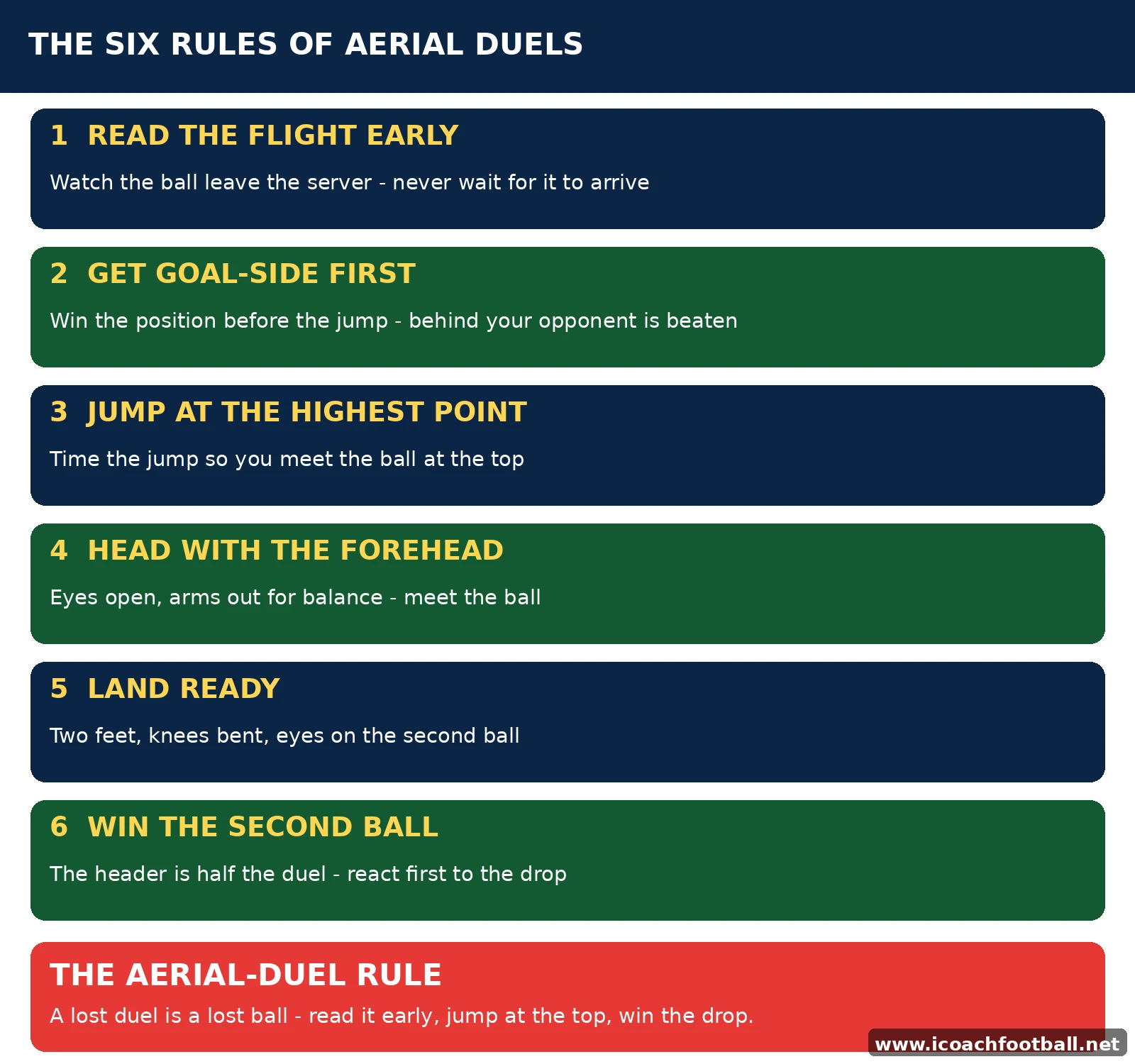
- Read the flight early. Watch the ball leave the server’s hands or foot — never wait for it to arrive.
- Get goal-side first. Win the position before the jump; a player behind their opponent is already beaten.
- Jump at the highest point. Time the jump so you meet the ball at the top — jump too early and you are falling when it arrives.
- Head with the forehead. Eyes open, arms out for balance, meet the ball — never let it hit you.
- Land ready. Two feet, knees bent, eyes on the second ball before your feet touch the ground.
- Win the second ball. The header is half the duel — the player who reacts first to the drop wins the possession.
Drill 1 — Jump Timing
The starting point. Two players, one server, one ball tossed high between them — and the only rule that matters: meet the ball at its highest point. A player who jumps on time beats a taller player who jumps late, every time.
Setup
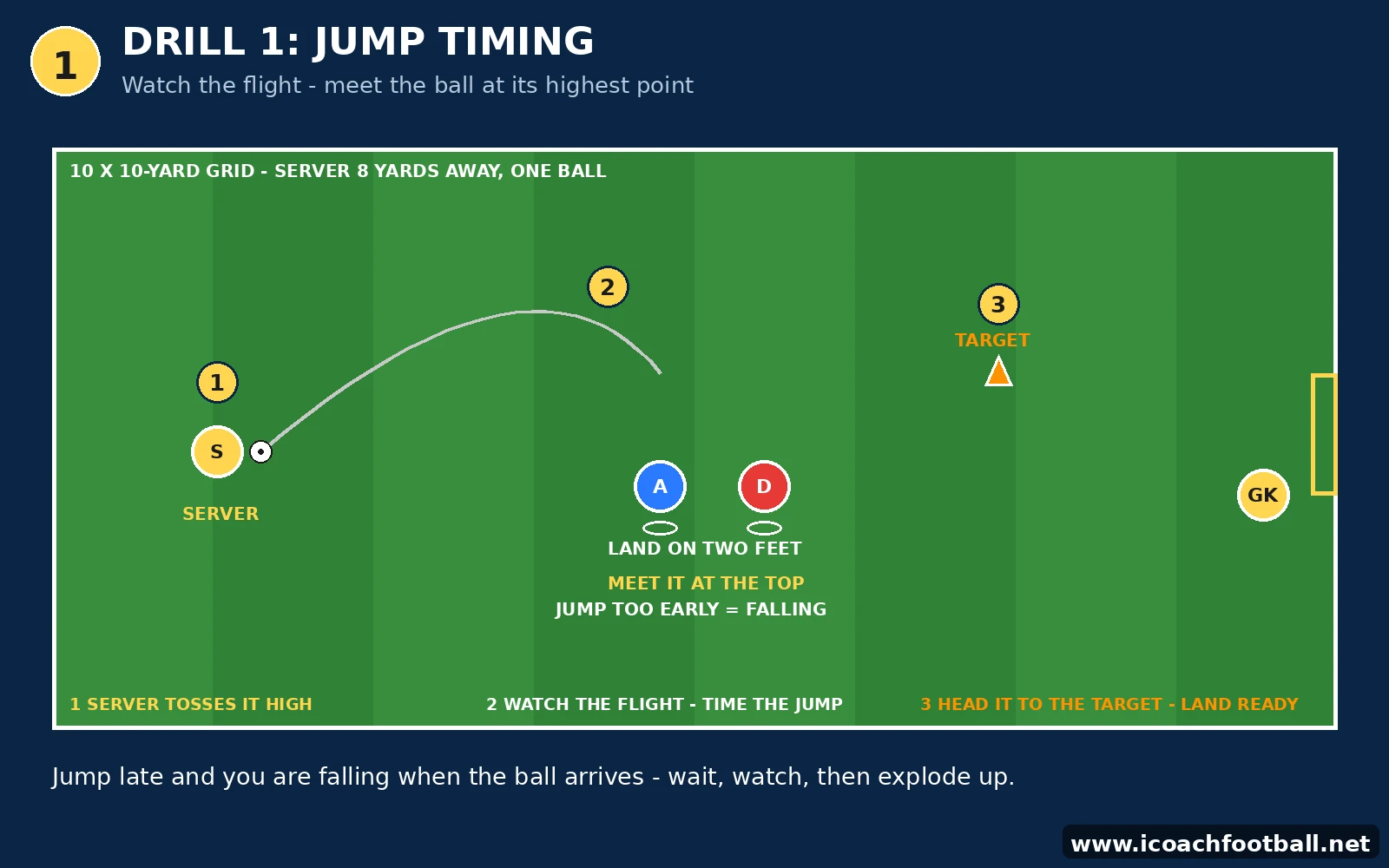
- 10 x 10-yard grid, one ball, server 8 yards away.
- 12 players: 6 pairs, 1 server per grid. 8 minutes.
How to Play
- The server tosses the ball high between the two players, from 8 yards away.
- Both players watch the ball leave the server’s hands — never the opponent.
- Each player times their jump to meet the ball at its highest point.
- The player who wins the header heads it to the target cone — 1 point for winning it, 2 for hitting the target.
- Both players land on two feet, knees bent, and immediately react to the drop.
- After 4 goes, swap pairs so everyone jumps against someone new.
Coach’s note: “Jump late and you are falling when the ball arrives — wait, watch, then explode up.”
Progressions: The server tosses the ball higher so the jump must be timed later; the winner must head to a moving target; the loser must win the second ball to cancel the point. FIFA’s “Use your head” session builds the same skill with a throw-head-catch sequence before any heading — start there with younger or nervous players.
Drill 2 — Body-Position Duel
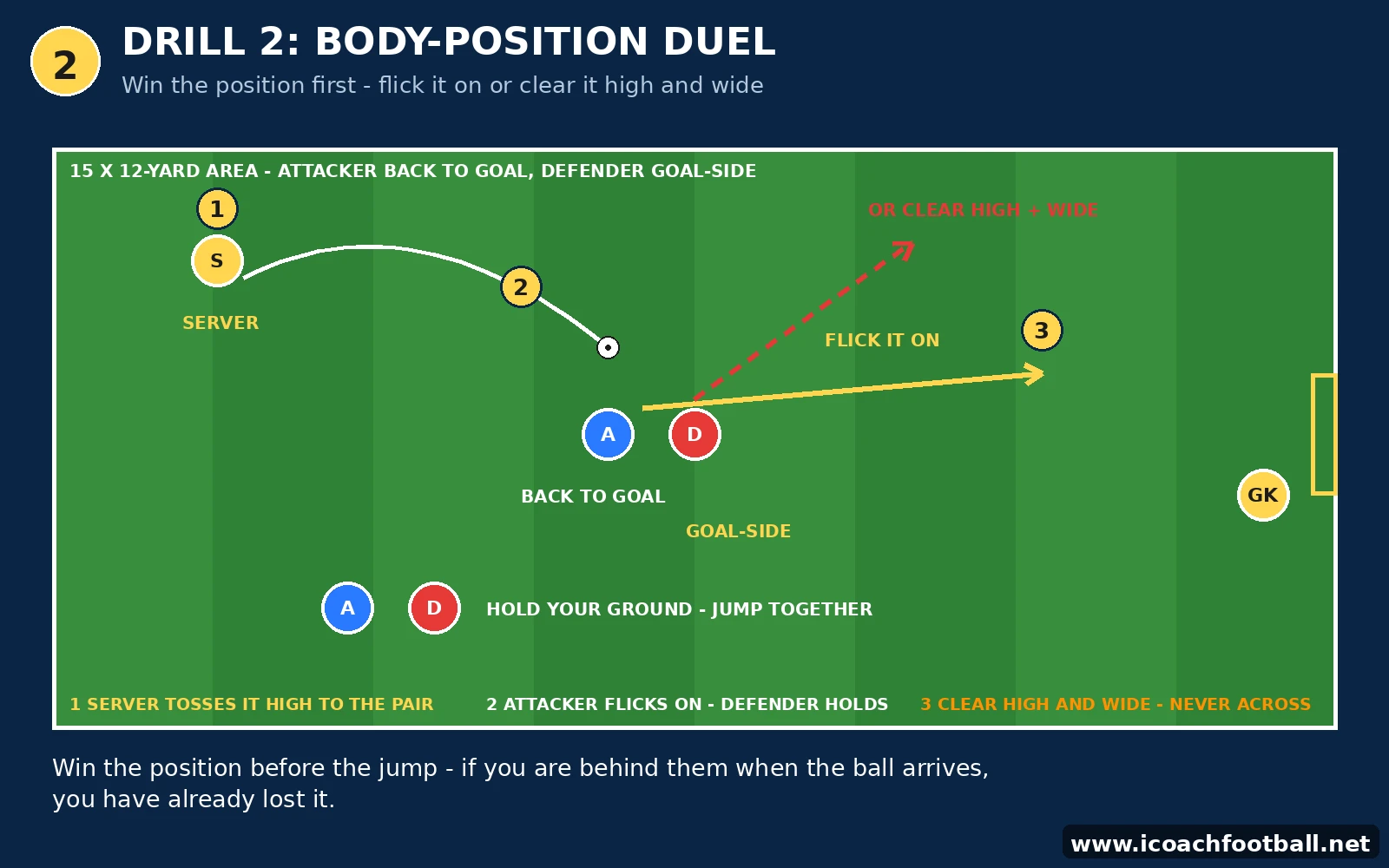
The shield. An attacker with their back to goal, a defender goal-side behind them, and a ball served in high — and the attacker must win the flick-on while the defender holds their ground. This is the duel that decides every long ball in a match.
Setup
- 15 x 12-yard area, one goal 15 yards behind the pair, server at the side.
- 10 players: 4 attackers, 4 defenders, 1 server, 1 goalkeeper. 8 minutes.
How to Play
- The attacker starts with their back to goal, the defender goal-side and touch-tight behind them.
- The server tosses the ball high towards the pair from 12 yards away.
- The attacker jumps to flick the ball on towards the goal — forehead, eyes open.
- The defender holds their ground, jumps with the attacker, and tries to win the header first.
- A flick-on that reaches the goalkeeper’s area scores 1 point for the attacker; a defensive header scores 1 for the defender.
- After 3 goes, rotate — server, attacker and defender all change.
Coach’s note: “Win the position before the jump — if you are behind them when the ball arrives, you have already lost it.”
Progressions: The server may serve from the other side so the pair must adjust; the defender must head the clearance high and wide, not back across goal; the attacker must flick on to a running teammate. The tight marking that holds the attacker in place is trained in our soccer drills for improving marking, and the goal-side position itself is our soccer drills for improving defensive positioning.
Drill 3 — Attack the Cross
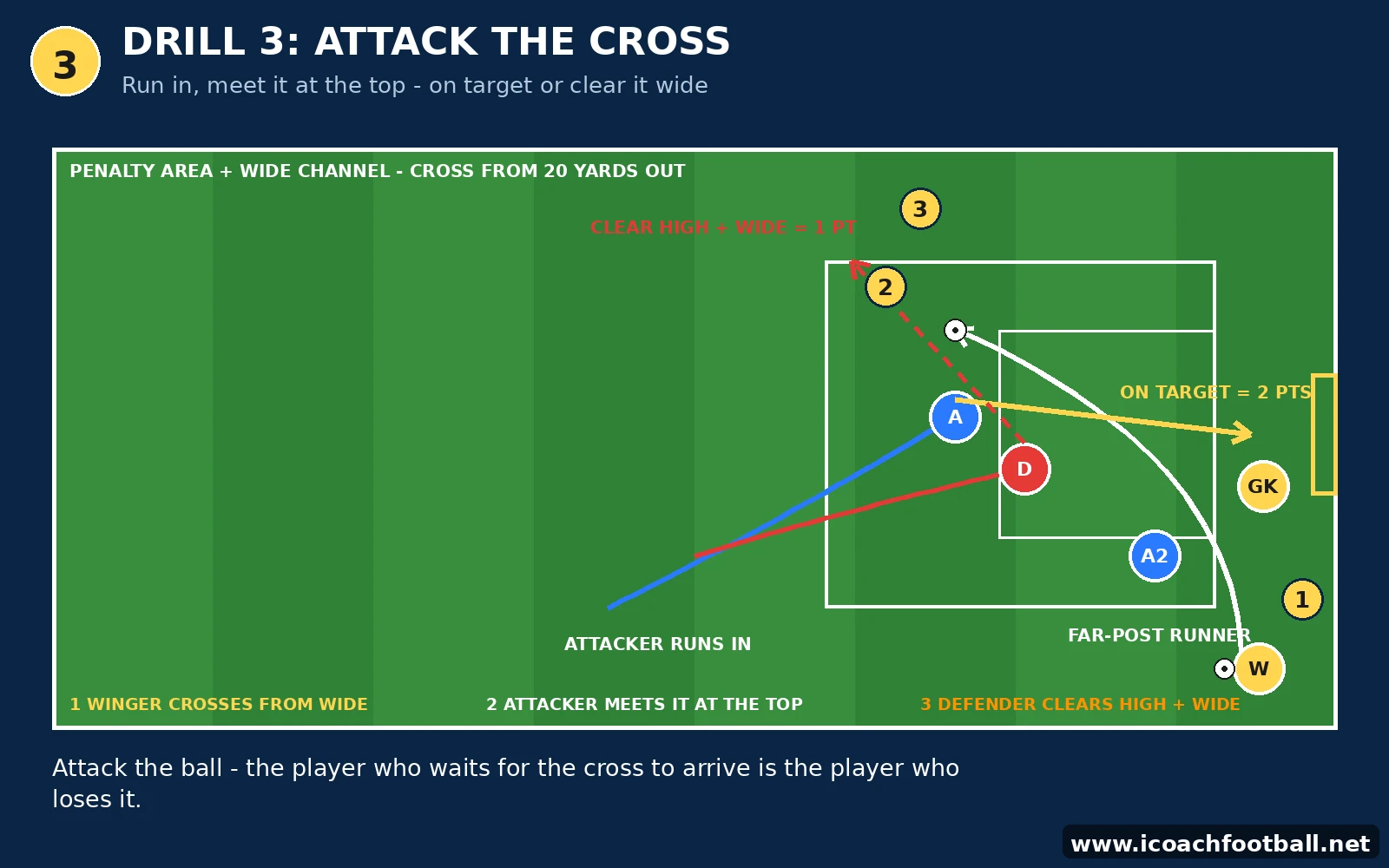
The cross. A winger serves from wide, an attacker and a defender run into the box, and the attacker must meet the ball at its highest point while the defender tries to clear it. This is the aerial duel that decides games — and the one youth teams practise least.
Setup
- Penalty area plus a wide channel, full goal, server wide on the right.
- 10 players: 4 attackers, 4 defenders, 1 server, 1 goalkeeper. 8 minutes.
How to Play
- The server takes the ball wide and crosses from 20 yards out.
- The attacker runs into the box and meets the cross at its highest point.
- The defender tracks the run, stays goal-side, and attacks the ball to clear it.
- An attacking header on target scores 2 points; a defensive clearance high and wide scores 1.
- A header that misses the target or goes across goal scores nothing — direction is the skill.
- After 4 crosses, swap attackers and defenders and cross from the other side.
Coach’s note: “Attack the ball — the player who waits for the cross to arrive is the player who loses it.”
Progressions: The cross may be driven low or floated high so the timing must change; a second attacker makes a near-post run; the defender must clear to a teammate, not just away. The cross itself is trained in our wide channel game, and the attacking header that finishes it is our football heading drills. Reading the flight early is trained in our soccer scanning drills.
Drill 4 — Win the Second Ball
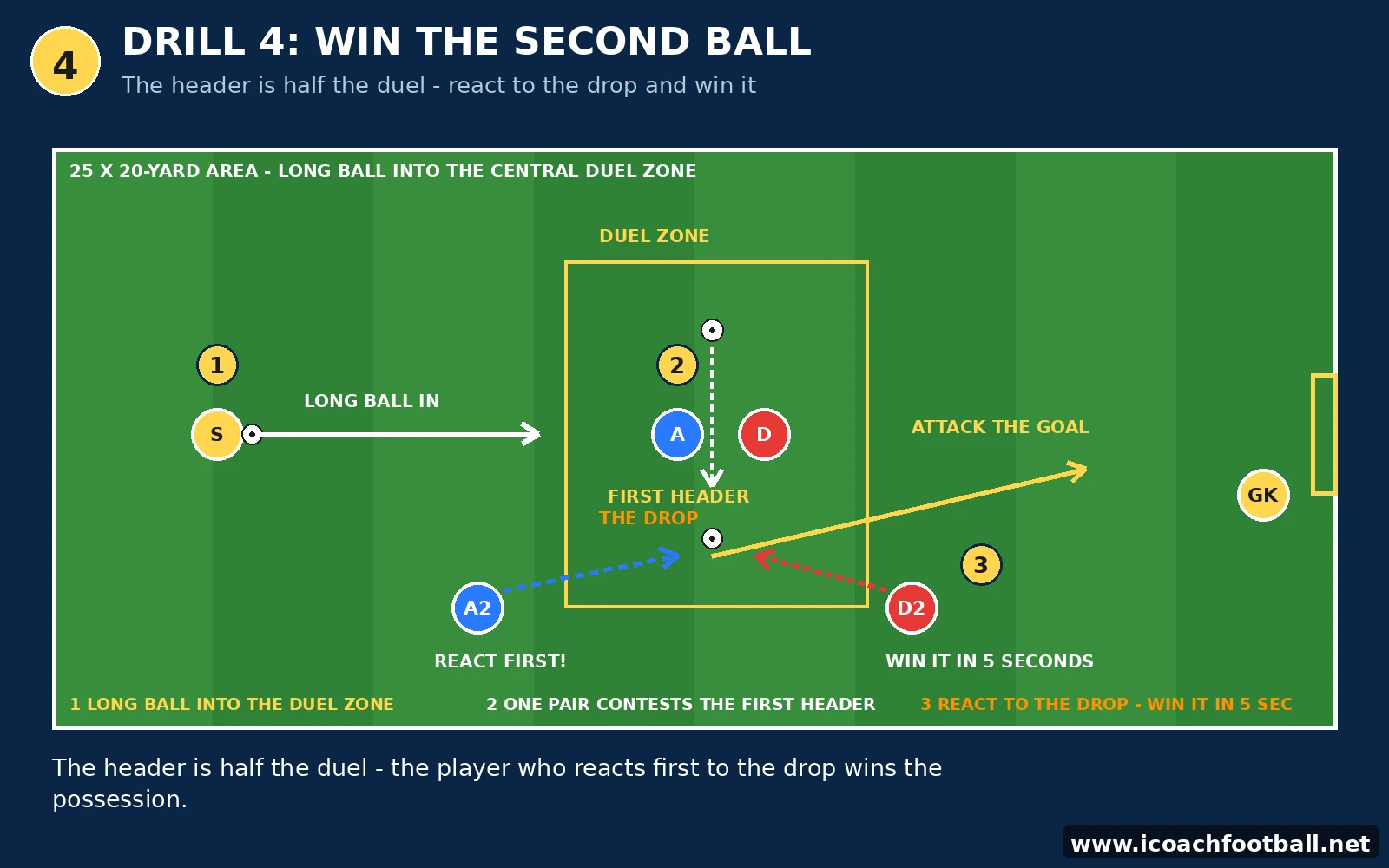
The drop. A long ball is played into a zone, two players contest the first header — and the real game starts when the ball drops. Three players on each side fight for the loose ball, and the team that wins it attacks the goal.
Setup
- 25 x 20-yard area, full goal at one end, cones marking a central duel zone.
- 12 players: 6 attackers, 6 defenders, 1 goalkeeper, 1 server. 8 minutes.
How to Play
- The server plays a long ball high into the central duel zone.
- One attacker and one defender jump for the first header — the rest hold their shape.
- The moment the header is won, the ball drops — and the second ball is live.
- The nearest player on each side reacts first and fights for the loose ball.
- The team that wins the second ball attacks the goal within 5 seconds.
- After 4 balls, swap the jumping pair so everyone contests the first header.
Coach’s note: “The header is half the duel — the player who reacts first to the drop wins the possession.”
Progressions: The first header must be directed to a teammate, not just won; the second-ball winner must play one-touch to a runner; add a second server so the next ball arrives before the last one is finished. The 1v1 fight for the loose ball is trained in our 1v1 defending drills.
Drill 5 — Aerial Duel at the Set Piece
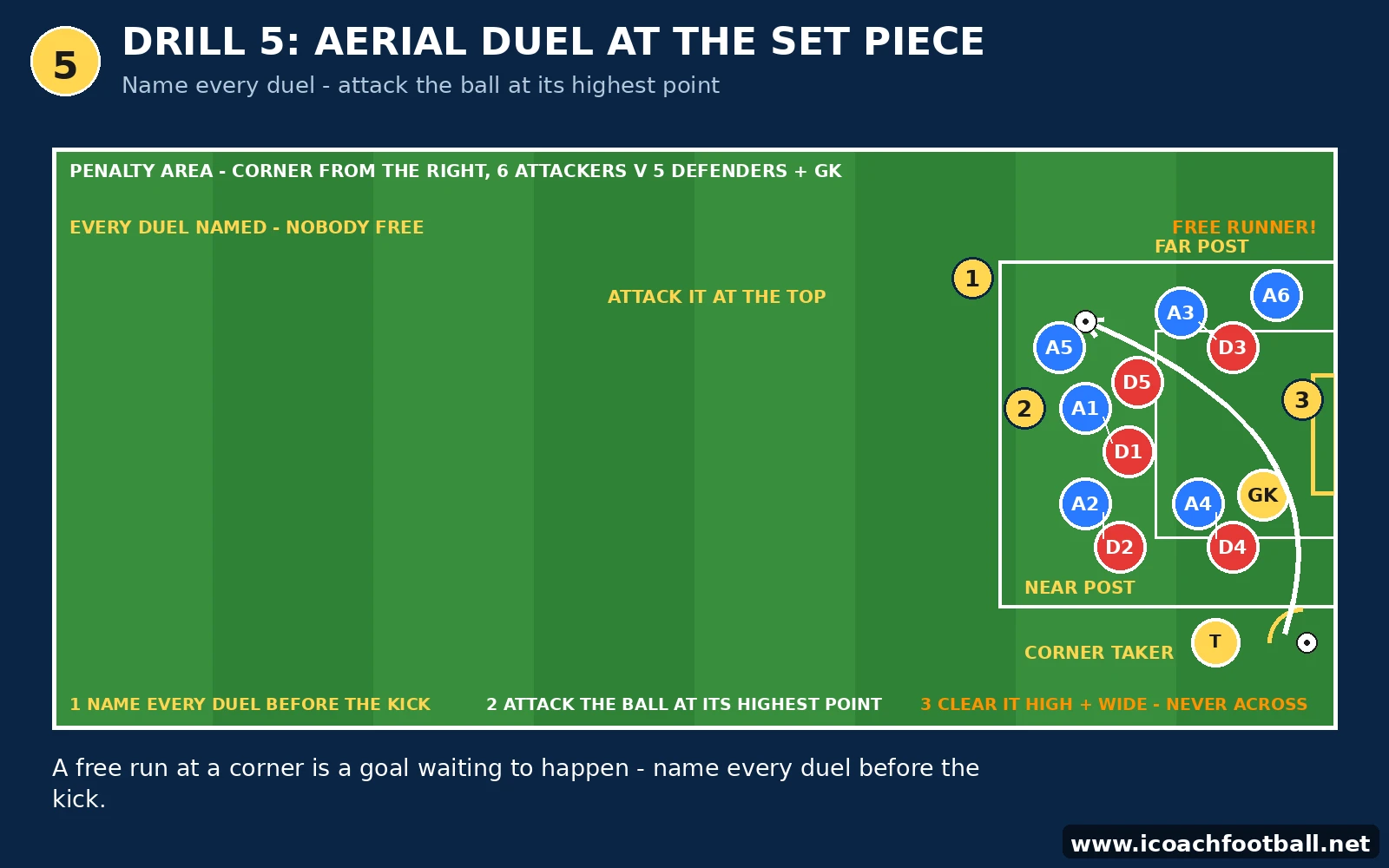
The set piece. A corner or free kick into the box, six attackers against five defenders and a goalkeeper — and every aerial duel is named before the kick. Most goals from set pieces are not lost headers; they are lost duels: a free run, a mistimed jump, or a second ball nobody attacked.
Setup
- Penalty area, corner from the right, 1 ball.
- 12 players: 6 attackers, 5 defenders, 1 goalkeeper. 8 minutes.
How to Play
- Before the kick, every defender names their duel out loud — near post, far post, and each attacker.
- The goalkeeper organises the line — “near post mine, far post yours.”
- The corner is taken; every defender attacks the ball at its highest point.
- The near-post defender attacks the ball at the near post; the far-post defender covers the back post.
- A clearance must go high and wide — never across the face of goal.
- After 3 corners, swap attackers and defenders and take the corner from the other side.
Coach’s note: “A free run at a corner is a goal waiting to happen — name every duel before the kick.”
Progressions: The attackers run a near-post flick or a far-post block; defenders must switch duels if an attacker changes position before the kick; the corner is taken short, so the nearest defender must press the taker. The full set-piece system is our football defending set pieces drills, and the keeper’s organising calls are our soccer goalkeeper communication drills.
Drill 6 — Aerial Duel Small-Sided Game
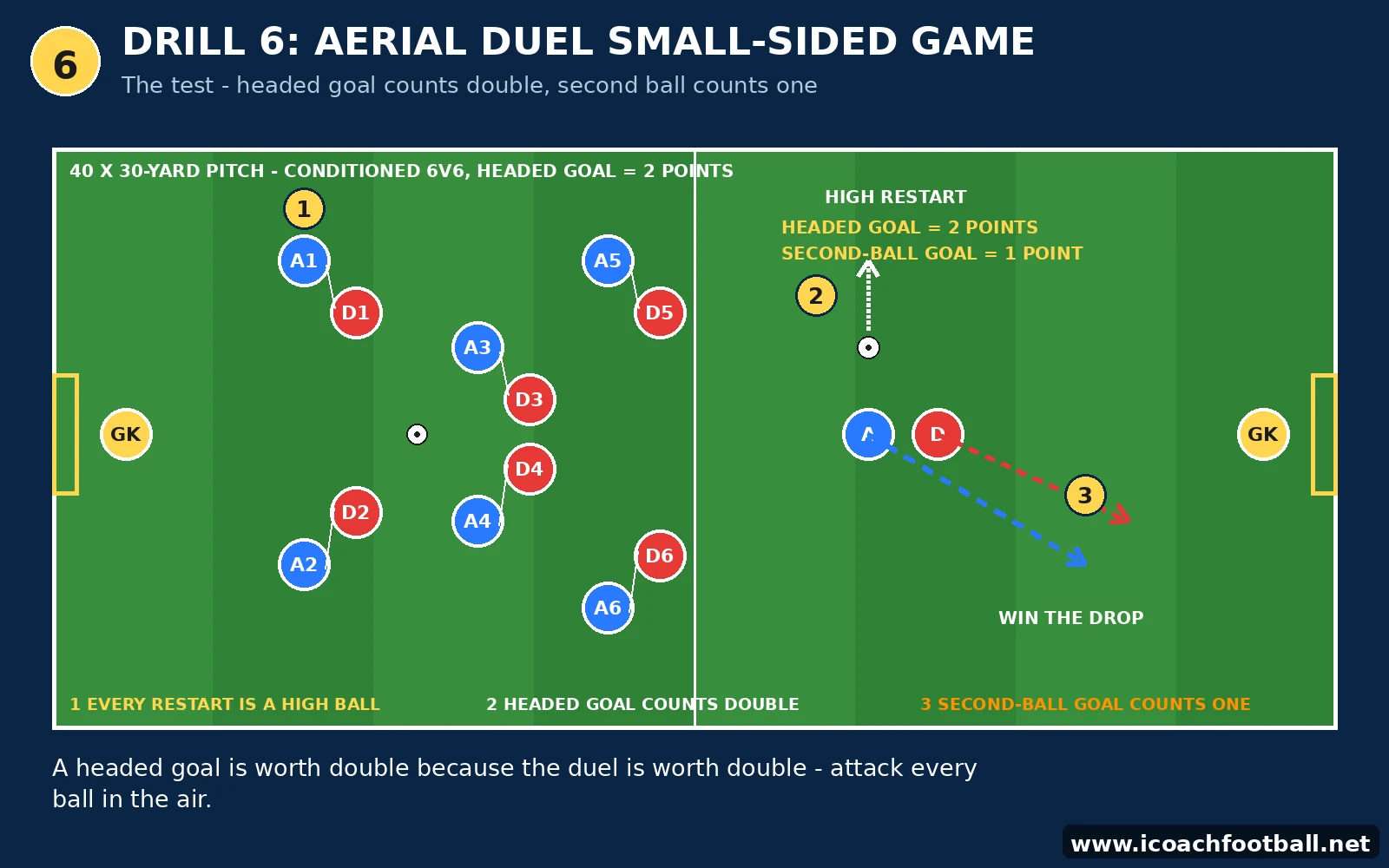
The test. A conditioned 6v6 where every goal must come from a header or a second ball — and a headed goal counts double. The scoreboard does the coaching: nobody waits for the ball to land twice when a header is worth two.
Setup
- 40 x 30-yard pitch, 2 full goals, bibs.
- 12 players: 6v6. 15 minutes.
How to Play
- The game starts with a pass-in from the coach — no kick-offs, no corners.
- Goals only count from a header or from a second ball won after an aerial duel.
- A headed goal counts 2 points; a goal from a won second ball counts 1 point.
- Every restart is a high ball into the middle — a new aerial duel every time.
- Play 3-minute games, then swap the jumping pairs and play again.
- The coach calls out every duel won and every second ball lost — “who attacked that ball?” — so the team hears it.
Coach’s note: “A headed goal is worth double because the duel is worth double — attack every ball in the air.”
Progressions: Goals only count if the header was attacked at its highest point; the second ball must be won within 3 seconds of the drop; add a neutral player who serves every restart high into the middle. FIFA’s “Use your head” session finishes the same way — a 6v6 game where a headed goal counts double and a diving header counts three.
Common mistakes
| Mistake | What you see | Fix |
|---|---|---|
| Jumping too early | The player is falling when the ball arrives, and the opponent heads it freely | Wait, watch the flight, then explode up — meet the ball at the top |
| Standing behind the opponent | The attacker shields the ball and the defender never gets a jump | Get goal-side before the ball is served — position first, jump second |
| Heading with the top of the head | The ball flies anywhere, and the player closes their eyes | Forehead, eyes open, arms out for balance — meet the ball, never let it hit you |
| Watching the header land | Both players watch the first header and the second ball falls to the opponent | Land on two feet, knees bent, eyes on the drop before your feet touch the ground |
| Clearing across goal | A defensive header drops to an attacker in front of goal | Clear high and wide — never across the face of goal |
| Switching off at set pieces | A free runner heads in at the far post from a corner | Keeper organises, every duel named before the kick, attack the ball at its highest point |
Age adaptations
| Age | Format | What changes |
|---|---|---|
| U10–U11 (ages 9–11) | No heading — chest/thigh version only | The duel is still trained, the header is not. Run every drill with chest and thigh control instead of heading: the server tosses the ball, players control it on the chest or thigh and play it to the target. Drill 1 becomes a chest-control timing game — meet the ball at its highest point with the chest. Drill 3 becomes a chest-and-volley game — control the cross, then finish. Keep the same rules for timing, body position and the second ball. Use a size 3–4 ball, 15 x 12-yard areas, and mini goals. See our U11 soccer practice plan for the session shape at this age |
| U12–U13 (ages 11–13) | 15 x 12-yard areas, size 4 ball, lightweight/foam balls for heading | Heading is introduced, and volume is capped: U.S. Soccer limits heading practice to 30 minutes and 15–20 headers per player per week, so this session is the week’s only heading block. Drill 1 runs as throw-head-catch first, exactly as FIFA’s “Use your head” session does, before any contested heading. Drill 3 uses floated crosses only — no driven balls. Drill 5 uses 4 attackers against 3 defenders, and the corner is taken from 10 yards out so the ball arrives slowly. See soccer drills for U13 and our U12 soccer practice plan |
| U14–U16 (ages 14–16) | Full areas, size 5 ball | All six rules run together at full speed. Drill 1 adds the moving target and the second-ball cancel. Drill 3 adds the driven cross and the near-post run. Drill 5 adds the short corner and duel-switching, and Drill 6 requires the second ball to be won within 3 seconds of the drop. Heading volume is no longer capped by U.S. Soccer at this age, but quality still beats quantity — stop the drill if technique drops. See soccer drills for U14, soccer drills for U15 and soccer drills for U16 |
60-minute session plan
| Time | Block | Drill |
|---|---|---|
| 0:00–0:05 | Arrival game | Free 2v2 throw-head-catch — a goal only counts from a header or a chest control |
| 0:05–0:13 | Jump timing | Drill 1 — Jump Timing |
| 0:13–0:21 | Body position | Drill 2 — Body-Position Duel |
| 0:21–0:29 | Crosses | Drill 3 — Attack the Cross |
| 0:29–0:37 | Second ball | Drill 4 — Win the Second Ball |
| 0:37–0:45 | Set pieces | Drill 5 — Aerial Duel at the Set Piece |
| 0:45–1:00 | The game | Drill 6 — Aerial Duel Small-Sided Game |
New to coaching this age? Stretch the arrival game to 8 minutes and cut Drill 6 to 12 minutes and you have the same session with more settling-in time — see our 60-minute plan for the structure (the same shape, shortened where you need it).
Keep building from here
The aerial duel sits underneath every defensive and attacking skill in the air — the clearance, the flick-on and the headed goal all start from a duel that was won on timing and position. The tight marking that holds an attacker in place is our soccer drills for improving marking, the 1v1 fight that follows a won second ball is our 1v1 defending drills, and the outnumbered situations a lost duel creates are our soccer defending 2v1 drills and our football defending 3v2 drills. Warm up with our 10 soccer warm-up drills. The far-post crosses that decide most aerial duels are covered in our soccer drills for improving defending the back post.
FAQ
What is an aerial duel in soccer?
An aerial duel is a contest for a ball in the air between two players — a cross, a long ball, a goal kick or a set piece. The duel is won by the player who reads the flight early, gets goal-side, times the jump to meet the ball at its highest point, and lands ready for the second ball. Heading technique is only part of it; timing and body position decide most duels.
At what age can players start heading the ball in soccer?
Heading is introduced at U12. U.S. Soccer’s Concussion Initiative bans heading in practice and games at U11 and under, and England Football is phasing deliberate heading out of grassroots matches at U7–U11, with heading introduced at U12. At U12–U13, U.S. Soccer limits heading practice to 30 minutes and 15–20 headers per player per week. Players U11 and under should train the same duels with chest and thigh control instead of heading.
How do you win an aerial duel in soccer?
Win the position first, then the jump. Get goal-side before the ball is served, watch the flight from the moment it leaves the server, and time your jump to meet the ball at its highest point — jump too early and you are falling when it arrives. Head with the forehead, eyes open, arms out for balance, and land on two feet, knees bent, ready for the second ball.
How do you teach jump timing for headers?
Start with a throw-head-catch sequence, exactly as FIFA’s ‘Use your head’ session does: the server tosses the ball, the player heads it and catches it. Then move to a 1v1 toss between two players, where the winner heads to a target — the competition forces the timing. Only add crossed balls once players are meeting the ball at its highest point from a toss. Drill 1 in this session is the full progression.
How do you win the second ball after an aerial duel?
Land ready and react first. The header is half the duel — the ball drops, and the team whose nearest player reacts first wins the possession. Teach players to land on two feet, knees bent, eyes on the drop before their feet touch the ground, and to attack the loose ball within 3 seconds. Drill 4 in this session practises exactly this: one pair contests the first header, and both teams fight for the ball that drops.
Sources
- FIFA Training Centre, “#102 Use your head” — a grassroots session for ages 12–15: a 2v2 throw-head-catch warm-up, 2v2 attacking headers where players serve each other and head towards goal, and a 6v6 game where a headed goal counts double. Verified live 2026-11-19 (HTTP 200, full text read). Drills 1, 3 and 6 are based on / in line with this FIFA material.
- England Football, “FA guidance on heading in football in England” — deliberate heading is being phased out of grassroots youth matches between U7–U11 over three seasons (U7–U9 from 2024–25, U10 from 2025–26, U11 from 2026–27), with heading introduced at U12 as players move from primary to secondary school; a deliberate header is an offence punishable by an indirect free kick. Verified live 2026-11-19 (HTTP 200, full text read). The heading-safety section, the U12–U16 age band and the U10–U11 chest/thigh adaptation are based on / in line with this England Football material.