Soccer Penalty Save Drills: 6 Games That Teach Keepers to Stop the Spot-Kick (U10–U16)
Quick answer
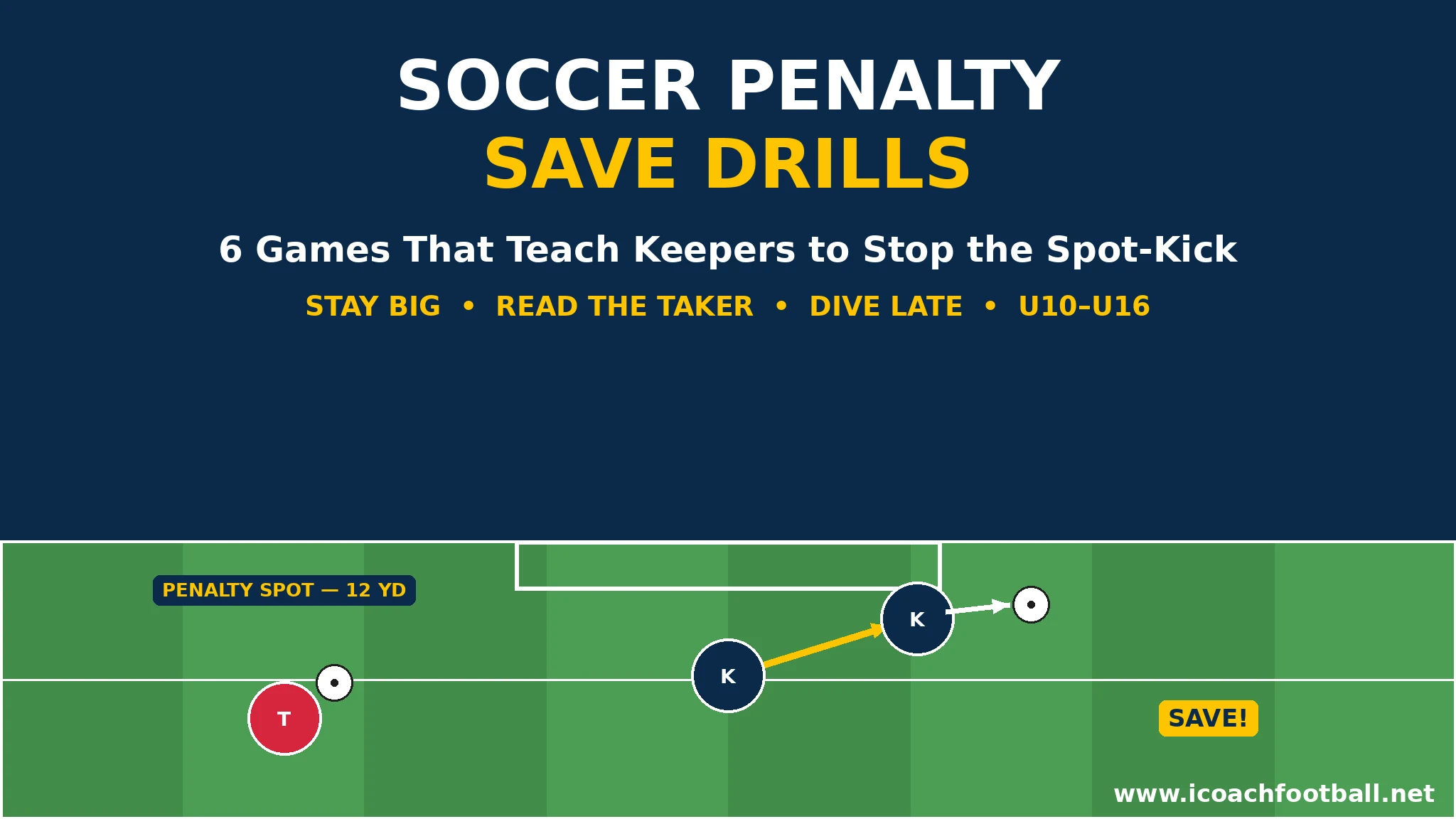
A penalty save is not a guess. It is a routine: stay big on the line, read the taker’s run-up, hips and plant foot, and move as the kicking foot comes through the ball. These six games train that routine step by step — set position, the side push, reading the taker, waiting until contact, recovering for the rebound, and a full shootout under pressure.
Suitable for: U10–U16 (ages 9–16)
Session snapshot
- Players: 10–14 (2–3 goalkeepers + 8–12 takers)
- Area: Full penalty area in front of one goal, expanding to a full shootout at the penalty spot
- Duration: 60 minutes
- Focus: Saving penalties — set position, reading the taker, timing the dive, and recovering for the second ball
- Equipment: 8–10 balls, 12 cones, bibs, 1 full-size goal (or 2 mini goals for U10–U11)
Diving safety first
Penalty drills mean a lot of diving, so work on grass or a soft surface, warm up the keepers properly first, and build shot power gradually. Start every drill with placed, half-pace shots and only raise the power once the keeper’s dive shape is clean. A keeper who lands badly stops training — a keeper who lands well trains again next week.
Why these six games work
Most keepers treat a penalty as a coin toss — pick a side and hope. The best keepers do the opposite: they gather information for as long as possible and move late. A professional keeper saves about one penalty in five, and the keepers above that number are not luckier — they prepare better, read more, and dive later. This session trains exactly those three habits, in order.
The first two drills build the body: a set position that makes the goal look small, and a side push that covers the low corners. The next two drills build the eyes: reading the taker’s run-up, hips and plant foot, then waiting until the ball is actually struck. The last two drills build the habit under pressure: recovering for the rebound, and a full shootout with a scoreboard.
The drills are grounded in the FIFA/UEFA coaching community. Drills 1 and 2 are based on / in line with the FIFA Training Centre session “Defending the penalty area”, in which FIFA Goalkeeping Coach Dean Santangelo trains young goalkeepers in correct footwork, smart positioning, quick repositioning and a strong, balanced body posture — first in controlled technical work, then in realistic game situations. Drills 5 and 6 are based on / in line with England Football Learning’s guidance on developing a skilful goalkeeper, which insists that keeper practices must have opposition, direction and goals — a real contest, not endless shooting at a tired keeper. In the UK the same session is football penalty save drills — the spot, the cues and the coaching points are identical.
The taker’s half of this duel is our soccer penalty kick drills — this session trains the keeper who faces those takers, and the two posts belong together. The diving that makes a save possible is trained in our youth goalkeeper shot-stopping drills, and the reading of a striker’s body that tells a keeper where the ball is going is the same skill as our soccer drills for improving anticipation.
Six rules of penalty saving
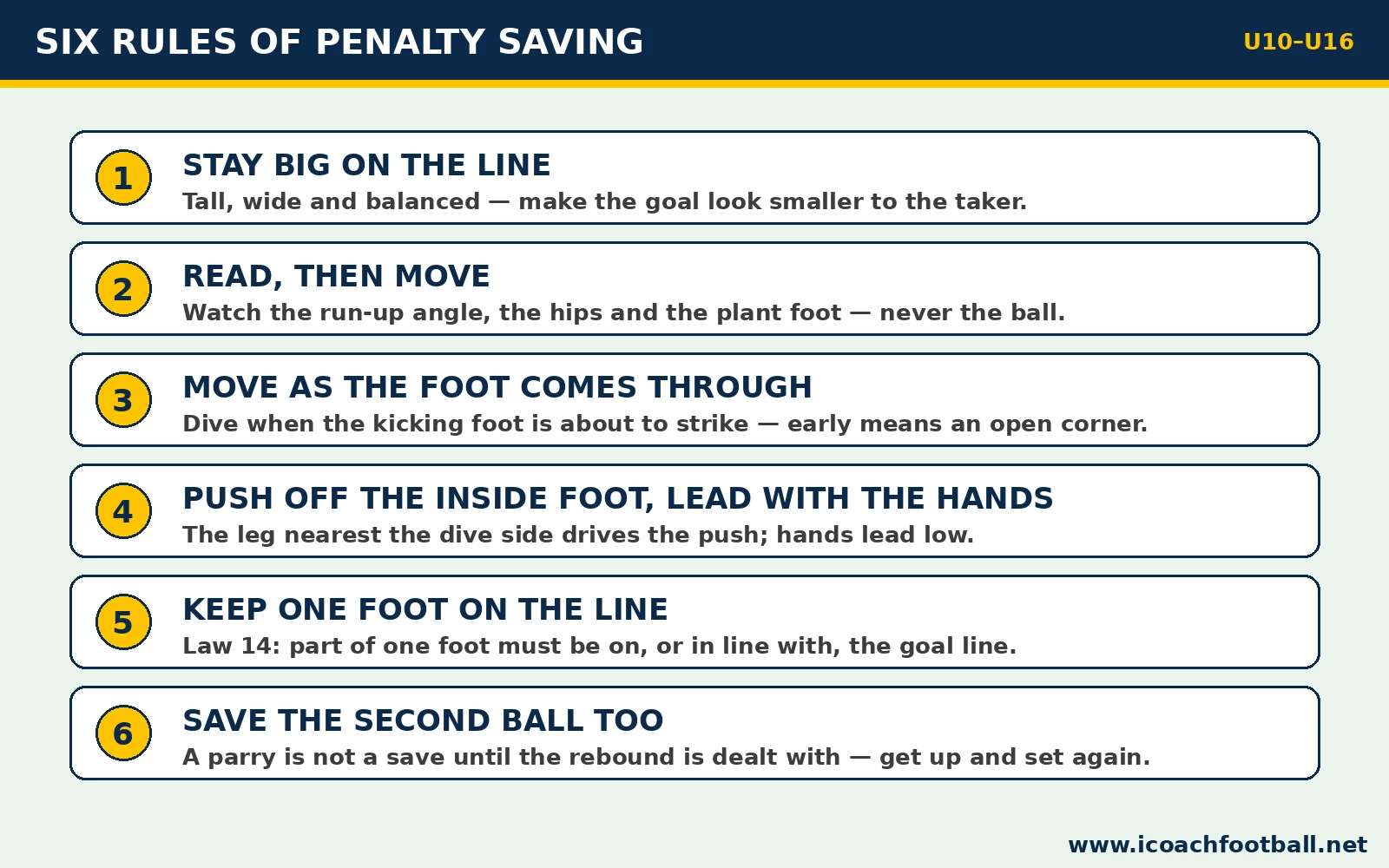
- Stay big on the line. Tall, wide and balanced — arms slightly out, weight on the balls of the feet. The goal should look smaller to the taker.
- Read, then move. Watch the run-up angle, the hips and the plant foot — never the ball, and never the taker’s eyes.
- Move as the foot comes through. Dive when the kicking foot is about to strike, not before. Early movement gives the taker an open corner.
- Push off the inside foot, lead with the hands. The leg nearest the dive side drives the push; the hands lead low and the body stays tall through the dive.
- Keep one foot on the line. Law 14: at the moment the ball is kicked, at least part of one foot must be touching, or in line with, the goal line.
- Save the second ball too. A parry is not a save until the rebound is dealt with — get up, set again, and compete for the follow-up.
Drill 1 — Set and Stay Big
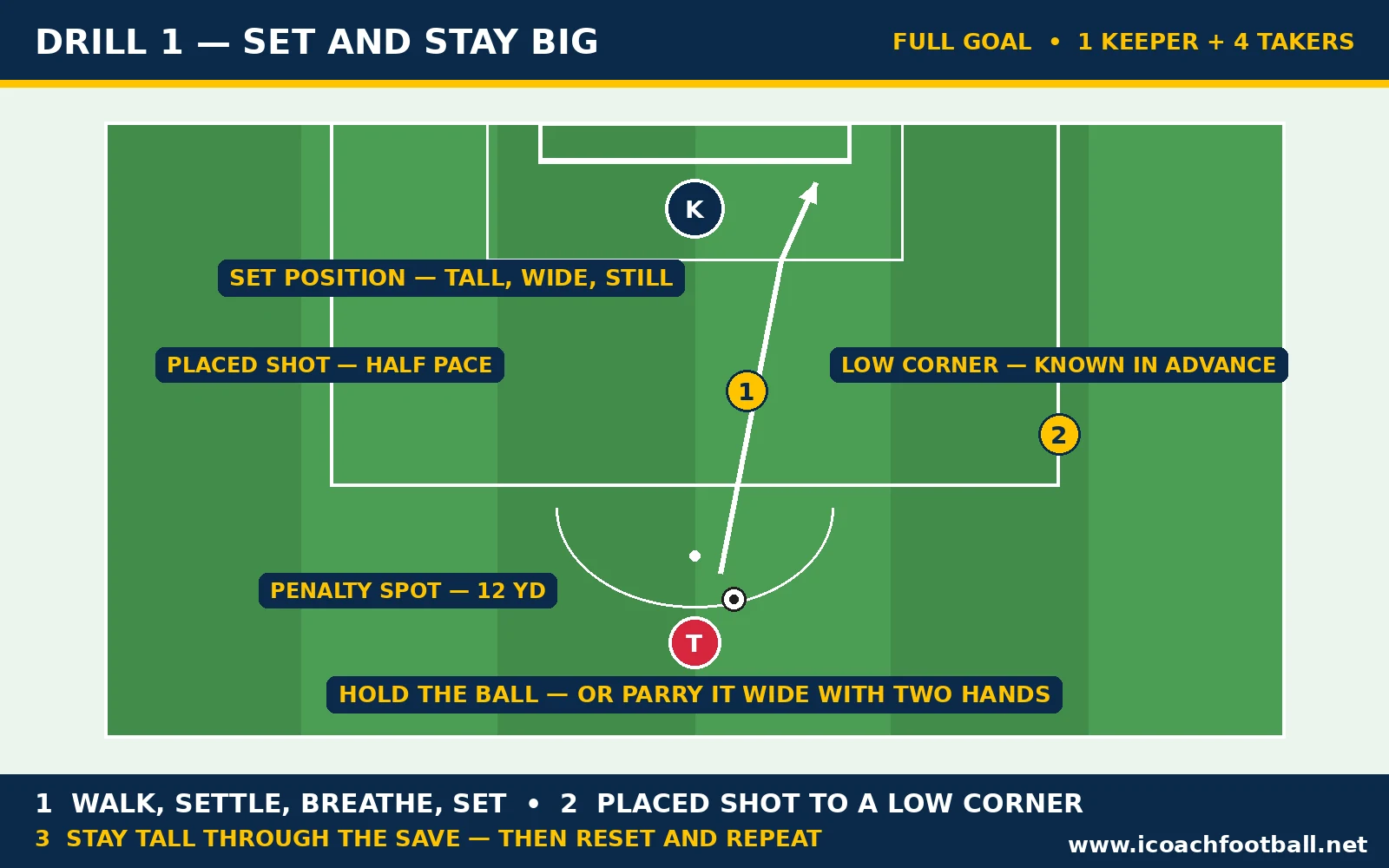
The keeper practises the full pre-penalty routine, then holds the line against placed shots. No diving yet — this drill is about the shape the taker sees.
Setup
- Full-size goal, penalty spot 12 yards out, 1 keeper, 4 takers with a ball each.
- 8 minutes, then rotate keepers.
How to Play
- The keeper walks to the line, finds the centre of the goal, and takes up the set position.
- The keeper takes one slow breath, sets the feet shoulder-width apart, and holds still for 2 seconds.
- The taker places a half-pace shot at a low corner the keeper already knows in advance.
- The keeper stays tall through the save and holds the ball, or parries it wide with two hands.
- After each save the keeper walks back to the centre, resets the feet, and repeats the routine.
- After 4 saves, rotate — the keeper becomes a taker and a taker becomes the keeper.
Coach’s note: “Make the goal look small — tall, wide, still. The taker should feel like there is nowhere to put it.”
Progressions: The taker chooses the corner without telling the keeper; the taker adds a short run-up; the keeper must call “Mine!” before every save to practise owning the moment.
Drill 2 — The Set Step
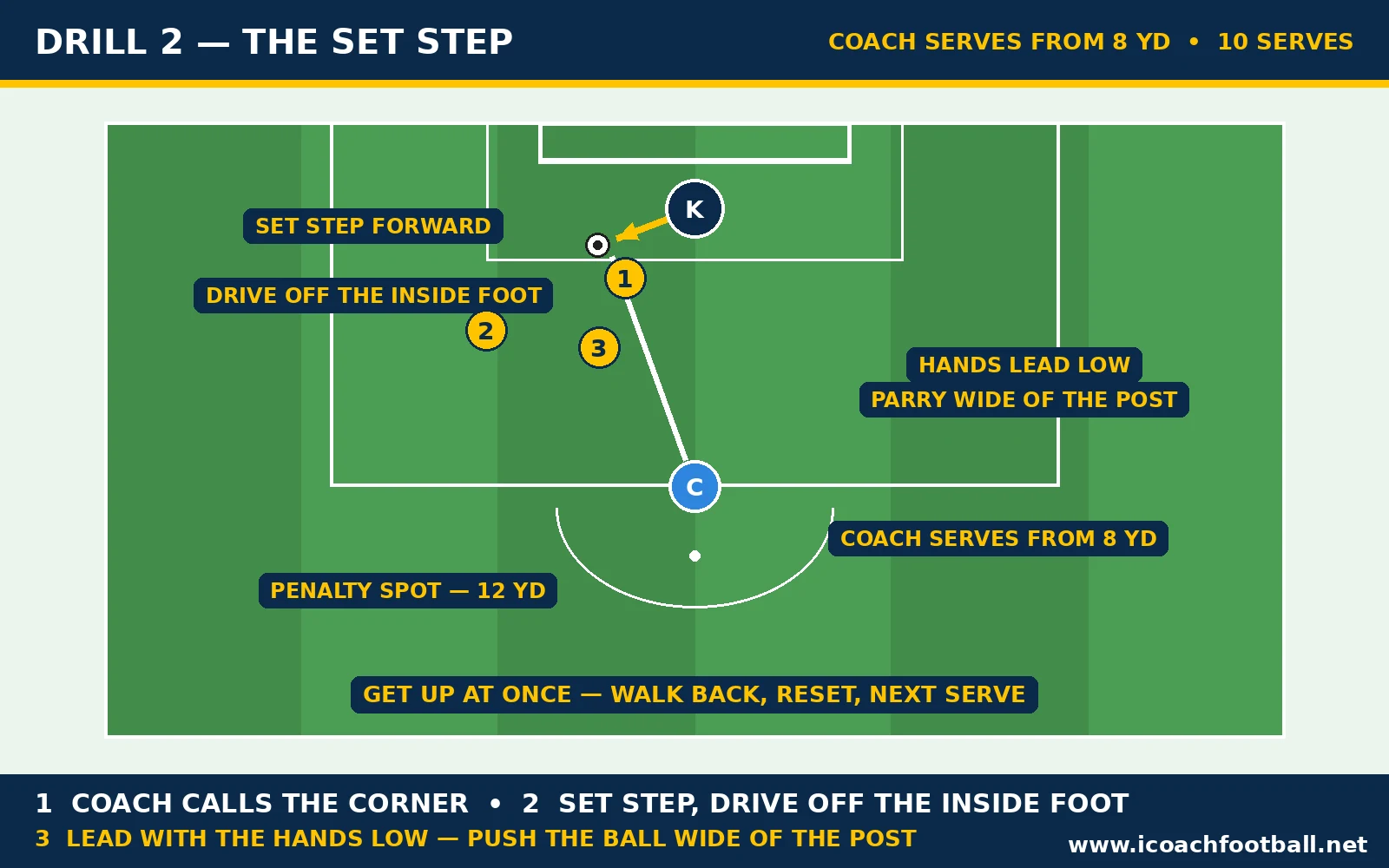
The side push that reaches the low corners. The coach serves from 8 yards and the keeper uses a small set step forward, then drives off the inside foot.
Setup
- Full-size goal, coach serving from 8 yards out, 1 keeper, 2 balls.
- 8 minutes, 10 serves per keeper, then rotate.
How to Play
- The keeper starts in the set position, one small step in front of the goal line.
- The coach calls a corner — “Left low!” or “Right low!” — one second before serving.
- The keeper takes a small set step forward onto the balls of the feet.
- The keeper drives off the inside foot — the leg nearest the dive side — and dives low.
- The keeper leads with the hands, low and together, and pushes the ball wide of the post.
- After the save the keeper gets up at once, walks back to the centre, and resets for the next serve.
Coach’s note: “Inside foot drives, hands lead low. If you dive with the outside foot, you spin — and the ball goes past you.”
Progressions: The coach serves without calling the corner; the coach serves from the penalty spot at full pace; the keeper must parry the ball past a cone 3 yards wide of the post, not just anywhere.
Drill 3 — Read the Taker
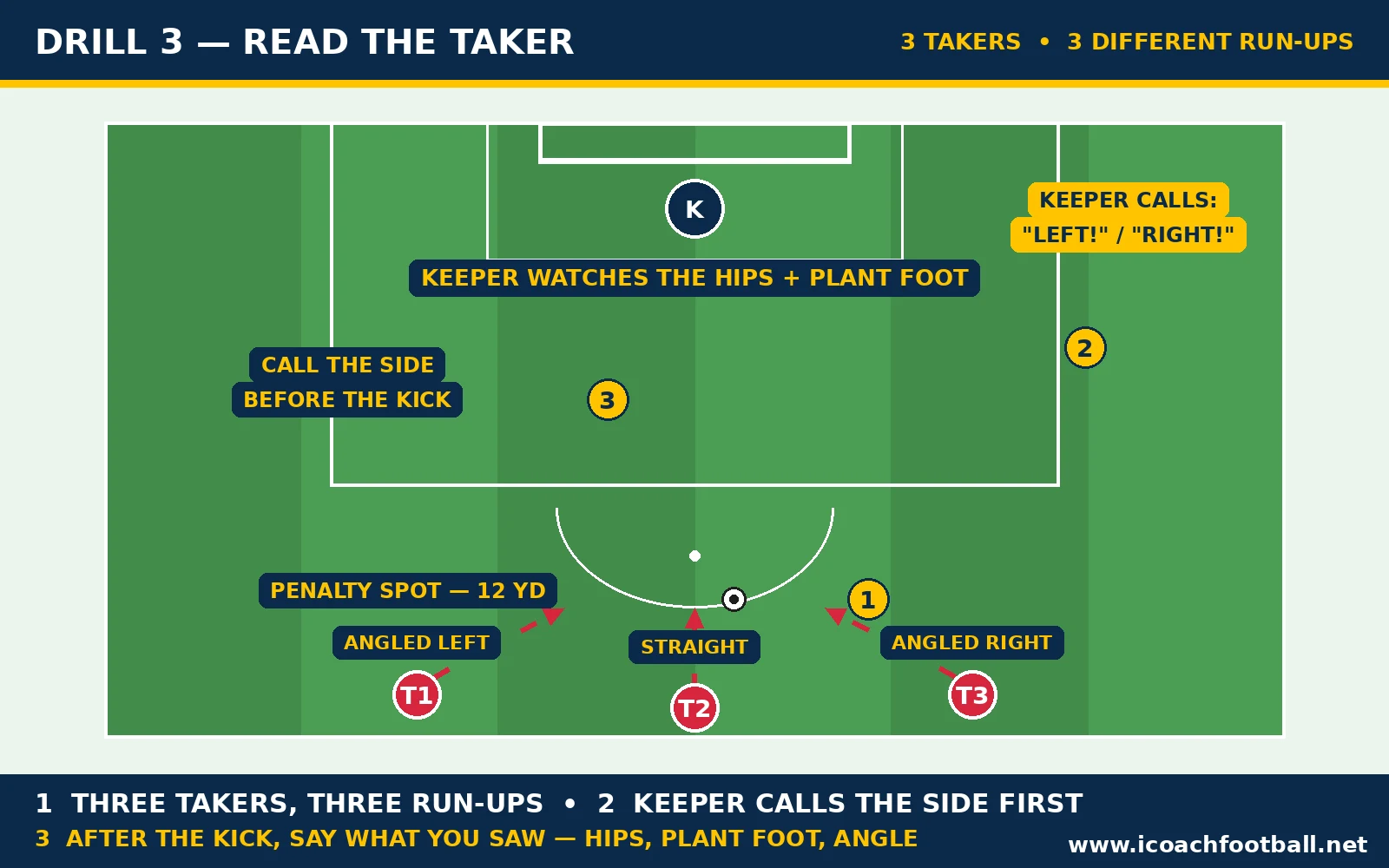
Three takers, three different run-ups. The keeper watches only the run-up — not the ball — and calls the side before the kick.
Setup
- Full-size goal, penalty spot 12 yards out, 1 keeper, 3 takers, 3 balls.
- 8 minutes, then rotate keepers.
How to Play
- The three takers line up behind the spot, each with a different run-up: straight, angled from the left, angled from the right.
- The first taker starts the run-up while the keeper watches the hips and the plant foot — not the ball.
- The keeper calls the side out loud — “Left!” or “Right!” — before the taker strikes the ball.
- The keeper dives to the called side as the kicking foot comes through.
- After the kick, the keeper says one sentence: what they saw — “Hips opened to the right” or “Plant foot pointed left”.
- After 3 kicks, rotate — the keeper becomes a taker and a taker becomes the keeper.
Coach’s note: “Hips do not lie — the plant foot can be faked, the eyes can be faked, but the hips always point where the ball is going.”
Progressions: The takers disguise their run-up — a stutter step, a look at the wrong corner; the keeper must call the side before the taker reaches the ball; the takers shoot at full pace once the keeper’s calls are right 7 times out of 10.
Drill 4 — The Delayed Dive
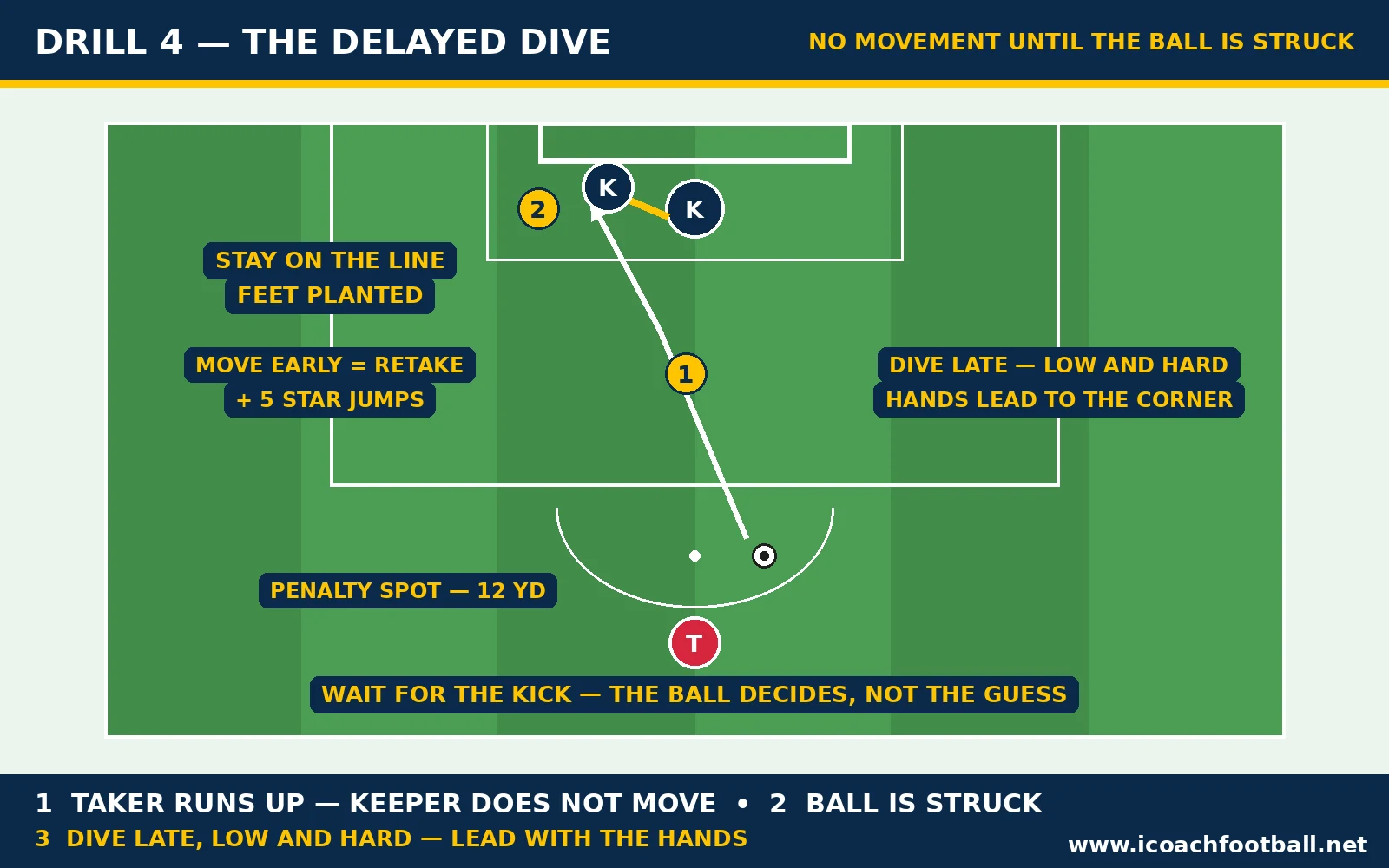
The keeper is not allowed to move until the ball is struck. It feels wrong — and it is the fastest way to learn to wait.
Setup
- Full-size goal, penalty spot 12 yards out, 1 keeper, 4 takers, 4 balls.
- 8 minutes, then rotate keepers.
How to Play
- The keeper takes up the set position and the taker starts a normal run-up.
- The keeper must stay on the line, feet planted, until the ball is actually kicked.
- The taker strikes at half pace to a low corner while the keeper reacts from a standing start.
- The keeper dives late, low and hard, leading with the hands toward the corner.
- If the keeper moves early, the kick is retaken and the keeper does 5 star jumps — the rule must hurt a little.
- After 4 kicks, rotate — the keeper becomes a taker and a taker becomes the keeper.
Coach’s note: “Wait for the kick — if you move before the ball is struck, you have given the taker a free corner.”
Progressions: The takers strike at full pace once the keeper waits cleanly 4 times in a row; the takers aim at the high corners; the keeper must stay on the line until the ball crosses the goal line on a miss, then react to a second ball served at once.
Drill 5 — Save and Recover
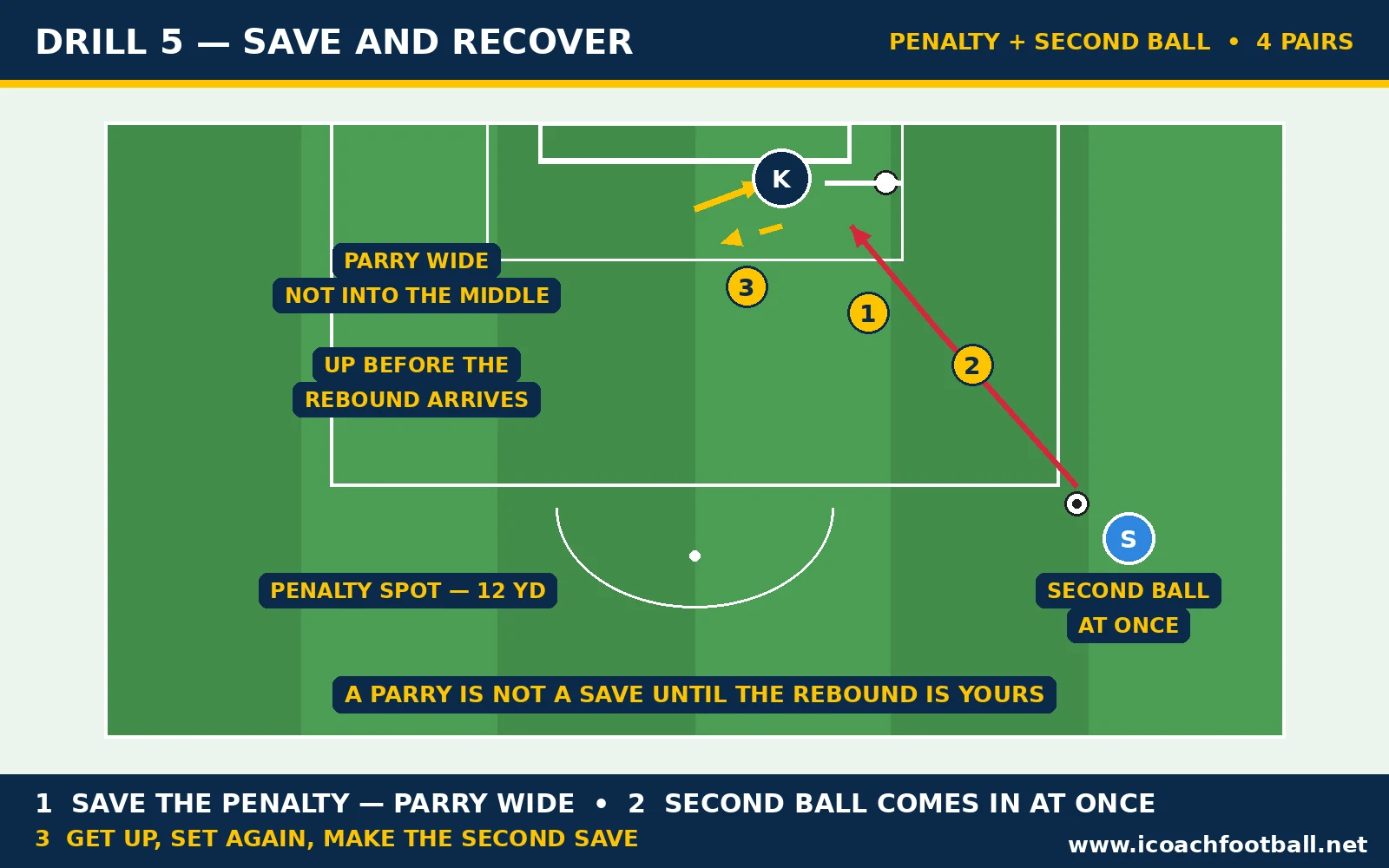
A parry is not a save. The keeper pushes the penalty wide, gets up, sets again — and faces the follow-up shot at once.
Setup
- Full-size goal, penalty spot 12 yards out, 1 keeper, 2 takers, 2 balls, 1 server at the edge of the box.
- 8 minutes, then rotate keepers.
How to Play
- The keeper takes up the set position and the taker strikes a penalty at full pace.
- The keeper dives and parries the ball wide of the post — parrying into the middle is a fail.
- The server at the edge of the box plays a second ball in at once, low and toward the far post.
- The keeper gets up off the ground, takes two quick steps back toward the centre, and sets again.
- The keeper makes the second save — a catch, a parry wide, or a smother — before the ball crosses the line.
- After 4 pairs of shots, rotate — the keeper becomes a taker and a taker becomes the keeper.
Coach’s note: “Up before the second ball arrives — the save is only finished when the rebound is yours.”
Progressions: The server varies the second ball — high, low, or a cut-back across the six-yard box; the keeper must catch the second ball cleanly, not parry it; the second ball comes from a taker running in from the edge of the box instead of a server.
Drill 6 — The Shootout Game
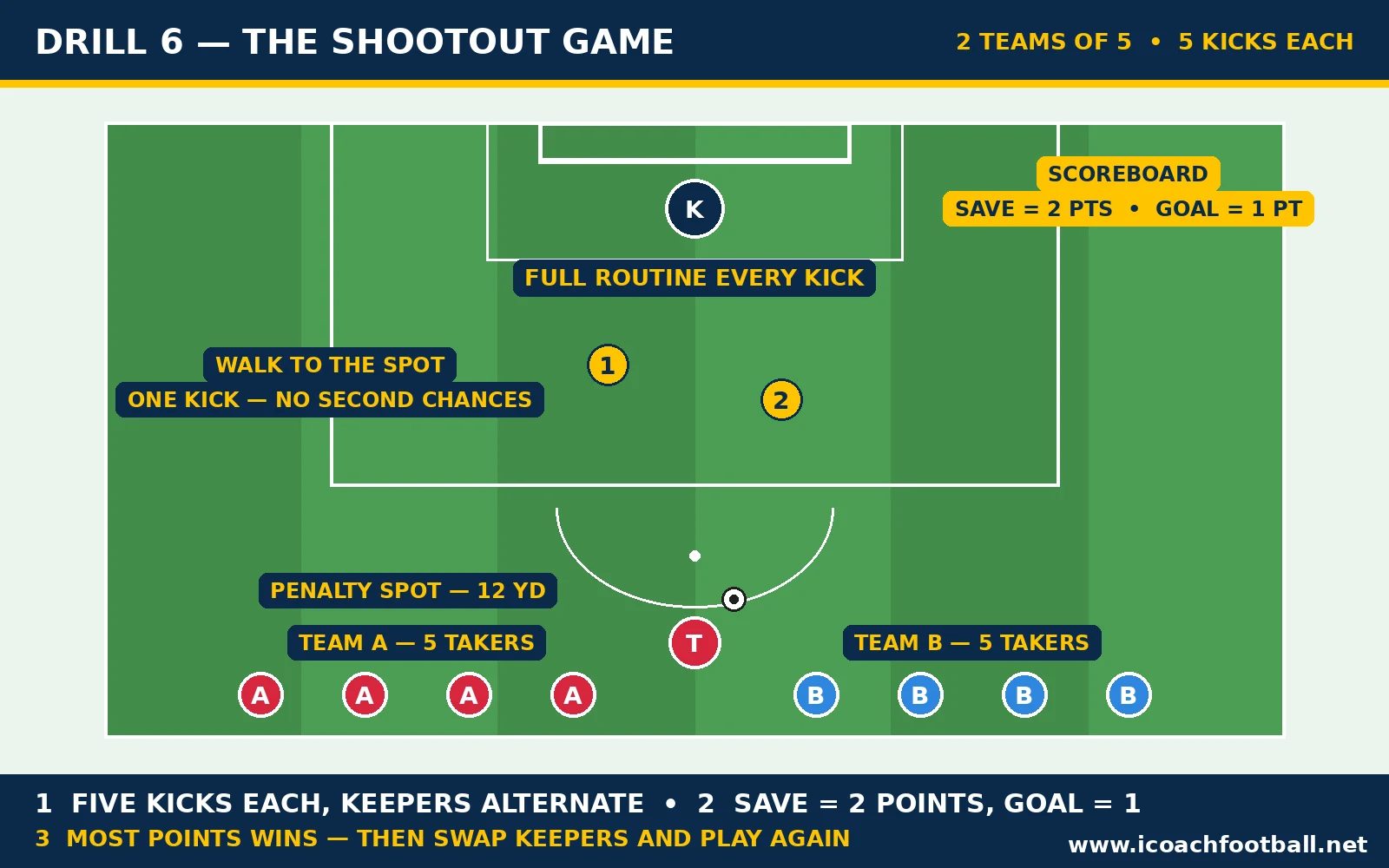
The full contest. Two keepers, two teams, five kicks each, a scoreboard, and the walk from the halfway line every time.
Setup
- Full-size goal, penalty spot 12 yards out, 2 keepers, 10 takers split into two teams, 5 balls.
- 15 minutes.
How to Play
- Two teams of 5 takers each line up at the halfway line; the keepers alternate in goal.
- Each taker walks to the spot, places the ball, and takes one kick — no second chances.
- The keeper uses the full routine: walk to the line, settle, breathe, set, read, dive late.
- A save scores 2 points for the keeper’s team; a goal scores 1 point for the taker’s team.
- The coach keeps the score on a board at the side, and the teams take it in turns to shoot first.
- After 5 kicks each, the team with the most points wins — then the keepers swap teams and play again.
Coach’s note: “Same routine, every kick — walk, settle, breathe, set, read, dive. Pressure does not change the routine; the routine beats the pressure.”
Progressions: The keeper must call the side out loud before every kick, as in Drill 3; sudden death after a draw — one kick each until someone misses; the takers get 10 seconds from the whistle to take the kick, so the keeper must settle fast.
Coaching points
- The set position is the save. Feet shoulder-width apart, knees soft, weight on the balls of the feet, hands relaxed in front — a keeper who sets well reaches the corner, a keeper who sets badly never does.
- Read the hips, not the eyes. The taker’s eyes can look at the wrong corner on purpose. The hips and the plant foot cannot lie — they point where the ball is going.
- The split step buys time. A small bounce on the toes just before the kick keeps the body loaded and shortens the reaction by a fraction of a second — the difference between a fingertip and a goal.
- Parry wide, never into the middle. A parry back into the six-yard box is a goal for the next attacker. Push the ball wide of the post, or hold it.
- The routine is the pressure valve. Walk, settle, breathe, set — the same four steps before every kick, in training and in games, so the moment never feels new.
- Keep the reps short and the power low at first. A keeper who dives 30 times at full pace in one session is a keeper with a sore shoulder next week. Quality over volume, always.
Common mistakes
| Mistake | Fix |
|---|---|
| Guessing a side before the run-up | The keeper must call the side only after the taker starts moving — drill it in Drill 3 until the call comes from the hips, not a hunch |
| Diving too early | The delayed dive in Drill 4 — no movement until the ball is struck, with 5 star jumps for every early move |
| Pushing off the outside foot | The keeper spins and the ball goes past — drill the set step in Drill 2 until the inside foot drives every dive |
| Parrying back into the middle | The parry must clear a cone 3 yards wide of the post, or the rep does not count — practise it in Drill 2 and Drill 5 |
| Staying down after the save | The second ball in Drill 5 punishes it at once — the keeper gets up before the rebound arrives, every time |
| No routine — a different setup every kick | The keeper walks through the same four steps (walk, settle, breathe, set) before every kick in Drill 6 until it is automatic |
Age adaptations
| Age | Format | What changes |
|---|---|---|
| U10–U11 (ages 9–11) | Mini goals or 6-yard-wide goal, penalty spot 8 yards out, size 4 ball | All shots are placed at half pace — no full-power penalties. Drill 3 uses two takers instead of three, and the keeper calls the side after the kick, not before. Drill 6 runs as a 3-kick shootout with no sudden death. Keepers rotate every 4 kicks so nobody dives too often |
| U12–U13 (ages 11–13) | Full-size goal, penalty spot 10 yards out, size 4 ball | All six drills run as written, with the spot moved to 10 yards. Drill 4 adds the full-pace progression only once the keeper waits cleanly 4 times in a row. The shootout in Drill 6 runs to 5 kicks, with the keeper calling the side before every kick |
| U14–U16 (ages 13–16) | Full-size goal, penalty spot 12 yards out, size 5 ball | Full distance, full pace. Drill 3 adds the disguise progression — stutter steps and wrong-corner looks. Drill 5 adds the cut-back second ball, and Drill 6 adds sudden death and the 10-second rule. Keepers keep a simple notebook of takers’ habits — “left 4 times out of 5” is the edge that wins shootouts |
60-minute session plan
| Block | Time | Content |
|---|---|---|
| Arrival game | 0:00–0:05 | Free 3v3 with a keeper at each end — every shot on target is a save to make |
| Set and stay big | 0:05–0:13 | Drill 1 — Set and Stay Big |
| The set step | 0:13–0:21 | Drill 2 — The Set Step |
| Read the taker | 0:21–0:29 | Drill 3 — Read the Taker |
| The delayed dive | 0:29–0:37 | Drill 4 — The Delayed Dive |
| Save and recover | 0:37–0:45 | Drill 5 — Save and Recover |
| The shootout game | 0:45–1:00 | Drill 6 — The Shootout Game |
Keep building from here
The taker’s half of this duel is our soccer penalty kick drills — train the takers there and the keepers here, and the shootout in Drill 6 becomes a real contest between two trained sides. The diving technique underneath every save is our youth goalkeeper shot-stopping drills, and the 1v1 situations that follow a saved penalty are our soccer goalkeeper 1v1 drills. The reading of a striker’s body that tells a keeper where the ball is going is trained in our soccer drills for improving anticipation and our soccer scanning drills, and the reactions that turn a read into a save are our soccer drills for improving reaction time. The communication that organises the wall and the box before a set piece is our soccer goalkeeper communication drills, the high balls a keeper must claim after a parry are our soccer goalkeeper cross-handling drills, and the starting position that lets a keeper sweep behind the defence is our soccer sweeper keeper drills. After a save, the keeper’s first pass starts the attack — our goalkeeper distribution drills to improve footwork and accuracy train that first pass, and the confidence that lets a young keeper own the penalty spot is our soccer drills for improving confidence. Penalty diving is high-load work for young shoulders — plan the week’s load with our training load calculator. And the starting position that makes every one of these saves possible is trained in our soccer drills for improving goalkeeper starting position.
FAQ
What percentage of penalties do goalkeepers save?
About one in five at professional level — roughly 15–20% in open play, and a little better in shootouts, where takers convert around 76% instead of 85%. Youth keepers save fewer, because takers place the ball better than they do at younger ages. Training raises the number: a keeper who reads the taker and dives late saves more than a keeper who guesses, and the drills in this session are built to train exactly that.
When should a goalkeeper move during a penalty?
As the kicking foot comes through to the ball — not before. Moving early gives the taker an open corner to aim at, and moving after contact leaves no time to reach the corner. The split step helps: a small bounce on the toes just before the kick keeps the body loaded, so the dive starts a fraction of a second faster. Drill 4 trains the wait until it feels natural.
What should a goalkeeper watch — the ball or the taker?
The taker — specifically the run-up angle, the hips and the plant foot. The ball tells you nothing until it is already moving, and by then it is too late. The taker’s eyes can look at the wrong corner on purpose, but the hips always point where the ball is going, and the plant foot lands in line with the target. Drill 3 trains the keeper to call the side from those cues before the kick.
Can a goalkeeper move off the line before a penalty is taken?
Only within the limit of Law 14: at the moment the ball is kicked, at least part of one foot must be touching, or in line with, the goal line. The keeper can move along the line, take a small step forward in the set, and shift position — but the foot must be on the line when the kick is taken. Coaches should train it exactly: one foot on the line, every rep, so the habit survives a real game.
What age should keepers start penalty save training?
From U10, with soft, placed shots at half pace and a penalty spot moved in to 8 yards. The set position, the routine and the reading can all be trained young — what must wait is full-power diving. Build shot power gradually, keep the reps short, and only add full-pace penalties and full shootouts from U13, once the keeper’s dive shape is clean and the landing is safe.
Sources
- FIFA Training Centre. “Defending the penalty area” — FIFA Goalkeeping Coach Dean Santangelo delivers a session on correct footwork, smart positioning, quick repositioning, judgement of the ball’s flight and a strong, balanced body posture, progressing from controlled technical work to realistic game situations. Verified live 2026-11-20 (HTTP 200, full text read). Drills 1 and 2 are based on / in line with this session’s footwork, positioning and set-position principles.
- England Football Learning. “How to develop a skilful goalkeeper” — England Football’s guidance that keeper practices must have opposition, direction and goals, and that shot-stopping improves when the practice is made game-realistic rather than endless shooting at a tired keeper. Verified live 2026-11-20 (HTTP 200, full text read). Drills 5 and 6 are based on / in line with this guidance.