Soccer Goalkeeper Cross Handling Drills: 6 Games to Claim, Punch and Command the Box
Quick answer
A cross is only dangerous if your goalkeeper is in two minds about it. These six soccer goalkeeper cross handling drills teach your keeper one decision — claim it, punch it, or stay — and the technique to carry it out at the highest point, in traffic, under pressure.
Suitable for: U12–U18
Most youth keepers stay glued to their line while crosses fly over their heads. The ball drops to an attacker six yards out, and the goal is conceded before the keeper has moved. A cross is the same problem in soccer and football alike — and the fix is trainable: read the flight early, take the shortest route to the ball, and arrive at the highest point with a loud call. These six games build that, one decision at a time.
Session snapshot
- Players: 2 goalkeepers plus servers, attackers and defenders as needed
- Area: Penalty area and six-yard box, one goal
- Duration: 60 minutes
- Focus: Flight reading, claim vs punch decision, commanding the box
- Age: U12–U18 (see Age adaptations)
Claim, punch or stay — the decision
Every cross asks your keeper the same question, and the answer is made in the first second of the flight. This decision frame is in line with the FIFA Training Centre’s analysis of goalkeepers dealing with crosses at the FIFA U-17 Women’s World Cup 2024: a clean claim needs certainty, a strong punch beats a hopeful catch, and staying is the right call when the ball cannot be reached. FIFA’s Technical Study Group found keepers completing 70.5% of aerial controls in 2024 — up from 64.3% in 2022 — by claiming more (+5.5%) and punching more (+7.1%), and tipping less (−12.6%). Aggression with a decision behind it works.
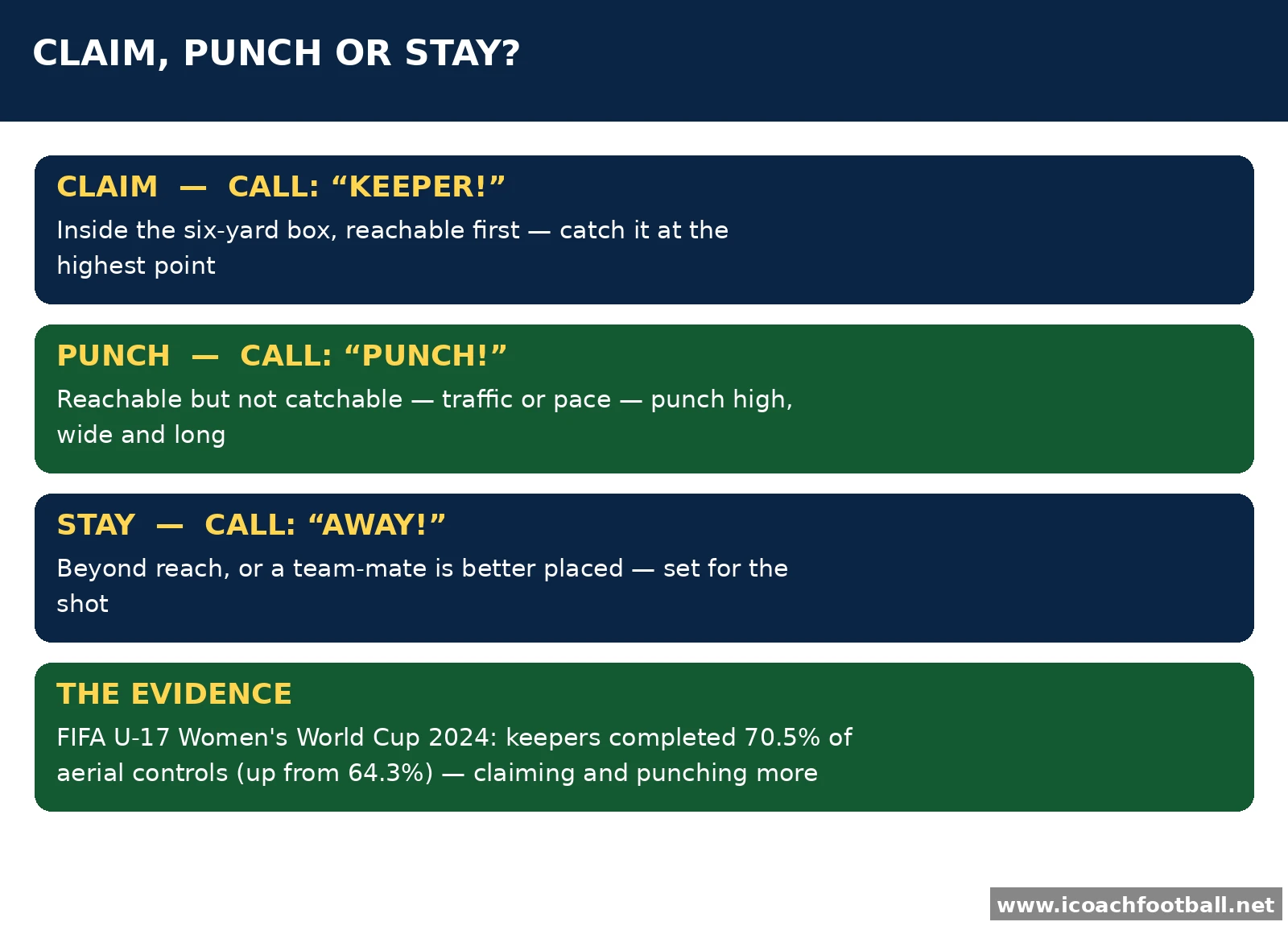
| Decision | When to choose it | The call |
|---|---|---|
| CLAIM | The ball is inside the six-yard box and the keeper can reach its highest point first | “KEEPER!” |
| PUNCH | The ball is reachable but not catchable — traffic, pace, or a late read | “PUNCH!” |
| STAY | The ball is beyond reach, or a team-mate is better placed to clear it | “AWAY!” |
Drill 1: Highest Point
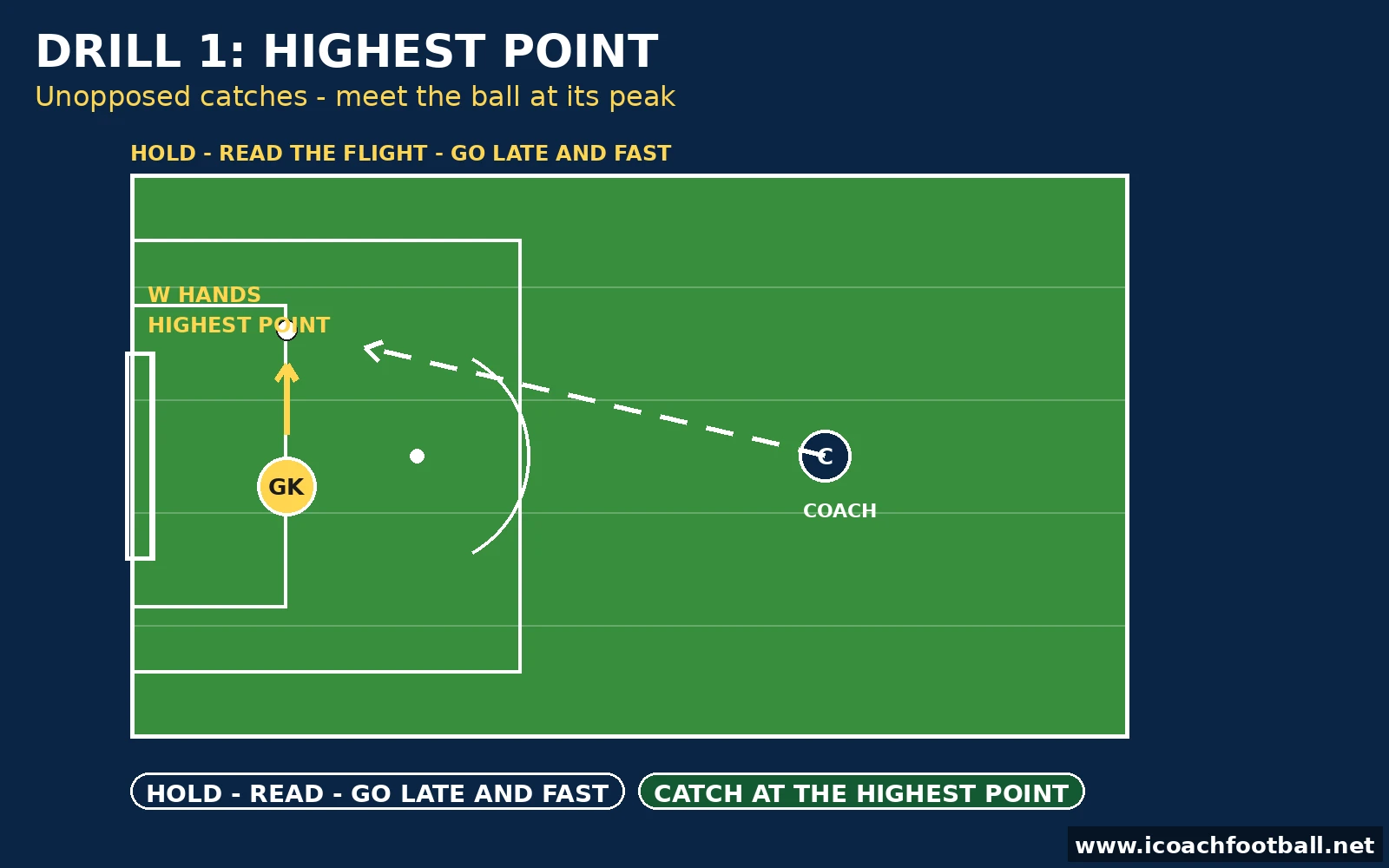
Before any keeper can deal with crosses, they must own the catch. This unopposed drill builds the take-off, the W hands and the habit of meeting the ball at its highest point.
Setup
- One goal, 2 goalkeepers, coach with a supply of balls 12 yards out
- Keepers alternate; 6 catches each, then swap sides
- 10 minutes; no attackers, no pressure
How to Play
- The keeper starts a yard off the line, on their toes, chest open to the ball.
- The coach volleys a high ball just in front of the keeper, into the air.
- The keeper takes short, quick steps to get under the ball, then jumps off one leg.
- Hands go up early in a W shape, thumbs almost touching, elbows slightly bent.
- The keeper catches at the highest point, brings the knee up for protection, and lands with the ball to the chest.
Coach’s note: The mistake to watch is the keeper jumping too early and catching on the way down. Make them hold — wait, read the flight, then go late and fast. The jump should meet the ball at its peak, not chase it down. This is the aerial ball-handling in Spain’s U15 goalkeeper session at the FIFA Training Centre: one foot in front, arms up in time, secure the ball before anything else.
Progressions: Vary the serve — high, flat, looping; serve from both sides; add a second ball so the keeper must reset between catches in two seconds.
Drill 2: Front, Middle, Back
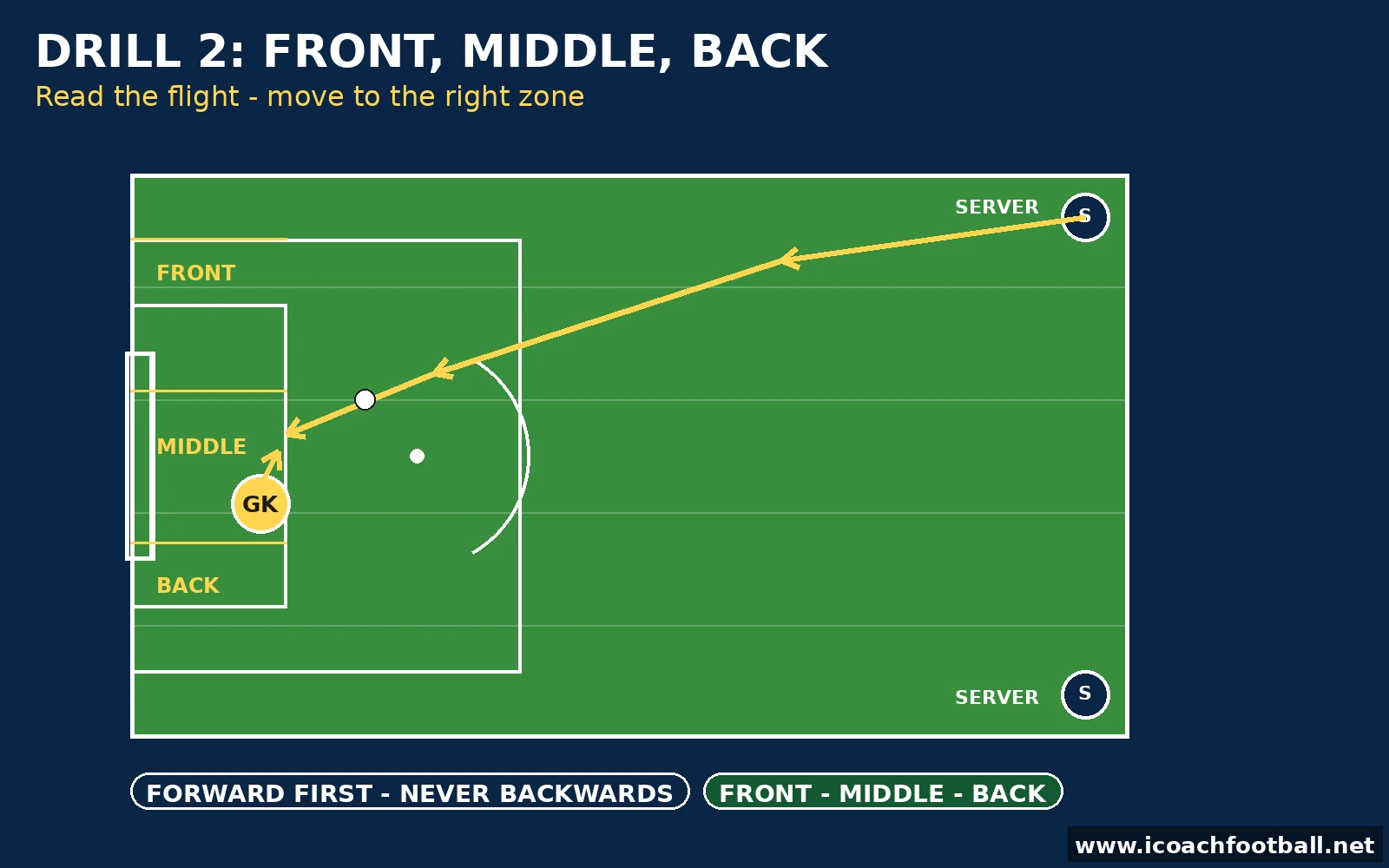
A cross never lands in the same place twice. This game teaches the keeper to read the flight and move to the right zone — front post, middle or back post — before the ball arrives.
Setup
- One goal, 1 goalkeeper, 2 servers (one on each wing), cones marking three zones in the six-yard box
- Servers take turns crossing from the wings; 8 crosses per keeper, then rotate
- 10 minutes; unopposed at first
How to Play
- The keeper starts in the middle of the goal, a yard off the line, open body facing the server.
- The server calls nothing — the keeper reads the flight the moment the ball is struck.
- The keeper moves to the front, middle or back zone and claims the ball at its highest point.
- After the catch, the keeper throws or rolls the ball back to the server and resets in two seconds.
- Servers alternate sides and vary the delivery — floated, driven, inswinging, outswinging.
Coach’s note: Watch the first step. A keeper who steps backwards first is beaten before they start — the first step must always be forward or sideways toward the ball’s line. Shout “forward first” until the feet stop going backwards. Keepers who arrive late at the back post almost always started by retreating.
Progressions: The server shouts “front,” “middle” or “back” after the cross is struck, so the keeper must adjust mid-flight; add a passive attacker standing in one zone who must not be touched.
Drill 3: Claim or Punch
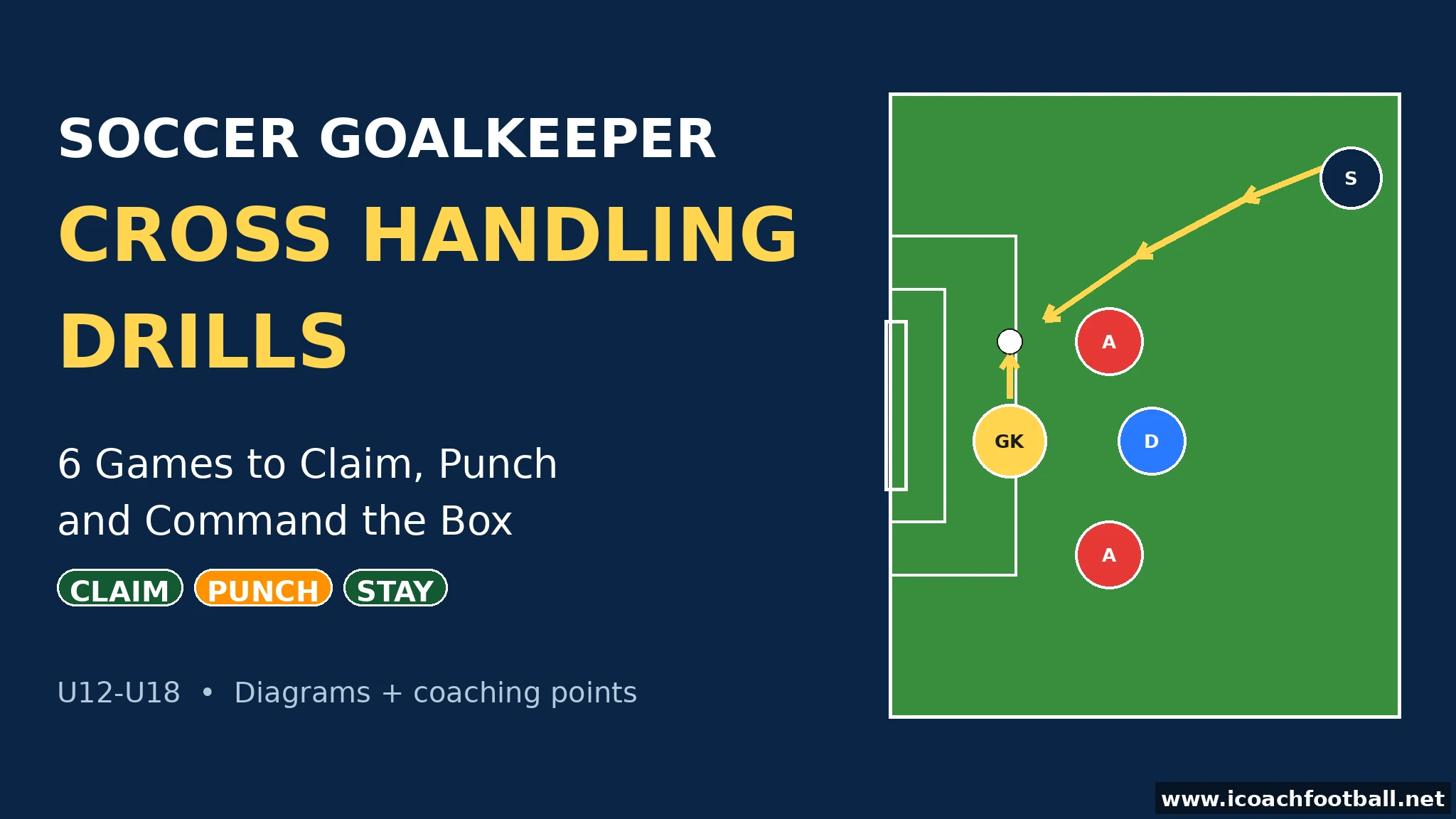
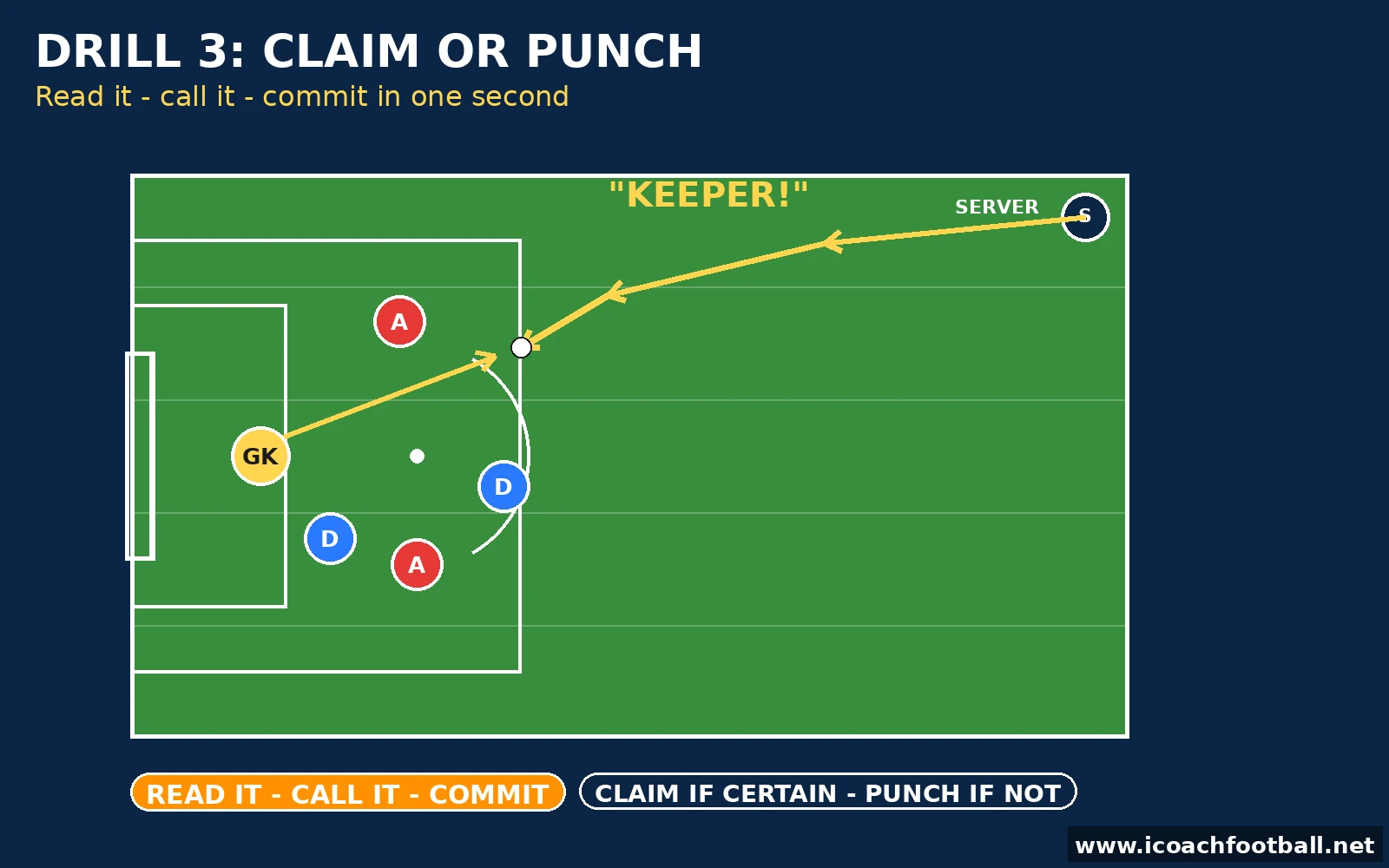
The decision game. The keeper reads the flight, judges the traffic, and commits — claim or punch — in one second. Watch the animation below the diagram: the read, the call and the intervention happen in that order.
Setup
- One goal, 1 goalkeeper, 1 server on the wing, 2 attackers and 2 defenders in the box
- Coach controls the delivery type with a hand signal the keeper cannot see
- 8 crosses per keeper, then rotate; 12 minutes
How to Play
- The server crosses into the six-yard box while the attackers and defenders jostle for position.
- The keeper reads the flight and the traffic in the first second — then commits out loud.
- If the path is clear and the ball is reachable, the keeper claims it at the highest point.
- If the ball is reachable but not catchable, the keeper punches it with both fists — high, wide and long.
- If the ball is beyond reach, the keeper stays, calls “AWAY!” and sets for the shot.
Coach’s note: The call is the skill, not the catch. A keeper who claims silently and collides with their own defender creates the chaos the drill is meant to prevent. Insist on a loud “KEEPER!” or “PUNCH!” before the keeper moves — no call, no rep. As FIFA’s Pascal Zuberbühler puts it, if the keeper is not certain they can catch it securely, a strong punch is the better option.
Progressions: Attackers are allowed to challenge for the ball; vary the delivery so half the crosses are punch balls and half are claim balls; score the keeper 2 points for a clean claim, 1 for a good punch, 0 for a wrong call.
Drill 4: Traffic Jam
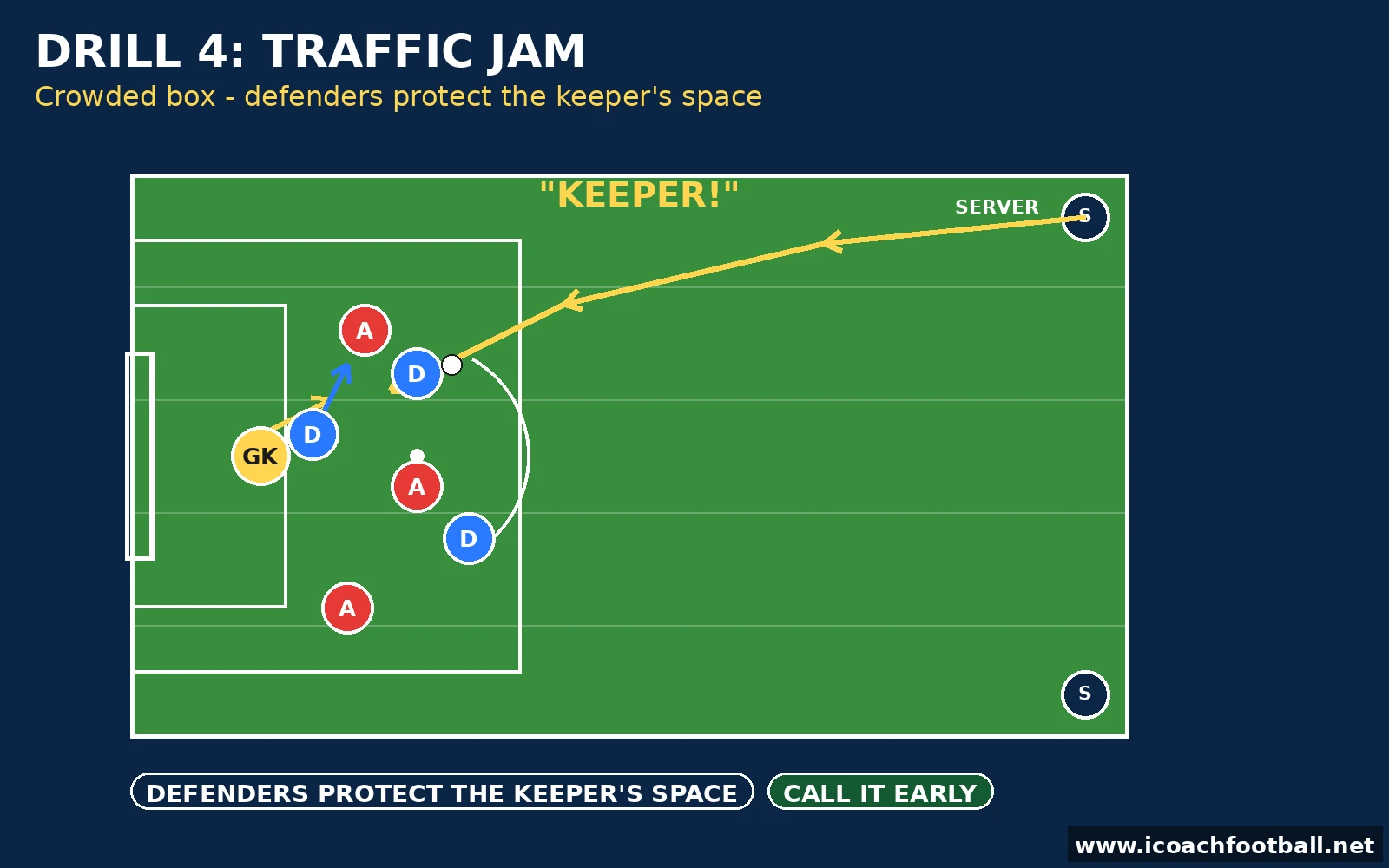
Crosses in a real game arrive with bodies everywhere. This drill teaches the keeper to command a crowded box — and teaches the defenders to protect the space their keeper needs to work in. Most crosses start wide, and the duel that stops the cross at source is trained in our football defending wide areas drills.
Setup
- One goal, 1 goalkeeper, 2 servers (one each wing), 3 attackers and 3 defenders in the box
- Full penalty area; 4 x 3-minute blocks, keepers rotate every block
- 12 minutes
How to Play
- Servers alternate crosses from the wings into the six-yard box.
- Attackers make near-post, far-post and penalty-spot runs; defenders mark them.
- The nearest defender’s job is to protect the space in front of the keeper — block the attacker, not the keeper.
- The keeper calls the decision early, attacks the ball at its highest point, and claims or punches.
- After the intervention, the keeper restarts play with a quick throw to a wide target.
Coach’s note: This is the drill where most keepers stop coming. The first time an attacker bumps them, they retreat to their line for the rest of the session. Do not let that settle — go back to Drill 1 for two minutes, rebuild the clean catch, then return. Confidence is built in small steps, and the FIFA analysis of the 2024 U-17 Women’s World Cup shows exactly why it matters: the keepers who completed the most aerial controls under pressure were the ones whose defenders kept their working space clear.
Progressions: Attackers are allowed to jump and challenge; add a second ball so the keeper must deal with a cut-back immediately after the first cross; let the keeper score by finding the wide target with the restart.
Drill 5: Cut-Back Cover
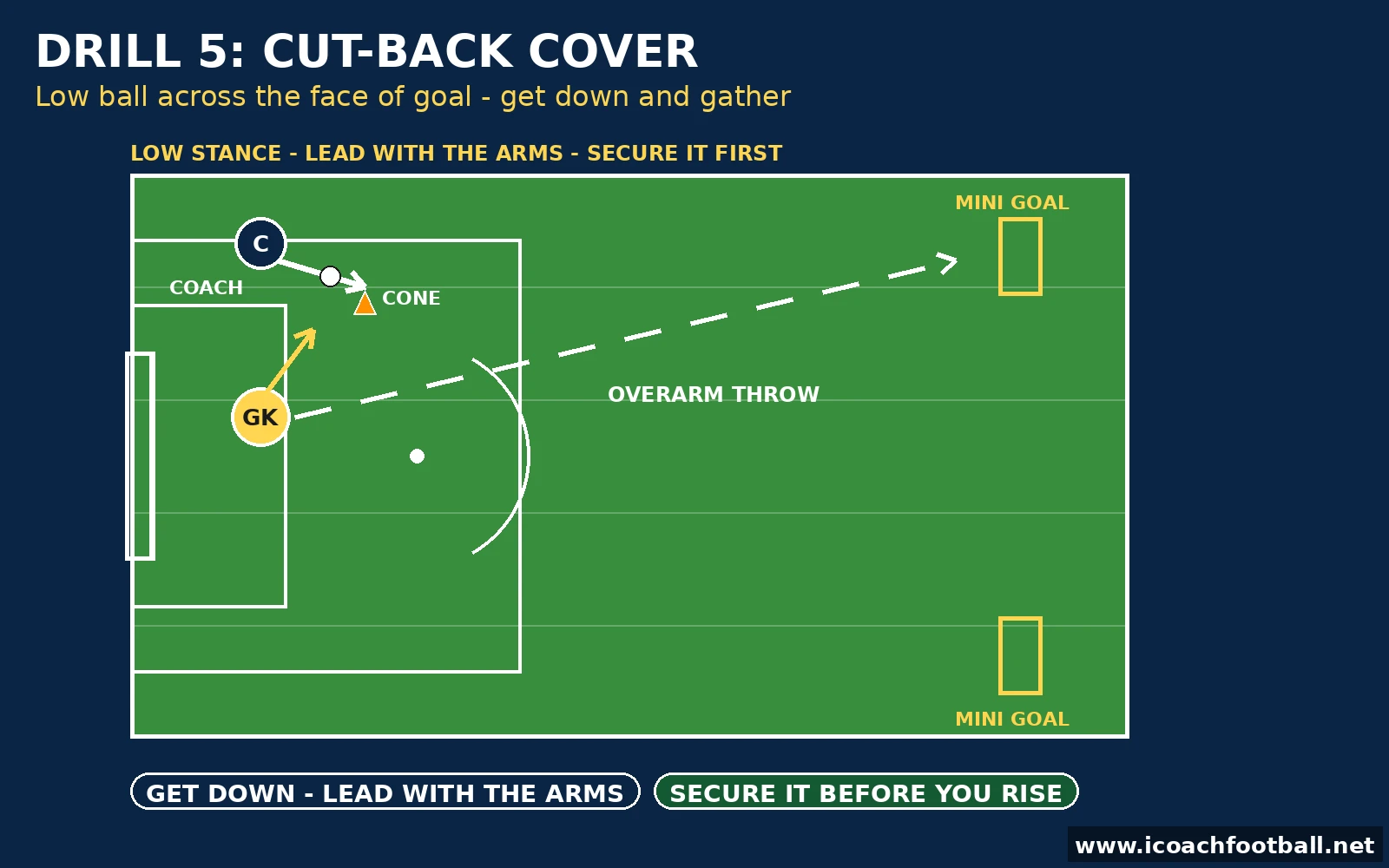
Not every cross is high. The low ball whipped across the face of goal — the cut-back — is the one that beats keepers who only train for high balls. This drill covers the front post and the drop.
Setup
- One goal, 1 goalkeeper, coach 5 metres from the near post with balls
- A cone 5 metres from and parallel to each post; 2 mini-goals at 45 degrees, 15 metres out
- 8 serves per side, then swap; 10 minutes
How to Play
- The keeper starts in the middle of the goal, low stance, arms held low by the legs.
- On the coach’s signal, the keeper shifts toward the near post, ready for the cut-back.
- The coach plays a low cross toward the cone; the keeper gets down and gathers it.
- Once secure, the keeper performs an overarm throw into the far mini-goal.
- The coach varies it — a high cross to the penalty spot instead, so the keeper must stay on their toes.
Coach’s note: The fault to watch is the keeper rising before the ball is secure. Get down, lead with the arms, meet the ball at the right moment — and only stand up once it is in the hands. This is straight from Spain’s U15 session: secure the ball before rising, or the spill becomes the goal. The low stance matters too — a keeper standing tall cannot get down in time for a ball at ankle height.
Progressions: Add an attacker arriving at the back post, so the keeper must choose between the cut-back and the far-post ball; play the cross from a moving winger instead of a static coach.
Drill 6: Catch and Counter
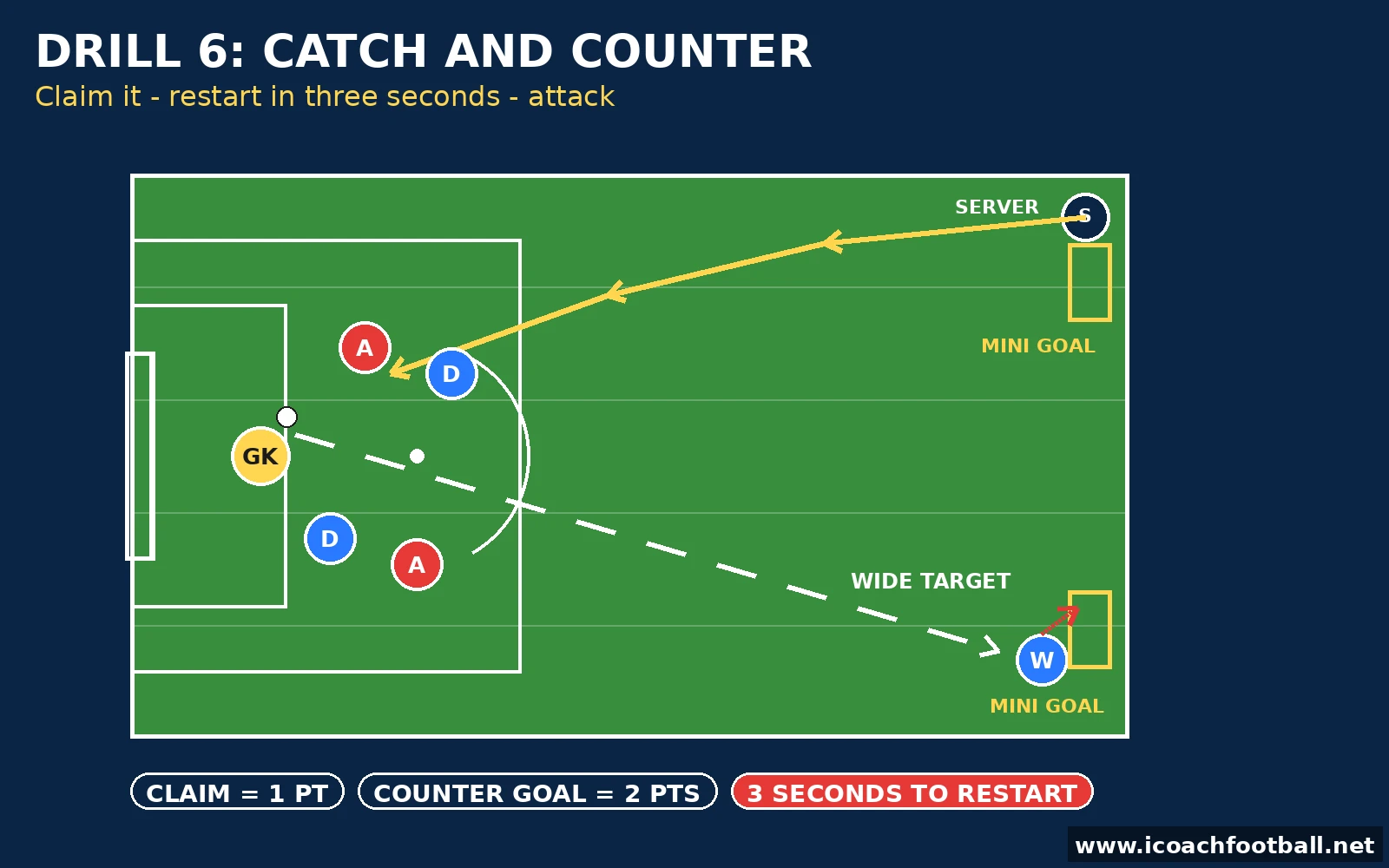
The best cross handling ends with your team attacking. This game rewards the keeper who claims the cross and starts the counter in under three seconds.
Setup
- One goal, 1 goalkeeper, 2 servers on the wings, 4 attackers and 4 defenders, 2 mini-goals 25 metres out
- Full penalty area; 4 x 3-minute games
- 12 minutes
How to Play
- The server crosses into the box; attackers and defenders compete for it.
- The keeper claims the cross at the highest point — or punches it to a team-mate.
- Within three seconds of the claim, the keeper distributes: a quick throw or roll to a wide target.
- The team that receives the distribution attacks the mini-goals; a goal scores 2 points.
- A clean claim scores the keeper’s team 1 point even before the counter starts.
Coach’s note: Count the three seconds out loud — “one, two, THREE” — until the habit is automatic. A keeper who claims brilliantly and then holds the ball for five seconds has given the opposition time to reorganise, and the counter is dead. The claim and the restart are one action, not two. This is the same transition thinking our sweeper keeper drills train: the keeper is the first attacker, not the last defender. If the keeper comes and misses, the duel that follows is trained in our soccer goalkeeper 1v1 drills.
Progressions: The distribution must find a specific target called by the coach; the counter must score within 10 seconds or the point is lost; play with two keepers, one in each goal, so both ends counter.
Coaching points
- Read the flight in the first second. The decision is made while the ball is still rising. A keeper who waits for the ball to arrive is already too late — the first second is for reading, the rest is for moving.
- Shortest route, late and fast. Hold, analyse the flight, then go late and fast on the quickest line to the ball. Back-pedalling and long curved runs both lose the race to the highest point.
- Take off on one leg, knee up. Push off the leg nearest the goal, bring the other knee up for height and protection. Two-footed jumps are slower and leave the keeper exposed in traffic.
- Hands lead, W shape, elbows soft. Hands go up early, thumbs almost touching, elbows slightly bent to absorb the ball. Straight arms spill it; hands that arrive late never get there.
- Call it before you move. “KEEPER!”, “PUNCH!” or “AWAY!” — loud, every time. The call tells defenders to clear the space and attackers they are beaten to it.
- Claim needs certainty. If the keeper is not sure they can catch it securely, a strong punch — high, wide and long — is the better option. A hopeful catch that spills is a goal; a punch is a reset.
- Defenders protect the keeper’s space. The nearest defender blocks the attacker, not the ball. A keeper with a clear metre of space claims crosses; a keeper with an attacker on their shoulder stays on the line.
- Corners are crosses too. A corner is a cross from a restart, and the marking shape that protects the keeper there is trained in our football defending set pieces drills.
- A beaten keeper still has a job. When the cross drops past the keeper, the reaction save that follows is trained in our youth goalkeeper shot-stopping drills.
- The restart is part of the save. A claim that ends with a slow roll-out wastes the turnover. Throw or roll within three seconds and the cross becomes your counter — our goalkeeper distribution drills train exactly that.
Common mistakes
- Staying on the line. The keeper who never leaves the line never concedes a flap — and concedes a goal every time the cross drops. Coming for crosses is a trained habit, not bravery.
- Jumping too early. The keeper who jumps on the cross’s rise catches it on the way down, or misses it entirely. Hold, read, go late and fast.
- Stepping backwards first. The first step must be toward the ball’s line. A backward step hands the highest point to the attacker.
- Silent claims. A keeper who comes without calling collides with their own defender. No call, no rep.
- Punching down or across. A punch must go high, wide and long — up and out of the box. A punch across the face of goal is a pass to the opposition.
- Rising before the ball is secure. On low crosses, the keeper who stands up with the ball still loose spills it at the attacker’s feet. Secure it first, then rise.
- Training only high balls. If every cross in training is floated, the first cut-back in a game beats the keeper. Train the low ball every session.
Age adaptations
| Age group | How the session changes |
|---|---|
| U12–U13 | Drills 1–3 only, unopposed or with passive attackers; throws and gentle volleys, no driven crosses; no jumping into traffic — the decision (claim/punch/stay) matters more than the contact |
| U14–U15 | Full Drills 1–4; introduce traffic gradually, one attacker at first, then two; driven crosses from 20 yards; keep the punch technique in front of the decision — a clean punch beats a dropped catch |
| U16–U18 | Full speed throughout; Drill 4 with full challenges, Drill 6 with the 10-second counter rule; keepers organise their own defenders and call the shape before the cross is struck |
60-minute session plan
This is the full session, built on our 60-minute plan structure — warm-up, two drill blocks, game, cool-down.
| Block | Time | Content |
|---|---|---|
| Warm-up | 0–10 min | High-ball catching in pairs — throw, jump, catch at the highest point, 10 reps each |
| Drill 1 + 2 | 10–25 min | Highest Point, then Front, Middle, Back |
| Drill 3 + 4 | 25–40 min | Claim or Punch (with animation), then Traffic Jam |
| Drill 5 + 6 | 40–55 min | Cut-Back Cover, then Catch and Counter |
| Cool-down | 55–60 min | Light jog, stretch, one-line review: “Which crosses were yours today — and which did you let go?” |
Sources
- FIFA Training Centre — Goalkeeping: Dealing with crosses from corners (https://www.fifatrainingcentre.com/en/game/tournaments/fu17wwcfu17wwc-24/2024/goalkeeping-dealing-with-crosses.php). The drills above are based on and in line with its analysis of goalkeepers at the FIFA U-17 Women’s World Cup 2024: starting position and overview of the situation, reading the trajectory, deciding claim or punch at the highest point, and defenders protecting the space around the keeper — they are not FIFA-approved sessions.
- FIFA Training Centre — Spain U15: Goalkeeper training matchday +1 (coach Juan Carlos Arévalo) (https://www.fifatrainingcentre.com/en/practice/elite-sessions/youth-national-teams/u15-boys-tournament/spain-u-15-training-camp-goalkeeper-session.php). Used in line with its aerial ball-handling work (come out, jump, catch at the highest point, one foot in front, arms up in time) and its cut-back cross practice (cover the front post, get down, secure the ball before rising, restart with an overarm throw).
FAQ
When should a goalkeeper come for a cross?
When the ball is inside the six-yard box and the keeper can reach its highest point before any attacker. The read is made in the first second of the flight: if the keeper is certain they can catch it securely, they come and call “KEEPER!”. If not, they punch it clear or stay and set for the shot. In football, as in soccer, the same rule holds — certainty decides.
Should my keeper catch or punch crosses?
Catch when certain, punch when not. FIFA’s analysis of the 2024 U-17 Women’s World Cup showed the best young keepers claiming more (+5.5%) and punching more (+7.1%) than two years earlier — and tipping far less (−12.6%). A strong punch high, wide and long is a good outcome; a dropped catch is a goal. Teach both, and teach the decision first.
What age should goalkeepers start training crosses?
Unopposed high-ball catching from U12, when keepers can judge flight and take off on one leg. Traffic versions — attackers challenging in the box — belong at U14 and above, once the keeper has the technique and the confidence to go up in a crowd. Younger keepers should never be asked to jump into a pack; the decision and the call matter more than the contact at that age.
How do I teach a keeper who is scared to come off the line?
Start unopposed and build in steps: clean catches from gentle throws (Drill 1), then varied zones (Drill 2), then the decision with no contact (Drill 3), and only then traffic (Drill 4). Every step back to unopposed work after a knock rebuilds the habit faster than pushing through fear. A keeper who claims five easy balls in a row will come for the sixth.
Should the goalkeeper shout when coming for a cross?
Yes — every time, before they move. “KEEPER!” tells defenders to clear the space and attackers the ball is taken. “PUNCH!” warns everyone to expect a clearance. “AWAY!” tells defenders the ball is theirs. A silent keeper collides with their own team; a loud keeper owns the box.