Soccer Sweeper Keeper Drills: 6 Games to Read the Through Ball, Sweep and Start the Attack
Quick answer
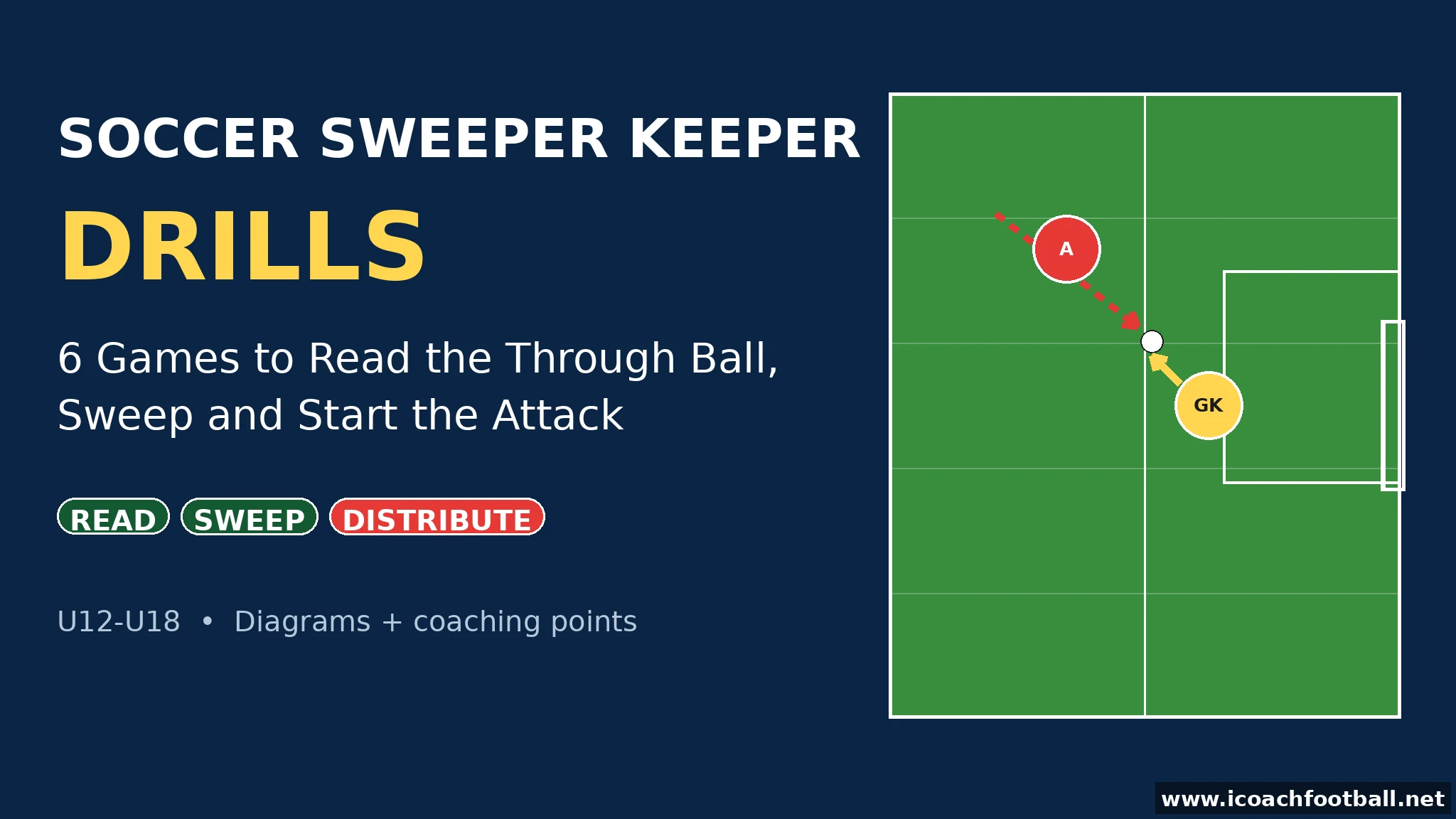
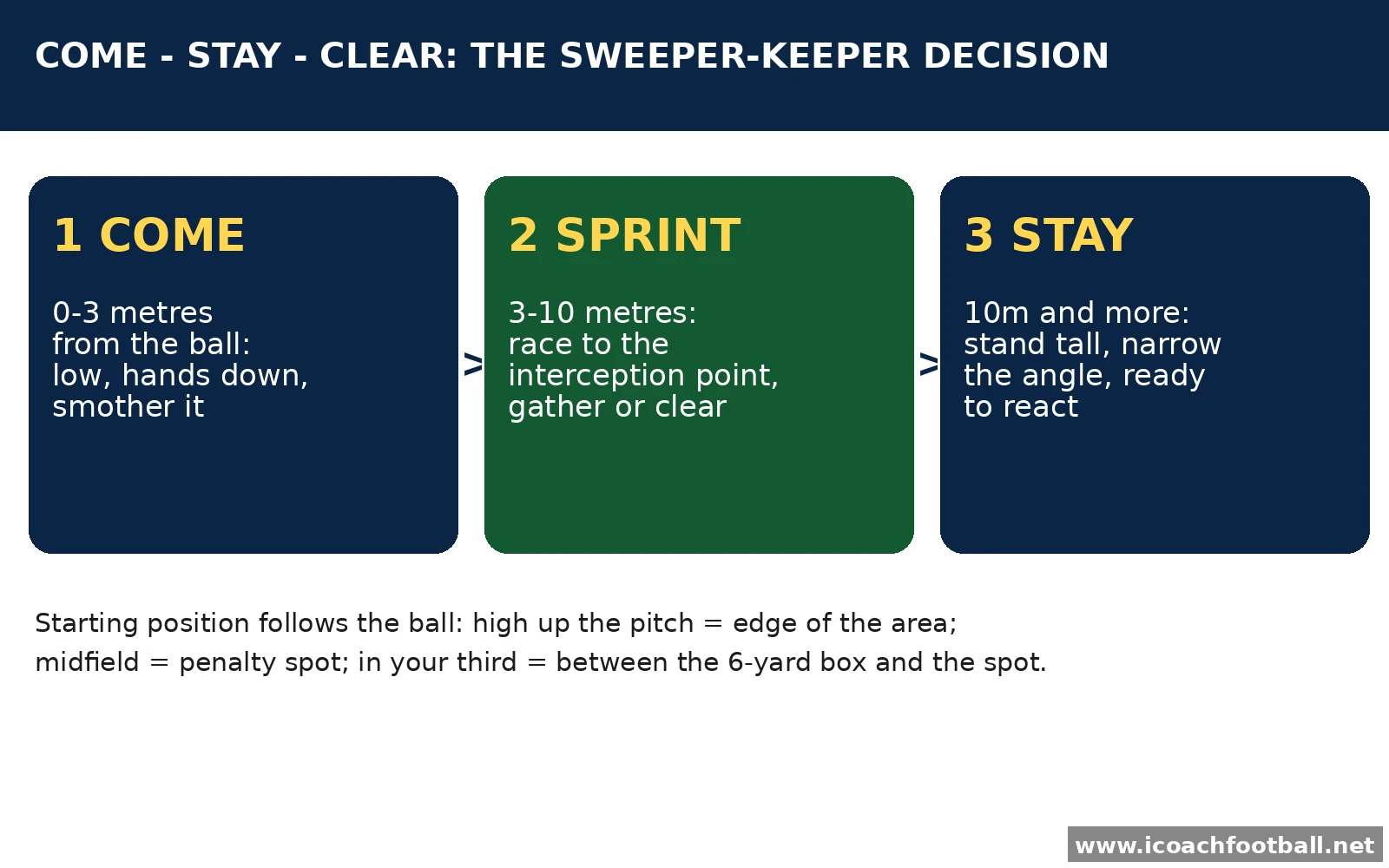
A sweeper-keeper reads the through ball before it arrives, sprints to sweep behind the defensive line, and starts the attack with the first pass. The decision is distance: come inside 3 metres, sprint to intercept from 3 to 10, stay tall and narrow the angle from further out.
Suitable for: U12–U18
Every team that plays a high line needs one. The moment an opponent slips a ball in behind, the goalkeeper is the last defender — and the difference between a clean sweep and a 1v1 is decided before the pass is played. These six soccer sweeper keeper drills teach your keeper to read the trigger, choose the right starting position and sweep with confidence. (In the UK the same role is usually called a football sweeper-keeper — the job is identical.)
Session snapshot
- Players: 4 or more (goalkeepers, servers, strikers, defenders)
- Area: Penalty area to half pitch, depending on the drill
- Duration: 60 minutes
- Focus: Read, sweep, distribute
- Age: U12–U18 (see Age adaptations)
The three decisions: come, stay, clear
The framework below is in line with the FIFA Training Centre’s goalkeeper positioning work: the keeper’s decision is set by distance from the attacker, and by where the ball is on the pitch. FIFA’s own analysis of the 2022 World Cup found the average goalkeeping position had pushed 4 metres higher than in 2018 — the sweeper-keeper is now the norm, not the exception.
| What the attacker does | The keeper’s answer |
|---|---|
| Through ball, keeper within 3 metres of the ball | Come — low, hands down, smother it |
| Through ball, keeper 3–10 metres away | Sprint to intercept — gather with feet or clear to a target |
| Striker shaping to shoot from distance | Stay tall, narrow the angle, be ready to react |
| Clipped ball over the line | Judge the flight early, claim it or punch it clear |
| Keeper wins the ball outside the box | Feet only — then play the first pass forward at once |
Drill 1: The 3-Metre Rule
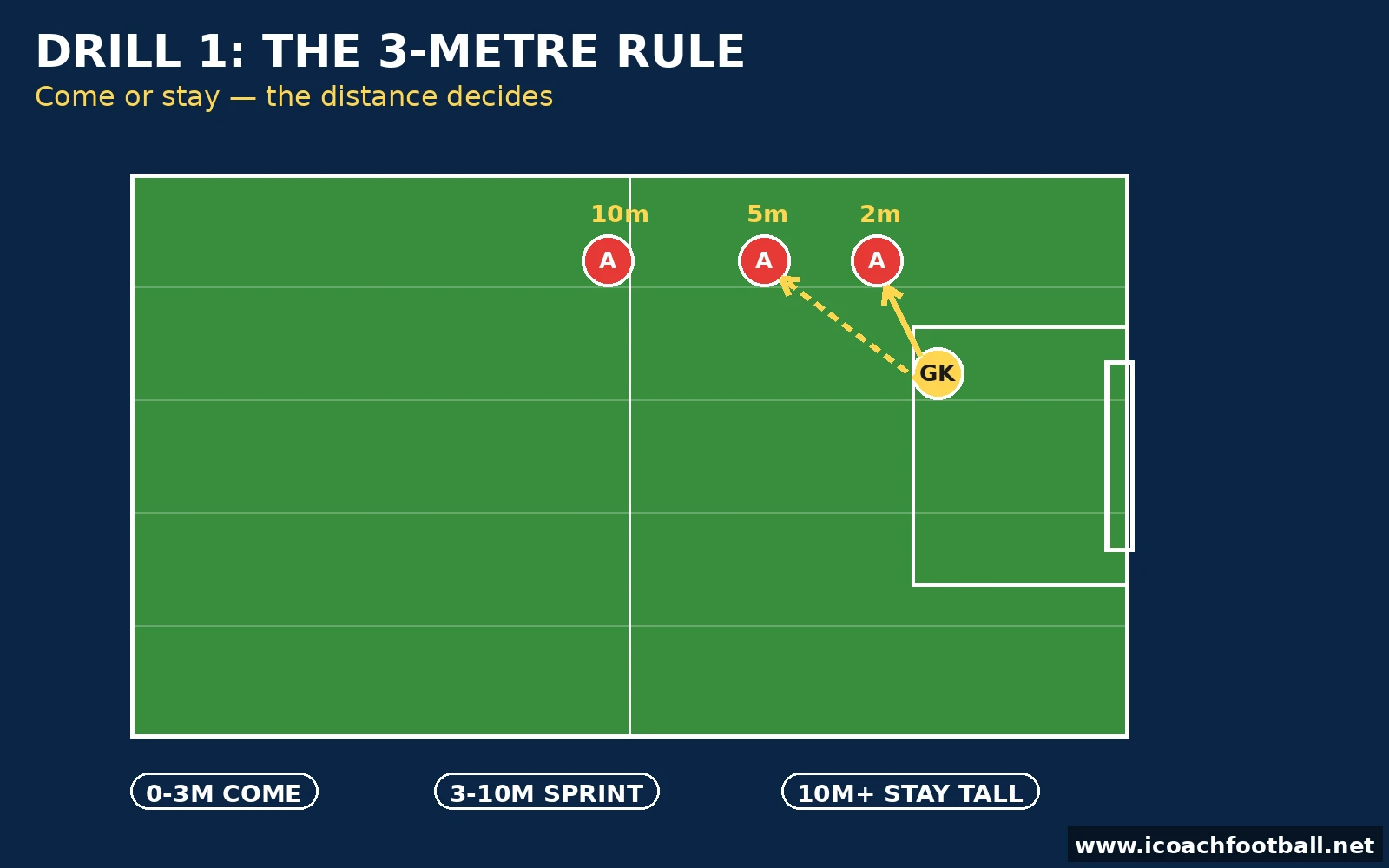
The keeper’s whole job in one decision: come or stay. This drill, based on the FIFA Training Centre session from The FA’s Tim Dittmer, makes that decision automatic.
Setup
- 1 goalkeeper, 1 server, 1 striker, balls at the server
- 18 x 12-yard area in front of a full-size goal
- Striker starts at different distances: 2, 5 and 10 yards from the keeper
- 10 reps, then swap the keeper
How to Play
- The server plays a ball in behind for the striker.
- The keeper reads the distance and calls “MINE!” or “STAY!” before moving.
- Inside 3 metres, the keeper comes low, hands down, and smothers the ball.
- From further out, the keeper holds position, stays tall, and narrows the angle.
- If the keeper wins it, they distribute to the server’s target within 3 seconds.
Coach’s note: Shout “Decide early!” — a keeper who hesitates is beaten twice: too late to sweep and too far out to save. The call must come before the feet move.
Progressions: Serve bouncing balls and balls over the top; let the striker shoot first-time if the keeper stays.
Drill 2: The Through-Ball Race
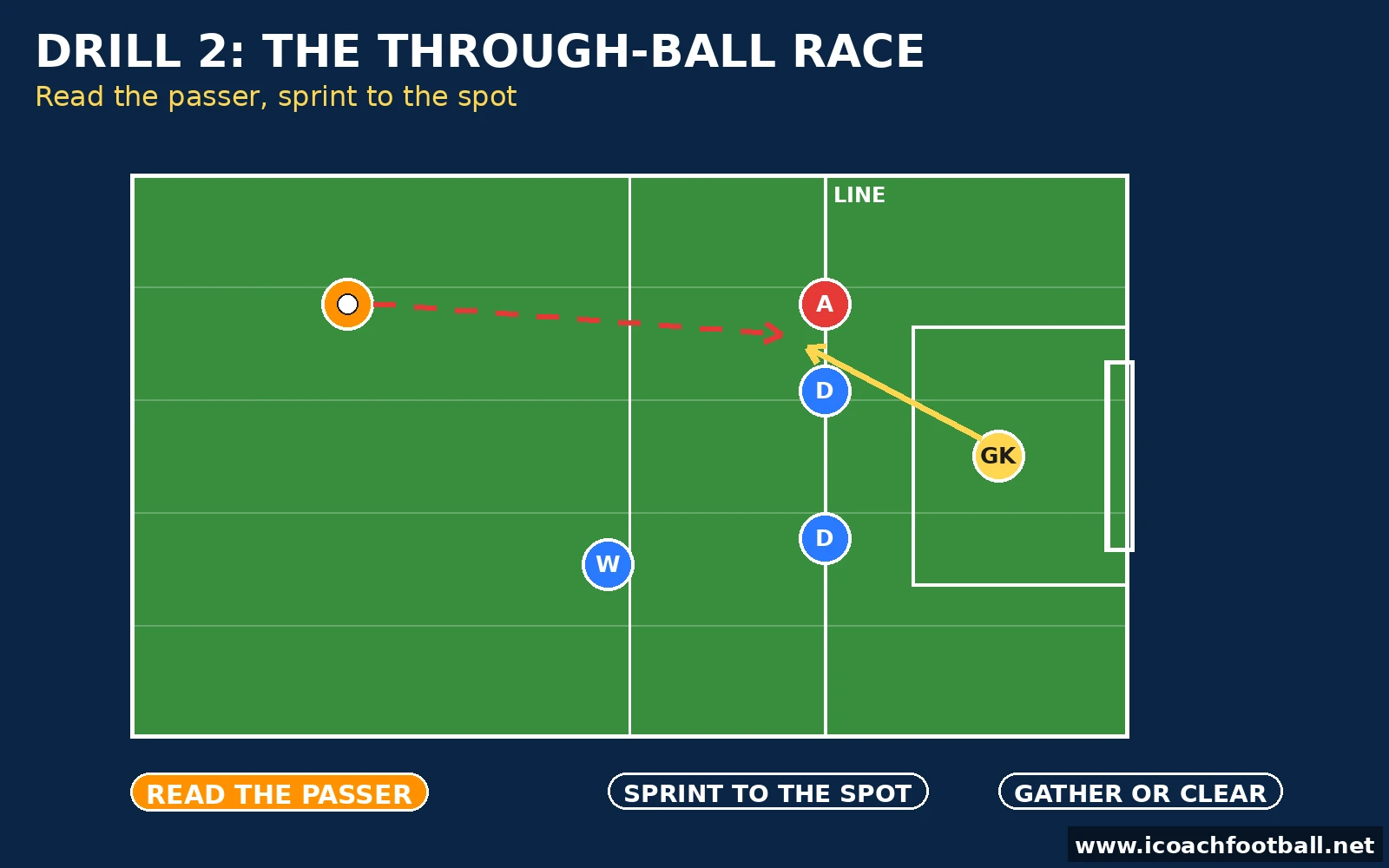
Read the passer’s body, not the ball. This is the drill that builds the sprint-and-sweep habit — and the one where the movement matters most, so watch the animation below the diagram.
Setup
- 1 goalkeeper, 1 server, 1 striker, 1 defender as the line
- Half pitch, full-size goal, defender holding a line 25 yards out
- Server 30 yards from goal with balls; striker on the defender’s shoulder
- 8 reps per keeper, then rotate
How to Play
- The server shapes to play a through ball for the striker.
- The keeper watches the server’s head and hips, not the ball.
- On the pass, the keeper sprints to the interception point — not to the ball.
- The keeper gathers with the feet, or clears first-time to a wide target.
- If the keeper is beaten to it, they recover goal-side and narrow the angle.
Coach’s note: The sprint starts on the passer’s backswing. A keeper who waits to see where the ball goes is already a yard too late — teach them to trust the read.
Progressions: Add a second striker so the keeper must choose which run to cover; let the server disguise the pass with a look the other way.
Drill 3: Diamond Rotation
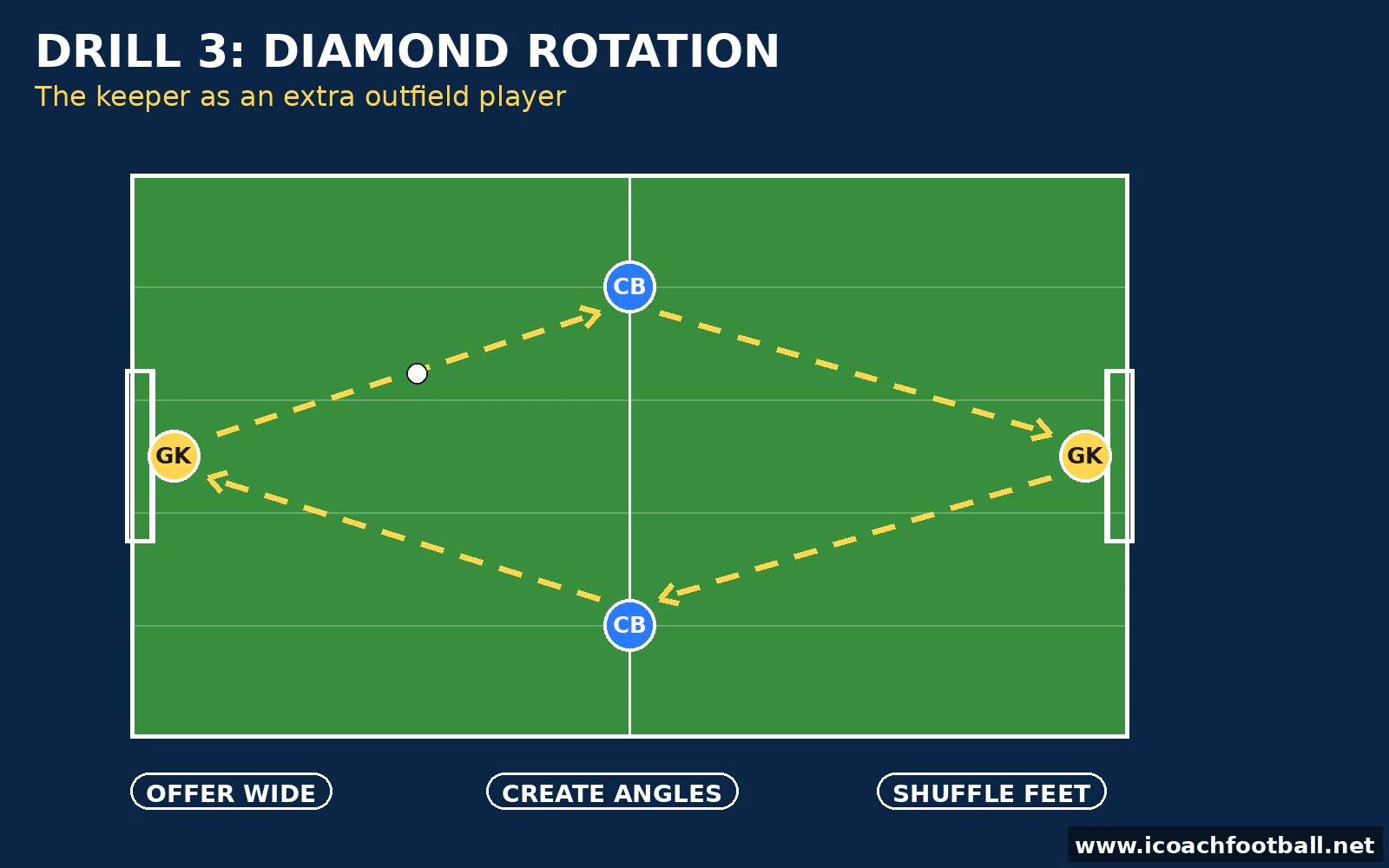
A sweeper-keeper is an outfield player when their team has the ball. This rotation, based on the FIFA Training Centre diamond exercise, trains the keeper to offer, receive and move like a centre-back.
Setup
- 4 goalkeepers (2 in goal, 2 acting as centre-backs), 4 cones as boxes
- Two goals, 30 yards apart, mannequins on the edge of each area
- 1 ball to start, 3-minute blocks, then swap roles
How to Play
- The four keepers pass the ball in rotation around the diamond.
- The keeper in goal offers wide, the centre-back keepers drop to create angles.
- If a centre-back is close, the keeper moves to the far box to create distance.
- If a centre-back is far, the keeper comes to the near box to offer support.
- On the whistle, the keeper with the ball shoots — the opposite keeper saves it.
Coach’s note: Watch the feet between passes. A sweeper-keeper shuffles constantly to stay in line with the ball — flat feet in goal is a habit this drill breaks.
Progressions: Add a pressing attacker; add a second ball so the keeper must scan before receiving.
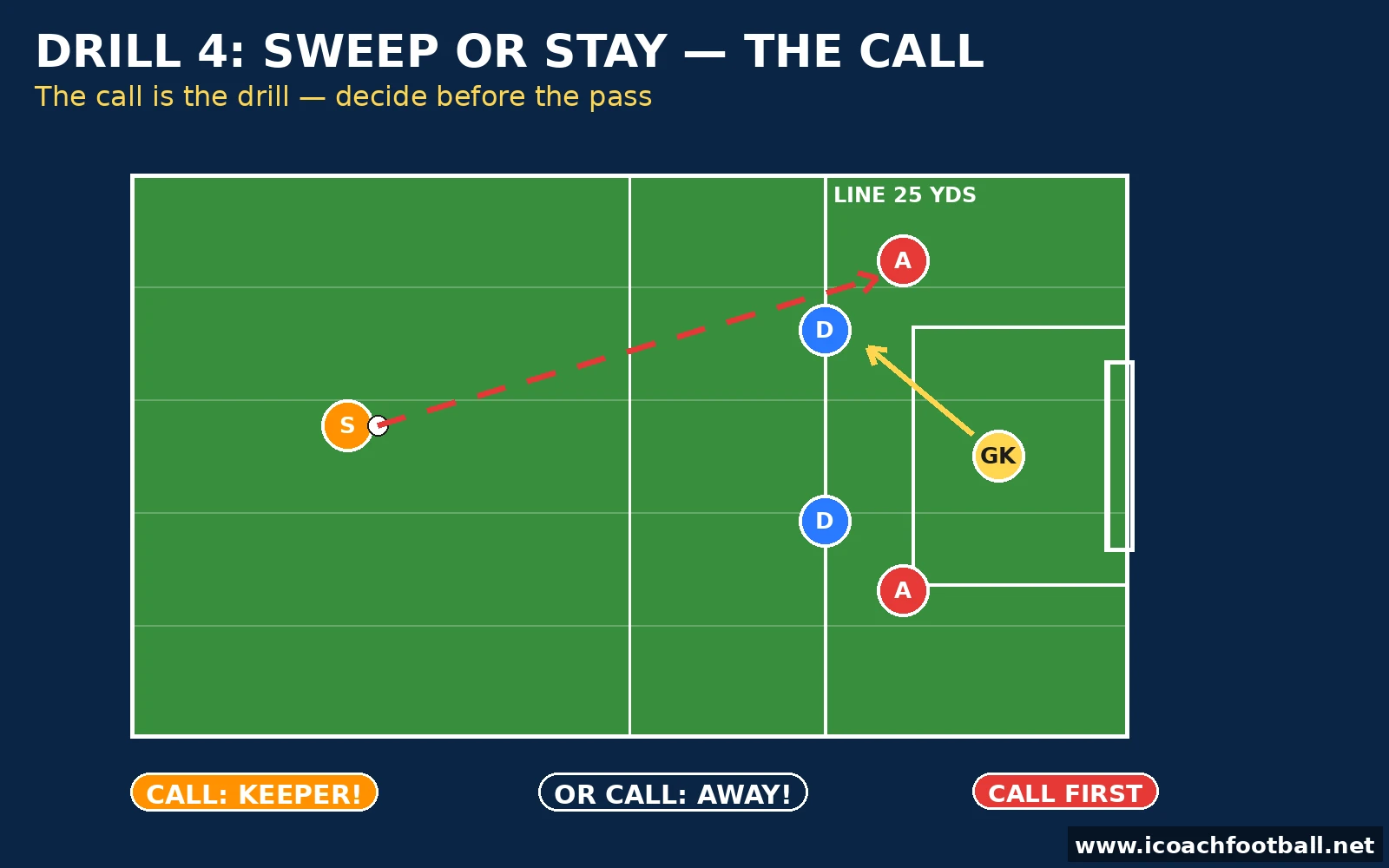
Drill 4: Sweep or Stay — The Call
The defence cannot hold a high line unless the keeper talks. This drill scores the call, not the save.
Setup
- 1 goalkeeper, 2 defenders, 2 strikers, 1 server
- Back line marked 25 yards from goal, full-size goal
- Strikers start on the defenders’ shoulders; server 35 yards out
- 6 balls with the server, 3-minute blocks
How to Play
- The server plays into a striker or over the top of the line.
- The keeper calls “KEEPER!” or “AWAY!” before the ball is played.
- On “KEEPER!”, the keeper sweeps and the defenders drop to cover the goal.
- On “AWAY!”, the keeper holds and the defenders press the ball.
- A late or missing call costs the defending team a point, even if they win the ball.
Coach’s note: The call is the drill. A keeper who sweeps silently leaves two defenders guessing — the voice has to arrive before the through ball does.
Progressions: Let the strikers make crossing runs so the keeper must re-call; add a third striker arriving late.
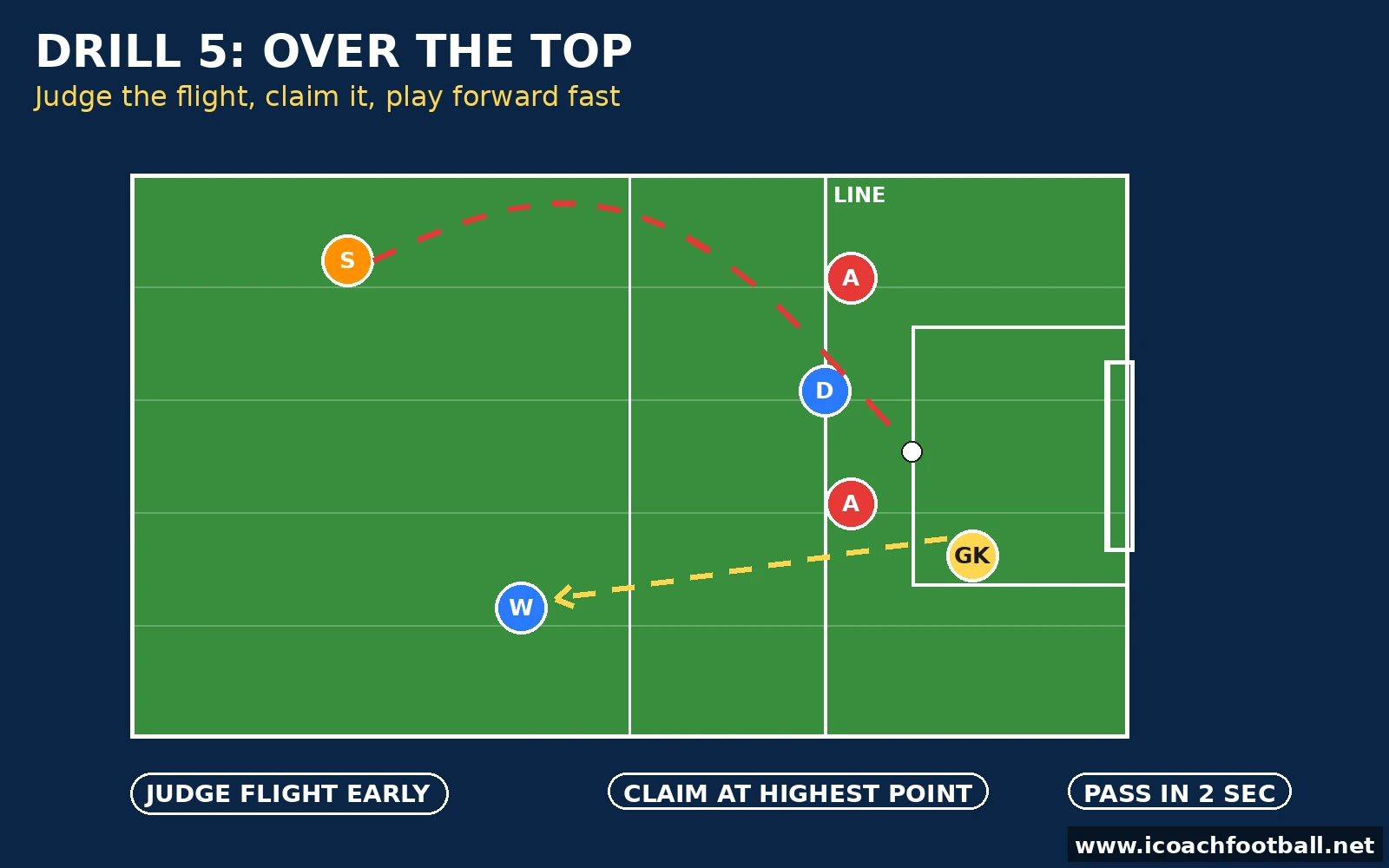
Drill 5: Over the Top
Through balls on the ground are only half the job. Clipped balls over the line test the keeper’s judgement of flight — and their courage to come for it.
Setup
- 1 goalkeeper, 1 server, 2 strikers, 1 defender
- Full-size goal, defender holding a line 20 yards out
- Server 40 yards from goal with balls; strikers on the line’s shoulder
- 8 reps per keeper, then rotate
How to Play
- The server clips a ball over the defensive line.
- The keeper judges the flight early and calls “KEEPER!” at once.
- The keeper comes to claim it at the highest point, knee up for protection.
- If the ball is too far, the keeper holds and lets the defender head it clear.
- On claiming it, the keeper distributes fast to a wide target to start the attack.
Coach’s note: Teach the landing, not just the catch. A keeper who claims a high ball and takes three touches has wasted the sweep — the first pass must go within 2 seconds.
Progressions: Serve from wider angles so the keeper must judge flight across their body; add a second ball for a quick restart after the claim.
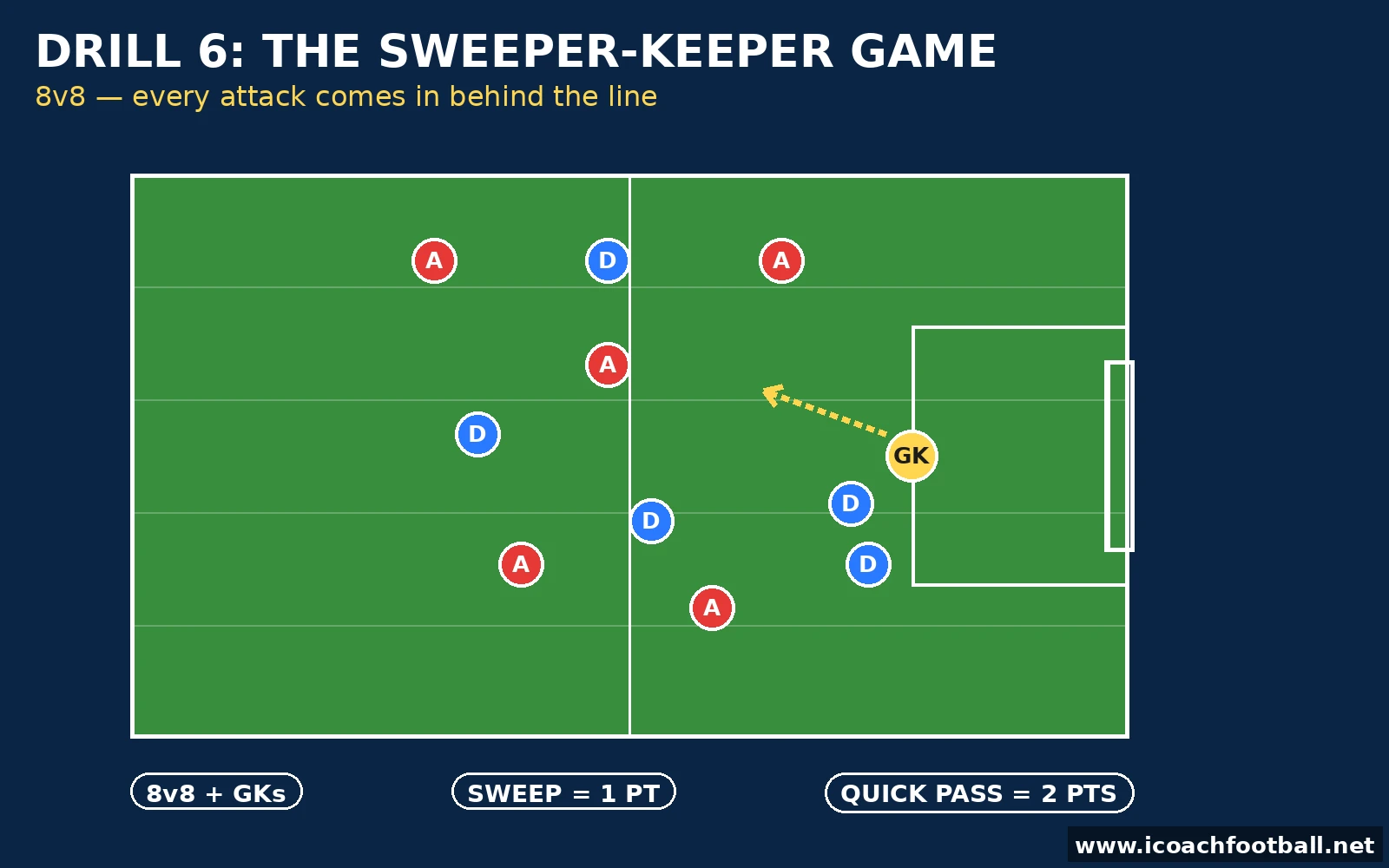
Drill 6: The Sweeper-Keeper Game
Put the keeper inside a real game where every attack is played in behind.
Setup
- 8v8 plus 2 goalkeepers on a 50 x 35-yard pitch with full-size goals
- Normal small-sided rules, plus the sweeper-keeper rule below
- 4 x 4-minute games, 1-minute rests
How to Play
- Teams play 8v8 as normal.
- The goalkeeper plays as an extra outfield player in possession, high off the line.
- Every attack must include at least one ball played in behind the defence.
- A clean sweep earns the keeper’s team a point; a quick first pass after a sweep earns two.
- Rotate keepers every game so every goalkeeper faces the through ball.
Coach’s note: Count sweeps on the whiteboard, not just saves. What you count is what they practise — and a keeper who never sweeps in training will never sweep in a match.
Progressions: Goals only count after a ball in behind; require the keeper’s first pass to reach the halfway line.
Coaching points
- Start high, stay connected. The keeper’s position follows the defensive line: line up, keeper up. A keeper 20 yards behind their line cannot sweep anything.
- Read the passer, not the ball. Head down, hips open, backswing — the trigger is in the server’s body. Teach keepers to watch it.
- Call before you move. “KEEPER!” or “AWAY!” — the defence needs the decision before the ball is played, not after.
- Feet outside the box, hands inside it. Outside the area the keeper is an outfield player: feet only, and never a handball. Inside the box, hands when safe.
- The sweep is only half the job. A keeper who wins the ball and then stands still has wasted it. The first pass forward is the point of the sweep.
Common mistakes
- Starting on the goal line. A keeper who stands on the line cannot sweep behind the defence. Start position follows the ball: higher when the ball is up the pitch.
- Sprinting to the ball instead of the interception point. The ball moves faster than the keeper. Run to where the ball will be, not where it is.
- Silent sweeping. A keeper who comes without calling leaves defenders stranded between dropping and pressing. Call first, move second.
- Handling outside the box. The most expensive mistake in the sweeper-keeper’s game: a hand outside the area is a foul and often a red card. Drill the feet-only rule until it is automatic.
- Slowing the attack after the sweep. Three touches after winning the ball lets the opponent reset. First pass within 2 seconds, forward if possible.
Age adaptations
| Age group | How the session changes |
|---|---|
| U12–U13 | Shorter distances (line 15 yards out), keeper stays within 10 yards of goal, no high sweeping against older strikers, celebrate every clean sweep |
| U14–U15 | Full Drills 1–4; introduce the diamond rotation at walking pace first; keep the through-ball race at half speed until the read is reliable |
| U16–U18 | Full speed throughout; add the disguised pass and second-striker progressions; keepers call the press and the sweep themselves with no coach prompts |
60-minute session plan
| Block | Time | Content |
|---|---|---|
| Warm-up | 0–10 min | Footwork ladders, short sprints to set position, handling in pairs |
| Drill 1 + 2 | 10–25 min | 3-Metre Rule, then Through-Ball Race (with animation) |
| Drill 3 + 4 | 25–40 min | Diamond Rotation, then Sweep or Stay — The Call |
| Drill 5 + 6 | 40–55 min | Over the Top, then Sweeper-Keeper Game |
| Cool-down | 55–60 min | Light jog, stretch, one-line review: “When did you come, and when did you stay?” |
Sources
- FIFA Training Centre — Goalkeeper’s positioning in and out of possession. The drills above are based on and in line with its 3-metre rule, high-position 1v1 work, balls through and over from distance, and diamond ball rotation; they are not FIFA-approved sessions.
- FIFA Training Centre — FIFA Insight episode 3: Goalkeeper distribution, positioning and offering. Used in line with its analysis of the rise of the sweeper-keeper and the higher goalkeeper line height seen at the 2022 World Cup.
FAQ
What age should goalkeepers start sweeper-keeper training?
From U12, with short distances and a keeper who stays within 10 yards of goal. Younger keepers should focus on handling and starting position close to goal — sweeping far off the line needs the reading speed that comes later.
How far off the line should a youth sweeper-keeper stand?
As far as the defensive line allows: close enough to sweep behind the last defender, and close enough to recover to goal if the ball is chipped. A good rule is to stay within 10–15 yards of the line, and never further out than the keeper can sprint back from in 3 seconds.
What happens when the keeper gets chipped?
It will happen — it is the trade-off for sweeping. Teach the recovery run and the nearest defender to drop to the line, and do not abandon the role after one goal. A keeper who never gets chipped is a keeper who never sweeps.
Can you train sweeper-keeper skills with only one goalkeeper?
Yes. Use servers and outfield players as strikers, and rotate an outfield player into goal for the game so the keeper also learns the role from the other side. The diamond rotation works with two keepers plus two outfield players as centre-backs.
Should the keeper use hands or feet outside the box?
Feet only. Outside the penalty area the goalkeeper is an outfield player — handling the ball there is a foul and usually a red card. Inside the box, use hands when the ball can be gathered safely.