Soccer Drills for Improving Goalkeeper Starting Position: 6 Games That Put the Keeper in the Right Place Before the Shot (U10–U16)
Quick answer
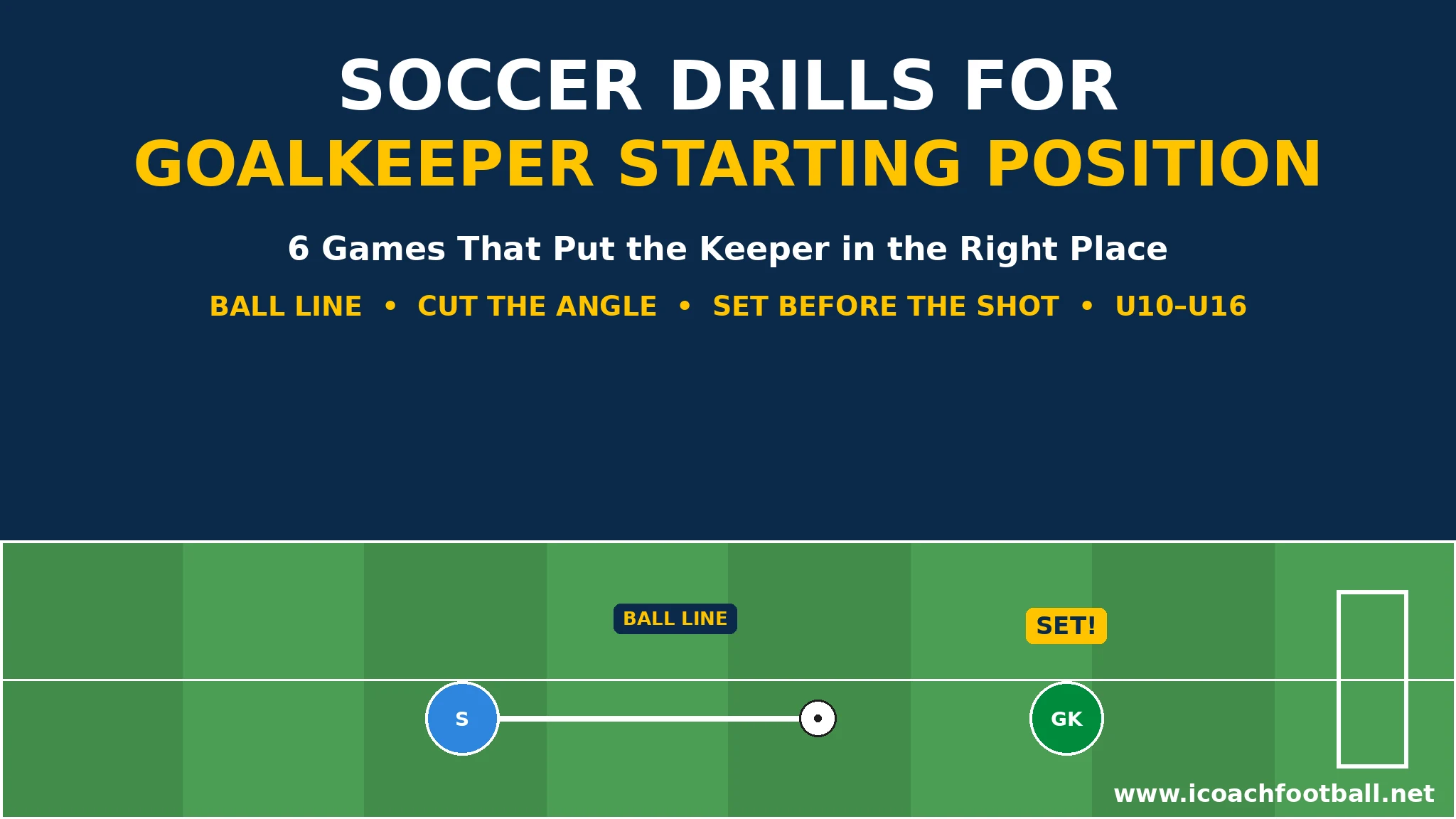
Most goals are conceded before the shot is struck. A goalkeeper in the right starting position — on the line between the ball and the centre of the goal, the right distance off the line, feet planted and balanced — saves shots a goalkeeper in the wrong position never reaches. These six soccer drills for improving goalkeeper starting position train that position step by step: the ball line, the arc, the set, the angle, the near and far post, and a full game where being set before the shot scores points.
Suitable for: U10–U16 (ages 9–16)
Session snapshot
- Players: 8–12, including 2–4 goalkeepers
- Age: U10–U16 (ages 9–16)
- Area: Penalty box and goalmouth, expanding to half a pitch
- Duration: 60 minutes
- Focus: Goalkeeper starting position — standing on the ball line, cutting the angle, and being set before the shot
- Equipment: 10 balls, 14 cones, bibs, 1 full goal (2 for the final game)
Why these six games work
A save is decided by two things: where the goalkeeper stands and whether the feet are still when the ball is struck. A keeper standing a yard off the ball line gives the shooter a free corner. A keeper still shuffling as the shot is struck cannot dive at all — the body is moving the wrong way while the ball is already travelling.
The first two drills build the line and the arc: finding the imaginary line from the ball through the keeper to the centre of the goal, then walking the arc from post to post so the keeper is always on that line. The next two drills build the set and the angle: stopping the feet and balancing before the shot, then stepping off the line to cut the angle as the attacker closes in. The last two drills build the game skill: shifting across goal as the ball swings from side to side, then a full game where a save only counts if the keeper was set before the shot.
The drills are grounded in the FIFA/UEFA coaching community. Drills 1, 4 and 6 are based on / in line with the FIFA Training Centre session “09) Goalkeeper’s positioning in and out of possession”, in which The FA and England’s Head of Coaching (and former Head of Goalkeeping) Tim Dittmer trains goalkeepers to understand when to close down an attacker and their shooting angle and when to stay in goal and protect their position, using the “3-metre rule” to decide when to win the ball and when to hold, and a low body posture close to the attacker and a tall, upright posture for shots from distance. Drills 2, 3 and 5 are based on / in line with The FA Level 1 and 2 in Coaching Goalkeepers Technical Manual, which sets out the set position — feet approximately shoulder width apart, weight on the front half of the feet, knees slightly flexed, hips square to the ball, head still with the nose in front of the toes, elbows narrow, hands in front of the bodyline approximately ball width apart — and its three starting-position key points: the goalkeeper’s starting position in relation to the ball, movement into the line of the ball, and the set position as the ball is struck. In the UK the same session is football drills for improving goalkeeper starting position — the ball line, the arc and the set are identical.
This post is the starting-position half of the site’s goalkeeper pair. The save that follows a good starting position — reading the taker and stopping the spot-kick — is our soccer penalty save drills, published earlier today. The 1v1 that tests the keeper’s angle-closing is our soccer goalkeeper 1v1 drills, and the cross-handling that starts from the keeper’s position on crosses is our soccer goalkeeper cross handling drills.
Six rules of goalkeeper starting position
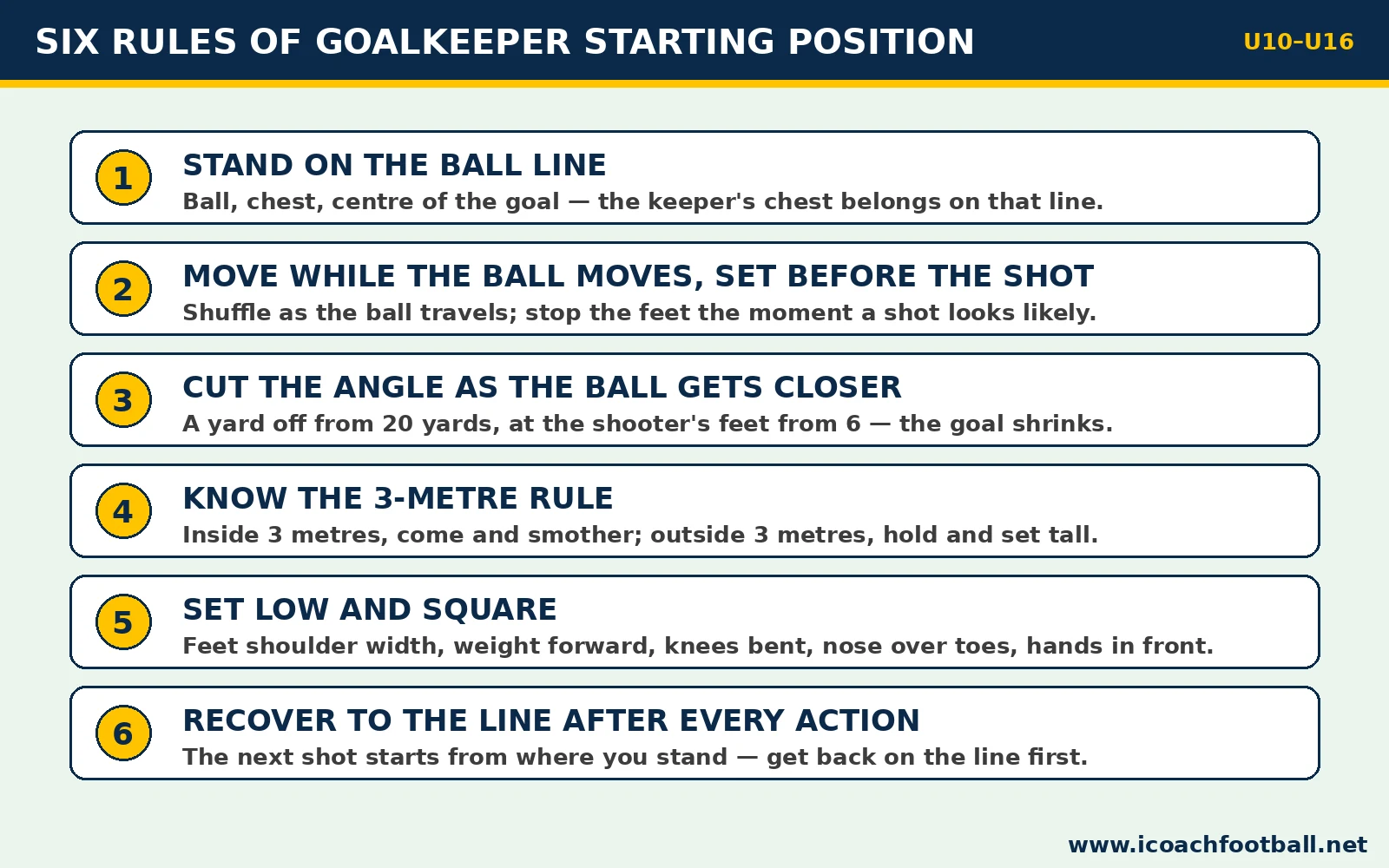
- Stand on the ball line. Draw an imaginary line from the ball through the keeper to the centre of the goal — the keeper’s chest belongs on that line, every time.
- Move while the ball moves, set before the shot. Shuffle as the ball travels; stop the feet and balance the moment a shot looks likely.
- Cut the angle as the ball gets closer. The nearer the shooter, the further off the line the keeper stands — a shot from 20 yards needs a yard; a shot from 6 yards needs the keeper at the shooter’s feet.
- Know the 3-metre rule. Inside 3 metres of the attacker, come and smother the ball; outside 3 metres, hold your position and set.
- Set low and square. Feet shoulder width, weight on the front of the feet, knees bent, hips square to the ball, nose over toes, hands in front.
- Recover to the line after every action. The next shot starts from where the keeper is standing, not from where the last save ended — get back on the ball line before the next ball is played.
Drill 1 — Find the Line
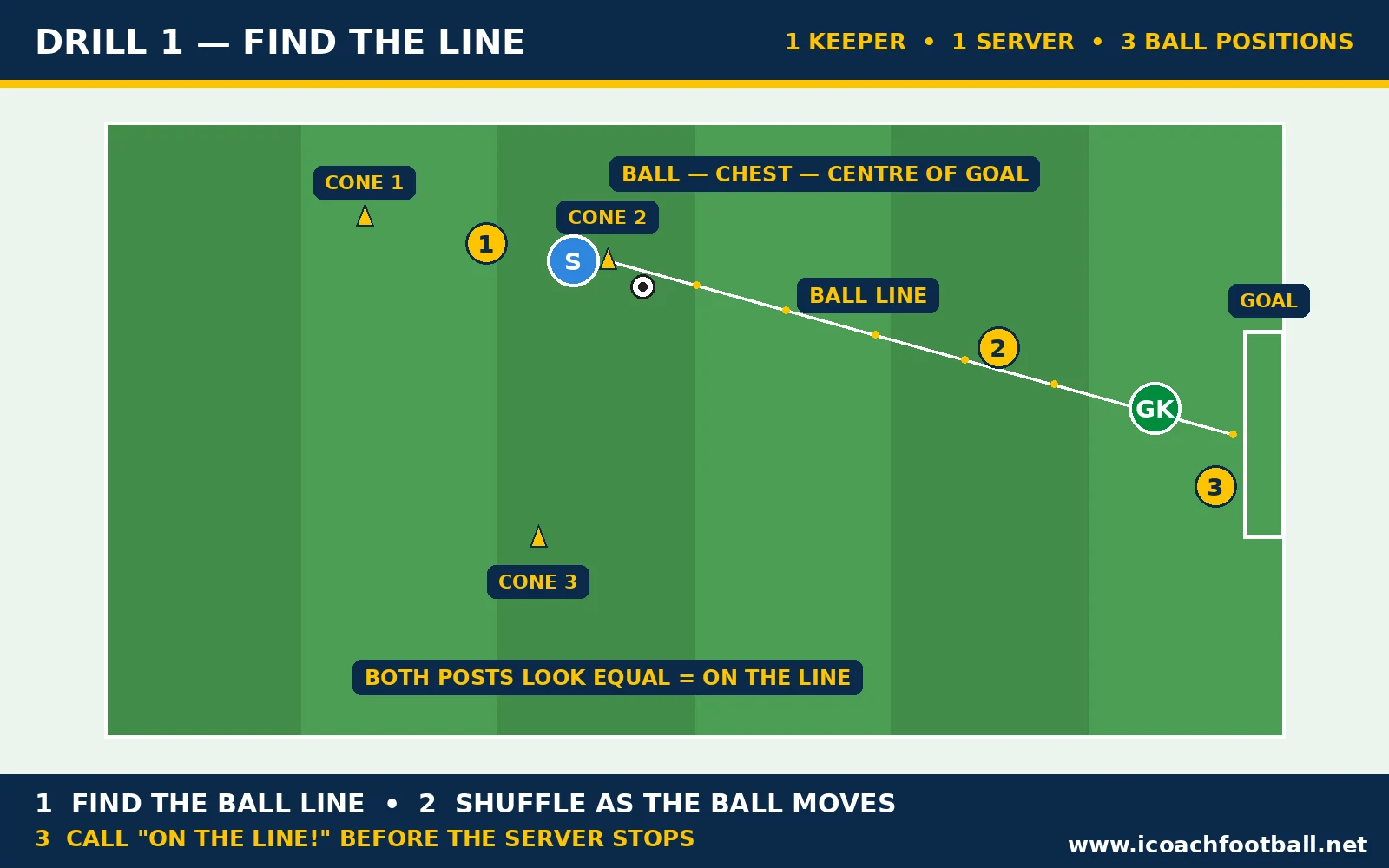
The keeper learns the ball line — the imaginary line from the ball to the centre of the goal — by walking it, then shuffling along it as the ball moves.
Setup
- Penalty box, 1 full goal, 1 keeper, 1 server with balls, 3 cones marking ball positions.
- 8 minutes, then rotate.
How to Play
- The server stands at the first cone, 18 yards out, with the ball at their feet.
- The keeper stands in goal and finds the ball line — ball, chest, centre of the goal.
- The coach calls “LINE!” and the keeper points at the ball, then at the centre of the goal.
- The server moves the ball to the second cone and the keeper shuffles to the new line.
- The server moves the ball to the third cone and the keeper shuffles again, staying on the line.
- After 6 moves, rotate — the keeper becomes the server and a new keeper steps in.
Coach’s note: “If you cannot see both posts equally, you are not on the line — shuffle until the goal looks the same size on both sides.”
Progressions: The server moves the ball without warning; the keeper must call “ON THE LINE!” before the server stops; add a shot from each cone that the keeper must save from the line.
Drill 2 — The Arc Walk
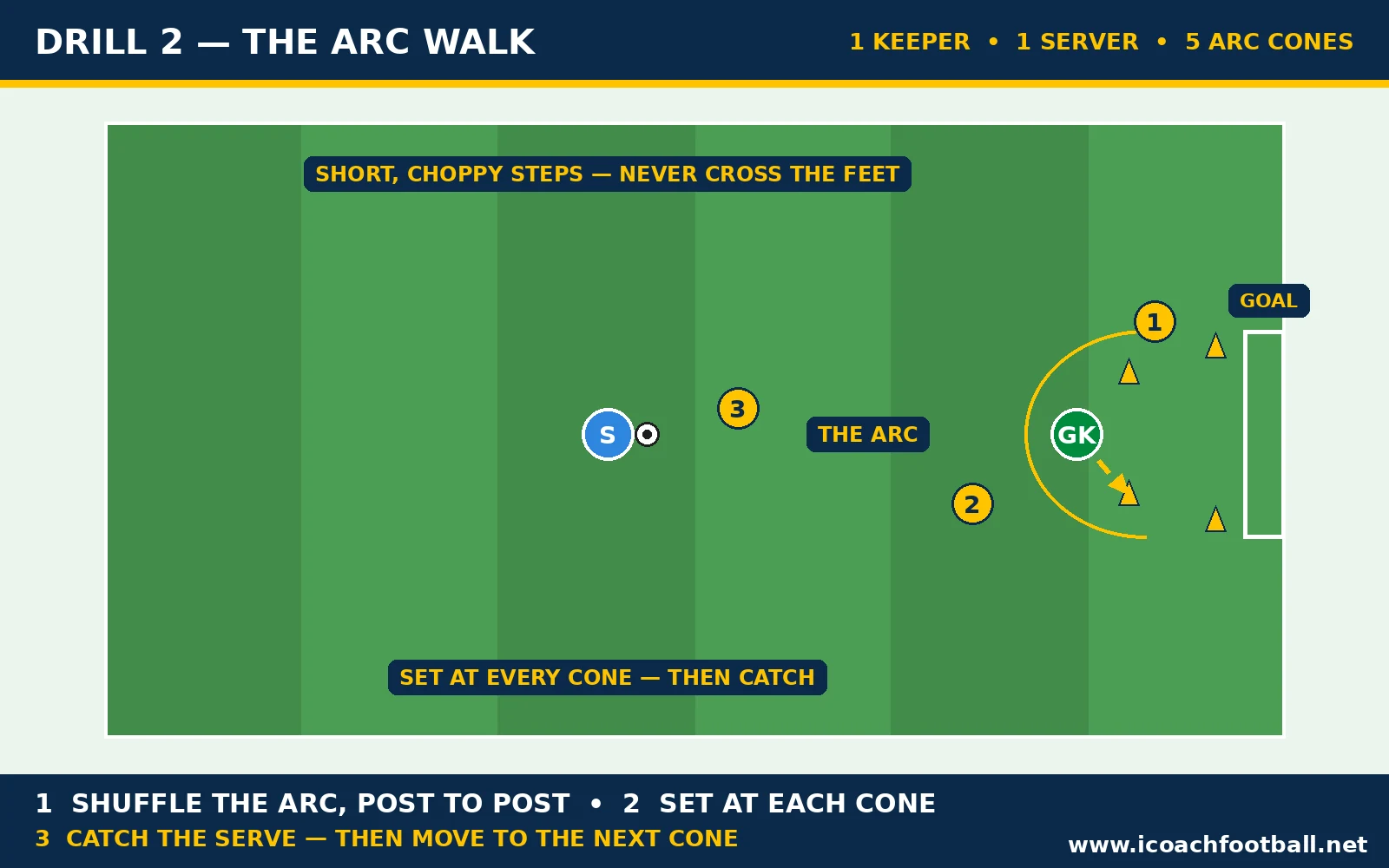
The keeper walks the arc — a curve of cones from post to post — shuffling sideways, setting at each cone, and catching a soft serve.
Setup
- Goal with 5 cones in an arc from post to post, peaking 1 yard off the six-yard line, 1 keeper, 1 server.
- 10 minutes.
How to Play
- The keeper starts on the near post, facing the server 10 yards out.
- The keeper shuffles along the arc to the first cone, keeping the feet under the body.
- At the cone the keeper sets — feet planted, knees bent, hands in front — and the server rolls a ball.
- The keeper catches the ball, returns it, and shuffles to the next cone.
- The keeper walks the whole arc, post to post, setting and catching at every cone.
- After 2 full arcs, rotate — the keeper becomes the server and a new keeper steps in.
Coach’s note: “Short, choppy steps on the arc — a keeper who crosses their feet over is a keeper who cannot dive.”
Progressions: The server varies the height of the serve; the keeper must set and catch with the weaker hand leading; the server fakes a shot and the keeper must set without flinching.
Drill 3 — Set Before the Shot
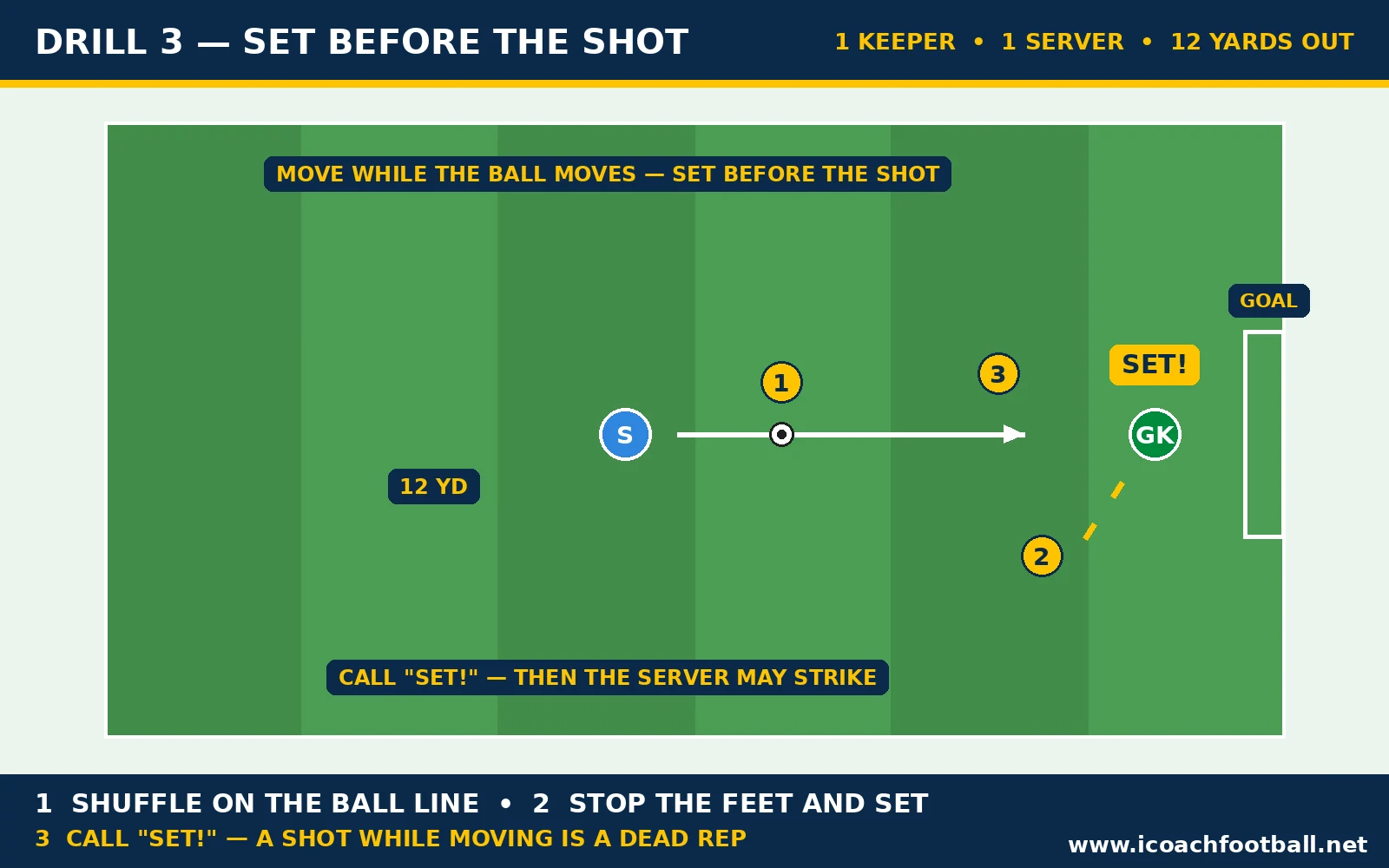
The timing drill — the keeper must be set, feet planted and balanced, before the ball is struck, or the rep is dead.
Setup
- Penalty box, 1 full goal, 1 keeper, 1 server 12 yards out with balls.
- 10 minutes.
How to Play
- The keeper starts on the ball line, 1 yard off the goal line, facing the server.
- The server moves the ball left and right, and the keeper shuffles to stay on the line.
- The server shapes to shoot — the keeper stops the feet and sets at once.
- The keeper calls “SET!” the moment the feet are planted and balanced.
- The server strikes only after the keeper calls “SET!” — a shot while the keeper is moving is a dead rep.
- Play for 2 minutes, then swap — the keeper becomes the server and a new keeper steps in.
Coach’s note: “Better to be in the wrong place and set than in the right place and moving — a moving keeper saves nothing.”
Progressions: The server varies the time between the shape and the strike; the server may fake the shot twice before striking; the keeper must save the shot and recover to the line within 3 seconds.
Drill 4 — Close the Angle
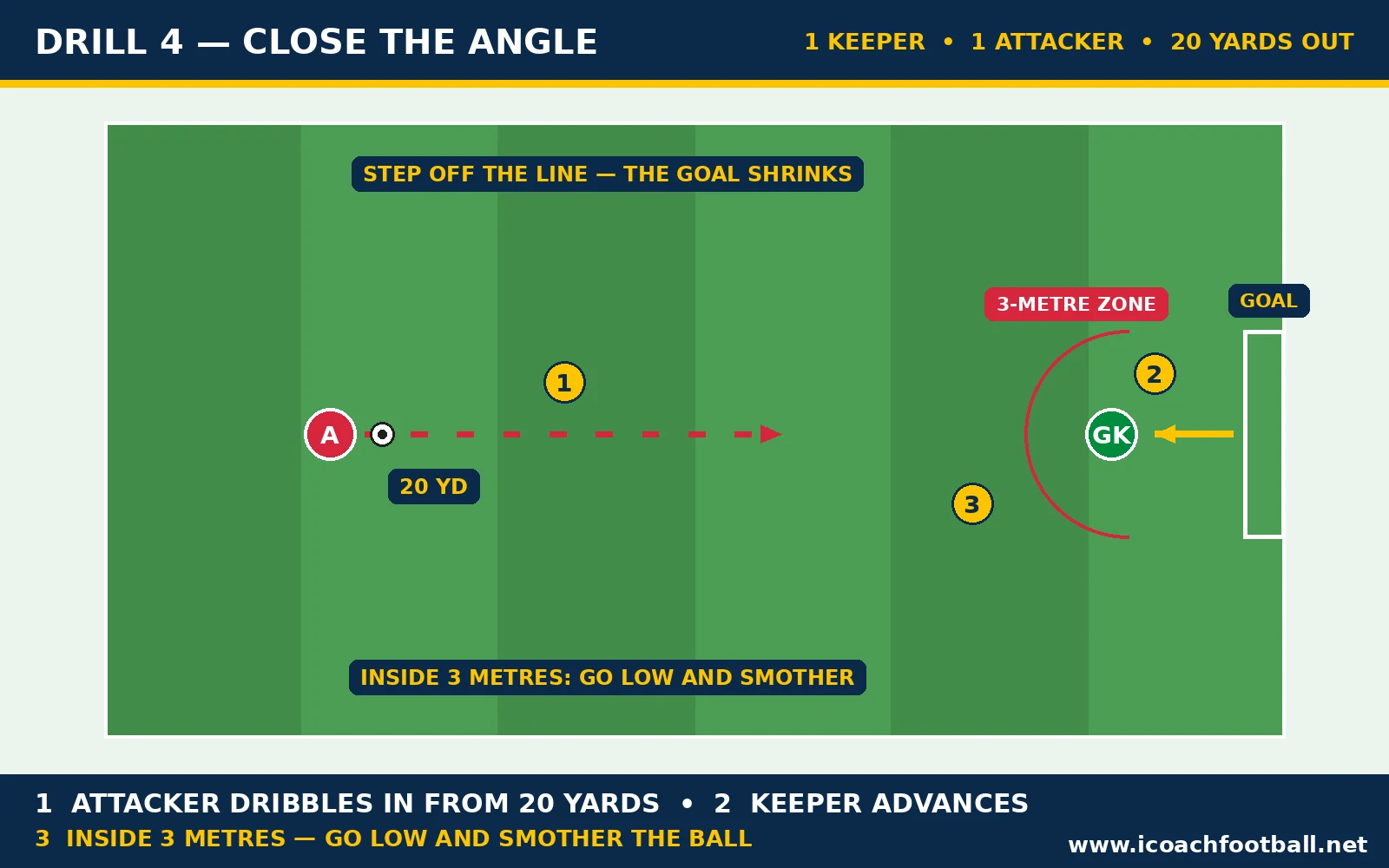
The 1v1 drill — the attacker dribbles in from distance and the keeper advances to cut the angle, using the 3-metre rule to decide when to come and when to hold.
Setup
- Penalty box, 1 full goal, 1 keeper, 1 attacker starting 20 yards out, balls at the attacker.
- 10 minutes.
How to Play
- The attacker starts 20 yards out and dribbles slowly towards goal.
- The keeper starts 1 yard off the line, on the ball line, in the set position.
- As the attacker closes in, the keeper steps off the line to cut the shooting angle.
- Inside 3 metres of the attacker, the keeper goes low, spreads, and smothers the ball.
- Outside 3 metres, the keeper holds, stays tall, and sets for the shot.
- Play for 2 minutes, then swap — the keeper becomes the attacker and a new keeper steps in.
Coach’s note: “Close the angle and the goal shrinks — stay on your line against a close attacker and the goal is as wide as the whole net.”
Progressions: The attacker may shoot early from distance; the attacker may try to round the keeper, who must stay on their feet; add a recovering defender chasing from behind.
Drill 5 — Near Post, Far Post
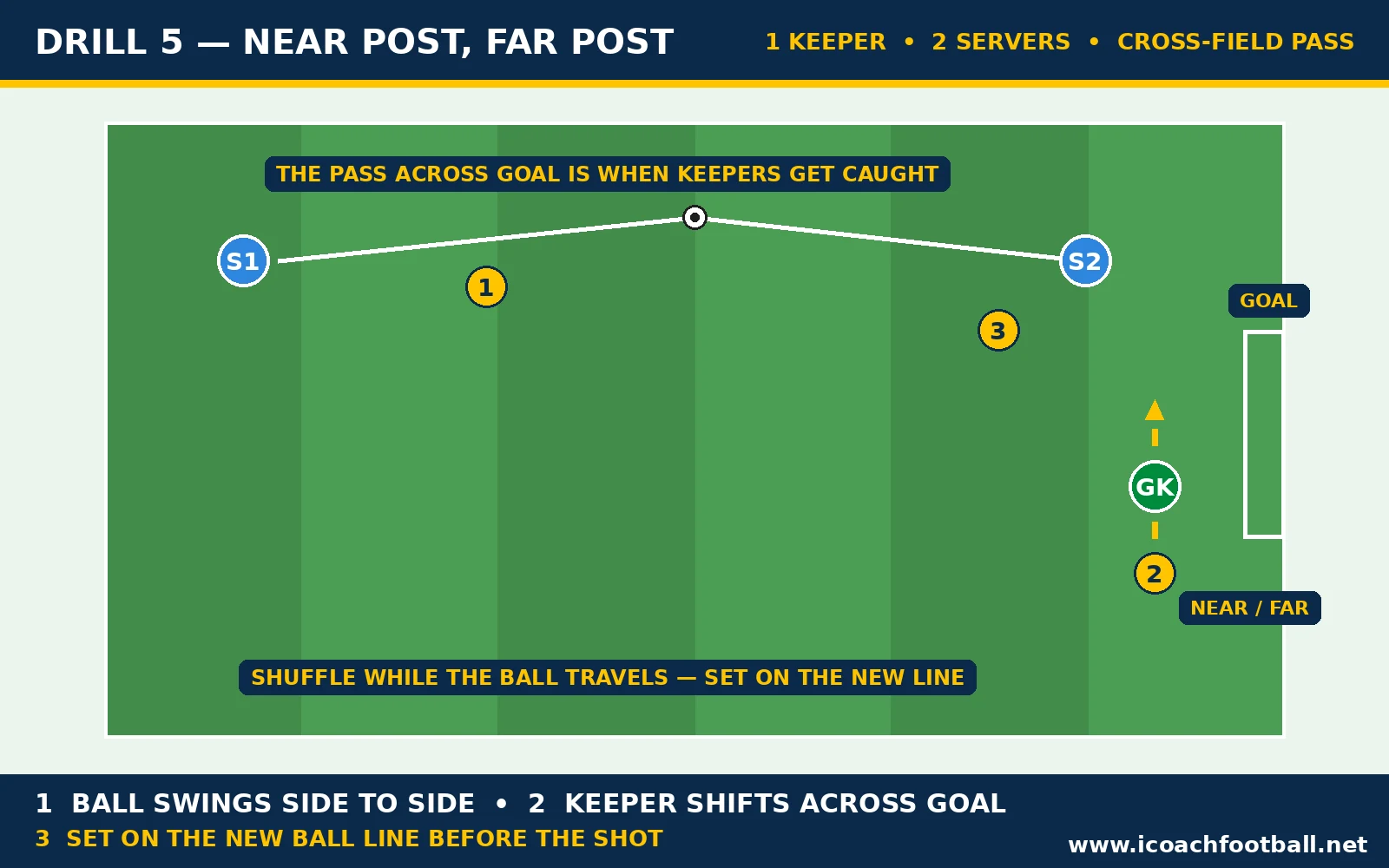
The ball swings from side to side and the keeper shifts across the goal, setting on the new ball line every time — the cross-field pass is the hardest move in goalkeeping.
Setup
- Penalty box, 1 full goal, 1 keeper, 2 servers wide on each side, balls at the servers.
- 8 minutes, then rotate.
How to Play
- The keeper starts on the ball line against the left server, 1 yard off the line.
- The left server passes across goal to the right server — the keeper shuffles across at once.
- The keeper sets on the new ball line before the right server can shoot.
- The right server shoots low to either post and the keeper saves from the set position.
- The servers pass back across and the keeper shifts to the other side and sets again.
- After 6 passes, rotate — the keeper becomes a server and a server becomes the keeper.
Coach’s note: “The pass across goal is when keepers get caught — shuffle while the ball travels, or you will still be moving when the shot comes.”
Progressions: The servers may shoot first time off the pass; the servers may fake the pass and shoot from their own side; the keeper must call the post they are covering — “NEAR!” or “FAR!” — before each set.
Drill 6 — The Starting Position Game
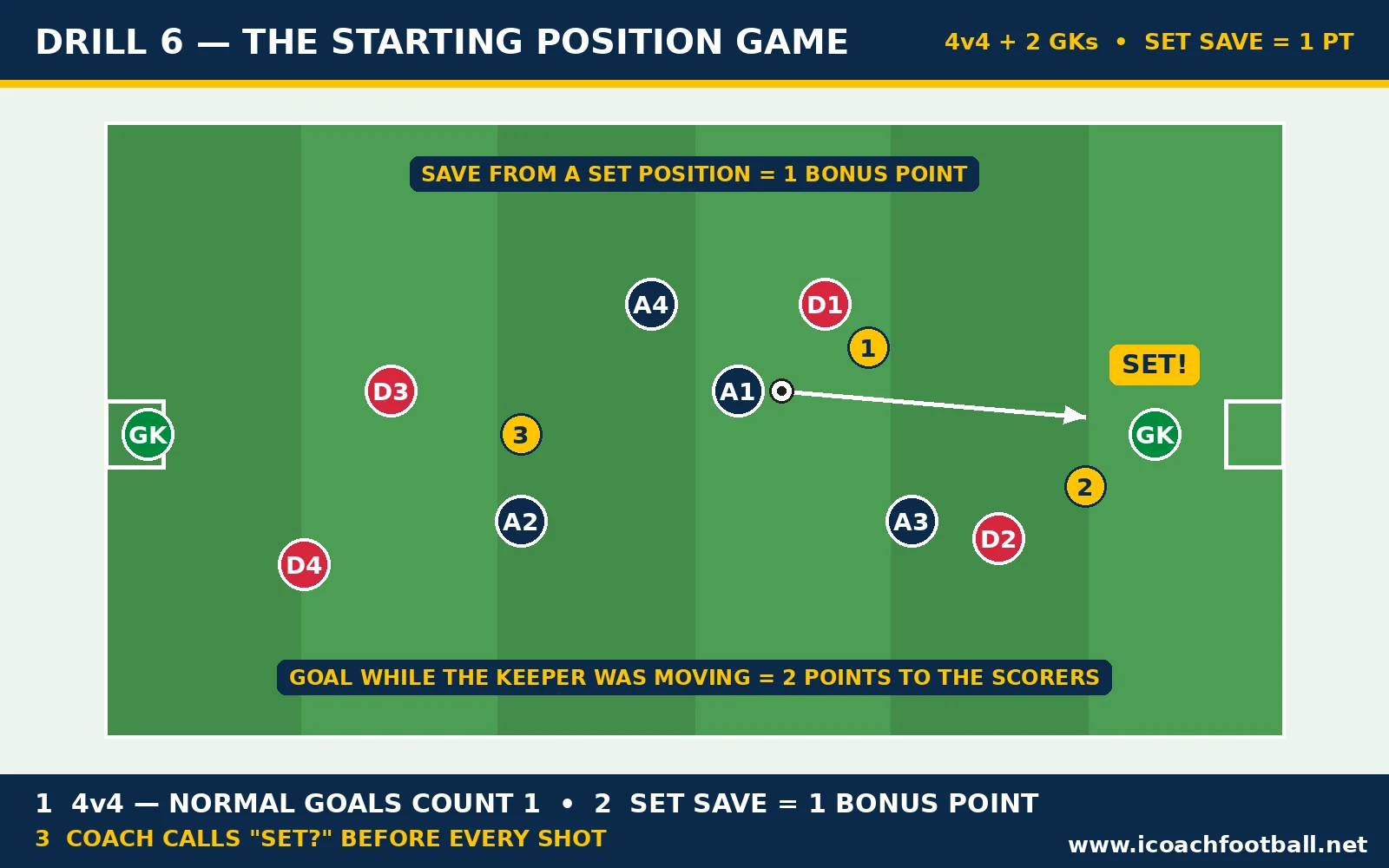
The full game. A 4v4 where the keeper earns a point for every save made from a set position — so the group starts watching the keeper’s feet before the shot, because the points depend on it.
Setup
- Half a pitch, 4v4 plus 2 goalkeepers, 2 full goals.
- 14 minutes.
How to Play
- Two teams of 4 play 4v4 with goalkeepers — normal goals count 1 point.
- A save made from a set position earns the keeper’s team 1 bonus point.
- A goal conceded while the keeper was still moving earns the scoring team 2 points.
- The coach calls “SET?” before every shot, so the whole group hears the check.
- The team with the most points after 14 minutes wins — then play again with new teams.
- Coaches call out every good starting position, so the whole group hears what good goalkeeping looks like.
Coach’s note: “Watch the keeper’s feet, not the ball — the moment the group starts celebrating a set position like a save, the habit is built.”
Progressions: Shots must be first-time; the attacking team may use a cutback from the byline; a save from a set position after a cross-field pass earns 2 bonus points.
Coaching points
- The ball line is everything. If the keeper’s chest is not on the line from the ball to the centre of the goal, one corner is open before the shot is even struck — check the line first, every time.
- Move while the ball moves, never while it is struck. The feet move when the ball moves and stop when a shot is likely. A keeper still shuffling as the ball is struck is beaten by the first step, not by the shot.
- Cut the angle with distance, not with panic. Step off the line in proportion to how close the shooter is — a yard from 20 yards, three yards from 12, at the shooter’s feet from 6. The goal shrinks with every step forward.
- The 3-metre rule decides stay or go. Inside 3 metres, come and smother low; outside 3 metres, hold and set tall. A keeper who guesses instead of measuring gets beaten both ways.
- Set low and square, nose over toes. Feet shoulder width, weight on the front of the feet, knees bent, hips square, hands in front and ball width apart. If the nose is behind the toes, the weight is back — and a keeper leaning back cannot dive forward.
- Recover to the line after every action. A save, a catch, a parry — the next shot starts from where the keeper is standing. Get back on the ball line before the next ball is played, or the next shot finds an empty corner.
Common mistakes
| Mistake | Fix |
|---|---|
| Standing a yard off the ball line and leaving a corner open | Find the line before every shot — Drill 1 stops the rep if the keeper cannot point at the ball and the centre of the goal |
| Crossing the feet over while shuffling across goal | Short, choppy steps on the arc — Drill 2 only scores the catch if the keeper shuffled without crossing the feet |
| Still moving when the ball is struck | Set and call “SET!” before the strike — Drill 3 kills the rep if the keeper is moving when the ball is struck |
| Staying on the line against a close attacker | Step off the line to cut the angle — Drill 4 only scores the save if the keeper advanced inside 3 metres |
| Standing too far off the line against a long shot | Hold 1 yard off the line from distance — Drill 4 stops the rep if the keeper is caught in no-man’s land |
| Watching the ball instead of recovering after a save | Recover to the ball line within 3 seconds — Drill 3 only scores the next rep if the keeper is back on the line |
Age adaptations
| Age | Format | What changes |
|---|---|---|
| U10–U11 (ages 9–11) | Small goal or coned goal, size 4 ball, serves rolled or thrown by hand | All six drills run with soft, predictable serves and the keeper walking the line and the arc first. Drill 3 uses a server who calls the shot — “Shooting now!” — so the set can be learned in slow motion. Drill 6 plays with no scoreboard for goals — only set-position saves are counted, so the group learns what a good starting position looks like |
| U12–U13 (ages 11–13) | Full goal, size 4 ball, shots struck from 12 yards | All six drills run as written, with the server varying the timing from the second round. Drill 4 adds the early shot from distance, and Drill 5 adds the first-time shot off the cross-field pass. Keepers keep a simple count of their sets — “six shots, five set” is the habit that sticks |
| U14–U16 (ages 13–16) | Full areas, size 5 ball, shots live from the first rep | Full pressure from the start. Drill 1 runs with the server moving the ball without warning, Drill 4 adds the recovering defender, and Drill 6 adds the cutback from the byline. Keepers are asked to name their position before each shot — “on the line, one yard off” — so the decision becomes a conscious skill, not a lucky guess |
60-minute session plan
| Block | Time | Content |
|---|---|---|
| Arrival game | 0:00–0:05 | Free 3v3 in the box — every save from a set position is worth 2 points |
| Find the line | 0:05–0:13 | Drill 1 — Find the Line |
| The arc walk | 0:13–0:23 | Drill 2 — The Arc Walk |
| Set before the shot | 0:23–0:33 | Drill 3 — Set Before the Shot |
| Close the angle | 0:33–0:43 | Drill 4 — Close the Angle |
| Near post, far post | 0:43–0:51 | Drill 5 — Near Post, Far Post |
| The starting position game | 0:51–1:00 | Drill 6 — The Starting Position Game |
Keep building from here
The save that follows a good starting position — reading the taker and stopping the spot-kick — is our soccer penalty save drills, and the 1v1 that tests the keeper’s angle-closing is our soccer goalkeeper 1v1 drills — together the three posts cover the whole goalkeeper sequence. The cross-handling that starts from the keeper’s position on crosses is our soccer goalkeeper cross handling drills, and the communication that organises the defence in front of the keeper is our soccer goalkeeper communication drills. The distribution that follows a save is our goalkeeper distribution 5 drills to improve footwork and accuracy, and the shot-stopping that a good starting position makes possible is our youth goalkeeper shot stopping drills. The full goalkeeper training library is our soccer drills goalkeeper training pdf. The defensive positioning that keeps the keeper’s job simple is our soccer drills for improving defensive positioning, and the aerial duel that decides most crosses into the box is our soccer drills for improving aerial duels. The anticipation that tells a keeper when the shot is coming is our soccer drills for improving anticipation, and the scan that lets a keeper read the shooter is our soccer scanning drills. The reaction time that turns a set position into a save is our soccer drills for improving reaction time. Goalkeeper work is high-intensity — plan the week’s load with our training load calculator.
Where should a goalkeeper stand before a shot?
On the ball line — the imaginary line from the ball through the keeper to the centre of the goal — about 1 yard off the goal line for a shot from distance, further off the line as the shooter gets closer. The keeper’s chest should be on that line, hips square to the ball, with both posts equally visible. If one post looks bigger than the other, the keeper is off the line. Drill 1 trains the line, and Drill 2 trains staying on it while moving. In the UK the same position is taught in football goalkeeping — the ball line and the set are identical.
How far off the line should a goalkeeper stand?
It depends on the distance of the shot. From 20 yards, about 1 yard off the line is enough to cut the angle while keeping time to react. From 12 yards, 2–3 yards off the line. Inside 3 metres of the attacker — the FIFA 3-metre rule — the keeper should come right out and smother the ball low. Standing too far off the line from distance leaves the keeper in no-man’s land, where a chip or a shot over the head beats them. Drill 4 trains the distance judgement.
What is the set position for a goalkeeper?
The set position is the balanced, ready shape a keeper holds the moment before a shot is struck. The FA Technical Manual sets it out as: feet approximately shoulder width apart, weight on the front half of the feet, body weight slightly forward, knees slightly flexed, hips square to the ball, head still with the nose in front of the toes, elbows narrow, hands in front of the bodyline approximately ball width apart. The key rule is that the feet must be planted and still when the ball is struck — a keeper still moving cannot dive. Drill 3 trains the set.
When should a goalkeeper come off their line?
When the attacker is close enough that coming out shrinks the goal more than it risks a chip — FIFA’s 3-metre rule is the guide: inside 3 metres, come and smother the ball low with a spread body; outside 3 metres, hold your position and set tall. A keeper should also come for a ball played in behind the defence that the keeper can reach first, and for a cross the keeper can claim. A keeper should never come off the line while the ball is being struck — move while the ball moves, set before the shot. Drill 4 trains the stay-or-go decision.
At what age should goalkeepers start training starting position?
From U10, with soft rolled serves and a walking ball line and arc, so the line, the set and the call become habits before the pressure is real. The set position itself can be trained young — what must wait is the full-speed shot against a live attacker closing in. Add struck shots and live attackers gradually from U12, and full-pressure 1v1 angle-closing from U14, once the keeper is set before every shot.
Sources
- FIFA Training Centre. “09) Goalkeeper’s positioning in and out of possession” — The FA and England’s Head of Coaching (and former Head of Goalkeeping) Tim Dittmer trains goalkeepers to understand when to close down an attacker and their shooting angle and when to stay in goal and protect their position, using the “3-metre rule” to decide when to win the ball and when to hold, with a low body posture close to the attacker and a tall, upright posture for shots from distance. Verified live 2026-11-20 (HTTP 200, full text read). Drills 1, 4 and 6 are based on / in line with this session’s angle-closing, 3-metre-rule and posture-by-distance principles.
- The FA. “Level 1 and 2 in Coaching Goalkeepers: Technical Manual” — the FA’s goalkeeping technical manual sets out the set position (feet shoulder width apart, weight on the front half of the feet, knees slightly flexed, hips square to the ball, nose in front of the toes, hands ball width apart in front of the bodyline) and its starting-position key points: the goalkeeper’s starting position in relation to the ball, movement into the line of the ball, and the set position as the ball is struck. Verified live 2026-11-20 (HTTP 200, full text read). Drills 2, 3 and 5 are based on / in line with this manual’s set-position and ball-line principles.