Soccer Drills for Improving the Clearance: 6 Games That Get the Ball High, Wide and Far (U11–U17)
Quick answer
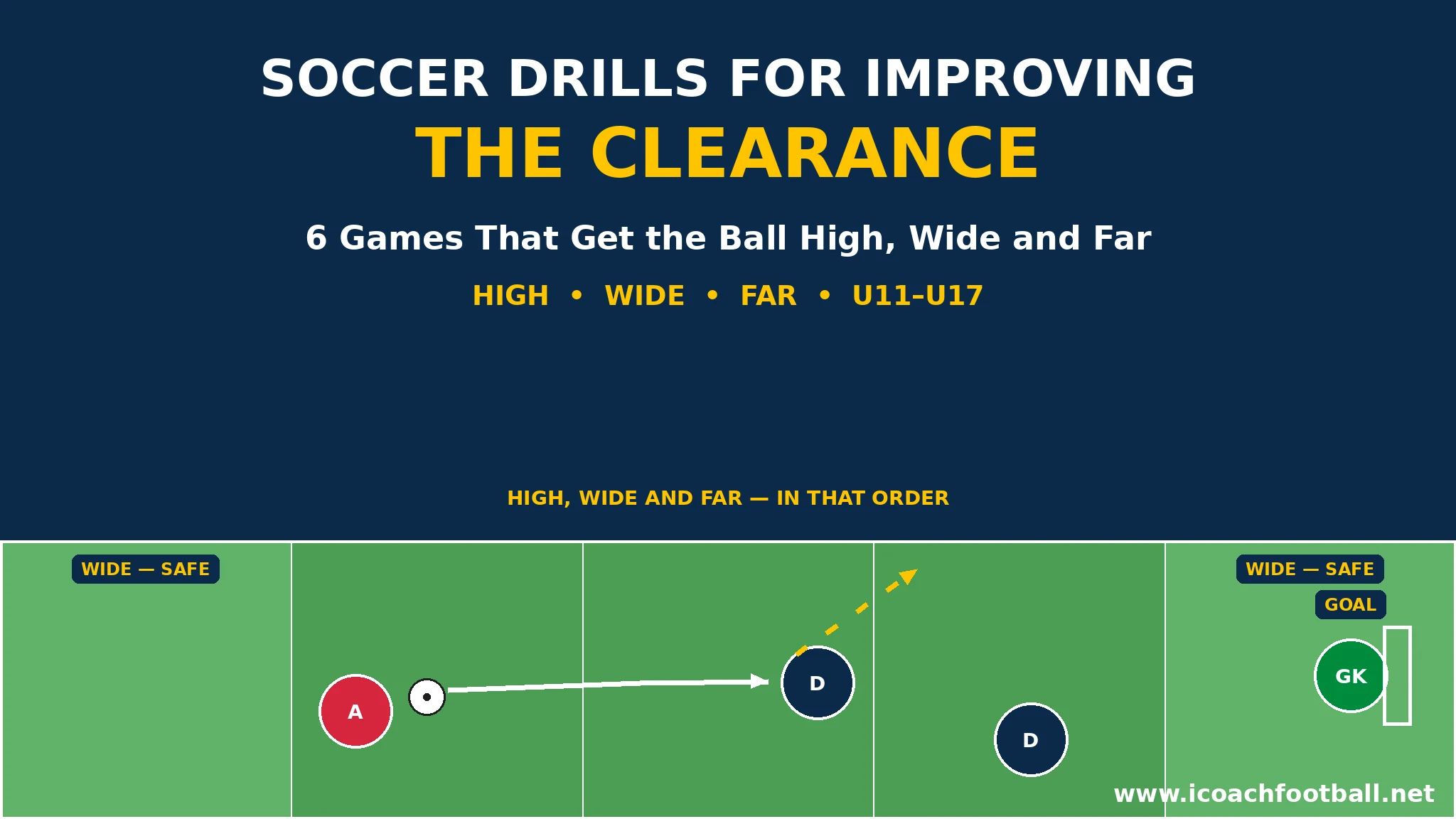
A clearance is a deliberate kick or header that sends the ball away from your goal — high, wide and far, in that order. Most goals conceded from clearances are not conceded because the defender failed to clear. They are conceded because the clearance went straight back into the middle, dropped short, or nobody chased the second ball. A good clearance buys your team ten seconds and forty yards. A bad one hands the attack a second chance from a better position. These six soccer drills for improving the clearance train the skill step by step: a first-time clearance drill, a headed clearance drill, a clear-wide game, a clear-or-play decision drill, a second-ball drill, and a full game where a clearance that leaves the danger zone is worth more than a goal.
Suitable for: U11–U17 (ages 10–17)
Session snapshot
- Players: 14–18
- Age: U11–U17 (ages 10–17)
- Area: Half a pitch, with 2 full goals
- Duration: 60 minutes
- Focus: Improving the clearance — first-time clearances, headed clearances, clearing wide, clearing under pressure, the second ball, and the clearance game
- Equipment: 14 balls (lightweight/foam balls for U12–U13 heading work), 30 cones, bibs, 2 full goals
Heading safety first
Read this before you run the session. Heading is age-restricted — leagues enforce the rules and referees apply them.
- U11 and under: no heading. U.S. Soccer’s Concussion Initiative bans heading in practice and games at U11 and under. If you coach U11s, run the headed-clearance drill with foot or chest clearances instead.
- U12–U13: limited heading. U.S. Soccer limits heading practice to 30 minutes per week, with no more than 15–20 headers per player per week. This session contains far fewer than 15 headers per player — count them, and do not add a second heading block in the same week.
- Light balls, low volume. Use lightweight or foam balls, serve by hand or with a soft toss, and stop the drill if a player heads with the top of their head or closes their eyes.
- U11–U12 run the headed-clearance drills with foot or chest clearances, or a soft lightweight ball only. The technique is identical either way.
Why these six games work
A team that cannot clear the ball cannot defend. The long ball drops into the box, the cross comes in from the flank, the loose ball bounces in the six-yard box — and in every case the defender has less than a second to decide. The wrong decision is the one most young defenders make by instinct: poke it back into the middle, where the next attacker is already waiting. The right decision is boring: get height on it, get width on it, get distance on it, then go and win the second ball.
The first drill fixes the technique: a first-time clearance drill where the defender meets the ball early and sends it high, wide and far. The second drill fixes the header: the defender attacks the ball at its highest point and heads through the bottom of it toward the touchline. The third drill fixes the direction: a clearance into the wide channel scores and one down the middle scores nothing, because the touchline is safe and the centre is not. The fourth drill fixes the decision: a live attacker presses the defender, who scans and chooses — clear, or play out. The fifth drill fixes the follow-up: the clearance is only half the job, and the drop on the edge of the box decides who keeps the ball. The last drill puts it into a game where a clearance that leaves the danger zone scores two points.
The drills are grounded in the FIFA/UEFA coaching community. Drills 1, 2, 3 and 5 are based on / in line with the FIFA Training Centre session “07) Defending principles (Johnson)”, in which Michael Johnson, ex-Derby County and Birmingham City defender and current England U-18 assistant coach, trains centre-backs defending in pairs: a high ball is played in, the centre-backs get distance and height on their clearance, with a focus on positioning, body posture and getting distance and height on clearances — progressing from a triple-goal action of a high pass and two crosses to a 6v5 phase in which the full-backs lock the wingers down. Drills 4 and 6 are based on / in line with the England Football Learning article “How to defend like England: roles and responsibilities”, which sets out how the national teams defend as a unit: the closest player presses the ball, the surrounding players provide cover, the players away from the ball provide balance, and the covering player tells the pressing team-mate which way to show the opposition — toward the touchline. In the UK the same session is football drills for improving the clearance — the call, the lane and the second ball are identical.
This is the clearance side of the defending our posts already teach. Our soccer drills for improving defending long balls train the first ball dropping into the box, and our football defending set pieces drills train the set-piece balls that must be cleared — this session trains what happens next: the clearance itself, and the second ball.
Six rules of the clearance
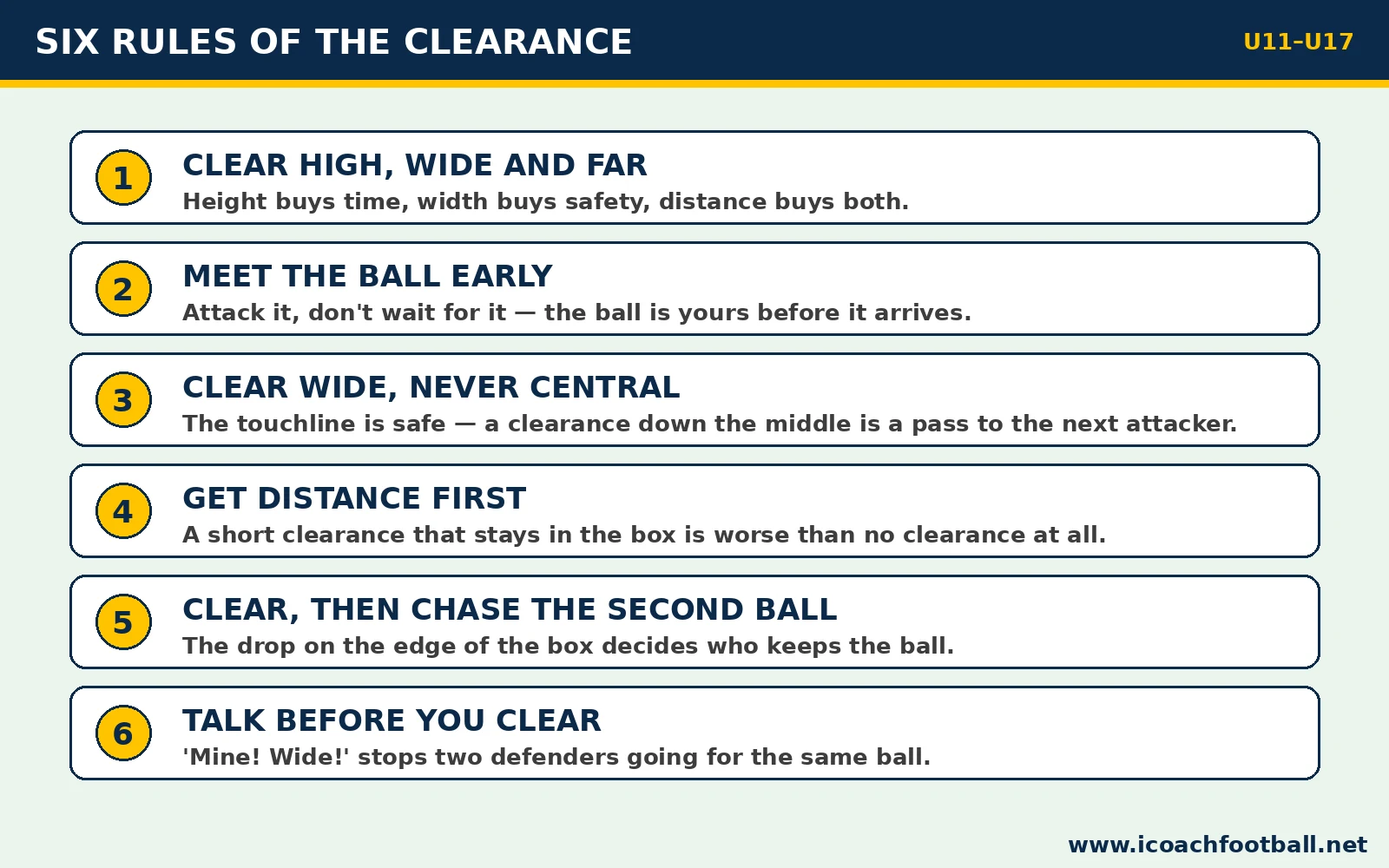
- Clear high, wide and far — in that order. Height buys time, width buys safety, distance buys both.
- Meet the ball early — attack it, don’t wait for it. The ball is yours before it arrives, not after it bounces.
- Clear wide, never central — the touchline is safe, the middle is not. A clearance down the middle is a pass to the next attacker.
- Get distance first, keep it second — the first clearance buys time. A short clearance that stays in the box is worse than no clearance at all.
- Clear, then chase the second ball — the clearance is half the job. The drop on the edge of the box decides who keeps the ball.
- Talk before you clear — call it, so two players don’t do it. “Mine! Wide!” is the call that stops two defenders going for the same ball.
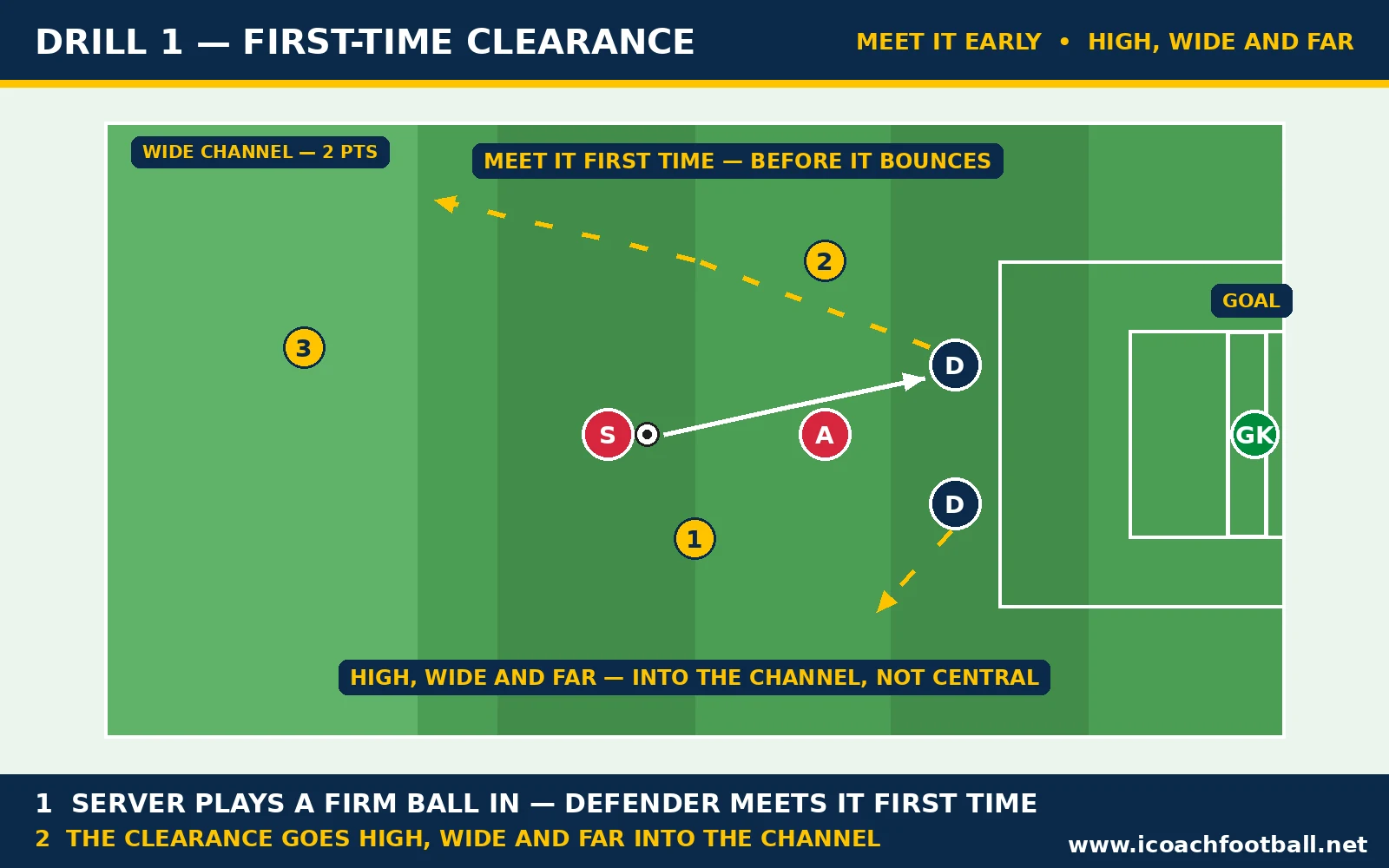
Drill 1 — First-Time Clearance
The technique drill — a defender meets a firm ball in first time and sends it high, wide and far into a marked wide channel, in line with FIFA’s “Defending principles (Johnson)” session: a high ball is played into the centre-backs, who get distance and height on their clearance.
Setup
- Area a 30 x 20-yard area in front of one full goal with a goalkeeper, two wide channels marked with cones.
- 8 minutes, then swap the defending pair.
How to Play
- Two defenders stand on the edge of the box, and a server stands 15 yards out with a supply of balls.
- The server plays a firm ball in along the ground toward the defenders.
- The nearest defender meets the ball first time, before it reaches them.
- The clearance goes high, wide and far — into the wide channel marked with cones, not central.
- The defender’s partner drops five yards to cover the space behind the clearing defender.
- A clearance that lands in a wide channel scores 2; a clearance down the middle scores 0.
Coach’s note: “Meet it early — the ball is yours before it arrives, not after it bounces.”
Progressions: The server plays bouncing balls; the server plays aerial balls; two attackers press the defenders as the ball comes in.
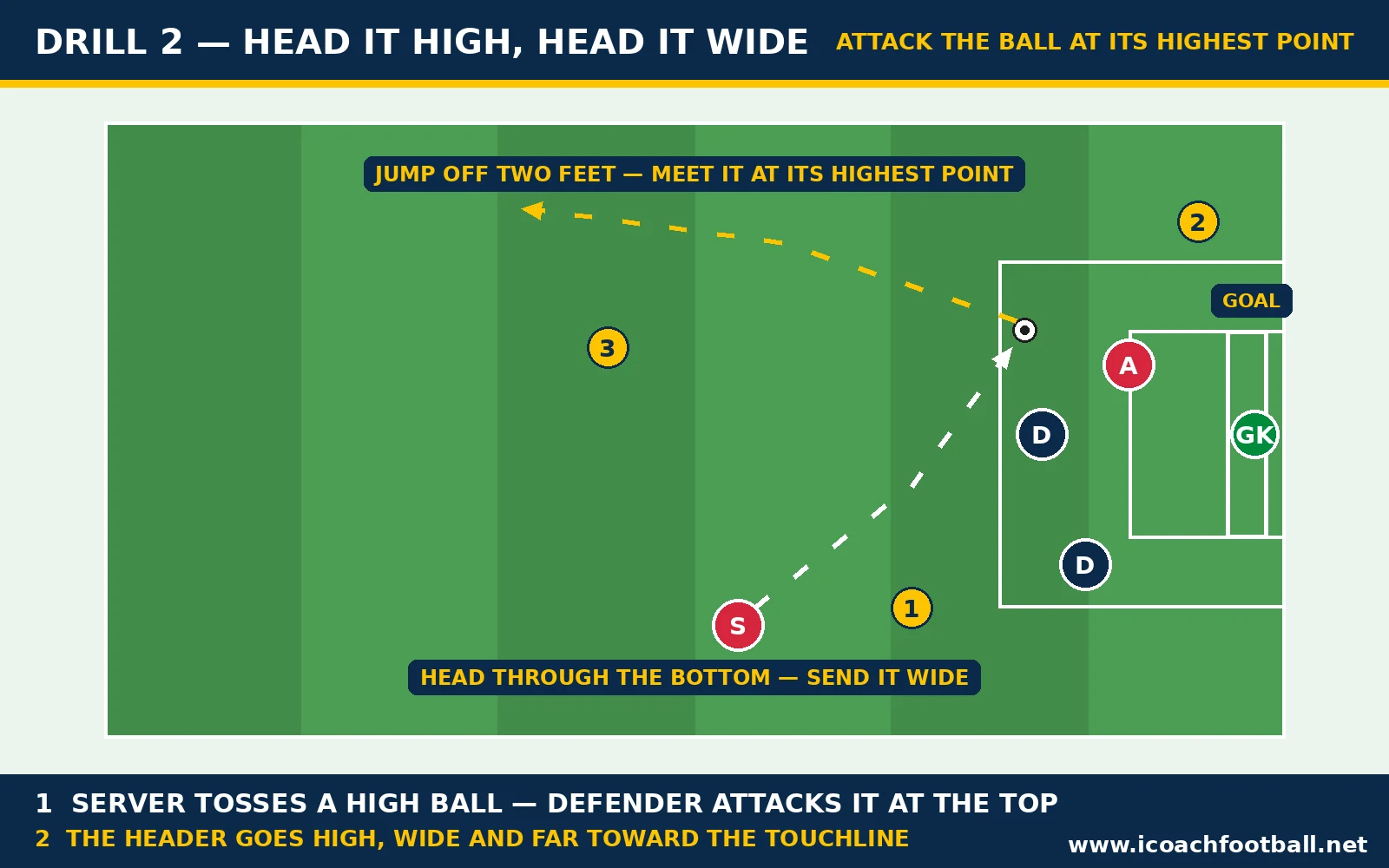
Drill 2 — Head It High, Head It Wide
The headed clearance drill — a defender attacks a high ball at its highest point and heads it through the bottom of the ball toward the touchline, in line with FIFA’s “Defending principles (Johnson)” session: the centre-backs focus on body posture and getting distance and height on clearances when dealing with crosses and high balls.
Setup
- Area the edge of the penalty box, a server 20 yards from goal with lightweight balls, 1 full goal with a goalkeeper.
- 9 minutes, then swap the defending pair.
How to Play
- A server stands 20 yards from goal with a supply of lightweight balls.
- The server tosses a high ball toward the penalty spot.
- The defender attacks the ball at its highest point, jumping off two feet.
- The header goes high, wide and far — through the bottom of the ball, toward the touchline.
- The defender lands facing the play, ready for the second ball.
- A headed clearance that leaves the box wide scores 2; a header back into the middle scores 0.
Coach’s note: “Attack the ball at its highest point — head through the bottom of it and send it wide.”
Progressions: The server tosses from the flank, like a cross; a passive attacker contests the header; two defenders head in pairs, one attacks the ball and one covers.
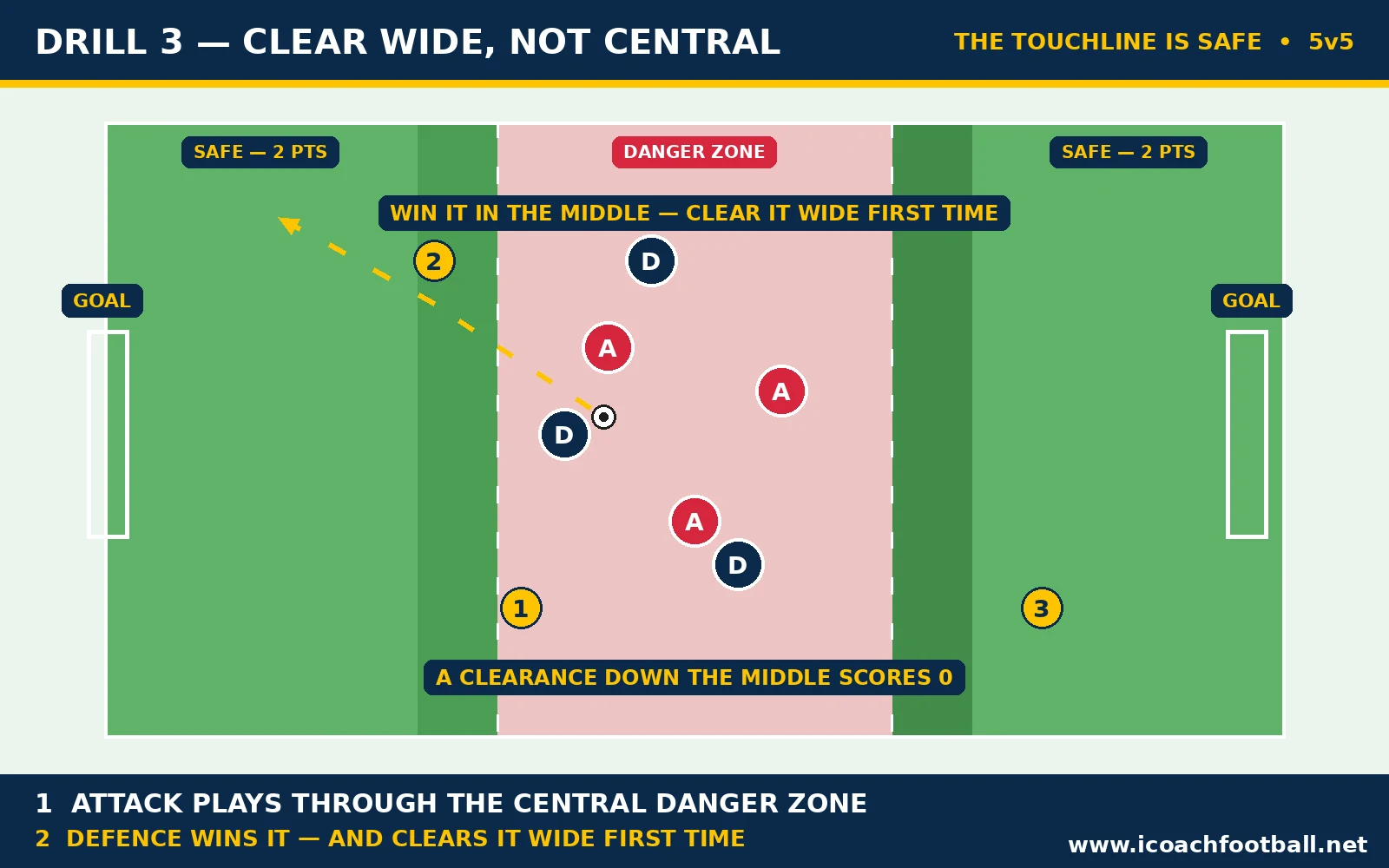
Drill 3 — Clear Wide, Not Central
The direction drill — the defence wins the ball in the central danger zone and must clear it wide first time into a marked safe channel, in line with FIFA’s “Defending principles (Johnson)” session: when the full-back engages the winger, the rest of the defence shuffles across and closes the space down, and the defenders always leave the least dangerous player free and focus on the imminent threat.
Setup
- Area a 40 x 30-yard area with two wide safe channels marked with cones and a central danger zone, 2 mini goals.
- 9 minutes, then swap the teams.
How to Play
- Two teams play 5v5 in the area with a mini goal at each end.
- The wide channels are marked with cones — a clearance into a channel scores 2.
- The attacking team tries to play through the central danger zone.
- When the defence wins the ball in the central zone, they must clear it wide first time.
- A clearance into a wide channel scores the defence 2; a clearance that stays central scores 0.
- After a wide clearance, the defending team keeps the ball and attacks the far goal.
Coach’s note: “Wide is safe, central is a goal — the touchline is your team-mate, the middle is theirs.”
Progressions: The central zone is narrowed by five yards; clearances must be first time; the wide channel targets shrink to three yards wide.
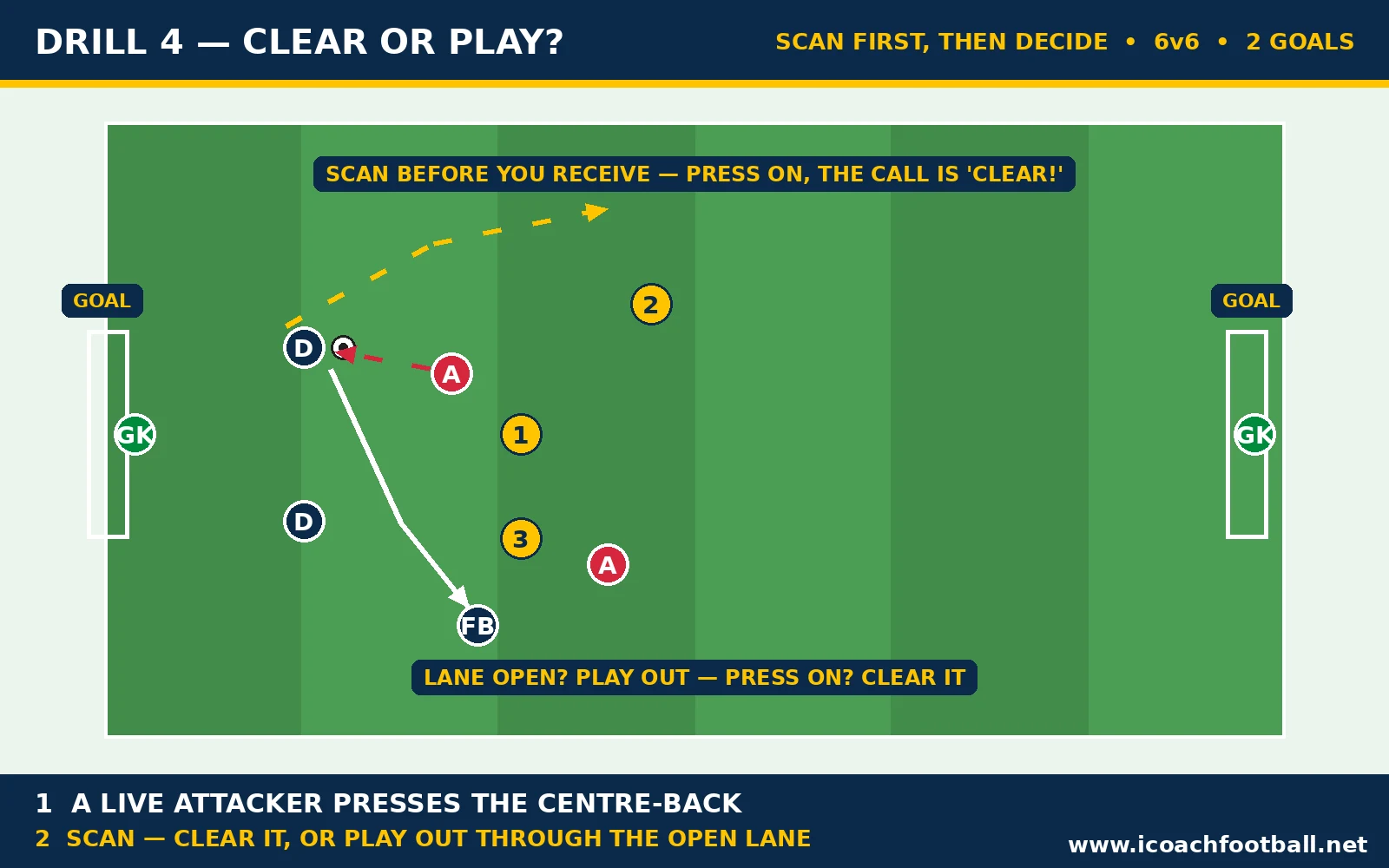
Drill 4 — Clear or Play?
The decision drill — a live attacker presses the centre-back, who scans before receiving and chooses: clear it, or play out through the open lane, in line with England Football Learning’s “How to defend like England: roles and responsibilities”: the closest player presses the ball, the surrounding players provide cover, and the covering player tells the pressing team-mate which direction to show the opposition.
Setup
- Area half a pitch, 2 full goals with goalkeepers, 6v6, the defence building from the back.
- 9 minutes, then swap the teams.
How to Play
- The defence builds from the back with a goalkeeper and two centre-backs.
- A live attacker presses the centre-back who receives the ball.
- The centre-back scans before receiving — if the press is on, the call is “Clear!”.
- If the lane to a team-mate is open, the defender plays out through it.
- A clearance under pressure that leaves the danger zone scores 2; a clearance straight to an attacker scores 0.
- A play-out that beats the press and reaches a team-mate scores 3.
Coach’s note: “Scan first, then decide — ‘Clear!’ is a decision, not a panic.”
Progressions: Two attackers press instead of one; the press starts from a goal kick; the defender has three seconds to make the decision.
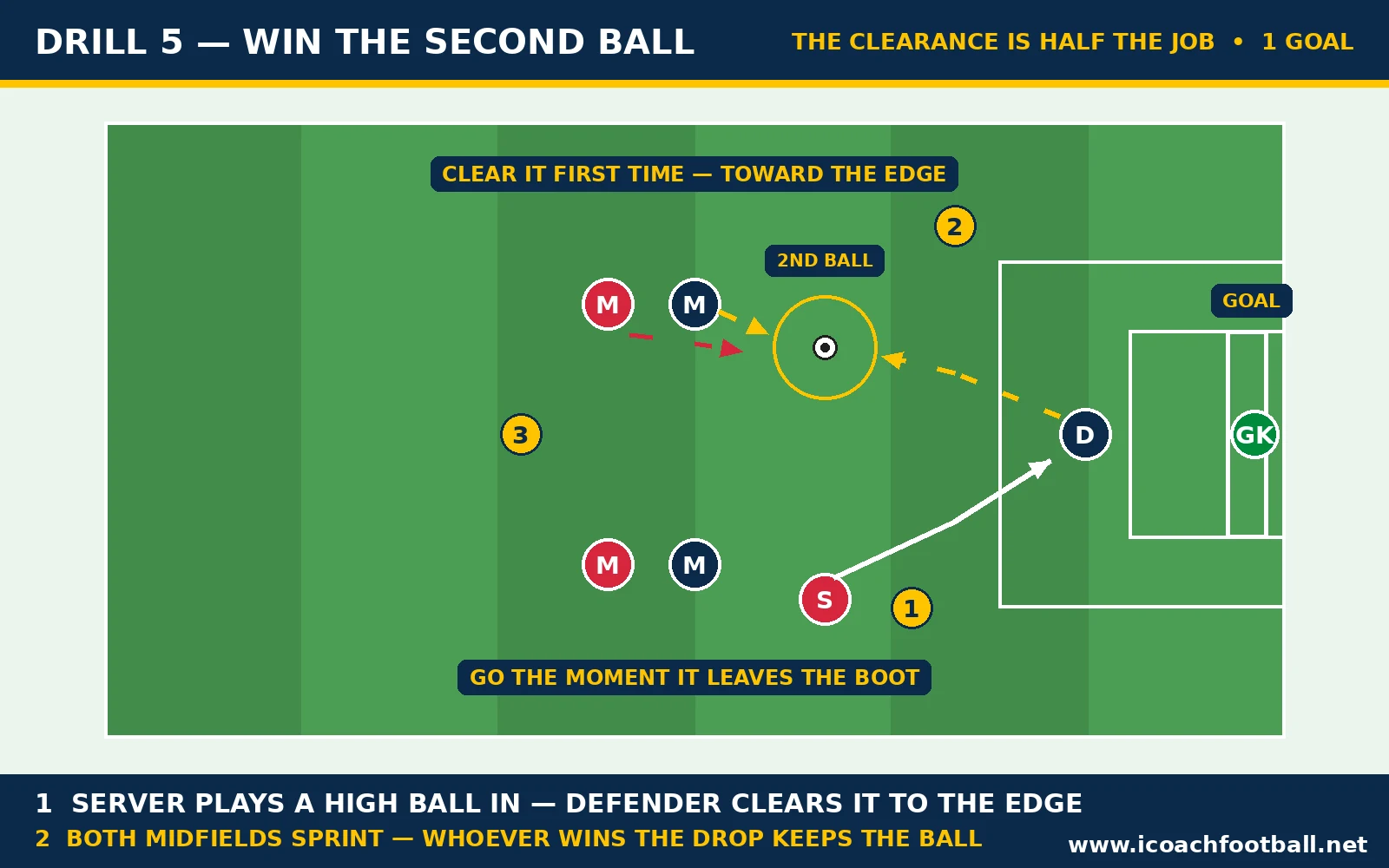
Drill 5 — Win the Second Ball
The follow-up drill — the defender clears a high ball first time toward the edge of the box, and both midfields sprint to the drop, in line with FIFA’s “Defending principles (Johnson)” session: once the ball is cleared, the defenders press the attackers, and communication is important — all of the defenders need to help each other regain their positions and focus.
Setup
- Area the edge of the penalty box, a drop zone on the edge marked with cones, 1 full goal with a goalkeeper.
- 10 minutes, then swap the teams.
How to Play
- A server plays a high ball into the box from 25 yards out.
- The defender clears it first time toward the edge of the box.
- Two midfielders from each team wait on the edge, 20 yards from goal.
- The moment the clearance leaves the defender’s foot, both midfielders sprint to the drop.
- The midfielder who wins the second ball must play it wide or forward first time.
- A second ball won and played wide scores 2; a second ball lost to the attack scores the attack 2.
Coach’s note: “The clearance is half the job — the second ball is the other half. Go the moment it leaves the boot.”
Progressions: The drop zone moves wider; the second ball must be won with one touch; the attack gets a third player on the edge.
Drill 6 — The Clearance Game
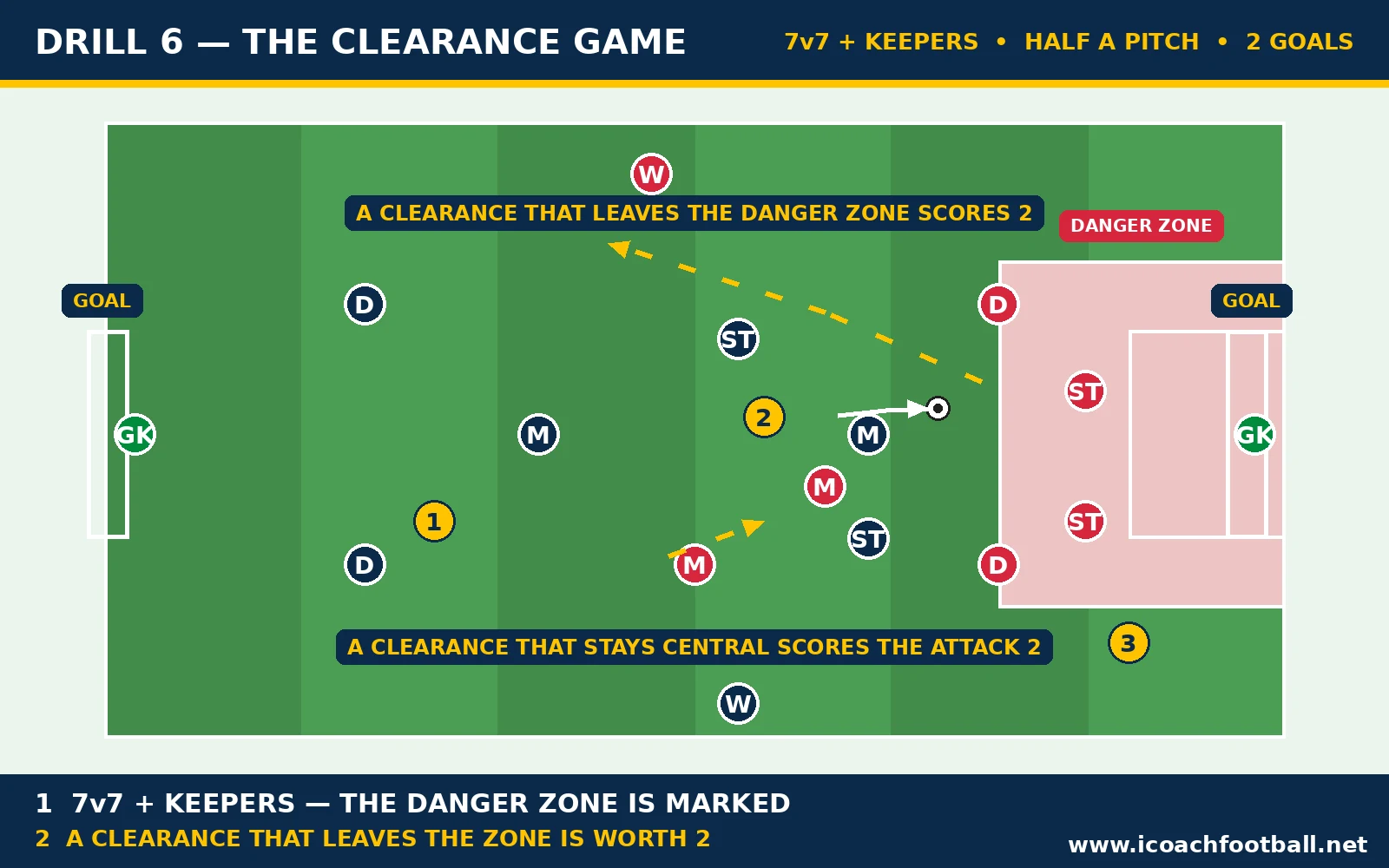
The full game. A 7v7 on half a pitch where a clearance that leaves the danger zone scores 2 and a clearance that stays central scores the attack 2, so both sides fight for the clearance, in line with England Football Learning’s “How to defend like England: roles and responsibilities” — press, cover and balance as a unit — and with FIFA’s method, the principles first, then the game.
Setup
- Half a pitch, 2 full goals with goalkeepers, 7v7, the danger zone marked with cones.
- 10 minutes, teams swap ends at five minutes.
How to Play
- Two teams play 7v7 on half a pitch with a goalkeeper in each goal.
- A clearance that leaves the danger zone — high, wide and far — scores the defence 2 points.
- A clearance that stays central or drops short scores the attack 2 points.
- A second ball won after a clearance scores 1 extra point.
- After a scoring clearance, the clearing team keeps the ball and attacks.
- The game runs for ten minutes; the team with the most points wins, and the teams swap ends at five minutes.
Coach’s note: “Two points for a clearance that leaves the danger zone — that is the club telling them a good clearance matters as much as a goal.”
Progressions: Only clearances from inside the box count in the final three minutes; a clearance followed by a goal within ten seconds scores 4; the goalkeepers must start the next attack with a throw to a defender, so every attack builds from the back.
Coaching points
- Clear high, wide and far — in that order. Height buys time, width buys safety, distance buys both.
- Meet the ball early — attack it, don’t wait for it. The ball is yours before it arrives, not after it bounces.
- Clear wide, never central — the touchline is safe, the middle is not. A clearance down the middle is a pass to the next attacker.
- Get distance first, keep it second — the first clearance buys time. A short clearance that stays in the box is worse than no clearance at all.
- Clear, then chase the second ball — the clearance is half the job. The drop on the edge of the box decides who keeps the ball.
- Talk before you clear — call it, so two players don’t do it. “Mine! Wide!” is the call that stops two defenders going for the same ball.
Common mistakes
| Mistake | Fix |
|---|---|
| Waiting for the ball to arrive, so the attacker gets there first | Meet it early — Drill 1 only counts clearances made first time |
| Heading the ball back into the middle, where the next attacker waits | Head it wide — Drill 2 scores 0 for a header back into the middle |
| Clearing down the middle because it feels safer | Clear wide — Drill 3 scores 2 only for a clearance into a wide channel |
| Panicking into a clearance when a pass is on | Scan first — Drill 4 scores 3 for a play-out that beats the press |
| Watching the clearance instead of chasing the second ball | Go on the clearance — Drill 5 scores the second ball, not the clearance |
| Two defenders going for the same ball, so nobody covers | Call it — Drill 6 only counts a clearance if one defender calls “Mine! Wide!” |
Age adaptations
| Age | Format | What changes |
|---|---|---|
| U11–U12 (ages 10–12) | Small areas, size 4 ball, wide channels marked wide (8 yards), the ball served slowly, no heading | No heading — U.S. Soccer’s Concussion Initiative bans heading in practice and games at U11 and under. Drill 2 runs with foot or chest clearances, or a soft lightweight ball only. Drill 1 runs with the server rolling balls in. Drill 6 counts every clearance that leaves the box, even a short one, so the players learn to celebrate clearing it |
| U13–U14 (ages 12–14) | Full areas, size 4 ball, lightweight balls for heading, volume capped | Heading is introduced and volume is capped: U.S. Soccer limits heading practice to 30 minutes and 15–20 headers per player per week, so this session is the week’s only heading block. Drill 2 adds the contested header, Drill 4 adds the second presser, and Drill 6 adds the clearance-then-goal bonus. Players keep a simple count — “six clearances, four wide” is the habit that sticks |
| U15–U17 (ages 14–17) | Full areas, size 5 ball, full pressure from the first rep, channels marked at 5 yards | Full pressure from the start. Drill 1 runs with bouncing and aerial serves, Drill 4 requires the decision in three seconds, and Drill 6 plays with the goalkeepers starting every attack with a throw to a defender. Players are asked to call the clearance before each rep — “Mine! Wide!” — so the decision becomes a conscious skill, not a lucky guess |
60-minute session plan
| Block | Time | Content |
|---|---|---|
| Arrival game | 0:00–0:05 | Clearance warm-up — pairs, one serves, one clears first time into the wide channel, no pressure yet |
| First-time clearance | 0:05–0:13 | Drill 1 — First-Time Clearance |
| Head it high, head it wide | 0:13–0:22 | Drill 2 — Head It High, Head It Wide |
| Clear wide, not central | 0:22–0:31 | Drill 3 — Clear Wide, Not Central |
| Clear or play? | 0:31–0:40 | Drill 4 — Clear or Play? |
| Win the second ball | 0:40–0:50 | Drill 5 — Win the Second Ball |
| The clearance game | 0:50–1:00 | Drill 6 — The Clearance Game |
Keep building from here
The first ball your defenders clear is our soccer drills for improving defending long balls, and the crosses that must be cleared are our soccer drills for improving defending crosses. The far-post drop that follows a ball cleared wide is our soccer drills for improving defending the back post, and the block that stops the shot when the clearance does not come is our soccer drills for improving blocking shots. The set-piece balls that must be cleared are our football defending set pieces drills, and the zone habits that put a defender in the right place to clear are our soccer drills for zonal marking. The starting position that puts the defender goal-side early is our soccer drills for improving defensive positioning, and the tight marking that denies the attacker space before the clearance is needed is our soccer drills for improving marking. The read that starts the whole sequence is our soccer drills for improving interceptions, and the anticipation that gets the defender moving before the pass is our soccer drills for improving anticipation. The transition that follows every clearance is our football defensive transition drills, and the recovery run that gets a defender back to clear the next ball is our soccer drills for improving defending against pace. The aerial duel that wins the first ball is our soccer drills for improving aerial duels. Clearing is high-repetition, high-intensity work — plan the week’s load with our training load calculator.
What is a clearance in soccer?
A clearance is a deliberate kick or header that sends the ball away from your goal — high, wide and far, in that order. Height buys time for your team to get back into shape, width takes the ball away from the danger in the middle, and distance means the next attack starts forty yards further from your goal. A clearance is not a hoof up the pitch for its own sake: it is a skill with a target, and the target is always the wide channel.
How do you teach players to clear the ball properly?
Teach the clearance as a first-time skill with a target. The defender meets the ball early, before it bounces, and strikes through the bottom of it so it goes high and wide — never central. Drill 1 trains the foot clearance with a marked wide channel to aim at, and Drill 2 trains the headed clearance: attack the ball at its highest point, head through the bottom of it, and send it toward the touchline. Count only clearances that leave the danger zone, so the target becomes the habit.
Should defenders clear the ball or play out from the back?
Scan first, then decide. If the press is on and no passing lane is open, clear it — high, wide and far — and chase the second ball. If a lane to a team-mate is open, play out through it. Drill 4 trains exactly this: a clearance under pressure that leaves the danger zone scores 2, but a play-out that beats the press and reaches a team-mate scores 3, so players learn that clearing is a decision, not a panic.
Is heading safe for young players clearing the ball?
Heading is age-restricted. U.S. Soccer’s Concussion Initiative bans heading in practice and games at U11 and under, and limits heading practice at U12–U13 to 30 minutes per week with no more than 15–20 headers per player per week. U11–U12 players run the headed-clearance drills with foot or chest clearances, or a soft lightweight ball only. At U12–U13, use lightweight or foam balls, serve by hand or with a soft toss, and keep this session as the week’s only heading block.
How do you coach clearances to U11s?
Start with the channels marked wide — eight yards, not five — so the target is easy to see, and serve the ball slowly so the clearance can be practised before the pressure arrives. Count every clearance that leaves the box, even a short one, and celebrate clearing it wide like a goal, because for a U11 the habit matters more than the technique. Drill 2 runs with foot or chest clearances — no heading at U11 and under — Drill 1 runs with the server rolling balls in, and Drill 6 counts every clearance that leaves the box.
Sources
- FIFA Training Centre. “07) Defending principles (Johnson)” — Michael Johnson, ex-Derby County and Birmingham City defender and current England U-18 assistant coach, trains centre-backs defending in pairs: a high ball is played in, the centre-backs get distance and height on their clearance, and the focus is on positioning when dealing with crosses, body posture and getting distance and height on clearances — starting with a triple-goal action of a high pass followed by two crosses, and progressing to a 6v5 phase in which the full-backs lock the wingers down and the rest of the defence shuffles across. Verified live 2026-11-23 (HTTP 200, full text read). Drills 1, 2, 3 and 5 are based on / in line with this session.
- England Football Learning / The FA Boot Room. “How to defend like England: roles and responsibilities” — The FA’s article on how the national teams defend as a unit: the closest player presses the ball, the surrounding players provide cover, the players away from the ball provide balance, and the covering player tells the pressing team-mate which direction to show the opposition — toward the touchline, or into the area where the team has more players. Verified live 2026-11-23 (HTTP 200, full text read). Drills 4 and 6 are based on / in line with this article.