Soccer Drills for Attacking Midfielders: 6 Games That Teach the Half-Turn, the Through Ball and the Late Run
Quick answer
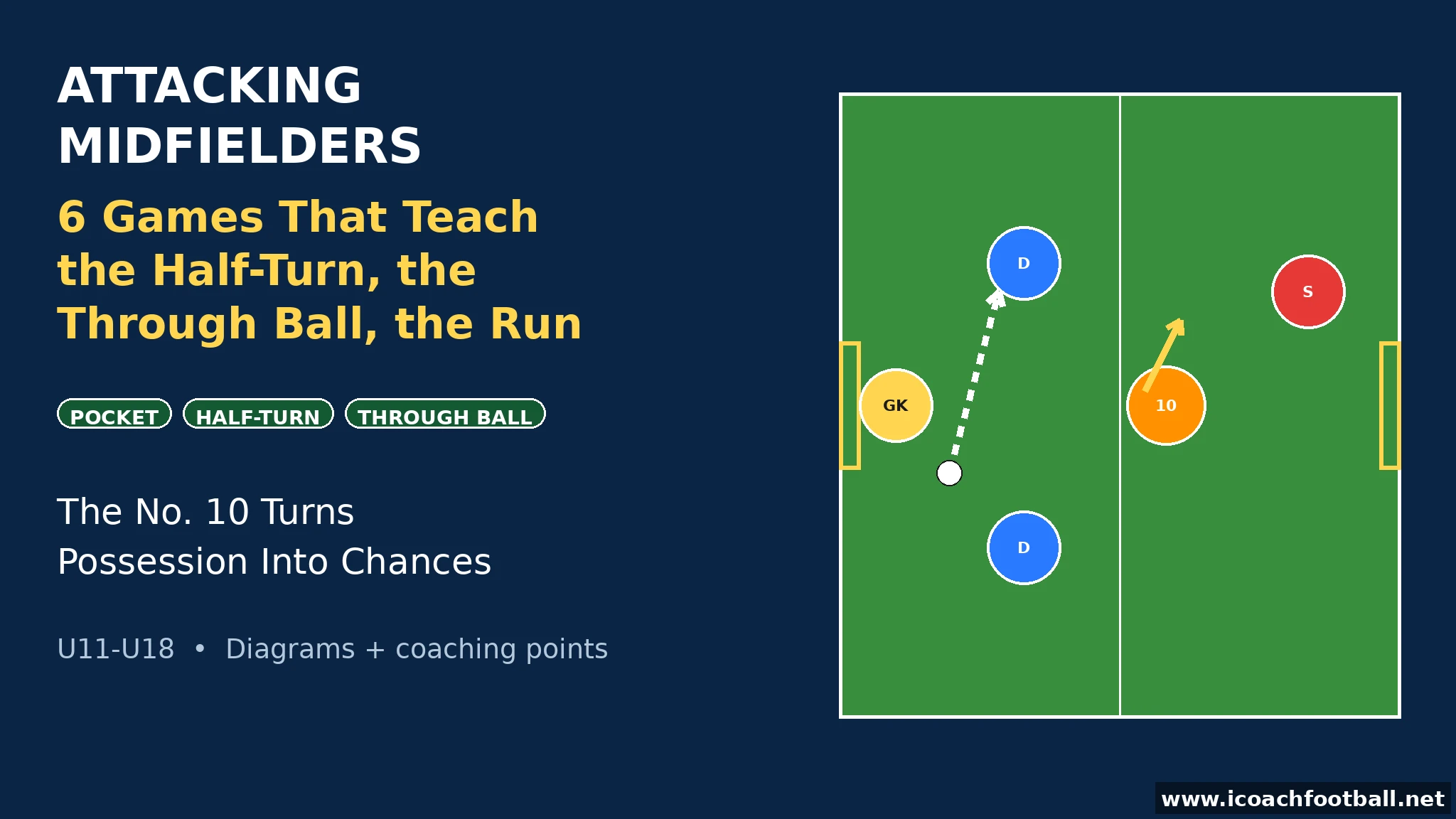
The attacking midfielder is the player who turns possession into chances. These six soccer drills for attacking midfielders teach the No. 10 to find the pocket between the lines, receive on the half-turn, combine with an up-back-through, isolate a defender and play in behind, finish the move in ten seconds, and arrive at the edge of the box — in one 60-minute session.
Suitable for: U11–U18
In football — soccer in the US — the attacking midfielder is the player the whole attack runs through, and the one most coaches train the least. Teams drill the striker’s finish and the winger’s cross, then hand the No. 10 the ball between two lines of defenders and hope for magic. The six games below train the job as FIFA teaches it: the FIFA Training Centre session “Movement to attack the space in behind” builds the through ball from a passing circuit through a 2v1 final-third sequence to a 4v4-plus-2 game, and the elite session “Combination play in the final third” by Abdelouahed Zamrat builds the one-two, the up-back-through and the third-man run against mannequins before testing them in a 10v8 attack v. defence game. This post is the specialist companion to our soccer drills for midfielders — that post trains the whole midfield job, and this one trains only the No. 10.
Session snapshot
- Players: 12–20 (three or four groups of 3–4 for the circuits, 10v8 plus a keeper for the finish)
- Area: A 15-by-15-metre pocket for the receiving circuit; half a pitch for the team games
- Duration: 60 minutes
- Focus: Finding the pocket, receiving on the half-turn, combining, playing in behind, arriving at the edge
- Age: U11–U18 (see Age adaptations)
The six No. 10 rules
Every one of these soccer drills for attacking midfielders is built on six rules. Teach them once, then repeat them in every game until the players say them back to you.

| Rule | What it means |
|---|---|
| Find the pocket, don’t chase the ball | The 10 receives between the lines — in the gap, not on top of the ball |
| Open body, half-turn | Receive side-on so the first touch faces forward, not back to your own goal |
| Play forward first | The first look is through the lines — backwards only when nothing is on |
| Time the run, don’t rush it | Arrive as the ball does — early and you are offside, late and the chance is gone |
| Combine in twos and threes | One-two, up-back-through, third man — the pass that breaks a line is rarely the first pass |
| Arrive at the edge | The second ball at the penalty arc is the No. 10’s goal — be there when it drops |
Drill 1: Find the Pocket — Receive Between the Lines
The receiving lesson. Three players and two mannequins in a 15-by-15-metre pocket: the No. 10 drops between the lines, receives on the half-turn and plays between the mannequins. Based on the FIFA Training Centre session “Movement to attack the space in behind”, in which the second activation circuit asks the receiver to move off the cone, receive on the half-turn and play between the mannequins — and on the FIFA Talent Coach Programme circuit, in which the midfielder receives with their back to the opposition goal between two mannequins, takes an oriented touch with the far foot and plays between the lines.


- Setup: A 15-by-15-metre pocket marked with four cones, two mannequins (or tall cones) standing 8 metres apart as the pressing line, three players (a passer, a No. 10 and a receiver), one ball, 8 minutes in four blocks of 2.
- How to play:
- The passer plays the ball into the No. 10, who waits between the two mannequins.
- The 10 moves off the cone as the pass is played, so they meet the ball on the move.
- The 10 receives with the far foot, body half-open, and takes an oriented touch forward.
- The 10 plays first time between the mannequins to the receiver on the far side.
- The receiver returns the ball to the passer, and the 10 drops back into the pocket.
- After four blocks of two minutes, swap roles — everyone receives between the lines.
- Coach’s note: Watch the 10 who waits in front of the mannequins with a closed body — from there the only pass is backwards, and the pocket is wasted; the cue is “open body, half-turn,” and our soccer scanning drills teach the shoulder check that finds the pocket in the first place, while our soccer passing drills build the firm first-time ball the pocket needs.
- Progressions: A defender stands behind the 10 and forces the choice — turn or play back; the pass must be one touch, so the scan must happen before the ball arrives; the mannequins move closer together, so the through ball must be weighted perfectly.
Drill 2: Up, Back, Through — The No. 10 Combination
The combination lesson. The No. 10 drops short, lays the ball off to the No. 8, and the third man runs in behind — the combination FIFA calls the most efficient way to penetrate a compact defence. Based on the FIFA Training Centre session “Combination play in the final third (Zamrat)”, in which the unopposed passing patterns rehearse exactly this: the forward comes short, lays off to the central midfielder who has moved into the space between the lines, and the midfielder plays first time between the defensive mannequins into the space ahead of the runner.
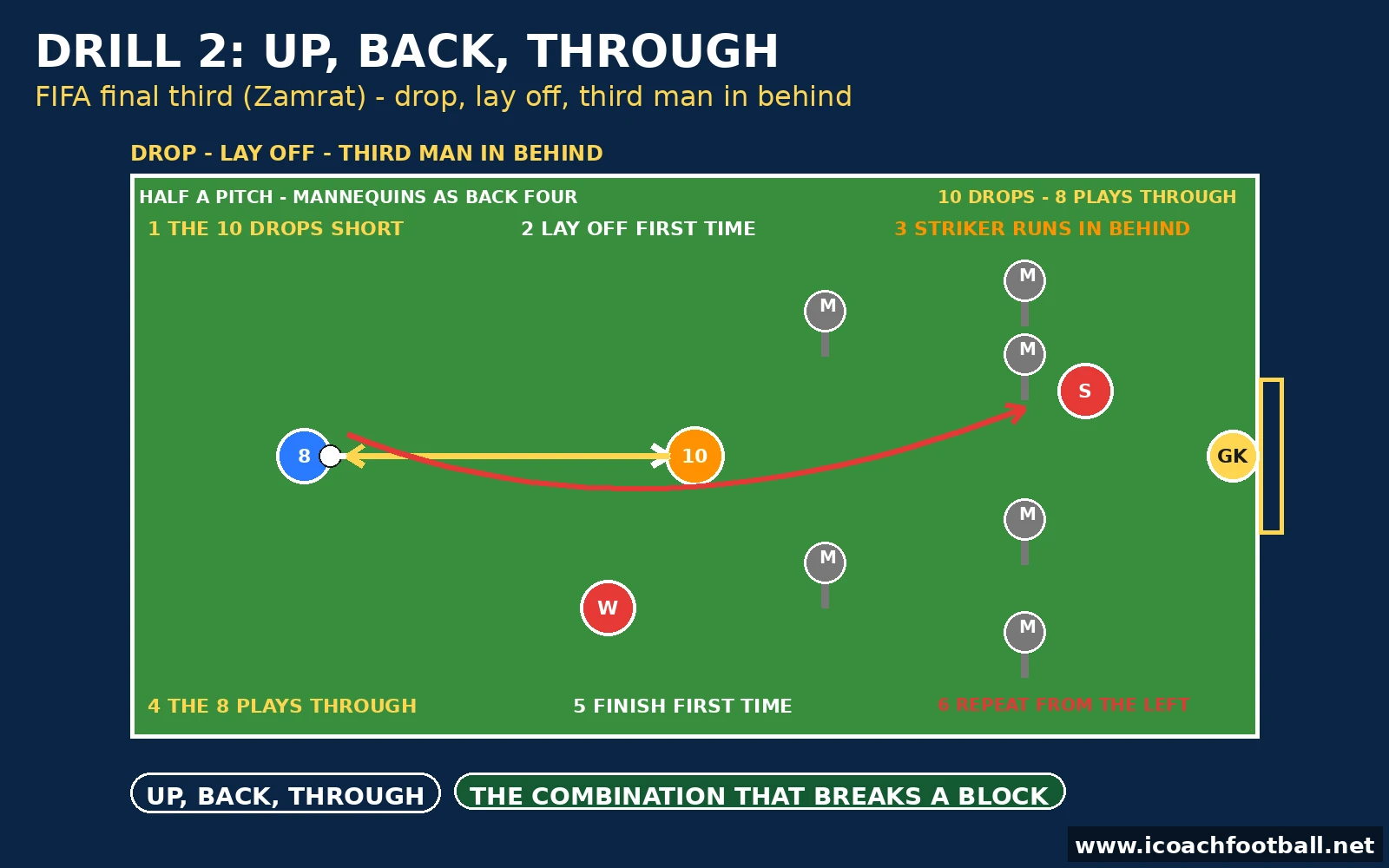
- Setup: Half a pitch with one full-size goal and a keeper, four mannequins as a back four 8 metres in front of the penalty area, two as a midfield pair 15 metres in front of them, six attackers, one ball, 10 minutes.
- How to play:
- The No. 8 plays the ball into the No. 10, who has dropped between the lines.
- The 10 lays it off first time to the No. 8, who has moved into the pocket.
- As the lay-off is played, the striker makes a run in behind the mannequins.
- The 8 plays a first-time through ball between the two central mannequins.
- The striker finishes first time, and the next group starts from the other side.
- After five minutes, the mannequins become two live defenders and the combination must beat them.
- Coach’s note: Watch the 10 who takes a touch before the lay-off — one extra touch and the striker’s run is already offside or the lane is closed; the cue is “lay it off first time,” and our soccer drills for strikers train the timed run this combination depends on, while our football attacking the half space drills train the same receive in the channel.
- Progressions: The 10 must receive on the half-turn and turn to face goal instead of laying off; the striker makes a decoy run across the defender while the winger runs in behind; the combination must finish within three passes of the first ball into the 10.
Drill 3: Isolate and Play In Behind — The 2v1 Final-Third Move
The penetration lesson. A 2v1 in the final third: the No. 10 dribbles at the defender to isolate them, then either beats them or plays the through ball to the runner in behind. Based on the FIFA Training Centre session “Movement to attack the space in behind”, in which the 2v1 final-third moves ask attackers to isolate defenders by dribbling towards them, creating 1v1 scenarios, while a team-mate times a run in behind — and the ball carrier decides whether to beat the defender or play the in-behind pass.

- Setup: A 20-by-10-metre zone running from the penalty arc towards the halfway line, one full-size goal and a keeper, two attackers (a No. 10 and a runner) against one defender, balls with the coach, 10 minutes.
- How to play:
- The coach plays the ball to the No. 10 at the edge of the zone.
- The 10 dribbles straight at the defender to isolate them and draw them in.
- The runner times a run in behind the defender — not too early, or they are offside.
- The 10 either beats the defender 1v1 or plays the through ball into the runner’s path.
- The runner finishes first time, and the next pair starts from the other side.
- After every two sequences, rotate the defender so every player defends the 2v1.
- Coach’s note: Watch the 10 who passes before drawing the defender — a pass played too early lets the defender step across and kill the move; the cue is “draw them in first,” and our soccer dribbling drills train the feint that unbalances the defender, while our soccer drills for wingers train the same isolation from the wide areas.
- Progressions: A second defender joins, so the 10 must play the through ball before the cover arrives; the runner must make a decoy run across the defender first; the 10 must finish with their weaker foot.
Drill 4: The Ten-Second Game — 4v4 Plus 2 With Wide Neutrals
The tempo lesson. A 4v4-plus-2 small-sided game in which the team in possession has ten seconds to finish — so the No. 10 must find the pocket, turn and play in behind at full speed. Based on the FIFA Training Centre session “Movement to attack the space in behind”, in which the 4v4-plus-2 game gives the team in possession ten seconds to finish on goal, the wide neutrals support the attack, and the offside rule applies — so every pass must be forward and every run must be timed.

- Setup: Half a pitch narrowed to the width of the goal area, two full-size goals with keepers, 4v4 plus 2 wide neutrals who always support the team in possession, balls with the coach, 10 minutes.
- How to play:
- The keeper starts the move, and the team in possession has ten seconds to finish.
- The No. 10 finds the pocket between the lines and calls for the ball.
- The wide neutrals stretch the defence, so the pocket opens in the middle.
- The 10 receives on the half-turn and plays the through ball to a runner in behind.
- If the ball goes to a wide neutral, the opposite neutral joins the attack to make it 6v4.
- After each move, the four players beside the goal enter and attack in place of their team-mates.
- Coach’s note: Watch the 10 who drops too deep to collect the ball — a No. 10 who comes to the ball leaves the pocket empty and the ten seconds run out in midfield; the cue is “stay in the pocket,” and our soccer possession drills build the patience to wait for the pass, while our soccer 4v4 drills train the same small-sided shape without the clock.
- Progressions: The ten seconds become eight; the neutrals may only play one touch, so the combination must be instant; the No. 10 must score or assist for the goal to count double.
Drill 5: Arrive at the Edge — Cutbacks and Second Balls
The finishing lesson. The No. 10 times their arrival at the penalty arc for the cutback and the second ball — the goal that comes from being in the right place a second after everyone else has run past it. In line with the FIFA Training Centre session “Combination play in the final third (Zamrat)”, in which the second midfielder makes a run to the edge of the penalty area for any second balls while the forwards attack the cross — and the No. 10 is the player who arrives there.

- Setup: Half a pitch with one full-size goal and a keeper, a winger and a striker against two defenders, the No. 10 starting 25 metres from goal, balls with the coach, 10 minutes.
- How to play:
- The coach plays the ball wide to the winger, who drives to the byline.
- The striker attacks the front post and the opposite winger attacks the back post.
- The No. 10 times the run to arrive at the penalty arc as the cross comes in.
- If the cross is cut back, the 10 finishes first time from the edge.
- If the cross is cleared, the 10 takes the second ball and shoots or plays it wide again.
- After five minutes, the defenders may step out to close the 10, so the arrival must be disguised.
- Coach’s note: Watch the 10 who runs into the box with the striker — two players at the same post leave the edge empty, and the cutback rolls through to nobody; the cue is “arrive at the edge,” and our football late runs into the box drills train the same timed arrival from deeper, while our soccer attacking third drills train the cutback this finish depends on.
- Progressions: The 10 must finish first time with their weaker foot; the winger may cut inside and shoot, so the 10 must read the shot and follow it in; the second ball must be finished within two seconds of the clearance.
Drill 6: The Attack v. Defence Game — 10v8 Plus a Keeper
The match-real finish. A 10v8-plus-goalkeeper attack v. defence game on a reduced pitch: the No. 10 plays free between the lines, the team must complete five passes before penetrating, and every attack must be finished within ten seconds. Based on the FIFA Training Centre session “Combination play in the final third (Zamrat)”, in which the 10v8-plus-goalkeeper game asks the attacking team to replicate the combinations rehearsed in the patterns — one-twos, up-back-throughs, overlaps and third-man runs — to break through a defensive block of eight plus a keeper, with five passes before penetrating and ten seconds to score.
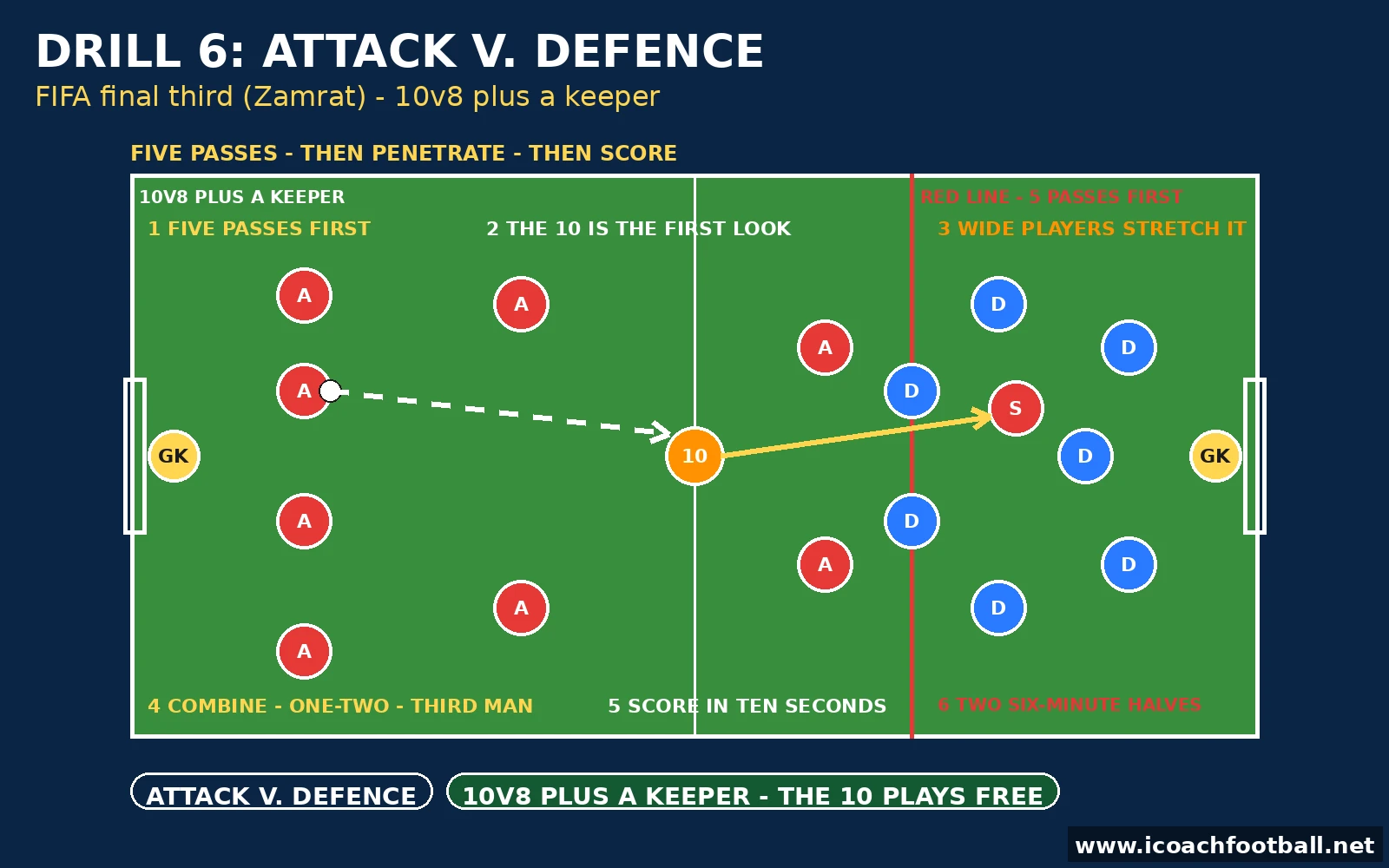
- Setup: Half a pitch plus 10 metres, full width, two full-size goals with keepers, 10 attackers in a 4-4-2 shape against 8 defenders in a 3-3-2 shape plus a keeper, balls with the coach, 12 minutes.
- How to play:
- Play a normal game, but the attacking team must complete five passes before penetrating the red line.
- The No. 10 plays free between the lines — they are the team’s first look on every attack.
- The wide players stretch the block, so the gaps open in the central areas.
- The 10 receives on the half-turn and combines — one-two, up-back-through, third-man run.
- Once the attack crosses the red line, the team has ten seconds to score.
- Play two six-minute halves, then swap which team attacks with the overload.
- Coach’s note: Watch the 10 who stands still between the lines — a No. 10 who waits for the ball is marked out of the game in two passes; the cue is “move while the ball moves,” and our soccer counter attack drills train the same ten-second finish this game demands, while our soccer drills for defensive midfielders train the No. 6 who must stop this exact attack.
- Progressions: The five-pass rule becomes three, so the penetration must come quicker; the No. 10 is limited to two touches, so the combination must be first time; only goals created through the No. 10 count double.
Coaching points
- Find the pocket, don’t chase the ball: The 10 receives between the lines — our soccer scanning drills teach the shoulder check that finds the gap, and our soccer drills for midfielders train the whole midfield job this role sits inside.
- Open body, half-turn: A closed body can only play backwards — our soccer passing drills build the firm first-time ball, and our soccer drills for U15 train the same receive one age up.
- Play forward first: The first look is through the lines — our soccer drills for strikers train the run the through ball needs, and our soccer 3v3 drills train the same forward pass in a smaller game.
- Time the run, don’t rush it: Early is offside, late is too late — our soccer drills for U16 run the same timing at full speed, and our soccer drills for U17 train it against senior defenders.
- Combine in twos and threes: The pass that breaks a line is rarely the first pass — our soccer possession drills train the patience, and our football attacking the half space drills train the same combination in the channel.
- Arrive at the edge: The second ball is the No. 10’s goal — our football late runs into the box drills train the same timed arrival, and our soccer attacking third drills train the cutback it finishes.
- Draw them in first: A pass played before the defender is drawn is a pass the defender steps across — our soccer dribbling drills train the feint, and our soccer drills for wingers train the same isolation wide.
- Move while the ball moves: A No. 10 who waits is a No. 10 who is marked — our soccer 6v6 drills train the same movement in a bigger game, and our soccer drills for U18 run it at senior pace.
- The 10 defends too: The modern No. 10 is the first defender after the ball is lost — our soccer drills for defensive midfielders train the No. 6 who covers behind them, and our soccer drills for U19 run the same press at adult intensity.
- The finish is the job: A No. 10 who creates but never scores is half a player — our soccer 4v4 drills train the same finish under pressure, and our college soccer drills run the same habits at the next level.
Common mistakes
- Waiting in front of the line: A 10 who waits in front of the defenders with a closed body can only play backwards — drop into the pocket instead.
- Taking a touch before the lay-off: One extra touch and the striker’s run is offside — lay it off first time.
- Passing before drawing the defender: A pass played too early lets the defender step across — draw them in, then play.
- Dropping too deep: A No. 10 who comes to the ball leaves the pocket empty — stay between the lines.
- Running into the box with the striker: Two players at the same post leave the edge empty — arrive at the arc, not the post.
- Standing still between the lines: A No. 10 who waits for the ball is marked out of the game — move while the ball moves.
Age adaptations
| Age | Area | Touches | What changes |
|---|---|---|---|
| U11–U12 | 15-by-15-metre pocket, 20-by-10-metre zone | Three touches | Drill 1 runs with a passive pressing line at first, so the 10 learns the pocket before the defender arrives; Drill 2 runs unopposed against the mannequins only; Drill 3 runs 2v0, so the 10 learns the timing of the run before a defender is added; Drill 4 runs without the ten-second clock; Drill 5 runs with the cross from one side only; Drill 6 runs 6v6 with no pass rule — our U13 soccer practice plan shows the same age band in a full session |
| U13–U14 | 15-by-15-metre pocket, 20-by-10-metre zone | Two touches | Drill 1 runs as written, with the defender added in the second block; Drill 2 runs with two live defenders from the start; Drill 3 runs 2v1 as written; Drill 4 runs with the ten-second clock; Drill 5 runs with the cross from either side; Drill 6 runs 8v6 with the five-pass rule — our soccer drills for U15 train the same habits one age up |
| U15–U16 | Half a pitch, reduced pitch | One–two touches | Drill 1 runs with the mannequins closer together and the one-touch pass rule; Drill 2 runs with the striker making a decoy run; Drill 3 runs with a second defender joining as cover; Drill 4 runs with the eight-second clock; Drill 5 runs with the 10 finishing first time with the weaker foot; Drill 6 runs with the three-pass rule — our soccer drills for U16 run the same age band in a full session |
| U17–U18 (and adult) | Half a pitch, reduced pitch | One touch | Drill 1 runs at full speed with the defender forcing the turn-or-play-back choice; Drill 2 runs with the combination finishing within three passes; Drill 3 runs with the 10 finishing with the weaker foot; Drill 4 runs with the neutrals on one touch; Drill 5 runs with the second ball finished within two seconds; Drill 6 runs with the 10 on two touches and only goals created through the 10 counting double — our soccer drills for U19 and our college soccer drills run the same habits at full size |
60-minute session plan
These six soccer drills for attacking midfielders fit into the hour like this:
| Block | Minutes | What to run |
|---|---|---|
| Warm-up | 0–10 | Drill 1, find the pocket, walking pace then half speed |
| Combinations | 10–20 | Drill 2, up, back, through |
| Penetration | 20–30 | Drill 3, isolate and play in behind |
| Tempo | 30–40 | Drill 4, the ten-second game |
| Finishing | 40–50 | Drill 5, arrive at the edge |
| Match-real finish | 50–60 | Drill 6, the attack v. defence game 10v8 plus a keeper |
For a full guide to building the hour around these blocks, see our 60-minute session plan.
FAQ
What does an attacking midfielder do?
The attacking midfielder — the No. 10 — receives between the lines, turns on the half-turn and plays the pass that breaks the defence. They find the pocket between the opposition’s midfield and defence, combine with the striker and the wingers, time the through ball, and arrive at the edge of the box for the cutback and the second ball. In the modern game they also press first when the ball is lost: the No. 10 is the team’s first defender after a turnover.
What age should players start playing as a No. 10?
From U11. Before that, every player should rotate through every position, including the No. 10, so they learn the pocket without being fixed in it. From U11 the role becomes a real job: the player who finds the gap, receives on the half-turn and plays the through ball. Drill 1 in this post is the first drill to teach it — a three-player circuit that works from U11 up.
How do you teach a No. 10 to receive between the lines?
Teach the body shape before the pass. The No. 10 scans, drops into the pocket, and receives side-on with the far foot, so the first touch faces forward. The mistake is receiving square-on with a closed body — from there the only pass is backwards. Drill 1 runs exactly that sequence as a circuit, and our soccer scanning drills train the shoulder check that finds the pocket in the first place.
Should the No. 10 track back and defend?
Yes — the modern No. 10 is the first defender after the ball is lost. They press the ball carrier, shut the lane back into midfield, and sprint back into shape if the press is beaten. A No. 10 who walks back leaves the No. 6 alone against the counter. Drill 6 trains the press as part of the attack v. defence game, and our soccer drills for defensive midfielders train the No. 6 who covers behind them.
What is the difference between an attacking midfielder and a defensive midfielder?
The defensive midfielder protects the space in front of the back four; the attacking midfielder attacks the space between the opposition’s midfield and defence. The No. 6 screens a lane and wins the ball; the No. 10 finds a pocket and plays the pass that breaks the line. The two jobs meet in the middle of the pitch — which is why our soccer drills for defensive midfielders train the holding role this post plays against.
Sources
- FIFA Training Centre — “Movement to attack the space in behind” (FIFA Talent Coach Claudio García with Costa Rican FA Talent Coaches Lina Arana and Manfred Schumann: two passing and finishing activation circuits, a 2v1 final-third sequence in which attackers dribble towards defenders and isolate them, a 4v4 plus 2 small-sided game with wide neutral players, and an 11v11 attack v. defence game in a 4-2-3-1; perfectly weighted passes combined with well-timed runs in behind, open body shape and receiving on the half-turn, decoy runs across the defender, and a 10-second finish in the small-sided game). Drills 1, 3 and 4 in this post are based on and in line with that session.
- FIFA Training Centre — “27) Combination play in the final third (Zamrat)” (Abdelouahed Zamrat, U-21 coach at the Mohammed VI Football Academy: a technical warm-up, an opposed possession game, unopposed passing and movement patterns against mannequins representing a back four and a midfield two, a 10v8-plus-goalkeeper attack v. defence game, and a 9v9 game; receiving in an open body posture to play forward quickly, one-twos, up-back-throughs, overlaps and underlaps, timing and coordinating runs off the ball, and using the width of the pitch to create gaps in central areas). Drills 2, 5 and 6 in this post are based on and in line with that session.