Soccer Drills for Defensive Midfielders: 6 Games That Teach the Screen, the Intercept and the Recovery
Quick answer
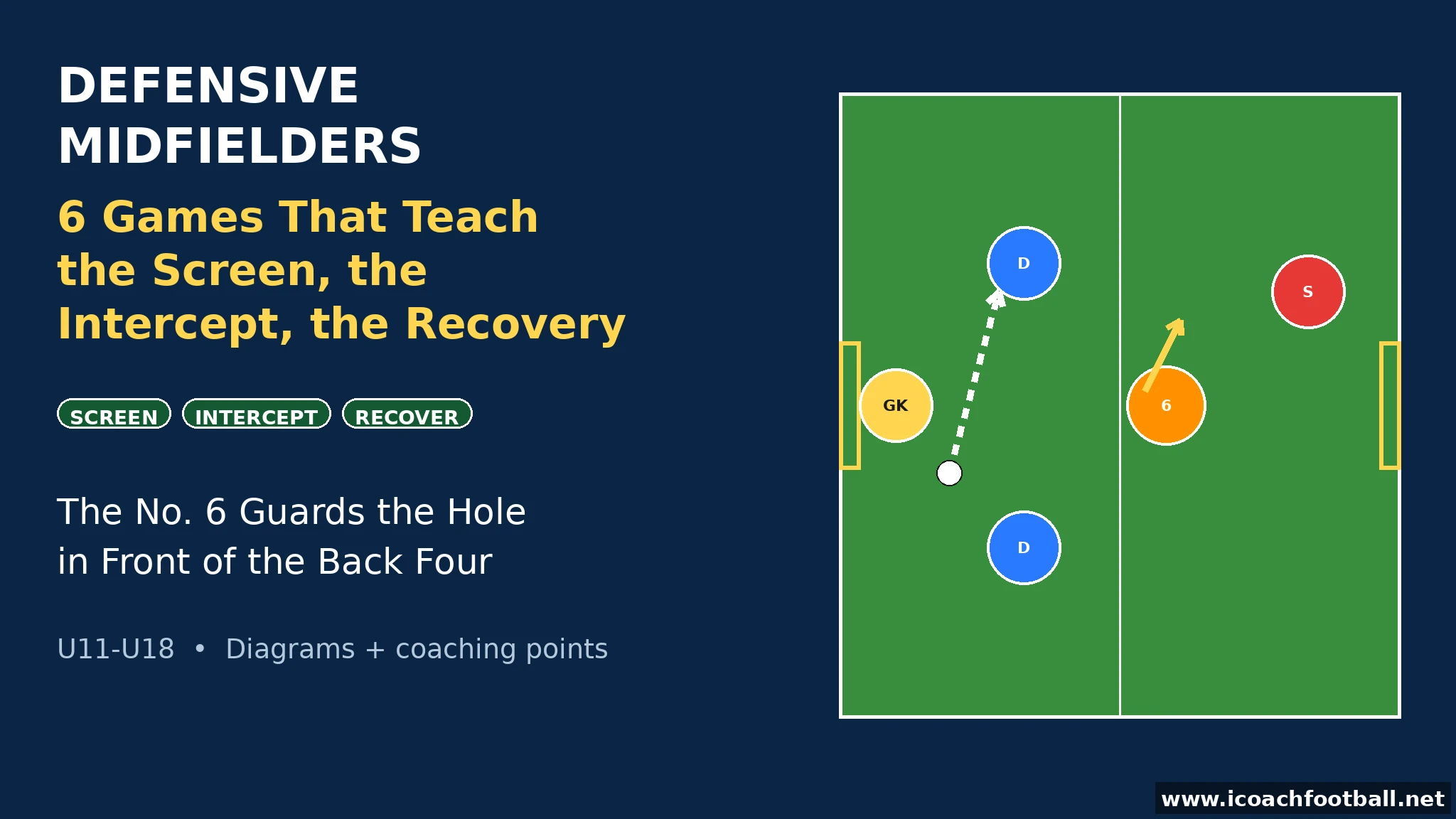
The defensive midfielder is the player who stops the other team playing through the middle. These six soccer drills for defensive midfielders teach the No. 6 to scan and screen the passing lane, intercept on the front foot, protect the centre as a unit, track a runner into the box, win it and play forward in two touches, and lead a mid-block — in one 60-minute session.
Suitable for: U11–U18
In football — soccer in the US — the defensive midfielder is the most misunderstood job on the pitch. Coaches see a player standing in front of the back four doing “nothing” and move them higher up, and then wonder why every pass goes straight through the middle. The six games below train the job as FIFA teaches it: the FIFA Training Centre session “Preventing progression through central areas” builds the intercept from a passing circuit through a 4v2 and a 4v4 to a 7v7-plus-3 team game, and the elite mid-block session by Saïd Chiba makes the defensive midfielder one of the team’s tactical leaders, responsible for the whole defensive set-up. This post is the specialist companion to our soccer drills for midfielders — that post trains the whole midfield job, and this one trains only the No. 6.
Session snapshot
- Players: 12–18 (three or four groups of 3–4 for the circuits, 7v7 plus 3 for the finish)
- Area: A 15-by-12-metre box for the screen game; half a pitch for the team games
- Duration: 60 minutes
- Focus: Scanning, screening, intercepting, protecting the centre, tracking runners, recovering
- Age: U11–U18 (see Age adaptations)
The six No. 6 rules
Every one of these soccer drills for defensive midfielders is built on six rules. Teach them once, then repeat them in every game until the players say them back to you.

| Rule | What it means |
|---|---|
| Scan before you receive | The picture is taken before the ball arrives — scan first, then receive |
| Guard the hole, not the ball | The 6 guards the space in front of the back four — leave it and the back four are exposed |
| Side-on, on the line | Stand on the line between the ball and the striker, side-on so you can see both |
| Press the lane, not the man | The intercept comes from cutting the pass, not from chasing the player |
| Win it, play forward | The tackle is only half the job — the first pass after the win goes forward |
| Recover behind the ball | After the ball is lost, sprint back into the hole before the next pass comes |
Drill 1: Scan and Screen — The 3-Player Lane Game
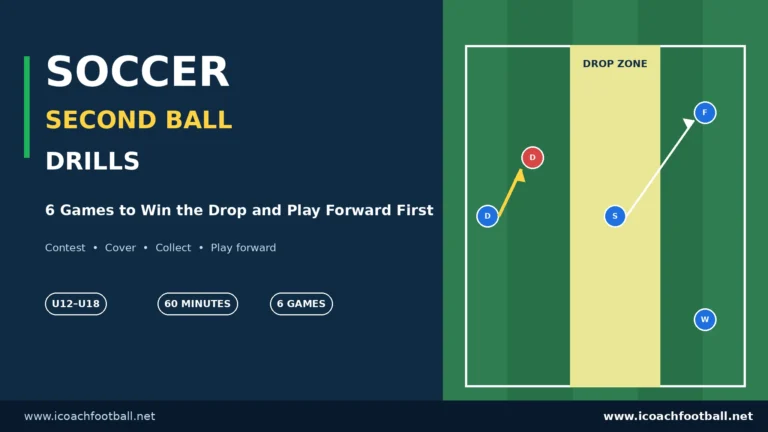
The screening lesson. Three players — a passer, a defensive midfielder and a striker — in a 15-by-12-metre box with a small goal behind the striker. The 6 keeps the striker in view, stands in the passing lane, and steps in front of the pass to intercept it or force it wide. In line with the FIFA Training Centre’s central-midfielders framework, where the modern 6 manages the space in front of the defence — and with the scan-and-screen drill that FIFA’s own coaching material uses to teach it: the screen is a lane, not a man.
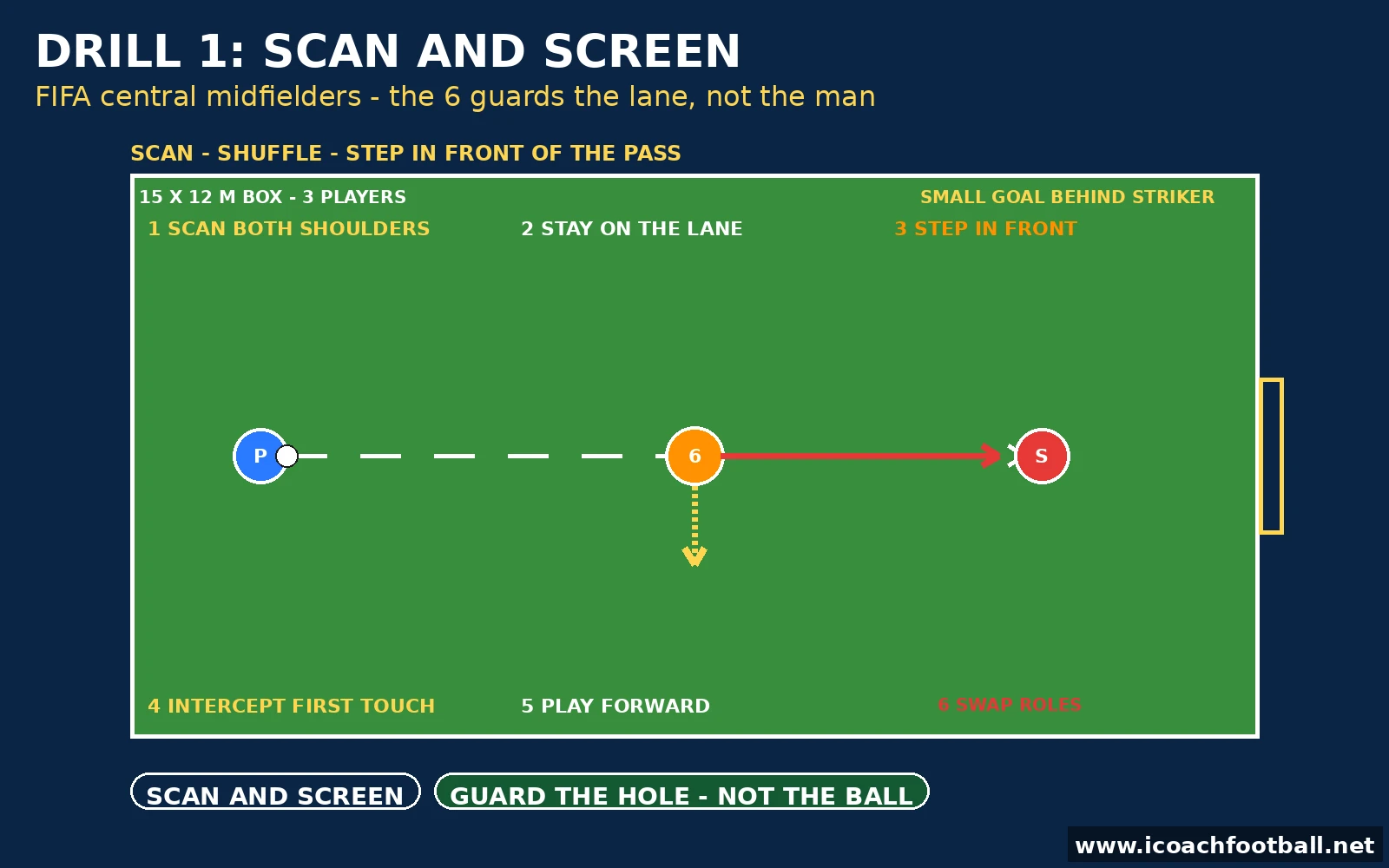
- Setup: A 15-by-12-metre box marked with four cones, a small goal on one end line, three players (a passer, a No. 6 and a striker), one ball, 6 minutes in three blocks of 2.
- How to play:
- The passer plays the ball to the striker, who tries to score in the small goal.
- The No. 6 stands between them, on the line from the ball to the striker.
- The 6 scans over both shoulders — ball, then striker, then ball again.
- When the pass comes, the 6 steps in front of it and takes it on the first touch.
- If the pass is forced wide, the 6 shuffles across while still facing the ball.
- After three blocks of two minutes, swap roles — everyone plays the screen.
- Coach’s note: Watch the 6 who chases the ball — the moment they run out to the passer, the lane behind them opens and the pass goes straight into the striker; the cue is “guard the hole, not the ball,” and our soccer scanning drills teach the shoulder check that makes the screen work, while our soccer tackling drills build the clean interception the screen ends with.
- Progressions: The passer may fake the pass, so the 6 must read the body shape, not the feet; the striker may move along the line, so the 6 must shuffle and stay on the line; only ground passes count — no chips over the screen.
Drill 2: The Intercept Circuit — Side-On and Arch the Run
The intercept lesson. A passing circuit where the pressing player approaches the receiver side-on and arcs the run, so the passing lane closes before the ball is even played. Based on the FIFA Training Centre session “Preventing progression through central areas”, in which the passing circuit teaches exactly this: pressing players approach the receiving player side-on and arch their runs to shut off passing lanes, forcing ball carriers wide or forcing turnovers by making the central area compact.

- Setup: Two lines of players 15 yards apart with a No. 6 in the middle, one ball, 8 minutes.
- How to play:
- The two lines pass the ball back and forth across the middle.
- The No. 6 in the middle reads the passer’s body shape before the ball is played.
- The 6 approaches the receiver side-on, arcing the run to shut the inside lane.
- The 6 steps in front of the pass and intercepts it on the front foot.
- The interception must become a forward pass to the far line within two touches.
- Rotate the 6 every two minutes so every player presses from the middle.
- Coach’s note: Watch the 6 who runs straight at the ball — a straight run leaves the lane open behind them and the pass slides past; the cue is “arch the run,” and our coaching soccer pressing triggers train the trigger itself, while our soccer passing drills build the first-time forward pass the intercept must become.
- Progressions: A second No. 6 joins, so one presses and one covers the lane behind; the pass must be one touch, so the read must be earlier; the lines move further apart, so the intercept must be made at full sprint.
Drill 3: Protect the Centre — 4v4 in the Inner Zone
The unit lesson. Four defenders protect a 3-by-3-metre inner zone in the middle of the area from four attackers, who try to pass into or through it. Based on the FIFA Training Centre’s mid-block work by Poland’s Sporting Director Marcin Dorna, in which the first exercise is exactly this 4v4: four defenders protect an inner zone that represents the central areas a mid-block protects, the nearest defender presses while the others cover, and the whole unit jumps together when the ball moves.
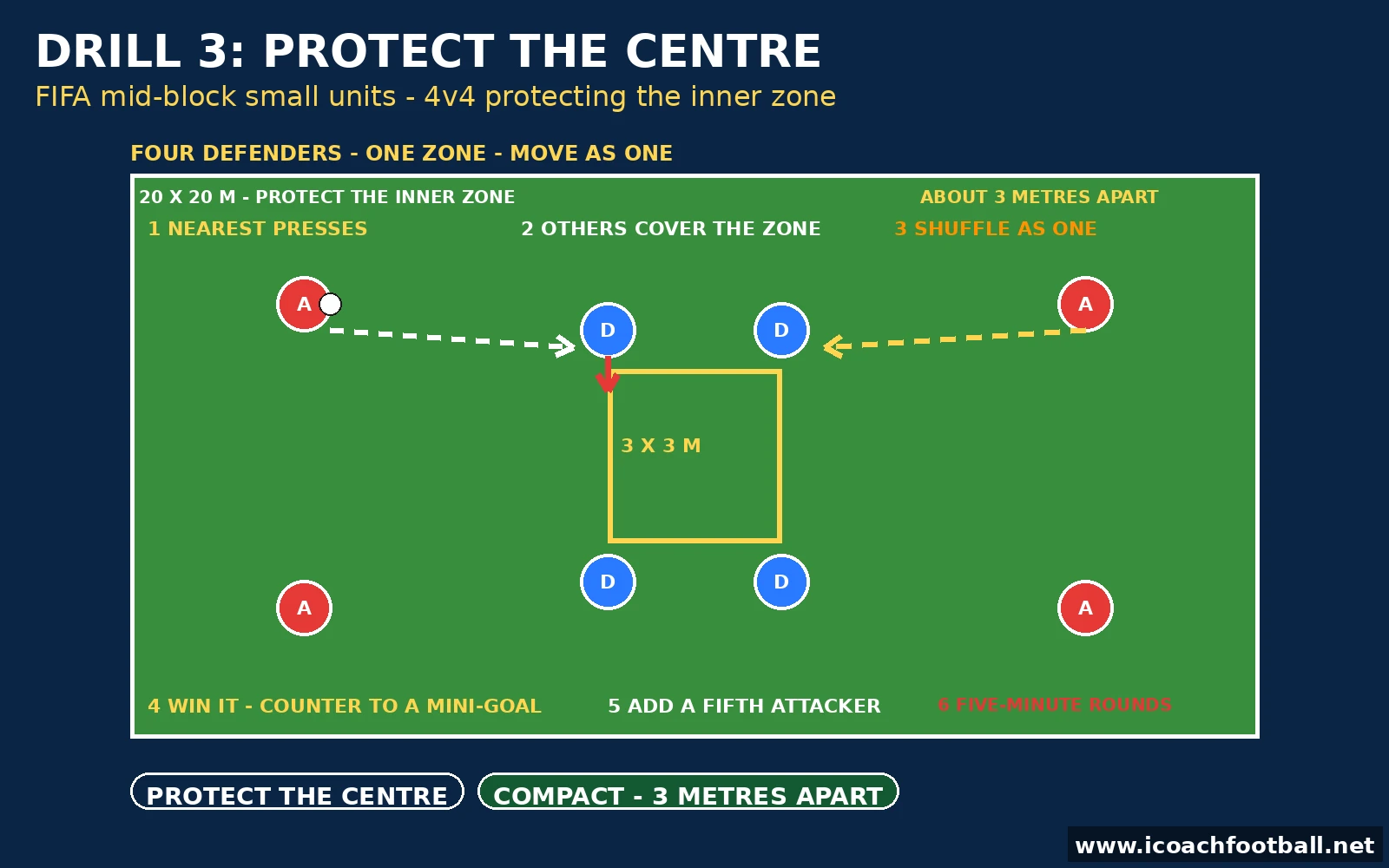
- Setup: A 20-by-20-metre area with a 3-by-3-metre inner zone marked in the middle, 4v4, one ball, 10 minutes.
- How to play:
- The attackers pass around the outside and try to play into or through the inner zone.
- The defenders stay compact — about three metres apart — and protect the zone.
- The nearest defender presses the ball carrier; the other three cover the zone.
- When the ball moves across the pitch, the whole unit shuffles with it.
- If the defenders win it, they counter into one of the two mini-goals.
- After five minutes, the attackers get a fifth player and the defenders protect the zone outnumbered.
- Coach’s note: Watch the unit that jumps one at a time — a block that presses in ones leaves gaps between the pressers and the pass goes through the middle; the cue is “move as one,” and our football defending 3v2 drills train the same outnumbered defending in a smaller game, while our soccer drills for center backs train the back-line connection this block depends on.
- Progressions: The inner zone shrinks to 2 by 2 metres, so the block must be tighter; the attackers may only score by passing through the zone, not into it; the defenders must win it within six seconds of the first pass.
Drill 4: Track the Runner — Goal-Side All the Way
The recovery lesson. A runner starts in midfield and times a run into the box; the No. 6 must track them, stay goal-side, and arrive with them — never dragged out of the hole by a decoy. In line with the FIFA Training Centre’s mid-block session by Saïd Chiba, in which the defending line must constantly monitor the space in behind and the block must move together towards the ball, so no runner arrives free.
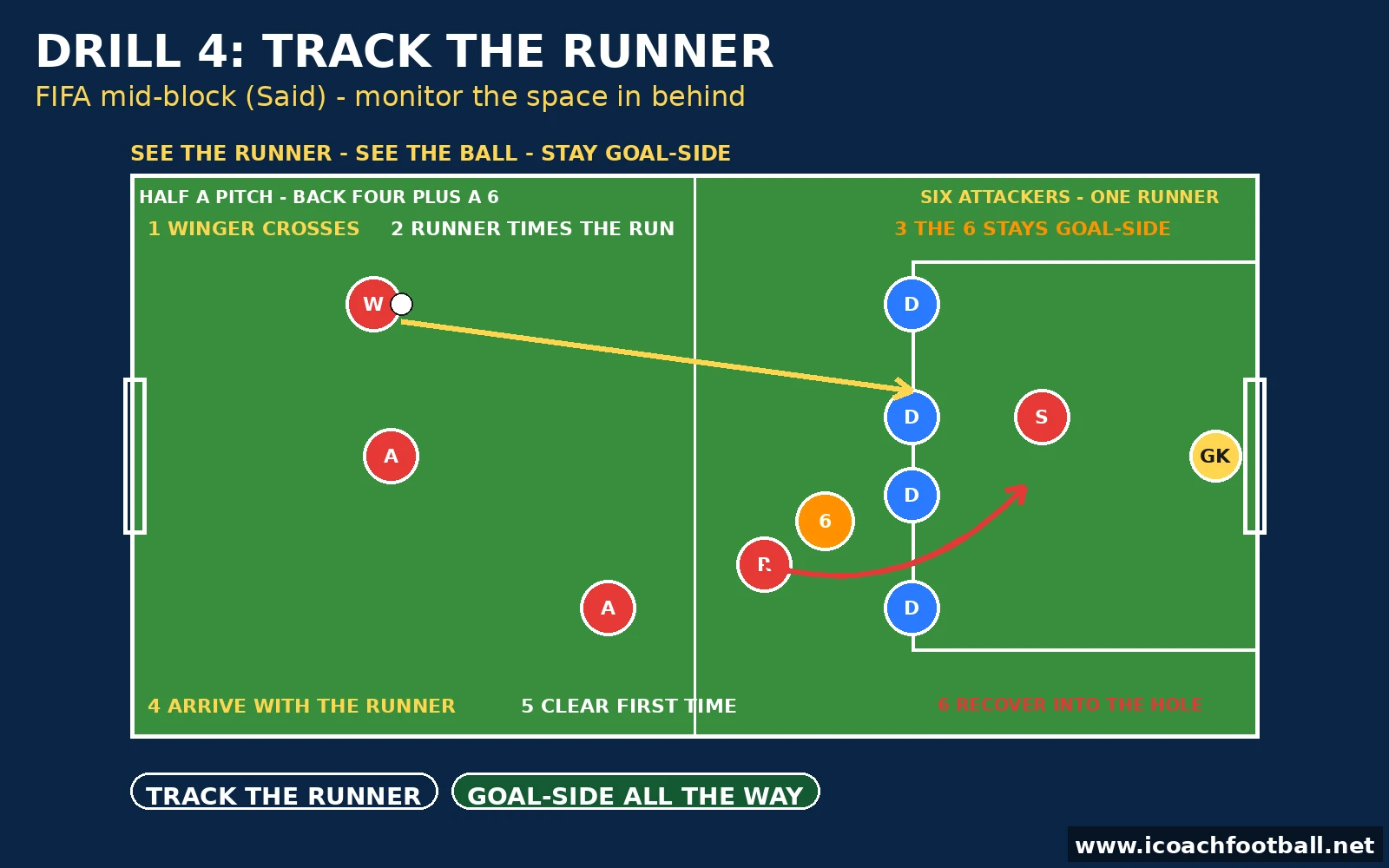
- Setup: Half a pitch with one full-size goal and a keeper, a back four plus a No. 6 against six attackers, balls with the coach, 10 minutes.
- How to play:
- The coach plays the ball to the attackers, who work it wide to cross.
- A midfielder times a run from deep into the box — the No. 6 tracks them.
- The 6 stays goal-side of the runner at every step, never in front of them.
- When the cross comes in, the 6 arrives with the runner and clears first time.
- If the runner checks back out of the box, the 6 follows them out — and recovers into the hole.
- Swap the runner every two minutes so every midfielder runs and every No. 6 tracks.
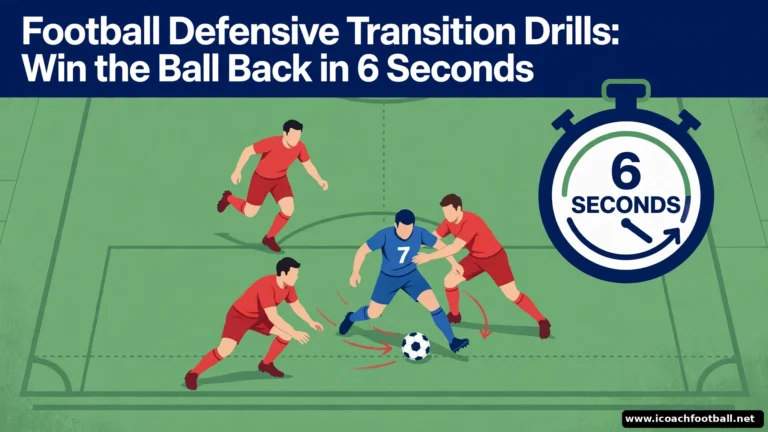
- Coach’s note: Watch the 6 who ball-watches — a No. 6 who watches the crosser loses the runner, and the runner arrives free at the back post; the cue is “see the runner, see the ball,” and our football defensive transition drills train the same recovery into shape, while our soccer goalkeeper communication drills train the keeper’s call that warns the 6 the runner is coming.
- Progressions: Two runners go at once, so the 6 must pick the dangerous one and the centre-back takes the other; the cross comes from the opposite side, so the 6 must track across the whole box; the runner starts from the No. 6’s blind side.
Drill 5: Win It, Play Forward — The 4v2 Turnover Game
The transition lesson. A 4v2 possession game where the win is only half the job: the player who wins the ball must play it forward within two touches, through the neutral player in the middle. Based on the FIFA Training Centre session “Preventing progression through central areas”, in which the 4v2 possession game and the 4-plus-1v2 game teach the same sequence — press, win it, and play forward before the opposition recovers.
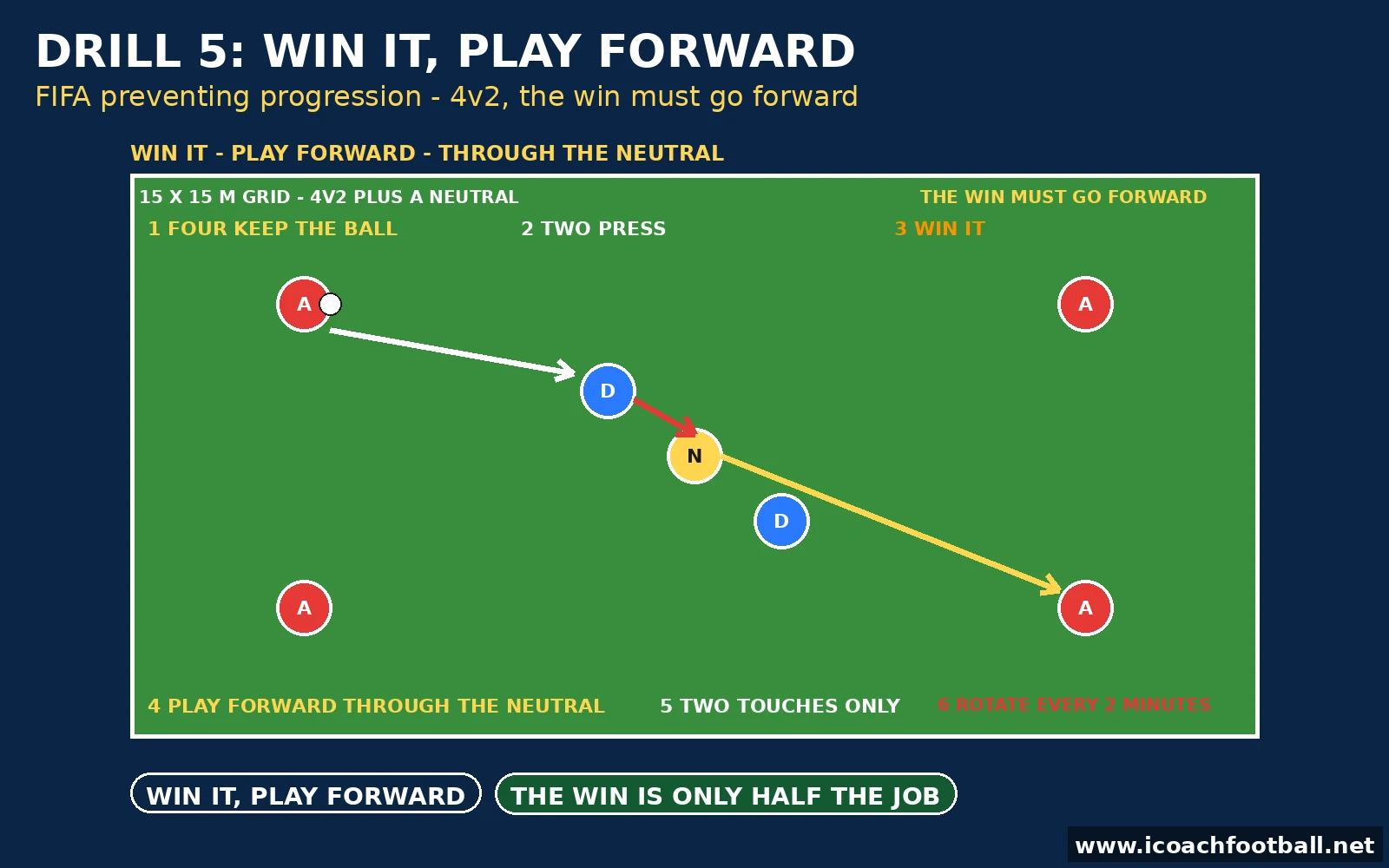
- Setup: A 15-by-15-metre grid with a neutral player in the middle, 4v2, one ball, 8 minutes.
- How to play:
- The four keep the ball in the grid while the two press.
- When the two win it, the winner must play forward through the neutral within two touches.
- The forward pass must go to a team-mate on the far side of the grid.
- If the forward pass is completed, the pressing pair stays in for one more round.
- If the forward pass fails, the four keep the ball and the press restarts.
- Rotate the pressing pair every two minutes so every player wins it and plays forward.
- Coach’s note: Watch the winner who turns back to safety — a win followed by a backwards pass is a turnover wasted; the cue is “win it, play forward,” and our soccer possession drills build the two-touch habit this game needs, while our soccer counter attack drills train the same four-pass finish this forward ball starts.
- Progressions: The forward pass must be first time; the neutral player may only play one touch, so the win must be clean; the grid shrinks to 12 by 12 metres and the press has four seconds to win it.
Drill 6: The Mid-Block Game — 7v7 Plus 3
The match-real finish. A 7v7-plus-3 team game on a reduced pitch where the defending team sets up in a mid-block, the No. 6 leads it, and the block forces the opposition wide before countering in seconds. Based on the FIFA Training Centre session “Preventing progression through central areas”, in which the final game is a 7v7-plus-3 team game with the neutral players operating in central areas at all times — and on the elite mid-block session by Saïd Chiba, in which the team’s tactical leaders, generally the central defenders and/or defensive midfielders, are responsible for the defensive set-up.
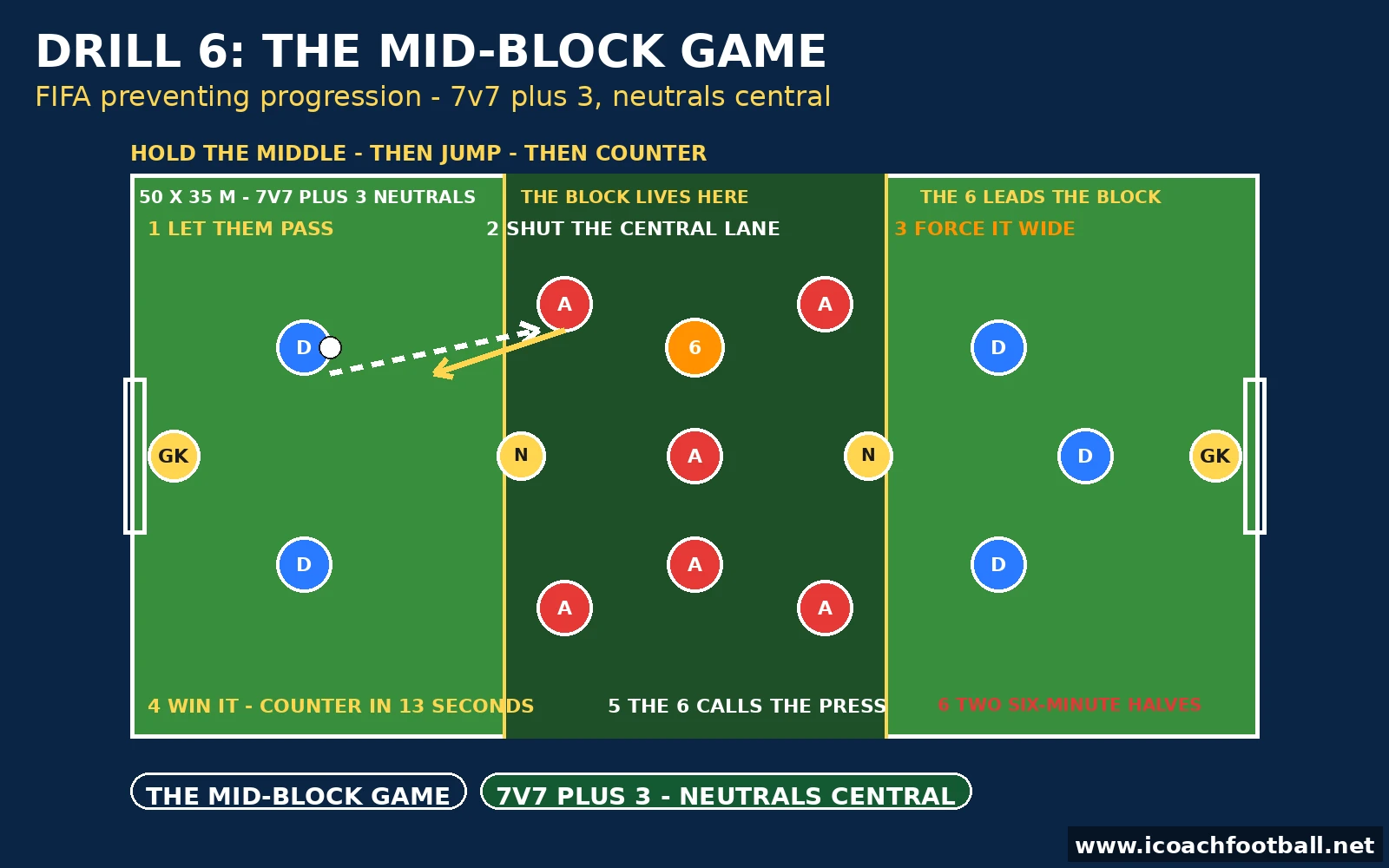
- Setup: A reduced pitch (50 by 35 metres) with two full-size goals and keepers, 7v7 plus 3 neutrals who always operate in central areas, balls with the coach, 12 minutes.
- How to play:
- Play a normal game, but the defending team sets up in a mid-block — compact, in the middle third.
- The No. 6 leads the block: they call the press, the shuffle and the drop.
- The block lets the opposition pass in their own half, then shuts the central lane.
- The nearest player presses and forces the ball wide; the rest cover the lane.
- When the block wins it, the team counters at once and must shoot within 13 seconds.
- Play two six-minute halves, then swap which team defends in the block.
- Coach’s note: Watch the block that chases into the opposition half — a mid-block that presses high is not a mid-block, it is a press with no cover behind it; the cue is “hold the middle, then jump,” and our football rest defence drills train the insurance shape this block depends on, while our soccer playing out from the back drills train the angles the counter starts from.
- Progressions: The block must win it within six seconds of the first forward pass; the neutrals join the team in possession, so the block defends outnumbered; only counter-attack goals count.
Coaching points
- Scan before you receive: The picture is taken before the ball arrives — our soccer scanning drills teach the shoulder check, and our soccer drills for midfielders train the No. 6 role in full.
- Guard the hole, not the ball: A 6 who chases the ball leaves the back four exposed — our soccer drills for center backs train the back-line connection, and our soccer defending long balls drills train what happens when the hole is left open.
- Side-on, on the line: The intercept starts with the body shape — our soccer tackling drills train the clean step-in, and our soccer defending 2v1 drills train the same lane discipline one size down.
- Press the lane, not the man: A chase is not a press — our coaching soccer pressing triggers train the trigger, and our football defending 3v2 drills train the same outnumbered defending.
- Win it, play forward: The first pass after the win goes forward — our soccer passing drills build the weight of that ball, and our soccer counter attack drills train the finish it creates.
- Recover behind the ball: After the ball is lost, sprint back into the hole — our football defensive transition drills train the moment the ball is lost, and our football rest defence drills train the insurance shape behind it.
- The No. 6 talks: The block runs on five calls — scan, screen, jump, cover, away — and our soccer goalkeeper communication drills train the keeper’s calls the block depends on.
- The block moves as one: Four players shifting together shut the middle — our soccer 4v4 drills and our soccer 3v3 drills train the same compact shape in smaller games, and our soccer 6v6 drills train it with more players.
- The half space is the danger zone: The runner arrives through the channel, not the middle — our football attacking the half space drills train the same receive, and our football defending set pieces drills train the same marking discipline.
- The 6 is the switchboard too: Every switch of play runs through the holding midfielder — our soccer possession drills train the patience, and our soccer attacking third drills train the finish the switch creates.
Common mistakes
- Chasing the ball: A No. 6 who runs to the ball leaves the hole — and the pass goes straight through it.
- Standing square-on: A screen who faces only the ball cannot see the striker — side-on, so both are in view.
- Running straight at the receiver: A straight run leaves the lane open behind you — arch the run and shut the lane.
- Ball-watching the crosser: A 6 who watches the ball loses the runner — see the runner, see the ball.
- Playing backwards after the win: A win followed by a safe backwards pass is a turnover wasted — win it, play forward.
- Pressing as individuals: One player pressing is a chase; a block pressing together is a trap — move as one.
Age adaptations
| Age | Area | Touches | What changes |
|---|---|---|---|
| U11–U12 | 15-by-12-metre box, 20-by-20-metre area | Three touches | Drill 1 runs with a passive passer at first, so the 6 learns the lane before the fake; Drill 2 runs unopposed for the first two minutes — the 6 walks the arc; Drill 3 uses a bigger inner zone (5 by 5 metres) and the attackers may not pass through it, only into it; Drill 4 runs with one runner only and the cross comes from one side; Drill 5 runs 4v1 instead of 4v2; Drill 6 runs 6v6 with no neutrals — our U13 soccer practice plan shows the same age band in a full session |
| U13–U14 | 15-by-12-metre box, 20-by-20-metre area | Two touches | Drill 1 runs as written, with the fake pass added in the second block; Drill 2 runs with one pressing player and one covering player; Drill 3 runs as written, with the fifth attacker added after five minutes; Drill 4 runs with two runners; Drill 5 runs 4v2 as written; Drill 6 runs 7v7 plus 3 as written — our soccer drills for U15 train the same habits one age up |
| U15–U16 | Half a pitch, reduced pitch | One–two touches | Drill 1 runs with the striker moving along the line and the passer faking from the first rep; Drill 2 runs with the one-touch pass rule; Drill 3 shrinks the inner zone to 2 by 2 metres; Drill 4 runs with the runner starting from the 6’s blind side; Drill 5 runs with the first-time forward pass rule; Drill 6 runs with the six-second win rule — our soccer drills for U16 run the same age band in a full session |
| U17–U18 (and adult) | Half a pitch, reduced pitch | One touch | Drill 1 runs at full speed with the chip ruled out; Drill 2 runs with two pressing players and the 15-yard lines moved to 20 yards; Drill 3 runs with the defenders winning it within six seconds of the first pass; Drill 4 runs with the cross from either side; Drill 5 runs in a 12-by-12-metre grid with a four-second press; Drill 6 runs with only counter-attack goals counting — our soccer drills for midfielders and our soccer drills for U15 run the same habits at full size |
60-minute session plan
These six soccer drills for defensive midfielders fit into the hour like this:
| Block | Minutes | What to run |
|---|---|---|
| Warm-up | 0–10 | Drill 1, scan and screen, walking pace then half speed |
| Intercepts | 10–20 | Drill 2, the intercept circuit |
| Unit defending | 20–30 | Drill 3, protect the centre 4v4 |
| Recovery | 30–40 | Drill 4, track the runner |
| Transition | 40–50 | Drill 5, win it, play forward |
| Match-real finish | 50–60 | Drill 6, the mid-block game 7v7 plus 3 |
For a full guide to building the hour around these blocks, see our 60-minute session plan.
FAQ
What does a defensive midfielder do?
The defensive midfielder — the No. 6 — protects the space in front of the back four. They screen the passing lane into the striker, intercept passes before they reach the final third, track runners into the box, and play the first forward pass after winning the ball. In the modern game they are also one of the team’s tactical leaders: in FIFA’s mid-block session, the defensive midfielder is responsible for the whole defensive set-up.
What age should players start playing defensive midfield?
From U11. Before that, every player should rotate through every position, including the No. 6, so they learn the lane discipline without being fixed in it. From U11 the role becomes a real job: the player who guards the hole, screens the striker and leads the block. Drill 1 in this post is the first drill to teach it — a three-player lane game that works from U11 up.
How do you teach a defensive midfielder to intercept passes?
Teach the read before the tackle. The No. 6 watches the passer’s body shape — the hips and the plant foot tell you where the pass is going before the foot hits the ball. Then they approach side-on, arcing the run so the passing lane closes, and step in front of the pass. Drill 2 runs exactly that sequence as a circuit, and our soccer tackling drills train the clean step-in that finishes it.
Should a defensive midfielder tackle or stay on their feet?
Stay on their feet first. The best defensive midfielders win the ball by intercepting it, not by tackling for it — an interception keeps the shape, a tackle that misses breaks it. Tackle only when the ball is there to be won and the cover is behind you. Drill 1 and Drill 2 both teach the intercept first; our soccer tackling drills train the tackle for the moments the intercept is not on.
What is the difference between a defensive midfielder and a centre-back?
The centre-back defends the goal; the defensive midfielder defends the space in front of the centre-back. The centre-back marks a man or a zone in the box; the No. 6 screens a lane in front of the box, and when the ball is lost they recover into the hole before the next pass comes. The two jobs meet in the same place — which is why our soccer drills for center backs train the back-line connection this post depends on.
Sources
- FIFA Training Centre — “Preventing progression through central areas” (talent-coach programme: a session by FIFA Talent Coach Claudio García and Costa Rican FA Talent Coach Lina Arana on blocking and preventing the opposition from playing through central areas — a passing circuit, a 4v2 possession game, a 4v4 small-sided game, a 4-plus-1v2 possession game and a 7v7-plus-3 team game; pressing players approach the receiving player side-on and arch their runs to shut off passing lanes, forcing ball carriers wide or forcing turnovers by making the central area compact). Drills 2, 5 and 6 in this post are based on and in line with that session. Link: https://www.fifatrainingcentre.com/en/practice/talent-coach-programme/sessions/preventing-progression-through-central-areas.php
- FIFA Training Centre — “23) Defending in a mid-block (Said)” (elite session by Saïd Chiba, former assistant coach of the Morocco national team: three exercises on the defensive principles of a mid-block — closing down, covering and defensive shuffling — with the defending players protecting the central channel as a priority, moving as a compact, synchronised block, and with the team’s tactical leaders, generally the central defenders and/or defensive midfielders, responsible for the defensive set-up). Drills 1, 3, 4 and 6 in this post are based on and in line with that session. Link: https://www.fifatrainingcentre.com/en/practice/elite-sessions/out-of-possession/chiba_said-defending-in-a-mid-block.php