Soccer Kick-Off Routines: 6 Plays That Turn the Restart Into an Attack (U11–U18)
Quick answer
A kick-off is the only restart where the whole team starts in a set shape and the opposition cannot come within 9.15 metres of the ball. Most youth teams waste it with a hopeful punt forward. Six routines — one 60-minute session — turn it into a planned attack: build short, go long with a plan, strike fast after conceding, or press and win it back in six seconds.
Suitable for: U11–U18 (ages 10–18)
Session snapshot
- Players: 12–16 (U11–U18)
- Area: Centre circle to halfway, expanding to half a pitch (grids 20 x 15 to 40 x 30 yards)
- Duration: 60 minutes
- Focus: The short/long/quick decision, first-receiver shape, second balls, and the six-second press after your own kick-off
- Equipment: 10–12 balls, 20 cones, 4 mini goals, bibs
Why these six routines work
A kick-off is a free start the other team cannot contest. Opponents must stay at least 9.15 m (10 yards) from the ball until it is in play, and the ball is in play the moment it is kicked and clearly moves. Most youth teams waste that free pass — they launch it long and fight for 50/50s, or tap it backwards and hand the initiative away.
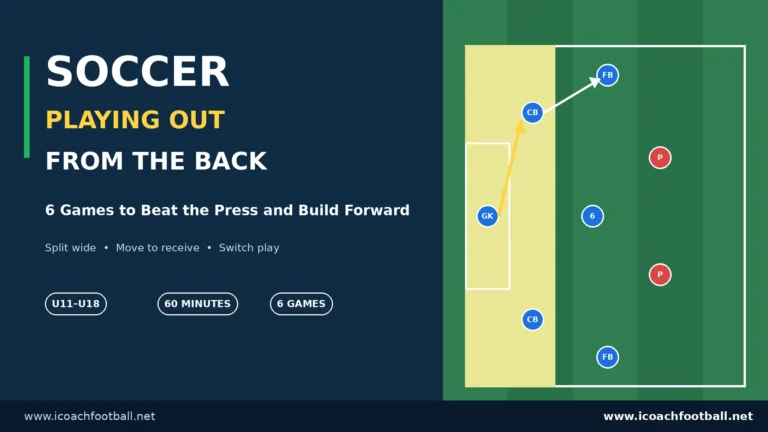
The fix is a decision, not a habit. FIFA’s Training Centre session “Playing out from the back” (Francesco Gabriele, Swiss FA head of youth development) makes the same point from open play: when the opposition presses, there is always a free player somewhere, and the objective is to get the ball to the free player and play forward. If you cannot reach the free player directly, use a third player to find them. Routines 1, 4 and 5 below are based on / in line with that FIFA session. In the UK the same session is football kick-off routines — the routines and the rules are identical.
This post completes the set-pieces cluster: our soccer goal kick routines teach the same free-player decision from the other restart, and our soccer playing out from the back drills take it into open play.
Six rules of kick-offs
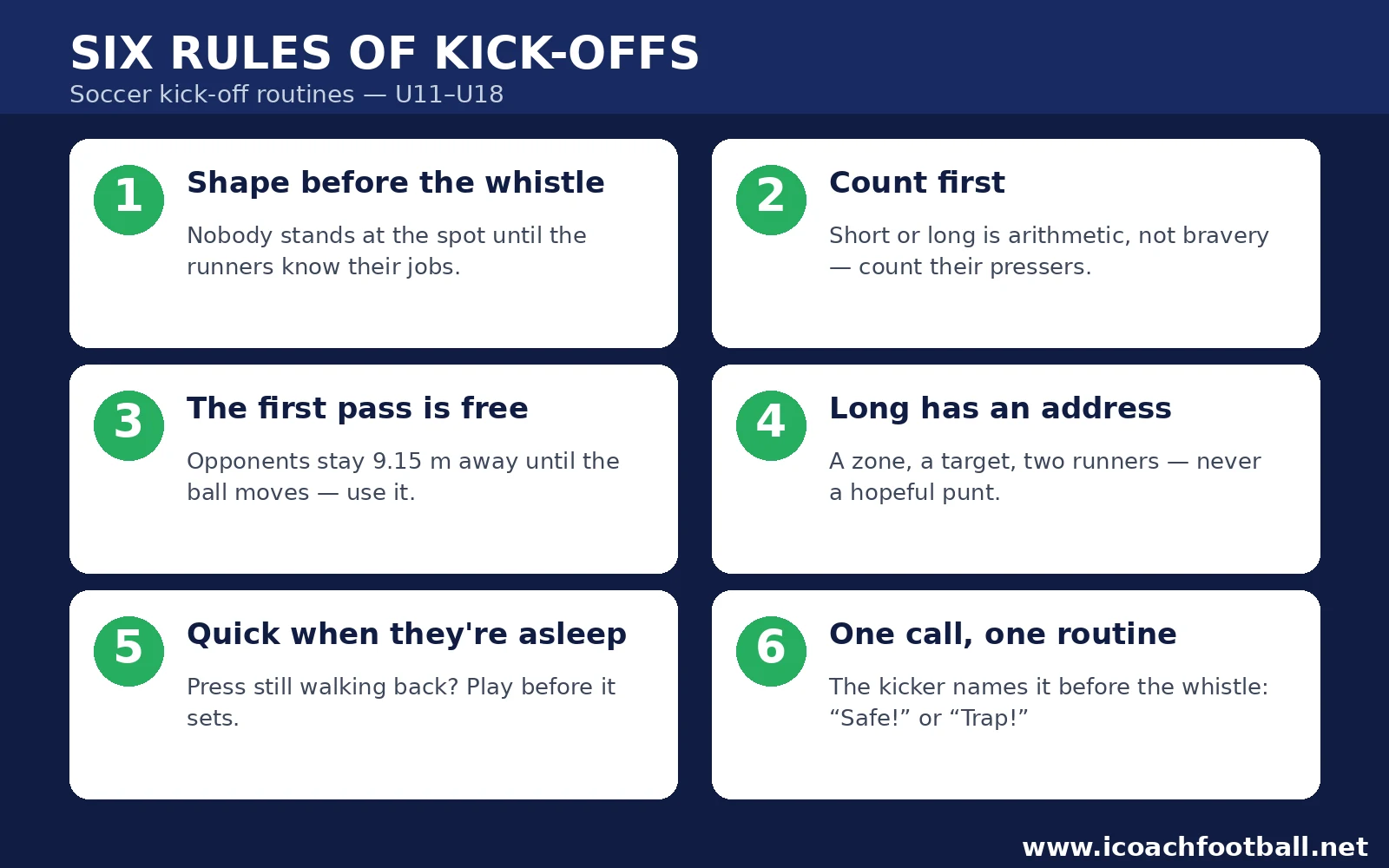
- Shape before the whistle. Nobody stands at the centre spot until the runners know their jobs.
- Count first — short or long is arithmetic, not bravery. Count their two strikers against your back line.
- The first pass is free — use it. Opponents cannot come within 9.15 m until the ball moves.
- Long has an address. A zone, a target, two runners — never a hopeful punt.
- Quick when they’re asleep. If the press is still walking back after conceding, play before it sets.
- One call, one routine. The kicker names it before the whistle: “Safe!” or “Wide right!”
Drill 1 — The Safe Build
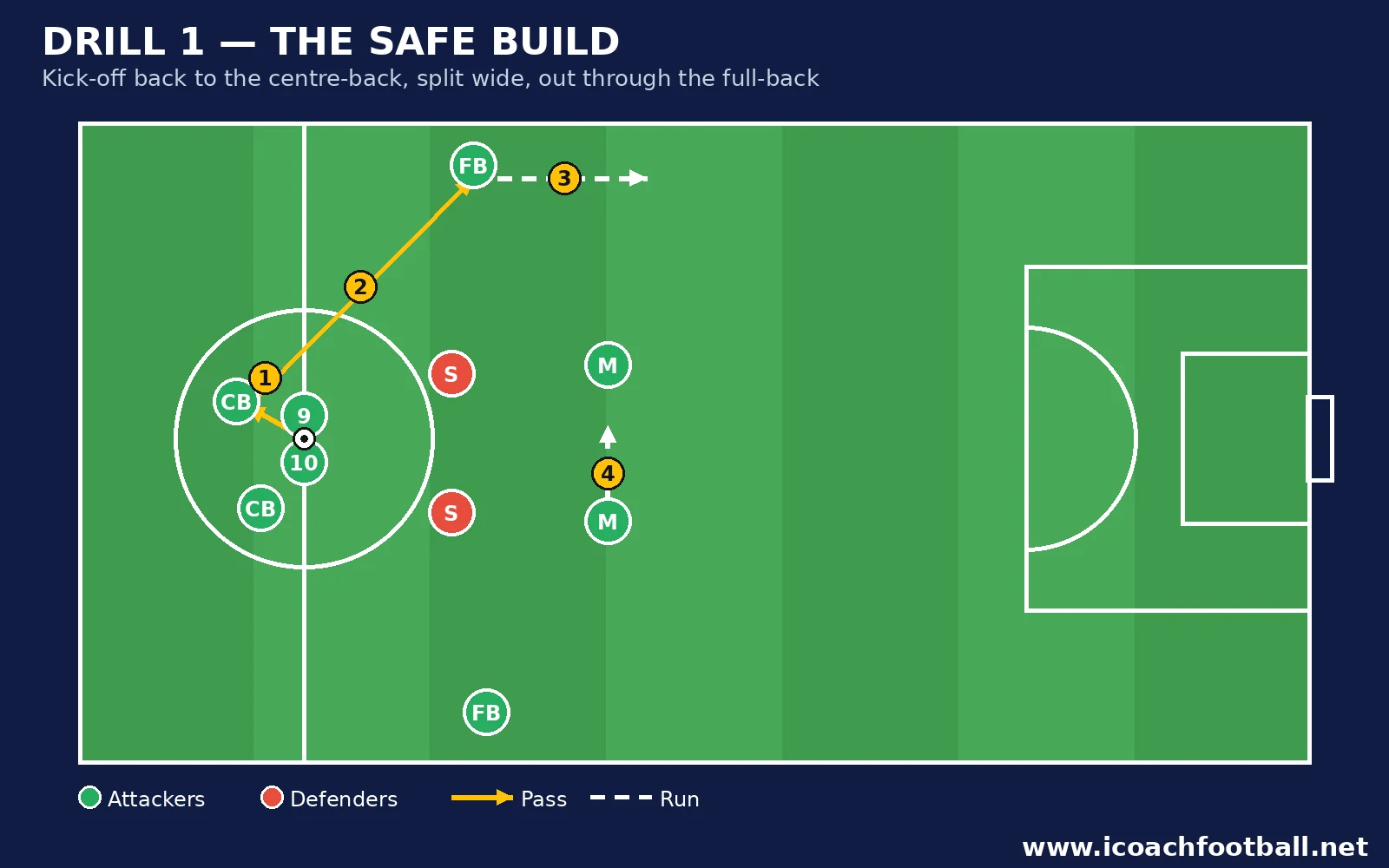
The default routine. Kick-off back to the centre-back, split wide, and out through the full-back — the first pass is unopposed, so keep it and build.
Setup
- Centre circle, cones marking a 20 x 15-yard build zone behind the takers.
- 8 players: 2 takers, 2 centre-backs, 2 full-backs, 2 midfielders vs 2 passive pressers. 10 balls. 8 minutes.
How to Play
- The kicker calls “Safe!” before the whistle.
- The ball is tapped back 5 yards to the dropping centre-back, who receives on the half-turn.
- The near full-back pushes 15 yards wide to the touchline.
- The centre-back plays wide to the full-back, who takes one touch forward.
- The far midfielder checks across to offer the switch if the press jumps to the ball side.
Coach’s note: “Half-turn or nothing — if the first receiver faces their own goal, the build dies on the first pass.”
Progressions: The pressers start live at the whistle; the full-back must play one-touch to the winger; the centre-back must switch to the far full-back within 3 passes.
Drill 2 — The Long Kick-Off
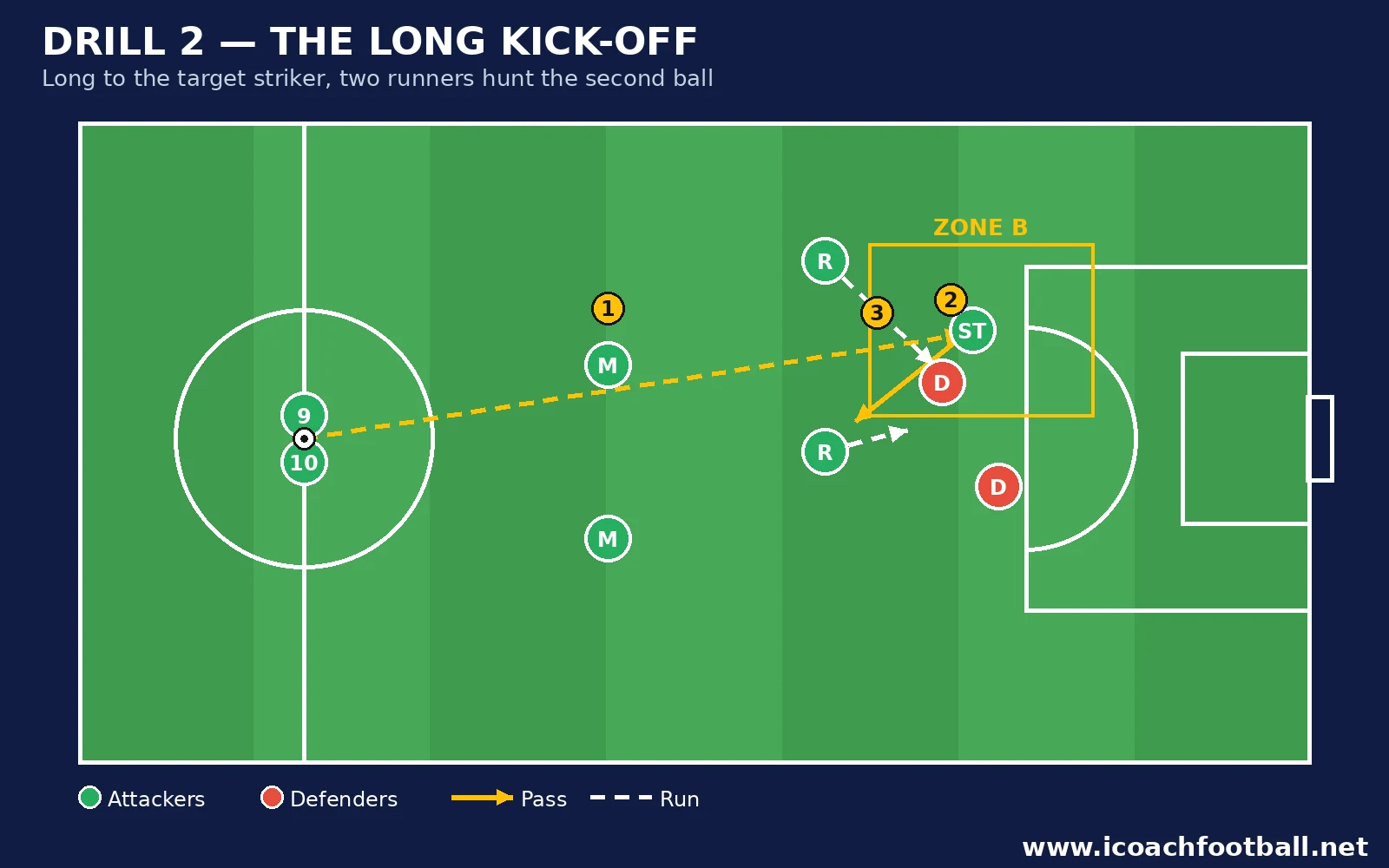
The kick-off goes long to a target striker with a second-ball plan. Long is no longer a punt — it is a plan with an address.
Setup
- Half a pitch, cones marking a target zone 25–30 yards from the centre spot.
- 8 players: 2 takers, target striker, 2 runners, 2 midfielders vs 2 defenders. 10 minutes.
How to Play
- The kicker calls the zone out loud — “Zone B!” — before the whistle.
- The target striker starts 5 yards inside the zone and shows for the ball.
- The kicker drives the long ball into the zone, to feet or chest height, never head height at U11–U12.
- The striker attacks the ball and flicks it on or holds it up for a runner.
- Two runners start moving on the kick, not on the header, to hunt the second ball.
Coach’s note: “Long has an address — if you can’t name the zone, don’t kick it long.”
Progressions: The defenders contest the first ball properly; the runners must win the second ball within 2 seconds; the flick must find a runner, not just go forward.
Drill 3 — The Quick Kick-Off
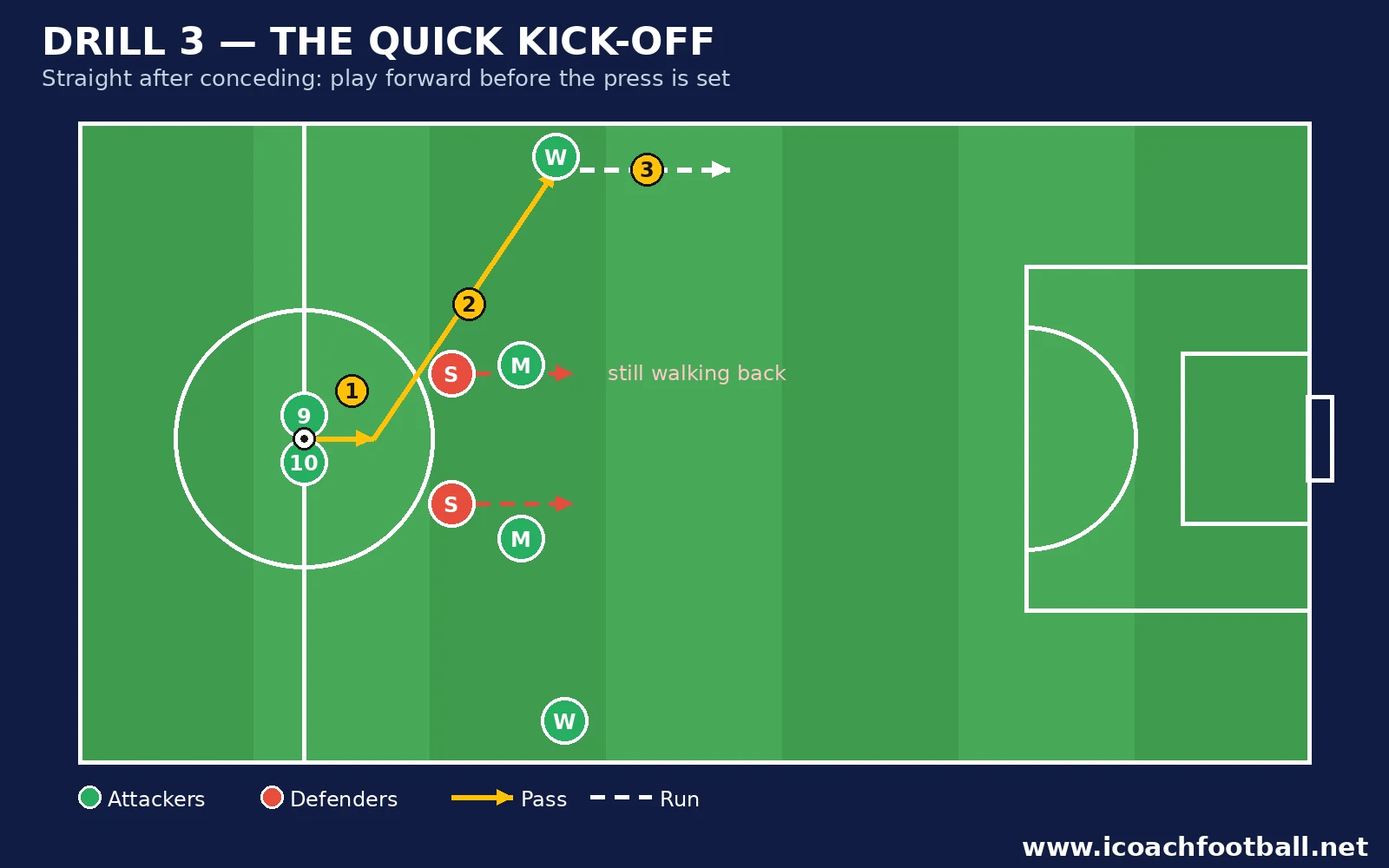
A quick kick-off straight after conceding, while the opposition is still celebrating and walking back. Timing and awareness — and knowing when not to rush it.
Setup
- Centre circle. 8 players: 2 takers, 2 wide players, 2 midfielders vs 2 opponents who walk back slowly after each rep. 7 minutes.
How to Play
- The opponents start each rep up the pitch and walk back to their shape.
- The takers scan before the whistle — is the press set, or still walking?
- If the press is still setting up, the kicker calls “Quick!” and taps the ball forward, not back.
- The second taker takes one touch forward and plays wide to the winger within 2 seconds.
- If the press is already set, the takers wait — a quick kick-off into a set press is a turnover.
Coach’s note: “Scan first, kick second — quick is a decision, not a habit.”
Progressions: The opponents jog back instead of walking; the quick kick-off must reach the final third within 3 passes; the kicker must call “Quick!” before the whistle.
Drill 4 — The Wide-Channel Kick-Off
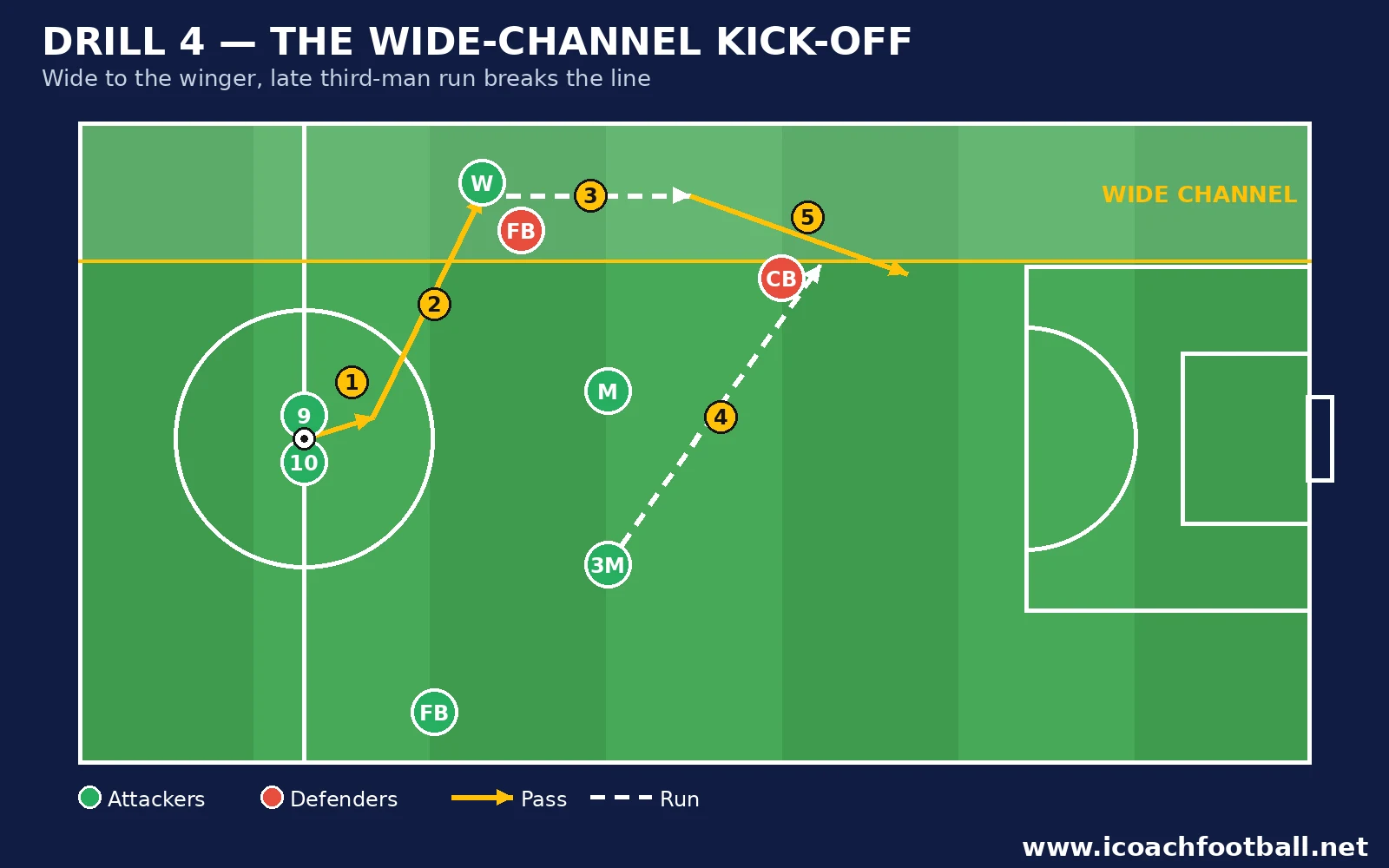
The kick-off goes wide to the winger, and a third-man run breaks the line behind the press. This routine needs the most rehearsal — the timing of the third-man run is everything.
Setup
- Half a pitch, cones marking a wide channel 12 yards wide on one touchline, from halfway to the penalty area.
- 9 players: 2 takers, winger, third-man runner, 2 midfielders, 2 full-backs vs 2 defenders. 10 minutes.
How to Play
- The takers call “Wide right!” and the winger starts 10 yards wide, level with halfway.
- The ball is tapped to the second taker, who plays first-time wide to the winger’s front foot.
- The winger receives on the half-turn and drives 10 yards up the channel.
- The third-man runner — the far midfielder — times the run behind the pressing full-back, only after the winger receives.
- The winger plays the through ball 15 yards ahead of the run, and the runner crosses or cuts inside.
Coach’s note: “The run is late on purpose — if the third man goes early, the defender sees it and the channel closes.”
Progressions: A defender starts on the winger’s shoulder; the winger must play one-touch to the runner; the channel narrows by 2 yards each round.
Drill 5 — The Disguised Kick-Off
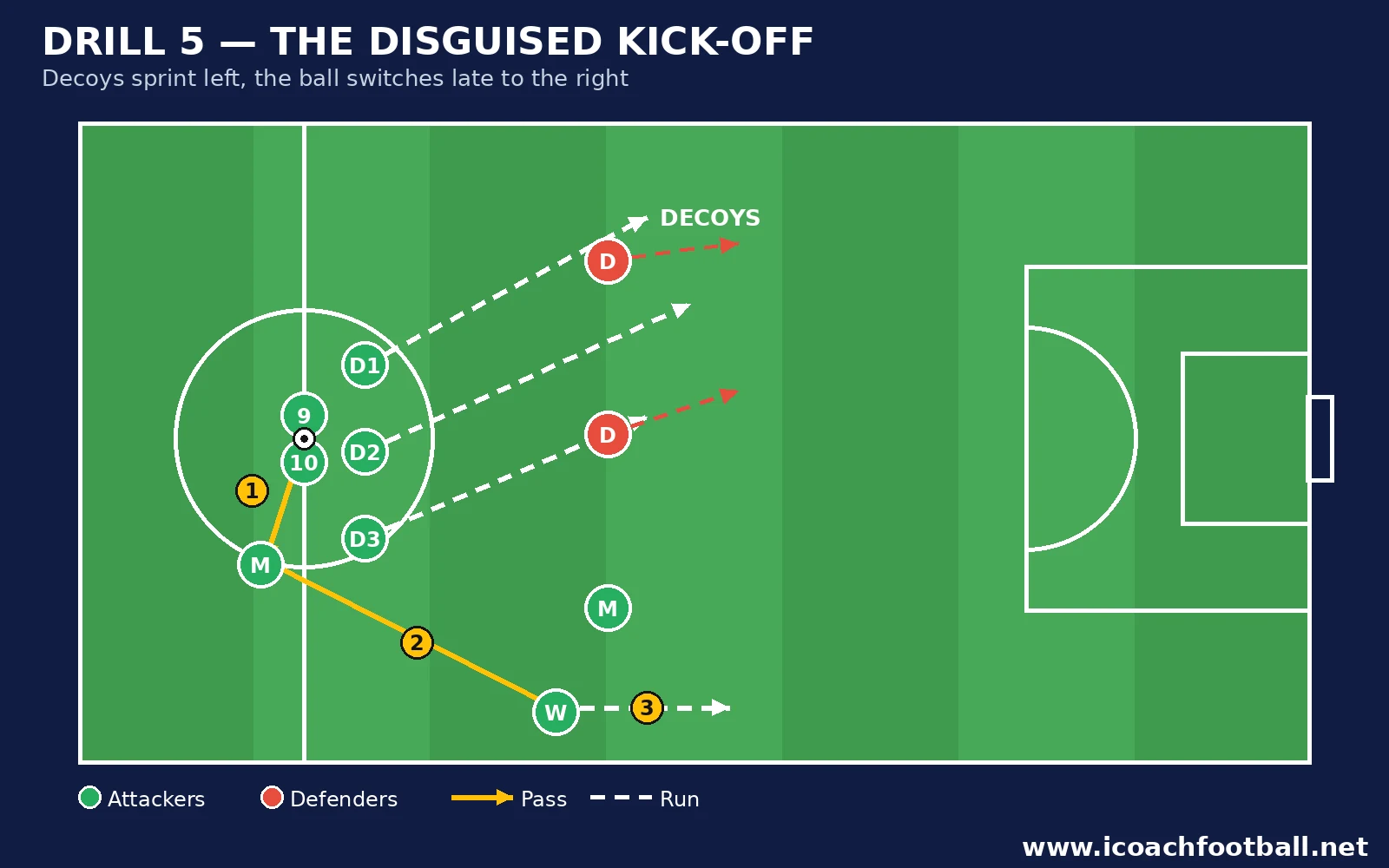
Decoy runners sell one side, then the ball switches late to the other. The opposition reads the decoys; the ball goes where they are not.
Setup
- Centre circle and halfway. 9 players: 2 takers, 3 decoy runners, 2 wide players, 2 midfielders vs 2 defenders who must react to the runners. 8 minutes.
How to Play
- The takers agree the real side in the huddle — the decoys just run.
- On the whistle, three runners sprint hard to the left, dragging both defenders with them.
- The ball is tapped back, not forward, to the dropping midfielder on the right.
- The midfielder plays first-time wide to the right winger, alone on the far touchline.
- If the defenders do not bite on the decoys, the takers play the safe build instead — the disguise is abandoned, not forced.
Coach’s note: “Sell it with your legs, not your eyes — the decoys sprint like they mean it, or nobody bites.”
Progressions: The defenders are told one rep in three is a disguise, so the takers must read them; the switch must reach the far winger within 3 seconds; the decoys must still be a threat if the ball comes back to them.
Drill 6 — The Kick-Off Press Trap
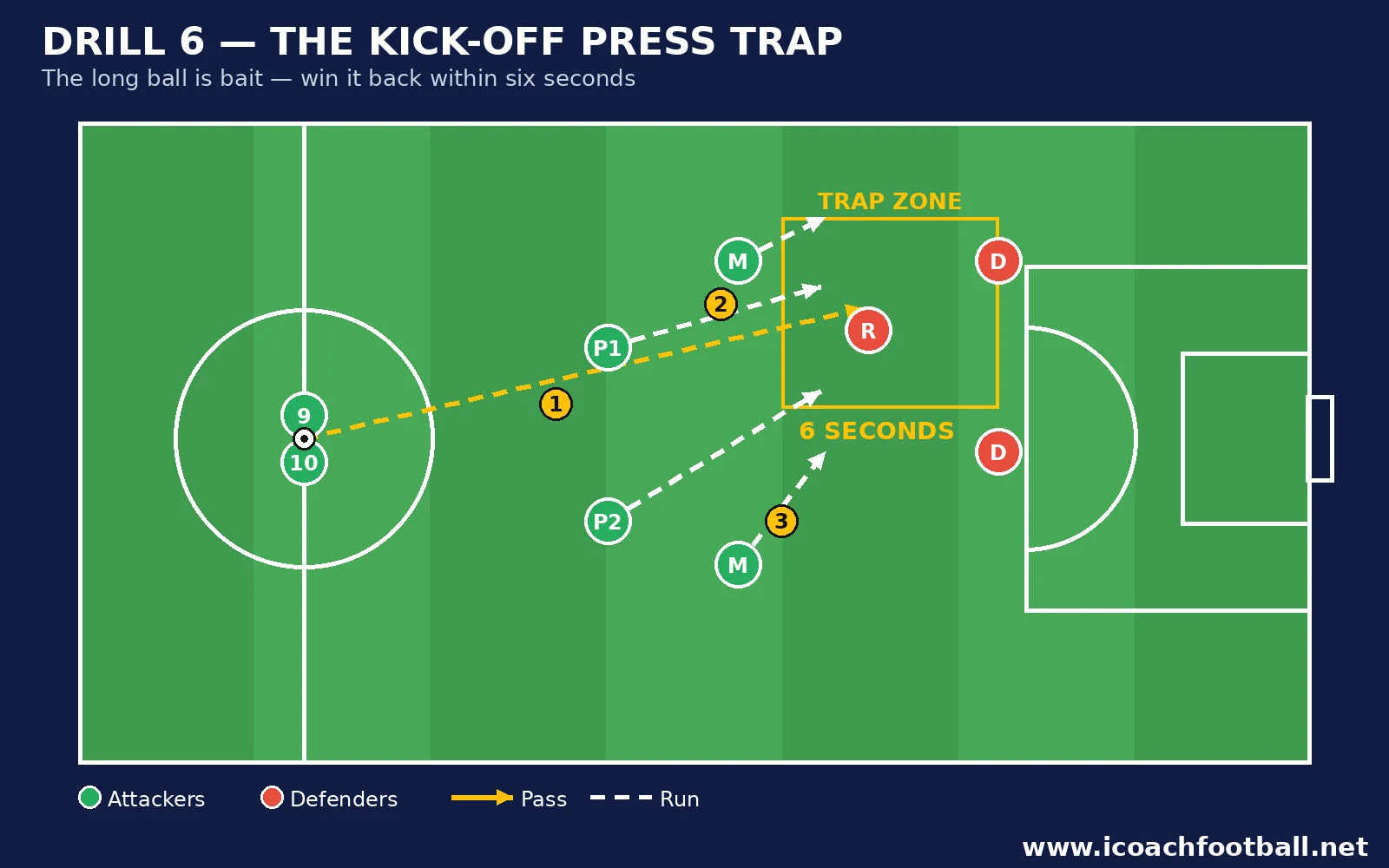
Your own kick-off goes long on purpose — and the whole team sprints to win it back within six seconds. The long ball is bait; the press is the plan.
Setup
- Half a pitch. 11 players in full team shape vs 5 opponents who receive the long kick-off. 12 minutes.
How to Play
- The kicker calls “Trap!” and drives the long ball to a zone where your two nearest players can reach it first.
- On the kick, the two nearest attackers sprint to the landing zone — the press starts on the kick, not on the touch.
- The first presser forces the receiver towards the touchline; the second cuts off the pass back inside.
- The midfielders push up 10 yards to close the escape routes and form the trap.
- If the ball is won within 6 seconds, the team attacks the goal at once — a goal from a trap counts double.
Coach’s note: “Six seconds, then shape — a press that chases for twenty seconds is just tired players.”
Progressions: The opponents are allowed one free first touch; the trap must win the ball in the wide channel, not centrally; the midfielders must win the second ball, not just the first.
Common mistakes
| Mistake | What you see | Fix |
|---|---|---|
| Kicking before the shape is set | The first pass goes straight to an opponent | Shape first, ball second — nobody stands at the spot until the runners know their jobs |
| Always going long by default | 50/50s all game and no control | Count the press — if you are 3v2 at the back, play the safe build and keep it |
| The kicker touching it twice | Indirect free kick to the opposition | The taker passes and moves — they cannot touch it again until a team-mate has |
| Decoys jogging, not sprinting | Nobody bites on the disguise | The decoys sprint like they mean it, every rep |
| The press trap chasing too long | Tired players and a broken shape | Six seconds, then drop into shape — the trap is one wave |
| Nobody calling the routine | Two players start different routines | One call before the whistle — “Safe!”, “Wide right!”, “Trap!” |
Age adaptations
| Age | Format | What changes |
|---|---|---|
| U11–U12 (ages 10–12) | 9v9, 20 x 15-yard grids | Safe build first — the long kick-off goes to feet or to a big target who can hold it, never to head height. The quick kick-off is walked through, not sprinted. Check your league’s handbook for the 9v9 centre-circle size and any local restart variation — in 11v11 opponents must be 9.15 m from the ball (Law 8). The kicker calls the routine out loud every time — see our U11 soccer practice plan and U12 soccer practice plan |
| U13–U14 (ages 13–14) | 11v11 shapes, 40 x 30 yards | Pressers added in Drill 1; the long kick-off runs with two runners; the quick kick-off introduced in Drill 3; the disguised kick-off in Drill 5 — see soccer drills for U13 and soccer drills for U14 |
| U15–U18 (ages 14–18) | Full pitch, 40 x 30 yards | Full press in Drill 6; the press trap is live with the six-second count; quick kick-offs become a set trigger after conceding; the third-man timing in Drill 4 is rehearsed against a real full-back — see soccer drills for U15 |
60-minute session plan
| Time | Block | Drill |
|---|---|---|
| 0:00–0:05 | Arrival game | Free 3v3 — every restart is a kick-off, taken quickly |
| 0:05–0:13 | The safe build | Drill 1 — The Safe Build |
| 0:13–0:23 | The long kick-off | Drill 2 — The Long Kick-Off |
| 0:23–0:30 | Quick when they’re asleep | Drill 3 — The Quick Kick-Off |
| 0:30–0:40 | The wide channel | Drill 4 — The Wide-Channel Kick-Off |
| 0:40–0:48 | The disguise | Drill 5 — The Disguised Kick-Off |
| 0:48–0:60 | The press trap | Drill 6 — The Kick-Off Press Trap |
New to coaching this age? Stretch the arrival game to 8 minutes and cut Drill 3 to 5 minutes and you have the same session with more settling-in time — see our 60-minute plan for the structure (the same shape, shortened where you need it).
Keep building from here
Kick-offs are the start of the attack, so the open-play build-up is the next step: our soccer playing out from the back drills take the same free-player idea into open play, and the look-up before the kick is our soccer scanning drills. The calls that make these routines work are the same skill as our soccer communication drills, and the choice the kicker makes in Drill 1 is a decision that can be trained with our soccer decision making drills. The third-man run in Drill 4 is trained in detail in our soccer third man runs drills, the wide-channel play in our wide channel game, and the switch in Drill 5 in our switching play drills. The press in Drill 6 is the same problem as our counter-pressing drills, and the duel after the long kick-off is the same problem as our 1v1 defending drills. The other restarts have their own sessions: our soccer goal kick routines, football free-kick routines, soccer corner kick plays, soccer throw-in drills and soccer penalty kick drills. The short build needs a first touch under no pressure, so our soccer drills for beginners give the foundation, soccer dribbling drills give the ball control the wide-channel escape needs, and soccer passing drills give the weight and accuracy Drill 2 needs. The turn in Drill 4 is trained in our soccer drills for improving turning, the pass under pressure in our soccer drills for improving passing under pressure, and the movement off the ball in our soccer drills for improving off the ball movement. The target striker has to finish the move the kick starts — see our soccer drills for strikers. Plan the shape on our Football Formation Maker and check the load with our training load calculator. Warm up with our 10 soccer warm-up drills, and if you run selections one day, our soccer tryout drills show how to grade a group fairly.
Can you score directly from a kick-off?
Yes. Law 8 says a goal may be scored directly against the opponents from a kick-off. If the ball goes directly into the kicker’s own goal, the opponents are awarded a corner kick.
How far must opponents stand at a kick-off?
Opponents must be at least 9.15 m (10 yards) from the ball until it is in play. That is why the centre circle is 9.15 m in radius — it marks the distance. All other players must be in their own half.
Can the player taking the kick-off touch the ball twice?
No. If the player taking the kick-off touches the ball again before it has touched another player, the opposition is awarded an indirect free kick — or a direct free kick if the second touch is a handball offence. That is why every routine above has the taker pass and move, never dribble from the spot.
What is the best kick-off routine for youth teams?
The safe build — kick-off back to the centre-back, split wide, and out through the full-back. It uses the one free pass the law gives you, it is easy to rehearse, and it works from U11 to U18. Add the long kick-off from U13, when the press is real and runners can hunt the second ball.
Do kick-off routines work straight after conceding?
Yes — that is when the quick kick-off is most dangerous, because the opposition is still celebrating and walking back. The takers scan before the whistle and only play fast if the press is not set. A quick kick-off into a set press is a turnover, so the rule is: scan first, kick second.
Sources
- The FA, “Law 8 — The Start and Restart of Play” (IFAB Laws of the Game 2026-27) — the ball must be stationary on the centre mark; all players except the taker must be in their own half; opponents must be at least 9.15 m (10 yards) from the ball until it is in play; the ball is in play when it is kicked and clearly moves; a goal may be scored directly against the opponents from the kick-off, but if the ball directly enters the kicker’s goal a corner kick is awarded to the opponents; if the taker touches the ball again before it has touched another player an indirect free kick (or direct free kick for handball) is awarded. The routines in this post follow the Law 8 procedure.
- FIFA Training Centre, “Playing out from the back” (Francesco Gabriele, Swiss FA head of youth development) — when the opposition presses, there is always a free player somewhere; the objective is to get the ball to the free player and play forward; if you cannot reach the free player directly, use a third player to find them; create overloads through movement, positional changes and passing triangles. Routines 1, 4 and 5 are based on / in line with this session.