Soccer Goal Kick Routines: 6 Plays That Turn Restarts Into Attacks (U11–U18)
Quick answer
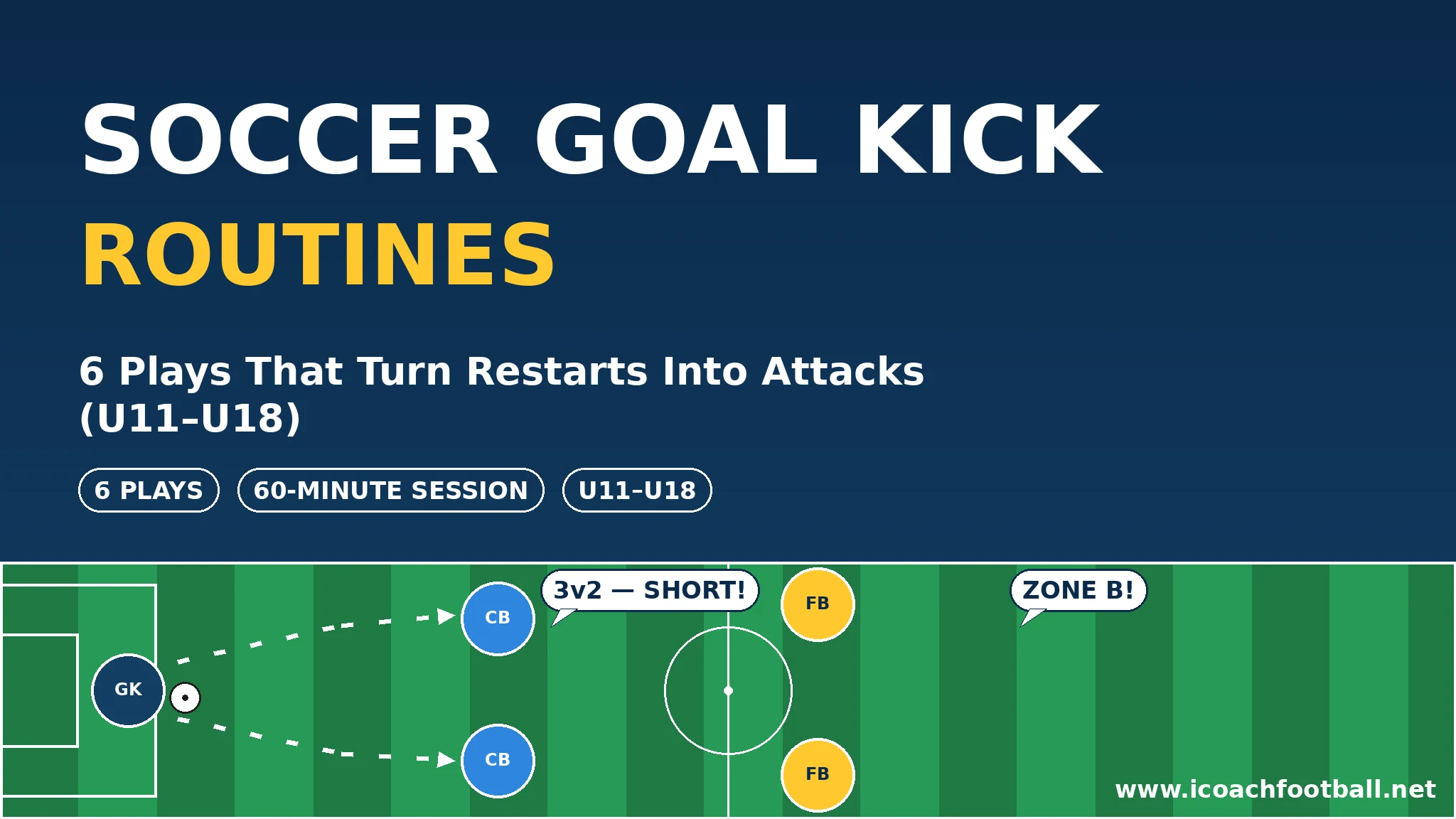
A goal kick is the most wasted restart in youth soccer. Most teams either launch it and hope, or play short and get trapped — this session teaches the third option: count the press, pick the exit, and turn the restart into an attack. Six routines, one 60-minute session.
Suitable for: U11–U18 (ages 10–18)
Session snapshot
- Players: 12–16 (U11–U18)
- Area: Full penalty area to halfway (grids 20 x 15 to 40 x 30 yards)
- Duration: 60 minutes
- Focus: The short/long/quick decision, first-receiver shape, second balls
- Equipment: 10–12 balls, 20 cones, 4 mini goals, bibs
Why these six routines work
A goal kick is a free pass the other team cannot contest — the law says opponents must stay outside the penalty area until the ball is in play, and since 2019 the ball is in play the moment it is kicked and clearly moves, so a team-mate may receive it inside the area. Most youth teams waste that free pass. They either launch it long every time and fight for 50/50s, or play short every time and get trapped against a press. The fix is a decision, not a habit — and the decision is arithmetic. FIFA’s Training Centre session “Playing out from the back” (Francesco Gabriele, Swiss FA head of youth development) makes the same point: when the opposition presses a goalkeeper playing the ball out, there is always a free player somewhere, and the objective is to get the ball to the free player and play forward. If the keeper cannot reach the free player directly, use a third player to find them. The keeper must be vocal and confident with and without the ball, and the team creates overloads through movement, positional changes and passing triangles. Drills 1, 2 and 5 below are based on / in line with that FIFA session. In the UK the same session is football goal kick routines — the routines and the rules are identical.
Six rules of goal kicks
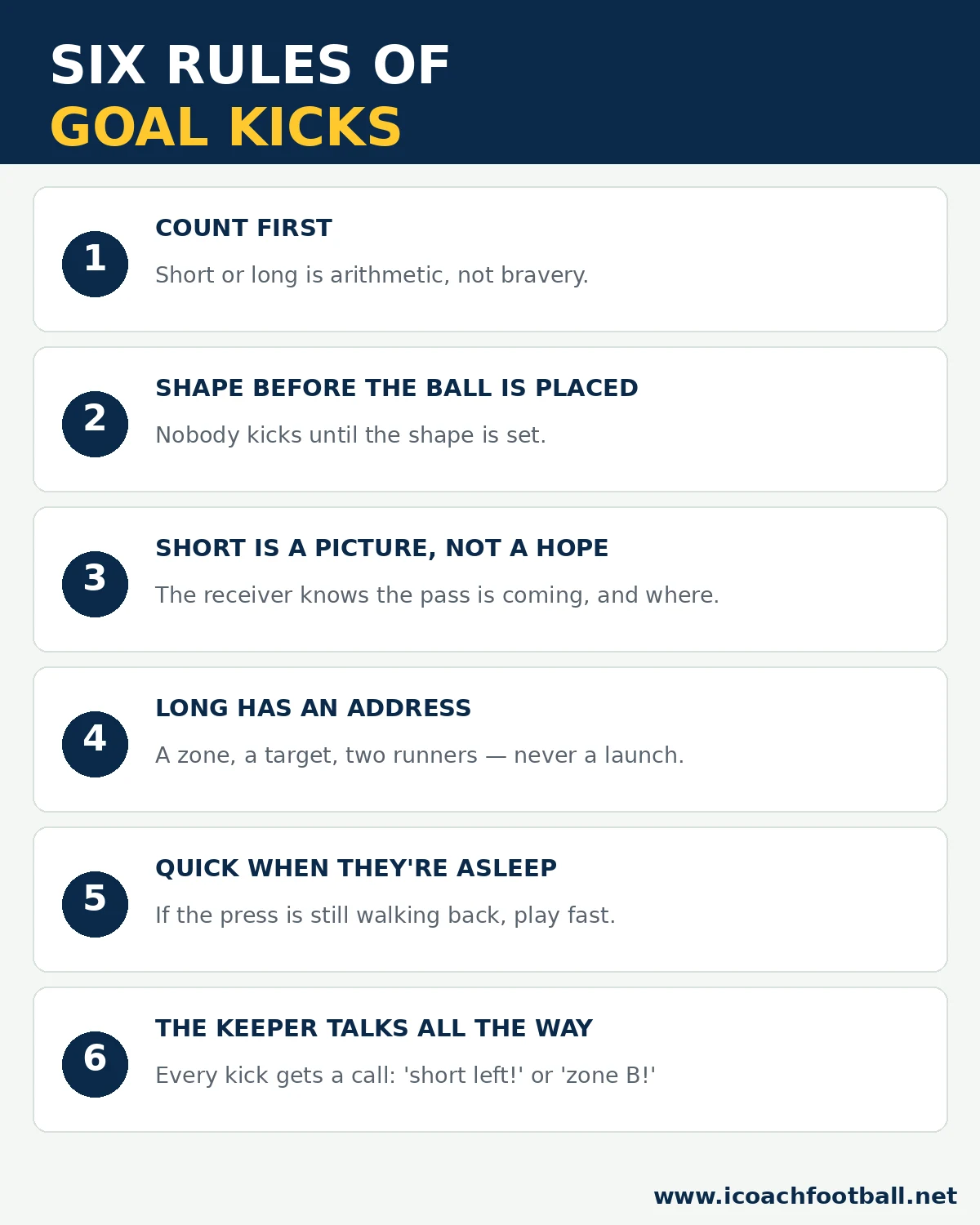
- Count first — short or long is arithmetic, not bravery. Count their pressers against your back line.
- Shape before the ball is placed. Nobody kicks until the shape is set.
- Short is a picture, not a hope. The receiver knows the pass is coming, and where.
- Long has an address. A zone, a target, two runners — never a hopeful launch.
- Quick when they’re asleep. If the press is still walking back, play before it sets.
- The keeper talks all the way. Every kick gets a call: “short left!” or “zone B!”
Drill 1 — Count, Then Kick
The spare-man decision rehearsal. The keeper counts the press out loud — “3v2 — short!” — and the whole team learns that short or long is a count, not a mood. Walk it first, then add the press.
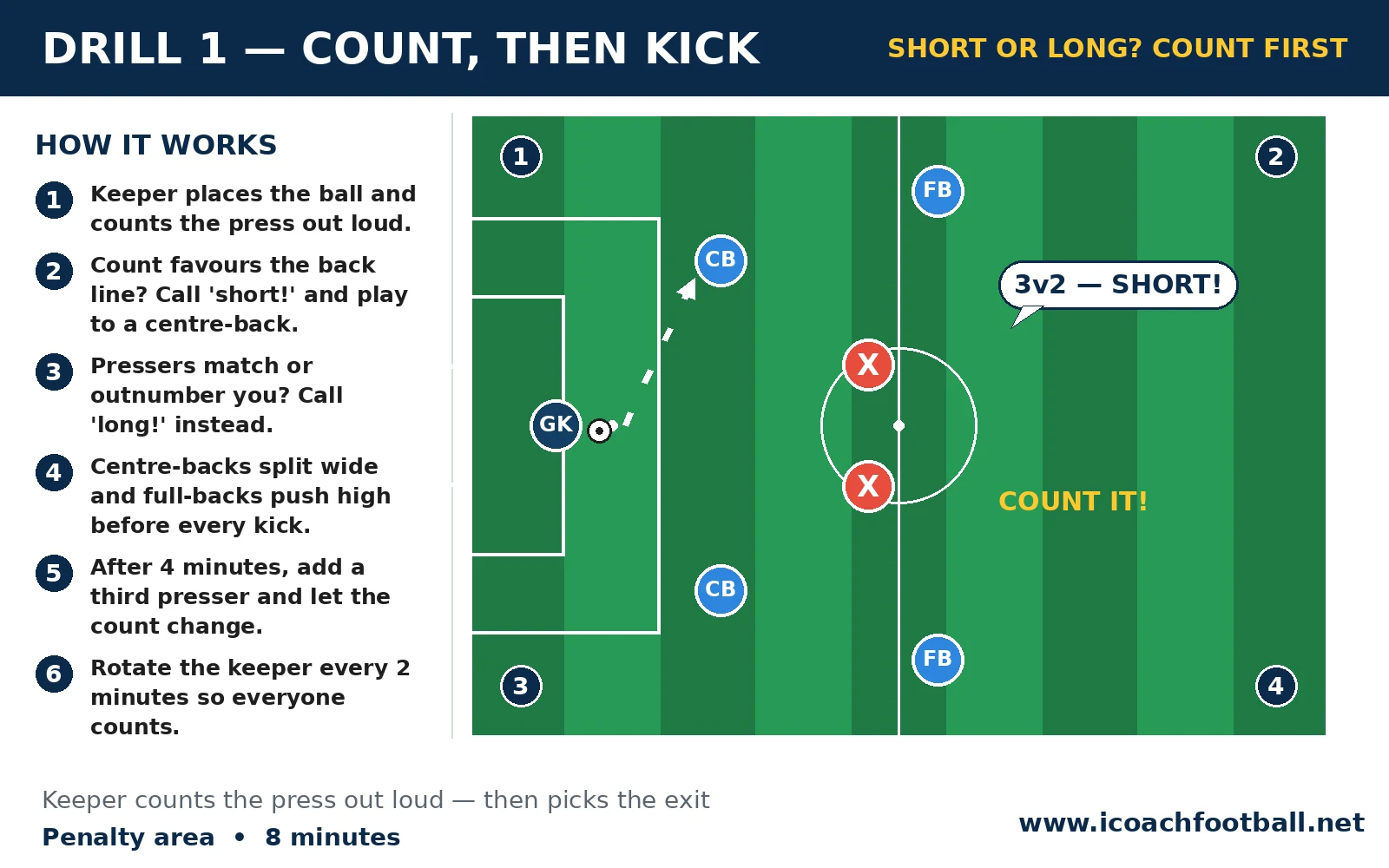
- Setup: Penalty area. Keeper + back 4 vs 2 pressers, 10 balls. 8 minutes.
How to play:
- The keeper places the ball in the six-yard box and counts the press out loud.
- If the count favours the back line, the keeper calls “short!” and plays to a centre-back.
- If the pressers match or outnumber the back line, the keeper calls “long!” instead.
- The centre-backs split wide and the full-backs push high before every kick.
- After 4 minutes, add a third presser and let the count change the answer.
- Rotate the keeper every 2 minutes so everyone counts.
- Coach’s note: “Count it out loud — if you can’t say the number, you can’t pick the exit.”
- Progressions: The pressers start closer to the ball; the keeper must count within 3 seconds; a wrong call costs the team a point.
Drill 2 — The Wide Gate Escape
Short goal kick to the full-back, who receives on the half-turn and drives through a wide gate. This is the first receiver’s body shape and the second pass — the two things that make a short goal kick work instead of trapping you.
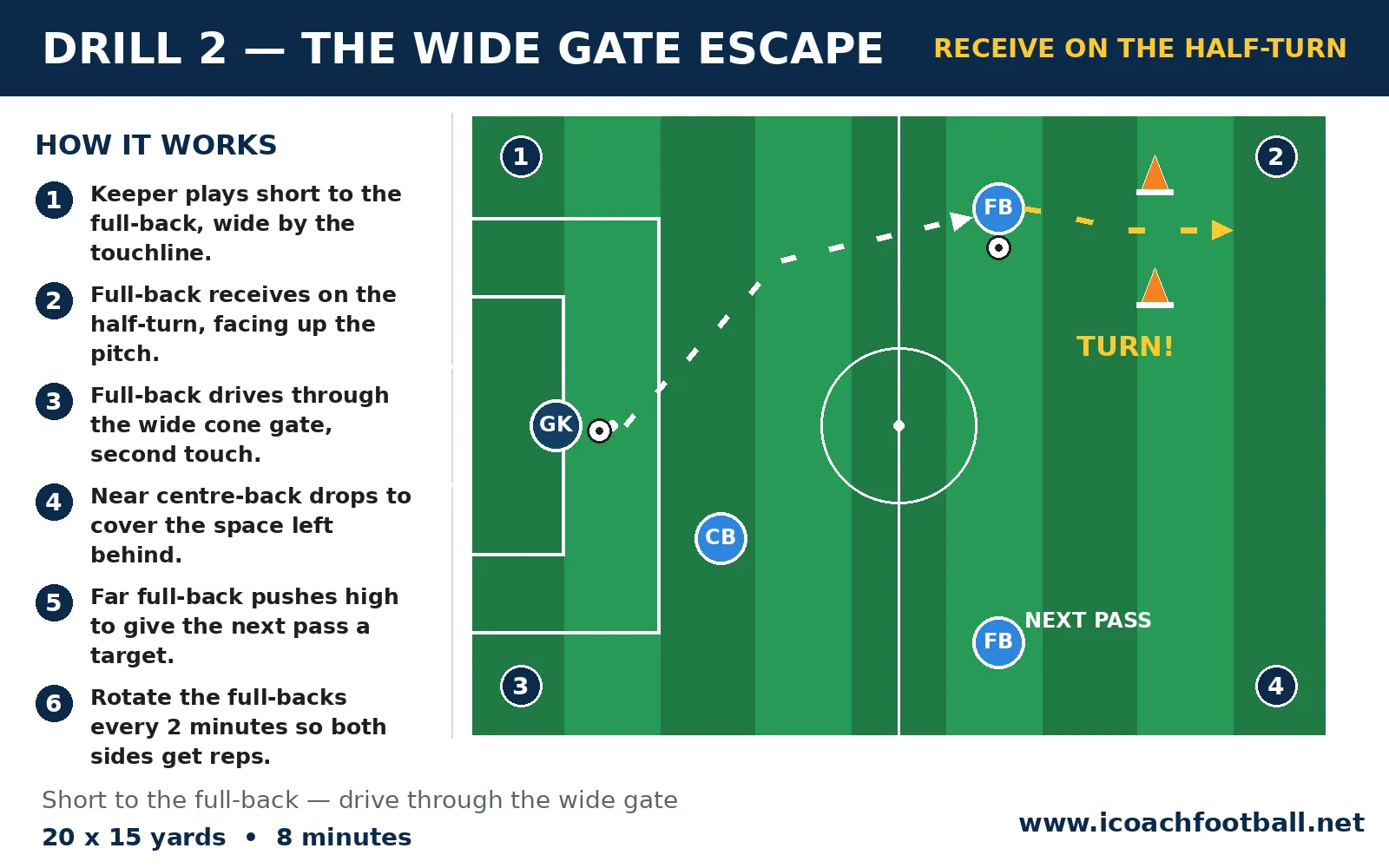
- Setup: 20 x 15 yard grid. Keeper + 2 centre-backs + 2 full-backs vs 2 pressers, cone gates wide. 8 minutes.
How to play:
- The keeper plays short to the full-back, who starts wide by the touchline.
- The full-back receives on the half-turn, facing up the pitch, not facing the keeper.
- The full-back drives through the wide cone gate with their second touch.
- The near centre-back drops to cover the space the full-back leaves behind.
- The far full-back pushes high to give the next pass a target.
- Rotate the full-backs every 2 minutes so both sides get the reps.
- Coach’s note: “Half-turn or nothing — if you face your own goal, you’re trapped.”
- Progressions: Add a presser on the full-back’s shoulder; the full-back must play one-touch to the winger; the gate narrows by a yard each round.
Drill 3 — The Long Kick Plan
The keeper picks a zone and calls it before the kick. The target striker attacks the ball, and two runners read the flick and hunt the second ball. Long is no longer a launch — it is a plan with an address.
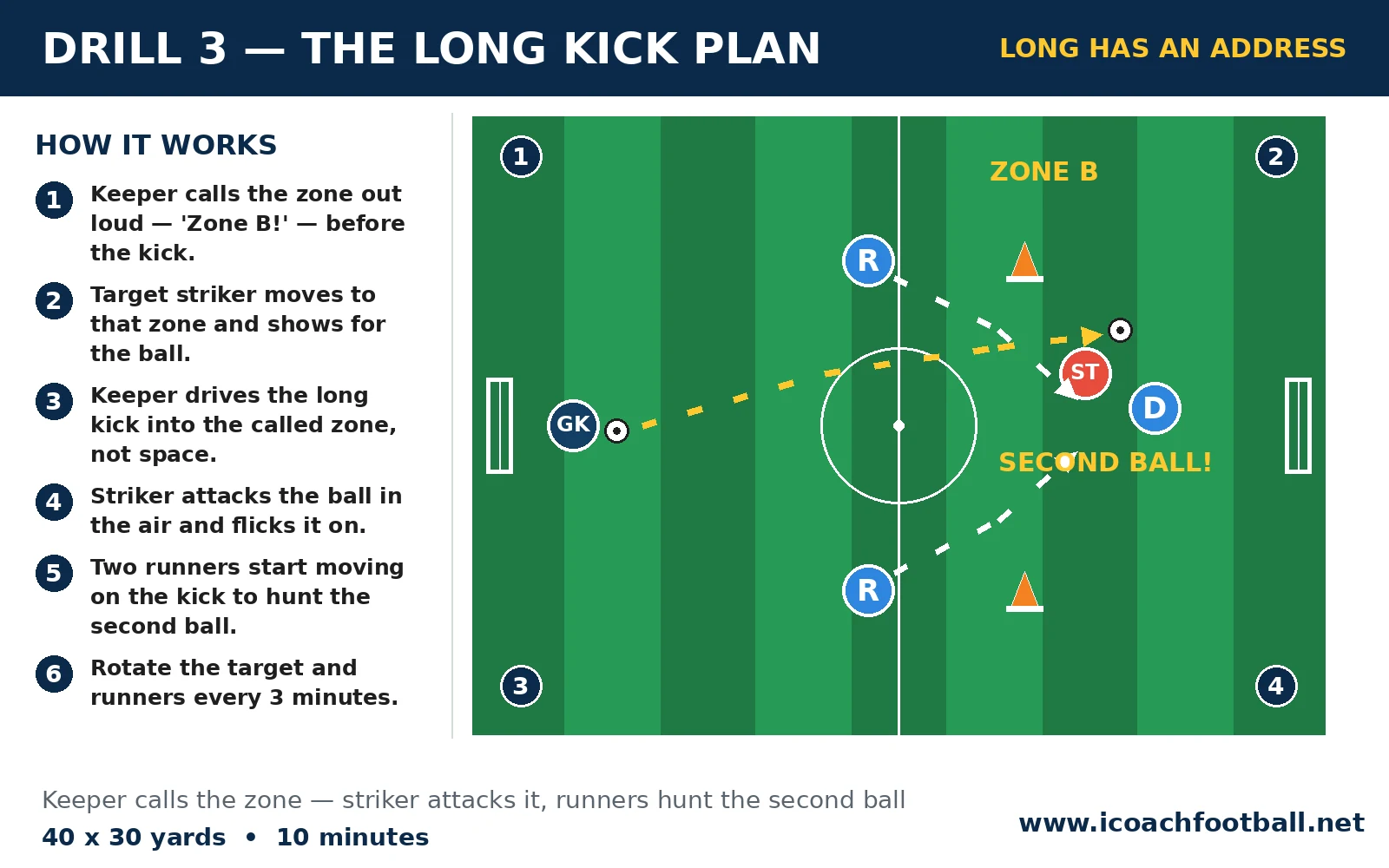
- Setup: 40 x 30 yard grid. Keeper + target striker + 2 runners vs 2 defenders, zones marked with cones. 10 minutes.
How to play:
- The keeper calls the zone out loud — “Zone B!” — before placing the ball.
- The target striker moves to that zone and shows for the ball.
- The keeper drives the long kick into the called zone, not into space.
- The striker attacks the ball in the air and flicks it on or holds it up.
- Two runners start moving on the kick, not on the header, to hunt the second ball.
- Rotate the target and the runners every 3 minutes so everyone attacks the ball.
- Coach’s note: “Long has an address — if you can’t name the zone, don’t kick it long.”
- Progressions: The defenders contest the first ball properly; the runners must win the second ball within 2 seconds; the flick must find a runner, not just go forward.
Drill 4 — Quick Kick Catch-Out
A quick goal kick while the opposition is still setting up. The keeper scans, sees the press still walking back, and plays fast to the free full-back before the press is set. Timing and awareness — and knowing when not to rush it.
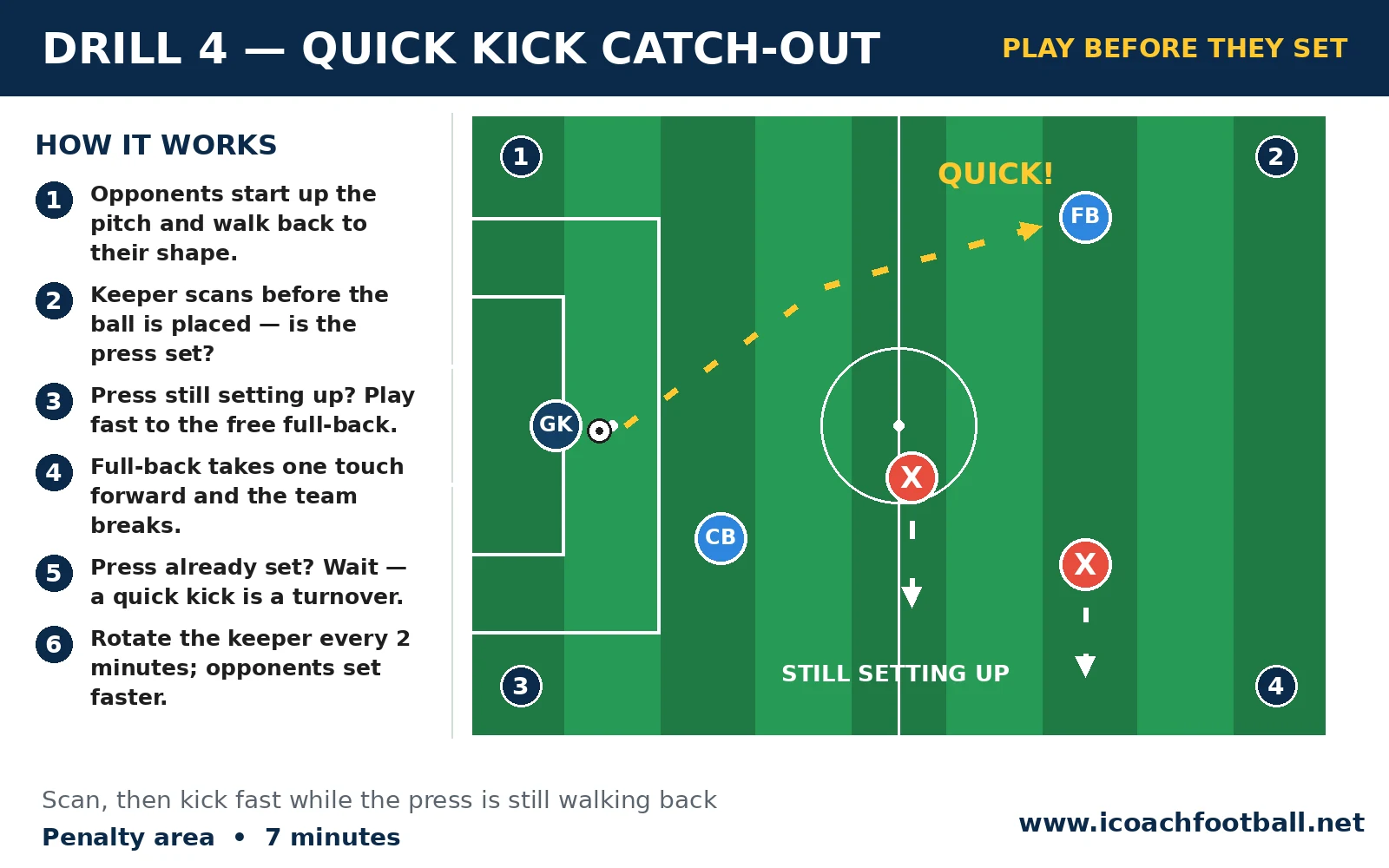
- Setup: Penalty area. Keeper + back 4 vs 4 opponents who walk back slowly after each rep. 7 minutes.
How to play:
- The opponents start each rep up the pitch and walk back to their shape.
- The keeper scans before the ball is placed — is the press set, or still walking?
- If the press is still setting up, the keeper plays fast to the free full-back.
- The full-back takes one touch forward and the team breaks before the press arrives.
- If the press is already set, the keeper waits — a quick kick into a set press is a turnover.
- Rotate the keeper every 2 minutes and let the opponents set faster each round.
- Coach’s note: “Scan first, kick second — quick is a decision, not a habit.”
- Progressions: The opponents jog back instead of walking; the quick kick must reach halfway within 3 passes; the keeper must call “quick!” before the kick.
Drill 5 — Beat the Press
The 7v5 game from goal kicks against a live press. All three exits are allowed — short, long or quick — and the team scores by reaching halfway, and scores more by scoring. This is the FIFA session’s macro situation, played for real.
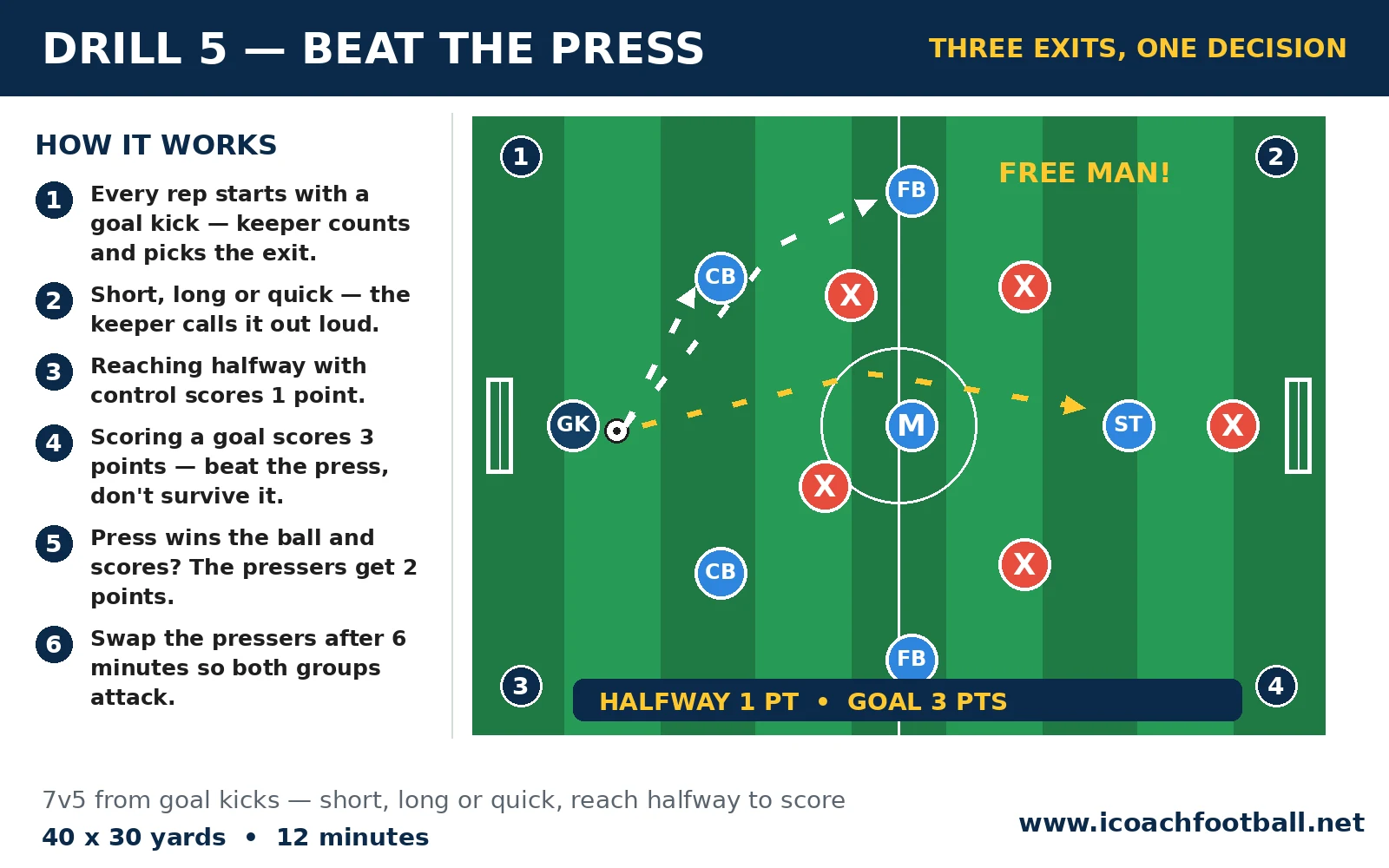
- Setup: 40 x 30 yard grid. 7 attackers (keeper + 6) vs 5 pressers, goals at each end. 12 minutes.
How to play:
- Every rep starts with a goal kick — the keeper counts the press and picks the exit.
- The attacking team can go short, long or quick — the keeper calls it out loud.
- Reaching halfway with control scores 1 point for the attacking team.
- Scoring a goal scores 3 points — the press must be beaten, not just survived.
- If the press wins the ball and scores, the pressers get 2 points.
- Swap the pressers after 6 minutes so both groups defend and attack.
- Coach’s note: “Three exits, one decision — count, call it, then play forward.”
- Progressions: The pressers start higher up the pitch; the attacking team must reach halfway in 4 passes or fewer; the keeper plays as an extra outfield passer after the first pass.
Drill 6 — Second-Ball Scramble
Long kick into a channel, contested header, runners win the second ball. A 4v4+2 in a channel where the first ball is worth 1 point and the second ball is worth 2 — because the second ball is where most long goal kicks are actually won or lost.
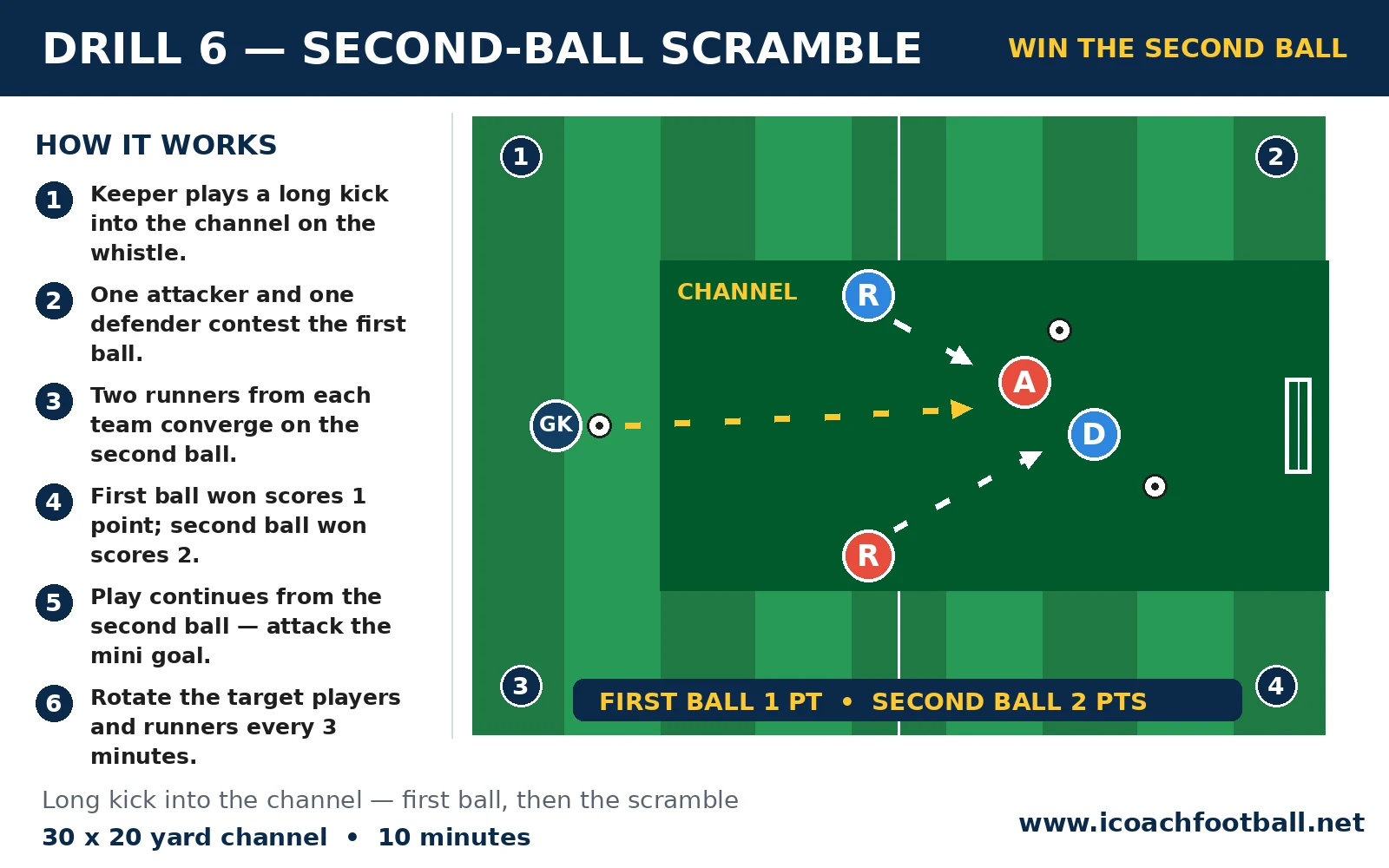
- Setup: 30 x 20 yard channel. 4v4 + 2 neutrals, one ball, cones marking the channel. 10 minutes.
How to play:
- The keeper plays a long kick into the channel on the coach’s whistle.
- One attacker and one defender contest the first ball in the air.
- Two runners from each team converge on where the ball will land second.
- The team that wins the first ball scores 1 point; the team that wins the second scores 2.
- Play continues from the second ball — the winner attacks the mini goal.
- Rotate the target players and the runners every 3 minutes.
- Coach’s note: “The header is the decoy — the second ball is the real ball.”
- Progressions: The channel narrows by 5 yards; the runners must win the second ball with one touch; the first ball must be flicked to a runner, not just headed forward.
Coaching points: the five mistakes that give goal kicks away
| Mistake | What you see | Fix |
|---|---|---|
| Kicking before the shape is set | The first pass goes straight to an opponent | Shape first, ball second — nobody kicks until the centre-backs are split and the full-backs are wide |
| Always going long by default | 50/50s all game and no control | Count the press — if you are 3v2 at the back, play short and keep it |
| Always going short by default | Trapped in your own box against a full press | If the numbers are against you, the long kick is the brave pass |
| The keeper going silent | Nobody moves and nobody calls for the ball | The keeper calls the exit out loud before every kick — “short left!” or “zone B!” |
| Nobody hunting the second ball | The flick drops to an opponent and the attack dies | Two runners start moving on the kick, not on the header |
Age adaptations
| Age | Area | What changes |
|---|---|---|
| U11–U12 (ages 10–12) | 9v9, 20 x 15-yard grids | Short first — the long kick goes to feet or to a big target who can hold it, never to head height. Note the build-out line rule: the build-out line is a 7v7 (U9–U10) rule under U.S. Soccer’s Player Development Initiatives — at U11–U12 9v9 there is no build-out line, so opponents only have to be outside the penalty area (Law 16) and the first receiver must be ready under pressure sooner; check your league’s handbook for a local variation. The keeper counts out loud every time — see the U11 soccer practice plan and the U12 soccer practice plan |
| U13–U15 (ages 13–15) | 11v11 shapes, 40 x 30 yards | Pressers added in Drill 1; the long-kick plan runs with two runners; quick kicks introduced in Drill 4; the five-second countdown taught in Drill 5 — see soccer drills for U13, soccer drills for U14 and soccer drills for U15 |
| U17–U18 (ages 16–18) | Full pitch, 40 x 30 yards | Full press in Drill 5; the keeper plays as an extra outfield passer after the first pass; quick kicks become a set trigger; the five-second countdown is live — delay the kick and you give away a corner |
60-minute session plan
| Time | Block | Drill |
|---|---|---|
| 0:00–0:05 | Arrival game | Free 3v3 — every restart is a goal kick, taken quickly |
| 0:05–0:13 | Count the press | Drill 1 — Count, Then Kick |
| 0:13–0:21 | The wide gate | Drill 2 — The Wide Gate Escape |
| 0:21–0:31 | The long kick plan | Drill 3 — The Long Kick Plan |
| 0:31–0:38 | Quick when they’re asleep | Drill 4 — Quick Kick Catch-Out |
| 0:38–0:50 | Beat the press | Drill 5 — Beat the Press |
| 0:50–0:60 | The second ball | Drill 6 — Second-Ball Scramble |
New to coaching this age? Stretch the arrival game to 8 minutes and cut Drill 4 to 5 minutes and you have the same session with more settling-in time — see our 60-minute plan for the structure (the same shape, shortened where you need it).
Keep building from here
Goal kicks are the start of the build, so the open-play build-up is the next step: our soccer playing out from the back drills take the same free-player idea into open play, and the keeper’s own technique is in our goalkeeper distribution drills — the accuracy behind every long kick in Drill 3. The calls that make these routines work are the same skill as our soccer goalkeeper communication drills, and the look-up before the kick is our soccer scanning drills — the keeper scans, then decides. The short build needs a first touch under no pressure, so our soccer drills for beginners give the foundation, soccer dribbling drills give the ball control the wide-gate escape needs, and soccer passing drills give the weight and accuracy Drill 2 needs. The press in Drill 5 is the same problem as our counter-pressing drills, and the shape behind it is the defensive block — while the duel in Drill 6 is the same problem as our 1v1 defending drills. The quick kick in Drill 4 is the same idea as our switching play drills — play before the defence is set — and the long kick in Drill 3 is the same skill as our soccer drills for strikers and our 1v1 finishing drills, because the target striker has to finish the move the kick starts. The other restarts have their own sessions: our football free-kick routines, soccer corner kick plays, soccer throw-in drills and soccer penalty kick drills. The keeper’s wider game is in our goalie drills for youth soccer, and the talking that holds it together is our soccer communication drills and our soccer decision making drills — the choice the keeper makes in Drill 1 is a decision, and it can be trained. Protect the players as they grow: our soccer injury prevention guide shows how to build the warm-up into every session, and our 10 soccer warm-up drills give you the full warm-up library. When they are older, the road runs through our soccer drills for U13, soccer drills for U14 and soccer drills for U15 — the U13 soccer practice plan gives the full session shape at that age — and if you run selections one day, our soccer tryout drills show how to grade a group fairly.
FAQ
Should youth teams always play short from goal kicks?
No — teach the decision, not the habit. Short first at U11–U12, when the press is light and the first touch is still developing, and the long-kick plan from U13, when the press is real and the runners can hunt the second ball. The keeper counts the press and picks the exit — that count is the whole session. In the UK the same session is football goal kick routines, and the answer is the same.
What does the 2019 law change actually allow?
Before 2019 the ball had to leave the penalty area before a team-mate could touch it. Now the ball is in play the moment it is kicked and clearly moves, so a team-mate may receive it inside the penalty area — which is what makes the short goal kick possible at all. Opponents must still be outside the penalty area until the ball is in play, and a player cannot be offside receiving directly from a goal kick.
How do you stop the press winning the ball on the first pass?
Shape before the ball is placed. Split the centre-backs, push the full-backs wide, and let the keeper count before the kick. If the keeper cannot reach the free player directly, use a third player — the full-back receives, the centre-back covers, and the ball moves through the triangle instead of straight into the press.
When should a team take a quick goal kick?
When the opposition is still setting up and a team-mate is free — the keeper scans, sees the press still walking back, and plays fast to the free full-back. The risk is a quick kick into a set press, which is a turnover. If the shape is not set, wait — quick is a decision, not a habit.
What if our goalkeeper cannot kick it far enough?
Play short first. The long kick goes to feet, not head height, and the target zone moves closer — the keeper does not have to reach halfway. Train the driven kick with the plant foot beside the ball and the body over it, and remember the keeper does not have to take it: any defender may take a goal kick.
Sources
- FIFA Training Centre, “Playing out from the back” (Francesco Gabriele, Swiss FA head of youth development) — when the opposition presses a goalkeeper playing the ball out, there is always a free player somewhere; the objective is to get the ball to the free player and play forward; if the keeper cannot play directly to the free player, use a third player to find them; the goalkeeper must be vocal and confident with and without the ball; create overloads through movement, positional changes and passing triangles. Drills 1, 2 and 5 below are based on / in line with this session.
- The FA, “Law 16 — The Goal Kick” (IFAB Laws of the Game 2026-27) — the ball must be stationary and is kicked from any point within the goal area by a player of the defending team; the ball is in play when it is kicked and clearly moves; opponents must be outside the penalty area until the ball is in play; if a player unfairly delays the kick the referee whistles and signals a five-second countdown — if the time runs out the restart goes to the opposition as a corner; a goal may be scored directly from a goal kick but only against the opponents; a player cannot be offside receiving directly from a goal kick (Law 11, No offence).