Soccer Attacking Third Drills: 6 Games That Turn Possession Into Goals
Quick answer
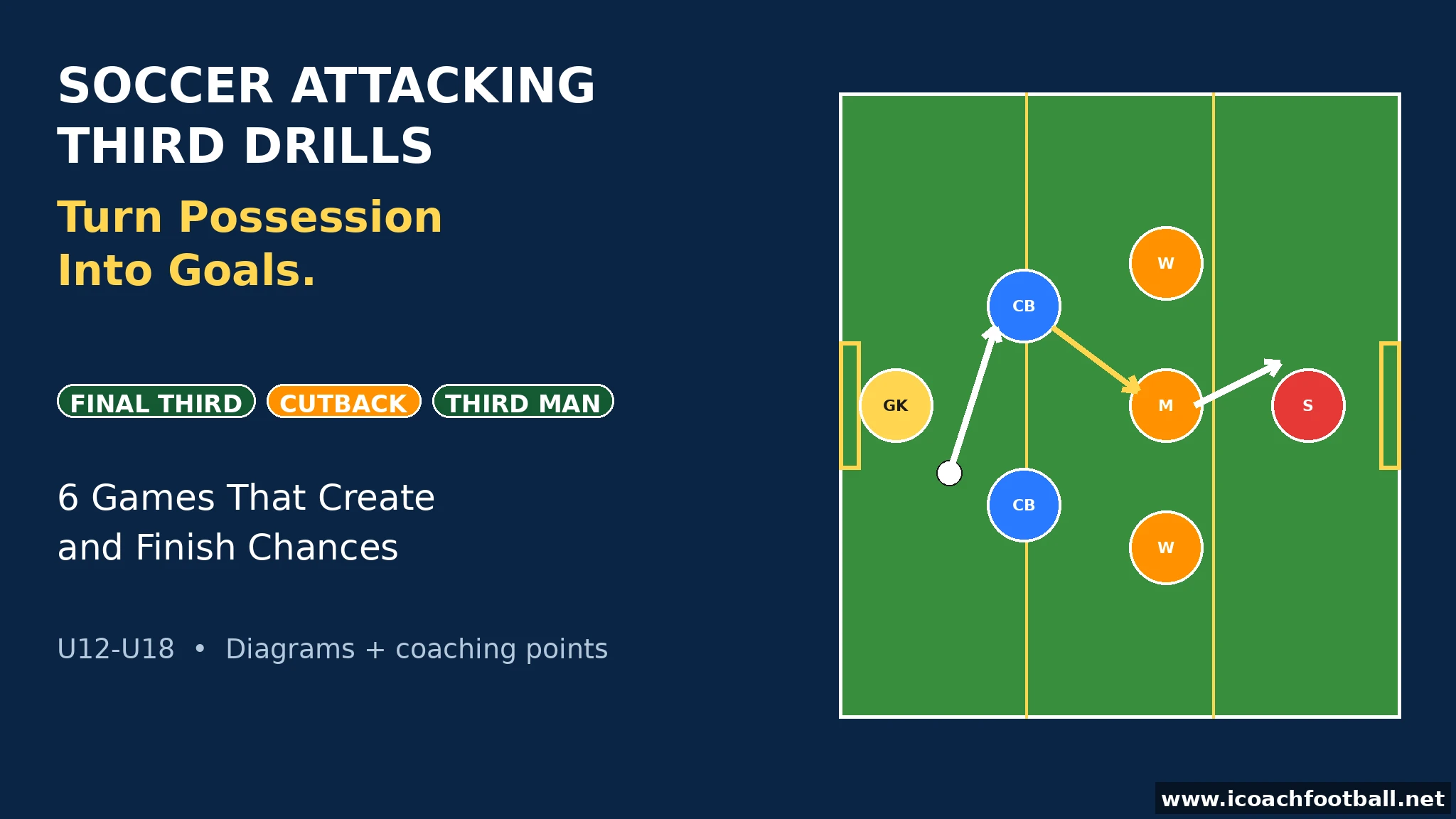
The attacking third is where possession has to become a goal — and most teams lose it there because they dribble into a set defence instead of combining past it. These six soccer attacking third drills teach a U12–U18 team to keep the ball in the third, break the line with a wall pass, cut it back, switch it wide, time three runs on a cross and finish under pressure — in one 60-minute session.
Suitable for: U12–U18
In soccer — football in the UK and most of the world — the attacking third is the last 35 yards, from the edge of the final third to the goal line. It is the hardest place on the pitch to play, because the defending team is compact, the space is small and every mistake becomes a counter-attack. The six games below follow the structure elite academies use: keep it, combine through it, go wide, deliver, arrive — then play the game.
Session snapshot
- Players: 16 (two teams of 8, including keepers)
- Area: The final third of a full pitch (about 50 by 40 yards), or half a pitch per drill
- Duration: 60 minutes
- Focus: Retaining possession in the third, wall passes and third-man runs, cutbacks, switches, timed runs on crosses, and finishing under pressure
- Age: U12–U18 (see Age adaptations)
The six attacking-third rules
Every drill below is built on six rules. Teach them once, then repeat them in every game until the players say them back to you.
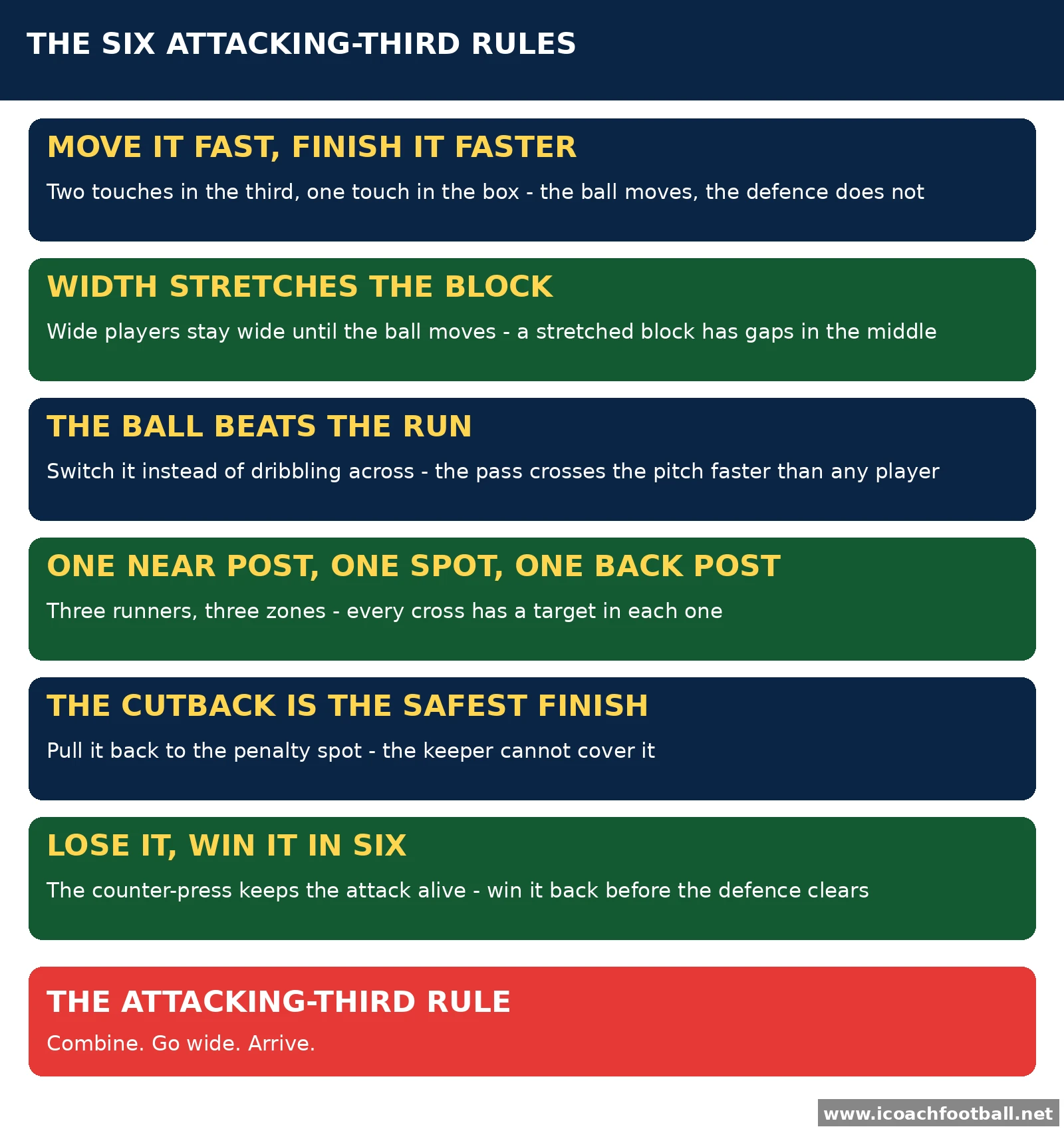
| Rule | What it means |
|---|---|
| Move it fast, finish it faster | Two touches in the third, one touch in the box — the ball moves, the defence does not |
| Width stretches the block | Wide players stay wide until the ball moves — a stretched block has gaps in the middle |
| The ball beats the run | Switch it instead of dribbling across — the pass crosses the pitch faster than any player |
| One near post, one penalty spot, one back post | Three runners, three zones — every cross has a target in each one |
| The cutback is the safest finish | Pull it back to the penalty spot — the keeper cannot cover it and the defence is facing its own goal |
| Lose it, win it in six | The counter-press keeps the attack alive — win it back before the defence can clear its lines |
Drill 1: The Final-Third Rondo
The possession lesson. Five attackers keep the ball in the final third against three defenders, then break the line with one penetrative pass to the striker. Based on the FIFA Training Centre session “Combination play in the final third (Zamrat)”, which opens with a technical warm-up and an opposed possession game built on retaining possession in the final third to create goalscoring chances.
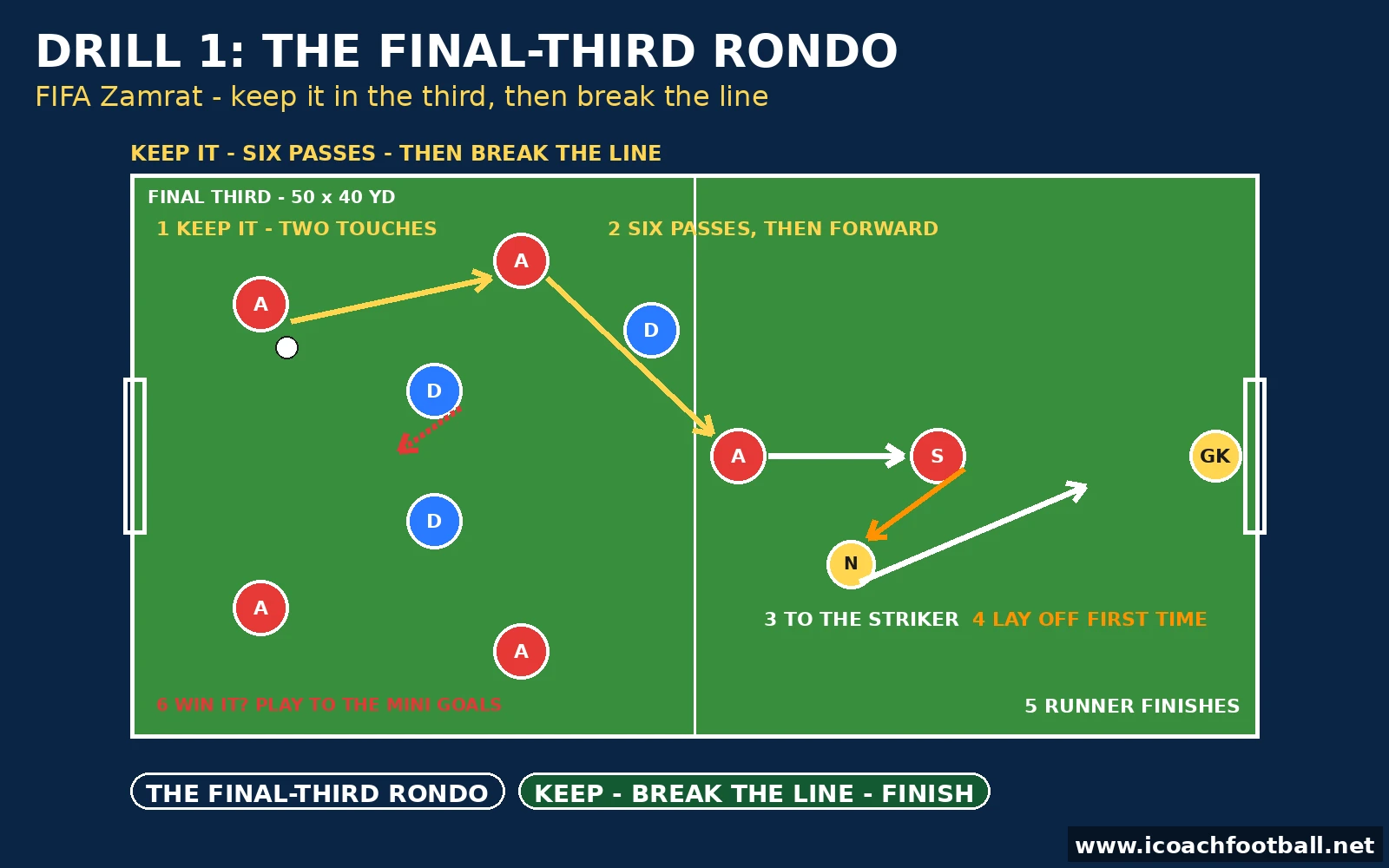
- Setup: The final third (about 50 by 40 yards) with one full-size goal and a keeper, 5 attackers, 3 defenders, 1 neutral, 1 striker on the edge of the box, balls with the coach.
- How to play:
- The attackers keep the ball in the zone with a two-touch maximum.
- After six passes, the ball must go forward through the line to the striker.
- The striker lays it off first time to a runner arriving from midfield.
- The runner finishes first time — a goal only counts if the attack went through the striker.
- If the defenders win it, they play out to the coach’s two mini goals and the roles swap.
- Coach’s note: Watch the sixth pass — a team that keeps passing after six is hiding, not attacking; the cue is “pass to move them, then break the line,” and our soccer possession drills build the two-touch habit this rondo needs.
- Progressions: One touch after six passes; the defenders may press the striker, so the lay-off must be first time; add a second neutral who always plays for the team in possession.
Drill 2: The Wall and the Runner
The combination lesson. The midfielder plays into the striker, who lays it off first time, and the third man — the runner nobody tracked — arrives to finish. Based on the same FIFA Training Centre session, which moves from the possession game into unopposed passing and movement patterns, then an attack v. defence game: the combinations are rehearsed first, then tested against a back line.
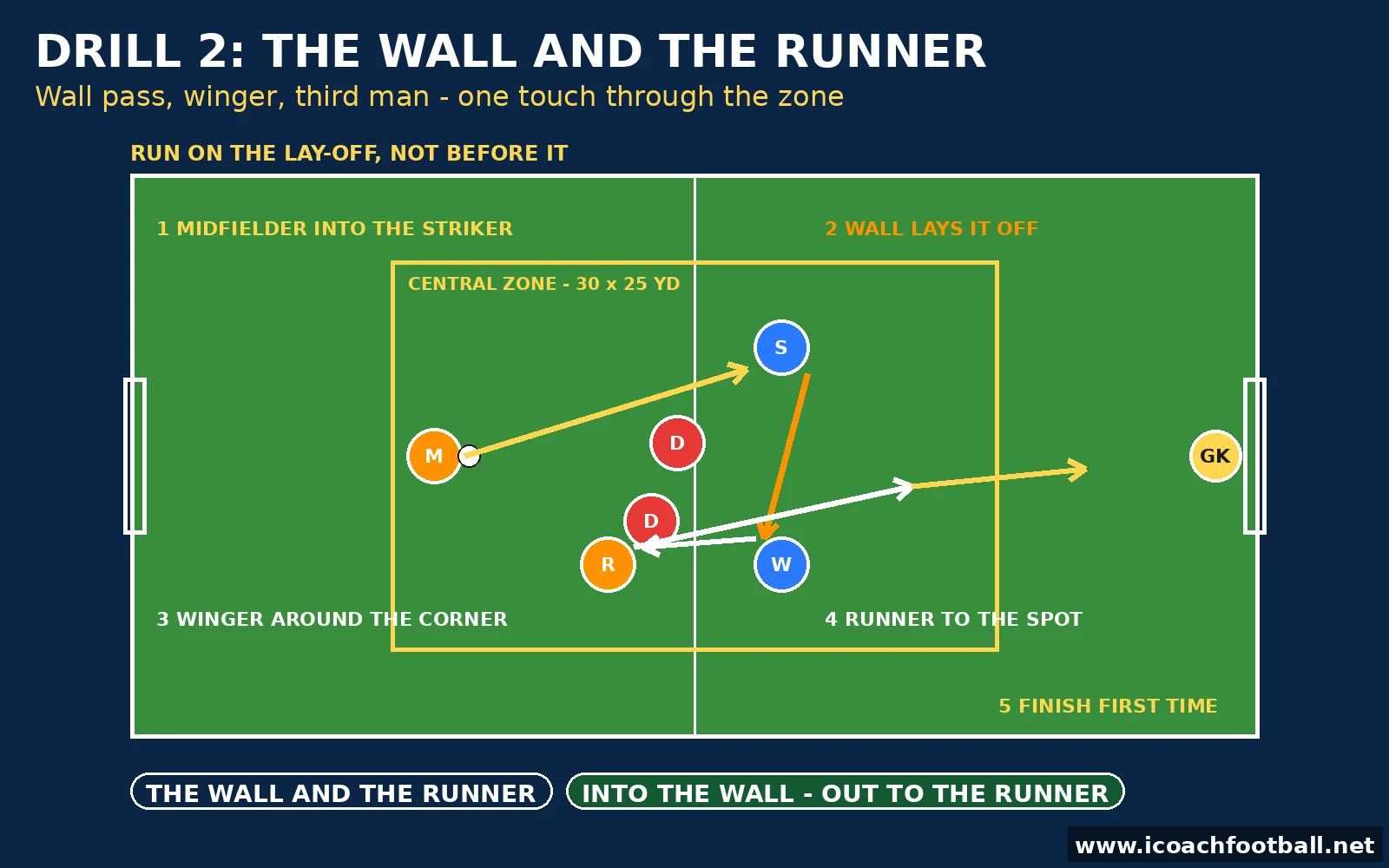
- Setup: A central zone 30 yards wide and 25 yards deep in front of the box, one full-size goal with a keeper, 1 midfielder, 1 striker as the wall, 1 winger, 1 runner, 2 defenders, balls with the midfielder.
- How to play:
- The midfielder plays into the striker’s feet, who is marked tight.
- The striker lays it off first time to the winger, who has checked away and come back.
- The winger plays first time around the corner to the runner.
- The runner arrives at the penalty spot and finishes first time.
- If any pass takes more than two touches, the combination is dead and it resets.
- Coach’s note: Watch the runner — the drill fails when the runner goes too early and gets marked, or too late and the lane closes; the cue is “run on the lay-off, not before it,” and our soccer third man runs drills train the same timing.
- Progressions: The wall must play with their back foot; a defender presses the wall, so the combination must be one touch throughout; the runner must be the full-back arriving late at the edge of the box.
Drill 3: The Cutback Game
The finishing lesson. The winger drives to the byline and cuts it back to the penalty spot, where the striker arrives first time. In line with UEFA’s Champions League analysis of goals from wide areas, which shows the cutback zone as the most reliable source of goals — and with the third-man run as “one of the most simple but effective actions in football”.
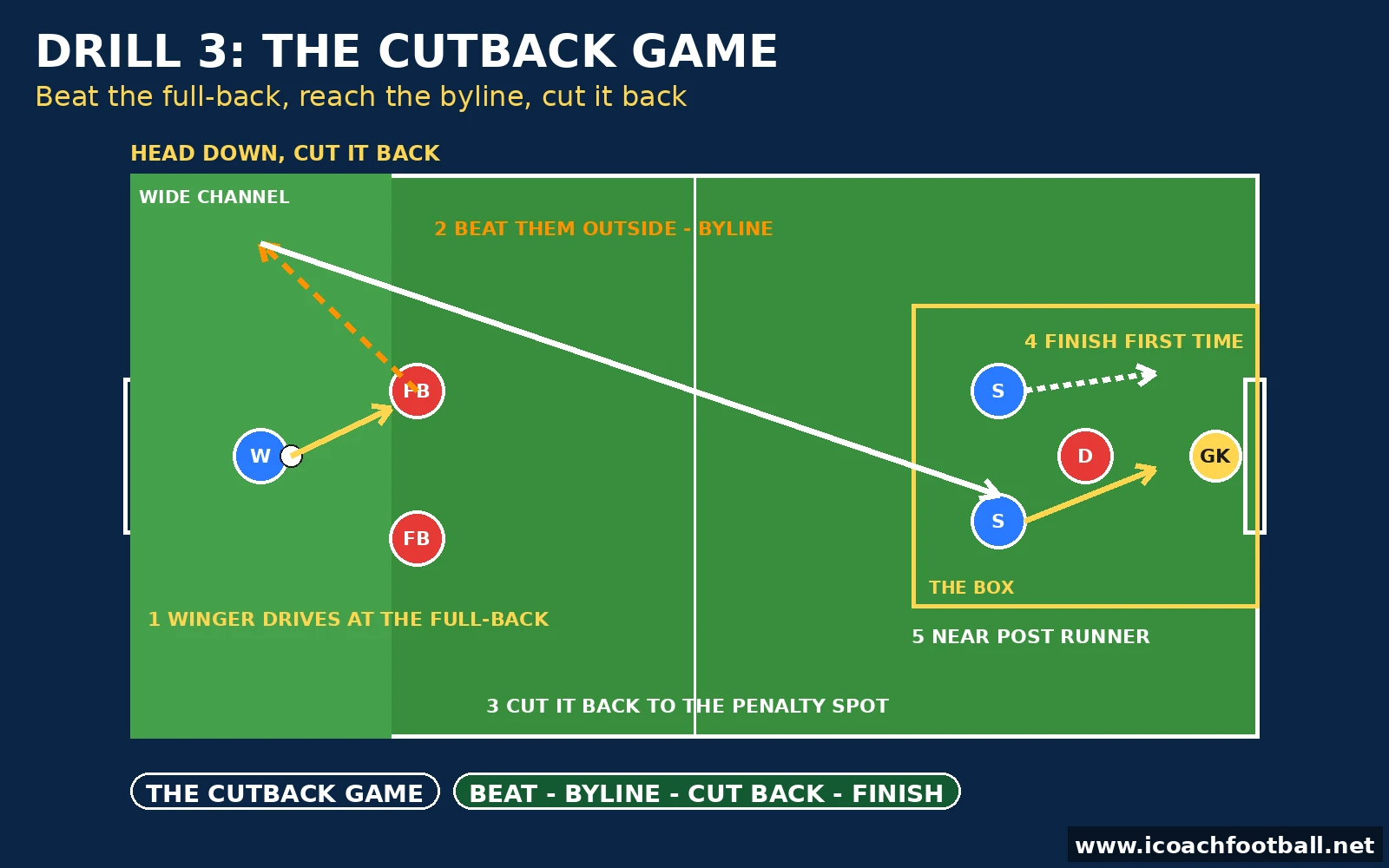
- Setup: One wide channel plus the penalty box, one full-size goal with a keeper, 2 wingers, 2 strikers, 2 defenders, balls with the coach.
- How to play:
- The coach plays wide to the winger, who drives at the full-back.
- The winger beats the defender on the outside and reaches the byline.
- Two strikers arrive in the box: one near post, one at the penalty spot.
- The winger cuts it back to the penalty spot — never across the face at head height.
- The striker finishes first time; if the cross is blocked, the ball goes back to the coach and the other side goes.
- Coach’s note: Watch the cutback — a ball drilled across the face of goal is a clearance waiting to happen; the cue is “head down, cut it back,” and our soccer drills for wingers train the 1v1 that gets the winger to the byline, while our soccer cutback drills train the finish.
- Progressions: The winger must beat the defender with a skill move before the byline; add a late runner from midfield who becomes the cutback target; the cutback must be played first time.
Drill 4: The Switch Game
The width lesson. The ball goes one side, the defence slides across, and the switch finds the far winger alone in space. In line with the FIFA Training Centre’s final-third principle — use the width of the pitch to stretch the opposition and create gaps in central areas — and with UEFA’s finding that goals from wide areas start with the ball moving quickly from one side to the other.
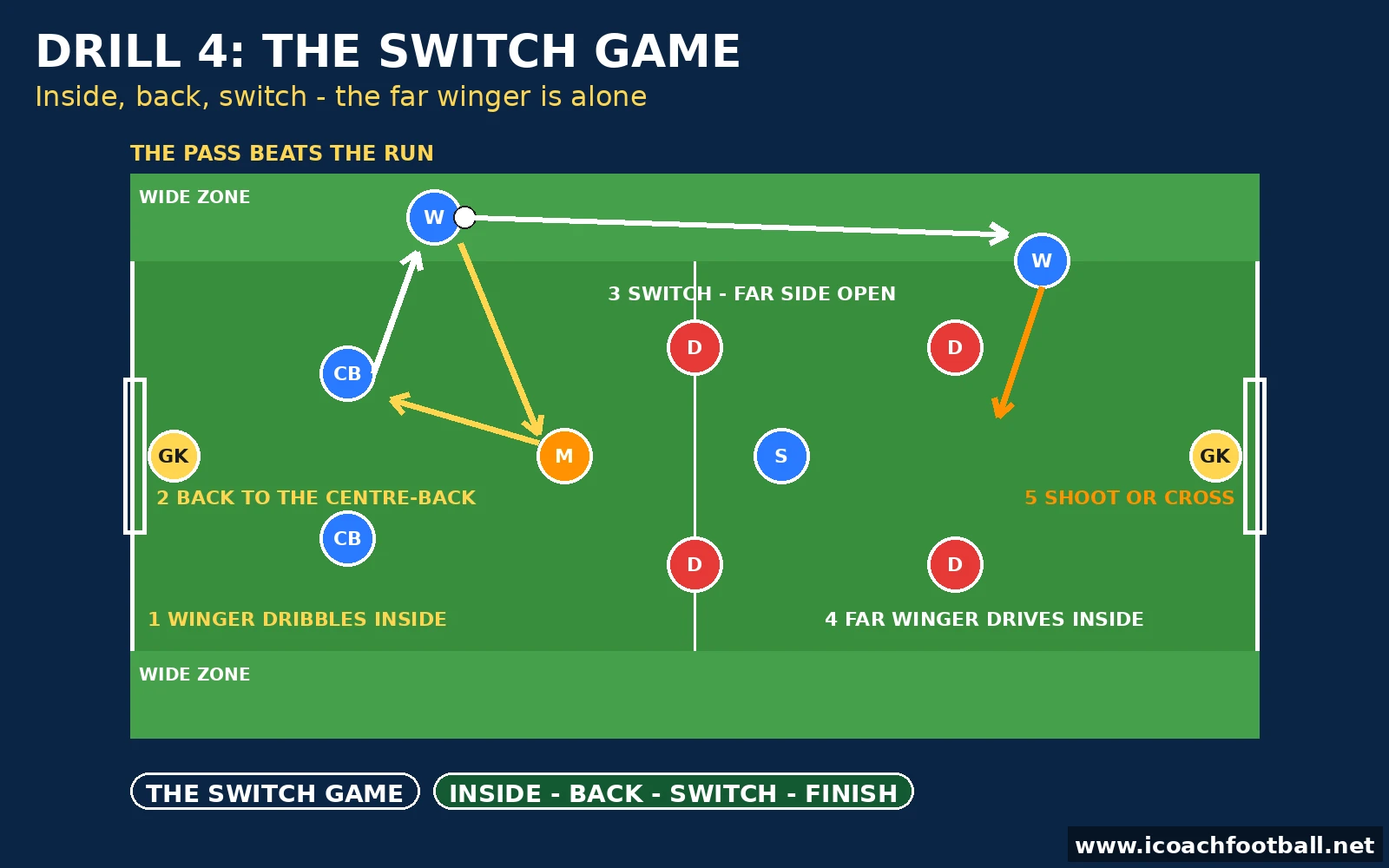
- Setup: The final third (about 50 by 40 yards) with one full-size goal and a keeper, 6 attackers against 4 defenders, two wide zones marked 8 yards in from each touchline, balls with the coach.
- How to play:
- The ball starts with the left winger in the wide zone, who dribbles inside.
- The defence slides across to follow — the midfielder plays the ball back to the centre-back.
- The centre-back switches the ball first time to the far winger, who is alone on the right.
- The far winger drives inside and shoots, or crosses for the striker.
- A goal scored after a switch counts double; a goal scored without one counts once.
- Coach’s note: Watch the far winger — if they drift inside before the switch, the space is gone; the cue is “the pass beats the run,” and our switching play drills train the same diagonal ball this switch depends on.
- Progressions: The switch must be first time; the far winger must finish with their weak foot; the defenders may press the centre-back, so the switch has to come off the first touch.
Drill 5: The Three Runs
The crossing lesson. Three attackers time three different runs — near post, penalty spot, back post — on the same delivery. Based on UEFA Technical Observer Gaizka Mendieta’s coaching reflection: “One needs to go near post, one needs to go penalty spot, one needs to go back post. It’s about practice and then timing” — and the runner waits for the moment the wide player puts their head down to send the ball in.
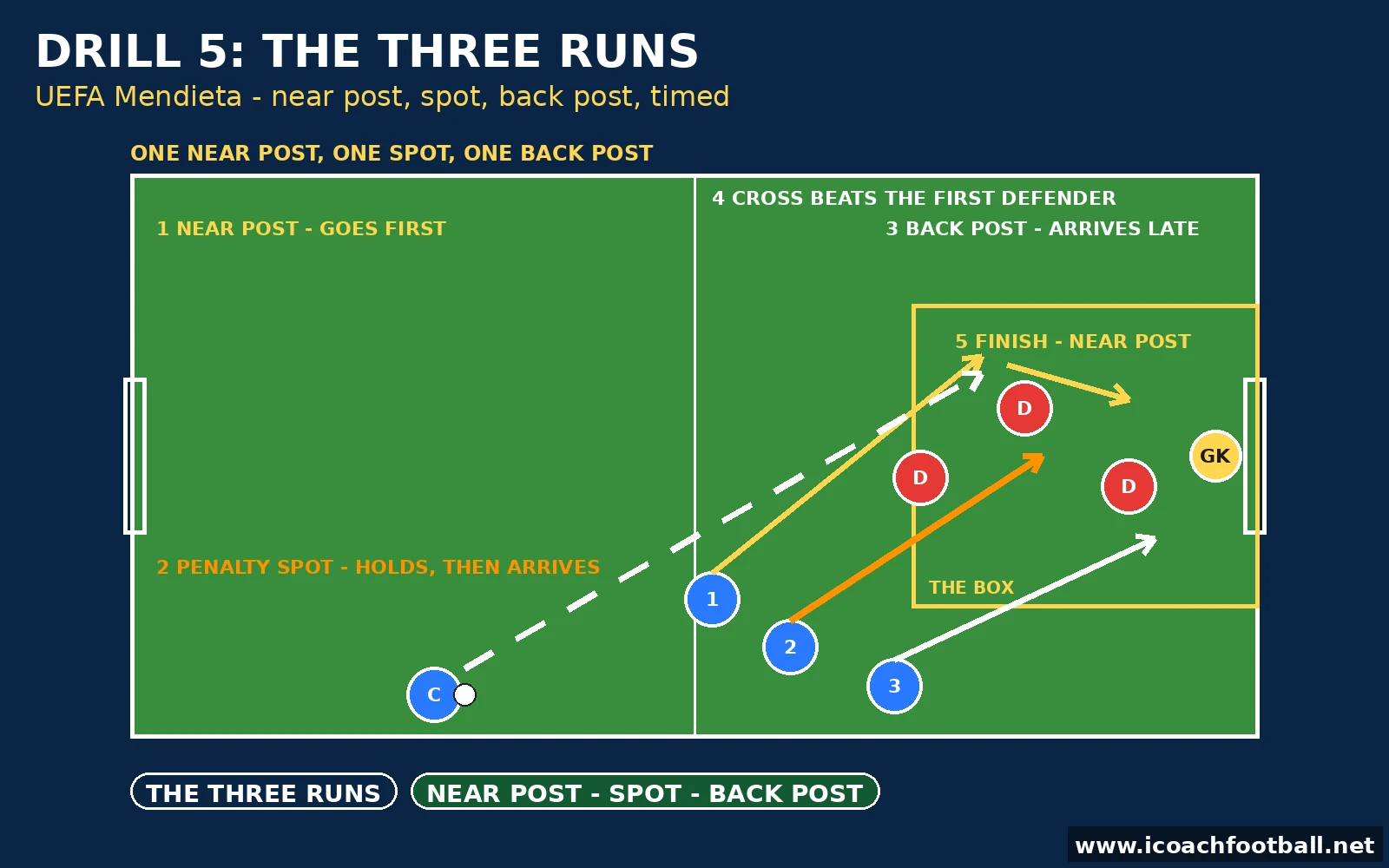
- Setup: The final third with one full-size goal and a keeper, 1 crosser wide, 3 attackers, 3 defenders, balls with the crosser.
- How to play:
- The crosser takes a touch and looks up at the box.
- The near-post runner starts the run as the crosser’s head goes down.
- The penalty-spot runner holds, then arrives on the delivery.
- The back-post runner stays wide and arrives late, unmarked.
- The cross must beat the first defender and drop between the penalty spot and the back post.
- Coach’s note: Watch the timing — three runners arriving together is one run, not three; the cue is “wait for the head to go down,” and our football late runs into the box drills train the same arrival timing.
- Progressions: The crosser must deliver first time; the defenders go man-to-man, so the runs must lose their markers; add a cutback option — the back-post runner becomes the cutback target instead.
Drill 6: The Attacking Third Game
The match-real finish. An 8v8 attack v. defence game with an overload for the attackers, where a goal only counts after a combination in the final third. Based on the FIFA Training Centre session, which builds from the rehearsed patterns into a 10v8+goalkeeper attack v. defence game and finishes with a 9v9 game — the patterns are practised, then they have to survive a real defence.
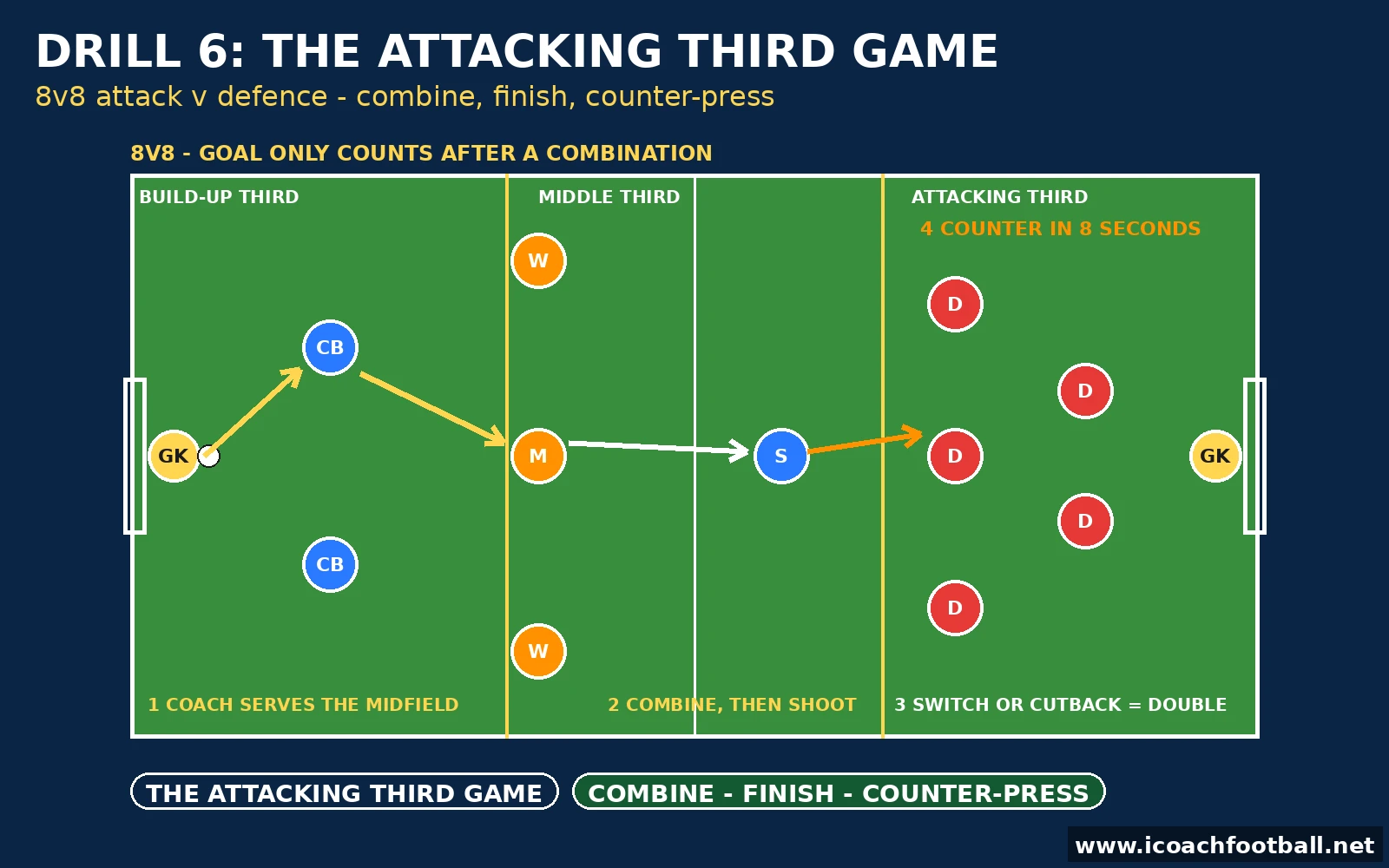
- Setup: The final third plus the middle third (about 60 by 50 yards), one full-size goal with a keeper, two mini goals on the halfway line, 8 attackers against 6 defenders plus a keeper, balls with the coach.
- How to play:
- Play starts with the coach serving the ball to the attacking midfield.
- The attackers must combine in the final third before they can shoot.
- A goal after a switch, a cutback or a third-man run counts double.
- If the defenders win it, they counter to the mini goals within eight seconds.
- Play two 8-minute halves, then swap the wide players to the other side.
- Coach’s note: Watch the shape when the ball is lost — if the team is still stretched across the pitch, the counter runs straight through them; the cue is “lose it, win it in six seconds,” and our soccer counter attack drills train what happens when the press is beaten, while our football rest defence drills train the shape behind the ball.
- Progressions: Goals only count from a cutback; the attackers are limited to two touches in the final third; the defenders add a recovery runner who sprints back on every turnover.
Coaching points
- Combinations break the line, dribbling does not: A wall pass and a third-man run take two defenders out of the game in two touches — a dribble into a set block takes one attacker out; our soccer third man runs drills build the runner’s timing, and our football playing between the lines drills train the pass that finds the wall in the first place.
- Width is a decision, not a position: Wingers and full-backs who hold the touchline until the ball moves create the space; players who drift inside kill it — our soccer drills for fullbacks train the same wide starting position this game needs.
- Two touches in the third: A midfielder who takes three touches invites the press and the combination is gone — our soccer passing drills build the one- and two-touch habit this game needs.
- Scan before you receive: A midfielder who checks over their shoulder knows whether the third-man lane is open before the ball arrives — our soccer scanning drills teach that shoulder check.
- The cutback beats the cross: A ball pulled back to the penalty spot is finished first time by a striker facing goal; a high cross is a duel the defence usually wins — our soccer cutback drills train the finish, and our soccer drills for strikers train the arrival.
- The switch is the fastest way across: A diagonal ball crosses the pitch in two seconds; a dribble takes ten and a press takes the ball — our switching play drills train the diagonal ball, and our soccer overlap underlap drills train the wide run that follows it.
- Runs are timed to the delivery, not the whistle: A runner who goes on the crosser’s touch arrives as the ball does; a runner who goes early is marked — our football late runs into the box drills train that arrival, and our football attacking the half space drills train the run through the channel the cross comes from.
- The half space is where the line breaks: A pass into the channel between full-back and centre-back splits the back line and opens the cutback — our football attacking the half space drills break that channel down in full.
- Finish with either foot when it is open: A striker who only shoots with one foot takes an extra touch to set it — and the extra touch is when the defender arrives; our weak foot soccer drills build the second foot this finish needs, and our shooting drills build the first-time finish itself.
- Through balls break the line: A ball played in behind the back line is the fastest way into the box — but only if the runner times it; our soccer through ball drills train the weight and the timing, and our 1v1 finishing trains the duel that follows.
- Play out, then attack the third: A team that cannot play out from the back never reaches the third with the ball under control — our soccer playing out from the back drills build the build-up this session starts from, and our soccer drills for midfielders train the midfielders who receive it.
Common mistakes
- Dribbling into the block: An attacker who dribbles into three set defenders loses the ball and starts a counter — combine past the block, or switch around it.
- Crossing to nobody: A cross with no runner in the box is a clearance — three runners, three zones, every single time.
- Everyone arriving at once: Three runners arriving together is one run the defence marks once — stagger the runs: near post first, penalty spot second, back post last.
- Shooting from distance when the combination is on: A hopeful shot from 25 yards ends the attack; a wall pass and a cutback ends it with a goal — our soccer dribbling drills train the 1v1 that creates the shooting lane, but the shot is the last option, not the first.
- No counter-press: A team that attacks with everyone forward and nobody ready to win it back concedes the counter every time — lose it, win it in six, and our soccer tackling drills train the clean challenge the press ends with.
Age adaptations
| Age | Area | Touches | What changes |
|---|---|---|---|
| U12–U14 | Final third, 40 by 30 yards | Three touches | Drill 2 runs with a passive defender on the wall; crosses in Drill 5 are cutbacks only — no high crosses and no heading; the press in Drill 6 is triggered by the coach’s call, not the turnover; the switch in Drill 4 may take two touches |
| U15–U18 | Final third, 50 by 40 yards | Two touches | Full live pressing in Drill 1, combinations in Drill 2 must be one touch throughout, the switch in Drill 4 must be first time, headed finishes are allowed in Drill 5, and the counter-press in Drill 6 is live from the turnover; players start to learn the full-pitch patterns — our soccer 9v9 drills and our soccer 11v11 drills pick up the same habits across the whole pitch |
60-minute session plan
| Block | Minutes | What to run |
|---|---|---|
| Warm-up | 0–10 | Drill 1, the final-third rondo, walking pace then half speed |
| Combinations | 10–20 | Drill 2, the wall and the runner |
| Cutbacks | 20–30 | Drill 3, the cutback game |
| Switches | 30–40 | Drill 4, the switch game |
| Crosses | 40–50 | Drill 5, the three runs |
| Match-real finish | 50–60 | Drill 6, the attacking third game |
For a full guide to building the hour around these blocks, see our 60-minute session plan.
FAQ
What is the attacking third in soccer?
The final third of the pitch — roughly the last 35 yards, from the edge of the third to the goal line. It is where goals are created, and it is the hardest place to play, because the defending team is compact and every mistake becomes a counter-attack. This session is built entirely in that zone.
How do you coach the attacking third?
In the order elite academies use: keep the ball in the third, rehearse the combinations unopposed, test them against a back line, then play the game. Start with the rondo in Drill 1, add the wall pass in Drill 2, then go wide for the cutback and the cross — never start with the game and hope the patterns appear.
What are the best attacking third drills for youth?
The six in this session: the final-third rondo, the wall and the runner, the cutback game, the switch game, the three runs and the attacking third game. For U12–U14, start with the rondo and the cutback; for U15–U18, add the three runs and the full game with a live counter-press.
How do you break down a low block?
With width, switches, cutbacks and third-man runs — never by dribbling into it. Stretch the block wide, switch the ball to the far side faster than the defence can slide, then cut it back to a runner arriving at the penalty spot. Patience with the ball, speed with the pass.
How many players do you need for attacking third drills?
Drill 1 works with nine players; the full session wants 14 to 16. With fewer players, run Drills 1 to 4 as small groups and finish with a 6v6 version of Drill 6 — the combinations and the cutback still work, and the 60-minute plan scales to any squad size.
Sources
- FIFA Training Centre — “Combination play in the final third (Zamrat)” (Abdelouahed Zamrat, U-21 coach at the Mohammed VI Football Academy, takes players through a technical warm-up, an opposed possession game, unopposed passing and movement patterns, a 10v8+goalkeeper attack v. defence game, and a 9v9 game; the attacking team should use the width of the pitch to stretch the opposition and create gaps in central areas through which to attack; players time and coordinate their runs off the ball). Drills 1, 2 and 6 in this post are based on and in line with that session.
- UEFA — “Champions League Performance Insights: How teams create goals from out wide” (UEFA Technical Observer Gaizka Mendieta on timing runs for a cross — one player near post, one at the penalty spot, one at the back post, “it’s about practice and then timing”; wait for the right moment when the wide player puts their head down to send the ball in; the third-man run is “one of the most simple but effective actions in football”). Drills 3 and 5 in this post are based on and in line with that analysis.