Soccer Through Ball Drills: 6 Games to Slip the Pass and Run In Behind
Quick answer
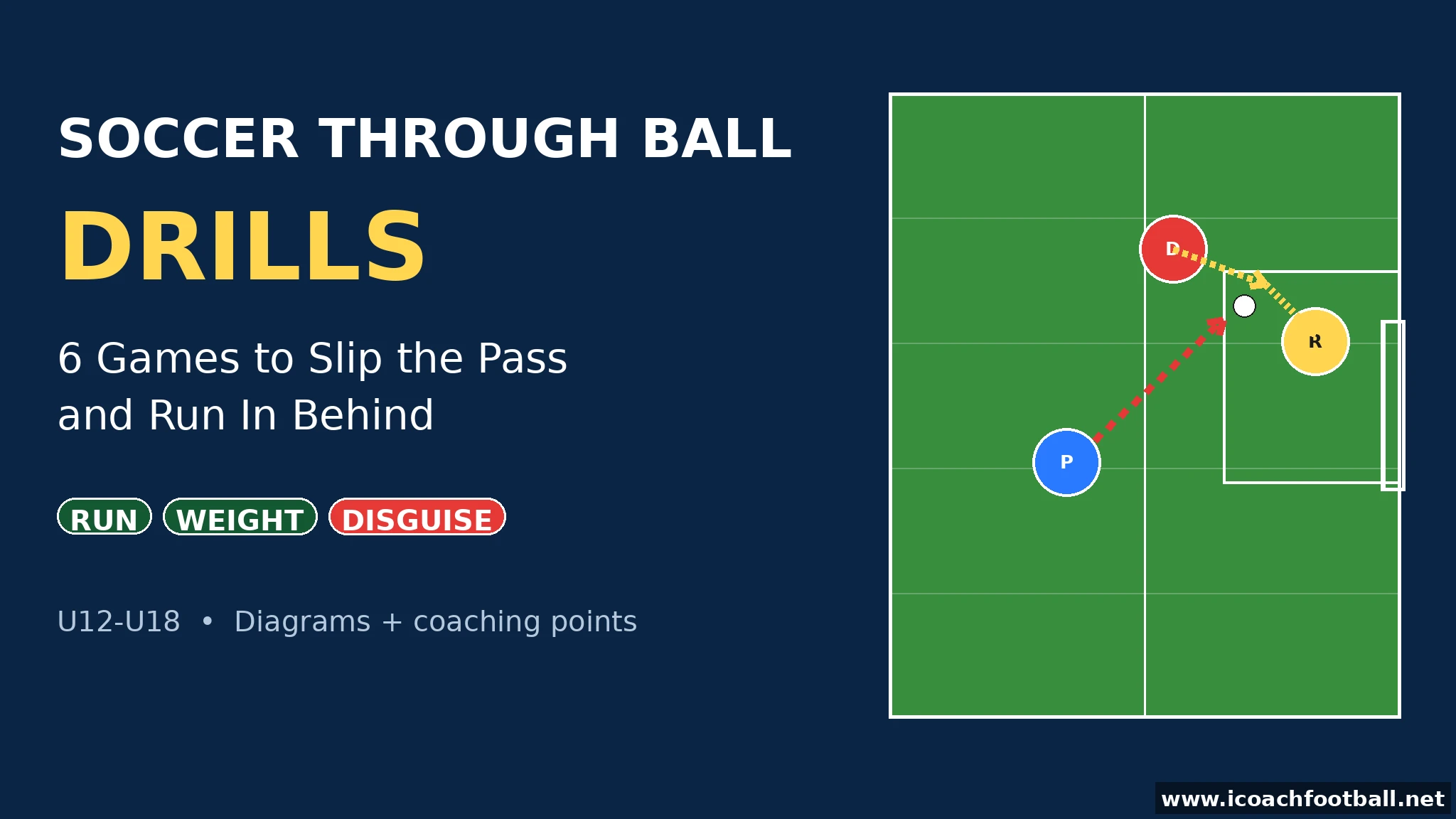
A through ball is a pass played into space behind the defence for a team-mate to run onto — not to feet, and not to where the runner is, but to where the runner will be. The three skills are the run (curved, onside, timed to the pass), the weight (firm enough to beat the line, soft enough to control) and the disguise (eyes and body shape saying one thing, the pass doing another).
Suitable for: U12–U18
Most youth teams either never play through balls or play them all wrong: passed too hard, passed to feet, or passed a second too late so the runner is offside or the keeper collects it. These six soccer through ball drills fix all three — the run, the weight and the timing — in games your players will actually enjoy. (In the UK the same pass is usually called a football through ball — the skill is identical.)
Session snapshot
- Players: 6 or more (passers, runners, defenders)
- Area: 20 x 30 yards up to half pitch, depending on the drill
- Duration: 60 minutes
- Focus: Run, weight, disguise
- Age: U12–U18 (see Age adaptations)
When to play the through ball
The decision below is in line with the FIFA Training Centre’s passing and receiving work: a firm, incisive pass played with an open body shape, only when the picture is right. If none of these pictures is on, keep the ball — a forced through ball is a turnover.
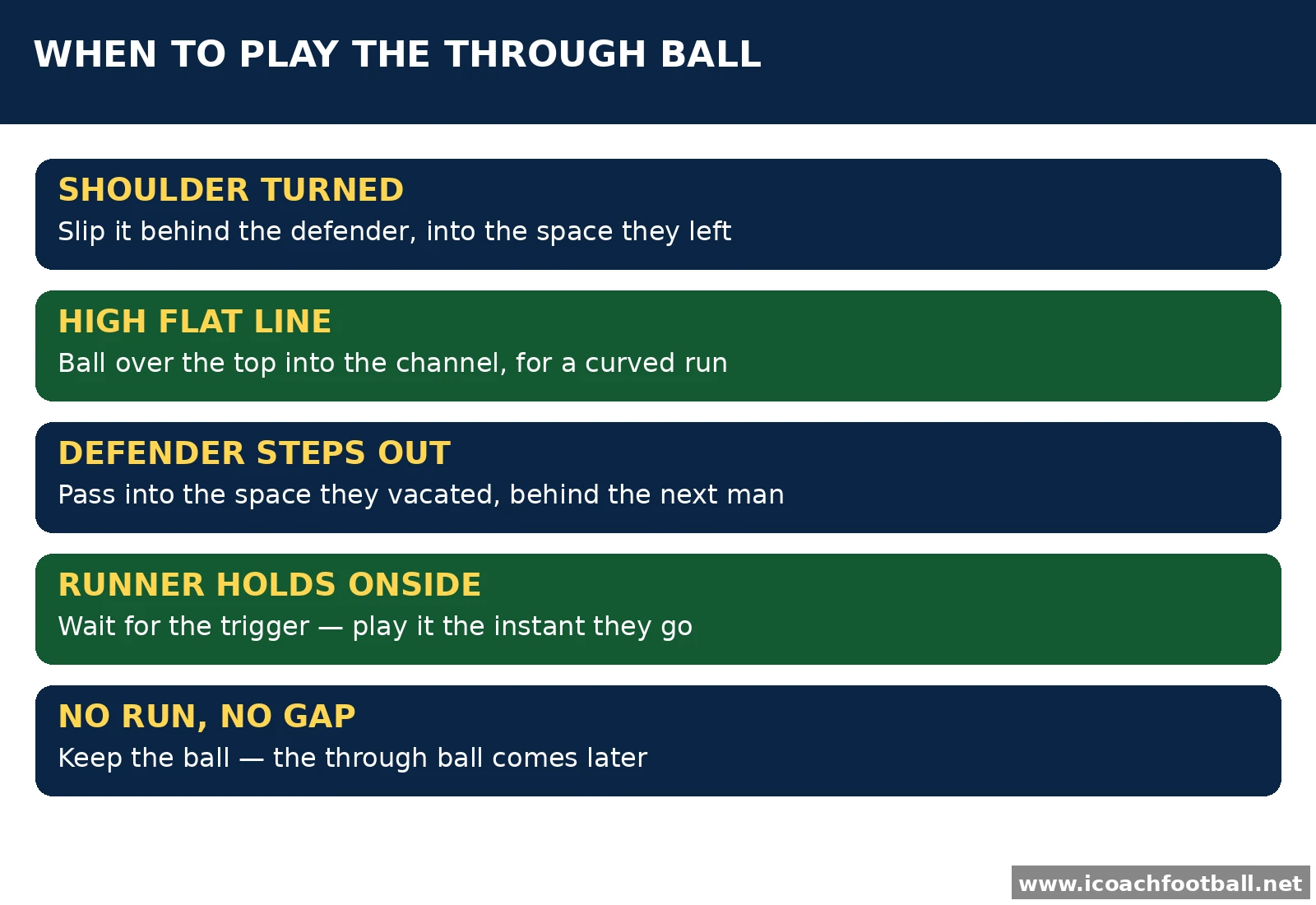
| What the defence shows | The through ball to play |
|---|---|
| A defender’s shoulder turned toward the ball | Slip it behind them, into the space they just left |
| A high, flat back line | A ball over the top into the channel, for a curved run |
| A defender stepping out to press the ball | Pass into the space they vacated, behind the next defender |
| A runner holding their run onside | Wait for the trigger — play it the instant they go |
| No run, no gap, no picture | Keep possession — the through ball comes later |
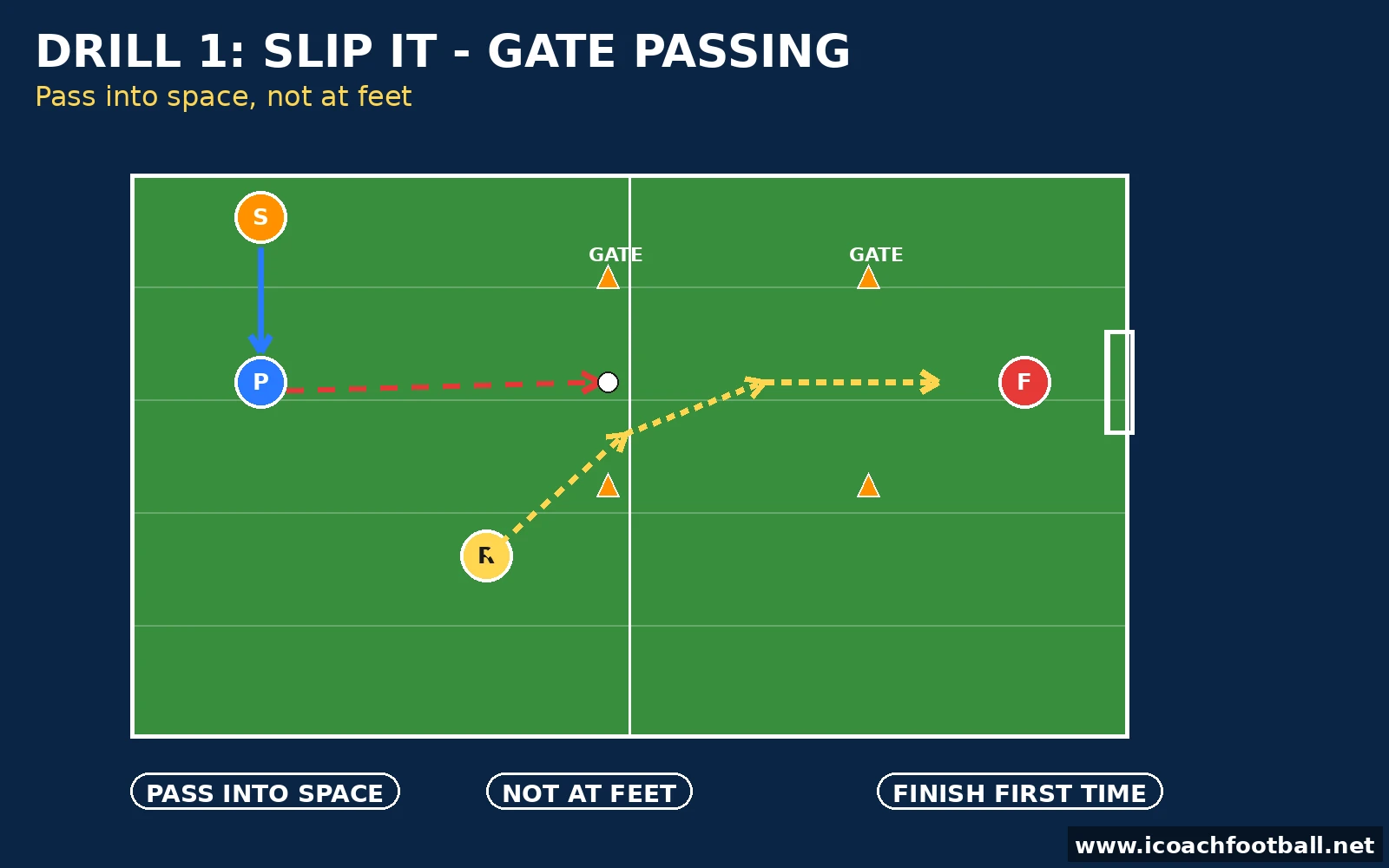
Drill 1: Slip It — Gate Passing
The pure skill, stripped down: pass through a gate, to a runner, at the right weight. If your players cannot do this with no defenders, they cannot do it in a game.
Setup
- 4 players per lane: passer, runner, receiver, server — plus balls
- 30 x 15-yard lane, two gates of cones 8 yards apart, 15 yards from the passer
- 2 minutes per role, then rotate
How to Play
- The server passes to the passer, who takes one touch to open up.
- The runner checks away, then curves their run through a gate.
- The passer slips the ball through the same gate, ahead of the runner.
- The runner takes one touch and finishes into the mini goal.
- Rotate roles every 2 minutes so every player passes and runs.
Coach’s note: Shout “Into space, not at feet!” — the classic youth error is passing to where the runner is standing. The ball should arrive where the runner will be in two strides.
Progressions: Narrow the gates to 4 yards; add a passive defender between the gates who can intercept.
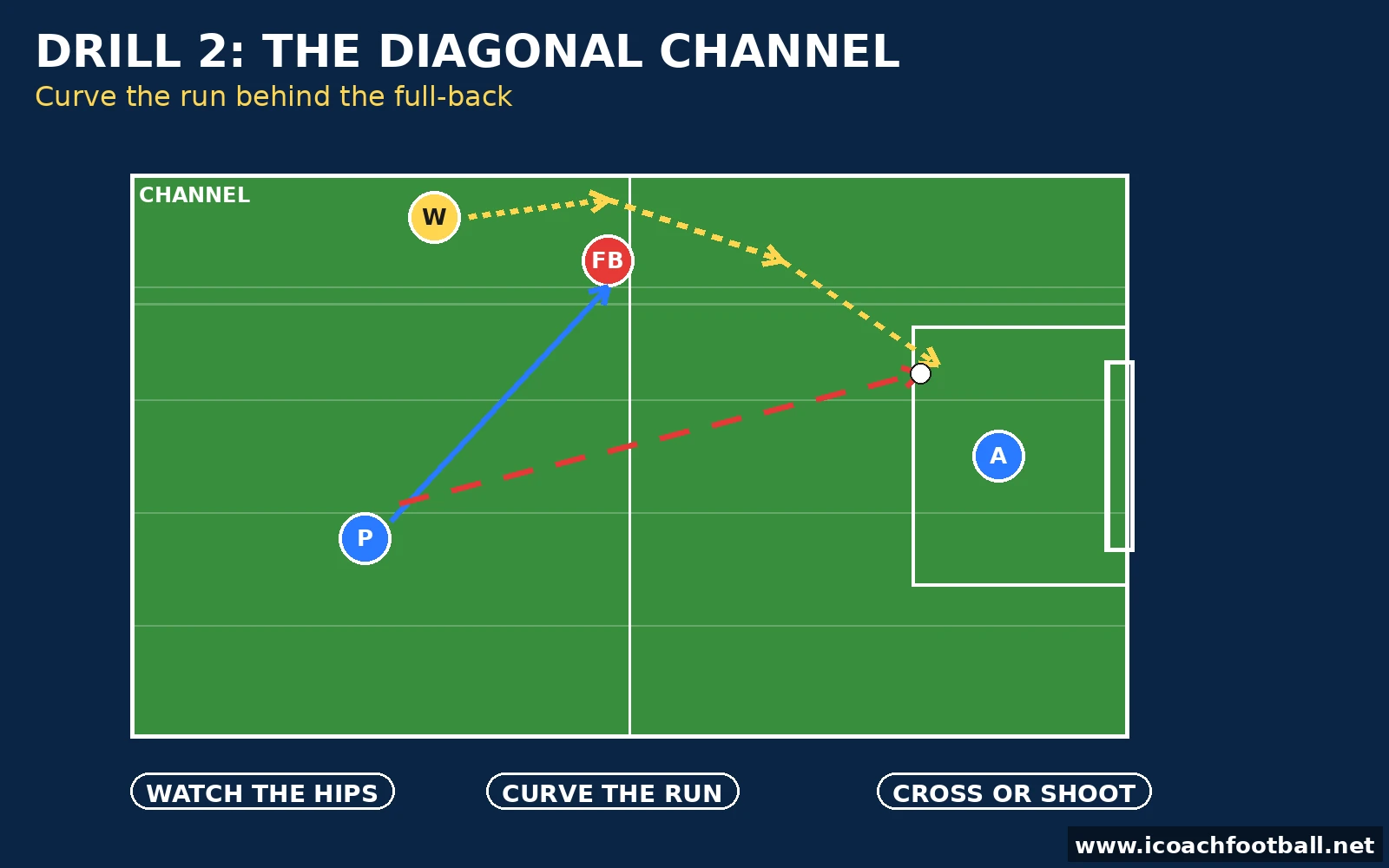
Drill 2: The Diagonal Channel
Most through balls in real games are diagonal, not straight. This drill teaches the hardest read in the game: the winger’s curved run behind the full-back.
Setup
- 1 passer, 1 winger, 1 full-back, 1 striker — plus balls
- 40 x 25-yard channel down one side of the pitch, goal at the end
- Full-back starts level with the winger; passer 25 yards from goal
- 6 reps per winger, then rotate
How to Play
- The passer drives at the full-back with the ball at their feet.
- The winger stays wide and level, then curves their run behind the full-back.
- The moment the full-back’s shoulder turns, the passer slips the diagonal ball.
- The winger takes the ball in stride and crosses or shoots first time.
- If the full-back stays, the passer keeps the ball and the winger checks back.
Coach’s note: The trigger is the full-back’s hips. When they turn square to face the ball, they cannot see the run behind them — that is the exact moment to play it. Teach your passers to watch hips, not feet.
Progressions: Add a second defender covering inside so the winger must beat the line twice; let the winger cut inside and shoot instead of crossing.
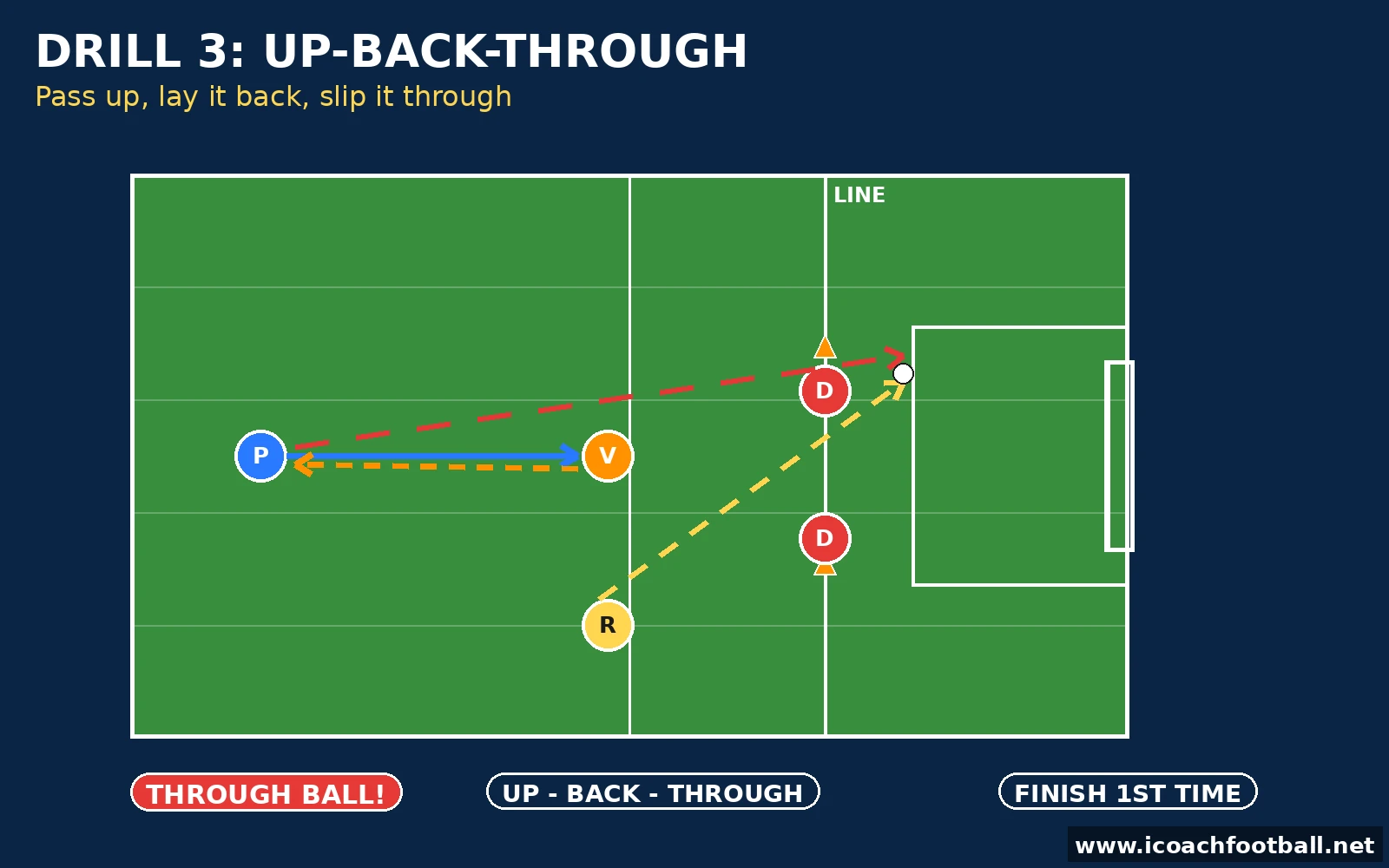
Drill 3: Up-Back-Through
The classic pattern that unlocks a set defence: pass up, lay it back, then slip it through the space the first pass created. The sequence is the lesson, so watch the animation below the diagram.
Setup
- 3 attackers (passer, pivot, runner), 2 defenders, balls at the passer
- 30 x 20-yard area, two cone gates as the defensive line, mini goal behind it
- Defenders start on the gate line; pivot 10 yards ahead of the passer
- 8 reps, then swap attackers and defenders
How to Play
- The passer plays UP into the pivot’s feet.
- The pivot lays it BACK first time to the passer, who has followed the pass.
- The runner, who held their run, sprints through a gate as the lay-off is played.
- The passer plays the THROUGH ball into the runner’s path, between the defenders.
- The runner finishes first time; if a defender intercepts, the roles swap.
Coach’s note: The lay-off is what makes it work — it drags a defender toward the ball and opens the gate. A team that tries to force the through ball on the first pass runs into a set line every time.
Progressions: Let the pivot turn and play the through ball themselves; add a second runner on the far gate so the passer must choose.
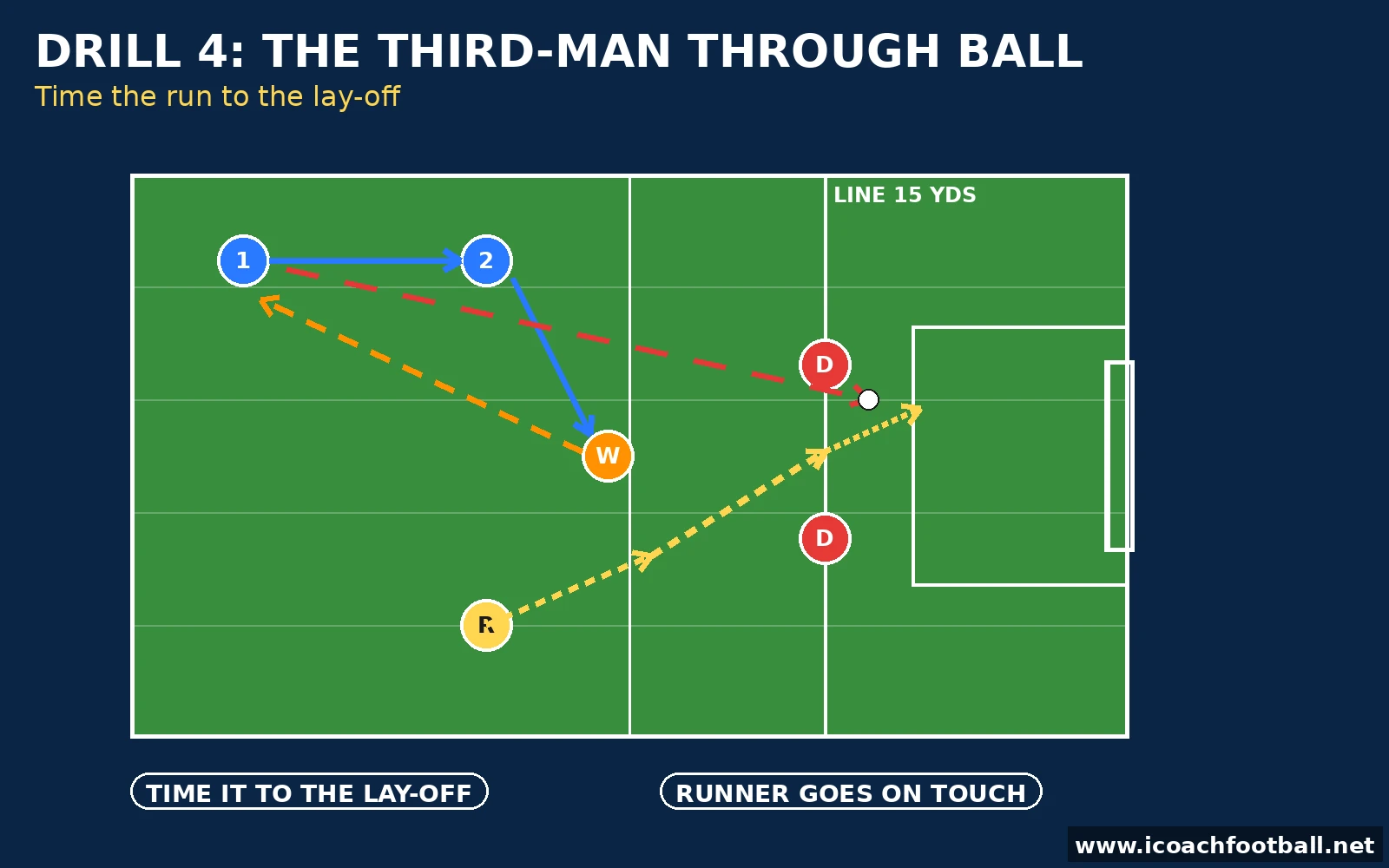
Drill 4: The Third-Man Through Ball
The through ball your players cannot see coming — because the player who plays it is not the player who started the move. Built on the same third-man timing as our soccer third man runs drills.
Setup
- 4 attackers (two passers, one wall player, one runner), 2 defenders
- 35 x 25-yard area, goal at the far end, defenders holding a line 15 yards out
- Balls with the first passer; 6 reps, then rotate
How to Play
- The first passer plays wide to the second passer and follows the pass.
- The second passer plays inside to the wall player, who is facing the ball.
- The wall player lays it off first time, back to the first passer.
- The first passer slips the through ball for the runner, who timed their run to the lay-off.
- The runner finishes; the defenders score a point for every interception.
Coach’s note: The runner must time the run to the lay-off, not the first pass. If they go early they are offside or the defenders see them; if they go late the gate is closed. The cue is the wall player’s first touch.
Progressions: Add a third defender so the runner must bend the run around the line; require the finish to be first time.
Drill 5: The End-Zone Game
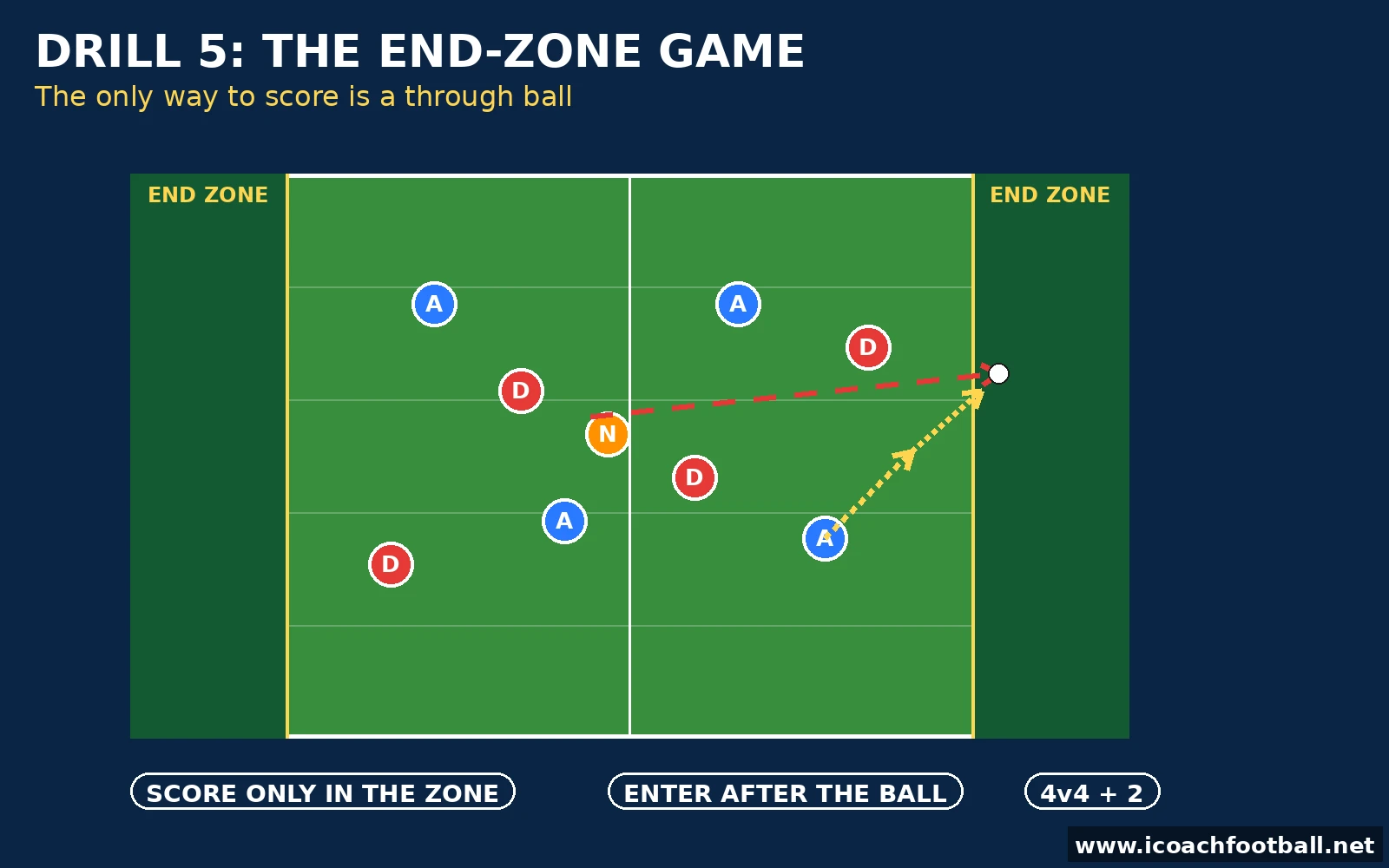
A small-sided game where the only way to score is a through ball. No long shots, no dribble-throughs — the pass is the point.
Setup
- 4v4 plus 2 neutrals, 2 end zones 5 yards deep at each end
- 40 x 30-yard pitch, end zones marked with cones, no goals
- 4 x 3-minute games, 1-minute rests, neutrals change each game
How to Play
- Teams keep possession and look to play a through ball into an end zone.
- A team-mate must receive the ball inside the end zone to score a point.
- The receiver must enter the zone after the ball is played — no camping.
- Defenders cannot enter the end zones, so the run and the pass must be perfect.
- If a team scores, the other team restarts with the ball from their end zone.
Coach’s note: Ban the safe pass. For the first two games, a team that makes five passes without attempting a through ball loses the ball — it forces the risk-taking this skill needs.
Progressions: Allow one defender into each end zone; require the through ball to be played first time.
Drill 6: The Through-Ball Game
Put the skill inside a real game, and make the through ball worth more than any other goal.
Setup
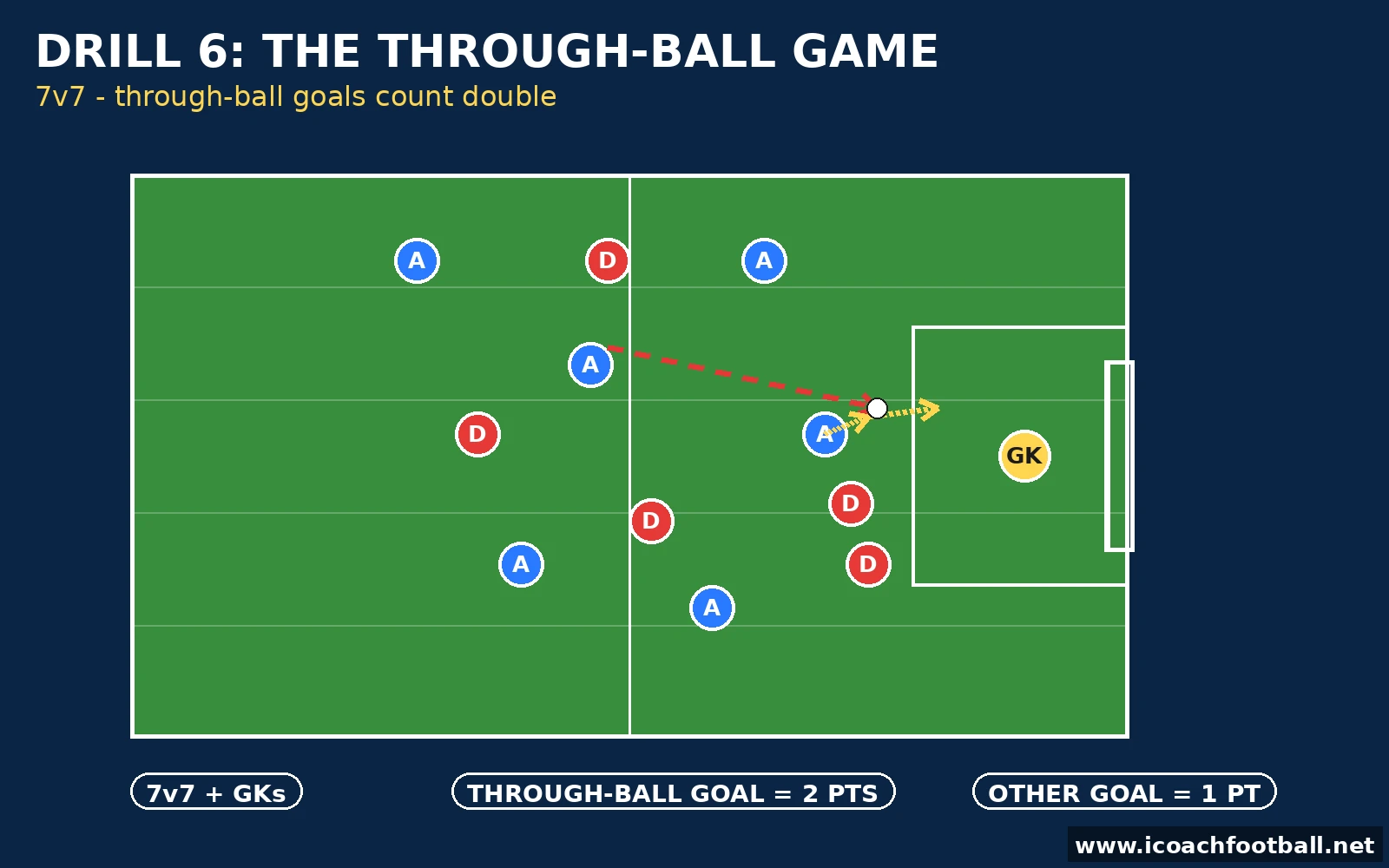
- 7v7 plus goalkeepers on a 50 x 35-yard pitch with full-size goals
- Normal small-sided rules, plus the scoring rule below
- 4 x 4-minute games, 1-minute rests
How to Play
- Teams play 7v7 as normal.
- A goal scored from a through ball — a pass played into space behind the defence — is worth 2 points.
- Any other goal is worth 1 point.
- A through ball that beats the line but is not finished still earns the team the ball back at the halfway line.
- Rotate goalkeepers every game so every keeper faces through balls in behind.
Coach’s note: Count through balls attempted, not just goals. A team that tries six and scores one is learning faster than a team that tries one and scores one — praise the attempt, then fix the weight.
Progressions: Goals only count from through balls; add an offside line 15 yards from each goal so runners must time their runs.
Coaching points
- Pass into space, not at feet. The through ball’s target is the space the runner is about to enter. If the ball goes to feet, the defender gets there first.
- Weight is the skill. Too soft and it is intercepted; too hard and the runner cannot control it. The right weight lets the runner take it in stride at full speed.
- Disguise it. Eyes one way, body shape one way, pass the other. A passer who stares at the runner telegraphs the ball — teach a look-away or a no-look weight.
- The run makes the pass. A straight run is easy to track. Curved runs — away then in, or in then away — lose the defender and open the gate.
- Scan before you receive. The passer’s decision is made before the ball arrives. A player who receives with their head down will never see the run in time.
Common mistakes
- Passing to where the runner is, not where they will be. The ball must lead the runner by two strides. If the runner has to stop or check back, the pass was wrong.
- Playing it too late. A through ball played after the runner has already gone is offside or intercepted. The pass and the run start together — the passer’s backswing is the runner’s trigger.
- Telegraphing the pass. Head down, body square, staring at the runner — the defender reads it all. Disguise is not showboating; it is what makes the pass arrive.
- Forcing it when nothing is on. A through ball into a set, watching defence is a turnover. Keep the ball, move it, and wait for the shoulder to turn or the line to step.
- Straight runs only. A runner who runs in a straight line is easy to mark and easy to play offside. Curve the run and the gate opens.
Age adaptations
| Age group | How the session changes |
|---|---|
| U12–U13 | Gates and end zones only (Drills 1 and 5); no offside lines, celebrate every completed through ball, keep the weight soft and the distances short |
| U14–U15 | Full Drills 1–4; introduce the up-back-through pattern at walking pace first; add the offside line in Drill 6 only when the timing is reliable |
| U16–U18 | Full speed throughout; add the disguised pass and second-runner progressions; runners call their own timing with no coach prompts |
60-minute session plan
| Block | Time | Content |
|---|---|---|
| Warm-up | 0–10 min | Passing in pairs through gates, 1-touch then 2-touch, short sprints to receive |
| Drill 1 + 2 | 10–25 min | Slip It — Gate Passing, then The Diagonal Channel |
| Drill 3 + 4 | 25–40 min | Up-Back-Through (with animation), then Third-Man Through Ball |
| Drill 5 + 6 | 40–55 min | End-Zone Game, then Through-Ball Game |
| Cool-down | 55–60 min | Light jog, stretch, one-line review: “What did you see before you played it?” |
Sources
- FIFA Training Centre — John Peacock: Passing and receiving. The drills above are based on and in line with its coaching of firm, incisive, well-weighted passes to progress the ball, scanning before receiving, and receiving with an open body posture on the half-turn; they are not FIFA-approved sessions. Link: https://www.fifatrainingcentre.com/en/practice/elite-sessions/in-possession/john-peacock-passing-and-receiving.php
- FIFA Training Centre — Talent Coach Programme: Passing Midfielders. Used in line with its sequence of receiving on the back foot and half-turn, then deciding whether to play back or turn and play beyond the cone — the passer’s decision at the heart of Drill 1 and Drill 3. Link: https://www.fifatrainingcentre.com/media/native/practice/talent-coach-programme/Talent_coach_3-05-1.pdf
FAQ
What age should players start learning through balls?
From U11–U12, with gates and end zones and no offside lines. At that age the skill is weight and timing, not tactics — keep the distances short and celebrate every ball that finds the runner in stride.
How do you stop players being offside on through balls?
Teach the runner to stay level until the ball is played — the trigger is the passer’s backswing, not the pass itself. In training, use a cone line as the offside line and let the players call ‘on’ or ‘off’ themselves before the pass.
What is the difference between a through ball and a pass in behind?
A through ball is played into space for a runner to meet — the ball leads the player. A pass in behind can also go to a team-mate’s feet behind the line. The through ball’s test is simple: if the runner has to stop, check back or stretch, it was not a through ball, it was a hopeful ball.
Why do youth through balls keep getting intercepted?
Three reasons, in order: the weight is wrong (too soft, so a defender steps in), the timing is late (the runner has already gone and the defence is set), or the pass is telegraphed (the passer stares at the runner). Fix the weight first — most interceptions are just under-hit passes.
How many touches should the passer take before playing a through ball?
As few as possible — one or two. Every extra touch lets the defence drop and the runner’s timing go stale. The best through balls are played first time off a lay-off, or off a single touch that opens the body toward the space.