Soccer Drills for Improving Attacking the Back Post: 6 Games That Turn the Far Post into Goals (U11–U17)
Quick answer
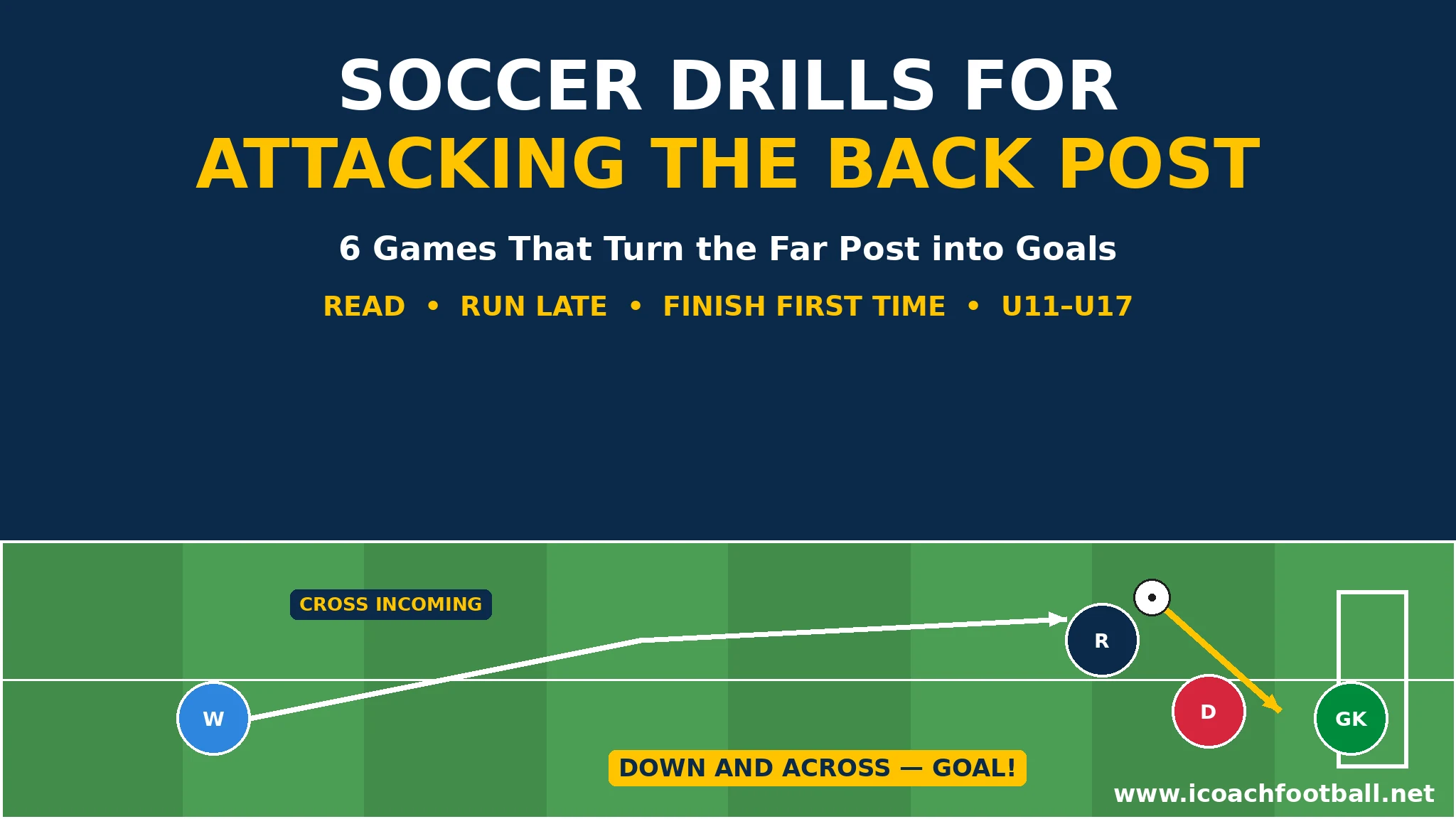
The back post is where crosses become goals. The far-side attacker’s job is three moves: hide from the marker, start the run on the crosser’s trigger, and arrive at the back post at the same moment as the ball. These six soccer drills for improving attacking the back post train that sequence step by step: the read, the timed run, the header, the crossover, the second ball, and a full game where a back-post goal counts double.
Suitable for: U11–U17 (ages 10–17)
Session snapshot
- Players: 12–16, plus 2 goalkeepers
- Age: U11–U17 (ages 10–17)
- Area: Penalty box and wide channels, expanding to half a pitch
- Duration: 60 minutes
- Focus: Attacking the back post — timing the far-post run, losing the marker, and finishing first time
- Equipment: 10 balls, 16 cones, bibs, 1 full goal (2 for the final game)
Why these six games work
Most back-post goals are not scored by the best header of the ball. They are scored by the best runner — the attacker who arrives at the far post at full speed, one step ahead of the defender, while the keeper is still turning. The cross does the hard work; the run does the rest.
The first two drills build the read and the run: watching the crosser’s head lift and body shape so the run starts on the trigger, then timing the sprint so the attacker arrives as the ball arrives — never early, never late. The next two drills build the finish: heading the ball down and across the keeper, and the crossover run that loses the marker before the cross is even played. The last two drills build the team skill: the edge-of-the-box runner who follows every cross in for the second ball, then a full game where the back post is worth double.
The drills are grounded in the FIFA/UEFA coaching community. Drills 1, 2 and 6 are based on / in line with the FIFA Training Centre session “Movement to attack the space in behind”, in which FIFA Talent Coach Claudio García and Costa Rican FA Talent Coaches Lina Arana and Manfred Schumann train attackers to combine perfectly weighted passes with well-timed runs, make decoy runs across the back of defenders, use wide players to stretch the opposition, and make runs based on the ball carrier’s actions. Drills 3, 4 and 5 are based on / in line with the England Football Learning session “Attacking session: width for deception”, which supports players to use width to create goalscoring chances, work on different types of crosses, develop their movement skills to get out wide, and practise finishing from a cross into the box. In the UK the same session is football drills for improving attacking the back post — the far post, the run and the finish are identical.
This post is the attacking half of the site’s back-post pair. The defending half — how to stop the cross at the far post — is our soccer drills for improving defending the back post, published earlier today. The late run that gets an attacker to the back post in the first place is our football late runs into the box drills, and the near-post run that attacks the other end of the cross is our football heading drills near post run.
Six rules of attacking the back post
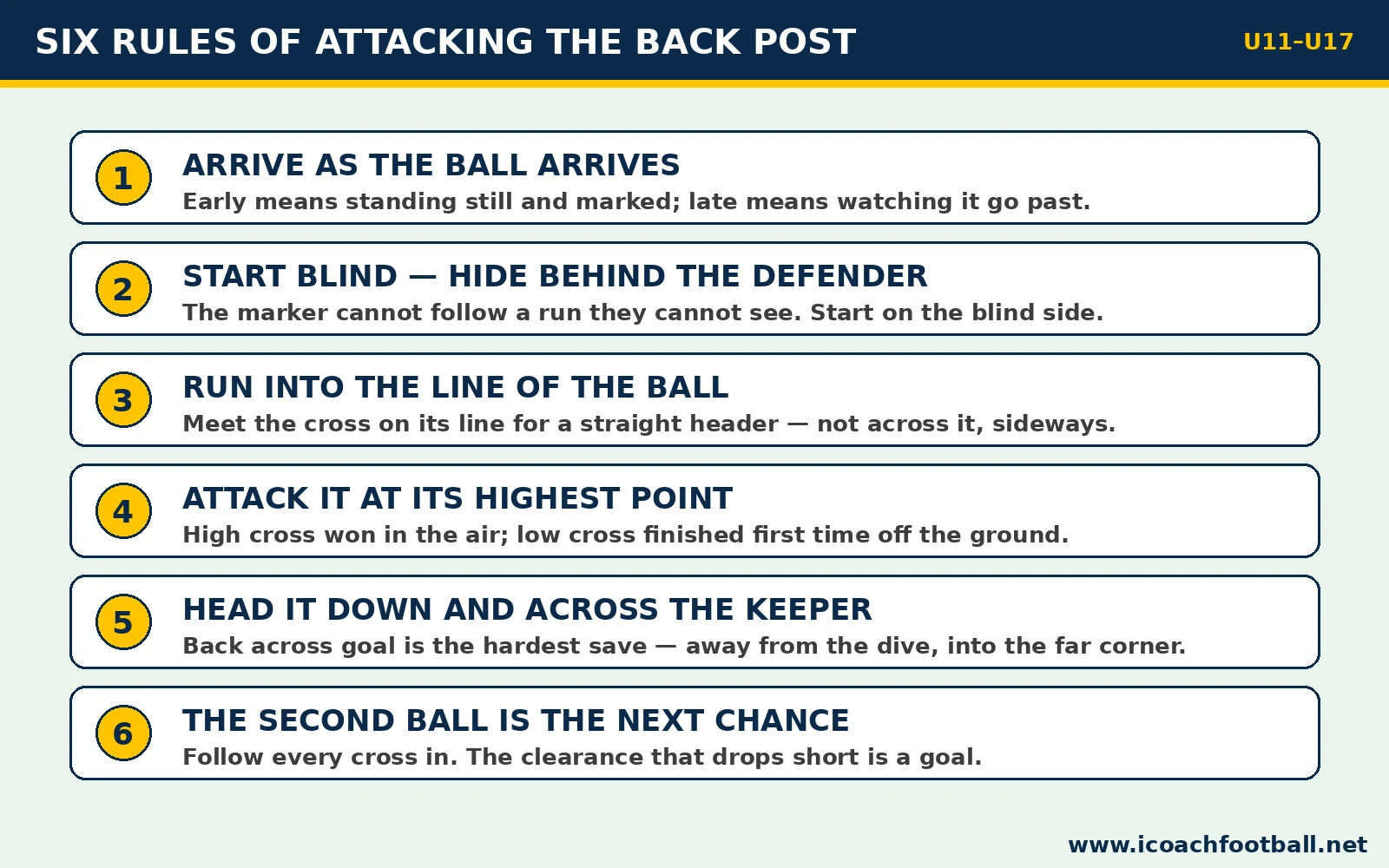
- Arrive as the ball arrives. A runner who arrives early stands still and gets marked; a runner who arrives late watches the ball go past. The run and the cross meet at the back post.
- Start blind — hide behind the defender. The marker cannot follow a run they cannot see. Start on the defender’s blind side, then break.
- Run into the line of the ball, not across it. A run across the cross meets the ball with the body sideways; a run into its line meets it with a straight header or volley.
- Attack the ball at its highest point — or let it drop to the volley. A high cross is won in the air; a low cross is finished first time off the ground. Never let the ball bounce.
- Head it down and across the keeper. A header back across goal is the hardest ball for a keeper to save — it travels away from their dive and into the far corner.
- The second ball is the next chance. Every cross that is cleared falls somewhere. The runner who follows the cross in wins the knock-down.
Drill 1 — Read the Cross Early
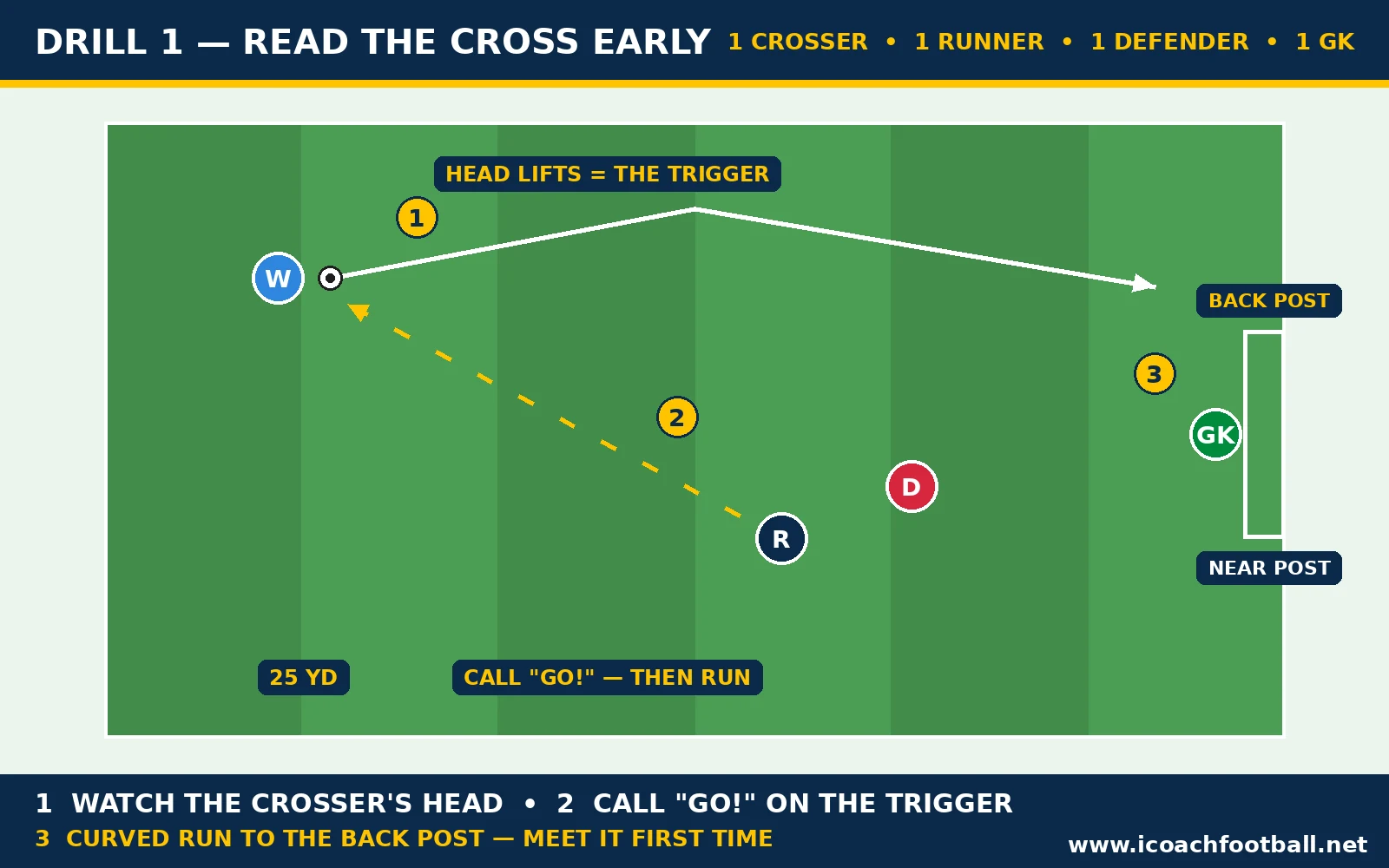
The far-side attacker practises the read — crosser’s head, body shape, ball — so the run starts on the trigger, not on the cross.
Setup
- 25×20-yard area with one full goal, 1 crosser wide, 1 runner, 1 passive defender, 1 goalkeeper.
- 8 minutes, then rotate.
How to Play
- The crosser receives the ball wide, 25 yards from goal.
- The runner stands on the defender’s blind side, side-on, eyes on the crosser.
- The runner watches the crosser’s head lift — that is the trigger, not the kick.
- When the head lifts, the runner calls “GO!” and starts the curved run.
- The crosser delivers to the back post and the runner meets it first time.
- After 6 reps, rotate — the runner becomes the crosser and the crosser becomes the runner.
Coach’s note: “The run starts when the crosser looks up — a runner who waits for the kick is already a yard behind the ball.”
Progressions: The crosser may fake the cross and drive inside; the runner must call the type of cross — “HIGH!” or “LOW!” — before it is played; the defender becomes live from the third round.
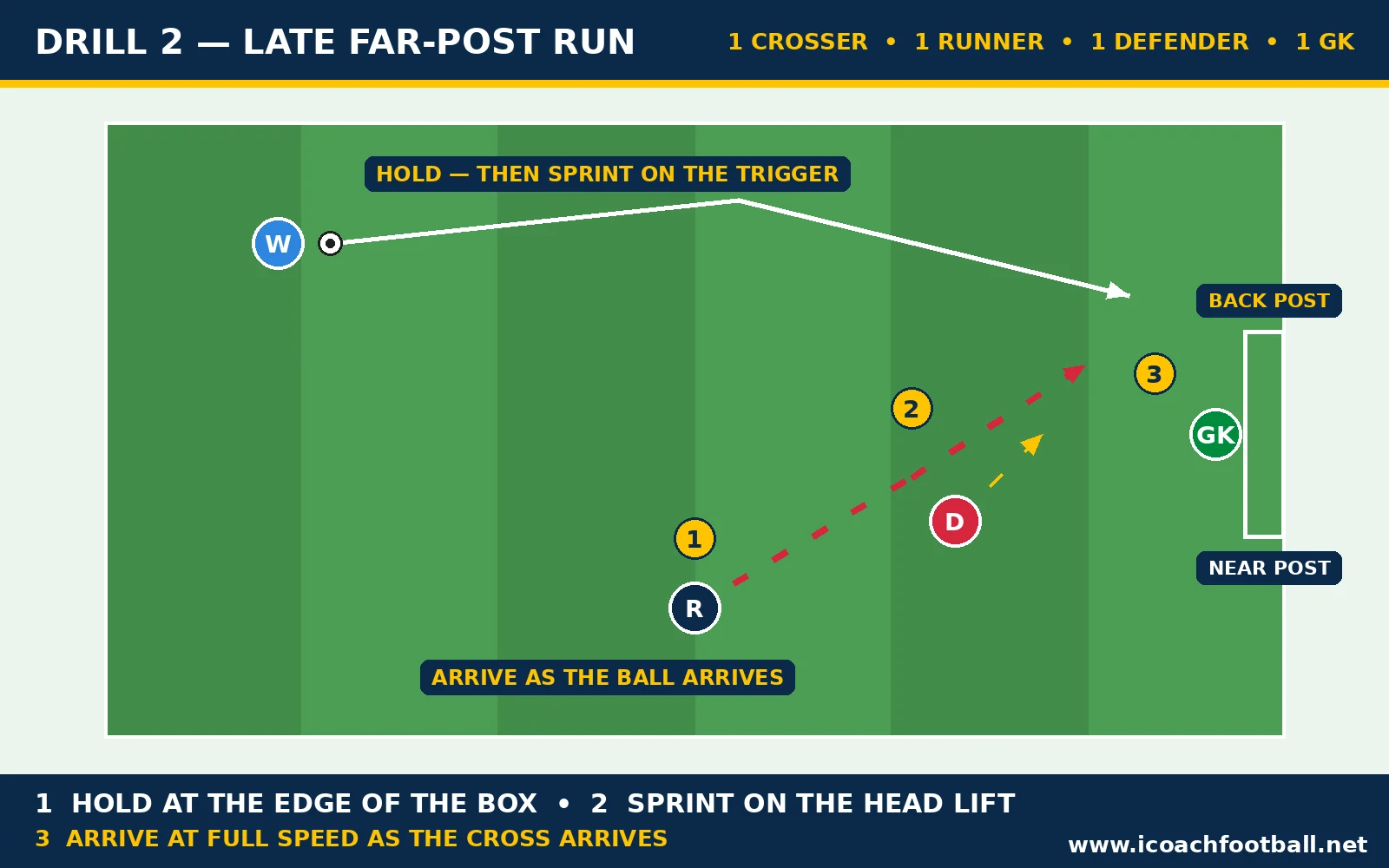
Drill 2 — The Late Far-Post Run
The timing drill — the runner holds, holds, then sprints, so they arrive at the back post at full speed at the same moment as the ball.
Setup
- Half a pitch, 1 crosser wide, 1 runner, 1 defender, 1 goalkeeper, balls at the crosser.
- 10 minutes.
How to Play
- The runner starts at the edge of the box, level with the penalty spot.
- The crosser takes a touch and looks up — the runner holds still.
- On the crosser’s head lift, the runner sprints on a curved run to the back post.
- The runner stays behind the ball’s flight, arriving as the cross arrives.
- The runner meets the cross first time — header or volley, no second touch.
- Play for 2 minutes, then swap — the runner becomes the crosser and a new runner steps in.
Coach’s note: “Late and fast beats early and slow — the runner who arrives at full speed meets the ball; the runner who arrives early stands still and gets marked.”
Progressions: The defender may track the runner from the second round; the crosser may deliver early or late; the runner must finish with the weaker foot on alternate reps.
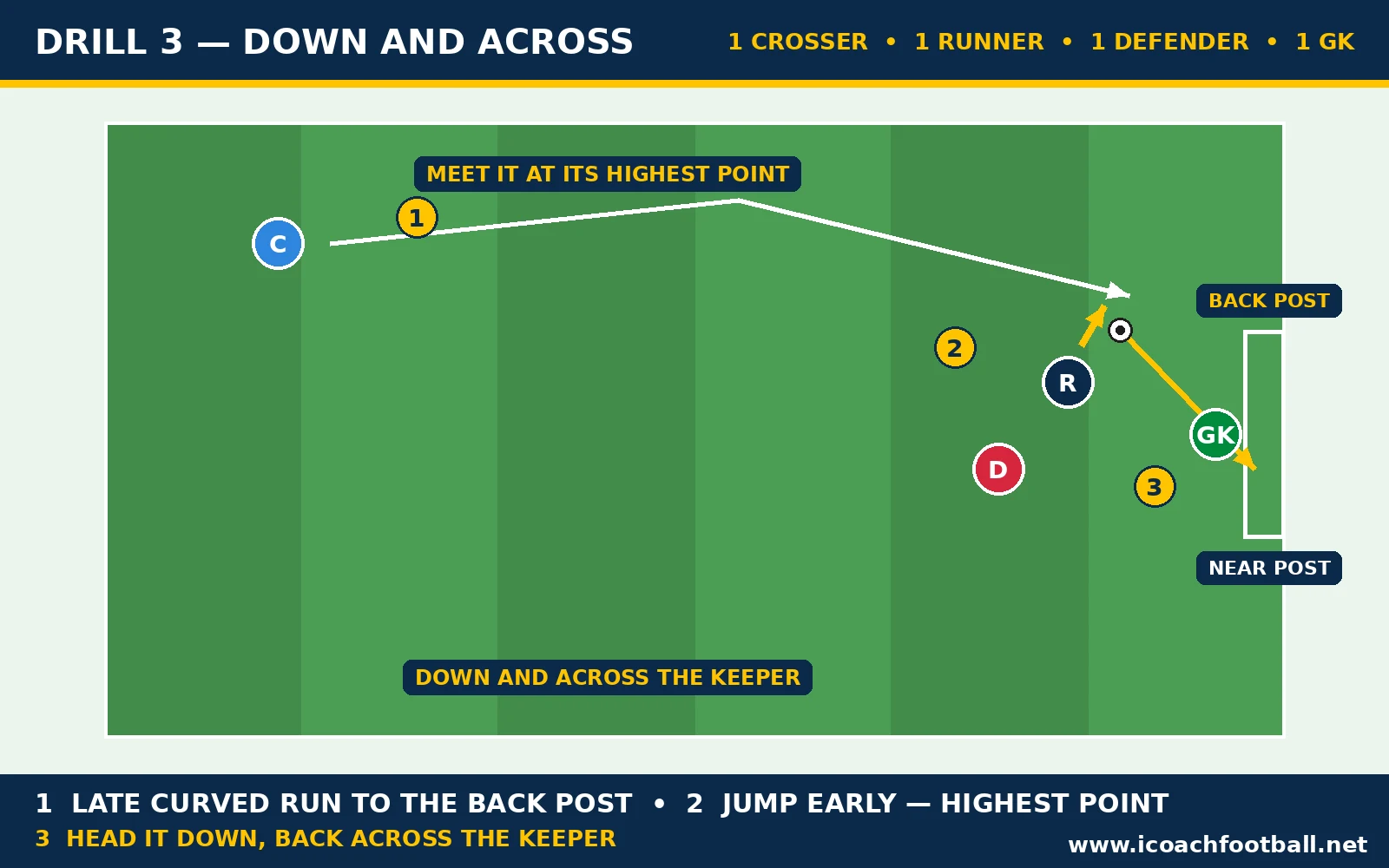
Drill 3 — Head It Down and Across
The finish — the runner meets the cross at its highest point and heads it down, back across the keeper, into the far corner.
Setup
- Penalty box, 1 crosser wide, 1 runner, 1 goalkeeper, 1 passive defender.
- 8 minutes, then rotate.
How to Play
- The crosser receives the ball wide and looks to deliver high to the back post.
- The runner makes the late curved run to the back post, arriving on the move.
- The runner jumps early and meets the ball at its highest point.
- The runner heads the ball down, back across the goalkeeper, into the far corner.
- The goalkeeper tries to save it — a header back across goal is the hardest to stop.
- After 6 reps, rotate — the runner becomes the crosser and the crosser becomes the runner.
Coach’s note: “Down and across — a header at the keeper is a save; a header back across the keeper is a goal.”
Progressions: The defender becomes live and jumps with the runner; the crosser may deliver a low driven cross for a first-time volley; the runner must score with a header from a cross played from the opposite flank.
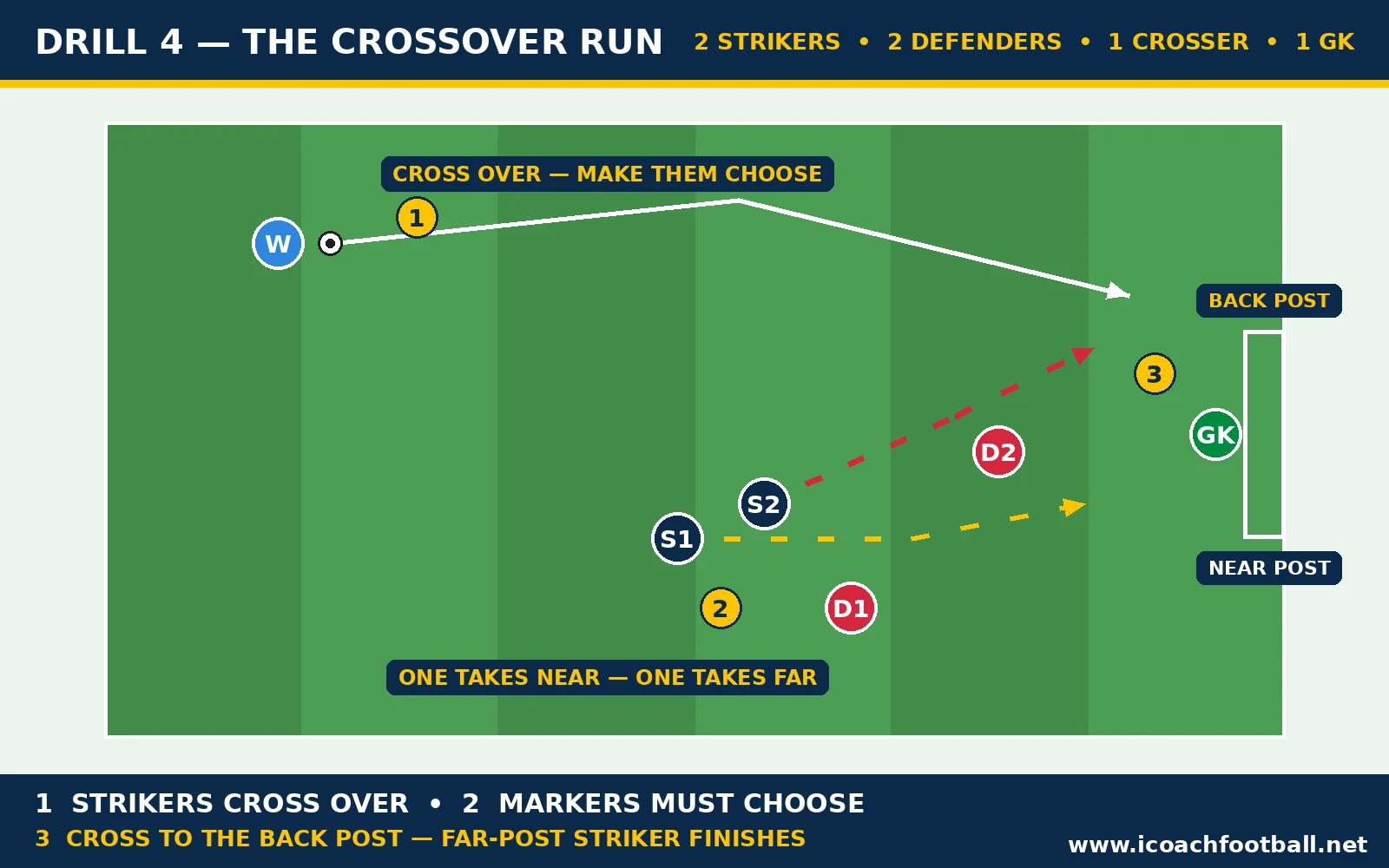
Drill 4 — The Crossover Run
Two strikers cross over to lose their markers — one takes the near post, the other takes the far post, and the defenders have to choose.
Setup
- Penalty box, 2 strikers, 2 defenders, 1 crosser wide, 1 goalkeeper.
- 10 minutes.
How to Play
- The two strikers start together, level with the penalty spot.
- The crosser takes a touch and looks up — the strikers hold.
- On the trigger, the strikers cross over — one sprints to the near post, one to the far post.
- The defenders must choose: stay with their man or pass him on zonally.
- The crosser delivers to the back post and the far-post striker finishes first time.
- Play for 2 minutes, then swap — the strikers become defenders and two defenders step in.
Coach’s note: “Cross over and the markers have to think — a defender who has to choose is a defender who is already half a second late.”
Progressions: The strikers may cross over twice before the cross; the crosser may deliver to the near post instead, so the near-post striker must be ready; add a third striker arriving late at the penalty spot.
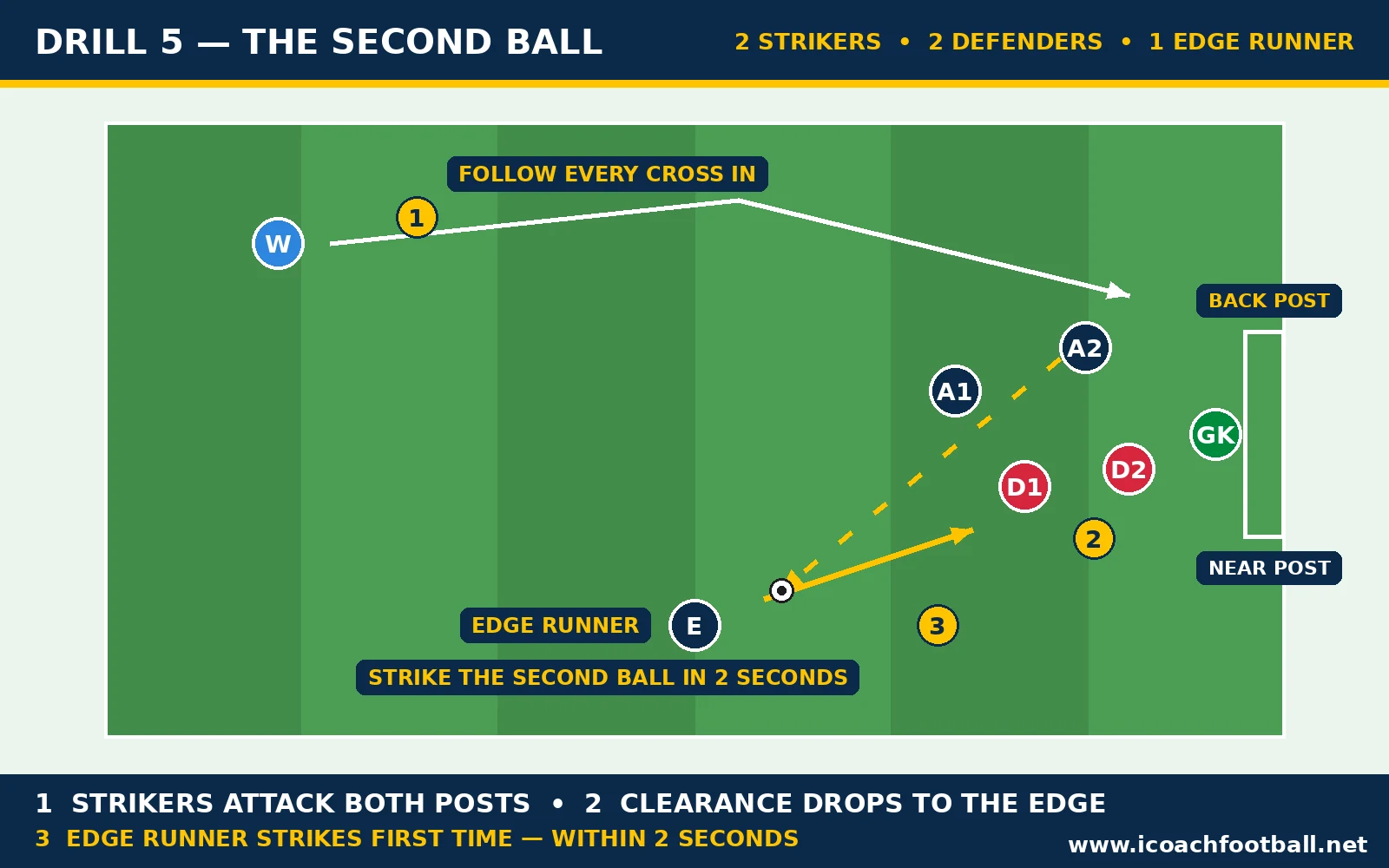
Drill 5 — The Second Ball at the Back Post
The edge runner — one attacker stays outside the box and follows every cross in, so the clearance that drops short becomes a goal.
Setup
- Penalty box and edge, 2 strikers, 2 defenders, 1 crosser wide, 1 edge runner, 1 goalkeeper.
- 10 minutes.
How to Play
- The crosser delivers to the back post from the wide channel.
- The two strikers attack the near and far posts; the edge runner holds at the D.
- The defender wins the first ball and heads it out — the clearance drops to the edge.
- The edge runner is already moving in and strikes the second ball first time.
- The edge runner must shoot within 2 seconds of the clearance, or the rep is dead.
- Play for 2 minutes, then swap — the edge runner becomes a striker and a striker drops to the edge.
Coach’s note: “Follow every cross in — the striker who watches the header and walks away never scores the second ball.”
Progressions: The defenders may clear to a target zone the edge runner must read; the edge runner may take one touch before shooting; add a second edge runner arriving from the opposite side.
Drill 6 — The Back-Post Game
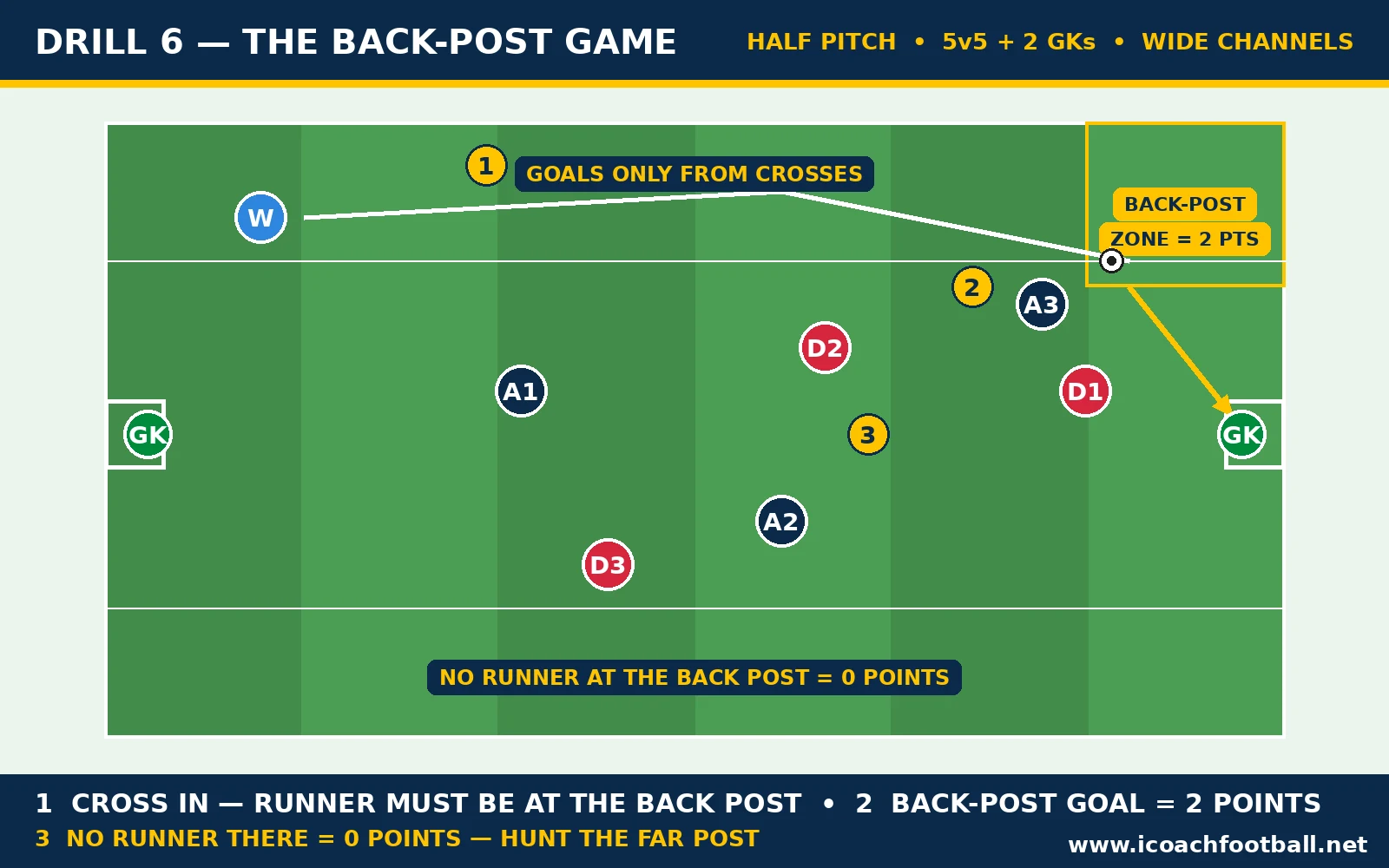
The full game. A 5v5 where goals only count from crosses, and a goal from the back-post zone is worth two — so the group starts hunting the far post like it matters, because it does.
Setup
- Half a pitch, 5v5 plus 2 goalkeepers, wide channels marked on both sides.
- 15 minutes.
How to Play
- Two teams of 5 play 5v5 with goalkeepers — goals only count from crosses.
- A goal from the back-post zone is worth 2 points; a goal from anywhere else is worth 1.
- The attacking team must have a runner at the back post for every cross.
- If no runner is at the back post when the cross comes in, the goal counts for 0 — even if it goes in.
- The team with the most points after 15 minutes wins — then play again with new teams.
- Coaches call out every back-post arrival, so the whole group hears what good attacking sounds like.
Coach’s note: “Count the back-post arrivals out loud — the moment the group starts celebrating a far-post run like a goal, the habit is built.”
Progressions: Crosses must be first-time; the attacking team may use an overlapping full-back to deliver; goals from the back post only count if the scorer arrived from outside the box.
Coaching points
- The trigger is the head lift, not the kick. A runner who starts when the ball is struck is already late. Watch the crosser’s head and body — the cross is decided before the foot meets the ball.
- Late and fast beats early and slow. The run must arrive at full speed. A runner who arrives early has to stop, turn and jump from a standstill — and a standing jumper never beats a moving one.
- Hide, then break. Start on the defender’s blind side, on the outside shoulder, where the marker cannot see both you and the ball. The break is what loses the marker, not the speed.
- Run into the line of the ball. A curved run that meets the cross on its line gives a straight header or volley. A run across the ball’s line gives a sideways glance that rarely finds the corner.
- Head it down and across. The header that goes down and back across the keeper is the hardest save in football. A header straight at the keeper, or up in the air, is a catch.
- Follow every cross in. The second ball is a goal waiting to happen. The edge runner who is already moving when the clearance drops scores it — the one who watches the header loses it.
Common mistakes
| Mistake | Fix |
|---|---|
| Starting the run too early and standing still at the back post | Hold until the crosser’s head lifts — Drill 2 stops the rep if the runner is standing still when the cross arrives |
| Running in a straight line the defender can track | Curve the run from the defender’s blind side — Drill 1 only scores the finish if the runner started unseen |
| Meeting the ball flat-footed under it | Arrive at full speed and jump early — Drill 3 only scores the header if the runner meets the ball at its highest point |
| Heading the ball straight at the goalkeeper | Head it down and across goal — Drill 3 stops the rep if the header goes within a yard of the keeper |
| Both strikers running to the same post | One takes near, one takes far — Drill 4 only scores the finish if the two strikers crossed over |
| Watching the header instead of following it in | The edge runner follows every cross — Drill 5 only scores the second ball if it is struck within 2 seconds of the clearance |
Age adaptations
| Age | Format | What changes |
|---|---|---|
| U11–U12 (ages 10–12) | Penalty box only, size 4 ball, crosses thrown by hand or rolled in | All six drills run with soft, predictable crosses and the runner walking the curved run first. Drill 3 uses a server who calls the cross — “Crossing now!” — so the jump and the header can be learned in slow motion. Drill 6 plays with no scoreboard for goals — only back-post arrivals are counted, so the group learns what a good run looks like |
| U13–U14 (ages 12–14) | Half a pitch, size 4 ball, crosses struck from 20 yards | All six drills run as written, with the defender becoming live from the second round. Drill 2 adds the weaker-foot finish, and Drill 4 adds the third late striker at the penalty spot. Runners keep a simple count of their arrivals — “four back-post runs, two finishes” is the habit that sticks |
| U15–U17 (ages 14–17) | Full areas, size 5 ball, crosses live from the first rep | Full pressure from the start. Drill 1 runs with the crosser free to fake the cross and drive inside, Drill 5 adds the second edge runner, and Drill 6 adds the overlapping full-back. Runners are asked to name the cross they read before each run — “high, back post” — so the decision becomes a conscious skill, not a lucky guess |
60-minute session plan
| Block | Time | Content |
|---|---|---|
| Arrival game | 0:00–0:05 | Free 3v3 in the box — every back-post finish is worth 2 points |
| Read the cross early | 0:05–0:13 | Drill 1 — Read the Cross Early |
| The late far-post run | 0:13–0:23 | Drill 2 — The Late Far-Post Run |
| Head it down and across | 0:23–0:31 | Drill 3 — Head It Down and Across |
| The crossover run | 0:31–0:41 | Drill 4 — The Crossover Run |
| The second ball at the back post | 0:41–0:51 | Drill 5 — The Second Ball at the Back Post |
| The back-post game | 0:51–1:00 | Drill 6 — The Back-Post Game |
Keep building from here
The defending half of this pair — how to stop the cross at the far post — is our soccer drills for improving defending the back post, and the late run that gets an attacker to the back post in the first place is our football late runs into the box drills — together the three posts cover the whole back-post sequence. The near-post run that attacks the other end of the cross is our football heading drills near post run, and the wide-area play that creates the cross is our the wide channel game crossing and finishing. The attacking-third shape that gets the ball wide is our soccer attacking third drills, and the finishing under pressure that turns a back-post arrival into a goal is our soccer drills for improving finishing under pressure. The 1v1 finish that follows a back-post knock-down is our 1v1 finishing drills soccer, and the aerial duel that decides most back-post crosses is our soccer drills for improving aerial duels. The crossing-and-finishing routine that rehearses the same deliveries is our excellent shooting drill crossing finishing in actions, and the anticipation that tells an attacker which cross is coming is our soccer drills for improving anticipation. The scan that lets a runner read the crosser is our soccer scanning drills. Back-post attacking is high-intensity work — plan the week’s load with our training load calculator.
The near-post finish that completes the crossing pair is our soccer drills for improving attacking the near post.
Sources
- FIFA Training Centre. “Movement to attack the space in behind” — FIFA Talent Coach Claudio García and Costa Rican FA Talent Coaches Lina Arana and Manfred Schumann train attackers to combine perfectly weighted passes with well-timed runs, make decoy runs across the back of defenders, use wide players to stretch the opposition, and make runs based on the ball carrier’s actions. Verified live 2026-11-20 (HTTP 200, full text read). Drills 1, 2 and 6 are based on / in line with this session’s well-timed-runs, decoy-runs and wide-players principles.
- England Football Learning. “Attacking session: width for deception” — a finishing session programme session that supports players to use width to create goalscoring chances, work on different types of crosses, develop their movement skills to get out wide, and practise finishing from a cross into the box. Verified live 2026-11-20 (HTTP 200, full text read). Drills 3, 4 and 5 are based on / in line with this session’s width, cross-types and finishing-from-a-cross principles.
What is the back post in soccer?
The back post — also called the far post — is the goalpost furthest from the ball when a cross comes in. Crosses to the back post are dangerous for defenders because the far-side attacker arrives with a run, the goalkeeper is often caught between coming for the ball and staying on the line, and the header can be directed back across goal. In the UK it is usually called the far post, but the job is the same: arrive at the back post as the ball arrives.
When should a player start their run to the back post?
On the crosser’s trigger — the moment the crosser’s head lifts and the body opens to cross — not when the ball is struck. A runner who starts on the kick is already a yard behind the ball. The run should be late and fast: hold at the edge of the box, then sprint on a curved run so you arrive at the back post at full speed at the same moment as the cross. Drill 2 trains exactly that timing.
How do you finish a cross at the back post?
Meet the ball at its highest point and head it down, back across the goalkeeper, into the far corner. A header back across goal is the hardest ball for a keeper to save because it travels away from their dive. A low cross should be finished first time — volley or side-foot — using the pace of the ball, with no second touch. Never let the ball bounce at the back post. Drill 3 trains the header, and Drill 5 trains the second ball when the cross is cleared.
What is a crossover run in soccer?
A crossover run is when two attackers swap sides as they run into the box — one sprints to the near post, the other to the far post — so their markers have to choose whether to stay with their man or pass him on. The defender who has to choose is already half a second late. The cross then goes to the back post, where the far-post striker finishes first time. Drill 4 trains the crossover with two strikers against two defenders.
At what age should players start training back-post attacking?
From U11, with soft thrown crosses and a walking curved run, so the read, the timing and the call become habits before the pressure is real. The jump and the header can both be trained young — what must wait is the full-speed cross against a live, tracking defender. Add struck crosses and live defenders gradually from U13, and full-pressure back-post games from U14, once the run is late and the finish is down and across.