Soccer Drills for Improving Finishing Under Pressure: 6 Games That Teach Players to Score When It Matters (U10–U16)
Quick answer
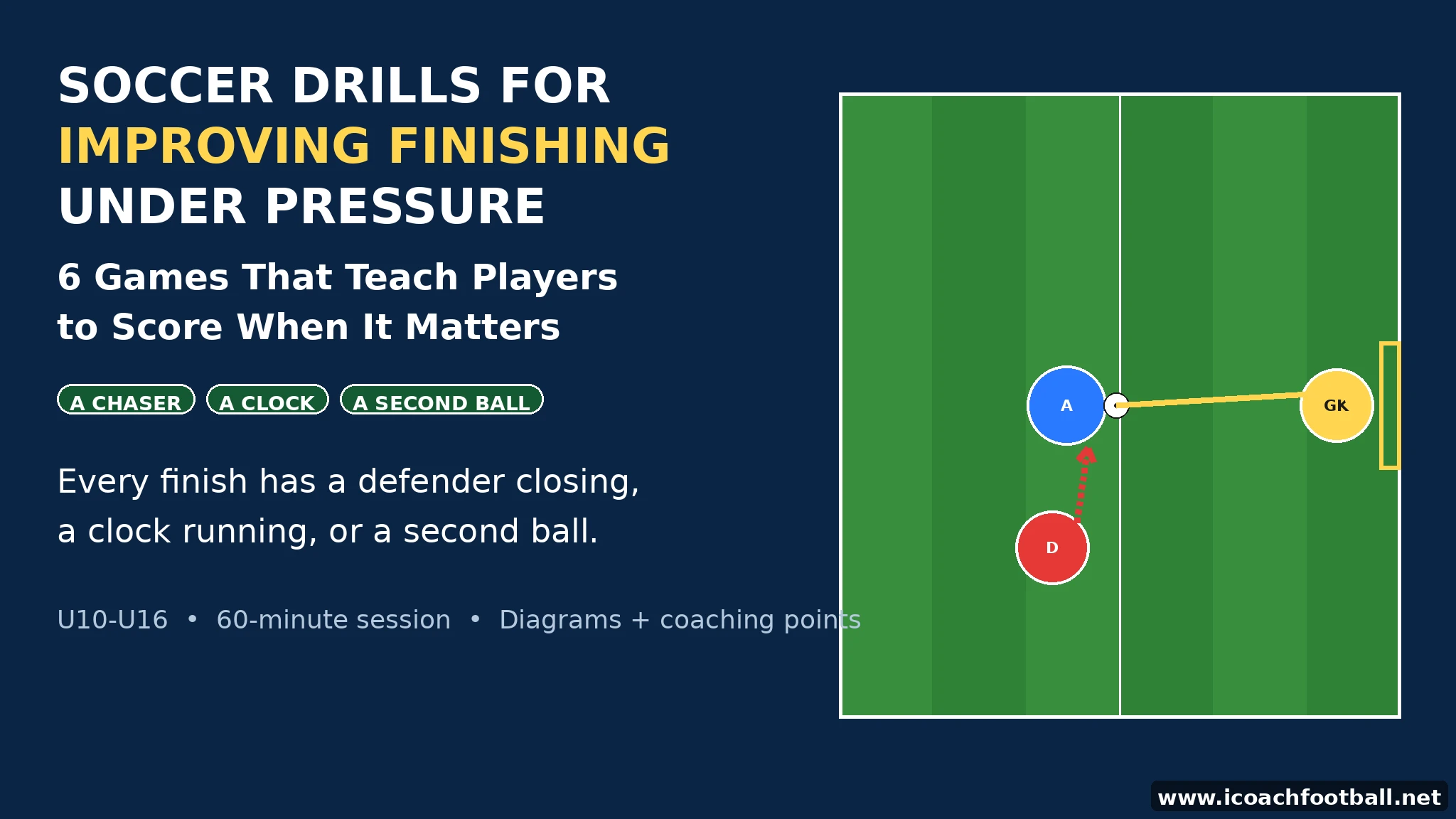
Finishing under pressure is a different skill from finishing in an empty net. It is shooting with a defender closing, a clock running, or a rebound dropping — and it is trained by putting all three into every drill. Six games — one 60-minute session — teach players to shoot on sight, pick a corner early, and follow every shot, from a chase finish to a conditioned 6v6.
Suitable for: U10–U16 (ages 9–16)
Session snapshot
- Players: 12–16 (U10–U16)
- Area: 25 x 20-yard area expanding to a 40 x 30-yard game pitch
- Duration: 60 minutes
- Focus: Finishing past a keeper with a defender closing, a clock running, or a second ball arriving
- Equipment: 12–14 balls, 20 cones, 2 full goals, bibs
Why these six games work
Most finishing practice is a lie. The striker stands still, takes three touches, and shoots at an empty net — then wonders why the same chance goes over the bar on Saturday. A goal in a real game is normally scored past a goalkeeper and whilst the player is under some pressure, as The FA’s coach development officer Pete Augustine puts it. His advice is blunt: create a practice that emulates elements of the game — obstacles in the way, players in the way, game-like challenges or timed games.
That is the rule this session is built on. Every drill has a live presser, a clock, or a second ball — usually two of the three. FIFA’s Training Centre runs the same principle in its “Creating chances and finishing” session: a 5v3 overload game that forces players to take goalscoring chances when they appear, first-time finishes after a through ball or cross, and a points system that rewards spectacular goals. Drills 2, 4 and 6 below are based on / in line with that FIFA material. In the UK the same session is football drills for improving finishing under pressure — the games, the clocks and the coaching points are identical.
This post sits in the finishing cluster: our 1v1 finishing drills train beating a defender before the shot, our finishing drills train the transition from winning the ball to scoring, and our soccer shooting drills cover the striking technique itself. This session adds the missing piece — the pressure.
Six rules of finishing under pressure
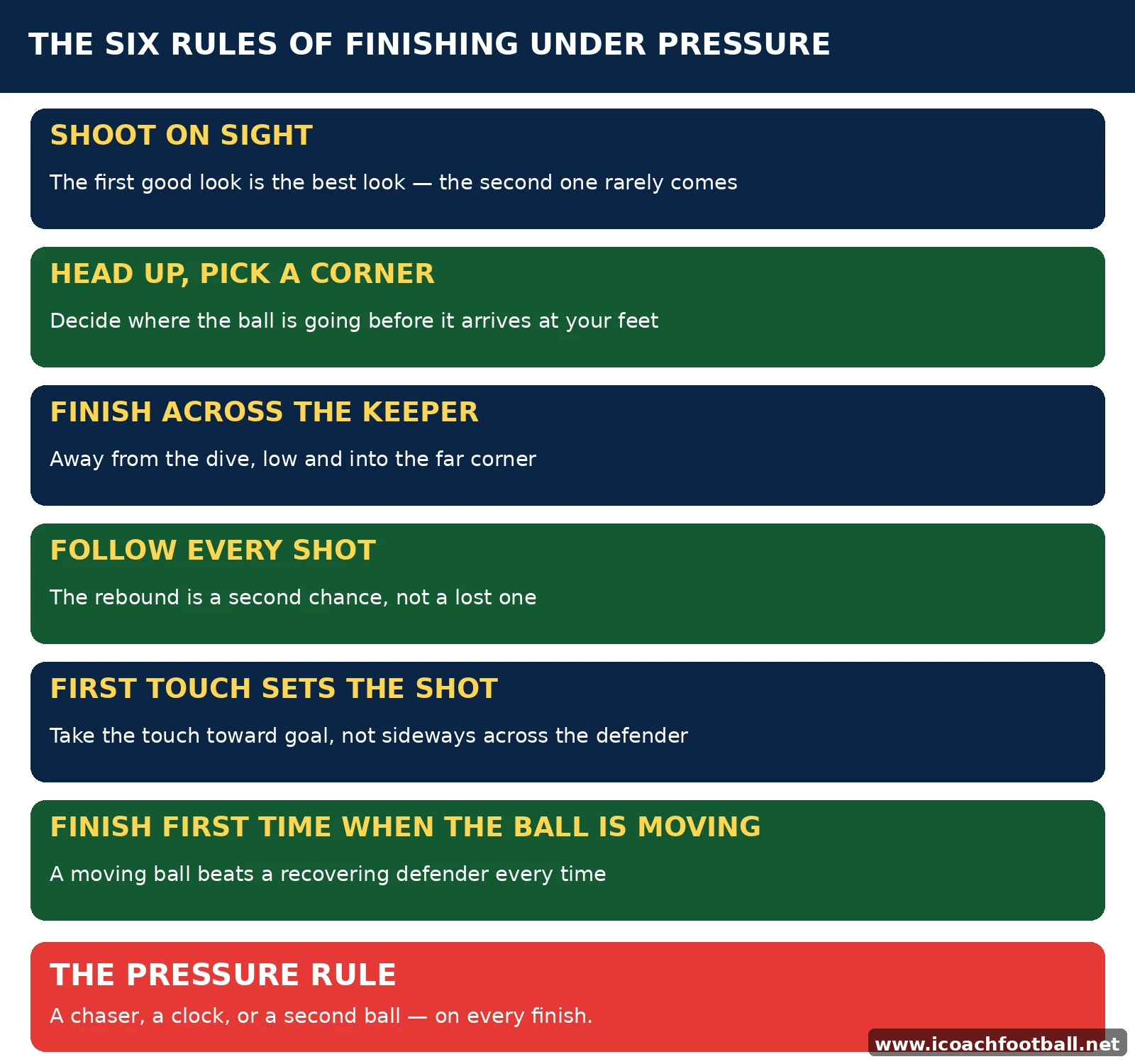
- Shoot on sight. The first good look is the best look — the second one rarely comes.
- Head up, pick a corner. Decide where the ball is going before it arrives at your feet.
- Finish across the keeper. Away from the dive, low and into the far corner.
- Follow every shot. The rebound is a second chance, not a lost one.
- First touch sets the shot. Take the touch toward goal, not sideways across the defender.
- Finish first time when the ball is moving. A moving ball beats a recovering defender every time.
Drill 1 — Chase the Finish
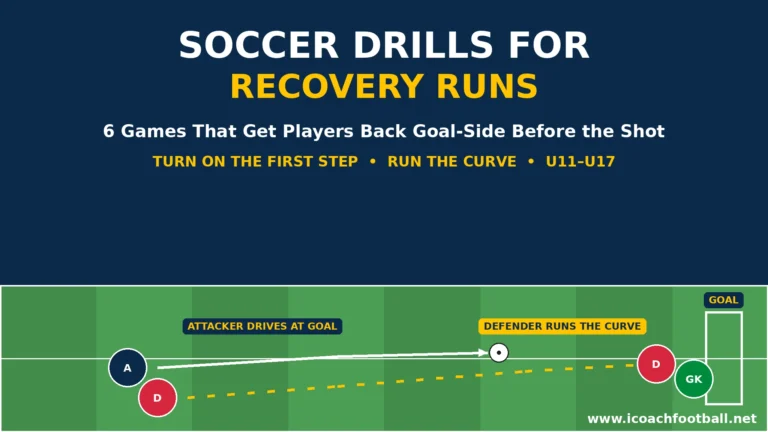
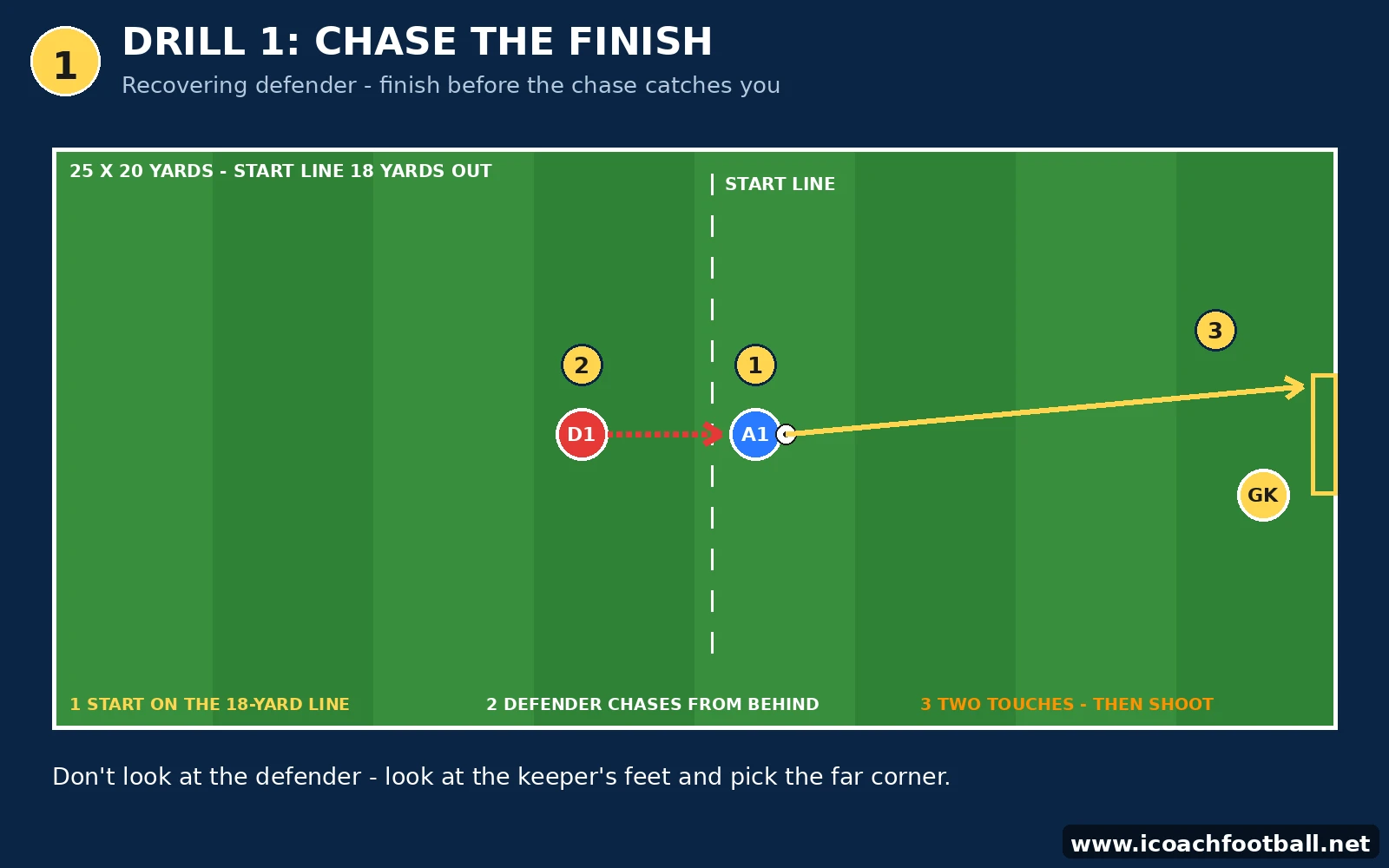
The recovering defender. The attacker starts 18 yards out with a defender 5 yards behind — finish before the chase catches you, or the chance is gone.
Setup
- 25 x 20-yard area, full goal at one end, cones marking a start line 18 yards out.
- 10 players: 8 attackers, 2 defenders, 1 goalkeeper. 8 minutes.
How to Play
- The attacker starts on the line 18 yards from goal, ball at their feet.
- The defender starts 5 yards behind the attacker and chases on the coach’s whistle.
- The attacker takes two touches maximum, then must shoot.
- If the defender touches the attacker or the ball, the attack is dead and no goal counts.
- A goal past the keeper scores 2 points; a goal after beating the defender clean scores 3.
- After 4 minutes, swap attackers and defenders so everyone is chased.
Coach’s note: “Don’t look at the defender — look at the keeper’s feet and pick the far corner before you shoot.”
Progressions: The defender starts 3 yards behind; the attacker must finish first time; the chase starts from the side instead of from behind.
Drill 2 — Three-Second Finish
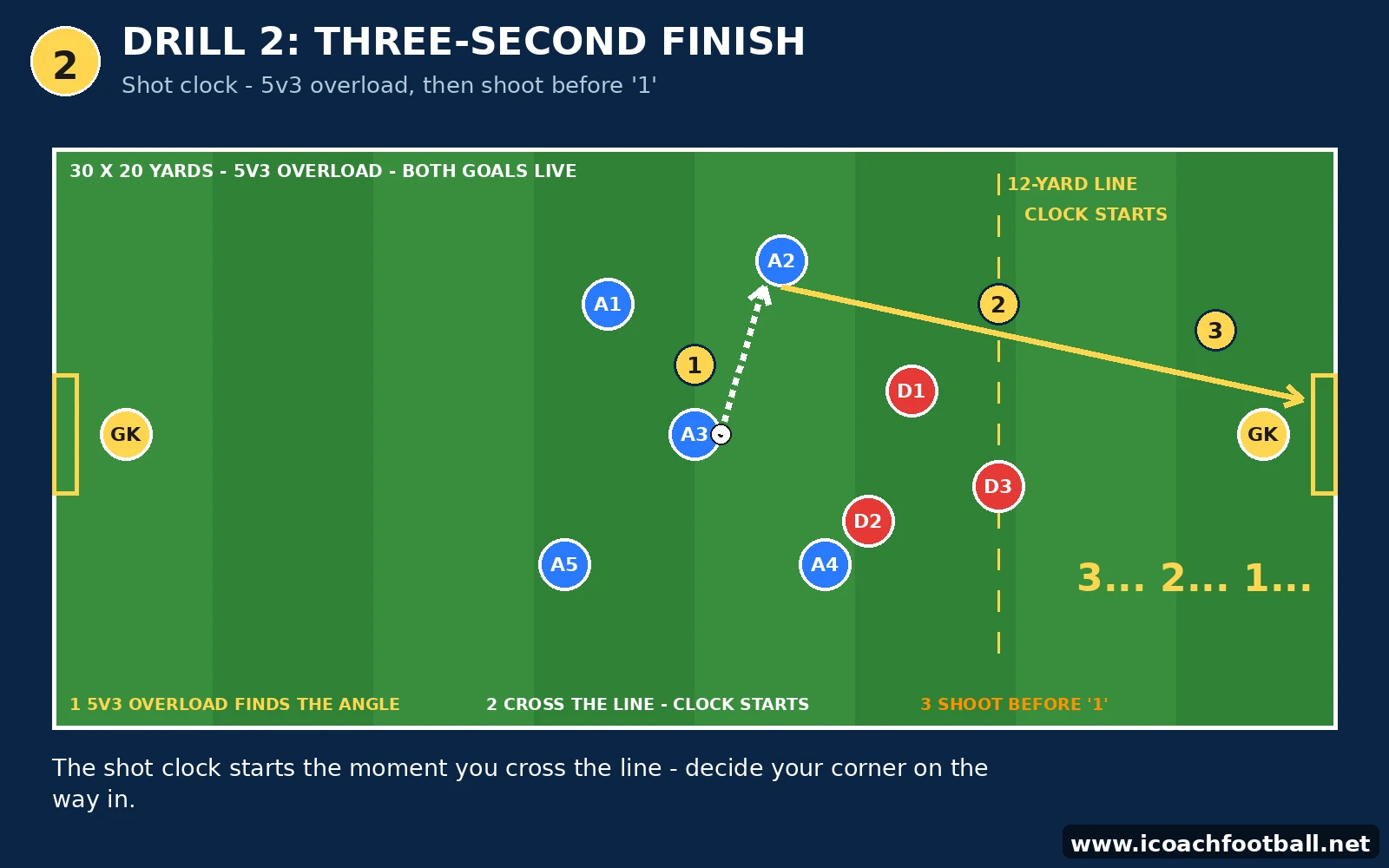
The shot clock. A 5v3 overload works a shooting angle, then the moment the ball crosses the 12-yard line the coach starts counting — shoot before “1” or the attack is dead.
Setup
- 30 x 20-yard area, full goal at each end, penalty line marked 12 yards out.
- 10 players: 5 attackers, 3 defenders, 2 goalkeepers. 8 minutes.
How to Play
- The attackers start with the ball and use their 5v3 overload to work a shooting angle.
- The moment the ball crosses the 12-yard line, the coach starts counting: “3… 2… 1…”
- The attackers must shoot before the count ends or the attack is dead.
- A goal scores 1 point; a first-time finish scores 2.
- If the defenders win it, they attack the other goal with the same 3-second rule.
- After 4 minutes, swap the overload so the other team attacks 5v3.
Coach’s note: “The shot clock starts the moment you cross the line — decide your corner on the way in, not when you arrive.”
Progressions: The count drops to 2 seconds; the overload becomes 4v3; goals only count from first-time finishes.
Drill 3 — Second Ball
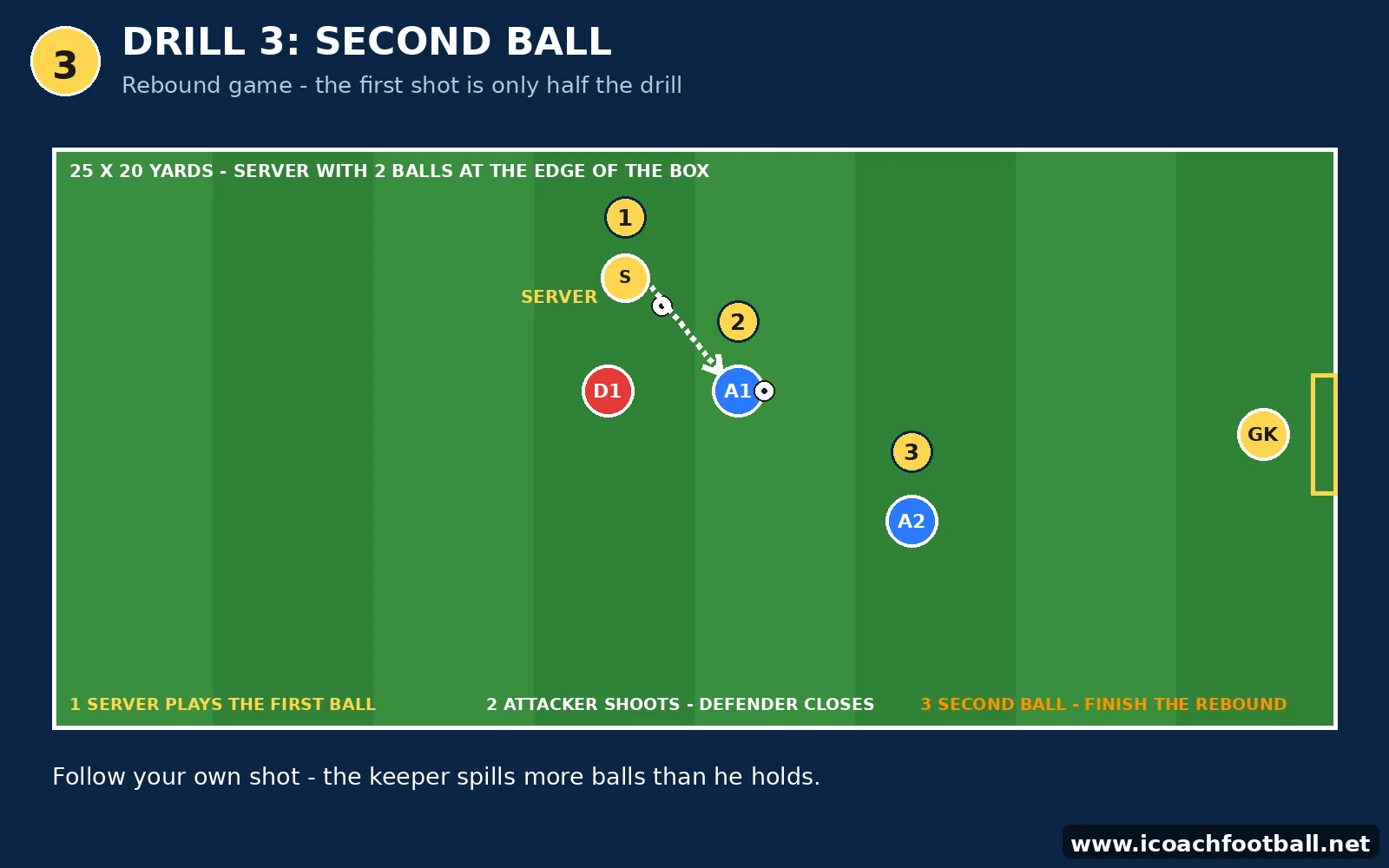
The rebound game. The first shot is only half the drill — the instant it is taken, a second ball is served into the box, and the player who attacks it scores double.
Setup
- 25 x 20-yard area, full goal, a server with 2 balls at the edge of the box.
- 10 players: 6 attackers, 3 defenders, 1 goalkeeper. 8 minutes.
How to Play
- The server plays the first ball to an attacker on the edge of the box.
- The attacker shoots first time or after one touch, with a defender closing from behind.
- The instant the shot is taken, the server plays the second ball into the box.
- The nearest attacker must attack the second ball and finish the rebound.
- A first-shot goal scores 1 point; a rebound goal scores 2.
- After 4 minutes, swap attackers and defenders so everyone chases the second ball.
Coach’s note: “Follow your own shot — the keeper spills more balls than he holds, and the rebound belongs to the player who runs.”
Progressions: The server plays the second ball wide for a cutback finish; the rebound must be first time; a defender is allowed to clear the second ball.
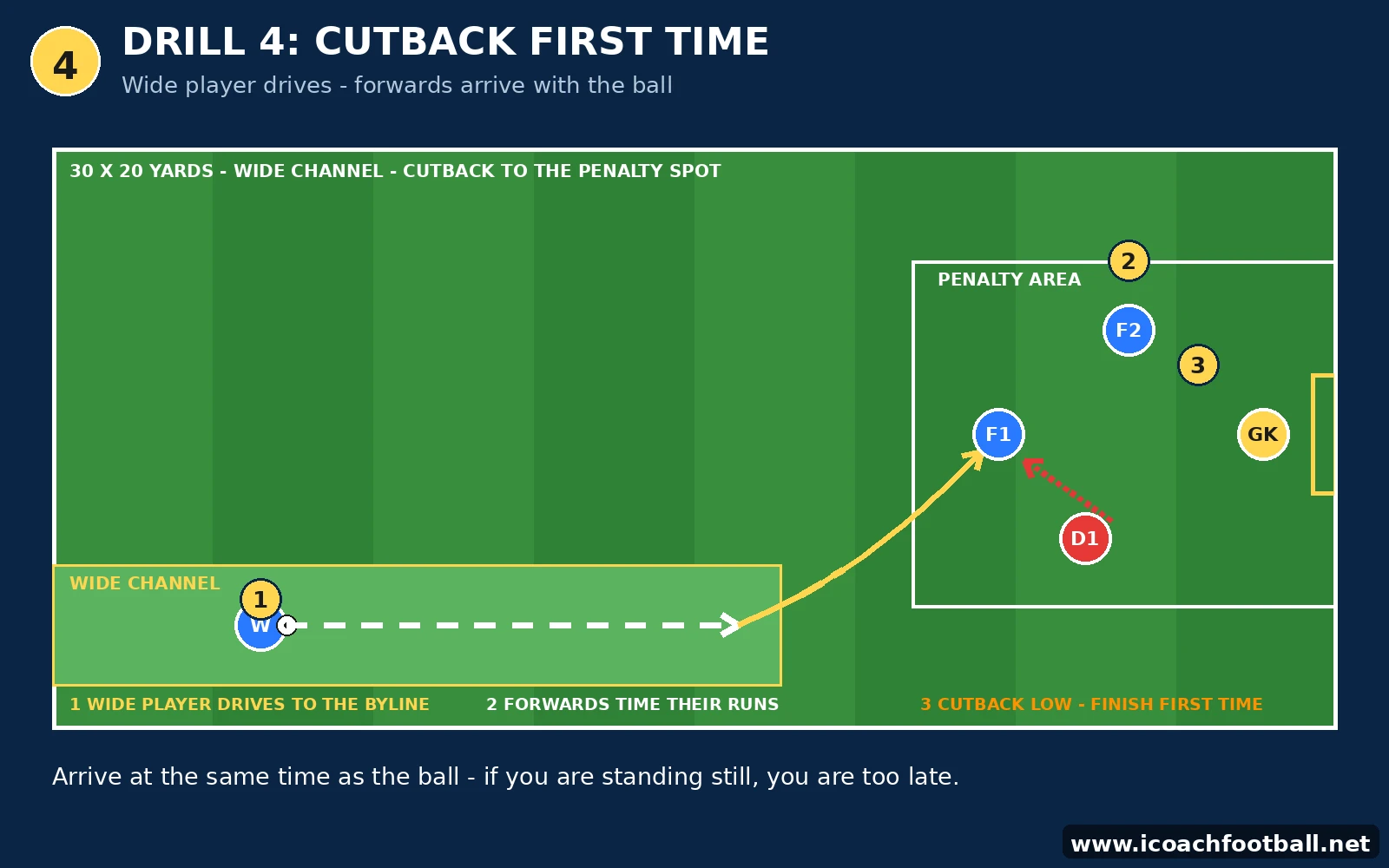
Drill 4 — Cutback First Time
The cutback. A wide player drives to the byline and cuts it back low and hard — the forwards must arrive at the same time as the ball and finish first time, with a defender recovering into the box.
Setup
- 30 x 20-yard area, full goal, wide channel marked with cones.
- 10 players: 6 attackers, 3 defenders, 1 goalkeeper. 8 minutes.
How to Play
- The wide player receives on the touchline and drives toward the byline.
- The two forwards time their runs to the penalty spot and the far post.
- The wide player cuts the ball back across the box — low and hard.
- The nearest forward finishes first time; no extra touch allowed.
- A cutback goal scores 2 points; a first-time finish from the far post scores 3.
- After 4 minutes, swap the wide players and forwards so everyone cuts and finishes.
Coach’s note: “Arrive at the same time as the ball — if you are standing still when the cutback comes, you are already too late.”
Progressions: A recovering defender chases the far-post runner; the cutback must be played with the weak foot; the forwards must finish with a volley or header.
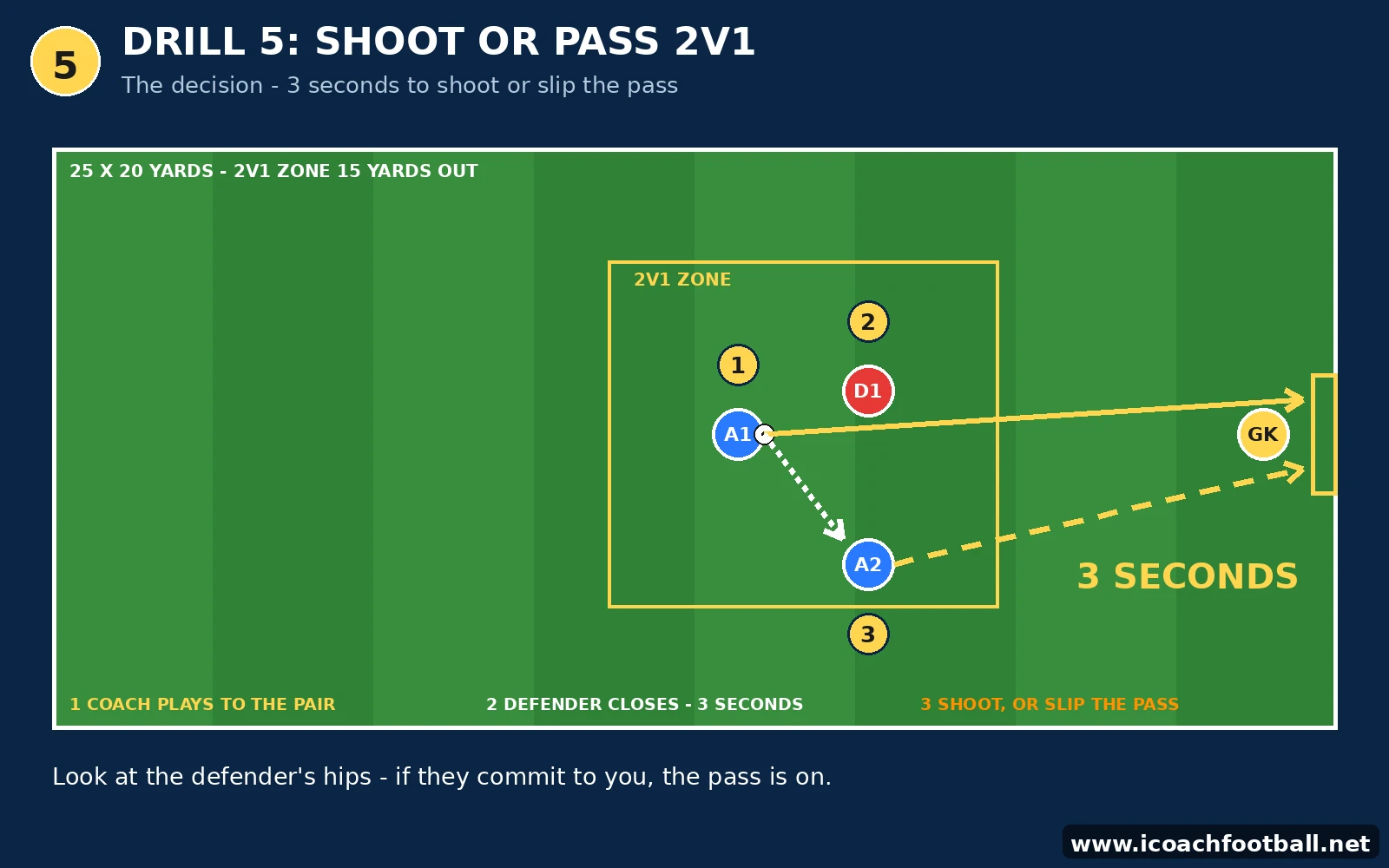
Drill 5 — Shoot or Pass 2v1
The decision. A pair of attackers against one defender and a keeper, with 3 seconds to choose — shoot, or slip the pass. The wrong choice is a dead attack.
Setup
- 25 x 20-yard area, full goal, cones marking a 2v1 zone 15 yards out.
- 9 players: 6 attackers, 2 defenders, 1 goalkeeper. 8 minutes.
How to Play
- The coach plays the ball to a pair of attackers at the top of the zone.
- One defender closes the ball carrier; the keeper sets their feet.
- The ball carrier has 3 seconds to decide: shoot or slip the pass to their partner.
- A goal from a shot scores 1 point; a goal from the slipped pass scores 2.
- If the defender wins it or the 3 seconds run out, the attack is dead.
- After 4 minutes, rotate the defenders so everyone defends the 2v1.
Coach’s note: “Look at the defender’s hips — if they commit to you, the pass is on; if they hold, take the shot.”
Progressions: The defender starts closer, so the decision comes faster; the second attacker must finish first time; the pair must score within 2 seconds.
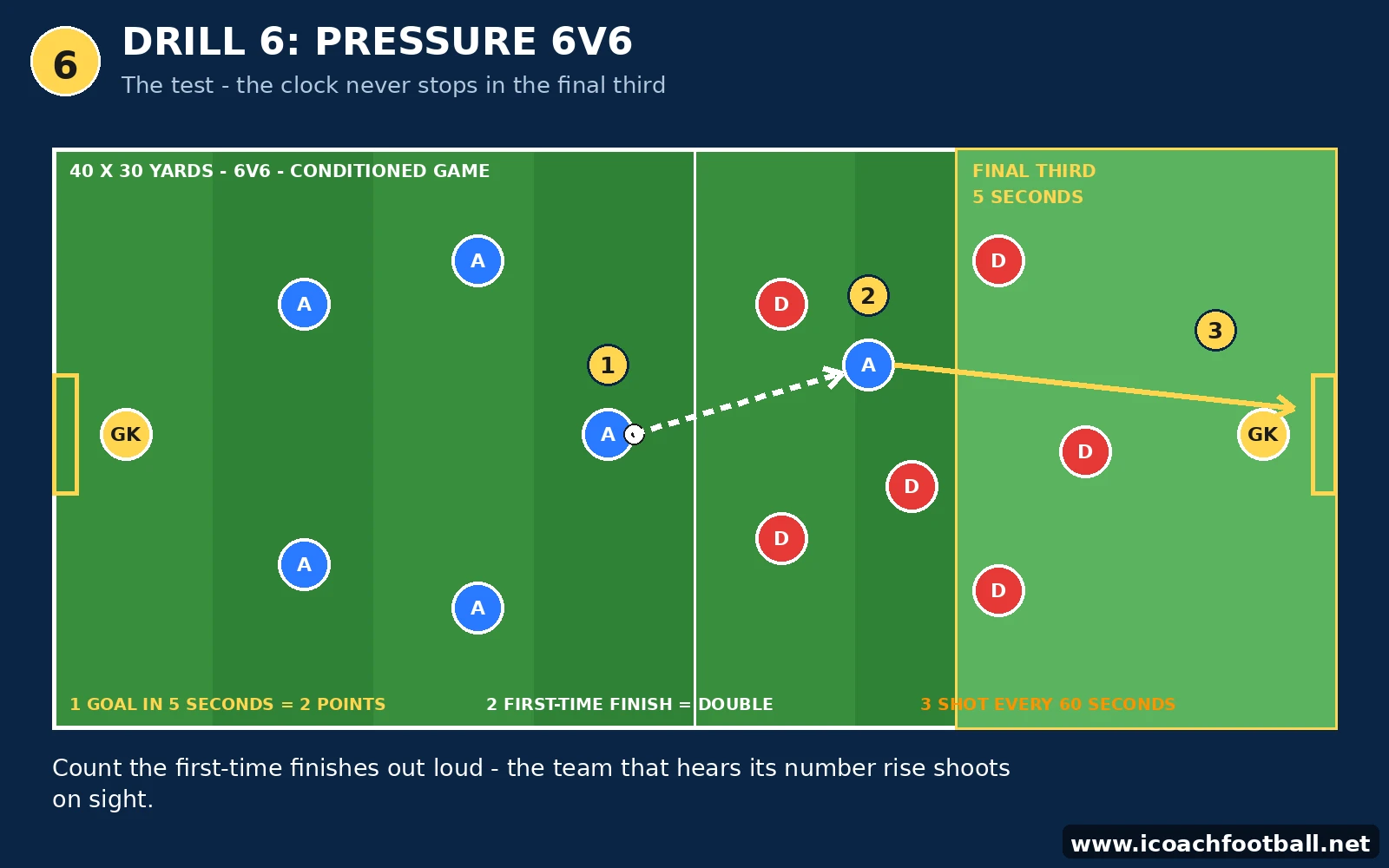
Drill 6 — Pressure 6v6
The test. A conditioned 6v6 where the clock never stops — goals scored within 5 seconds of entering the final third count double, and every team must shoot within 60 seconds of winning the ball.
Setup
- 40 x 30-yard pitch, 2 full goals, bibs.
- 12 players: 6v6. 15 minutes.
How to Play
- The game starts with a pass-in from the coach — no kick-offs, no corners.
- A normal goal counts 1 point; a goal scored within 5 seconds of entering the final third counts 2.
- A first-time finish or a rebound goal counts double.
- Every team must have a shot within 60 seconds of winning the ball or lose a point.
- Play 3-minute games, then swap the teams and play again.
- The coach calls out the shot clock — “5 seconds!” — every time a team enters the final third.
Coach’s note: “Count the first-time finishes out loud — the team that hears its own number rise starts shooting on sight.”
Progressions: Goals only count from first-time finishes or rebounds; the 60-second rule drops to 45 seconds; add a neutral player who must be found before a shot counts.
Common mistakes
| Mistake | What you see | Fix |
|---|---|---|
| Waiting for the perfect shot | The attacker takes three touches, the defender recovers, the chance is gone | Shoot on sight — the first good look is the best look |
| Head down at the ball | The shot goes straight at the keeper | Head up before the shot — pick a corner early |
| Shooting at the near post | The keeper saves it easily | Finish across the keeper, low and into the far corner |
| Stopping after the shot | The rebound falls to a defender and is cleared | Follow every shot — the rebound belongs to the player who runs |
| A big backlift under pressure | The defender blocks the shot before it leaves the foot | Short backlift, strike through the ball, finish first time |
| No call on the 2v1 | The partner does not know whether to shoot or pass | Call it — “mine!” or “slip!” — before the defender arrives |
Age adaptations
| Age | Format | What changes |
|---|---|---|
| U10–U12 (ages 9–12) | 20 x 15-yard areas, size 3–4 ball, mini goals | The pressure is taught one element at a time — the chaser first, then the clock. The shot clock in Drill 2 is 5 seconds, not 3, and the second ball in Drill 3 is served slowly so players have time to read it. Two touches allowed before the shot in Drill 1 until the two-touch habit is clean. See our U11 soccer practice plan for the session shape at this age, and our U12 soccer practice plan for the next step |
| U13–U14 (ages 13–14) | 25 x 20-yard areas, size 4 ball | All three pressure elements run together — chaser, clock and second ball. The shot clock in Drill 2 drops to 3 seconds and the rebound in Drill 3 must be first time. The cutback in Drill 4 must be played with the weak foot once the strong-foot version is clean. See soccer drills for U13 and soccer drills for U14 |
| U15–U16 (ages 14–16) | Full areas, size 5 ball | The chaser in Drill 1 starts 3 yards behind and the 60-second rule in Drill 6 drops to 45 seconds. Drill 5 adds the 2-second decision window, and Drill 6 only counts goals from first-time finishes or rebounds. See soccer drills for U15 and soccer drills for U16 |
60-minute session plan
| Time | Block | Drill |
|---|---|---|
| 0:00–0:05 | Arrival game | Free 3v3 — every shot on target scores a point, goals count double |
| 0:05–0:13 | The chaser | Drill 1 — Chase the Finish |
| 0:13–0:21 | The clock | Drill 2 — Three-Second Finish |
| 0:21–0:29 | The rebound | Drill 3 — Second Ball |
| 0:29–0:37 | The cutback | Drill 4 — Cutback First Time |
| 0:37–0:45 | The decision | Drill 5 — Shoot or Pass 2v1 |
| 0:45–1:00 | The game | Drill 6 — Pressure 6v6 |
New to coaching this age? Stretch the arrival game to 8 minutes and cut Drill 6 to 12 minutes and you have the same session with more settling-in time — see our 60-minute plan for the structure (the same shape, shortened where you need it).
Keep building from here
Finishing under pressure sits at the end of the attacking chain — the pass creates the chance, the decision picks the moment, and this session trains the finish. The 2v1 choice in Drill 5 is our soccer decision-making drills in a shooting context, and the pass that creates the chance is our soccer passing drills — under pressure it becomes our soccer drills for improving passing under pressure. The third-man timing in Drill 4 is trained in detail in our soccer third-man runs drills, and the cutback itself is the finish in our wide channel game. The turn a player needs when the read says “no shot on” is trained in our soccer drills for improving turning, and the read itself is our soccer drills for improving anticipation. The picture before the finish is our soccer scanning drills, and the confidence to take the shot is built in our soccer drills for improving confidence. The keeper at the other end of every drill needs our soccer goalkeeper communication drills, and the striker who wants more goals should read our soccer drills for strikers. The transition that starts Drill 2 is our finishing drills, and the calls that keep the pressure organised are our soccer communication drills. Warm up with our 10 soccer warm-up drills.When the finish has to come from further out, our soccer drills for improving shooting from distance train the laces strike, the set touch and the early release from 20–25 yards.
How do you teach players to finish under pressure?
Put the pressure into the drill, not just the game. Every finish in this session has a live presser, a clock, or a second ball — a defender chasing from 5 yards behind, a 3-second shot clock, or a rebound served the instant the first shot is taken. The FA’s advice is the same: a goal is normally scored past a goalkeeper and whilst the player is under some pressure, so practices should emulate the game with obstacles, players, or timed games.
What is the best finishing drill for U12 players?
Chase the Finish — Drill 1 in this session. The attacker starts 18 yards out with a defender 5 yards behind and must shoot within two touches. It teaches the two habits young finishers lack most: deciding the corner before the shot, and shooting before the defender arrives. For U10–U12, use a 5-second clock and allow two touches until the habit is clean.
How many touches should a player take before shooting?
Two at most, and one is better. FIFA’s Training Centre finishing work asks players to set themselves up so the first touch takes them toward goal, and its first-time finishes after a through ball or cross are the highest-value chances in the session. If a player needs three touches to shoot, the defender has already recovered — that is why Drills 1, 2 and 4 in this session all cap the touches before the shot.
Why do players miss easy chances in games?
Because they train against empty nets. Shooting with no keeper and no defender teaches a clean strike; it does not teach the decision, the corner pick, or the short backlift that a real chance demands. The fix is pressure in practice: a chaser, a clock, or a second ball on every finish, so the technique a player uses in training is the technique they use on Saturday.
How often should we practice finishing?
Every session, for 10–15 minutes. The FA’s guidance is to include an element of finishing in every practice, not just in a shooting session once a month. This 60-minute session runs once a week, and the chase finish from Drill 1 works as a 5-minute arrival game before any session — players shoot under pressure from the moment they arrive.
Sources
- FIFA Training Centre, “Creating chances and finishing (Urias)” — FIFA Technical Expert Jonas Urias’s session on giving players the confidence to score in a range of scenarios: a 5v3 overload game that forces players to take goalscoring chances when they appear, first-time finishes following a through ball or a cross, and a points system rewarding spectacular goals. Verified live 2026-11-18 (HTTP 200, full text read). Drills 2, 4 and 6 are based on / in line with this FIFA material.
- The FA / England Football Learning, Pete Augustine (FA coach development officer), “Finishing — when do we practice it” — “a goal is normally scored past a goalkeeper and/or whilst the player is under some pressure”, so finishing practices should emulate elements of the game: obstacles in the way, players in the way, game-like challenges or timed games. Verified live 2026-11-18 (HTTP 200, full text read). The framing of this post and Drills 1, 3 and 5 are based on / in line with this FA material.