Soccer Drills for Improving Marking: 6 Games That Teach Players to Stay Tight and Track Their Runner (U10–U16)
Quick answer
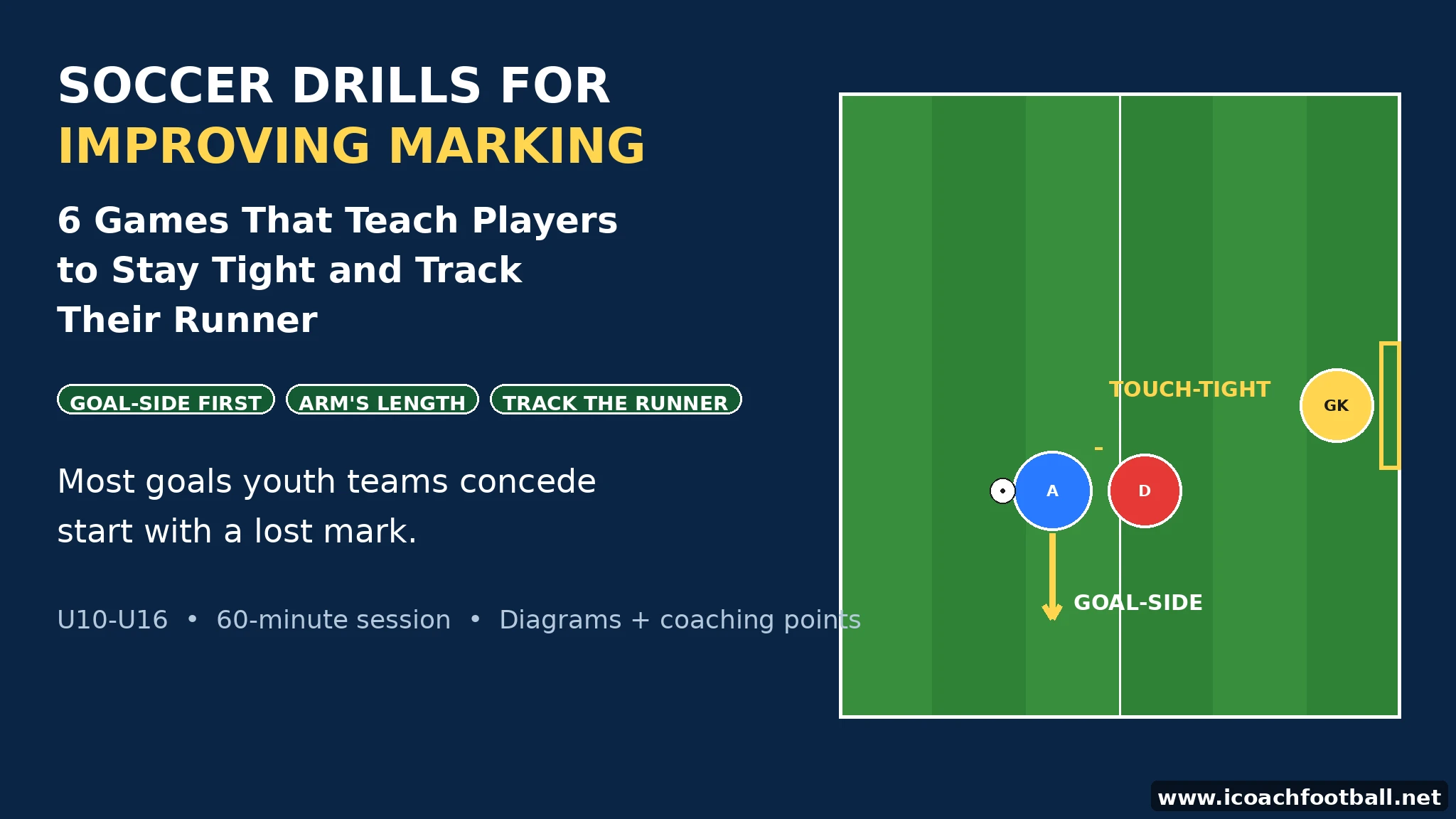
Marking is staying close enough to your opponent that they cannot receive the ball, turn, or run free — within arm’s length, goal-side, and watching ball and man at the same time. Most goals youth teams concede are not lost tackles; they are lost marks: a defender who lets their man turn, a runner nobody tracked, or a free attacker at the far post from a corner. Six games — one 60-minute session — teach players to stay touch-tight, stop the turn, track every run, hold a zone, mark at a corner, and never lose their man.
Suitable for: U10–U16 (ages 9–16)
Session snapshot
- Players: 12–16 (U10–U16)
- Area: 20 x 15-yard area expanding to a 40 x 30-yard game pitch
- Duration: 60 minutes
- Focus: Staying goal-side and touch-tight, tracking runners, handing over clearly
- Age: U10–U16
- Equipment: 12–14 balls, 20 cones, 2 full goals, bibs
Why these six games work
Watch a youth game for five minutes and you will see it. A striker receives the ball with their back to goal, turns, and shoots — and the defender is a yard behind, reaching. The tackle was never the problem. The mark was.
Marking is the skill that comes before every defensive action. FIFA’s Training Centre puts it plainly in its collective-defending methodology with Talent Coach Conor Marlin: effective defending begins with the individual player, and the first job is to influence the attacker in a direct 1v1 — apply immediate pressure, delay the attacker, force them away from central areas and onto their weaker foot, and prevent them from turning. Drills 1, 2, 3 and 6 below are based on / in line with that FIFA material. England Football’s marking and intercepting programme for 12–16s teaches the same idea from the other end: mark the target and force them away from goal, adapt your movement to track runs, use a side-on body position when marking tight, and give early and clear communication to the first defender. The framing of this post and Drills 2, 3 and 5 are based on / in line with that England Football material. In the UK the same session is football drills for improving marking — the distances, the cues and the coaching points are identical.
This post fills the gap in our defending cluster: our soccer drills for improving defensive positioning train where a player stands, our 1v1 defending drills train the duel itself, our defensive block trains the team shape, and our defensive transition drills train the first six seconds after losing the ball. This session adds the missing piece — who you mark, how tight you stay, and when you let a runner go.
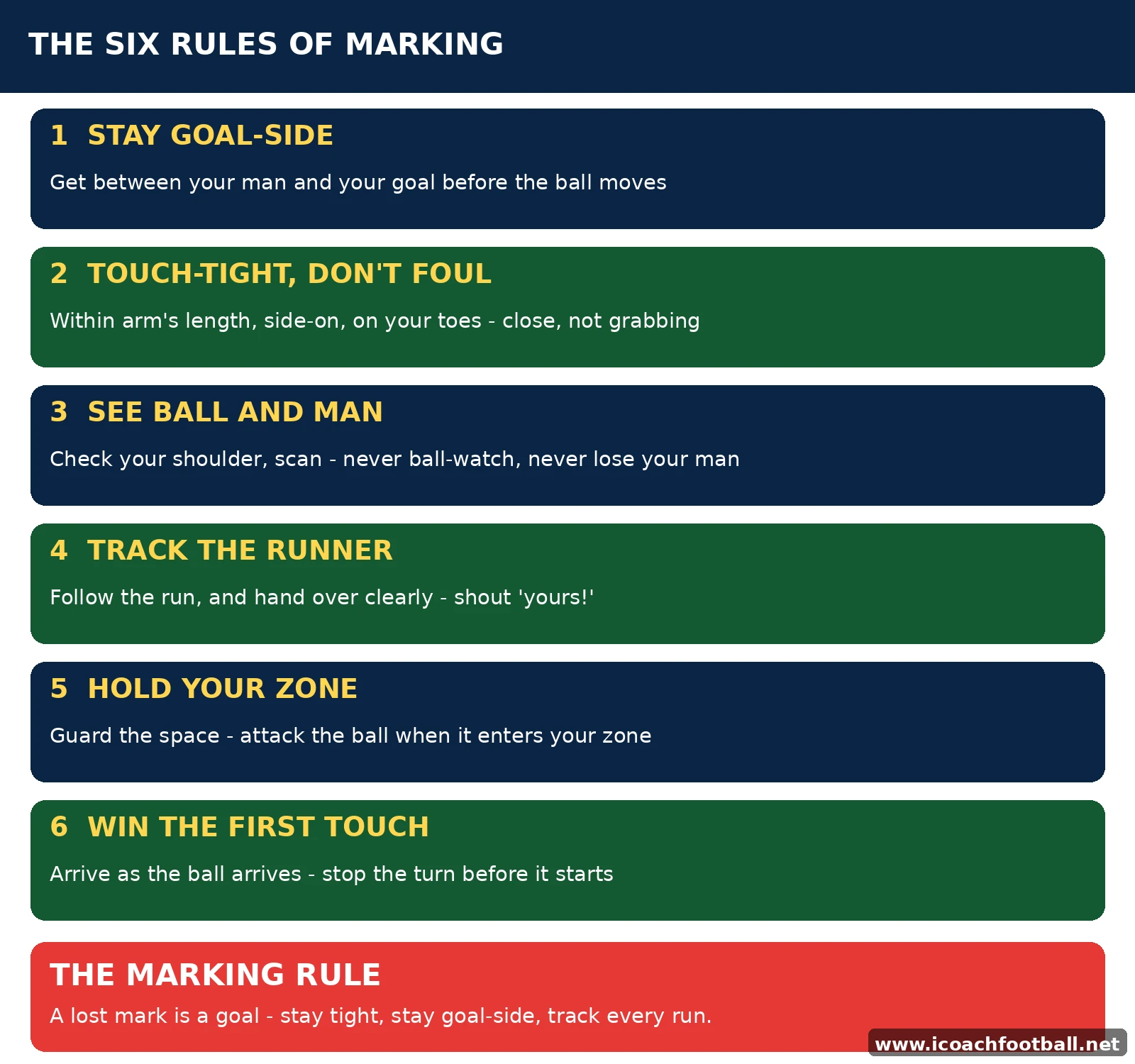
Six marking rules
- Stay goal-side. Get between your man and your goal before the ball moves.
- Touch-tight, don’t foul. Within arm’s length, side-on, on your toes — close, not grabbing.
- See ball and man. Check your shoulder, scan — never ball-watch, never lose your man.
- Track the runner. Follow the run, and hand over clearly — shout “yours!”
- Hold your zone. Guard the space — attack the ball when it enters your zone.
- Win the first touch. Arrive as the ball arrives — stop the turn before it starts.
Drill 1 — Shadow Marking
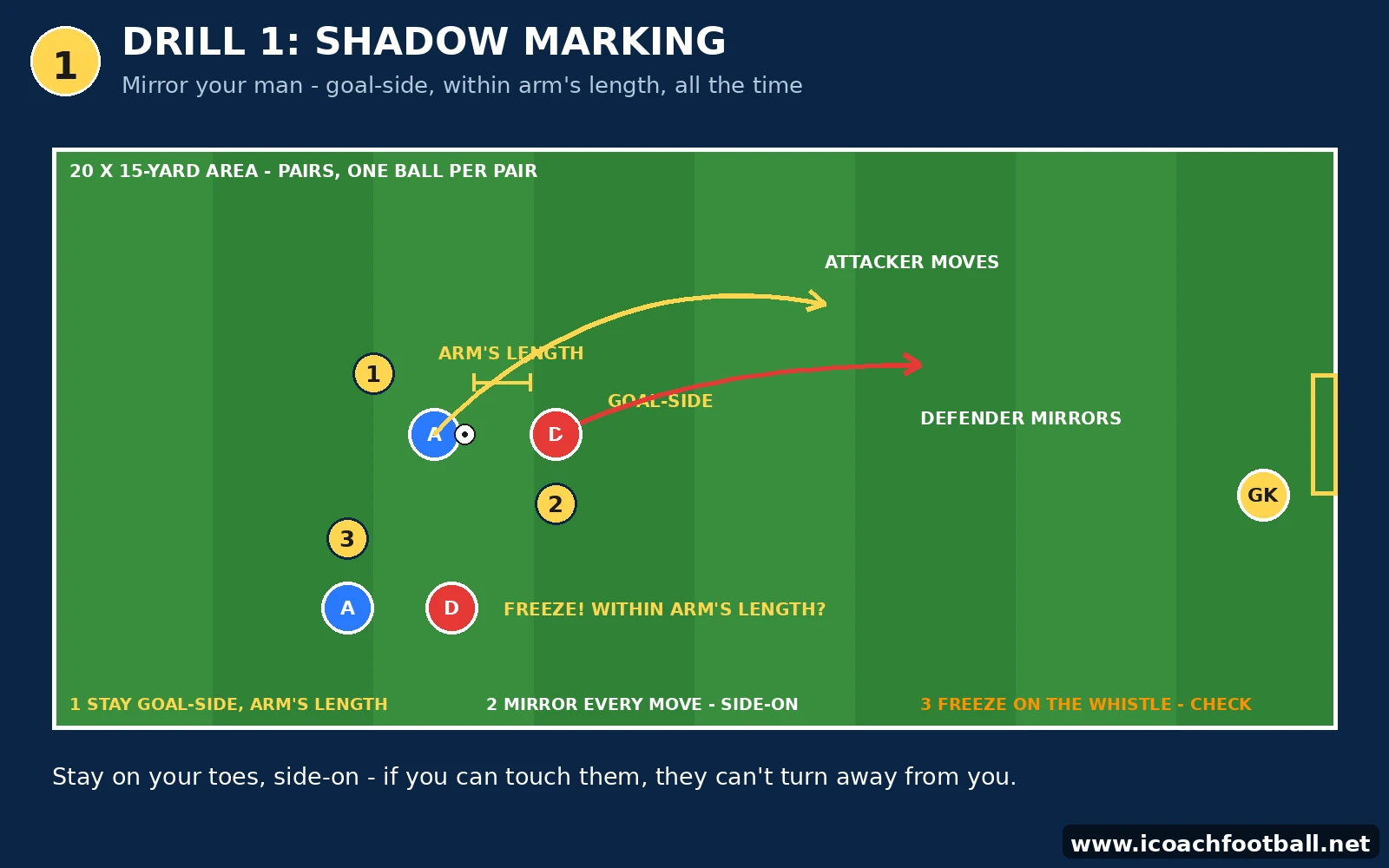
The starting point. A defender against an attacker in a small area, and the only rule that matters: stay goal-side and within arm’s length, wherever the attacker goes. A defender who can mirror a man for 30 seconds can mark anyone.
Setup
- 20 x 15-yard area, one ball per pair.
- 12 players: 6 attackers, 6 defenders, in pairs. 8 minutes.
How to Play
- The attacker starts with the ball in the middle of the area, the defender a yard away, goal-side.
- The attacker dribbles anywhere in the area — changes of speed and direction, no set pattern.
- The defender mirrors every move, staying goal-side and within arm’s length at all times.
- On the coach’s whistle, everyone freezes — the defender must be within arm’s length and goal-side.
- A defender caught more than arm’s length away, or on the wrong side, gives the attacker 1 point.
- After 4 minutes, swap roles so everyone marks and everyone attacks.
Coach’s note: “Stay on your toes, side-on — if you can touch them, they can’t turn away from you.”
Progressions: The attacker may try a turn or a burst of pace to lose the marker; the defender must call “goal-side!” every time they reset; shrink the area to 15 x 12 yards so the mirror has to be quicker.
Drill 2 — Touch-Tight Receive-and-Turn
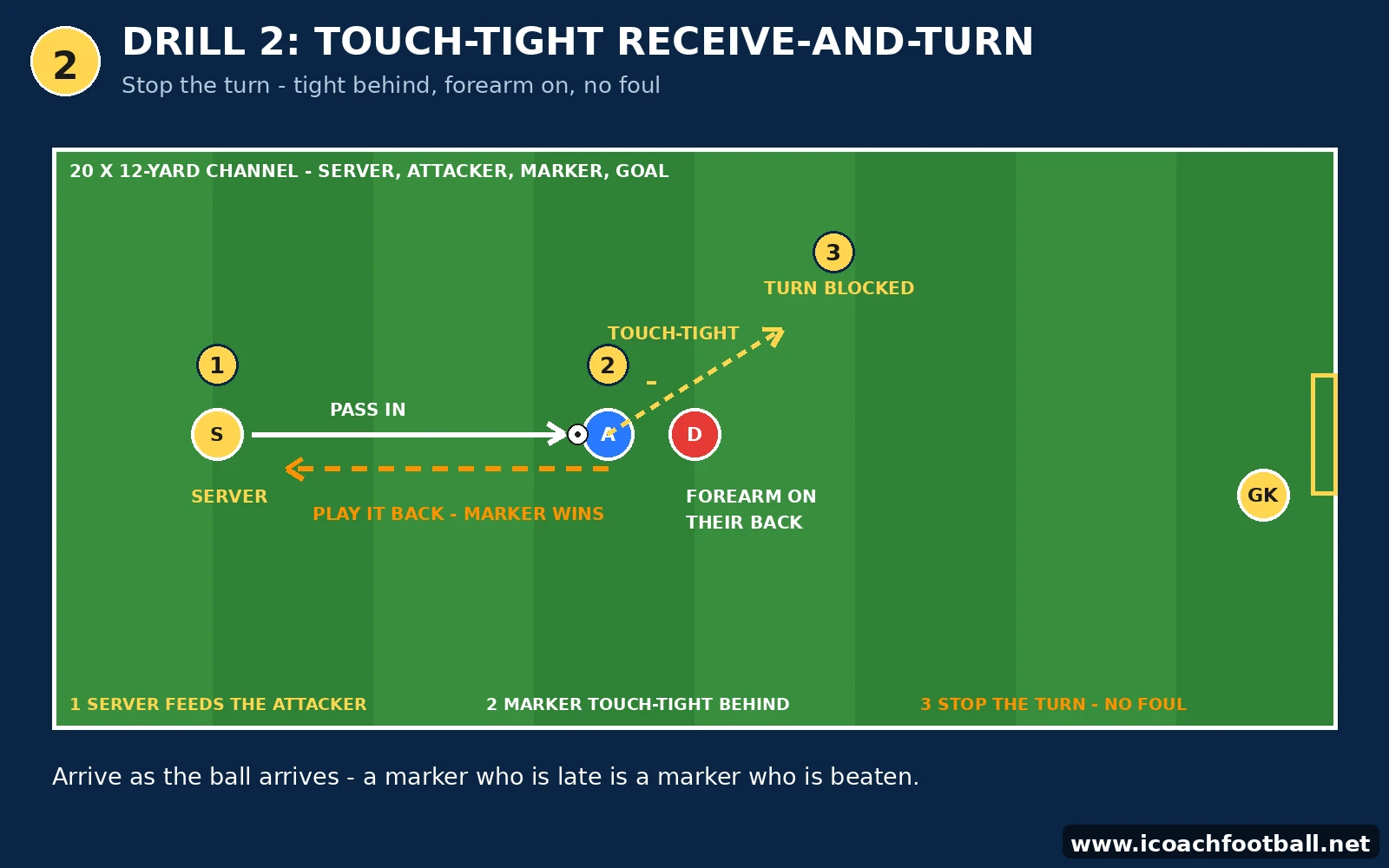
The duel. A server feeds an attacker with a marker tight behind them — and the attacker has 5 seconds to turn and shoot. The marker’s job is to stop the turn without fouling, exactly the skill FIFA’s 1v1-from-behind exercise trains: apply pressure from behind, maintain contact, and prevent the attacker from turning.
Setup
- 20 x 12-yard channel, full goal at one end, server at the other.
- 10 players: 4 attackers, 4 markers, 1 server, 1 goalkeeper. 8 minutes.
How to Play
- The server passes into the attacker’s feet from 15 yards out.
- The marker starts touch-tight behind the attacker — forearm on their back, side-on.
- The attacker takes a touch and tries to turn and shoot within 5 seconds.
- The marker stays tight, blocks the turn with hips and forearm, and never grabs the shirt.
- If the attacker is forced to play the ball back to the server, the marker scores 1 point.
- After 3 goes, rotate — server, attacker and marker all change.
Coach’s note: “Arrive as the ball arrives — a marker who is late is a marker who is beaten.”
Progressions: The server may play a firmer pass so the first touch is harder to control; the attacker may use the server for a one-two; the marker must win the ball and play it out to score, not just stop the turn.
Drill 3 — Track the Runner
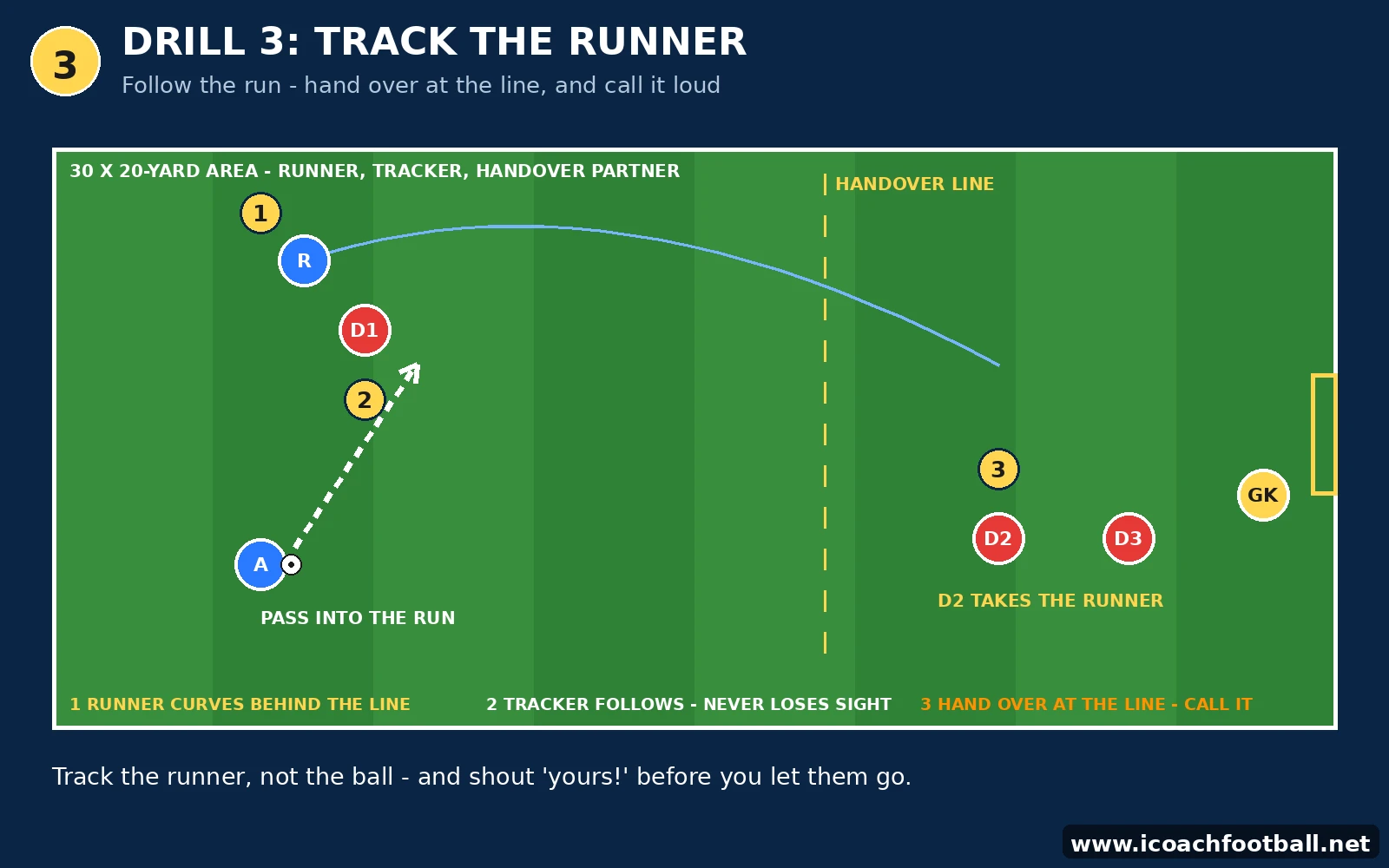
The run. A runner curves in behind the defensive line and the tracker must follow — then hand the runner over to a teammate at the right moment, with a loud call. Losing a runner is the most common way youth teams concede, and the handover is the part nobody practises.
Setup
- 30 x 20-yard area, full goal at one end, cones marking a handover line halfway across.
- 10 players: 4 attackers, 4 defenders, 1 goalkeeper, 1 server. 8 minutes.
How to Play
- The ball starts with a server on the left; a runner waits wide on the right.
- The runner curves in behind the defensive line, aiming for the space behind the full-back.
- The tracker follows the run — never losing sight of the runner, never watching the ball.
- As the runner crosses the handover line, the tracker calls “yours!” and the next defender takes over.
- The new marker picks the runner up goal-side and shows them wide, away from goal.
- After 4 minutes, swap attackers and defenders so everyone tracks and everyone hands over.
Coach’s note: “Track the runner, not the ball — and shout ‘yours!’ before you let them go.”
Progressions: The runner may overlap outside the full-back or underlap inside — see our soccer overlap and underlap drills for the runs themselves; the pass may be delayed so the tracker has to hold the run; add a second runner so two handovers happen at once. Reading the run early is trained in our soccer drills for improving anticipation, and the call itself is trained in our soccer communication drills.
Drill 4 — Zonal Shift Game
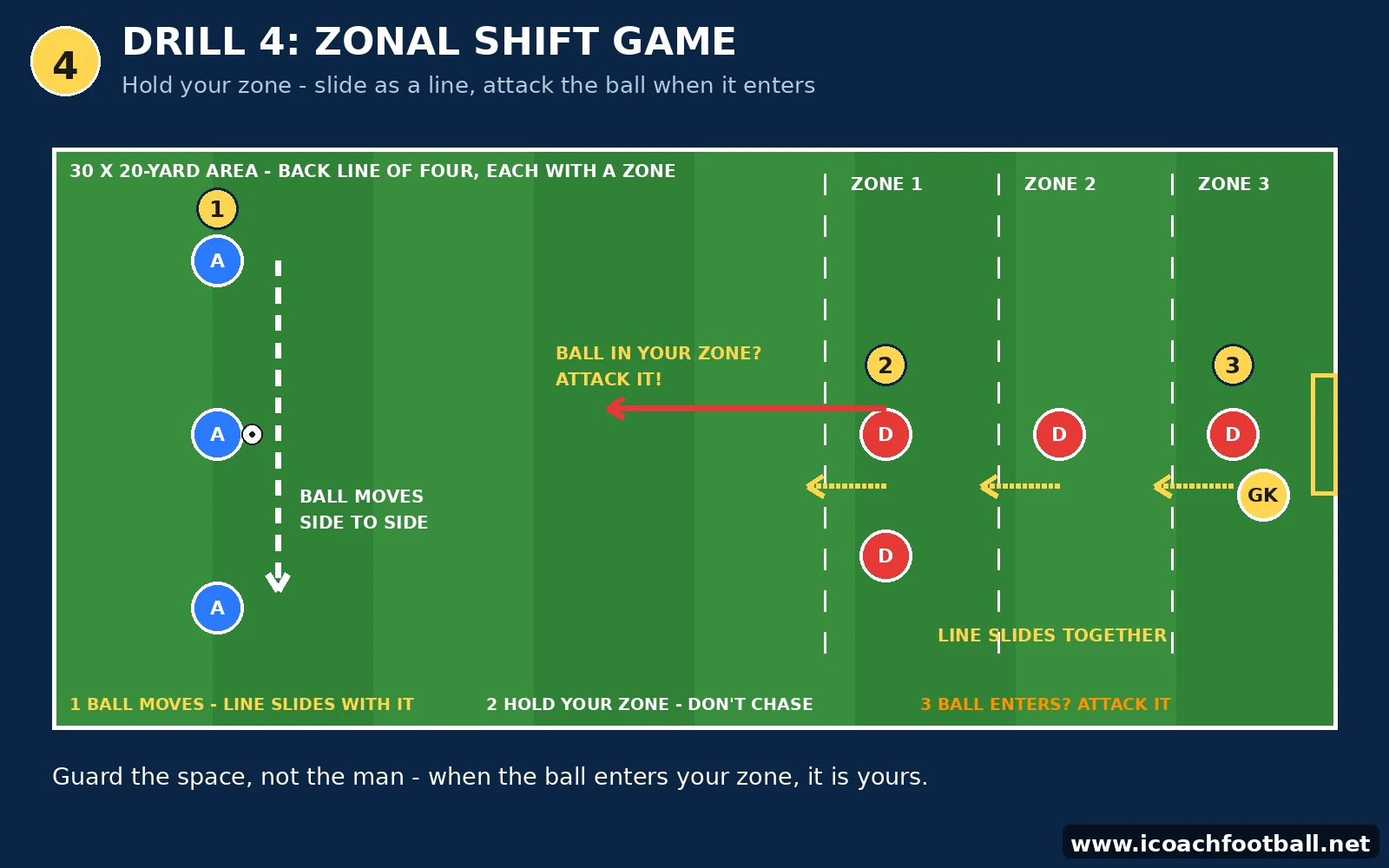
The zone. A back line of four, each responsible for one zone — and the line must slide together as the ball moves, then attack the ball the moment it enters a zone. Man marking teaches you to stay with a player; zonal marking teaches you to guard a space.
Setup
- 30 x 20-yard area, full goal at one end, cones marking three zone lines.
- 10 players: 4 defenders in a line, 4 attackers, 1 goalkeeper, 1 server. 8 minutes.
How to Play
- The defenders set up in a line, each responsible for one zone of the area.
- The attackers pass the ball side to side — no forward passes yet.
- Every time the ball moves, the whole line slides with it — together, in a straight line.
- A defender never leaves their zone to chase the ball — the zone is their job.
- When the ball is played into a zone, that defender attacks it and the others tuck in behind.
- After 4 minutes, rotate the line so everyone holds each zone.
Coach’s note: “Guard the space, not the man — when the ball enters your zone, it is yours.”
Progressions: The attackers may play forward, so the line must squeeze up on a backward pass; remove one defender so the line of three covers more ground; the line must shift in under 3 seconds on a switch of play.
Drill 5 — Marking at the Corner
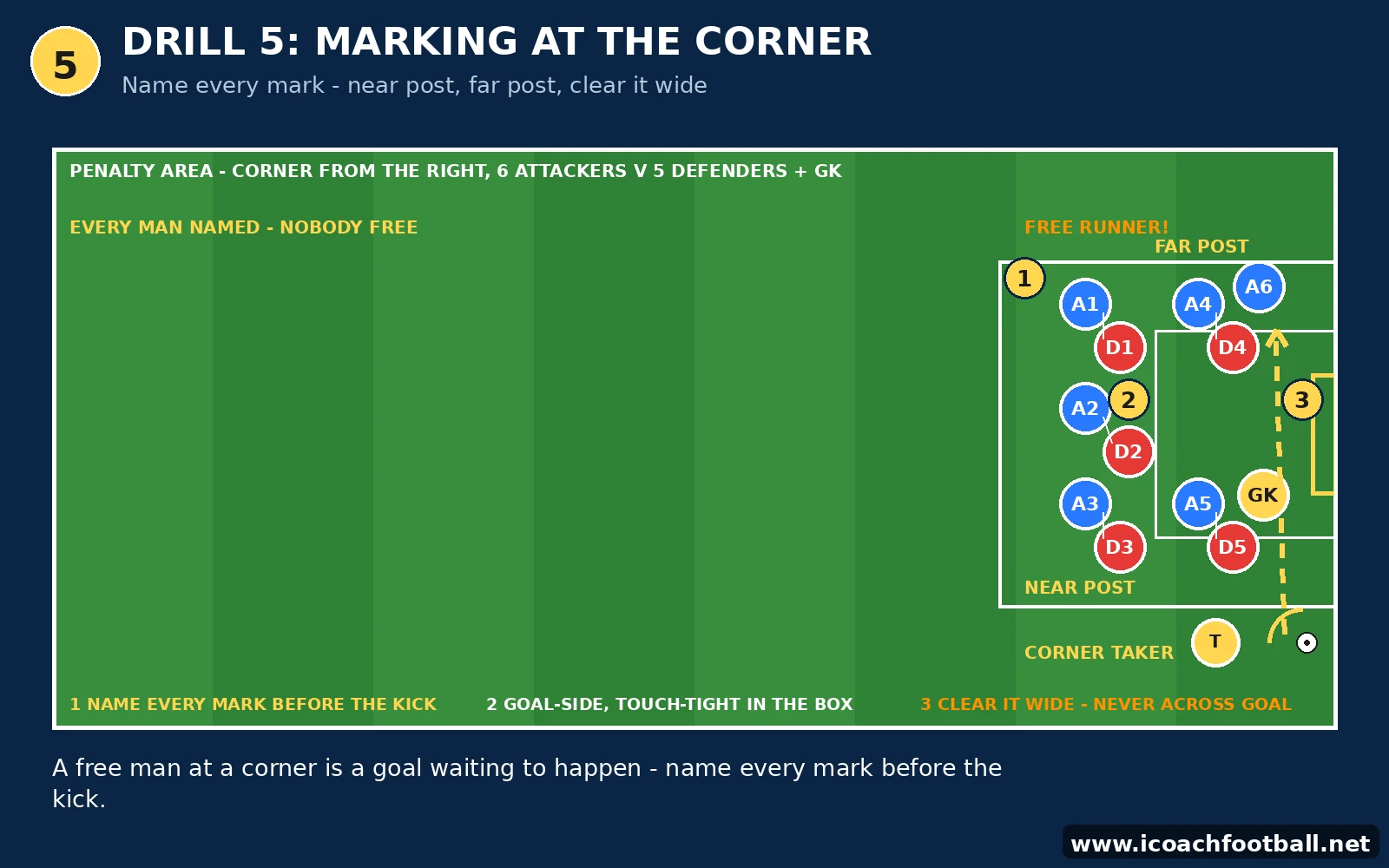
The set piece. Six attackers against five defenders and a goalkeeper, and every mark is named out loud before the kick. A free man at a corner is the easiest goal in youth football — and the easiest to prevent.
Setup
- Penalty area, corner from the right, 1 ball.
- 12 players: 6 attackers, 5 defenders, 1 goalkeeper. 8 minutes.
How to Play
- Before the kick, every defender names their mark out loud — near post, far post, and each attacker.
- The goalkeeper organises the line — “near post mine, far post yours.”
- The corner is taken; every defender stays goal-side and touch-tight on their mark.
- The near-post defender attacks the ball at the near post; the far-post defender covers the back post.
- A clearance must go wide or up the line — never across the face of goal.
- After 3 corners, swap attackers and defenders and take the corner from the other side.
Coach’s note: “A free man at a corner is a goal waiting to happen — name every mark before the kick.”
Progressions: The attackers run a near-post flick or a far-post block; defenders must switch marks if an attacker changes position before the kick; the corner is taken short, so the nearest defender must press the taker. The full set-piece system is our football defending set pieces drills, and the keeper’s organising calls are our soccer goalkeeper communication drills.
Drill 6 — Man-to-Man Small-Sided Game
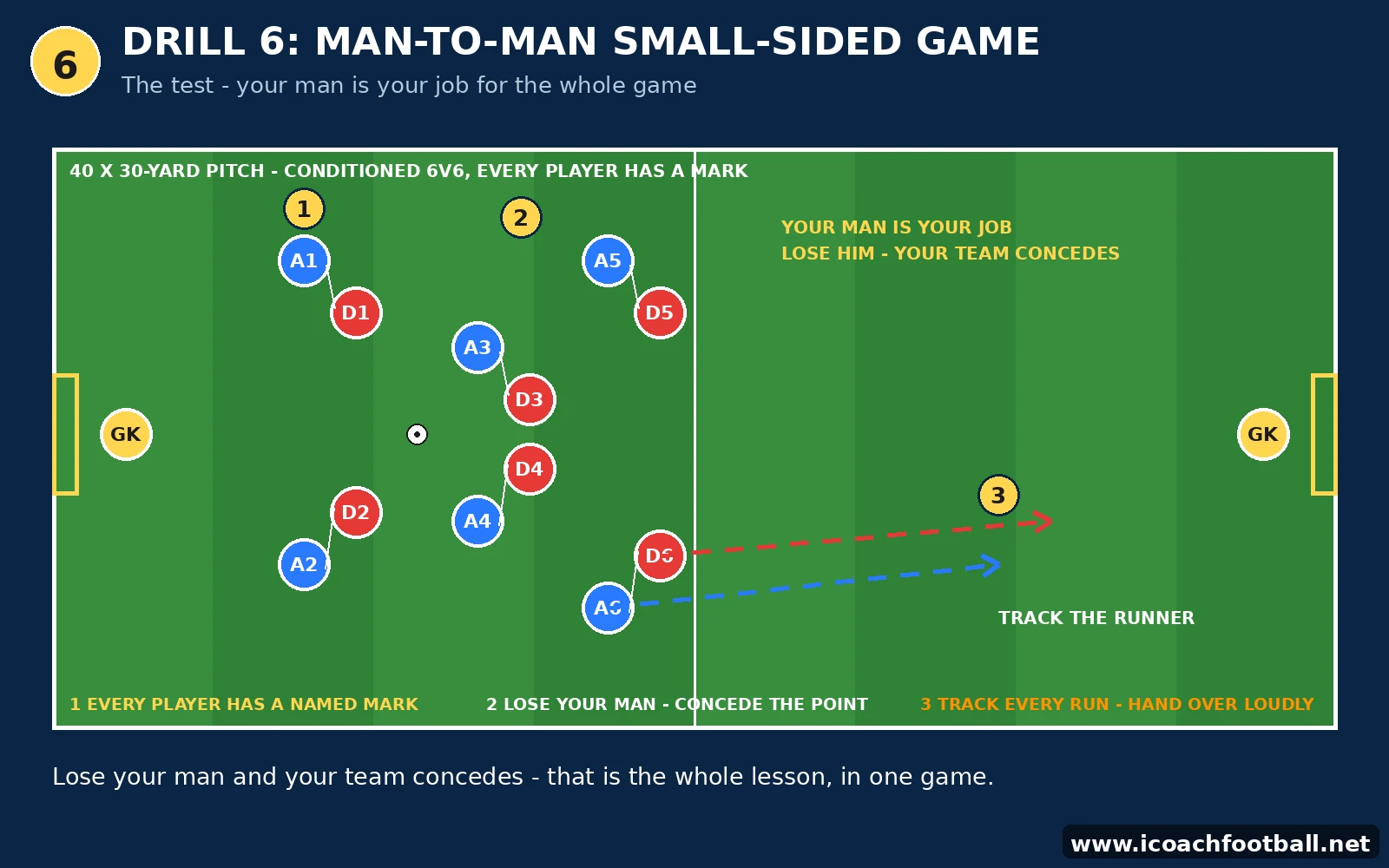
The test. A conditioned 6v6 where every player has a named opponent to mark for the whole game — and losing your man costs your team the point. The scoreboard does the coaching: nobody forgets a mark twice when it costs a goal.
Setup
- 40 x 30-yard pitch, 2 full goals, bibs.
- 12 players: 6v6. 15 minutes.
How to Play
- Each player is given a named opponent to mark — the whole game, not just when the ball is near.
- The game starts with a pass-in from the coach — no kick-offs, no corners.
- A normal goal counts 1 point; a goal scored by a player who lost their marker counts double for the attackers.
- If a player loses their mark and the team concedes, the defending team loses 1 point.
- Play 3-minute games, then swap the marks and play again.
- The coach calls out every lost mark — “who had number 9?” — so the team hears it.
Coach’s note: “Lose your man and your team concedes — that is the whole lesson, in one game.”
Progressions: Marks must be tracked even when the ball is on the far side; add a neutral player who must be marked goal-side at all times; goals only count if the scorer beat their marker. The trigger that tells a player when to leave their mark and press is trained in our coaching soccer pressing triggers, and the press that follows is our counter-pressing drills.
Common mistakes
| Mistake | What you see | Fix |
|---|---|---|
| Ball-watching | The defender stares at the ball and loses their man | Side-on stance — check your shoulder every 3 seconds, see ball and man |
| Standing square-on | The attacker turns easily and the defender is beaten by one touch | Side-on, forearm on their back, hips across to block the turn |
| Diving in | The defender lunges, the attacker steps past, and the mark is gone | Stay on your feet, delay, win the first touch instead of the tackle |
| Losing the runner | A runner arrives free at the far post and scores unmarked | Track the run, hand over with a loud “yours!” before you let them go |
| Two marking one man | Two defenders on the same attacker, and a free man scores | Name every mark before the kick — one man each, nobody free |
| Switching off at set pieces | A free man heads in at the far post from a corner | Keeper organises, every mark named before the kick, clear it wide |
Age adaptations
| Age | Format | What changes |
|---|---|---|
| U10–U11 (ages 9–11) | 15 x 12-yard areas, size 3–4 ball, mini goals | Marking is taught one idea at a time — stay close first, then goal-side. Drill 1 runs as a freeze game: the coach stops play and asks “are you within arm’s length?” Drill 5 uses 4 attackers against 3 defenders, and the corner is taken from 10 yards out so the ball arrives slowly. Drills 3 and 4 run as walk-throughs — the coach stops play at the handover line and asks who takes the runner. See our U11 soccer practice plan for the session shape at this age, and our U12 soccer practice plan for the next step |
| U12–U13 (ages 12–13) | 20 x 15-yard areas, size 4 ball | All six rules run together — the handover in Drill 3 must be called before the runner crosses the line, and the zone in Drill 4 must be held without chasing. The receive-and-turn in Drill 2 is timed at 5 seconds, and Drill 5 adds the near-post flick. See soccer drills for U13 |
| U14–U16 (ages 14–16) | Full areas, size 5 ball | The handover in Drill 3 must happen at full speed with a second runner, and Drill 4 requires the line to shift in under 3 seconds on a switch of play. Drill 5 adds the short corner and mark-switching, and Drill 6 requires marks to be tracked even when the ball is on the far side. See soccer drills for U14, soccer drills for U15 and soccer drills for U16 |
60-minute session plan
| Time | Block | Drill |
|---|---|---|
| 0:00–0:05 | Arrival game | Free 2v2 — a goal only counts if the scorer beat their marker |
| 0:05–0:13 | Shadow marking | Drill 1 — Shadow Marking |
| 0:13–0:21 | Touch-tight | Drill 2 — Touch-Tight Receive-and-Turn |
| 0:21–0:29 | Tracking | Drill 3 — Track the Runner |
| 0:29–0:37 | Zonal | Drill 4 — Zonal Shift Game |
| 0:37–0:45 | Set pieces | Drill 5 — Marking at the Corner |
| 0:45–1:00 | The game | Drill 6 — Man-to-Man Small-Sided Game |
New to coaching this age? Stretch the arrival game to 8 minutes and cut Drill 6 to 12 minutes and you have the same session with more settling-in time — see our 60-minute plan for the structure (the same shape, shortened where you need it).
Keep building from here
Marking sits underneath every defensive skill — the tackle, the interception and the recovery all start from a mark that was never lost. The duel that follows a good mark is the 1v1, the position a good mark starts from is defensive positioning, and the team shape that holds when marks are kept is the defensive block — all linked above. The outnumbered situations a lost mark creates are our soccer defending 2v1 drills and our football defending 3v2 drills. The picture before the mark is our soccer scanning drills. Warm up with our 10 soccer warm-up drills.For the other half of marking — defending space instead of a shirt — see our soccer drills for zonal marking. Once the mark is tight, the next step is winning the pass itself — read the passer, step into the lane and play forward with our .soccer drills for improving interceptions.
FAQ
What is marking in soccer?
Marking is staying close enough to an opponent that they cannot receive the ball, turn, or run free. Man marking means each defender is responsible for one opponent; zonal marking means each defender guards a space and attacks the ball when it enters it. FIFA’s Training Centre puts the individual first: effective defending begins with a player who can influence an attacker in a direct 1v1 — apply pressure, delay them, and force them away from central areas.
How close should you mark an opponent in soccer?
Within arm’s length, side-on, and on your toes — close enough to touch them, far enough to react when they move. FIFA’s 1v1-from-behind exercise teaches the marker to maintain contact from behind and prevent the attacker from turning. If you are more than arm’s length away, the attacker can receive and turn freely; if you are grabbing their shirt, you are fouling.
When do you track a runner and when do you hand over?
Track the runner until they cross into a teammate’s zone, then hand over with a loud, early call — ‘yours!’ — before you let them go. Never hand over silently, and never stop tracking before the call is made. England Football’s marking programme makes the same point: adapt your movement to track runs, and give early and clear communication to the first defender.
Should youth players man-mark or zone-mark?
Start with man marking. At U10–U11, one opponent each is the only marking system young players can hold — it teaches closeness, goal-side positioning and tracking. Introduce zonal marking from U12–U13, one zone each in a back line, and mix both from U14–U16: man-mark in the final third, zone-mark in open play. Drill 6 in this session is man-to-man; Drill 4 is zonal.
How do you mark at a corner in soccer?
Name every mark before the kick. The goalkeeper organises the line — near post and far post covered, every attacker with a named defender, all goal-side and touch-tight. The near-post defender attacks the ball at the near post, the far-post defender covers the back post, and every clearance goes wide or up the line, never across the face of goal. Drill 5 in this session practises exactly this.
Sources
- FIFA Training Centre, “Building the foundations of collective defending” — FIFA Talent Coach Conor Marlin’s first stage of the progressive zonal defending methodology: four practices that develop the individual defensive behaviours required for effective collective defending, through 1v1 situations from the front, from behind and from the side, applying the three 1v1 principles of direct, delay and deny, and ending in a small-sided game where defenders must apply player-to-player marking. Verified live 2026-11-19 (HTTP 200, full text read). Drills 1, 2, 3 and 6 are based on / in line with this FIFA material.
- England Football Learning, “Session programme: marking and intercepting to stop goals” — a six-week football session programme to help 12–16s defend as an individual, in pairs and in units: mark the target and force them away from goal, adapt movement to track runs and the movement of the opponent, use a side-on body position when marking tight and covering spaces, use quick movement to get into a covering position, and give early and clear communication to the first defender. Verified live 2026-11-19 (HTTP 200, full text read). The framing of this post and Drills 2, 3 and 5 are based on / in line with this England Football material.