Soccer Drills for Improving Crossing Accuracy: 6 Games That Put Every Cross on a Runner (U11–U17)
Quick answer
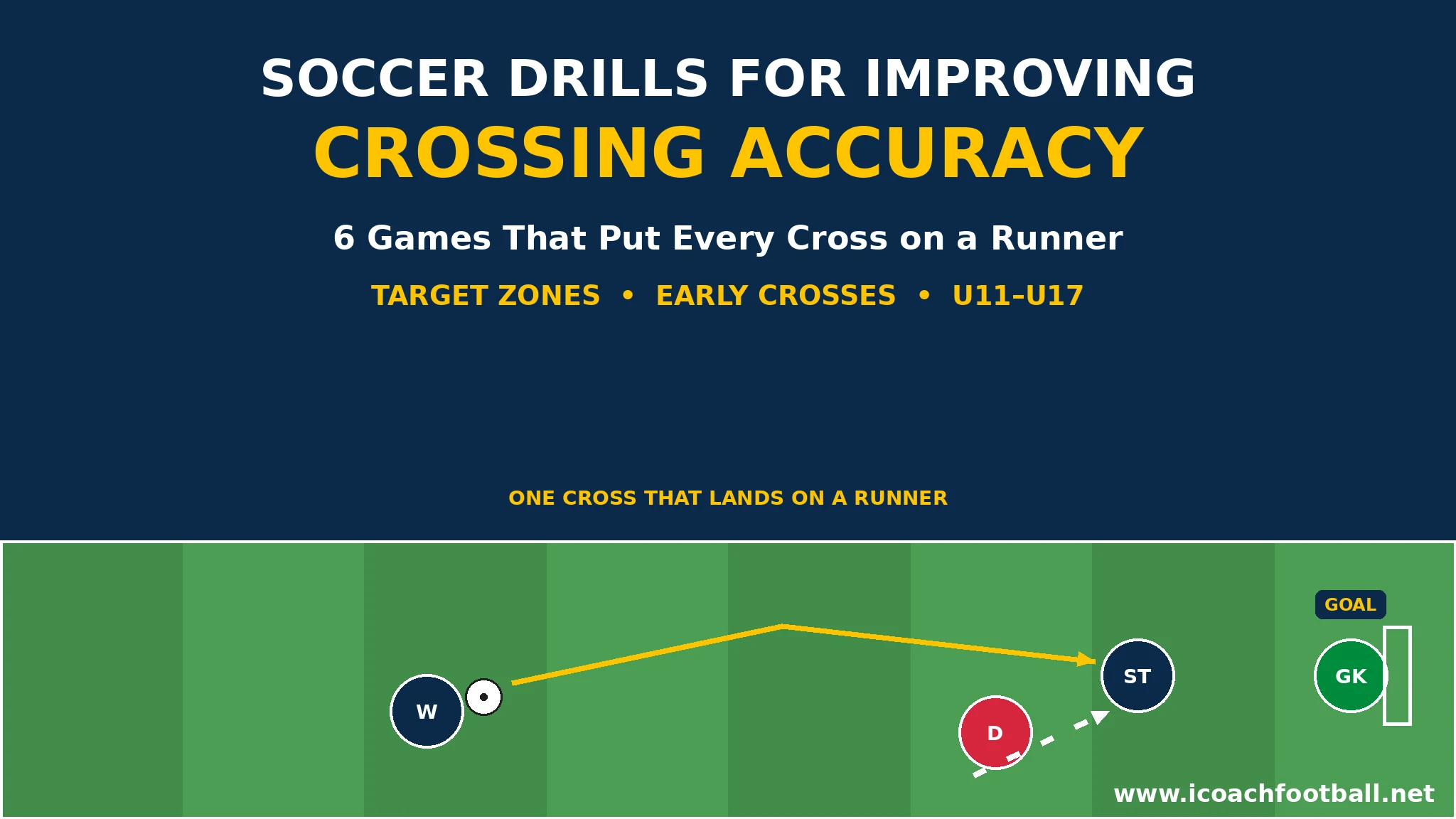
A cross is only as good as where it lands. Most youth crosses fail the same way: they hit the first defender, float over everyone, or arrive after the runners have already stopped. An accurate cross does three things — it beats the first defender, it lands in a zone a runner is attacking, and it arrives at a pace the runner can finish first-time. These six soccer drills for improving crossing accuracy train exactly that: a target-zone circuit that scores every cross by where it lands, an early cross that catches the defence before it sets, a driven cross played between the goalkeeper and the defenders, a 1v1 drill where the winger has to beat the full-back before crossing, a wide-area game that rewards getting into the channel and scoring from a cross, and a full game where a goal scored from a cross is worth double.
Suitable for: U11–U17 (ages 10–17)
Session snapshot
- Players: 14–18
- Age: U11–U17 (ages 10–17)
- Area: Half a pitch, with 2 full goals and 2 mini-goals
- Duration: 60 minutes
- Focus: Crossing accuracy — target zones, the early cross, the driven cross, beating the full-back, and timing the run to meet the ball
- Equipment: 14 balls, 24 cones, bibs, 2 full goals, 2 mini-goals, 4 mannequins or poles
Why these six games work
Most crosses die before they ever reach a team-mate. The winger looks down at the ball, hits it hopefully, and the first defender clears it — or the ball floats over the box and out the other side. The problem is rarely power. The problem is that nobody taught the crosser where the ball is supposed to land, and nobody taught the runners when to move. Accuracy is not a talent; it is a target and a timing habit, and both can be drilled.
The first drill fixes the target: a zone circuit where every cross is scored by the zone it lands in, so the players stop aiming at a team-mate and start aiming at a space. The next two drills fix the two crosses that win matches: the early cross, played before the defence has set, and the driven cross, played low and hard between the goalkeeper and the defenders. The fourth drill fixes the 1v1 — a winger who cannot beat the full-back never gets to cross at all. The fifth drill fixes the decision: a wide-area game where getting into the channel scores a point and scoring from a cross scores three. The last drill puts it all into a game where a goal from a cross is worth double.
The drills are grounded in the FIFA/UEFA coaching community. Drills 1, 2, 3 and 6 are based on / in line with the FIFA Training Centre session “Attacking the cross”, in which the FIFA Talent Development programme works on combination play that ends in a first-time cross, a rondo that finishes with a long pass out wide and a cross for players arriving from deep, and a 6v6 plus 3 game in which the team in possession works the ball into the wide zones before attacking the cross — with the key coaching points that players should play first-time crosses that take advantage of the space behind the opposition’s back line, that central players should play on the half-turn with an open body shape to find wide players quickly, that attacking players must sprint into the penalty area as the pass is played towards the wide player, that they should time their runs to attack the cross, and that the wide players should deliver well-placed, driven crosses that hit the area between the goalkeeper and defenders in coordination with the attackers’ runs. Drills 4 and 5 are based on / in line with England Football Learning’s session “Dribbling session: penetrating from wide areas”, in which teams play 3v3s with a diamond inside the pitch, score a point for getting into an attacking wide area and three points for scoring from a cross or a pass from a team-mate in a wide area, and score three points for beating an opponent in a 1v1 and then scoring. In the UK the same session is football drills for improving crossing accuracy — the zones, the weight and the timing are identical.
The cross is also the pass that starts the next action. Our soccer drills for improving passing accuracy train the weight and the plant foot every cross needs, and our soccer drills for improving first-time shooting train the finish that a good cross creates.
Six rules of crossing accuracy
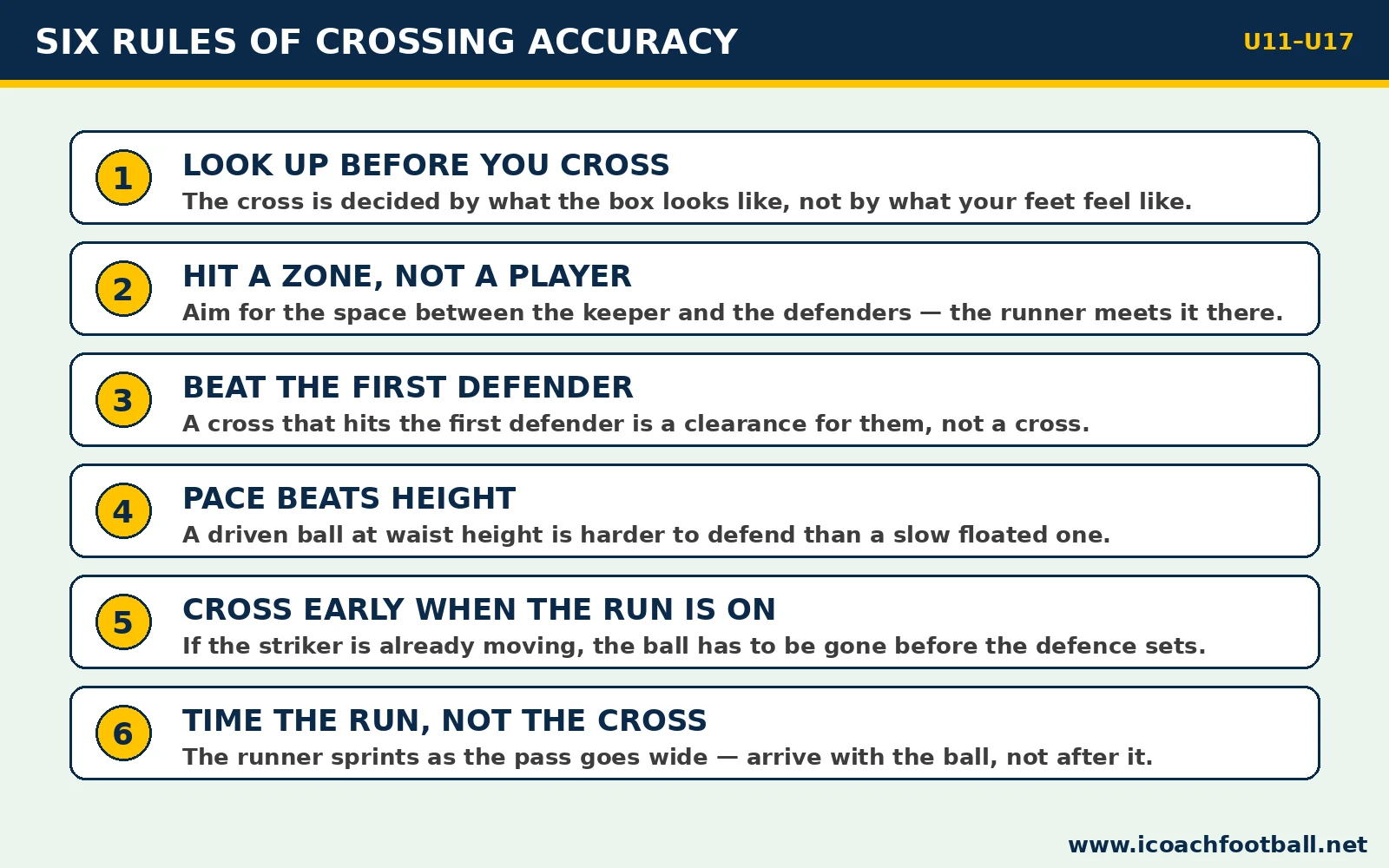
- Look up before you cross. The cross is decided by what the box looks like, not by what your feet feel like.
- Hit a zone, not a player. Aim for the space between the goalkeeper and the defenders — the runner meets the ball there.
- Beat the first defender. A cross that hits the first defender is not a cross — it is a clearance for them.
- Pace beats height. A driven ball at waist height is harder to defend than a slow floated one.
- Cross early when the run is on. If the striker is already moving, the ball has to be gone before the defence sets.
- Time the run, not the cross. The runner sprints as the pass goes wide — arrive with the ball, not after it.
Drill 1 — Target Zones
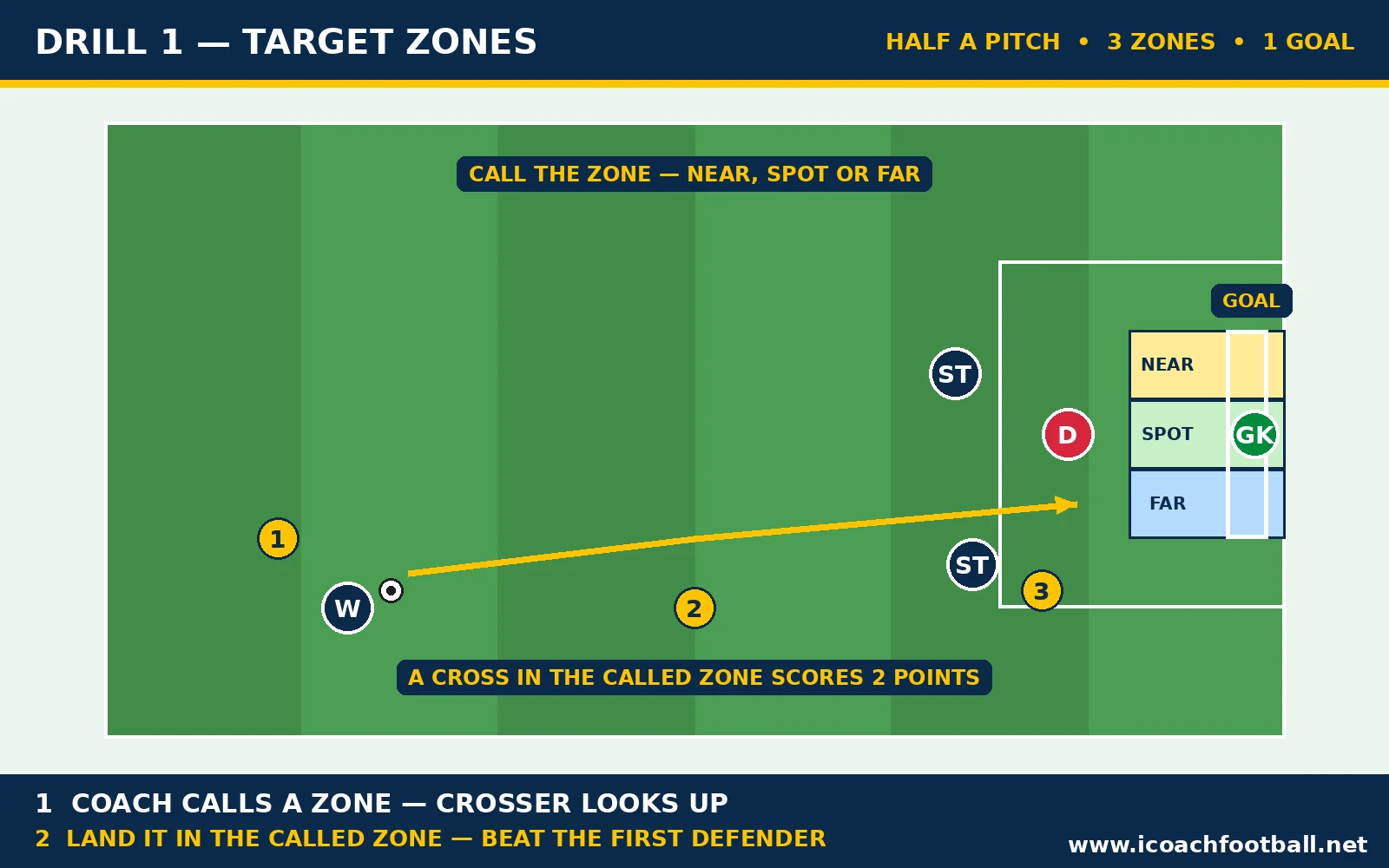
The accuracy drill — a crossing circuit where the box is split into three target zones and every cross is scored by the zone it lands in, in line with FIFA’s coaching point that well-timed runs and correctly weighted passes decide the quality of combination play, and that crosses should be driven into the area between the goalkeeper and the defenders.
Setup
- Area half a pitch, 1 full goal with a goalkeeper, 3 target zones marked with cones across the six-yard box and the penalty spot.
- 8 minutes, then swap the crossers to the other wing.
How to Play
- The crosser starts in the wide channel with a ball, 25 yards from the goal line, facing the box.
- The coach calls a zone — near post, penalty spot or far post — before each cross.
- The crosser takes one touch to set the ball, looks up, and delivers the cross into the called zone.
- Two runners attack the box: one at the near post, one at the far post, timing their runs to the cross.
- A cross that lands in the called zone scores 2 points; a cross that beats the first defender but lands in the wrong zone scores 1.
- After six crosses each, the crossers swap wings and the runners become the crossers.
Coach’s note: “Call the zone out loud before the cross. If they cannot say where it is going, they are not aiming — they are hoping, and hopeful crosses hit the first defender.”
Progressions: The crosser must cross first-time off a pass from the coach; the called zone changes mid-run, so the crosser has to adjust on the move; a defender stands at the near post, so the cross has to beat a real marker.
Drill 2 — The Early Cross
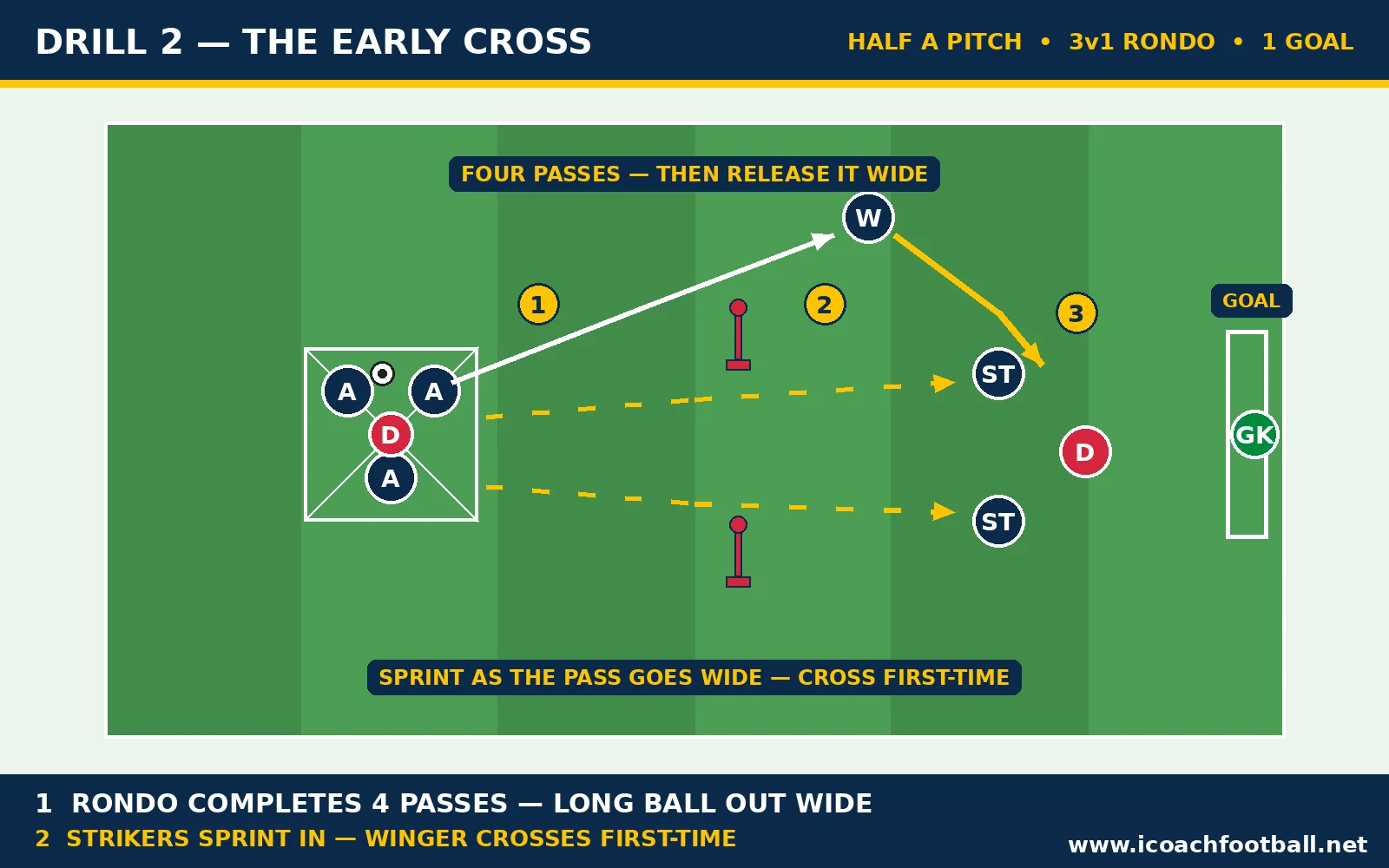
The timing drill — a long ball out wide, a sprint into the box, and a first-time cross played behind the back line before the defence has set, in line with FIFA’s rondo-and-cross exercise: the wide player sets off as the long pass is played, the attackers sprint into the penalty area, and the cross is delivered first-time for players arriving from deep.
Setup
- Area half a pitch, 1 full goal with a goalkeeper, 3v1 rondo square 10 metres by 10 metres on the halfway line.
- 10 minutes, then swap the rondo group and the wide players.
How to Play
- Three attackers keep the ball in the 10 by 10 rondo square against one defender, aiming to complete four passes.
- As soon as the fourth pass is played, the receiver plays a long pass out wide, over or around the mannequins on the flank.
- Before the long pass is played, the wide player sets off to run into the space beyond the mannequins.
- As soon as the long pass is played, the three attackers sprint from the rondo square towards the penalty area.
- The wide player delivers a first-time cross for the three attackers to meet, while a defender tries to cut it out.
- After each cross the players rotate — rondo players become wide players, wide players join the rondo.
Coach’s note: “The sprint starts before the pass, not after it. If the attackers wait to see the ball go wide, they arrive after the cross — the run and the pass have to happen at the same moment.”
Progressions: The cross must be played first-time, with no touch to settle it; the long pass has to go over the mannequins, so the wide player receives on the run; a second defender joins the box, so the cross has to pick out a runner, not just reach the area.
Drill 3 — The Driven Cross
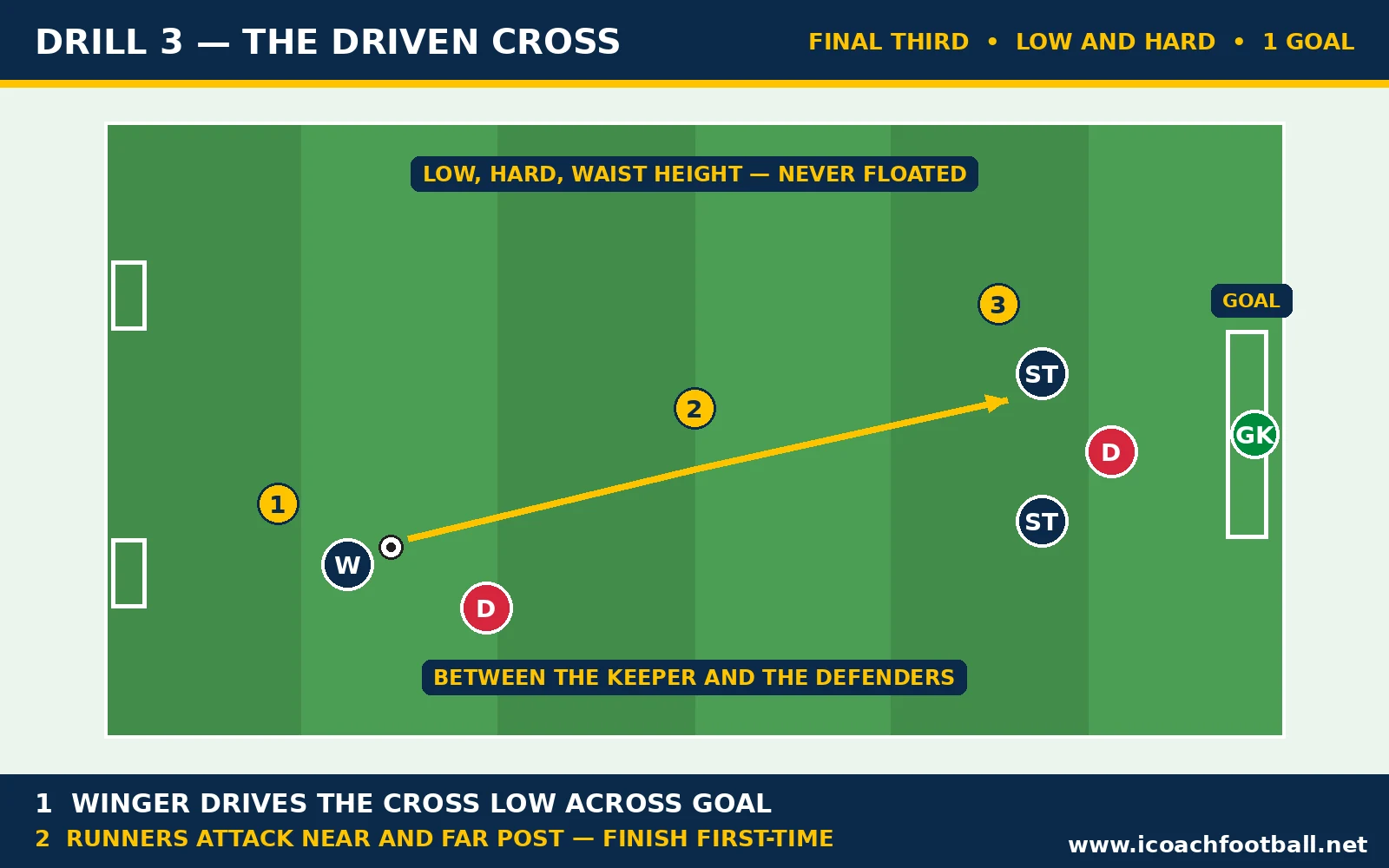
The pace drill — a low, hard cross driven across the face of goal into the space between the goalkeeper and the defenders, in line with FIFA’s game-phase coaching point: the wide players should deliver well-placed, driven crosses that hit the area between the goalkeeper and defenders, in coordination with the attackers’ runs.
Setup
- Area the final third, 1 full goal with a goalkeeper, 2 mini-goals at the halfway line for the defenders to counter to.
- 9 minutes, then swap the crossing wing.
How to Play
- The winger receives the ball in the wide channel, 20 yards from the byline, with a defender closing them down.
- The winger takes one touch inside, looks up, and drives the cross low across the face of goal.
- The cross must travel between the goalkeeper and the defenders — waist height, with pace, never above head height.
- Two attackers make coordinated runs: one to the near post, one to the far post, arriving as the ball crosses the six-yard box.
- An attacker who meets the driven cross first-time and scores earns the team 2 points; a cross that beats the first defender but finds nobody earns 1.
- If the defence clears the cross, they counter to the mini-goals — then the other wing attacks.
Coach’s note: “Waist height, with pace. A floated cross gives the goalkeeper time to come and claim it — a driven cross gives the defenders no time to turn, and the goalkeeper no time to decide.”
Progressions: The winger must cross with their weaker foot every third rep; the near-post runner must flick the cross on, so the far-post runner finishes; the defender is allowed to press the winger, so the cross has to be played under pressure.
Drill 4 — Beat the Full-Back, Then Cross
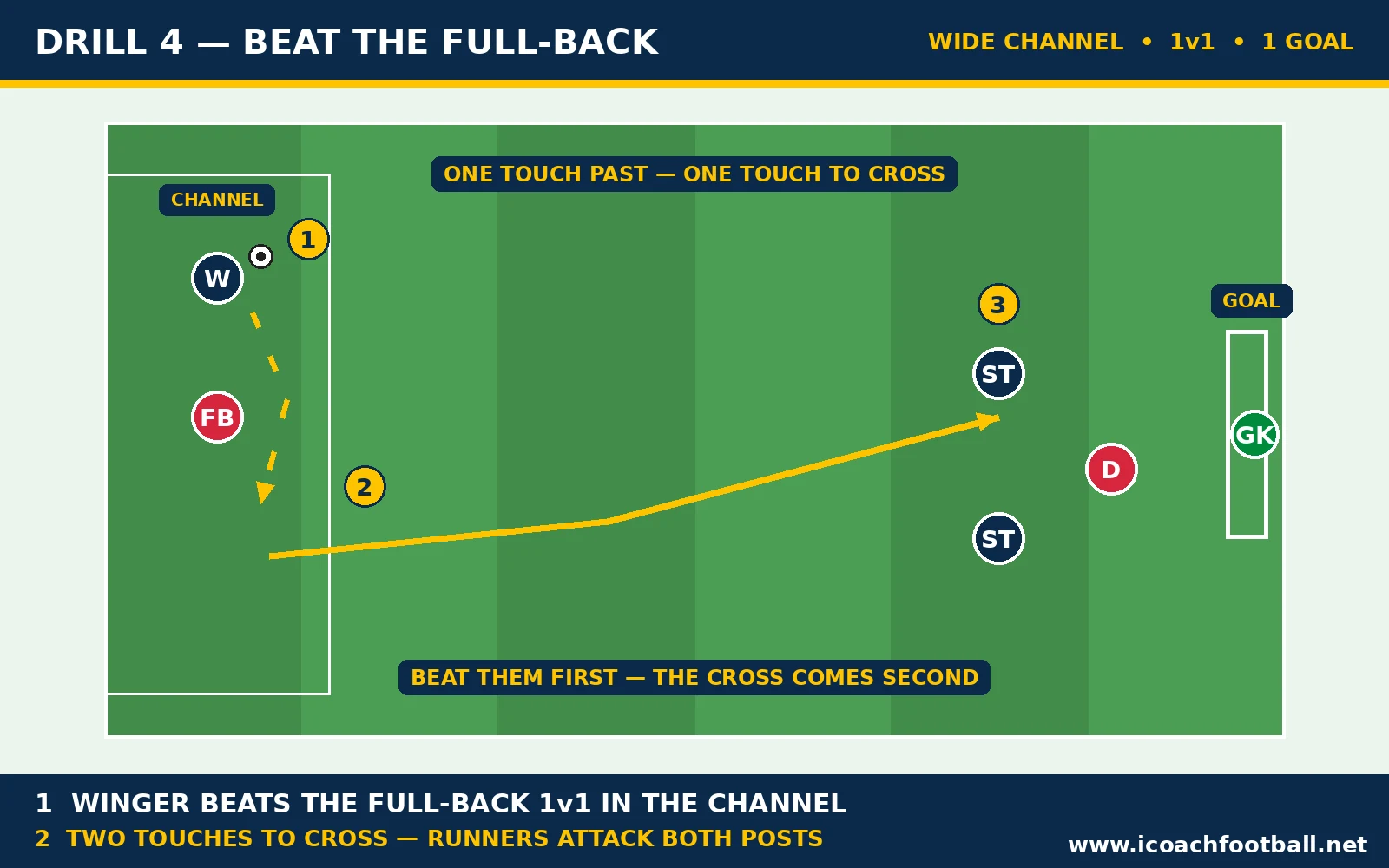
The 1v1 drill — the winger has to beat the full-back before the cross is even possible, in line with England Football Learning’s wide-areas session: teams score three points when they beat an opponent in a 1v1 and then score, and the session asks players to keep composed on the ball and make intelligent decisions when moving with the ball.
Setup
- Area a wide channel 25 yards long by 15 yards wide, 1 full goal with a goalkeeper, 1v1 plus 2 attackers in the box.
- 9 minutes, then swap the wing and the defending full-back.
How to Play
- The winger starts with the ball at the top of the channel, facing the full-back one-on-one.
- The winger must beat the full-back with a touch, a feint or a change of pace — no pass around them is allowed.
- Once past the full-back, the winger has two touches to deliver the cross into the box.
- Two attackers make runs into the box: one to the near post, one to the far post, timed to the winger beating the defender.
- A goal scored after beating the full-back earns 3 points; a cross that beats the first defender but finds nobody earns 1.
- After each rep the winger and the full-back swap roles, so everyone practises both the beat and the defend.
Coach’s note: “The cross starts with the first touch past the defender. If the winger takes four touches to beat them, the box is already set — one touch to go past, one touch to cross, and the ball is gone before the defence recovers.”
Progressions: The winger may only use their weaker foot to beat the defender; the full-back is allowed to show the winger inside, so the cross has to come from a different angle; the attackers must finish first-time, so the cross has to arrive at the right pace.
Drill 5 — The Wide-Area Game
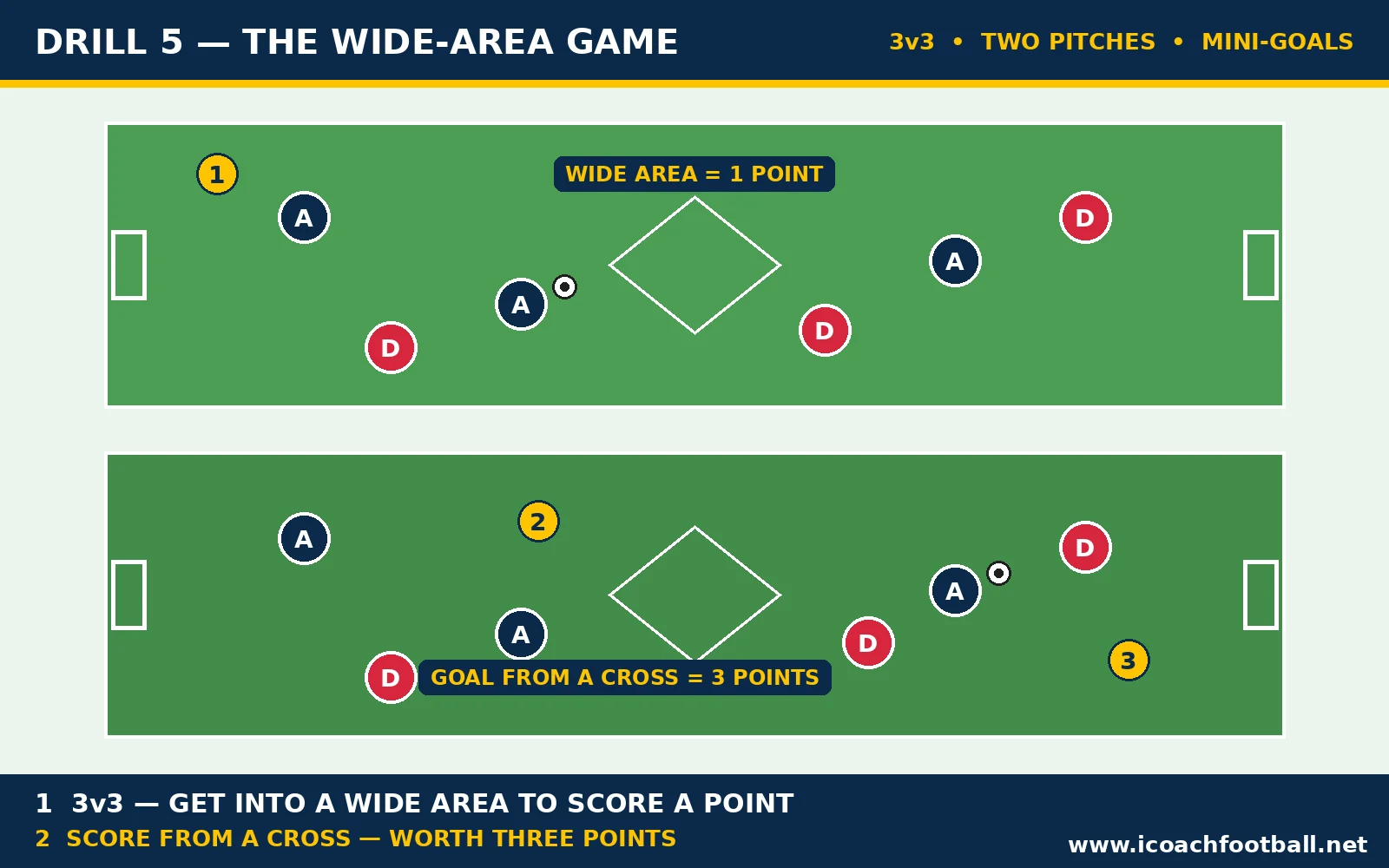
The decision drill — a 3v3 game on parallel pitches where getting into the wide area scores a point and scoring from a cross scores three, in line with England Football Learning’s wide-areas session: teams get a point if they get into an attacking wide area, and three points if they manage to score from a cross or a pass from a team-mate in a wide area.
Setup
- Area two parallel pitches, each 30 yards by 20 yards, mini-goals at each end, a diamond of flat markers inside each pitch.
- 9 minutes, then the two pitches merge into one bigger pitch for the final three minutes.
How to Play
- Two teams play 3v3 on each pitch, with mini-goals at each end and a diamond marked inside the pitch.
- A team scores 1 point when a player receives the ball inside an attacking wide area.
- A team scores 3 points when they score from a cross or a pass played by a team-mate in a wide area.
- A normal goal scores 1 point, so the wide-area route is always worth more than going through the middle.
- Players cannot shoot from their own half, so every attack has to travel through a wide area to count for three.
- After six minutes the diamonds come out, the pitches merge into one bigger game, and the same scoring stays in place.
Coach’s note: “Watch which team keeps going through the middle for one point. The moment they realise the wide route is worth three, the whole game changes — that is the decision you are coaching, not the cross itself.”
Progressions: The wide areas become safe zones where players cannot be tackled, so the cross is always available; the team that scores from a cross must finish first-time, so the cross has to arrive at the right pace; one team plays a player down, so the wide overload has to be found, not assumed.
Drill 6 — The Crossing Game
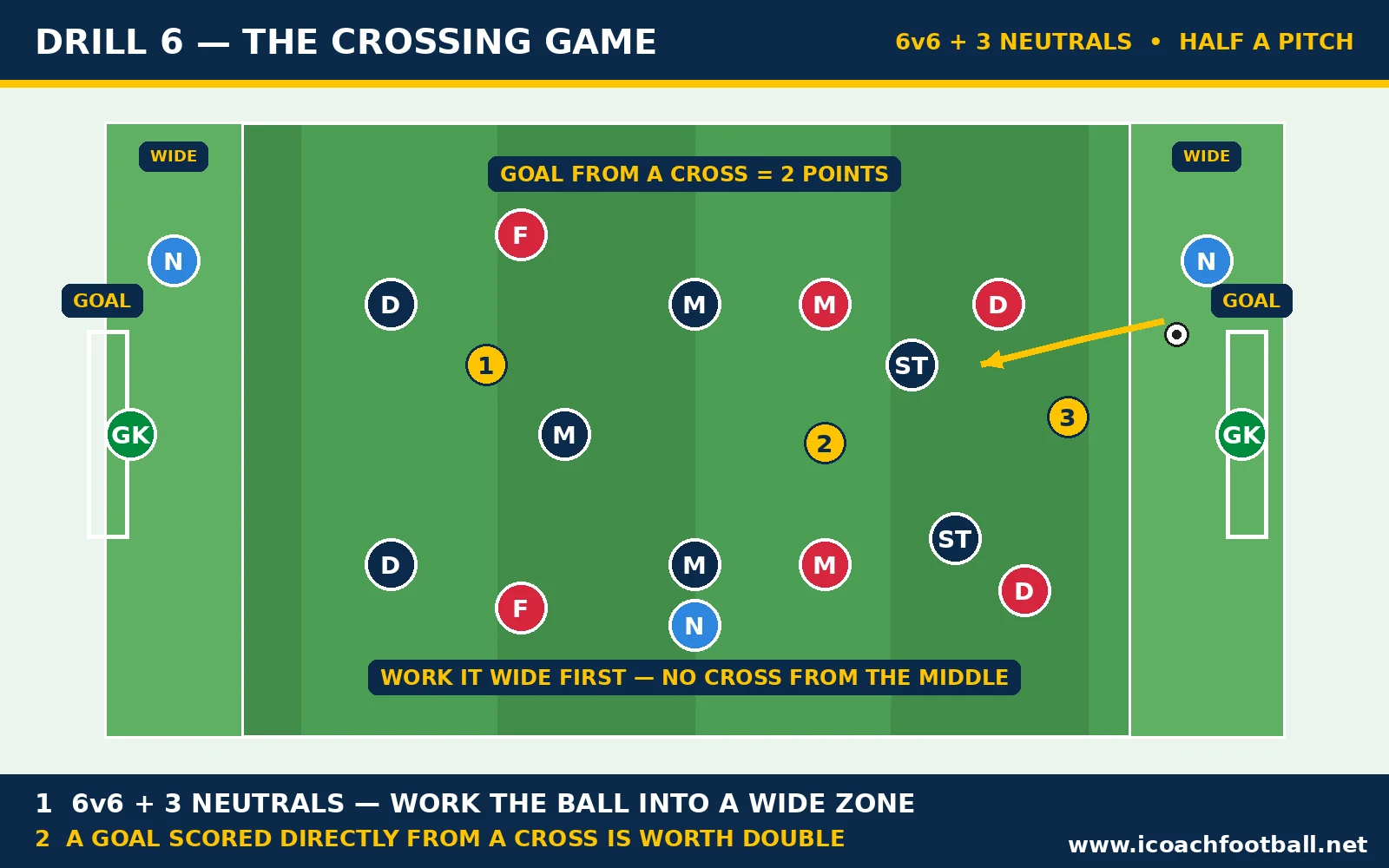
The full game. A 6v6 plus 3 where the team in possession must work the ball into the wide zones before attacking the cross, and a goal scored from a cross is worth double, in line with FIFA’s final game phase: the in-possession team works the ball into the wide zones before attacking the cross, the wide players deliver first-time crosses, and the attackers sprint into the area in readiness to meet them.
Setup
- Half a pitch, 2 full goals with goalkeepers, 6v6 plus 3 neutrals, wide zones marked on both flanks.
- 10 minutes.
How to Play
- Two teams play 6v6 on half a pitch, with three neutral players who always play with the team in possession.
- The team in possession must work the ball into a wide zone before they are allowed to cross — a cross from central areas does not count.
- One neutral plays in each wide zone and one in the centre, so the overload is always available out wide.
- A goal counts one point — but a goal scored directly from a cross counts double.
- The wide neutral players should deliver first-time crosses when the space is behind the opposition’s back line.
- If the defending team wins the ball, they counter to the goal at the other end — then the roles swap and the other team builds wide.
Coach’s note: “Double points for a goal from a cross is not a gimmick — it is permission. Most wingers never cross because they are afraid of losing it; the points tell them the club wants the ball in the box.”
Progressions: Only goals scored from a cross count in the final three minutes; the neutrals may only play first-time, so every attack has to move at match speed; the goalkeepers must distribute to a wide player, so the next attack starts in the channel.
Coaching points
- Look up before you cross. The cross is decided by what the box looks like, not by what your feet feel like.
- Hit a zone, not a player. Aim for the space between the goalkeeper and the defenders — the runner meets the ball there.
- Beat the first defender. A cross that hits the first defender is not a cross — it is a clearance for them.
- Pace beats height. A driven ball at waist height is harder to defend than a slow floated one.
- Cross early when the run is on. If the striker is already moving, the ball has to be gone before the defence sets.
- Time the run, not the cross. The runner sprints as the pass goes wide — arrive with the ball, not after it.
Common mistakes
| Mistake | Fix |
|---|---|
| Crossing without looking up, so the ball goes where nobody is running | Look up before you cross — Drill 1 only counts the cross if the called zone was hit |
| Aiming at a team-mate instead of a zone, so the cross arrives behind the run | Hit a zone, not a player — Drill 1 scores the landing spot, not the receiver |
| Hitting the first defender, so the attack dies on the edge of the box | Beat the first defender — Drill 3 only counts the cross if it reaches the six-yard box |
| Floating the cross, so the goalkeeper claims it easily | Pace beats height — Drill 3 requires a driven cross at waist height |
| Crossing too late, after the defence has already set | Cross early when the run is on — Drill 2 only counts the cross if it is played first-time |
| Runners arriving after the cross, so the ball runs through the box untouched | Time the run, not the cross — Drill 2 stops the rep if the attackers are still outside the box when the cross arrives |
Age adaptations
| Age | Format | What changes |
|---|---|---|
| U11–U12 (ages 10–12) | Small areas, size 4 ball, crosses from 15–20 yards, big target zones 4 yards wide | All six drills run shorter and slower — 15–20 yard crosses, not 25 — because the crossing range is not there yet and the landing zone is the lesson. Drill 1 uses a stationary ball and called zones, Drill 2 plays the long pass along the ground, and Drill 4 runs with the full-back starting two yards behind the winger |
| U13–U14 (ages 12–14) | Full areas, size 4 ball, crosses from 20–25 yards, target zones 3 yards wide, runners call their own zone from the second round | All six drills run as written, with the runners calling their own zone from the second round. Drill 2 adds the first-time cross, Drill 4 adds the weaker-foot rep, and Drill 6 adds the double points for a goal from a cross. Players keep a simple count — “six crosses, four beat the first defender” is the habit that sticks |
| U15–U17 (ages 14–17) | Full areas, size 5 ball, full pressure from the first rep, defenders allowed to block the lane | Full pressure from the start. Drill 1 runs with a defender at the near post, Drill 3 requires the cross with the weaker foot every third rep, and Drill 6 plays with the neutrals only allowed first-time passes. Players are asked to call the trigger before each rep — “near post free, drive it!” — so the decision becomes a conscious skill, not a lucky guess |
60-minute session plan
| Block | Time | Content |
|---|---|---|
| Arrival game | 0:00–0:05 | Target-zone warm-up — cross in pairs at a cone target, weak foot every third rep |
| Target zones | 0:05–0:13 | Drill 1 — Target Zones |
| The early cross | 0:13–0:23 | Drill 2 — The Early Cross |
| The driven cross | 0:23–0:32 | Drill 3 — The Driven Cross |
| Beat the full-back | 0:32–0:41 | Drill 4 — Beat the Full-Back, Then Cross |
| The wide-area game | 0:41–0:50 | Drill 5 — The Wide-Area Game |
| The crossing game | 0:50–1:00 | Drill 6 — The Crossing Game |
Keep building from here
The cross that starts every attack in this session is our wide channel game crossing and finishing, and the pull-back from the byline is our soccer cutback drills. The overlap that gets the winger into the crossing position is our soccer overlap underlap drills, and the switch that finds the free winger on the far side is our 4 progressive drills to coach switching the play. The through ball that releases the winger is our soccer through ball drills, and the finish that a good cross creates is our soccer drills for improving first-time shooting. The same finish under a closing defender is our soccer drills for improving finishing under pressure, and the near-post run that meets the driven cross is our football heading drills near post run. The volley that finishes a cross first-time is our soccer volley drills technique, and the 1v1 skill that beats the full-back is our soccer dribbling drills. The decision of when to cross and when to keep it is our soccer decision making drills, and the scan that spots the runner before the ball arrives is our soccer scanning drills. The cross played in behind a high line is our soccer drills for improving attacking against a high defensive line. Crossing is high-repetition, high-intensity work — plan the week’s load with our training load calculator.
What is a good crossing accuracy target for youth players?
Aim for 6 out of 10 crosses beating the first defender and landing in a called target zone. That is a realistic target for U13–U14 players, and it gives the coach a number to track week to week. For U11s, start at 4 out of 10 with bigger zones and a stationary ball. Drill 1 is built for exactly this: every cross is scored by the zone it lands in, so the players can see their own accuracy improve across the session.
How do you coach a player to cross with their weaker foot?
Start with the stationary-ball version of Drill 1, from 10–15 yards, with a big target zone and no defender. The plant foot is the whole skill: it points where the ball goes, so plant it beside the ball and pointing at the zone. Only add a run-up when the stationary crosses land in the zone three times in a row, and only add a defender when the run-up crosses do. Drill 3 uses the weaker foot every third rep, so the player gets the reps without the whole session depending on it.
When should a player cross early instead of dribbling to the byline?
Cross early when the striker is already running and the defence is still retreating — the ball beats the back line before it can set. Dribble to the byline when the box is empty and nobody is making a run yet, or when the full-back is isolated and can be beaten 1v1. Drill 2 trains the early cross: the wide player delivers first-time as the attackers sprint in, and Drill 4 trains the other choice — beat the full-back first, then cross from the byline.
What is the difference between a driven cross and a floated cross?
A driven cross is low, hard and at waist height, played across the face of goal into the space between the goalkeeper and the defenders — use it when runners are attacking the near and far posts at pace. A floated cross is higher and slower, giving attackers time to position themselves — use it when the target is a taller striker at the far post, or when the box is crowded and the ball has to drop over the first defender. Drill 3 trains the driven cross; the floated cross is the progression when the near-post runner is marked and the far-post runner is free.
How do you coach crossing accuracy to U11s?
Start shorter — 15–20 yard crosses, not 25 — with a size 4 ball, a stationary ball, and big target zones 4 yards wide. Call the zone for them until it is automatic, and count completed crosses into a zone instead of goals. Drill 1 runs at walking pace for U11s with the coach calling the zone, Drill 2 plays the long pass along the ground, and Drill 4 starts the full-back two yards behind the winger so the 1v1 is winnable.
Sources
- FIFA Training Centre. “Attacking the cross” — FIFA Talent Development session on attacking the cross: a passing circuit of three-player combinations, combinations and crossing in which the wide player delivers a first-time cross to runners, a 3v1 rondo that finishes with a long pass out wide and a cross for players arriving from deep, and a 6v6 plus 3 game in which the team works the ball into the wide zones before attacking the cross — with the key coaching points that players should play first-time crosses that take advantage of the space behind the opposition’s back line, that central players should play on the half-turn with an open body shape to find wide players quickly, that attackers must sprint into the penalty area as the pass is played wide, that they should time their runs to attack the cross, and that wide players should deliver well-placed, driven crosses that hit the area between the goalkeeper and defenders in coordination with the attackers’ runs. Verified live 2026-11-22 (HTTP 200, full text read). Drills 1, 2, 3 and 6 are based on / in line with this session.
- England Football Learning. “Dribbling session: penetrating from wide areas” — The FA’s session for 12–16s on penetrating from wide areas: 3v3s on parallel pitches with a diamond inside, where teams score a point for getting into an attacking wide area and three points for scoring from a cross or a pass from a team-mate in a wide area, and three points for beating an opponent in a 1v1 and then scoring. Verified live 2026-11-22 (HTTP 200, full text read). Drills 4 and 5 are based on / in line with this session.