Soccer Drills for Improving the Reverse Pass: 6 Games That Sell One Way and Play the Other (U11–U17)
Quick answer
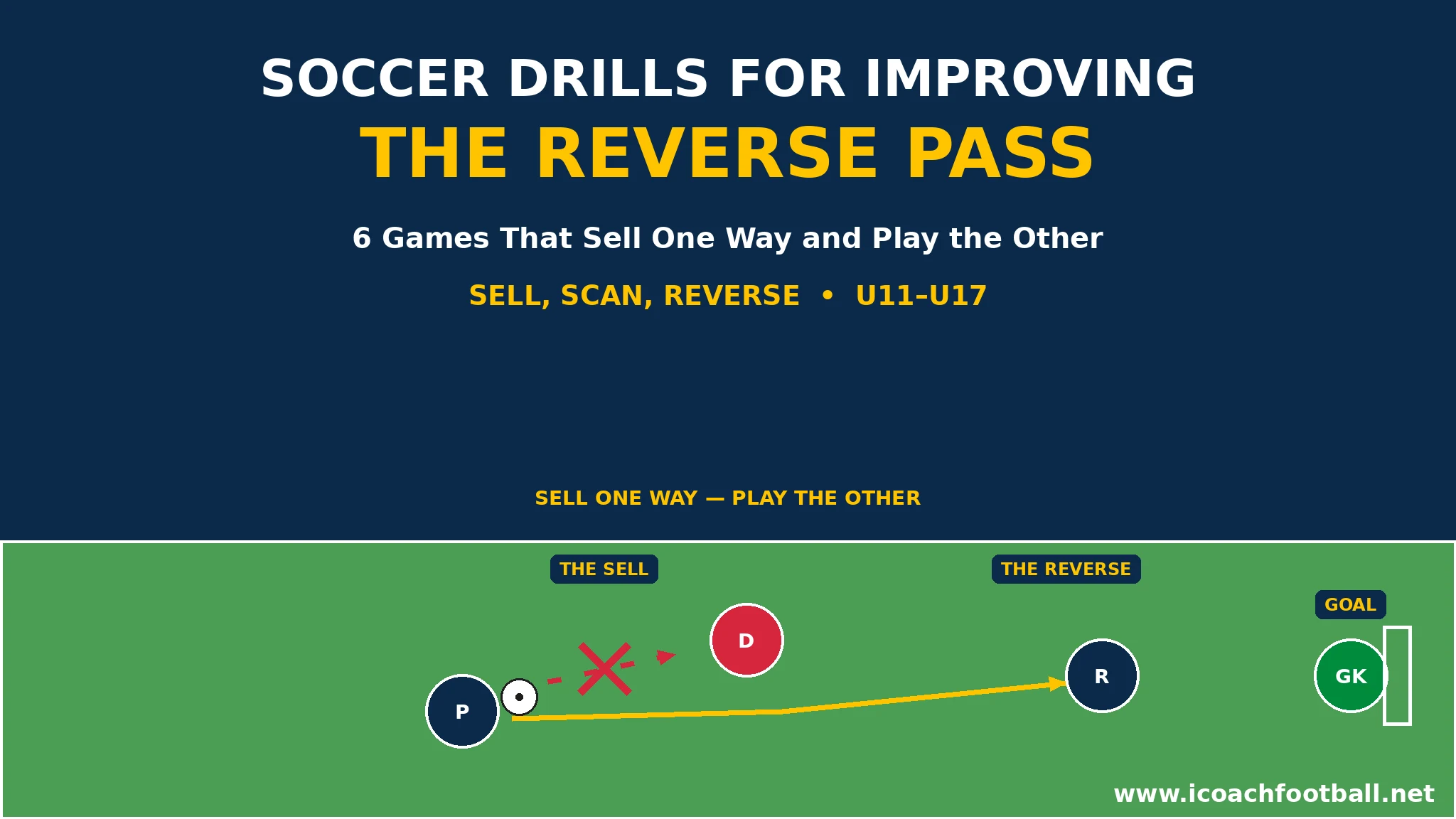
A reverse pass is a pass played in the opposite direction to the passer’s body shape and movement. The player sells one way — eyes, hips and shoulders all pointing where the ball is not going — and then plays the ball the other way, into space the defence has just left. Most attacks die because every pass goes where the defence expects it to go. The reverse pass breaks that pattern: the defender reads the passer’s body, commits to the wrong side, and the ball is already gone the other way. A good reverse pass needs three things: a scan before the ball arrives, so the passer knows where the runner is; a plant foot behind the ball, so the kicking foot can wrap around it; and a receiver who calls his name, so the timing lands. These six soccer drills for improving the reverse pass train the skill step by step: a sell-one-way technique circle, a reverse gate game, the striker’s reverse ball in behind, the winger’s reverse to the overlap, a reverse rondo under pressure, and a full game where a goal after a reverse pass scores two.
Suitable for: U11–U17 (ages 10–17)
Session snapshot
- Players: 14–18
- Age: U11–U17 (ages 10–17)
- Area: Half a pitch, with 2 full goals
- Duration: 60 minutes
- Focus: The reverse pass — sell one way, reverse gates, the striker’s reverse ball, the winger’s reverse to the overlap, the reverse rondo, and the reverse pass game
- Equipment: 14 balls, 30 cones, bibs, 2 full goals
Why these six games work
A team that only passes where its body points is easy to defend. The defender watches the passer’s hips, reads the pass a second early, steps across and kills the attack before it starts. The reverse pass is the answer to that defender. The passer sells one direction with his whole body — the look, the hips, the shoulders — and the defender commits to it. Then the ball goes the other way, into the space the defender has just left. It is the cheapest way in football to beat a man without beating him: no skill move, no pace, just a lie told well and a pass played with intent.
The first drill fixes the technique: the plant foot stays behind the ball so the kicking foot can wrap around it, and the body sells the pass that is never played. The second drill fixes the pattern: the middle player feints toward one gate and reverses through the other, so the decision becomes a habit. The third drill fixes the game use: the striker lays the ball off and spins, and the midfielder sells a pass to his feet before reversing the ball in behind. The fourth drill fixes the wide use: the winger drives at the full-back, sells the run down the line, and reverses the ball into the space for the overlapping full-back. The fifth drill fixes the pressure: a rondo where a reverse pass that splits both defenders scores double, so thedisguise has to survive contact. The last drill puts it into a game where a goal after a reverse pass scores two and an intercepted reverse pass scores the defence one, so both sides fight for the lie.
The drills are grounded in the FIFA/UEFA coaching community. Drills 1, 2, 5 and 6 are based on / in line with the FIFA Training Centre session “43) Breaking lines”, in which FIFA Technical Expert Jonas Urias trains players to break opposition lines: receive with a view to turning out toward the next phase of play, constantly scan and check shoulders for pockets of space, use body and passing feints to deceive and eliminate opponents, and create passing lanes between the lines — including a circuit in which the middle player feints before receiving and then plays a pass from beyond the square, and a 6v6 game that breaks the opposition’s first pressing line. Drills 3 and 4 are based on / in line with the FIFA Training Centre session “05) Balls behind the defence”, in which FC Basel youth development coach Dennis Hediger trains players to combine a well-aimed pass behind the defensive line with a well-timed run: an up-back-through pattern in which a pass back from midfield sets up a penetrating ball to the striker, who lays it off and sprints into space, and games in which attackers run into space in the opposite direction to the defender. In the UK the same session is football drills for improving the reverse pass — the disguise, the scan and the timing are identical.
This is the one pass our passing cluster has never drilled on its own. Our soccer drills for improving the diagonal pass trains the reverse pass’s cousin — the same disguise, a different direction — and our soccer drills for improving creativity trains disguise in general — this session trains one specific pass, the reverse, from its first plant-foot rep to a full game where it decides the score.
Six rules of the reverse pass
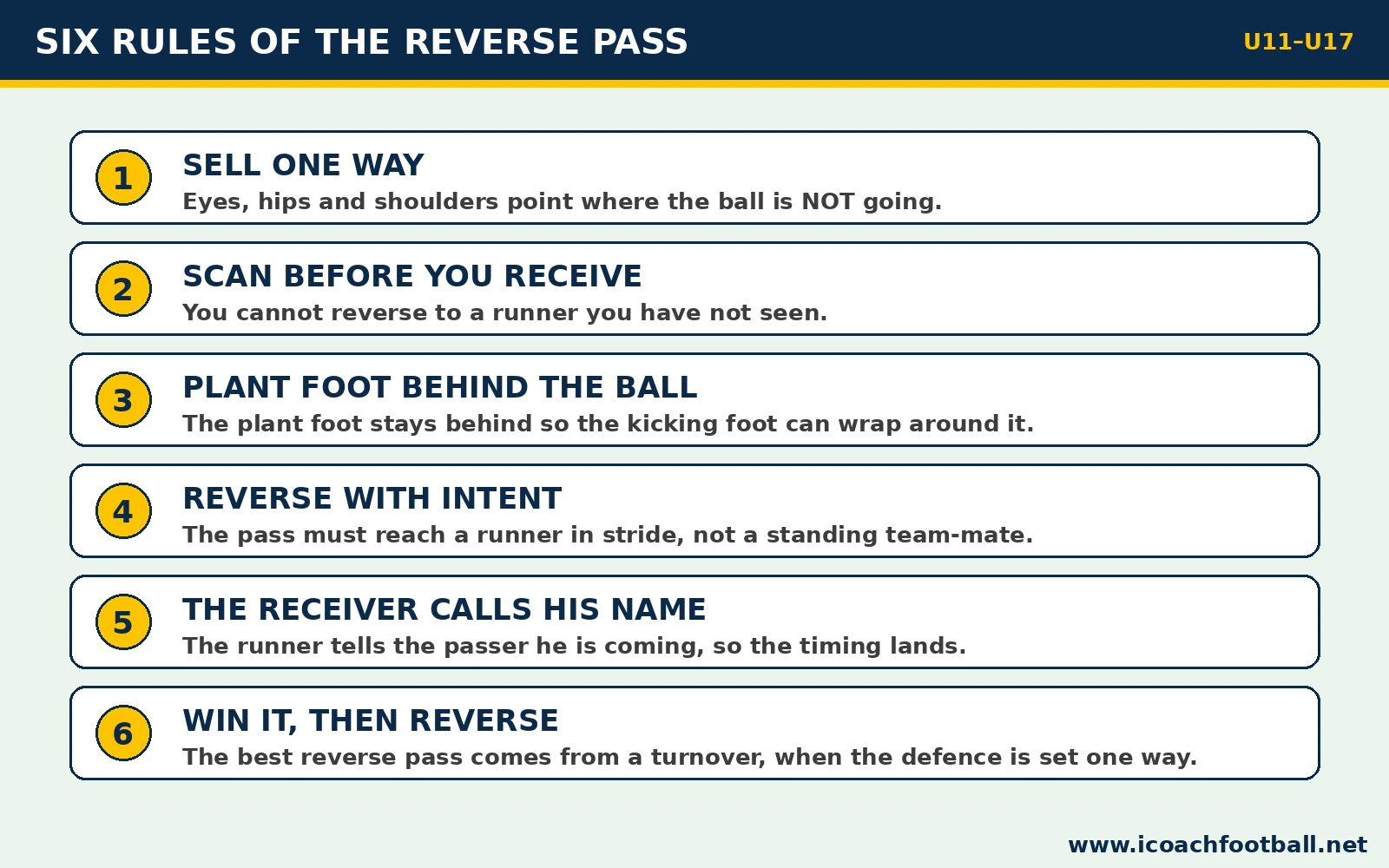
- Sell one way — eyes, hips and shoulders point where the ball is NOT going. A defender reads your body, not your feet. Sell it with your whole body.
- Scan before you receive — you cannot reverse to a runner you have not seen. The picture is taken before the ball arrives, not after it.
- Plant foot behind the ball — the plant foot stays behind so the kicking foot can wrap around it. A plant foot level with the ball can only pass forward.
- Reverse with intent — the pass must reach a runner in stride, not a standing team-mate. A reverse pass to a standing player is just a slow pass backwards.
- The receiver calls his name — the runner tells the passer he is coming, so the timing lands. The reverse ball and the run arrive together, or neither works.
- Win it, then reverse — the best reverse pass comes from a turnover, when the defence is set one way. A defence that has just lost the ball is already facing the wrong way.
Drill 1 — Sell One Way, Play the Other
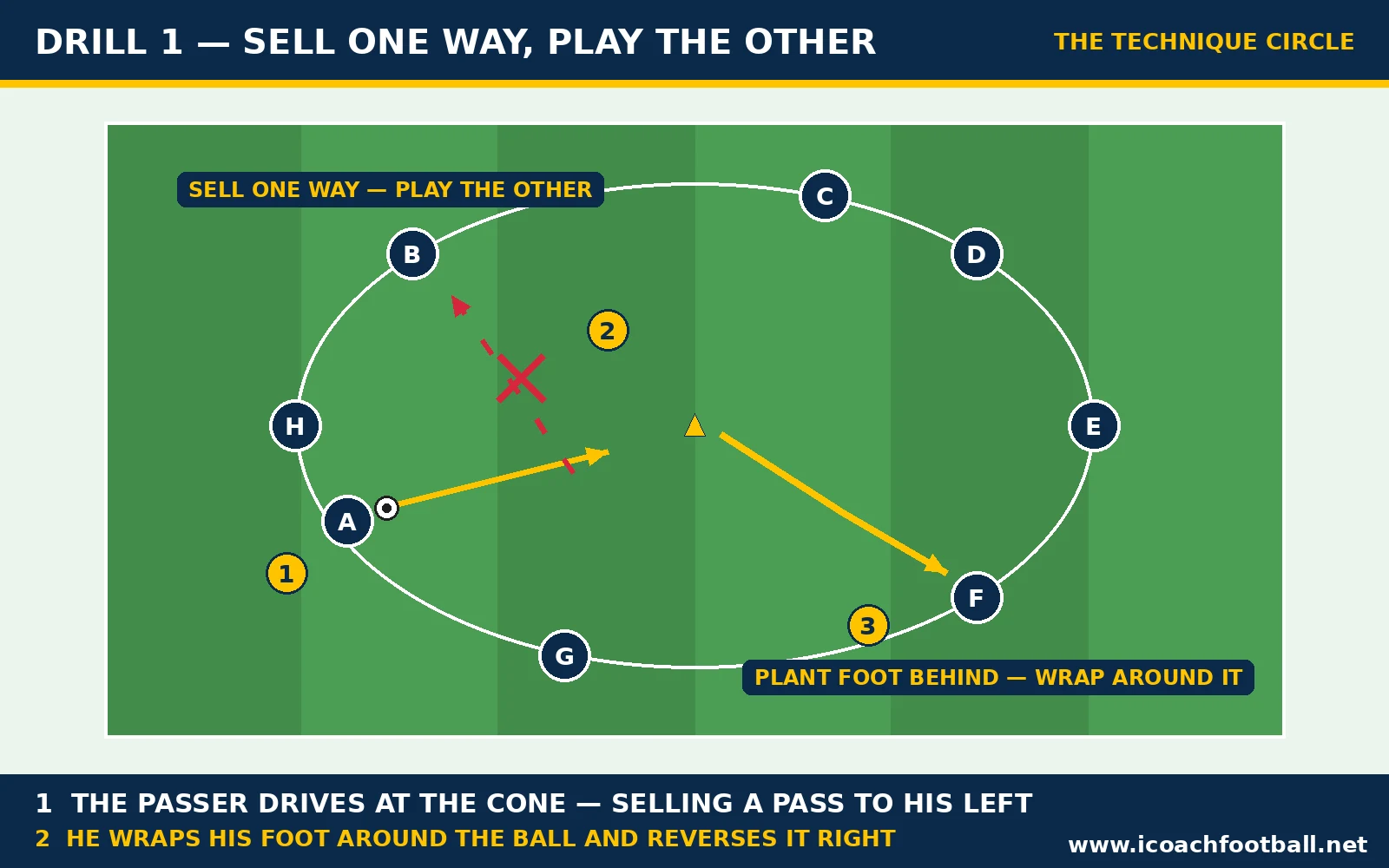
The technique drill — eight players on a circle, one ball, and the passer drives at the centre cone, sells a pass to his left with his eyes and hips, then wraps his kicking foot around the ball and reverses it to the right, in line with FIFA’s “Breaking lines” session: use body and passing feints to deceive and eliminate opponents, and receive with a view to turning toward the next phase of play.
Setup
- Area a 20-yard diameter circle with 1 cone in the centre, 8 players, 1 ball.
- 8 minutes, then swap direction so the weak foot leads.
How to Play
- Eight players stand on a 20-yard circle, one cone in the centre, one ball in play.
- The player on the ball drives at the centre cone, selling a pass to his left with his eyes and hips.
- At the cone he plants his non-kicking foot behind the ball, so his kicking foot can wrap around it.
- He plays the reverse pass to the right, to the player on the far side of the circle.
- The receiver takes the ball round the cone and reverses it on, so the ball keeps moving.
- A reverse pass that reaches its target scores the group 1; a reverse pass the group reads scores 0.
Coach’s note: “Sell the lie — look left, pass right. The defender reads your eyes, not your feet.”
Progressions: The reverse pass must be played with the weak foot; one touch only, so the scan has to happen before the ball arrives; a defender stands in the middle and hunts the ball, and the passer must reverse away from him.
Drill 2 — The Reverse Gate Game
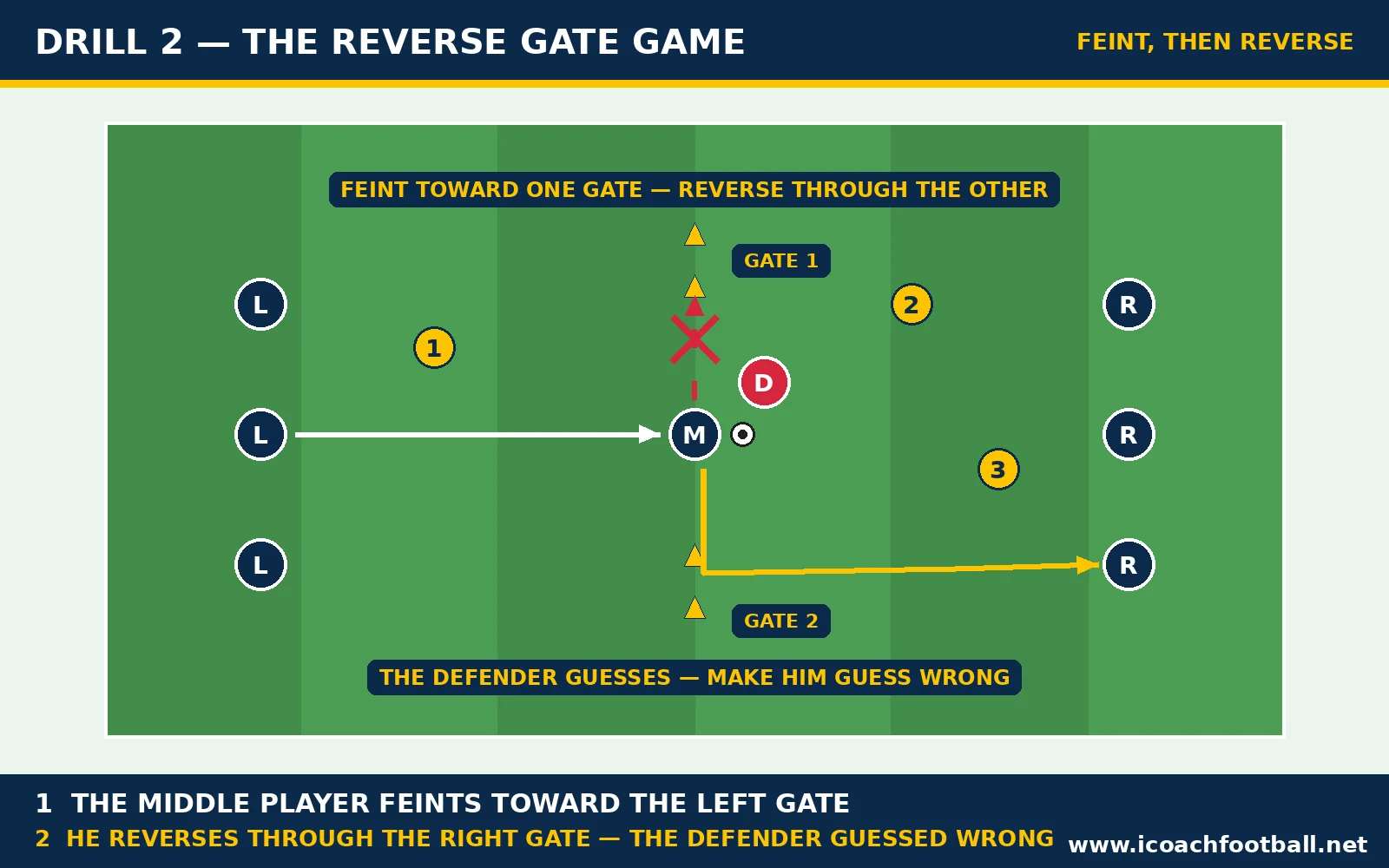
The pattern drill — two lines of three, two cone gates, and the middle player feints toward one gate and reverses through the other while a defender guesses wrong, in line with FIFA’s “Breaking lines” session: the player in the middle square feints before receiving and then plays a pass from beyond the square, and players should perform feints to deceive opponents and create space to receive on the turn.
Setup
- Area a 30 x 20-yard area with two cone gates 2 yards wide, 6 players in two lines of three plus 1 defender.
- 9 minutes, then swap the middle player and the defender.
How to Play
- Two lines of three stand 30 yards apart, with two cone gates 2 yards wide between them.
- A defender stands between the gates and guesses which gate the pass will go through.
- The first player passes to the middle player, who checks away and receives on the half-turn.
- The middle player feints toward the left gate, selling the pass with his eyes and hips.
- He reverses the ball through the right gate, with his plant foot behind the ball.
- A reverse pass through the gate the defender did not pick scores 1; a pass the defender reads scores 0.
Coach’s note: “The defender guesses — make him guess wrong. Sell it with your whole body, not just your eyes.”
Progressions: The gates narrow to 1 yard wide, so the weight must be exact; one touch only for the middle player; the middle player must reverse with his weak foot.
Drill 3 — The Striker’s Reverse Ball
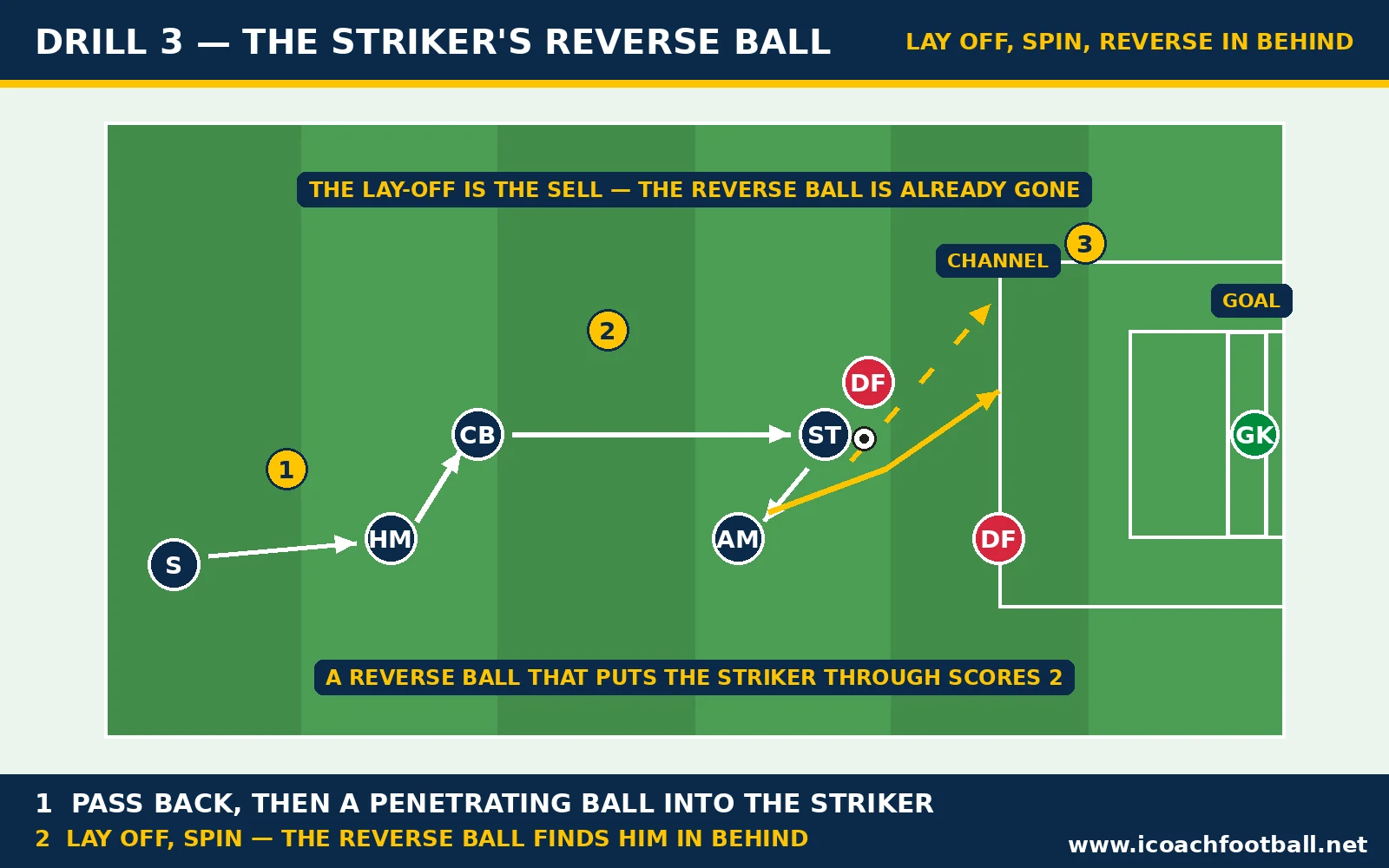
The combination drill — a pass back sets up a penetrating ball to the striker, who lays it off first time and spins in behind while the midfielder sells a pass to his feet and reverses the ball into the channel, in line with FIFA’s “Balls behind the defence” session: a pass back from midfield sets up a penetrating ball to the striker, who lays it off and sprints into space while the midfielder plays the ball in behind.
Setup
- Area half a pitch, 1 full goal with a goalkeeper, 9 players per group: server, centre-back, holding midfielder, attacking midfielder, striker, 2 runners, 2 defenders.
- 9 minutes, then swap the striker and the attacking midfielder.
How to Play
- The holding midfielder receives from the server and passes back to the centre-back.
- The centre-back takes his first touch forward and plays a weighted pass into the striker’s feet.
- The striker checks away from his marker and receives with an open body, facing the ball.
- The striker lays the ball off first time to the attacking midfielder and spins in behind.
- The midfielder sells a pass back to the striker’s feet, then reverses the ball into the channel.
- The striker runs onto the reverse ball in stride and finishes first time.
Coach’s note: “The lay-off is the sell — the defender watches the ball at the striker’s feet, and the reverse ball is already gone.”
Progressions: A defender presses the midfielder, so the reverse must be played under pressure; the striker must finish with his weak foot; the reverse ball must go to the far channel, not the near one.
Drill 4 — The Winger’s Reverse to the Overlap
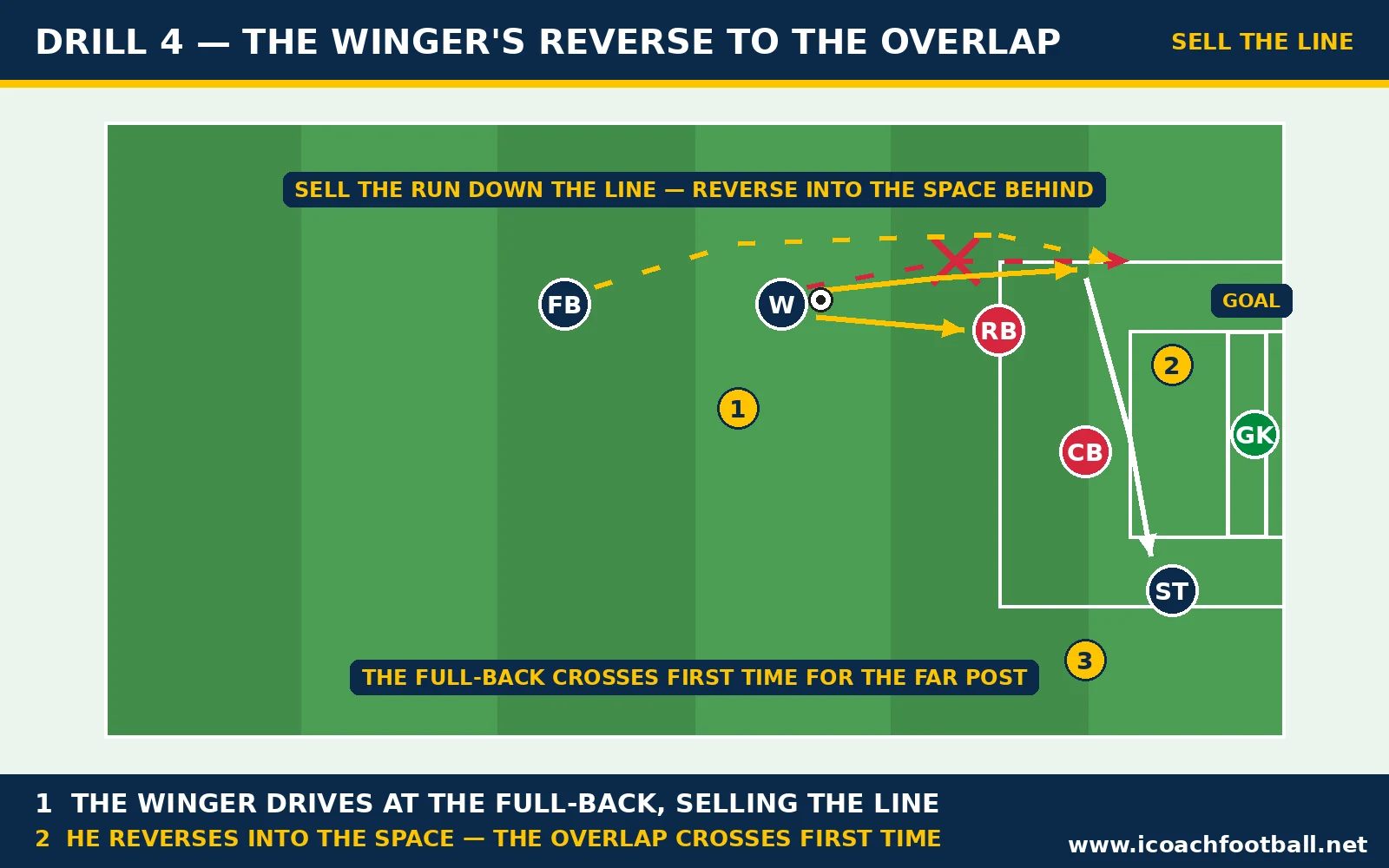
The wide drill — the winger drives at the full-back, sells the run down the line, and cuts the ball back to reverse it into the space for the overlapping full-back, in line with FIFA’s “Balls behind the defence” session: attackers make direct runs into space in the opposite direction to the defender and use deep runs to drag defenders out of position.
Setup
- Area the right half of the pitch, 1 full goal with a goalkeeper, winger plus overlapping full-back against a full-back and a centre-back, plus a striker arriving at the far post.
- 10 minutes, then swap sides so the left winger leads.
How to Play
- The winger receives wide on the right, 30 yards from goal, with the full-back overlapping outside him.
- The winger drives at the full-back, selling the run down the line with his body and eyes.
- The full-back commits to the line, and the centre-back shuffles across to cover.
- The winger cuts the ball back with the inside of his foot, still facing forward.
- He plays the reverse pass into the space behind the full-back for the overlapping full-back.
- The full-back crosses first time, low across the goal, for the striker arriving at the far post.
Coach’s note: “Beat him three times first — then the fourth time he believes the run, and the reverse ball is open.”
Progressions: The full-back starts five yards closer, so the disguise must be better; the winger must reverse with his weak foot; the cross must be first time or the goal does not count.
Drill 5 — The Reverse Rondo
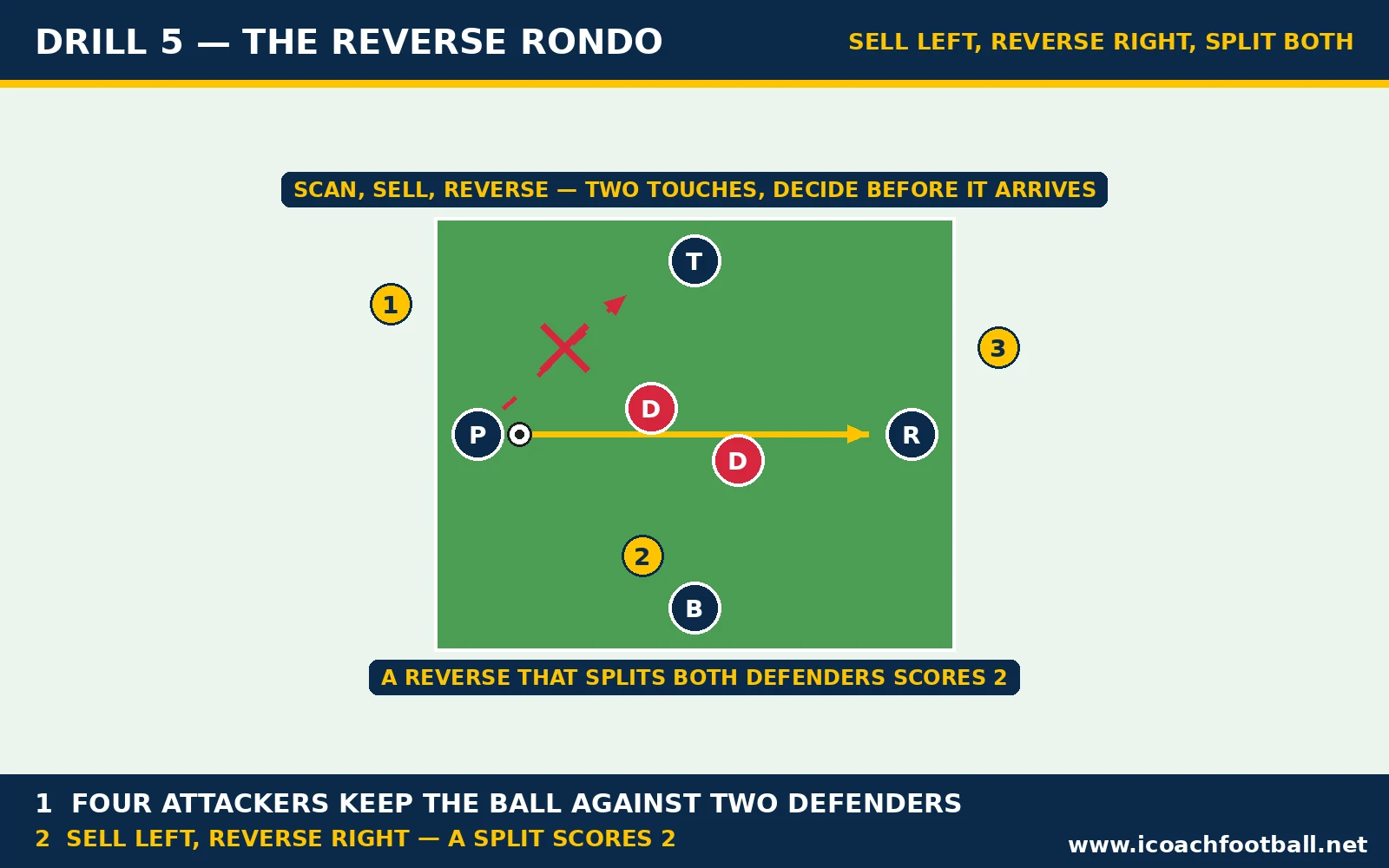
The pressure drill — a 4v2 rondo where a reverse pass that splits both defenders scores double, so the passer must sell one way under pressure and still find the other, in line with FIFA’s “Breaking lines” session: to overcome the midfield press, players must master passing feints, move sharply in tight spaces and constantly scan for pockets of space.
Setup
- Area a 12 x 12-yard grid, 4 attackers against 2 defenders, 1 ball.
- 9 minutes, then swap the defenders.
How to Play
- Four attackers keep the ball in a 12-yard grid against two defenders in the middle.
- The attackers are limited to two touches, so every pass must be decided before the ball arrives.
- The player on the ball scans before receiving and picks the defender he will sell the pass to.
- He shapes to pass to his left, with his eyes, hips and shoulders all pointing that way.
- He reverses the ball to his right, splitting the two defenders with a pass they did not expect.
- A reverse pass that splits both defenders scores 2; an ordinary completed pass scores 1.
Coach’s note: “Two touches means you decide before the ball arrives — scan, sell, reverse.”
Progressions: One touch only for every attacker; the grid shrinks to 10 yards, so the disguise must be faster; a reverse pass that splits both defenders and is followed by a third pass scores 3.
Drill 6 — The Reverse Pass Game
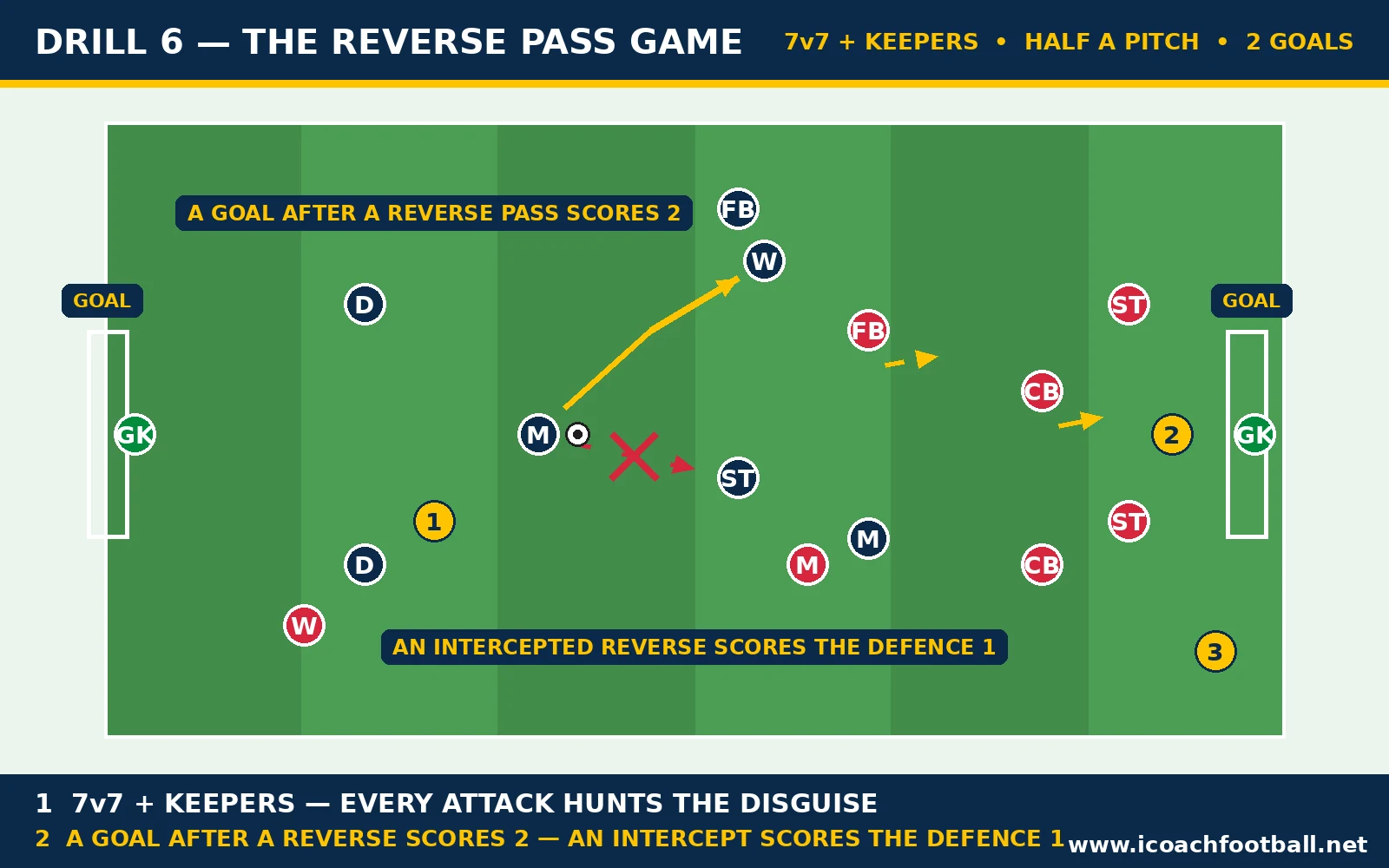
The full game. A 7v7 on half a pitch where a goal after a reverse pass scores 2 and an intercepted reverse pass scores the defence 1, so both sides fight for the lie, in line with FIFA’s “Breaking lines” session: a 6v6 game that breaks the opposition’s first pressing line, and a final exercise that overcomes the midfield press.
Setup
- Half a pitch, 2 full goals with goalkeepers, 7v7.
- 10 minutes, teams swap ends at five minutes.
How to Play
- Two teams play 7v7 on half a pitch with a goalkeeper in each goal.
- A goal scored after a reverse pass — a pass played opposite to the passer’s body direction — scores 2.
- A goal scored without a reverse pass scores 1, so the attack keeps hunting the disguise.
- A reverse pass that splits the defensive line but does not lead to a goal scores the attack 1.
- A reverse pass that is intercepted scores the defending team 1, so the disguise has to be real.
- The game runs for ten minutes; the team with the most points wins, and the teams swap ends at five minutes.
Coach’s note: “Two points for a goal after a reverse pass — that is the game telling the attack what to do.”
Progressions: Only goals after a reverse pass count in the final three minutes; the reverse pass must come from a midfielder, not a defender; the goalkeepers must start the next attack with a throw to a centre-back, so every attack can reverse.
Coaching points
- Sell one way — eyes, hips and shoulders point where the ball is NOT going. A defender reads your body, not your feet. Sell it with your whole body.
- Scan before you receive — you cannot reverse to a runner you have not seen. The picture is taken before the ball arrives, not after it.
- Plant foot behind the ball — the plant foot stays behind so the kicking foot can wrap around it. A plant foot level with the ball can only pass forward.
- Reverse with intent — the pass must reach a runner in stride, not a standing team-mate. A reverse pass to a standing player is just a slow pass backwards.
- The receiver calls his name — the runner tells the passer he is coming, so the timing lands. The reverse ball and the run arrive together, or neither works.
- Win it, then reverse — the best reverse pass comes from a turnover, when the defence is set one way. A defence that has just lost the ball is already facing the wrong way.
Common mistakes
| Mistake | Fix |
|---|---|
| The passer only moves his eyes, so the defender is not sold and reads the reverse | Sell it with the whole body — Drill 1 scores 0 if the group reads the reverse |
| The plant foot lands level with the ball, so the kicking foot cannot wrap around it | Plant behind the ball — Drill 1 scores 0 if the reverse pass goes straight instead of across |
| The passer never scans, so he reverses into empty space with no runner there | Scan before you receive — Drill 2 scores 0 if the middle player reverses to a gate nobody is running to |
| The striker lays the ball off and stands still, so the reverse ball has nobody to find | Spin the moment the lay-off leaves your foot — Drill 3 scores 0 if the striker is still standing when the reverse ball is played |
| The winger cuts the ball back too late, after the full-back has already recovered | Cut it back the moment the full-back commits — Drill 4 scores 0 if the overlapper is caught offside or arrives after the ball |
| The rondo passer telegraphs the reverse by looking at his target before he sells the other way | Look at the lie until the last moment — Drill 5 scores the defenders 1 for every reverse pass they intercept |
Age adaptations
| Age | Format | What changes |
|---|---|---|
| U11–U12 (ages 10–12) | 20-yard circle, size 4 ball, gates 3 yards wide, the defender in Drill 2 only walks | Keep it to one lie at a time. Drill 1 runs with the passer walking to the cone, so he can practise the plant foot and the wrap slowly. Drill 2 runs with the gates 3 yards wide and the defender walking, and the coach calls “Sell!” before every rep. Drill 6 counts every completed reverse pass, even one that goes nowhere, so the players learn to celebrate trying it |
| U13–U14 (ages 12–14) | Full circle and gates, size 4 ball, the defender in Drill 2 jogs, the press in Drill 3 starts from a jog | The disguise becomes the session’s main skill. Drill 1 adds the weak foot, so the wrap must work on both sides. Drill 2 narrows the gates to 2 yards and Drill 5 drops to one touch for the last three minutes. Players are asked to name the sell before each rep — “Left” or “Right” — so the deception becomes a conscious skill, not a lucky guess |
| U15–U17 (ages 14–17) | Full areas, size 5 ball, full pressure from the first rep, gates 1 yard wide | Full pressure from the start. Drill 1 runs with a live defender hunting the ball, Drill 3 runs with a defender pressing the midfielder, and Drill 6 plays with only goals after a reverse pass counting in the final three minutes. Players are asked to reverse without a call — eye contact only — so the communication becomes a habit, not a shout |
60-minute session plan
| Block | Time | Content |
|---|---|---|
| Arrival game | 0:00–0:05 | Reverse warm-up — pairs, one passer, one receiver, the passer practises selling one way and reversing the other over five yards |
| Sell one way, play the other | 0:05–0:13 | Drill 1 — Sell One Way, Play the Other |
| The reverse gate game | 0:13–0:22 | Drill 2 — The Reverse Gate Game |
| The striker’s reverse ball | 0:22–0:31 | Drill 3 — The Striker’s Reverse Ball |
| The winger’s reverse to the overlap | 0:31–0:41 | Drill 4 — The Winger’s Reverse to the Overlap |
| The reverse rondo | 0:41–0:50 | Drill 5 — The Reverse Rondo |
| The reverse pass game | 0:50–1:00 | Drill 6 — The Reverse Pass Game |
Keep building from here
The diagonal pass our soccer drills for improving the diagonal pass trains is the reverse pass’s cousin — the same disguise, a different direction. The disguise this session trains in one pass is the whole subject of our soccer drills for improving creativity, and the first-time finish the striker’s reverse ball sets up is our soccer drills for improving first-time shooting. The runner the reverse ball finds is often the third man — our soccer third man runs drills — and the pocket the reverse pass finds is between the lines, our football playing between the lines drills. The one-touch speed the reverse pass needs is our soccer one-touch passing drills, and the run that makes the reverse pass possible is our soccer drills for improving off the ball movement. The rotation that opens the lane for the reverse ball is our soccer drills for improving midfield rotation, and the far-post run the winger’s reverse ball finds is our soccer drills for improving attacking the back post. The final-third combinations the reverse pass unlocks are our soccer attacking third drills, and the weight and accuracy the reverse pass needs is our soccer drills for improving passing accuracy. The decision of when to reverse and when to play safe is our soccer decision making drills. The reverse pass is high-repetition, high-intensity work — plan the week’s load with our training load calculator.
What is a reverse pass in soccer?
A reverse pass is a pass played in the opposite direction to the passer’s body shape and movement. The player sells one way — eyes, hips and shoulders all pointing where the ball is not going — and then plays the ball the other way, into space the defence has just left. It works because defenders read a passer’s body, not his feet: commit them to the wrong side and the ball is already gone. The technique is a plant foot behind the ball and a kicking foot that wraps around it.
How do you teach the reverse pass to young players?
Start with Drill 1, the circle: walk to the cone, plant the non-kicking foot behind the ball, wrap the kicking foot around it and play the ball the other way. Practise the shape slowly before any defender arrives — at U11 the plant foot and the wrap matter more than the disguise. Count every completed reverse pass, even one that goes nowhere. Only add a defender once the shape is clean on both feet.
What is the difference between a reverse pass and a disguised pass?
A disguised pass is the family and the reverse pass is one member of it. Any pass that hides its destination is a disguised pass — a no-look pass, a pass with the outside of the foot, a look one way and pass the other. A reverse pass is the specific disguise where the ball goes in the opposite direction to the passer’s body shape and movement. Every reverse pass is a disguised pass, but not every disguised pass is a reverse pass.
When should a player play a reverse pass instead of a normal pass?
When the defender has already committed to one side, when a runner is arriving on the blind side, or when the obvious pass is covered and the space is the other way. The reverse pass is a weapon for breaking a set defence, not a default: if the simple forward pass is open, play it. Drill 5 trains the decision: a reverse pass that splits both defenders scores double, an intercepted one scores the defence — so players reverse only when the sell is real.
How do you coach the reverse pass to U11s?
Keep it to one lie at a time. Use the 20-yard circle in Drill 1 with the passer walking to the cone, so he can practise the plant foot and the wrap slowly, and widen the gates in Drill 2 to 3 yards with the defender only walking. Call “Sell!” before every rep, so the deception is a named action and not a guess. Count every completed reverse pass in the final game, even one that goes nowhere. The shape matters more than the outcome at this age.
Sources
- FIFA Training Centre. “43) Breaking lines” — FIFA Technical Expert Jonas Urias trains players to break opposition lines: receive with a view to turning out toward the next phase of play, constantly scan and check shoulders for pockets of space, use body and passing feints to deceive and eliminate opponents, and create passing lanes between the lines — including a circuit in which the middle player feints before receiving and then plays a pass from beyond the square, and a 6v6 game that breaks the opposition’s first pressing line. Verified live 2026-11-24 (HTTP 200, full text read). Drills 1, 2, 5 and 6 are based on / in line with this session.
- FIFA Training Centre. “05) Balls behind the defence (Hediger)” — FC Basel youth development coach Dennis Hediger trains players to combine a well-aimed pass behind the defensive line with a well-timed run: an up-back-through pattern in which a pass back from midfield sets up a penetrating ball to the striker, who lays it off and sprints into space, and games in which attackers run into space in the opposite direction to the defender. Verified live 2026-11-24 (HTTP 200, full text read). Drills 3 and 4 are based on / in line with this session.