Soccer Drills for Improving Midfield Rotation: 6 Games That Swap Positions and Open the Pitch (U11–U17)
Quick answer
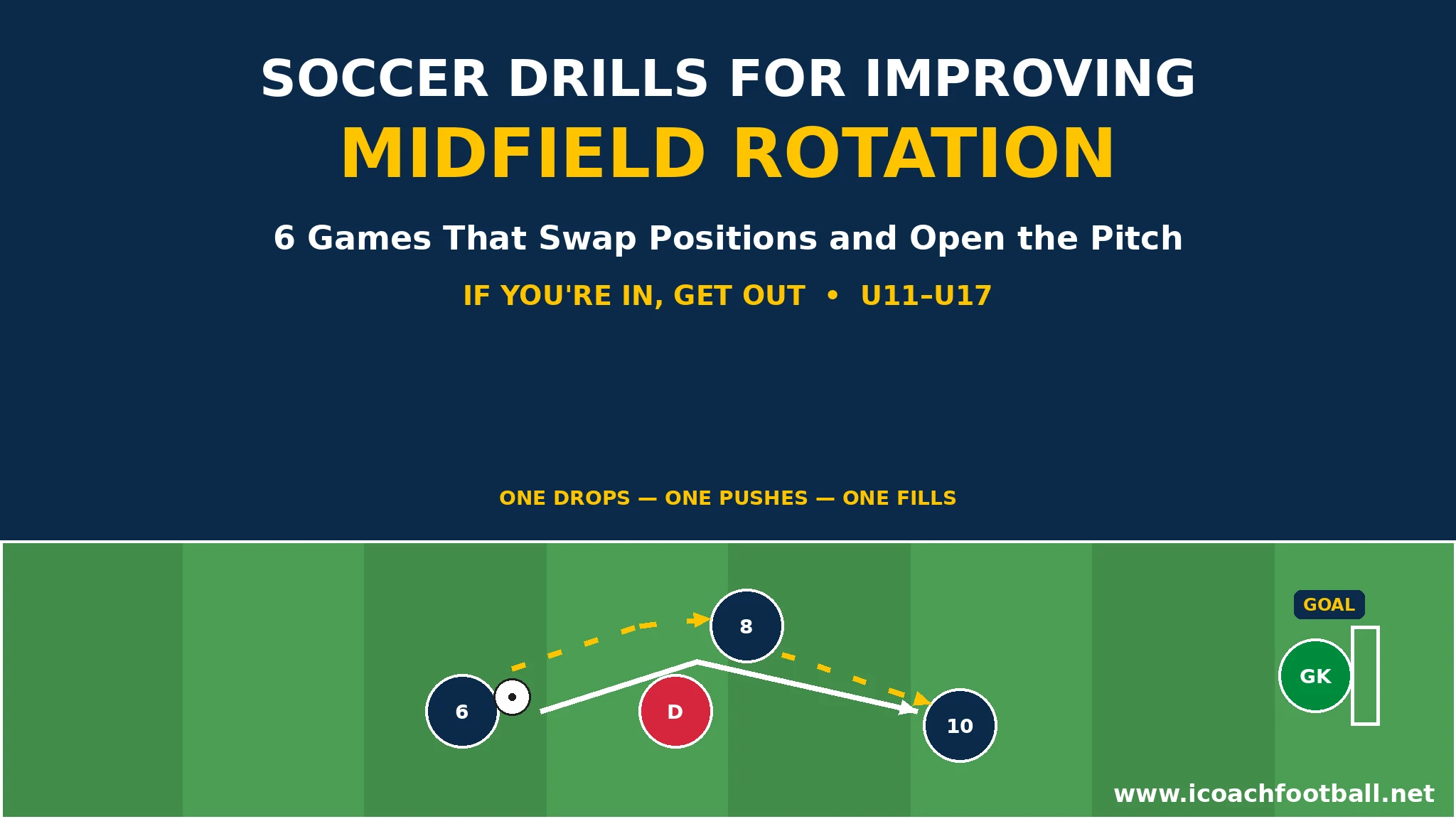
Midfield rotation is the moment a midfielder leaves their starting position and a team-mate fills the space they vacated — the 6 drops deep, the 8 pushes forward, the 10 slides into the gap, and suddenly the opposition midfield is marking nobody and following everybody. A midfield that never rotates is easy to defend: the markers stay with their men, the passing lanes stay shut, and the ball goes sideways. A midfield that rotates on every pass is almost impossible to mark, because the player the defender was tracking has gone and a different player is arriving in the space behind them. These six soccer drills for improving midfield rotation train exactly that: an unopposed diamond carousel that grooves the swap, a box-swap game built on one simple rule, an overload game that breaks lines, the 6-8-10 triangle rotation itself, a stretch-and-switch game that opens the pitch wide, and a full rotation game where every third pass has to move a midfielder.
Suitable for: U11–U17 (ages 10–17)
Session snapshot
- Players: 14–18
- Age: U11–U17 (ages 10–17)
- Area: Half a pitch, with 2 full goals and 2 mini goals
- Duration: 60 minutes
- Focus: Midfield rotation — the 6-8-10 swap, overloads, stretch-and-switch, receiving on the half-turn and transition cover
- Equipment: 14 balls, 24 cones, bibs, 2 full goals, 2 mini goals
Why these six games work
Most midfields fail in the same way. The three midfielders stand in their starting spots, the ball moves around them, and the opposition midfield simply stands next to them. Nobody moves, so nobody is free, so the ball goes backwards. The fix is not better passing — it is movement that creates the pass. One midfielder has to leave their zone so another can arrive in it, and the whole unit has to understand that the rotation is the pass, not something that happens after it.
The first two drills teach the two habits rotation runs on: a diamond carousel where four midfielders swap positions on every single pass, and a box-swap game built on one rule — if you pass out of your box, you must leave it, and a team-mate must replace you. The next two drills train the rotation itself: an overload game where two neutral midfielders create the extra man in the middle, and the 6-8-10 triangle, the classic three-player swap that every positional-play team uses. The last two drills finish the job: a stretch-and-switch game where wide players pull the defence apart so the midfielders can rotate into the gaps, and a full game where the midfield three must rotate on every third pass or the attack stalls.
The drills are grounded in the FIFA/UEFA coaching community. Drills 3, 5 and 6 are based on / in line with the FIFA Training Centre session “Game-phases: Developing central midfielders”, in which the holding midfielder’s role is trained in full game phases: midfielders must offer constant support, work closely together to recognise when to push forward to create space or drop in to receive when space has been created, create overloads and use numerical superiority in the centre to play through pressure, and use the stretched pitch to switch play diagonally or play through balls into advancing attackers — its first part is a 6v6 plus 2 neutrals on a 50-by-30-metre pitch creating overloads to start dynamic attacks, and its second part is a 6v6 plus 4 neutrals on a 50-by-40-metre pitch stretching the defence to open passing lanes. Drills 1, 2 and 4 are based on / in line with The FA’s Boot Room article “Developing multifunctional players”, in which former England U19 head coach Noel Blake teaches positional interchange with one rule — “if you’re in, get out; and if you’re out, get in” — shows how a midfield three can rotate with the wide players and the number 9, works on movement, interchange and receiving unopposed before adding pressure, and insists that every rotation leaves cover at the back because the transition is coming. In the UK the same session is football drills for improving midfield rotation — the swap, the timing and the cover are identical.
The space rotation creates is the space between the lines. Our football playing between the lines drills train receiving in that pocket once the rotation has opened it, and the pass that breaks the lines once the swap has dragged a marker away is our soccer through ball drills.
Six rules of midfield rotation
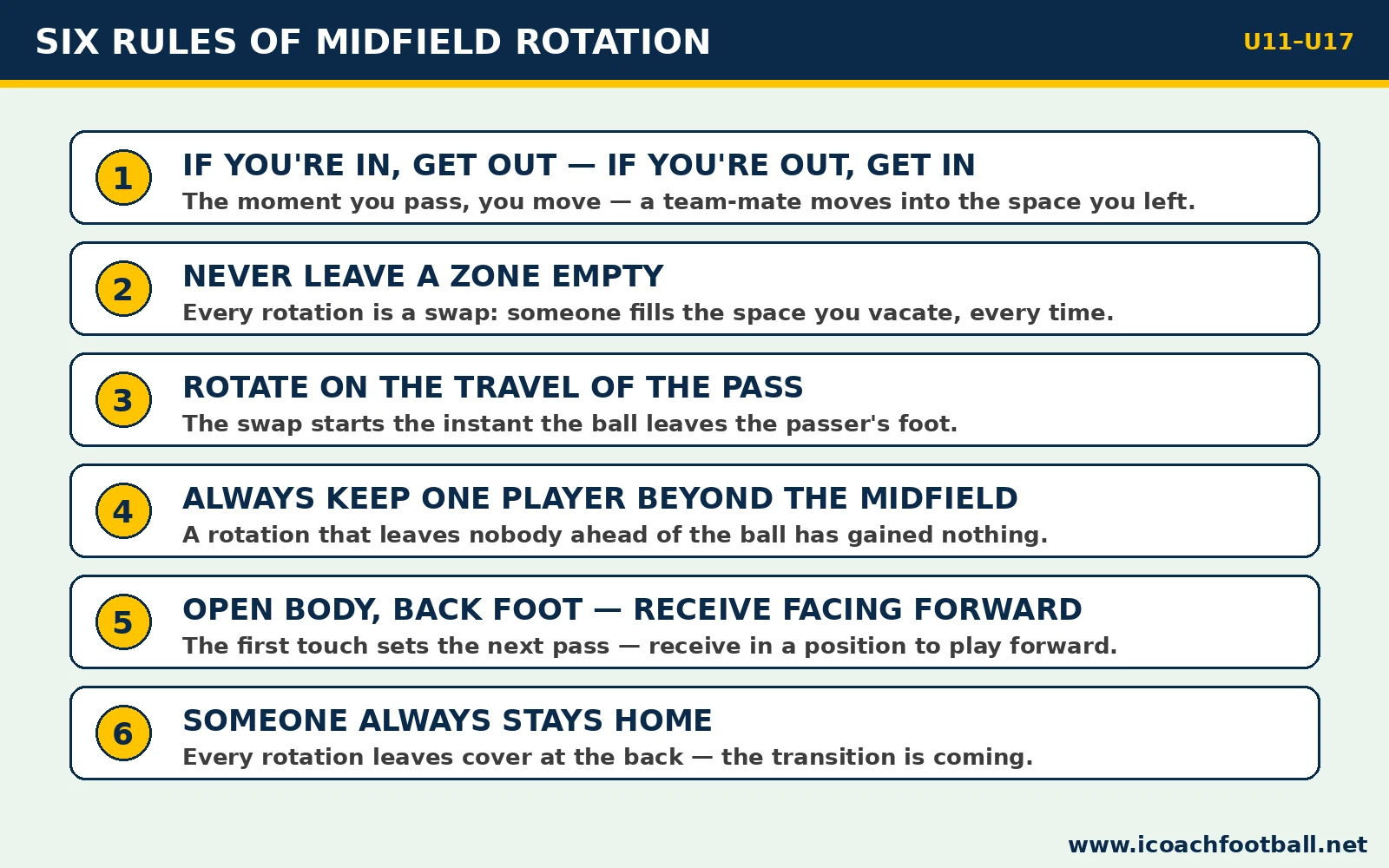
- If you’re in, get out — if you’re out, get in. The moment you pass, you move — and a team-mate moves into the space you left.
- Never leave a zone empty. Every rotation is a swap, not a departure: someone fills the space you vacate, every time.
- Rotate on the travel of the pass, not after it arrives. The swap starts the instant the ball leaves the passer’s foot.
- Always keep one player beyond the opposition midfield. A rotation that leaves nobody ahead of the ball has gained nothing.
- Open body, back foot — receive facing forward. A rotation that ends with a player facing their own goal has wasted the move.
- Someone always stays home. Every rotation leaves cover at the back — the transition is coming, and the back line must be ready.
Drill 1 — The Diamond Carousel
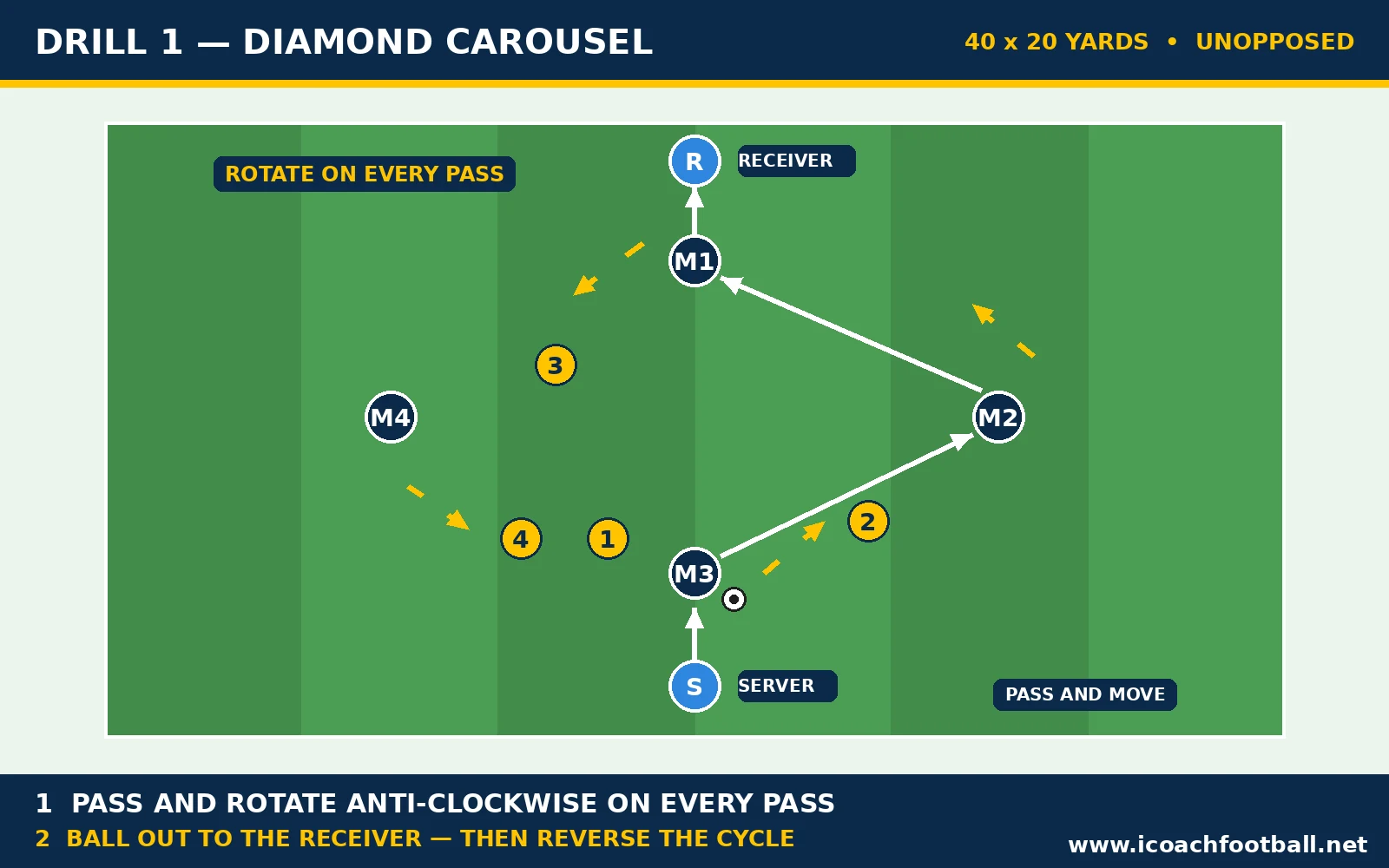
The groove drill — four midfielders in a diamond swap positions anti-clockwise on every pass, in line with The FA’s unopposed movement, interchange and receiving work: the pattern is learned before any pressure arrives.
Setup
- Area 40 yards by 20 yards, 1 ball, groups of 4 midfielders plus a server and a receiver.
- 8 minutes, then swap the midfield four.
How to Play
- Four midfielders stand on the corners of a 40-by-20-yard diamond, with a server at the bottom end and a receiver at the top.
- The server feeds the ball into the bottom midfielder, who takes one touch and passes it on to the next corner.
- The moment the pass is played, the passer rotates anti-clockwise to the next corner — the swap starts on the travel of the pass.
- Each midfielder moves off their cone to receive, passes on, and rotates — the ball travels up the diamond and out to the receiver.
- When the ball reaches the receiver, the cycle reverses and the diamond rotates clockwise back down.
- After two minutes, the coach calls “GOAL” and the top midfielder goes through to shoot at a mini goal.
Coach’s note: “Rotate on the pass, not on the touch. If you wait until the ball arrives at your feet, you are already a second late — the swap starts when the ball leaves the passer’s foot.”
Progressions: One-touch passing throughout, so the rotation has to be pre-planned; the server feeds the ball in at a different corner each time, so the diamond must rotate both ways; a passive defender stands in the middle, so the midfielders must rotate away from the marker.
Drill 2 — In, Get Out
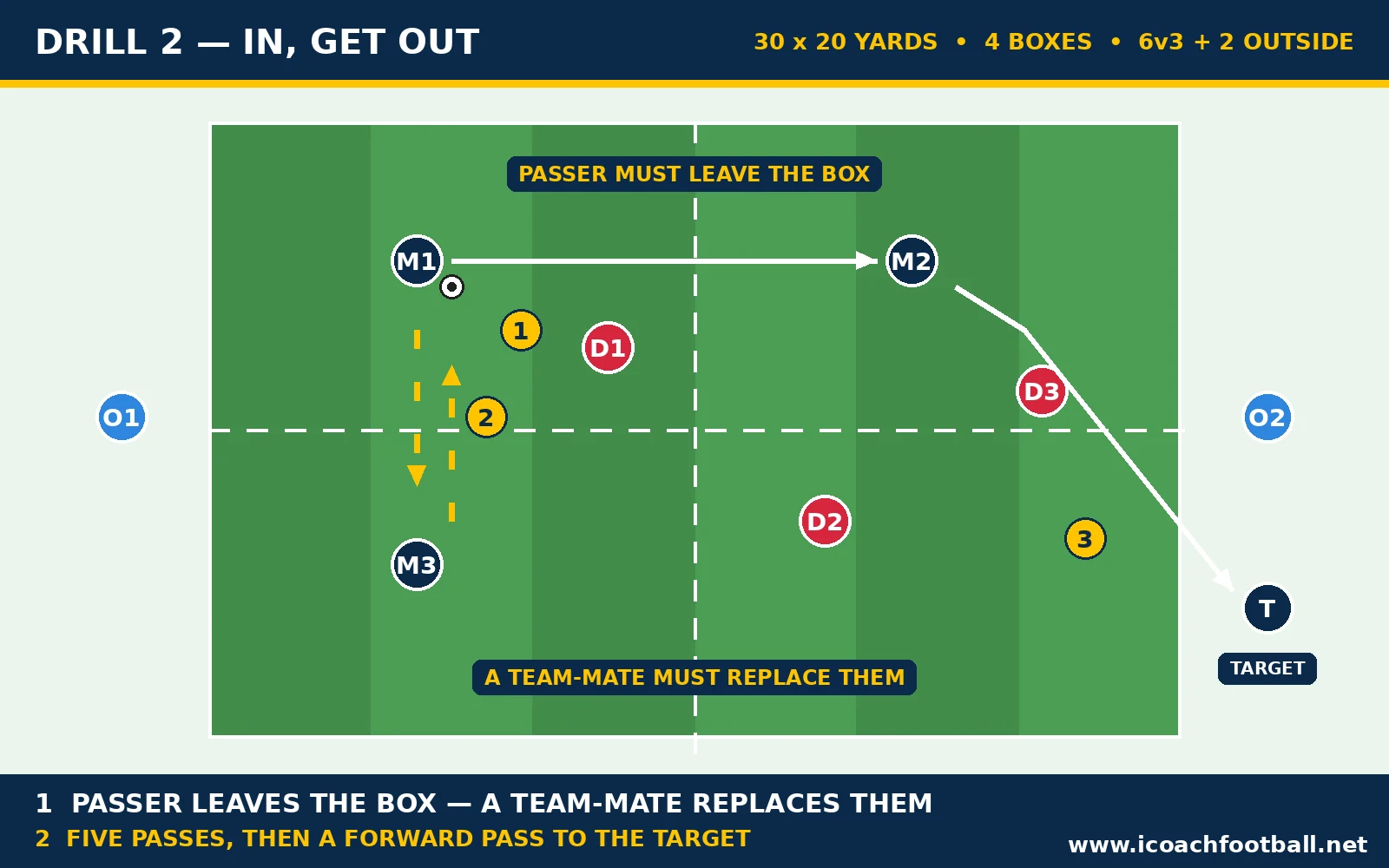
The rule drill — the grid is split into boxes, and the one rule is Blake’s: if you pass out of your box, you must leave it, and a team-mate must replace you — so the rotation becomes a habit, not a choice.
Setup
- Area 30 yards by 20 yards split into 4 boxes, 6v3 with 2 outside players, 2 balls.
- 10 minutes, then swap the defending three.
How to Play
- Three midfielders work inside the four-box grid against three defenders, with two outside players on the edges to bounce the ball off.
- The midfielders pass the ball around the grid, and the one rule applies: the player who passes out of a box must leave that box.
- A team-mate must replace them in the box they left — the zone is never empty, and the swap is instant.
- If a midfielder stays in their box after passing, the coach stops play and the team loses the ball.
- The outside players are two-touch only, so the ball comes back quickly and the rotation has to keep up.
- After five passes the midfielders must play a forward pass into a target player outside the grid — a point for every forward pass completed.
Coach’s note: “If you’re in, get out. If you pass and stand still, you have just told the defender exactly where you are — move, and make them choose who to follow.”
Progressions: The defenders may press the ball carrier, so the rotation has to happen under pressure; the outside players are removed, so the midfielders must rotate and find the forward pass alone; a second ball is added, so two rotations are happening at once and the unit must stay organised.
Drill 3 — The Overload Game
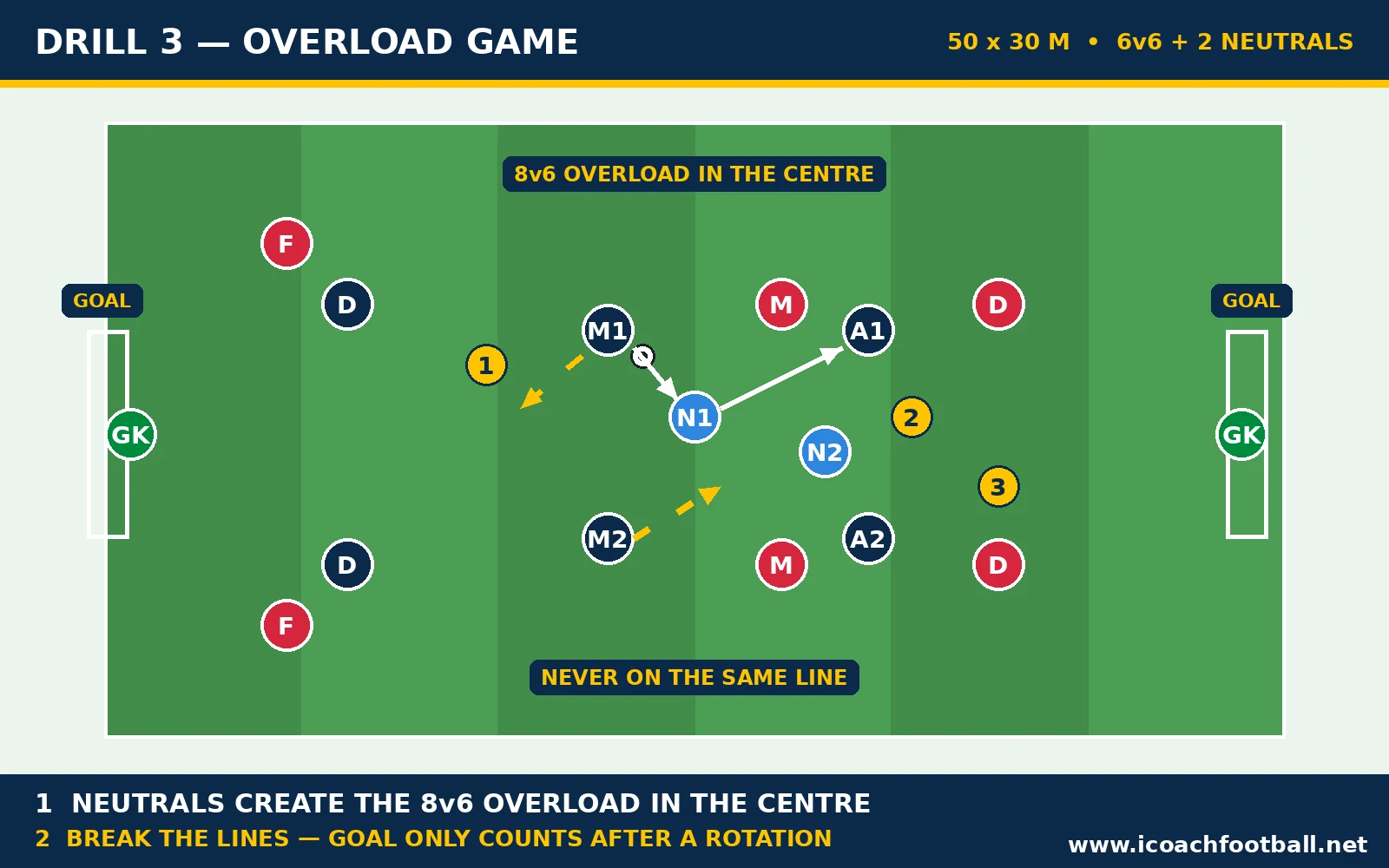
The lines-breaking drill — a 6v6 plus 2 neutral midfielders on a 50-by-30-metre pitch, exactly as the FIFA Training Centre’s game-phases session opens: the neutrals create the overload in the centre, and the team in possession must break the lines to score.
Setup
- Area 50 metres by 30 metres, 2 full goals with goalkeepers, 6v6 plus 2 neutral midfielders.
- 10 minutes, then swap the neutral pair.
How to Play
- Two teams of six play 6v6 on a 50-by-30-metre pitch, with two neutral midfielders stationed in the central area.
- The neutrals always play with the team in possession, creating an 8v6 overload in the middle of the pitch.
- The team in possession must spread out and use the full width, so the two central midfielders have space to rotate into.
- The two midfielders must never stand on the same vertical or horizontal line — one drops, one pushes, and the angles stay open.
- When a midfielder drops deep to receive, their team-mate pushes forward into the space beyond the opposition midfield.
- The team in possession must break the lines and score — a goal only counts if the final pass came from a midfielder who had rotated in the build-up.
Coach’s note: “Two midfielders on the same line is one midfielder. Split the lines — one drops, one pushes — and the overload becomes a through ball instead of a sideways pass.”
Progressions: The neutrals are limited to two touches, so the rotation has to be decided before the ball arrives; the defending team may press the neutrals, so the overload has to be protected; a goal only counts if it follows a switch of play, so the midfielders must use the full width.
Drill 4 — The 6-8-10 Triangle
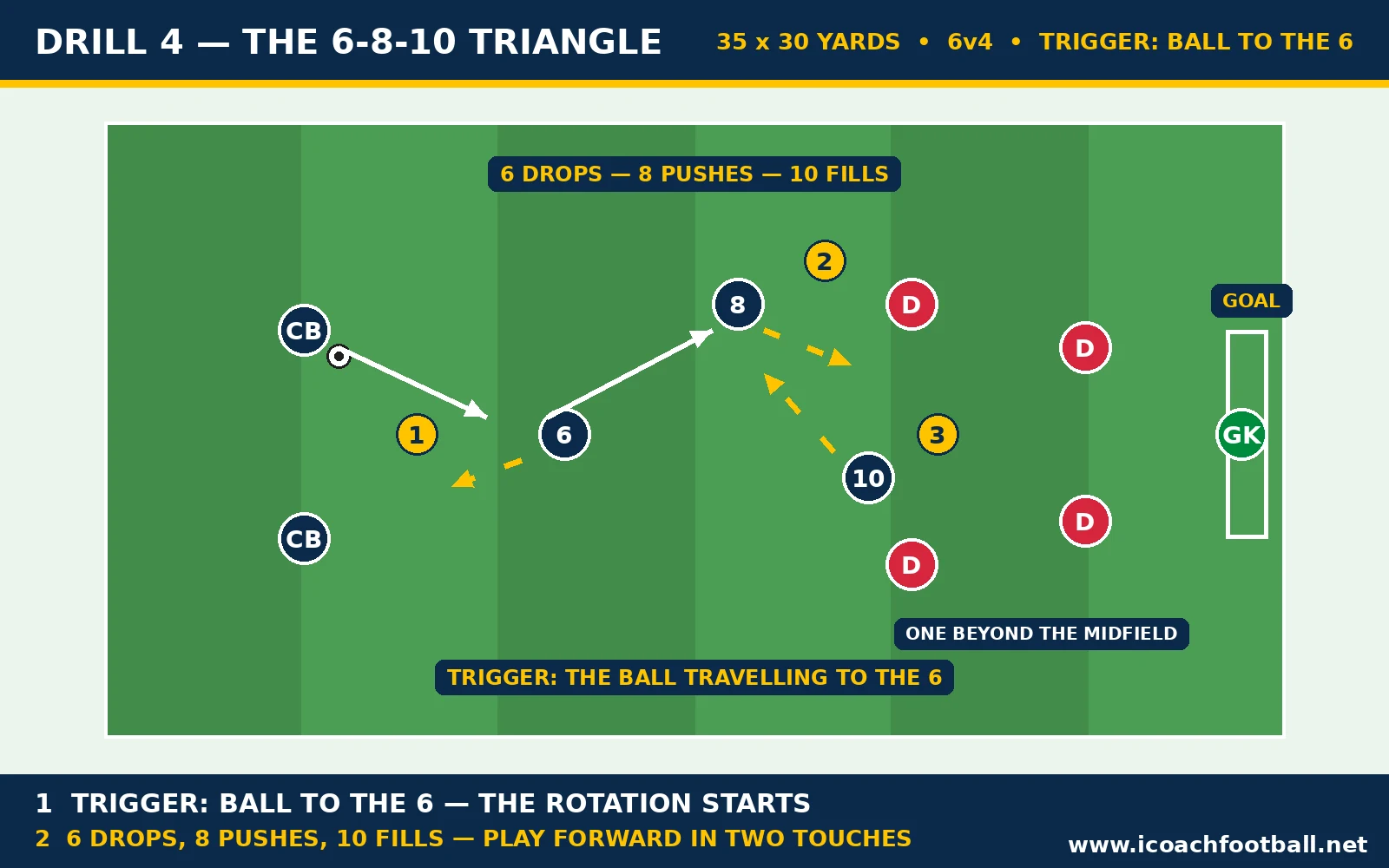
The signature rotation — the 6 drops deep, the 8 pushes forward and the 10 fills the space the 6 vacated, in line with The FA’s interchange principles: one midfielder’s movement is another midfielder’s space.
Setup
- Area 35 yards by 30 yards, 1 full goal with a goalkeeper, 6v4 with a back two feeding the midfield.
- 10 minutes, rotating the 6, 8 and 10 after every round.
How to Play
- A back two play the ball into a midfield three — the 6 deepest, the 8 to the right, the 10 highest — against four defenders in a 2-2 shape.
- The trigger is the ball travelling to the 6: the moment it leaves the defender’s foot, the rotation starts.
- The 6 drops five yards toward their own goal to receive, dragging their marker with them and opening the space behind.
- The 8 pushes forward into the space the 6 vacated, arriving on the half-turn with an open body shape.
- The 10 slides across into the pocket the 8 left, so there is always one midfielder beyond the opposition midfield.
- The 6 plays forward to the 8 or the 10, who must play the next pass forward within two touches — a point for every rotation that ends in a shot.
Coach’s note: “The 6 dropping is not running away from the ball — they are pulling a defender out so the 8 can arrive in the space. Watch the marker, not the ball: if the marker follows the 6, the 8 is free.”
Progressions: The defenders may man-mark the midfield three, so the rotation has to lose a marker, not just move; the 8 may rotate wide and swap with a winger, so the triangle becomes a four-player interchange; the back two may play directly to the 10, so the 6 and the 8 must rotate to support the higher player.
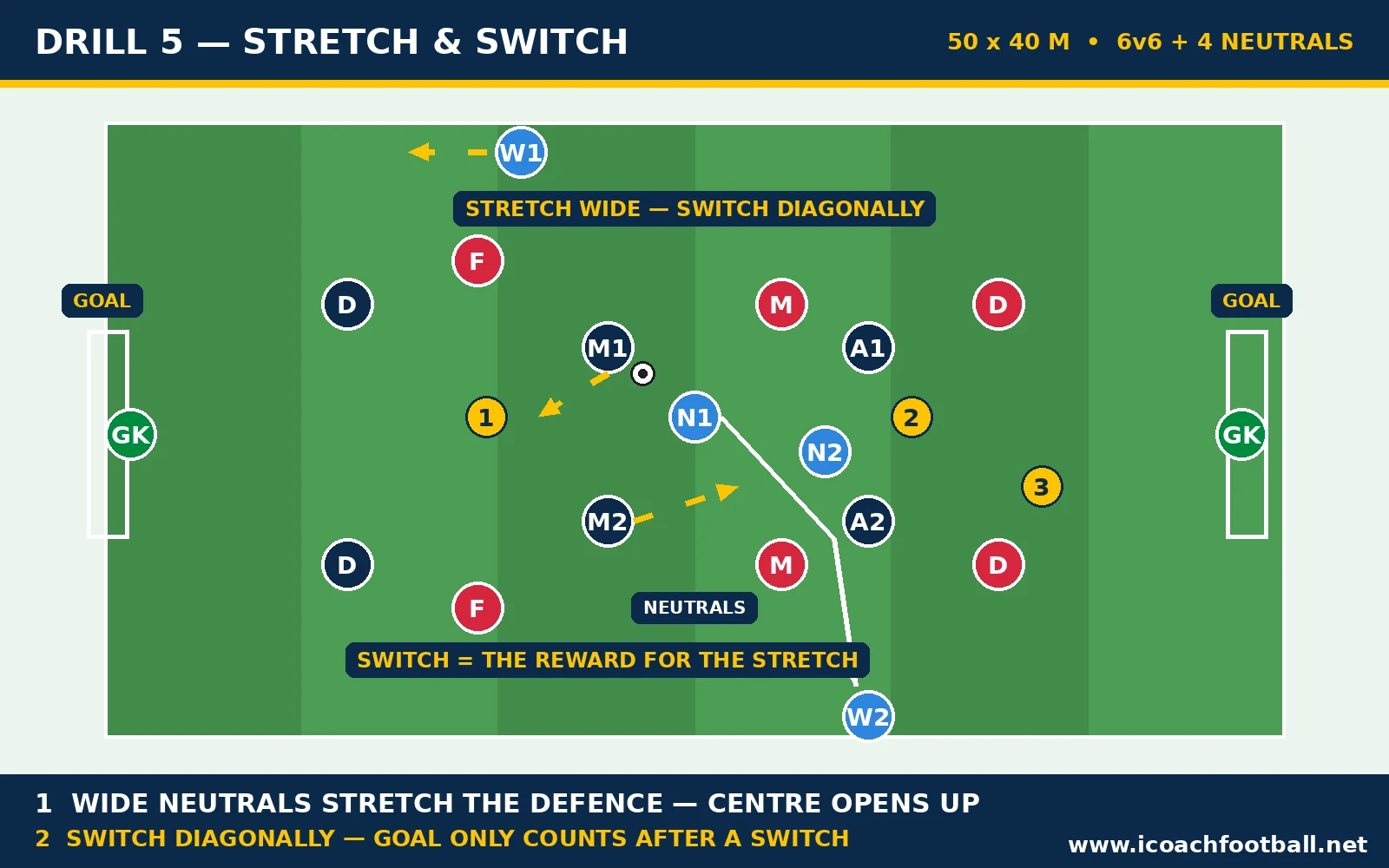
Drill 5 — Stretch and Switch
The width drill — two wide neutrals stretch the defence so the central midfielders can rotate into the gaps, exactly as the FIFA Training Centre’s second game phase teaches: wide options open central areas and create switches of play and through balls.
Setup
- Area 50 metres by 40 metres, 2 full goals with goalkeepers, 6v6 plus 4 neutrals (2 central, 2 wide).
- 10 minutes, then swap the neutral four.
How to Play
- Two teams of six play 6v6 on a 50-by-40-metre pitch, with two neutral midfielders in the centre and two neutral wide players on the touchlines.
- All four neutrals play with the team in possession, creating a 10v6 overload that stretches the defending team wide.
- The central midfielders use the stretched pitch to rotate: one drops to the ball, the other pushes into the gap the wide player has opened.
- When the ball goes wide, the far-side midfielder must switch play diagonally to the opposite wide player — the switch is the reward for the stretch.
- The wide neutrals stay wide until the switch comes, so the defence cannot squeeze the centre shut.
- A goal only counts if the build-up included a switch of play — the team must use the width before they can score.
Coach’s note: “Width is what buys the rotation its space. If the wide players come inside, the centre closes — stay wide, stretch them, and the gap in the middle opens by itself.”
Progressions: The defending team may press the wide neutrals, so the switch has to be played early; the central neutrals are limited to one touch, so the rotation must be pre-planned; the wide neutrals may drive inside with the ball, so the central midfielders must rotate to cover the space they leave.
Drill 6 — The Rotation Game
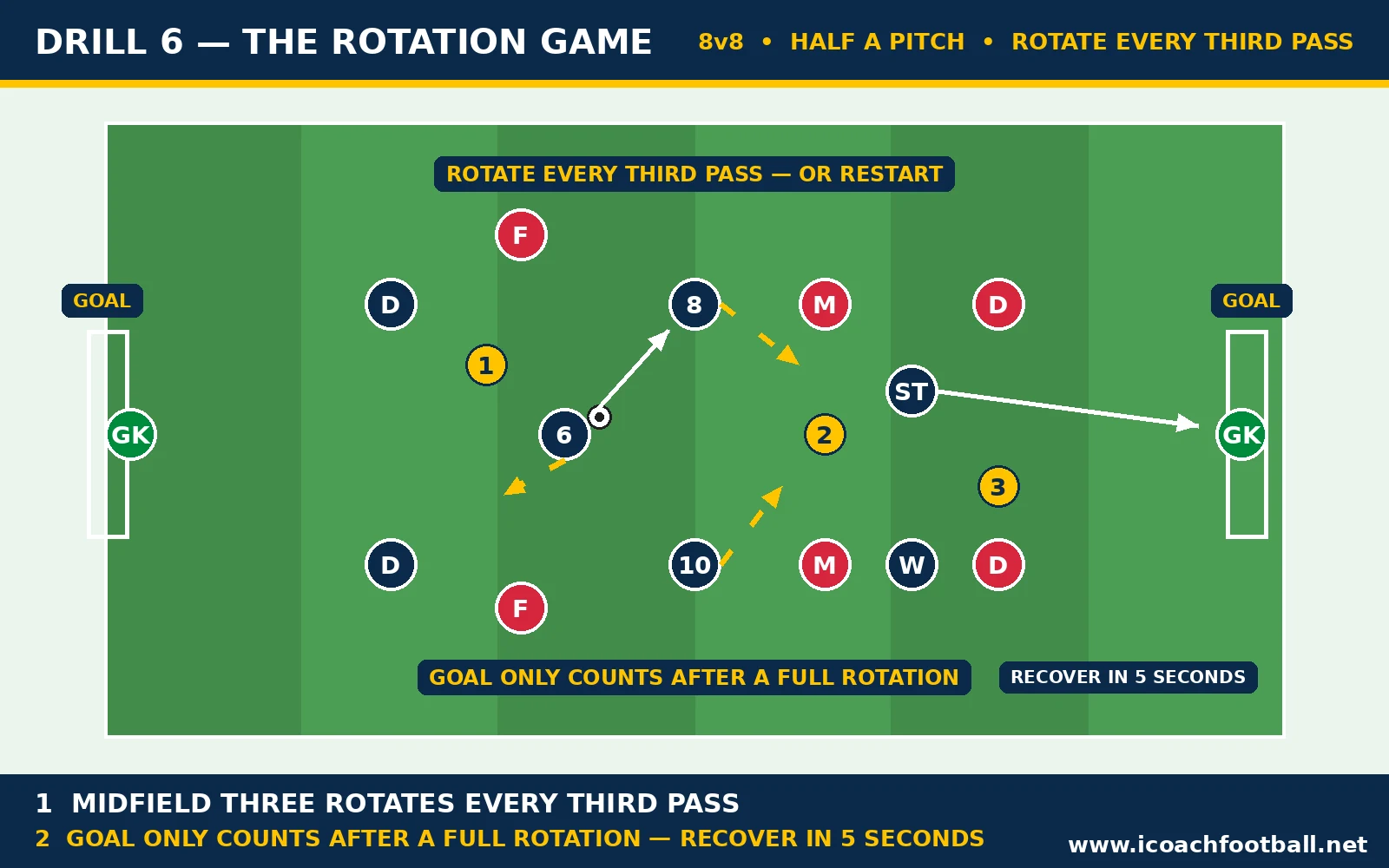
The full game. An 8v8 game where the midfield three must rotate on every third pass — so the rotation is not a drill any more, it is how the team plays.
Setup
- Half a pitch, 1 full goal at each end, 8v8.
- 12 minutes.
How to Play
- Two teams play 8v8 on half a pitch, each with a midfield three in a 6-8-10 shape.
- The midfield three must rotate on every third pass — one drops, one pushes, one fills — or the attack must restart from the goalkeeper.
- A goal only counts if the build-up included at least one full rotation of the midfield three.
- When possession is lost, the midfield three must recover to their starting shape within five seconds — someone always stays home.
- The team in possession must break the lines with a forward pass at least once per attack, so the rotation has to create a lane, not just movement.
- Play for three minutes, then rotate the teams’ ends — the team with the most goals after 12 minutes wins.
Coach’s note: “Rotation without a forward pass is just running. Every swap has to open a lane — if the third pass does not go forward, the rotation was decoration.”
Progressions: The midfield three must rotate on every second pass, so the tempo rises; a goal scored after a switch of play counts double, so the wide rotation is rewarded; the goalkeeper must play out through the 6 every time, so the rotation starts from the first pass.
Coaching points
- If you’re in, get out — if you’re out, get in. The rotation starts the moment the pass is played, not when the ball arrives.
- Never leave a zone empty. Every rotation is a swap: someone fills the space you vacate, every time, without being told.
- Rotate on the travel of the pass. The swap is timed to the ball leaving the passer’s foot — a second late and the marker has already followed you.
- Always keep one player beyond the opposition midfield. A rotation that leaves nobody ahead of the ball has gained nothing — the 10 must be there.
- Open body, back foot — receive facing forward. The point of the rotation is to receive in a position to play forward, so the first touch sets the next pass.
- Someone always stays home. Every rotation leaves cover at the back, because the transition is coming and the back line must be ready.
Common mistakes
| Mistake | Fix |
|---|---|
| Passing and standing still, so the marker never has to choose | Enforce Drill 2’s rule — the passer must leave their box, or the team loses the ball |
| Two midfielders on the same line, so one pass cuts them both out | Split the lines — one drops, one pushes — Drill 3 only counts the attack if the angles were open |
| Rotating after the ball arrives, so the swap is always a second late | Start the rotation on the travel of the pass — Drill 1 grooves it unopposed until the timing is automatic |
| All three midfielders pushing forward, so nobody is left to cover the transition | Someone always stays home — Drill 6 makes the midfield three recover to shape within five seconds of losing the ball |
| Rotating into a closed body shape, so the first touch goes backwards | Open body, back foot — Drill 4 only counts the rotation if the 8 receives on the half-turn facing forward |
| The wide players coming inside, so the centre closes and the rotation has no space | Stay wide until the switch comes — Drill 5 only counts a goal if the build-up included a switch of play |
Age adaptations
| Age | Format | What changes |
|---|---|---|
| U11–U12 (ages 10–12) | Small areas, size 4 ball, boxes marked with cones, coach calls every rotation | All six drills run with the coach calling each swap — “6 drops, 8 pushes, 10 fills” — so the pattern is learned before speed is added. Drill 1 runs at walking pace with the coach feeding the ball, Drill 2 uses only two boxes, and Drill 4 keeps the 6, 8 and 10 in fixed starting spots with the coach triggering the rotation, because the pattern is the lesson, not the pace |
| U13–U14 (ages 12–14) | Full areas, size 4 ball, boxes marked, players call their own rotation from the second round | All six drills run as written, with the players calling their own swap from the second round. Drill 1 adds one-touch passing, Drill 3 adds the two-touch limit on the neutrals, and Drill 6 adds the double points for a goal after a switch of play. Players keep a simple count — “three rotations, two forward passes” is the habit that sticks |
| U15–U17 (ages 14–17) | Full areas, size 5 ball, full pressure from the first rep, man-marking allowed | Full pressure from the start. Drill 2 runs with live pressing from the defenders, Drill 4 uses man-marking on the midfield three, and Drill 5 plays with the wide neutrals allowed to drive inside. Players are asked to call the trigger before each rep — “ball to the 6, rotate!” — so the decision becomes a conscious skill, not a lucky guess |
60-minute session plan
| Block | Time | Content |
|---|---|---|
| Arrival game | 0:00–0:05 | Diamond carousel warm-up — four midfielders walk the diamond, rotating on every pass |
| The diamond carousel | 0:05–0:13 | Drill 1 — The Diamond Carousel |
| In, get out | 0:13–0:23 | Drill 2 — In, Get Out |
| The overload game | 0:23–0:32 | Drill 3 — The Overload Game |
| The 6-8-10 triangle | 0:32–0:41 | Drill 4 — The 6-8-10 Triangle |
| Stretch and switch | 0:41–0:50 | Drill 5 — Stretch and Switch |
| The rotation game | 0:50–1:00 | Drill 6 — The Rotation Game |
Keep building from here
The space rotation creates is the space between the lines — our football playing between the lines drills train receiving in that pocket once the swap has opened it, and the pass that breaks the lines after the rotation drags a marker away is our soccer through ball drills. The third-man run that finishes a rotation is our soccer third man runs drills, and the wide rotation that swaps a midfielder with a winger is our soccer overlap underlap drills and our football attacking the half space drills. The one-two that starts a rotation is our soccer give and go drills, and the first touch that sets the next pass is our soccer drills for receiving under pressure. The scan that spots the space before the swap is our soccer scanning drills, and the decision of when to rotate and when to stay is our soccer decision making drills. The passing under pressure that keeps the rotation alive is our soccer drills for improving passing under pressure, and the accuracy that makes the forward pass stick is our soccer drills for improving passing accuracy. The small-sided games where rotation shows up most are our 25 small-sided games for soccer, and the session structure follows our U13 soccer practice plan. Midfield rotation is high-intensity, high-repetition work — plan the week’s load with our training load calculator.
What is midfield rotation in soccer?
Midfield rotation is when a midfielder leaves their starting position and a team-mate fills the space they vacated — the 6 drops deep, the 8 pushes forward, the 10 slides into the gap. The point is to drag markers out of position and open passing lanes that did not exist a second earlier. Drill 1 grooves the swap unopposed, and Drill 4 trains the classic 6-8-10 triangle rotation itself.
When should midfielders rotate — and when should they stay?
Rotate when the ball is travelling to a team-mate, when your marker is ball-watching, or when a team-mate has dropped into your zone and left theirs empty. Stay when the team is out of possession and the shape must hold, or when you are the cover player — someone always stays home. Drill 2’s rule makes the timing automatic: if you pass out of your box, you leave it, and a team-mate replaces you.
How do you coach midfield rotation to U11s without confusing them?
Start unopposed and call every swap for them — “6 drops, 8 pushes, 10 fills” — until the pattern is automatic, then add one defender, then full pressure. Keep the language to one rule at a time: first “if you’re in, get out”, then “never leave a zone empty”. Drill 1 runs at walking pace for U11s with the coach feeding the ball, because the pattern is the lesson, not the pace.
What happens when a rotation goes wrong and the team loses the ball?
That is exactly why every rotation leaves cover at the back — the transition is coming, and the back line must be ready. The most common failure is all three midfielders pushing forward at once, so nobody can recover. Drill 6 trains the fix directly: the midfield three must recover to their starting shape within five seconds of losing possession.
How is midfield rotation different from just switching positions?
Switching positions is two players swapping jobs. Rotation is the whole midfield unit moving in relation to the ball — one drops, one pushes, one fills — so the shape stays balanced while the personnel change. The difference shows in the cover: a rotation always leaves someone home, while a simple swap can leave a zone empty. Drill 3 trains the unit movement, with the two midfielders never standing on the same line.
Sources
- FIFA Training Centre. “Game-phases: Developing central midfielders” — the FIFA Training Centre position-specific session for the holding midfielder in full game phases: midfielders must offer constant support, work closely together to recognise when to push forward to create space or drop in to receive when space has been created, create overloads and use numerical superiority in the centre to play through pressure, and use the stretched pitch to switch play diagonally or play through balls into advancing attackers: its first part is a 6v6 plus 2 neutrals on a 50-by-30-metre pitch creating overloads to start dynamic attacks, and its second part is a 6v6 plus 4 neutrals on a 50-by-40-metre pitch stretching the defence to open passing lanes. Verified live 2026-11-22 (HTTP 200, full text read). Drills 3, 5 and 6 are based on / in line with this session’s game-phase principles.
- The FA. “Developing multifunctional players” — The FA’s Boot Room article in which former England U19 head coach Noel Blake teaches positional interchange with one rule — “if you’re in, get out; and if you’re out, get in” — shows how a midfield three can rotate with the wide players and the number 9, works on movement, interchange and receiving unopposed before adding pressure, and insists that every rotation leaves cover at the back because the transition is coming. Verified live 2026-11-22 (HTTP 200, full text read). Drills 1, 2 and 4 are based on / in line with this article’s interchange principles.