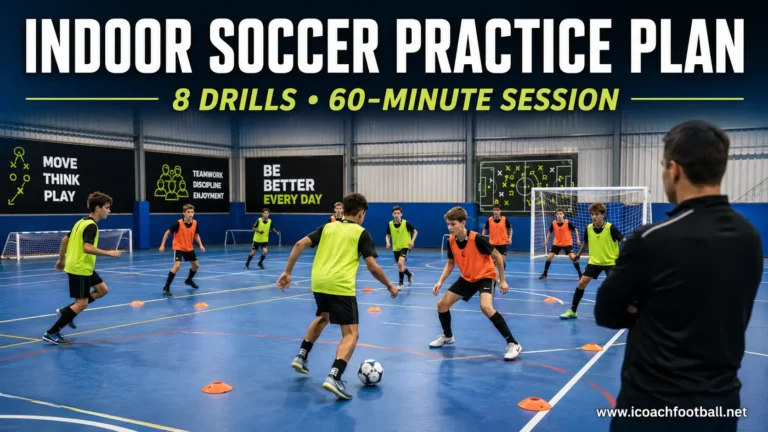
Soccer Drills for Improving Attacking the Near Post: 6 Games That Turn the First Post into Goals (U11–U17)
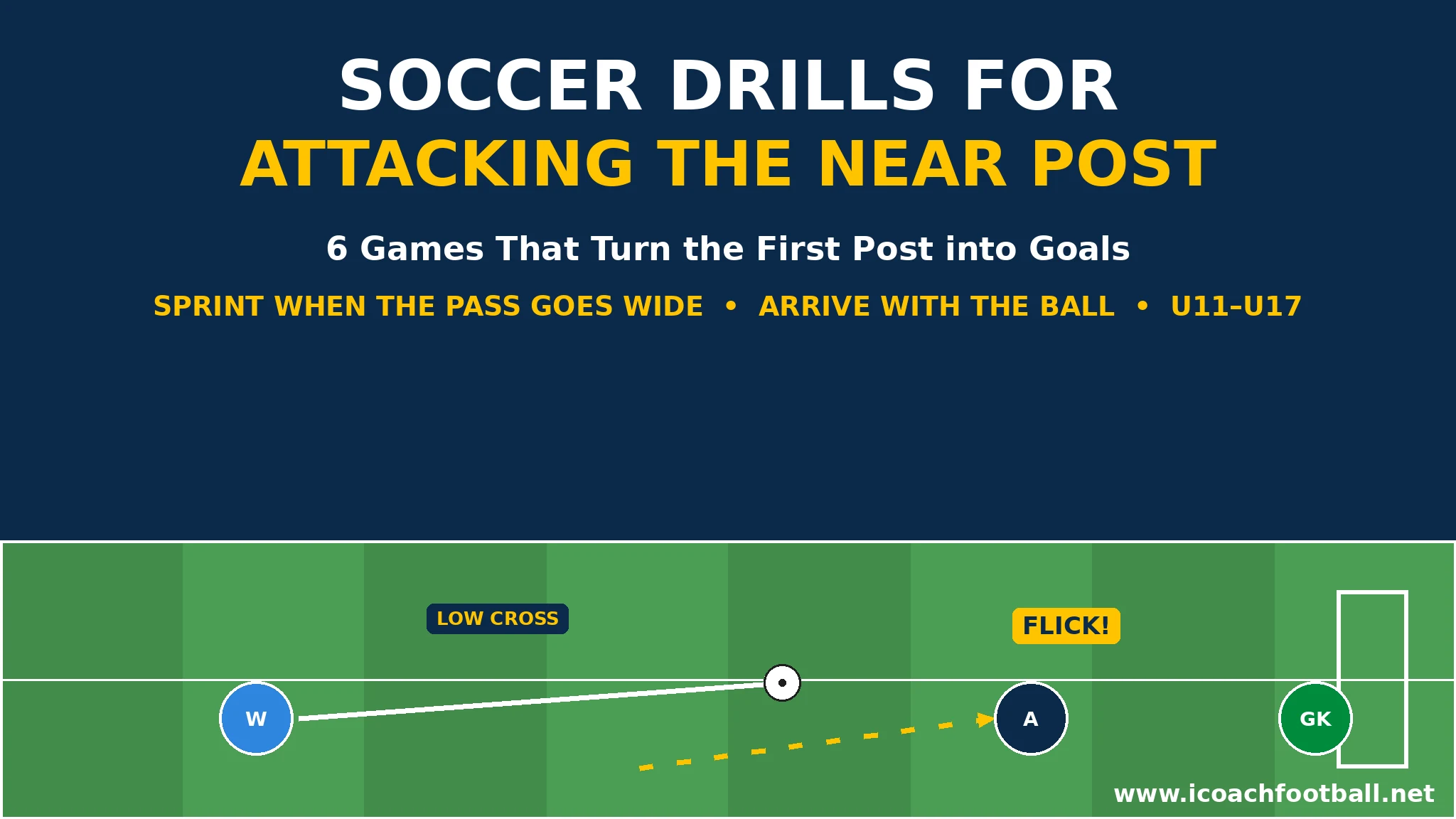
Quick answer
The near post is where crosses are won or lost. A striker who arrives at the first post a step before the defender — sprinting as the pass goes wide, not after the cross is struck — meets the ball first and only needs a glance to score. These six soccer drills for improving attacking the near post train that arrival step by step: the timing of the run, the blindside dart across the defender, the flick-on, the drop-off when the crosser reaches the byline, the opposed finish, and a full game where near-post goals count double.
Suitable for: U11–U17 (ages 10–17)
Session snapshot
- Players: 8–14, including 1 goalkeeper
- Age: U11–U17 (ages 10–17)
- Area: Penalty box and wide channels, expanding to half a pitch
- Duration: 60 minutes
- Focus: Attacking the near post — timing the run, beating the first defender, and finishing first time
- Equipment: 10 balls, 14 cones, bibs, 1 full goal (2 for the final game)
Why these six games work
Most near-post goals are decided before the cross is struck. The striker who waits to see the cross is already late — the defender has stepped across, the goalkeeper has set, and the ball is gone. The striker who sprints into the box the moment the ball is played wide arrives with the cross and meets it first.
The first two drills build the run: timing the sprint so the striker arrives with the ball, then starting blindside — behind the defender’s shoulder — and darting across the defender’s front hip. The next two drills build the finish: the flick-on that redirects a driven cross across goal, and the drop-off when the crosser reaches the byline and engages the goalkeeper. The last two drills build the game skill: beating a live defender to the first post, then a full game where near-post goals count double and the whole team starts hunting the first post.
The drills are grounded in the FIFA/UEFA coaching community. Drills 1, 2 and 4 are based on / in line with the FIFA Training Centre session “Attacking the cross” (FCRF Talent Development), which trains players to anticipate the cross by sprinting into the penalty area as the pass is played towards the wide player, to time their runs so they do not arrive too early, and to deliver first-time, driven crosses that hit the area between the goalkeeper and the defenders in coordination with the attackers’ runs. Drills 3, 5 and 6 are based on / in line with the England Football Learning “Attacking skills” session programme — week four, “Width for deception”, which trains players to use the wide channels and to time their runs into the box, and week six, “Scoring as a team”, which trains players to shoot early whenever there is a good chance, to create space by going away from the ball and running beyond a player, and to understand their roles around scoring in game situations. In the UK the same session is football drills for attacking the near post — the run, the timing and the finish are identical.
This post is the near-post half of the site’s crossing pair. The far-post run that completes the box is our soccer drills for improving attacking the back post, published yesterday — together the two posts cover both posts. The heading routine from a corner that shares the near-post name is our football heading drills near post run — a set-piece heading drill, where this post trains open-play runs from crosses in the wide channel.
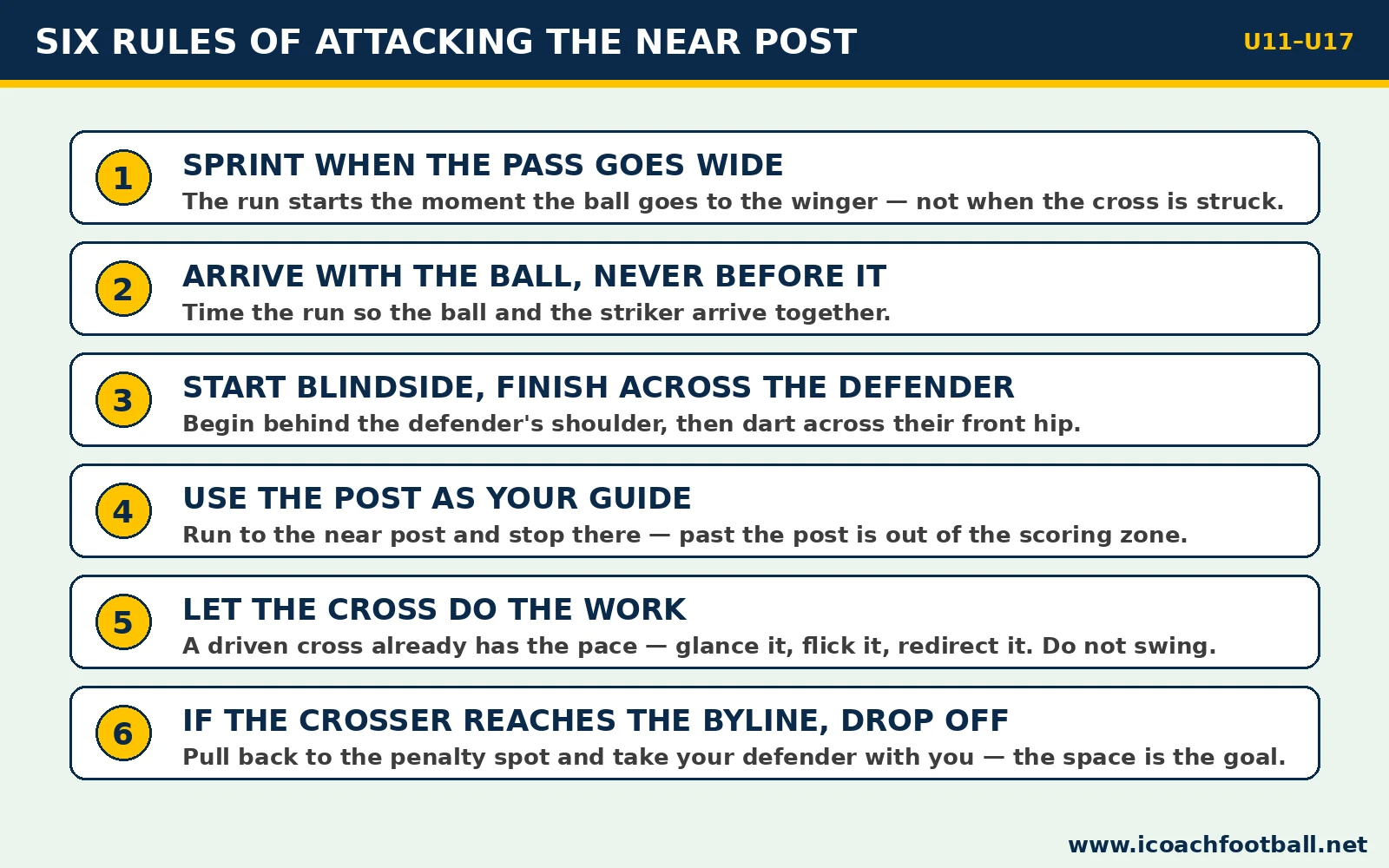
Six rules of attacking the near post
- Sprint when the pass goes wide, not when the cross is struck. The run starts the moment the ball is played to the winger — by the time the cross leaves the foot, the striker must already be moving.
- Arrive with the ball, never before it. A striker who arrives early stands still in the box and is easy to mark — time the run so the ball and the striker arrive together.
- Start blindside, finish across the defender. Begin behind the defender’s shoulder, out of their eyeline, then accelerate across their front hip so they cannot see the run until it is too late.
- Use the post as your guide. Run to the near post and stop there — a striker who runs past the post has run out of the scoring zone.
- Let the cross do the work. A driven cross already has the pace — the finish is a glance, a flick or a redirect, not a swing.
- If the crosser reaches the byline, drop off. When the winger engages the goalkeeper on the end line, the near-post runner pulls back to the penalty spot — the space the defender just left is the goal.
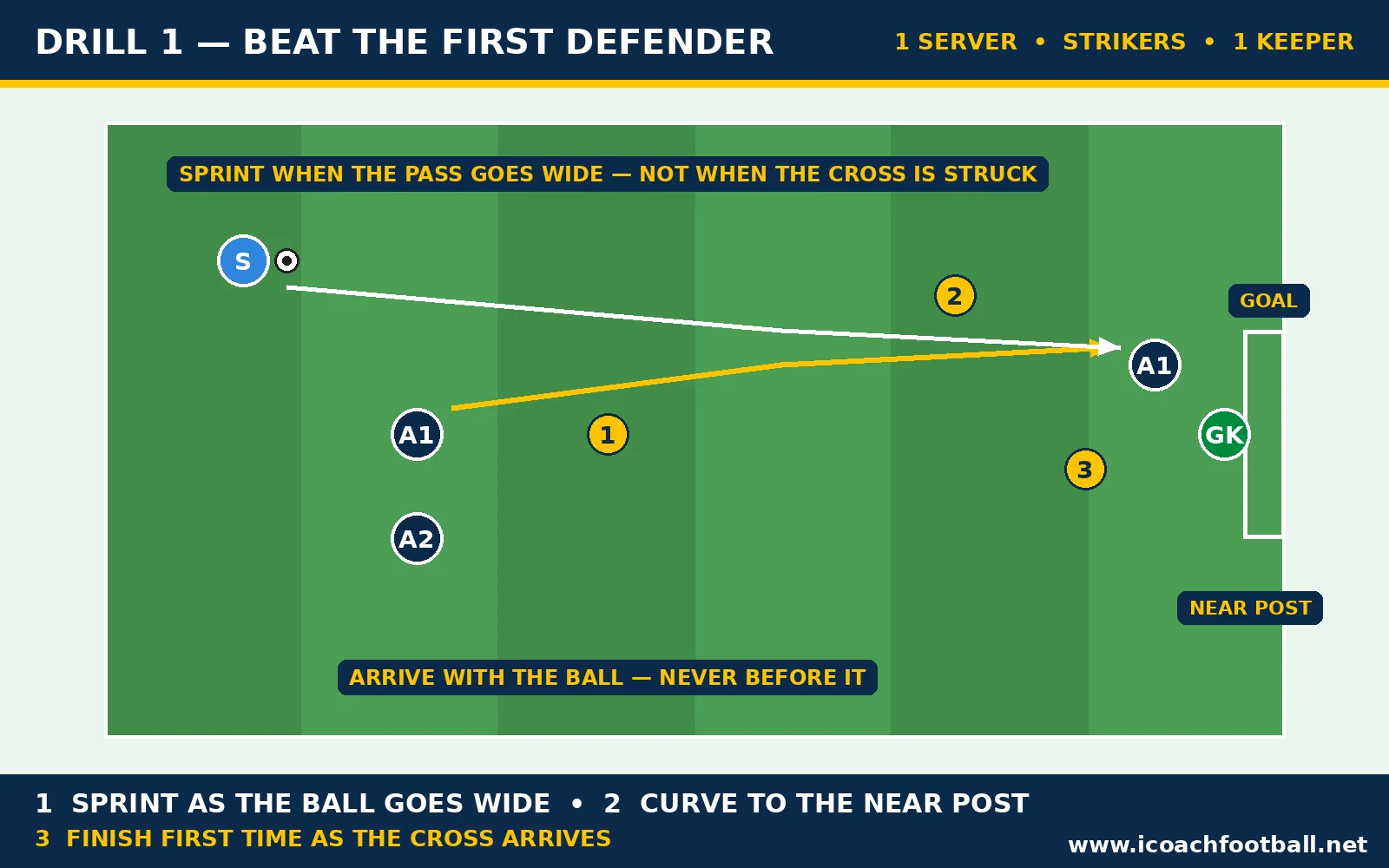
Drill 1 — Beat the First Defender
The timing drill — the striker learns to sprint into the box the moment the ball goes wide and arrive at the near post at the same instant as the cross.
Setup
- Penalty box, 1 full goal, 1 keeper, 1 server wide, strikers lined up on the edge of the box.
- 8 minutes, then swap sides.
How to Play
- The strikers line up on the edge of the penalty area, 18 yards from goal.
- The server stands wide near the touchline with a supply of balls.
- The server plays the ball forward down the channel and the first striker sprints at once.
- The striker curves their run to the near post, using the post as the guide.
- The server drives a low cross to the near post and the striker finishes first time.
- After each finish, the striker joins the server’s line and the next striker goes.
Coach’s note: “If you are still standing on the edge of the box when the cross is struck, you have already lost the race — sprint when the pass goes wide.”
Progressions: The server varies the timing of the cross; the striker must finish with the weaker foot; the server may fake the cross and cut inside, and the striker must hold the run.
Drill 2 — The Blindside Dart
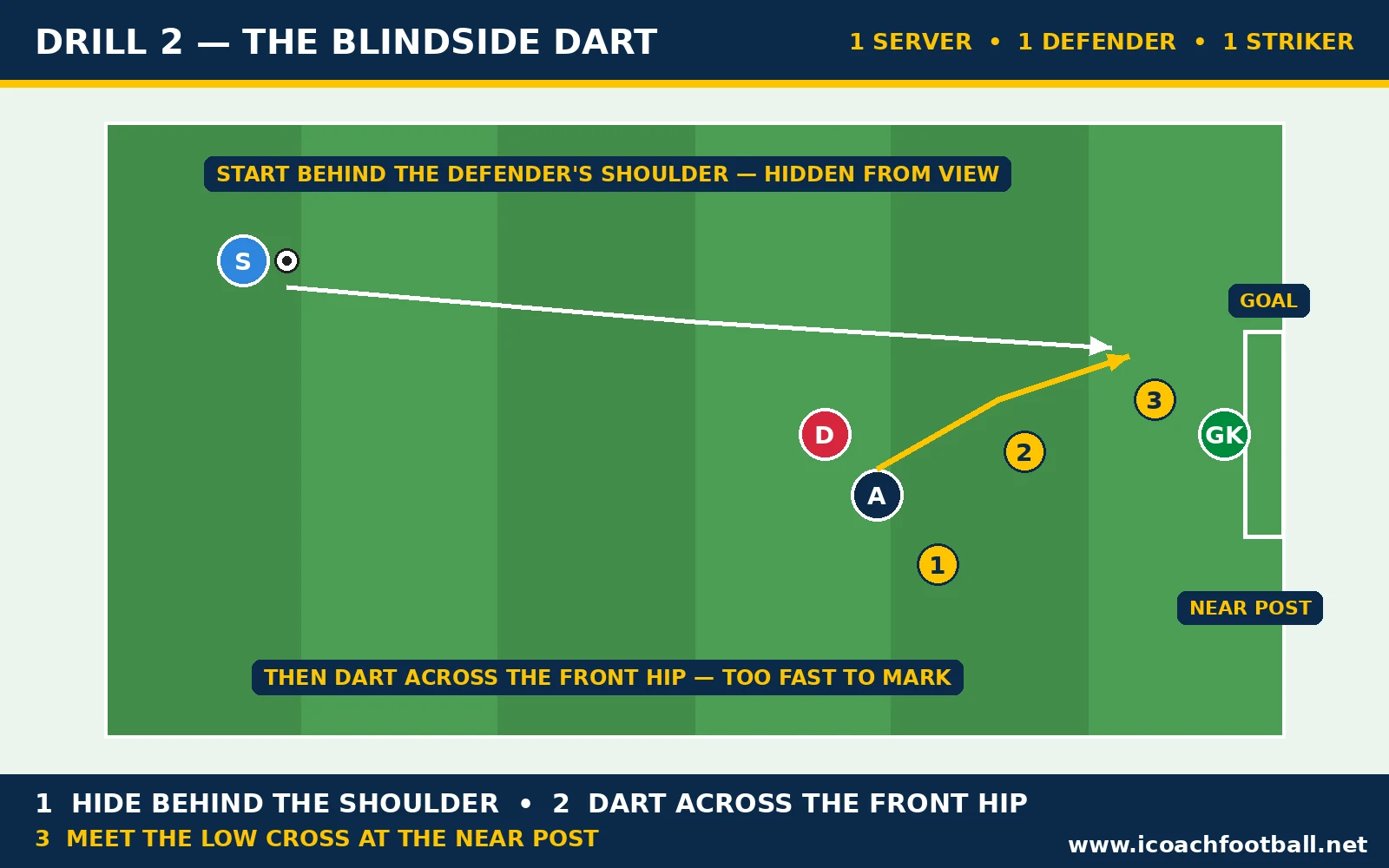
The deception drill — the striker starts behind the defender’s shoulder, hidden from view, then darts across the defender’s front hip to win the near-post space.
Setup
- Penalty box, 1 full goal, 1 keeper, 1 defender, 1 server wide, strikers at the penalty spot.
- 10 minutes.
How to Play
- The striker starts at the penalty spot, half a step behind the defender’s shoulder.
- The defender faces the ball, watching the server — the striker is in their blind spot.
- The server plays the ball wide and the striker holds for one beat, staying hidden.
- As the winger shapes to cross, the striker accelerates across the defender’s front hip.
- The striker meets the low cross at the near post and glances it across goal.
- After 4 reps, rotate — the striker becomes the defender and the defender becomes the striker.
Coach’s note: “The defender cannot mark what they cannot see — start behind the shoulder, then cross their front hip so fast they have no time to turn.”
Progressions: The defender may step out to intercept, so the striker must change the angle of the dart; the server may cross early, so the striker must go on the first touch; add a second defender at the far post.
Drill 3 — The Flick-On
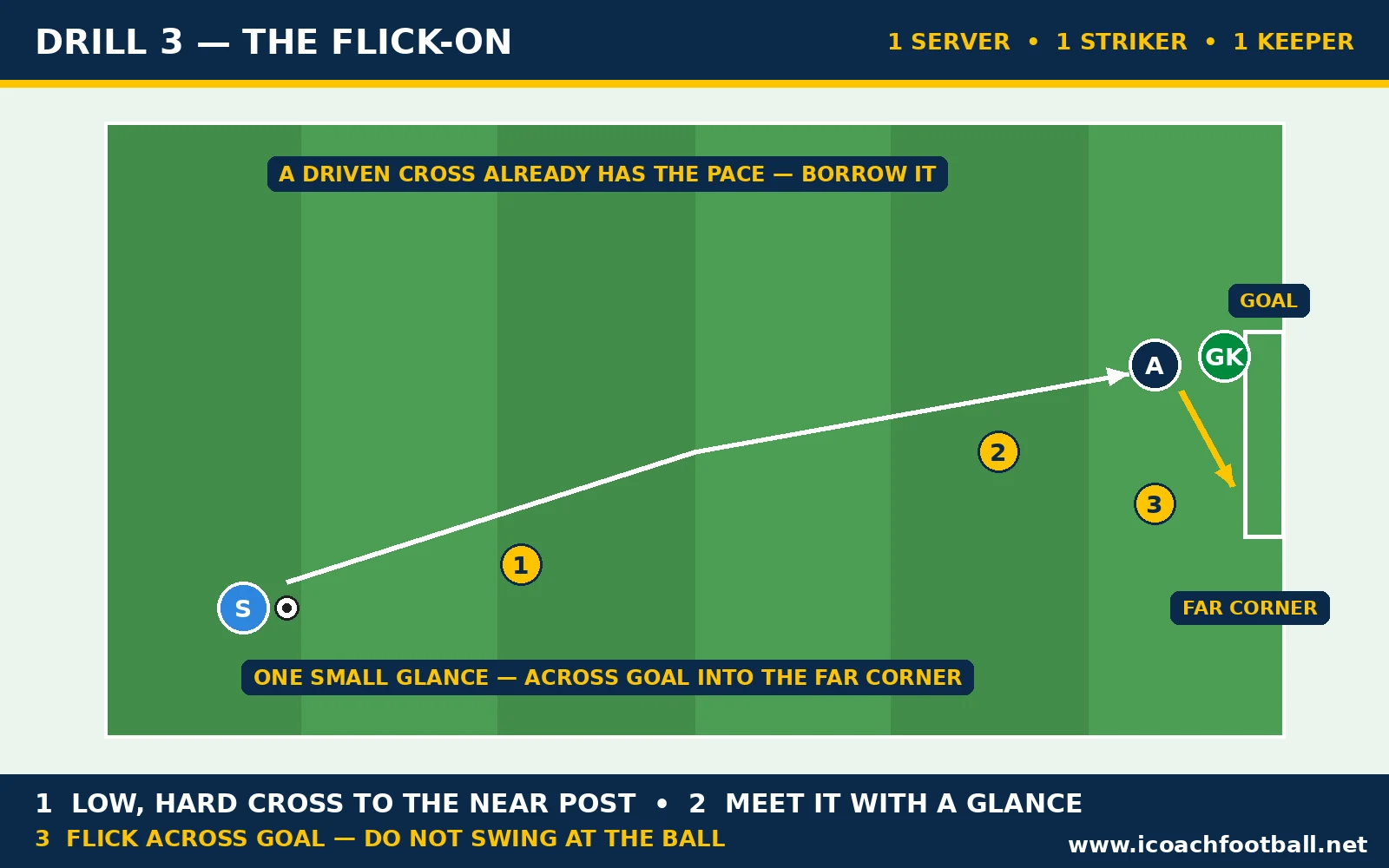
The finish drill — the striker meets a driven cross at the near post and, with one small touch, flicks it across the goalkeeper into the far corner.
Setup
- Penalty box, 1 full goal, 1 keeper, 1 server wide on the byline, strikers at the near post.
- 10 minutes.
How to Play
- The striker stands 6 yards from goal, a yard outside the near post.
- The server drives a low, hard cross along the six-yard line towards the near post.
- The striker meets the ball with the inside of the front foot, or the forehead on a higher ball.
- The touch is small — a glance, not a swing — and redirects the ball across goal.
- The ball must travel across the face of goal and into the far corner to score.
- After 5 flicks, rotate — the striker becomes the server and the server joins the line.
Coach’s note: “Do not hit the cross — borrow its pace. A firm neck and a still head turn a driven ball into a goal with one glance.”
Progressions: The server varies the height — knee, waist and head height; the striker must flick with the weaker foot; the server may play an in-swinging cross that needs only a touch of five degrees.
Drill 4 — The Drop-Off
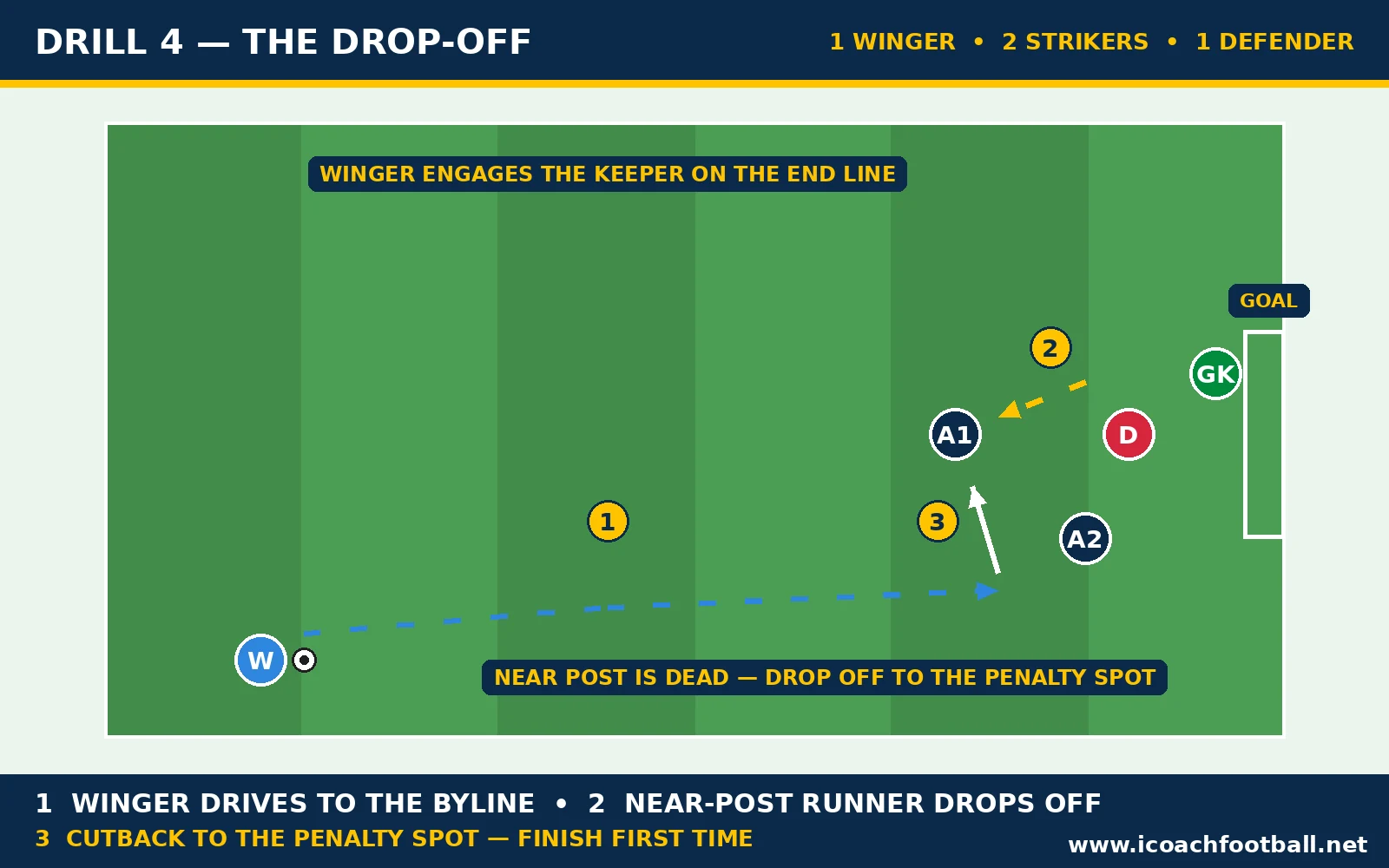
The decision drill — when the winger dribbles to the byline and engages the goalkeeper, the near-post runner drops off to the penalty spot, dragging the defender with them and opening the space behind.
Setup
- Penalty box, 1 full goal, 1 keeper, 1 defender, 1 winger wide, 2 strikers at the edge of the box.
- 10 minutes.
How to Play
- The winger receives wide and dribbles quickly towards the byline.
- The first striker makes the near-post run as the winger travels.
- The winger reaches the end line and engages the goalkeeper — the keeper steps to the near post.
- The near-post striker drops off at once, pulling back to the penalty spot.
- The winger cuts the ball back to the penalty spot and the striker finishes first time.
- After 4 reps, rotate — the striker becomes the winger and the winger joins the line.
Coach’s note: “The moment the winger has the keeper’s eyes, the near post is dead — drop off, take your defender with you, and the penalty spot is yours.”
Progressions: The defender may stay at the near post instead of following, so the striker must read and stay; the winger may shoot from the byline if the keeper stays deep; add a second striker arriving late at the far post.
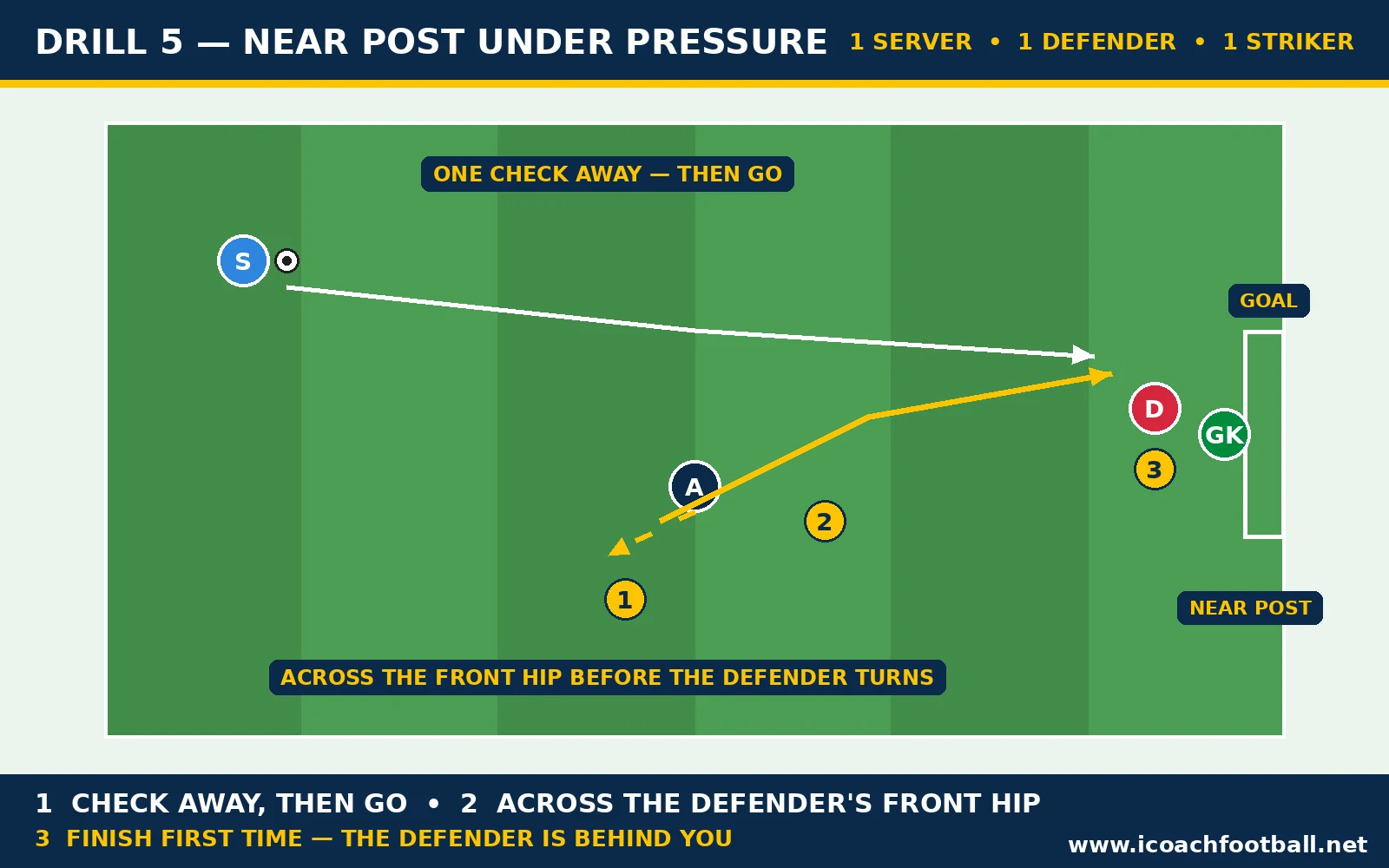
Drill 5 — Near Post Under Pressure
The opposed drill — a live defender guards the near post and the striker must beat them to the ball, with the crosser choosing the delivery.
Setup
- Penalty box, 1 full goal, 1 keeper, 1 defender at the near post, 1 server wide, strikers at the edge of the box.
- 10 minutes.
How to Play
- The defender starts on the near post, goal-side of the striker.
- The striker starts on the edge of the box, level with the penalty spot.
- The server plays the ball wide and the striker sprints — the defender reacts a beat later.
- The striker must get across the front of the defender before the cross arrives.
- The server drives the cross low to the near post and the striker finishes first time.
- After 4 reps, rotate — the striker becomes the defender and the defender becomes the striker.
Coach’s note: “You do not outrun the defender — you out-think them. One check away, then go, and you are across their front hip before they have turned.”
Progressions: The defender may start goal-side and tight, so the striker must use a double movement; the server may cross to the penalty spot instead, so the striker must read the delivery; add a second attacker for the cutback.
Drill 6 — The Near-Post Game
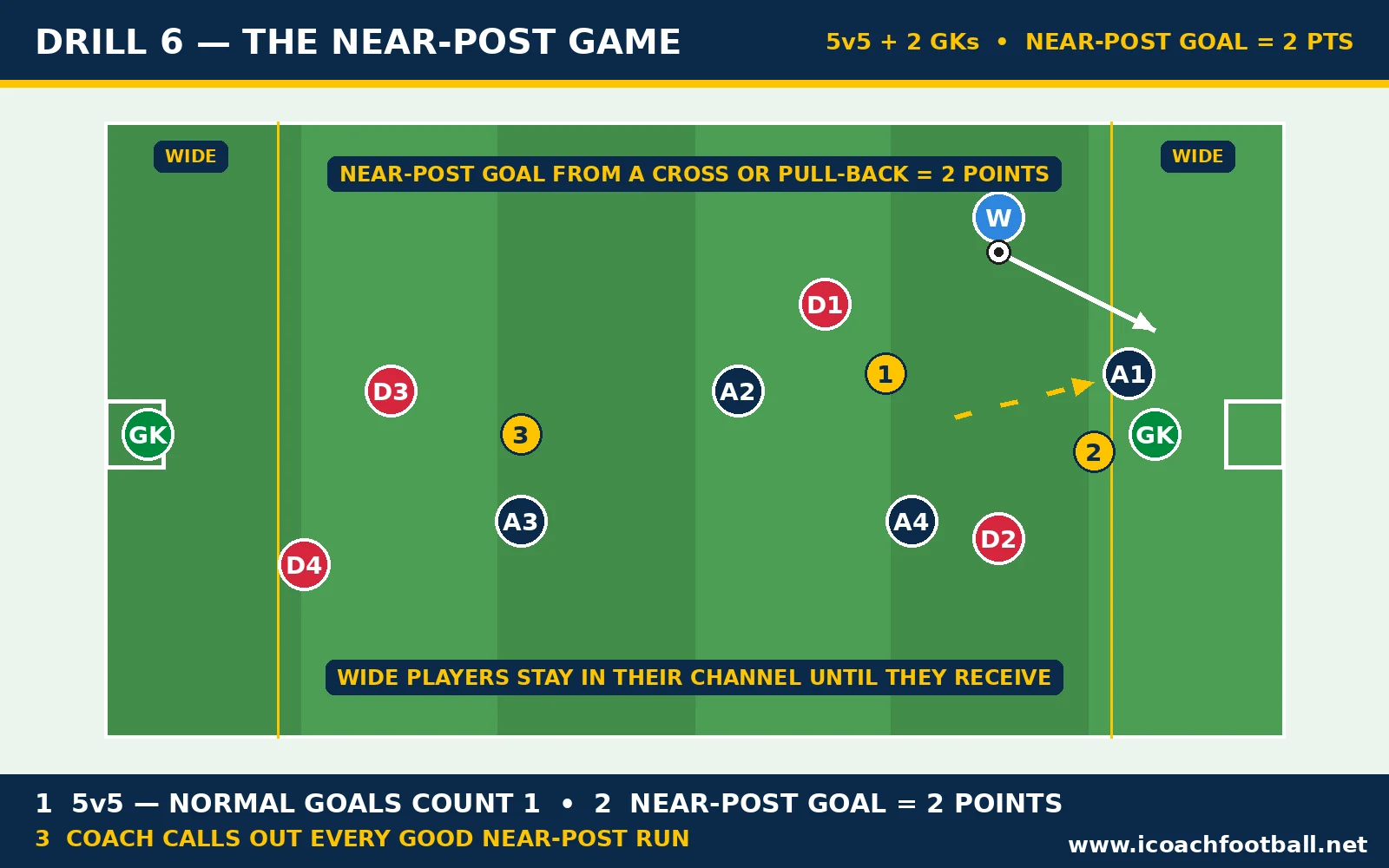
The full game. A 5v5 where a goal scored at the near post, directly from a cross or a pull-back, counts double — so the whole team starts hunting the first post.
Setup
- Half a pitch, 5v5 plus 2 goalkeepers, 2 full goals, wide channels marked with cones.
- 12 minutes.
How to Play
- Two teams of 5 play 5v5 with goalkeepers — normal goals count 1 point.
- A goal scored at the near post, directly from a cross or a pull-back, counts 2 points.
- Goals must come from a cross or a pull-back to count double — a dribble-and-shoot scores 1.
- Wide players must stay in their channel until they receive the ball, then they may cross.
- The team with the most points after 12 minutes wins — then play again with new teams.
- Coaches call out every good near-post run, so the whole group hears what good movement looks like.
Coach’s note: “Watch the runners, not the ball — the moment the group starts celebrating a near-post run like a goal, the habit is built.”
Progressions: Near-post goals count 3 points; the crosser must deliver first time; a flick-on at the near post that a team-mate finishes counts double for both players.
Coaching points
- The run starts when the pass goes wide. The striker who sprints as the ball travels to the winger arrives with the cross. The striker who waits for the cross is a step late and a goal short.
- Arrive with the ball, never before it. A striker who arrives early stands still in the box, lets the defender step across, and kills the space. Time the run so the ball and the striker arrive together.
- Start blindside, finish across the front hip. Begin behind the defender’s shoulder, out of their eyeline, then accelerate across their front hip. A defender cannot mark a run they never saw start.
- Use the post as the guide. Run to the near post and stop there — the post is the edge of the scoring zone. A striker who runs past it has run out of the goal.
- Let the cross do the work. A driven cross already carries the pace, so the finish is a glance, a flick or a redirect. A striker who swings at a driven ball usually misses it completely.
- Drop off when the crosser reaches the byline. When the winger engages the goalkeeper on the end line, the near-post run is dead — pull back to the penalty spot, take the defender with you, and the space behind is the goal.
Common mistakes
| Mistake | Fix |
|---|---|
| Waiting to see the cross before starting the run | Sprint the moment the ball goes wide — Drill 1 only scores the finish if the striker was moving before the cross was struck |
| Arriving at the near post too early and standing still | Time the run so ball and striker arrive together — Drill 1 stops the rep if the striker is waiting in the box |
| Running straight at the defender instead of across their front hip | Start blindside, behind the shoulder — Drill 2 only scores the finish if the striker crossed the defender’s front hip |
| Running past the near post and out of the scoring zone | Use the post as the guide and stop there — Drill 1 stops the rep if the striker runs beyond the post |
| Swinging at a driven cross instead of glancing it | Borrow the cross’s pace with a small touch — Drill 3 only scores the flick if the ball travels across goal into the far corner |
| Staying at the near post when the winger reaches the byline | Drop off to the penalty spot at once — Drill 4 only scores the finish if the striker pulled back before the cutback |
Age adaptations
| Age | Format | What changes |
|---|---|---|
| U11–U12 (ages 10–12) | Small goal or coned goal, size 4 ball, serves thrown or rolled by the coach | All six drills run with slow, predictable crosses and the striker walking the run first. Drill 3 uses hand-served balls at waist height so the flick can be learned without pace. Drill 6 plays with no scoreboard for goals — only near-post runs are counted, so the group learns what good movement looks like |
| U13–U14 (ages 12–14) | Full goal, size 4 ball, crosses driven from the wide channel | All six drills run as written, with the defender added from the second round. Drill 2 adds the defender who may step out to intercept, and Drill 5 adds the second attacker for the cutback. Strikers keep a simple count of their runs — “six crosses, five first to the post” is the habit that sticks |
| U15–U17 (ages 14–17) | Full areas, size 5 ball, crosses live from the first rep | Full pressure from the start. Drill 1 runs with the server varying the timing without warning, Drill 4 adds the second striker arriving late at the far post, and Drill 6 adds the first-time cross rule. Strikers are asked to call their run before each cross — “blindside, across the hip” — so the decision becomes a conscious skill, not a lucky guess |
60-minute session plan
| Block | Time | Content |
|---|---|---|
| Arrival game | 0:00–0:05 | Free 3v3 in the box — every near-post finish counts double |
| Beat the first defender | 0:05–0:13 | Drill 1 — Beat the First Defender |
| The blindside dart | 0:13–0:23 | Drill 2 — The Blindside Dart |
| The flick-on | 0:23–0:33 | Drill 3 — The Flick-On |
| The drop-off | 0:33–0:43 | Drill 4 — The Drop-Off |
| Near post under pressure | 0:43–0:51 | Drill 5 — Near Post Under Pressure |
| The near-post game | 0:51–1:00 | Drill 6 — The Near-Post Game |
Keep building from here
The far-post run that completes the box is our soccer drills for improving attacking the back post, and the heading routine from a corner that shares the near-post name is our football heading drills near post run — together the three posts cover every near-post and far-post finish. The wide-channel game that creates the crossing positions is our the wide channel game crossing and finishing, and the late run that arrives at the penalty spot behind the near-post dart is our football late runs into the box drills. The finish under pressure that a near-post run creates is our soccer drills for improving finishing under pressure, and the 1v1 finish that follows a near-post flick is our 1v1 finishing drills soccer. The give-and-go that releases the winger down the channel is our soccer give and go drills, and the one-touch pass that keeps the move at full speed is our soccer one touch passing drills. The scan that lets a striker read the crosser’s body is our soccer scanning drills, and the anticipation that tells a striker when the cross is coming is our soccer drills for improving anticipation. The receiving under pressure that lets a winger control the ball wide before crossing is our soccer drills for receiving under pressure, and the aerial duel that decides the high cross into the box is our soccer drills for improving aerial duels. The defending that a near-post run must beat is our soccer drills for improving defending the back post and our soccer drills for improving marking. Near-post work is high-intensity — plan the week’s load with our training load calculator.
When should a striker start their near-post run?
The moment the ball is played wide to the winger — not when the cross is struck. FIFA’s “Attacking the cross” session trains players to sprint into the penalty area as the pass is played towards the wide player, because a striker who waits for the cross arrives a step late. The run should be timed so the striker and the ball arrive at the near post together. Drill 1 trains the trigger, and Drill 2 trains the blindside start.
What is the near-post run in soccer?
The near-post run is the striker’s sprint to the post nearest the crosser, timed to meet a low, driven cross first time. The striker starts from the edge of the box or the penalty spot, curves the run to the near post, gets across the front of the first defender, and finishes with a glance, a flick or a redirect. The post is the guide — a striker who runs past it has run out of the scoring zone. In the UK the same run is taught in football attacking — the timing, the blindside start and the first-time finish are identical.
How do you beat the first defender at the near post?
Start blindside, behind the defender’s shoulder where they cannot see you, then accelerate across their front hip as the winger shapes to cross. A defender cannot mark a run they never saw start, and once the striker is across the front hip the defender cannot get goal-side without fouling. One check away, then go, is the move that creates the yard. Drill 2 trains the blindside dart, and Drill 5 trains it against a live defender.
Should the near-post runner flick the cross on or shoot?
It depends on the cross. A low, driven cross already has the pace — flick it on with a small glance across goal into the far corner, using the ball’s own speed. A slower cross or a cutback from the byline can be struck first time. The mistake is swinging at a driven ball, which usually misses completely. Drill 3 trains the flick-on, and Drill 4 trains the decision to drop off for the cutback when the winger reaches the byline.
At what age should strikers start training near-post runs?
From U11, with slow, predictable crosses and the striker walking the run first, so the timing and the blindside start become habits before the pressure is real. The run itself can be trained young — what must wait is the full-speed finish against a live defender closing in. Add opposed defenders and live crosses gradually from U13, and full-pressure near-post finishing from U15, once the striker arrives with the ball every time.
Sources
- FIFA Training Centre. “Attacking the cross” — the FIFA Training Centre FCRF Talent Development session trains players to anticipate the cross by sprinting into the penalty area as the pass is played towards the wide player, to time their runs so they do not arrive too early, and to deliver first-time, driven crosses that hit the area between the goalkeeper and the defenders in coordination with the attackers’ runs. Verified live 2026-11-21 (HTTP 200, full text read). Drills 1, 2 and 4 are based on / in line with this session’s anticipation, run-timing and driven-cross principles.
- England Football Learning. “Attacking skills — session programme” — the England Football Learning attacking skills programme, delivered by FA coach development officer Peter Augustine: week four, “Width for deception”, trains players to use the wide channels and to time their runs into the box, and week six, “Scoring as a team”, trains players to shoot early whenever there is a good chance, to create space by going away from the ball and running beyond a player, and to understand their roles around scoring in game situations. Verified live 2026-11-21 (HTTP 200, full text read). Drills 3, 5 and 6 are based on / in line with this programme’s width, run-timing and shoot-early principles.