Soccer Drills for Improving Interceptions: 6 Games That Teach Players to Step In and Win the Ball (U10–U16)
Quick answer
An interception is won before the pass is played. The defender reads the passer’s head, hips and plant foot, waits for the trigger — the moment the passer opens the body to play — then steps into the passing lane and takes the ball facing forward. These six games train that sequence step by step: reading the passer, the lane, the feint that sells the pass, the end-zone game, the channel press, and a full game where an interception is worth more than a goal.
Suitable for: U10–U16 (ages 9–16)
Session snapshot
- Players: 12–16
- Age: U10–U16 (ages 9–16)
- Area: 20×15-yard zones, expanding to a 30×20-yard game
- Duration: 60 minutes
- Focus: Interceptions — reading the passer, timing the step-in, and playing forward at once
- Equipment: 10 balls, 16 cones, bibs, 2 mini goals
Why these six games work
Most interceptions are lost by players who chase the ball. They run at the carrier, get played around, and the pass goes through the lane they just left. The fix is a sequence, and it starts with the eyes, not the feet.
The first two drills build the read: watching the passer’s cues in a lane, then working the middle zone as a pair. The next two drills build the timing: the feint that sells the pass, and the end-zone game where patience beats gambling. The last two drills build the team skill: pressing a channel as a unit, then a full game where an interception that leads to a shot is worth two points.
The drills are grounded in the FIFA/UEFA coaching community. Drills 1, 3 and 6 are based on / in line with the FIFA Training Centre session “#11 Interception”, which trains defensive anticipation and defenders’ ability to intercept the ball — anticipating the trajectory of the pass, getting in front of the attacker, and using a feint to deceive the passer as they look to release the ball. Drills 2, 4 and 5 are based on / in line with the England Football Learning six-week programme “Session programme: marking and intercepting to stop goals”, whose week-three practice “be on guard to intercept” runs the Interceptors game — two interceptors in a middle zone who block the pass and break out to score — and whose week-five practice “intercept as a team” trains defenders to decide together when to mark and when to step in. In the UK the same session is football drills for improving interceptions — the cues, the timing and the coaching points are identical.
This post is the defending half of the site’s reading-the-game pair. The anticipation that tells a defender which pass is coming is trained in our soccer drills for improving anticipation, and the marking that keeps a defender goal-side before the step-in is trained in our soccer drills for improving marking. The scan that lets a defender see the passer and the receiver at once is our soccer scanning drills.
Six rules of intercepting
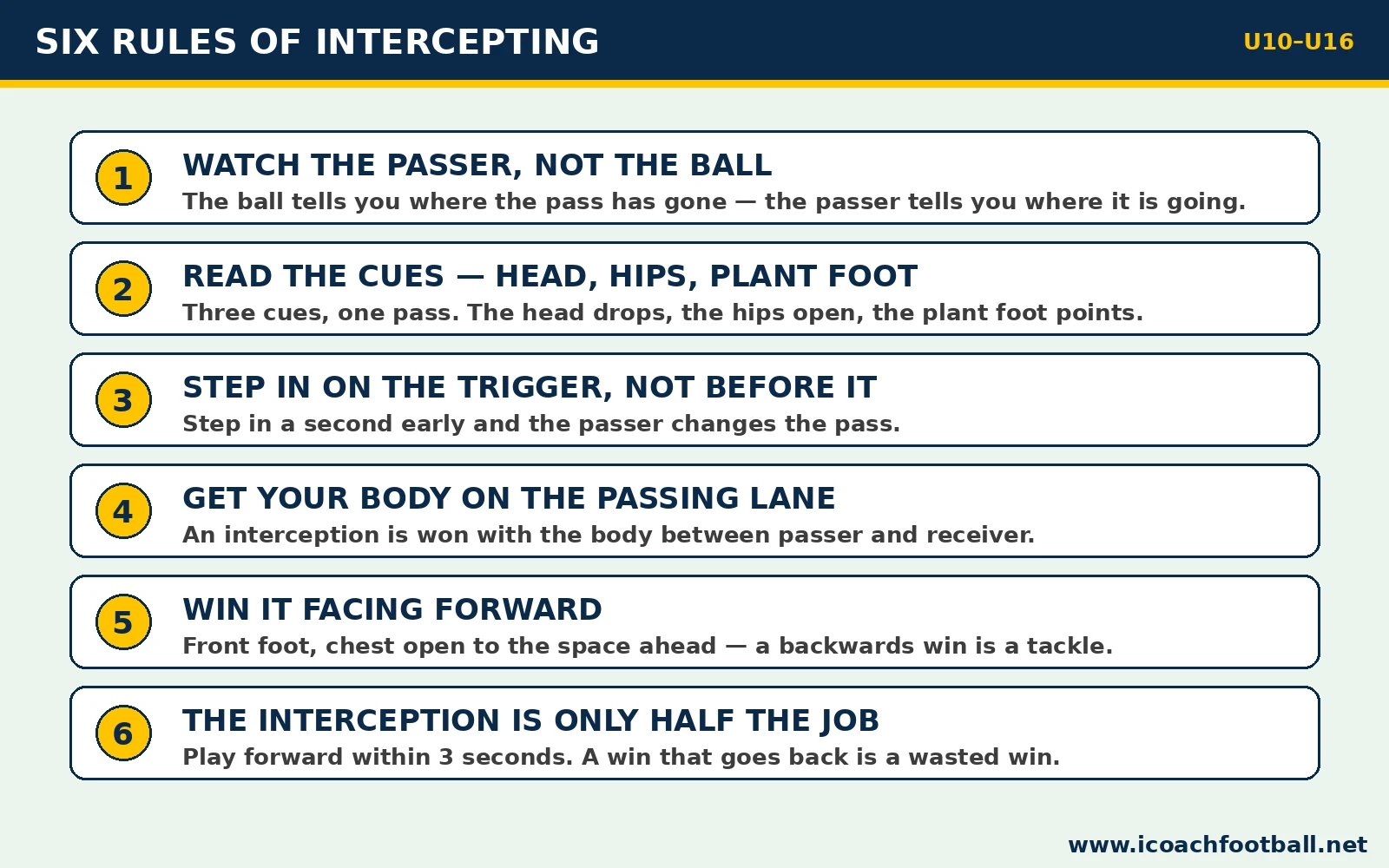
- Watch the passer, not the ball. The ball only tells you where the pass has gone — the passer tells you where it is going.
- Read the cues — head, hips, plant foot. The head goes down, the hips open, the plant foot points at the target. Three cues, one pass.
- Step in on the trigger, not before it. The trigger is the moment the passer opens the body to play. Step in a second early and the passer changes the pass.
- Get your body on the passing lane. An interception is won with the body between passer and receiver, not with a stretched leg.
- Win it facing forward. Take the ball with the front foot, chest open to the space ahead — a backwards interception is a tackle, not a win.
- The interception is only half the job. Play forward within 3 seconds. A win that goes straight back to the passer is a wasted win.
Drill 1 — Read the Passer
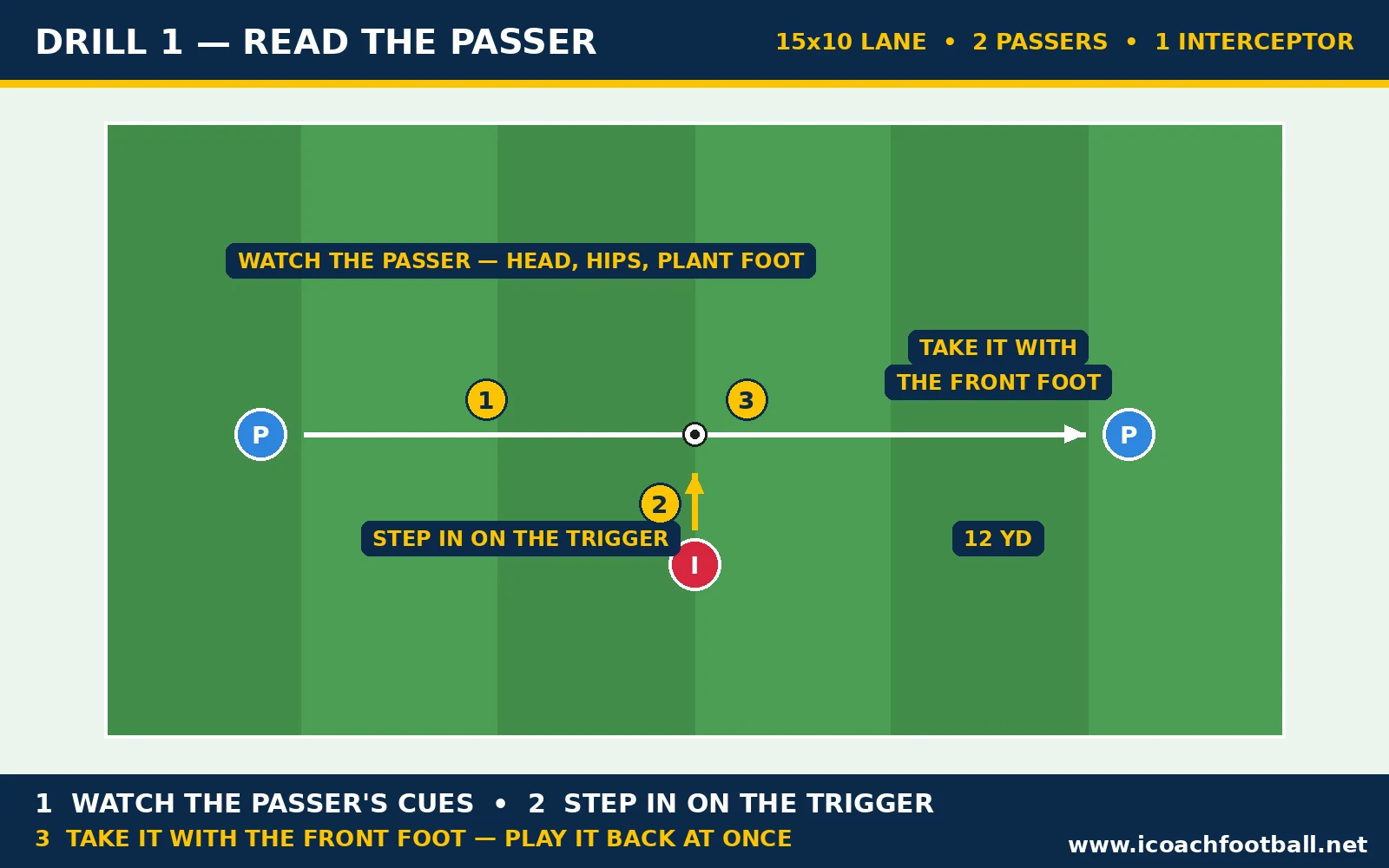
The interceptor practises reading the passer’s cues in a simple lane, so the step-in is timed to the passer’s body shape, not to a guess.
Setup
- 15×10-yard lane, 2 passers 12 yards apart, 1 interceptor in the middle.
- 8 minutes, then rotate.
How to Play
- The two passers play the ball back and forth along the ground.
- The interceptor stands in the middle, side-on, watching the passer.
- The interceptor watches the passer’s head, hips and plant foot for the cue.
- When the passer opens the body to play across, the interceptor steps in.
- The interceptor takes the ball with the front foot and plays it back at once.
- After 6 reps, rotate — the interceptor becomes a passer and a passer steps in.
Coach’s note: “The pass is decided before it is played — the head goes down, the hips open, the plant foot points at the target. Read the body, not the ball.”
Progressions: The passers may fake the pass before playing it; the interceptor must call “Mine!” before stepping in; the passers play one-touch only.
Drill 2 — The Interception Lane
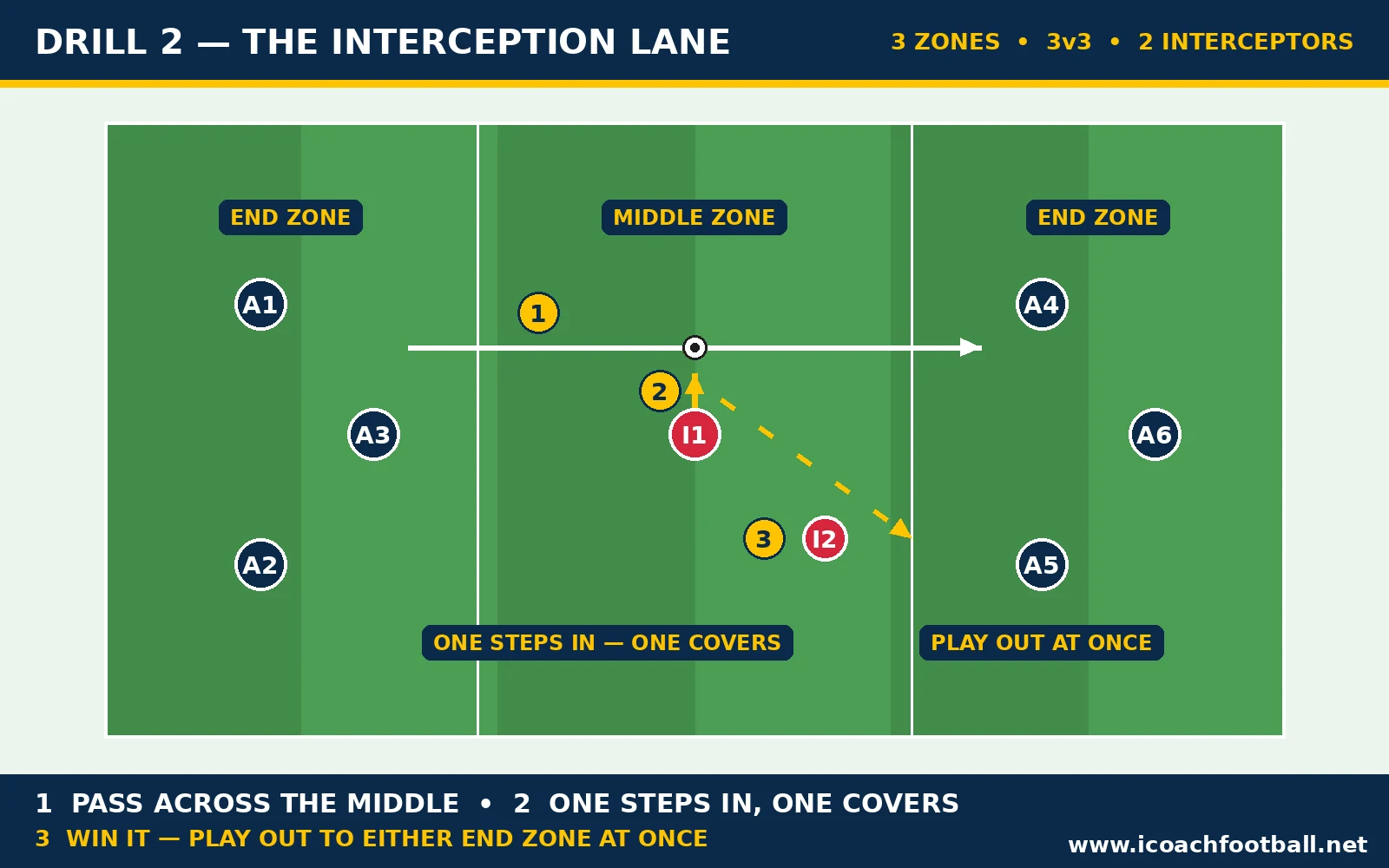
Two interceptors work a middle zone as a pair — one steps in, one covers — so the lane is closed even when the first step-in misses.
Setup
- 20×12-yard area split into 3 zones (two 8-yard end zones, 4-yard middle zone), 3 attackers in each end zone, 2 interceptors in the middle.
- 10 minutes.
How to Play
- The attackers pass the ball between the two end zones through the middle.
- The two interceptors work as a pair in the middle zone, one pressing the lane, one covering.
- The interceptors read the passer’s body shape and step in on the trigger.
- An interceptor who wins the ball plays it out to either end zone at once.
- The attacker whose pass is intercepted swaps into the middle zone.
- Play for 2 minutes, then swap — the interceptors become attackers and two attackers step in.
Coach’s note: “Two interceptors, one lane — the first one steps in, the second one covers the space behind. If both step in, the lane is wide open.”
Progressions: Limit the attackers to two touches; the interceptors may press into an end zone once per round; the pass must travel through a 3-yard gate in the middle zone.
Drill 3 — Feint and Step In
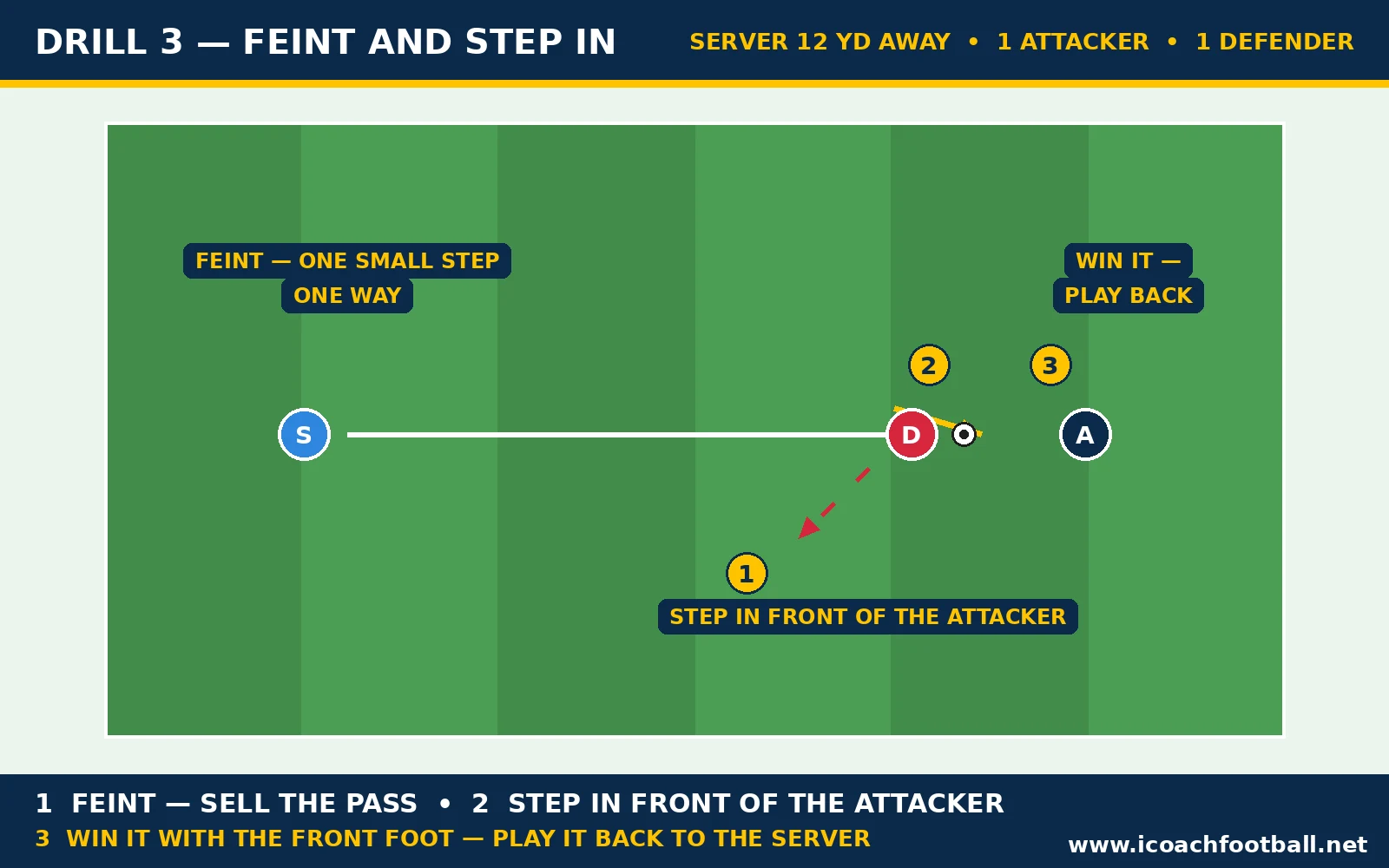
The defender learns the feint that sells the pass — a small step one way that makes the passer play the ball straight into the space the defender is about to take.
Setup
- 15×15-yard area, 1 server 12 yards away, 1 attacker, 1 defender between them.
- 8 minutes, then rotate.
How to Play
- The server starts with the ball and looks to play it to the attacker.
- The defender stands goal-side of the attacker, side-on, watching the server.
- The defender feints — a small step one way — to make the server think the lane is open.
- As the server opens the body to play the pass, the defender steps in front of the attacker.
- The defender wins the ball with the front foot and plays it back to the server at once.
- After 6 reps, rotate — the defender becomes the attacker and the attacker becomes the server.
Coach’s note: “The feint sells the pass — step one way, and the server plays the ball straight into the space you are about to take.”
Progressions: The attacker may check away to lose the defender; the server may play a lofted pass; the defender must win the ball and dribble through a gate to score.
Drill 4 — End Passes, Middle Man
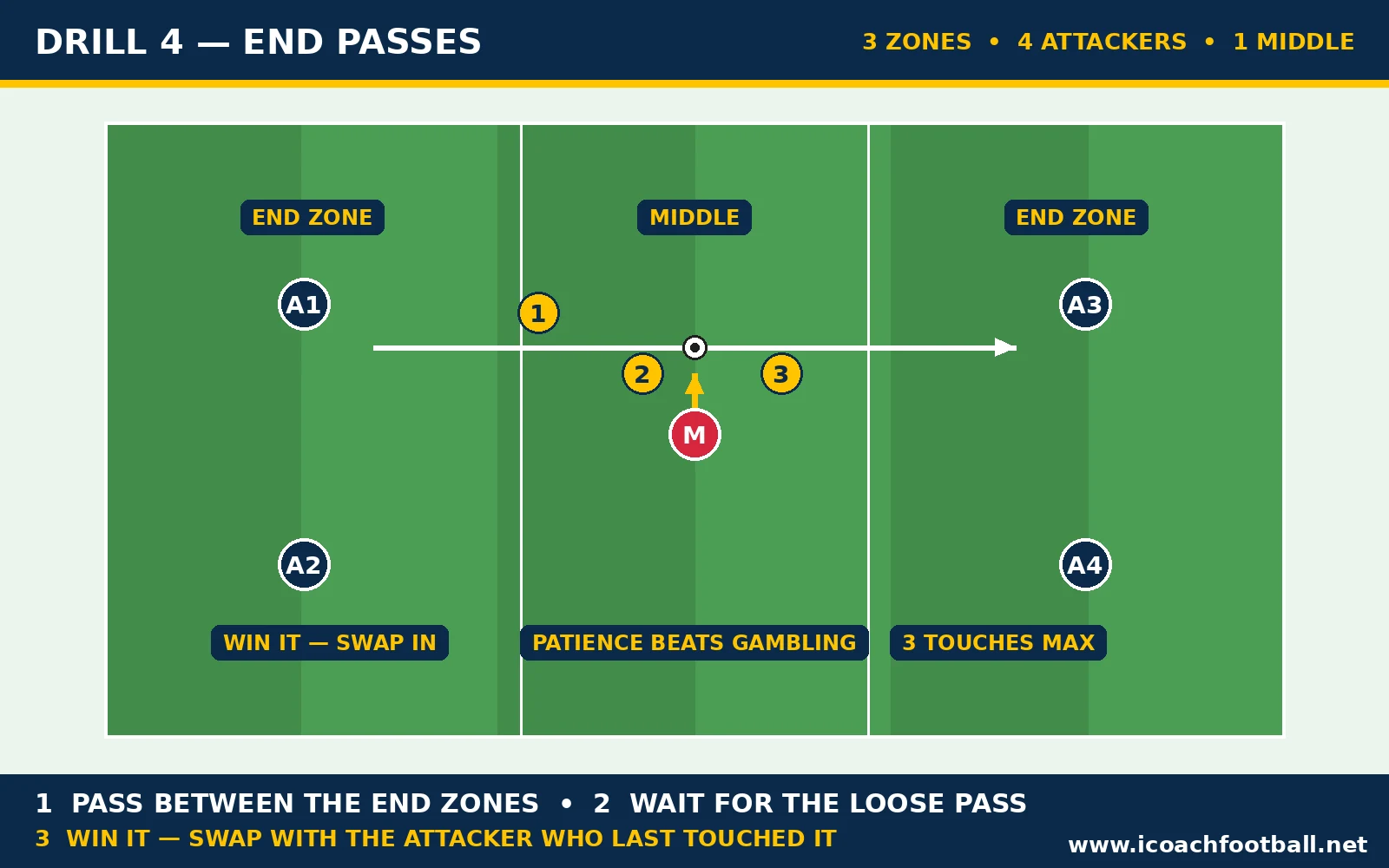
The classic end-zone game — four attackers pass between two zones while one interceptor in the middle waits for the loose pass, and patience is what wins the ball.
Setup
- 20×15-yard area in 3 zones, 4 attackers split between the two end zones, 1 interceptor in the middle.
- 10 minutes.
How to Play
- Four attackers split between the two end zones and pass between them.
- A maximum of three touches is allowed in each zone before the pass back.
- The interceptor in the middle reads the pass and tries to step in.
- When the interceptor wins the ball, they swap with the attacker who last touched it.
- The attackers must pass within their zone before playing across the middle.
- Play for 2 minutes, then rotate the interceptor — everyone takes a turn in the middle.
Coach’s note: “Patience beats gambling — the interceptor who steps in on every pass gets played around; the one who waits for the loose pass wins the ball.”
Progressions: No touch limit in the end zones; a second interceptor joins the middle; the pass across must be one-touch.
Drill 5 — Press the Channel, Win the Ball
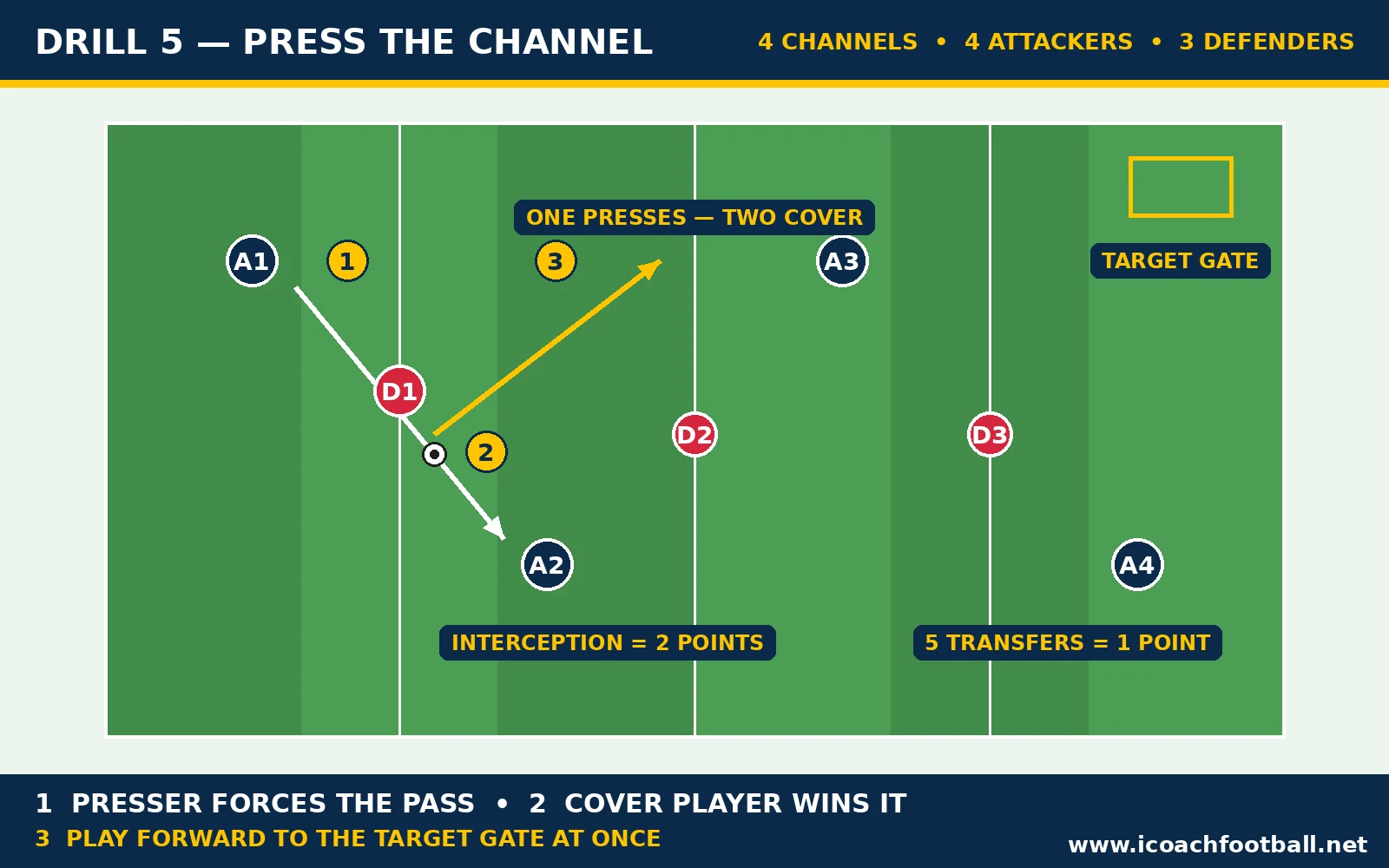
Three defenders press four channels as a unit — one steps to the ball, two cover the lanes — so the interception is a team action, not a solo gamble.
Setup
- 30×20-yard area split into 4 vertical channels, 4 attackers (one per channel), 3 defenders in the central channels.
- 10 minutes.
How to Play
- The attackers transfer the ball across the channels, one in each channel.
- The three defenders press as a unit, one stepping to the ball, two covering the lanes.
- The defenders read the passer’s cues and step in when the pass is played across.
- A defender who intercepts the ball plays it forward to a target gate at once.
- If the attackers complete 5 transfers, they score a point; an interception scores 2.
- Play for 2 minutes, then swap — the defenders become attackers and three attackers step in.
Coach’s note: “One presses, two cover — the presser forces the pass, the cover player wins it. A press with no cover is just a player running past the ball.”
Progressions: Add a neutral player in each half; limit the attackers to two touches; the interception must lead to a shot within 5 seconds.
Drill 6 — The Interception Game
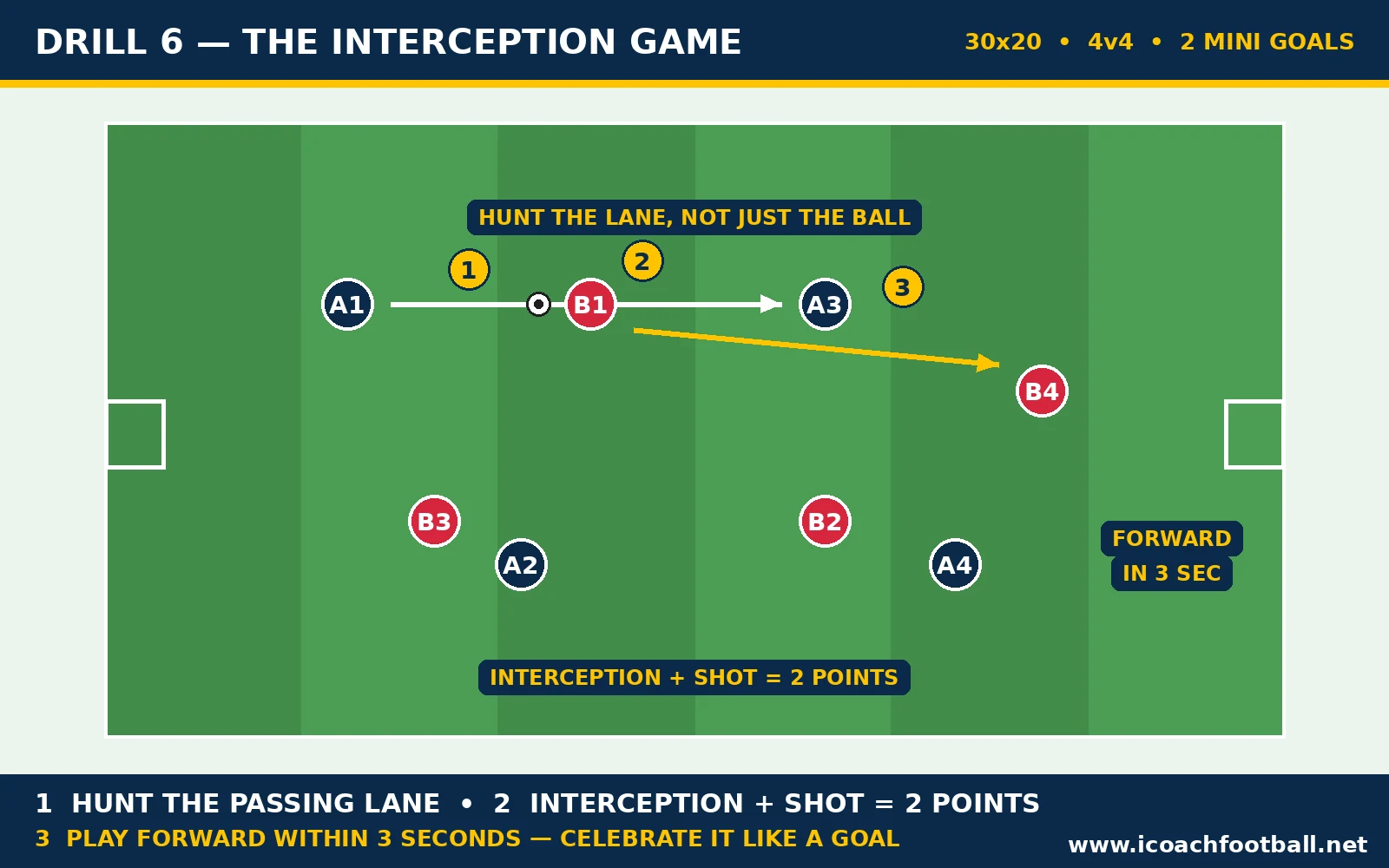
The full game. A 4v4 where an interception that leads to a shot is worth two points — so the group starts hunting the passing lane, not just the ball carrier.
Setup
- 30×20-yard area, 4v4, 2 mini goals.
- 15 minutes.
How to Play
- Two teams of 4 play 4v4 with a normal game — except interceptions score.
- A team scores 1 point for a goal and 2 points for an interception that leads to a shot.
- The team out of possession hunts the passing lanes, not just the ball carrier.
- After an interception, the team must play forward within 3 seconds to keep the bonus.
- The team with the most points after 15 minutes wins — then play again with new teams.
- Coaches call out every interception, so the whole group hears what a win sounds like.
Coach’s note: “Count the interceptions out loud — the moment the group starts celebrating a step-in like a goal, the habit is built.”
Progressions: Interceptions only count if the team keeps the ball for 5 seconds; the team in possession is limited to two touches; play 5v5 with a neutral.
Coaching points
- The eyes win the ball before the feet do. A defender who watches the passer sees the pass a full second before it is played — a defender who watches the ball sees it when it is already past them.
- Side-on is the interception shape. A square body can only chase; a side-on body can step into the lane and still see the receiver. Teach the shape before the step-in.
- The trigger is the passer’s body, not the ball. The head drops, the hips open, the plant foot points — step in on that picture, and the ball arrives where your body already is.
- A stretched leg is a lost duel. If the interceptor has to lunge, they are too far from the lane. The step-in is a short, sharp move from a good starting position, never a dive.
- Win it facing forward. The first touch after the interception should travel forward, into space, at a pace the team can follow. A backwards touch hands the ball straight back.
- Cover is what makes the step-in safe. One defender steps in, one covers behind. Without the cover player, a missed interception is a goal — with one, it is just a missed chance.
Common mistakes
| Mistake | Fix |
|---|---|
| Chasing the ball carrier instead of the lane | Stand side-on in the lane in Drill 1 — the interceptor who watches the passer, not the ball, wins it |
| Stepping in too early, before the trigger | Wait for the passer’s body to open — Drill 3 punishes an early step, because the server changes the pass |
| Lunging with a stretched leg | Short, sharp step from a good start position — Drill 2 stops the rep if the interceptor has to dive for the ball |
| Winning the ball facing backwards | Front foot, chest open to the space ahead — Drill 5 only scores the interception if the team plays forward within 3 seconds |
| Both defenders stepping in at once | One presses, one covers — Drill 5 gives the attackers a point every time both defenders leave the lane |
| No positive action after the win | Play forward at once — Drill 6 only awards the 2-point bonus if the interception leads to a shot |
Age adaptations
| Age | Format | What changes |
|---|---|---|
| U10–U11 (ages 9–11) | 10×10-yard areas, size 4 ball, passive passers only | All six drills run with the passers playing soft, predictable passes and the interceptor starting 2 yards from the lane. Drill 3 uses a server who announces the pass — “Playing now!” — so the feint and the step-in can be learned in slow motion. Drill 6 plays 4v4 with no scoreboard for goals — only interceptions are counted, so the group learns what a win looks like |
| U12–U13 (ages 11–13) | 15×15-yard areas, size 4 ball, passers go live in the last 2 minutes of each drill | All six drills run as written, with the passers allowed to fake the pass from the second round. Drill 2 adds the 3-yard gate in the middle zone, and Drill 5 adds the neutral player. Interceptors keep a simple count of their wins — “three interceptions, two forward” is the habit that sticks |
| U14–U16 (ages 13–16) | Full areas, size 5 ball, passers live from the first rep | Full pressure from the start. Drill 1 runs one-touch only, Drill 4 adds the second interceptor, and Drill 6 adds the 5-second possession rule after the win. Defenders are asked to name the cue they read before each step-in — “hips opened, plant foot at the far post” — so the read becomes a conscious skill, not a lucky guess |
60-minute session plan
| Block | Time | Content |
|---|---|---|
| Arrival game | 0:00–0:05 | Free 3v3 — every interception that leads to a shot is worth 2 points |
| Read the passer | 0:05–0:13 | Drill 1 — Read the Passer |
| The interception lane | 0:13–0:23 | Drill 2 — The Interception Lane |
| Feint and step in | 0:23–0:31 | Drill 3 — Feint and Step In |
| End passes, middle man | 0:31–0:41 | Drill 4 — End Passes, Middle Man |
| Press the channel, win the ball | 0:41–0:51 | Drill 5 — Press the Channel, Win the Ball |
| The interception game | 0:51–1:00 | Drill 6 — The Interception Game |
Keep building from here
The anticipation that tells a defender which pass is coming is our soccer drills for improving anticipation, and the marking that keeps a defender goal-side before the step-in is our soccer drills for improving marking — together the three posts cover the whole reading-the-game sequence. The zonal shape that puts defenders on the right lanes in the first place is our soccer drills for zonal marking, and the positioning that puts a defender on the right side of the lane is our soccer drills for improving defensive positioning. The 1v1 duel that follows when the interception is missed is our 1v1 defending drills — jockeying, and the compact block that forces the pass into the lane is our the defensive block to teach compactness. The pressing triggers that tell a team when to step in as a unit are our coaching soccer pressing triggers, and the loose ball that follows a blocked interception is our soccer second ball drills. The scan that lets a defender see the passer and the receiver at once is our soccer scanning drills, the reactions that turn a read into a step-in are our soccer drills for improving reaction time, and the receiving skill the interception is trying to stop is our soccer drills for receiving under pressure. Interceptions are high-intensity work — plan the week’s load with our training load calculator.
FAQ
What is an interception in soccer?
An interception is winning the ball by stepping into the passing lane and taking the pass before it reaches its target — no tackle, no duel, just a read and a step. It is different from a tackle, which wins the ball from the carrier’s feet, and from a block, which stops a shot. A good interception starts the attack at once, because the defender wins the ball facing forward with the opposition out of shape.
How do you teach players to intercept passes?
Start with the read, not the step. In a simple lane, teach players to watch the passer’s head, hips and plant foot — the three cues that tell them where the pass is going. Then teach the trigger: step in the moment the passer opens the body to play, never before. Drill 1 trains the read in isolation, Drill 3 adds the feint that sells the pass, and Drill 6 rewards the interception in a real game.
When should a defender step in to intercept, and when should they stay?
Step in when the passer is about to play a pass you can reach — the pass is slow, the lane is short, and you have cover behind you. Stay when the pass is fast, the lane is long, or a missed step-in leaves your goal exposed. The rule is simple: step in if you can win it and your team can cover you if you miss; stay goal-side if you cannot do both.
What is the difference between intercepting and tackling?
Tackling wins the ball from the player who has it; intercepting wins the ball from the pass before it arrives. An interception needs no contact, keeps the defender on their feet, and starts the attack facing forward — which is why coaches prize it. A tackle is the fallback when the interception is not on. Drill 2 teaches the difference: the interceptor who lunges for the ball is tackling, the one who steps into the lane is intercepting.
At what age should players start training interceptions?
From U10, with soft, predictable passes and the interceptor starting close to the lane, so the read and the timing become habits before the pressure is real. The feint and the team press can both be trained young — what must wait is the full-speed step-in against live, disguised passes. Add fakes and live passers gradually from U12, and full-pressure interception games from U13, once the step-in is clean and the cover player is in place.
Sources
- FIFA Training Centre. “#11 Interception” — a session that aims to improve defensive anticipation and defenders’ ability to intercept the ball: the defender anticipates the trajectory of the pass, gets in front of the attacker, and can feint to deceive the passer as they look to release the ball. Verified live 2026-11-20 (HTTP 200, full text read). Drills 1, 3 and 6 are based on / in line with this session’s anticipation, get-in-front and feint principles.
- England Football Learning. “Session programme: marking and intercepting to stop goals” — a six-week programme that helps players defend as individuals, in pairs and units, and regain possession to attack. Week three, “be on guard to intercept”, runs the Interceptors game — two interceptors in a middle zone who block the pass and break out to score — and week five, “intercept as a team”, trains defenders to decide together when to mark and when to step in. Verified live 2026-11-20 (HTTP 200, full text read). Drills 2, 4 and 5 are based on / in line with this programme’s middle-zone interceptor game and team-interception principles.