Soccer Second Ball Drills: 6 Games to Win the Drop and Play Forward First
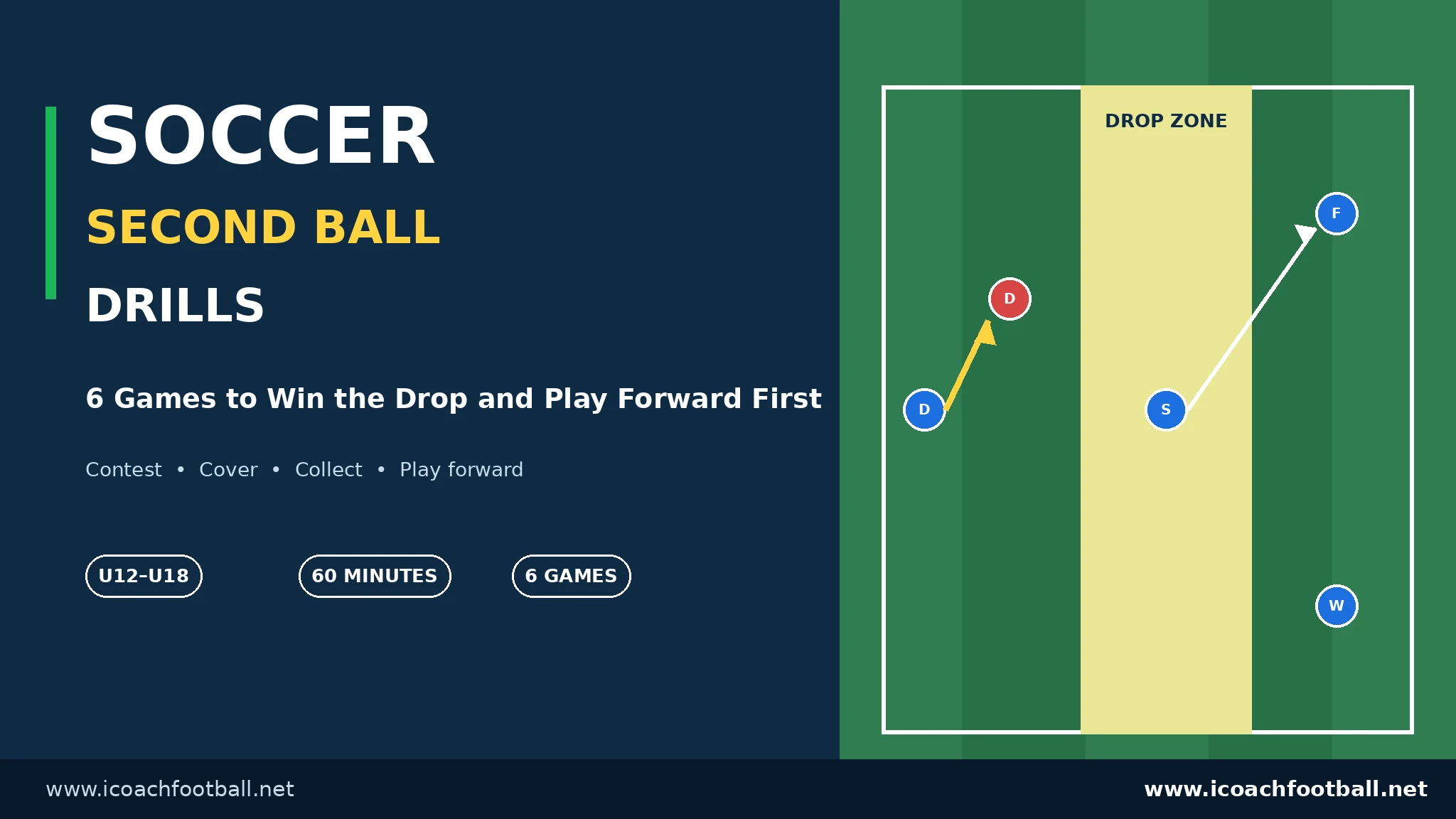
Quick answer: The second ball is the loose ball that drops after a long ball, clearance or goal kick is contested in the air. Win it by giving three players three jobs: one contests the first ball, one covers the drop, and one sweeps it up side-on and plays forward first. These six games train exactly that, in order, from reading the drop to a full game where every restart is a long ball.
Suitable for: U12–U18
Most teams practise the long ball and forget what happens next. The ball goes up, two players jump, and nine others watch it land.
The team that wins the drop wins the next five seconds. UEFA’s game-insights analysis of second-ball battles calls those moments “golden moments”: brief imbalance, created by a long ball that only one team is set up to exploit. The side that is already moving toward the drop, already facing forward, gets the first pass away while the other side is still turning.
Coaches in the UK teach the same moment as football second-ball drills, and the jobs are identical: contest, cover, collect, then play forward. These six soccer second ball drills build the habit in stages: reading the drop, the flick-on, the five-second forward-pass rule, goal-kick second balls, clearance to counter, and a full second-ball game.
Session snapshot
- Players: 6–16 (pairs and small groups for Drills 1–2, 10 for Drill 3, 12 for Drills 4–5, two teams of 7 for Drill 6)
- Area: 20 x 25 yards for Drill 1, 25 x 20 yards for Drill 2, 30 x 25 yards for Drill 3, half pitch for Drills 4–6
- Duration: 60 minutes (20-minute version: Drills 1 and 3 only)
- Focus: Reading the drop, body shape to collect, first pass forward, transition speed, communication
- Equipment: 10–12 balls, 16 cones, bibs, 2 full goals, 4 mini-goals
- Age: U12–U18 (see age adaptations; no headers at U12, limited headers at U13–U14)
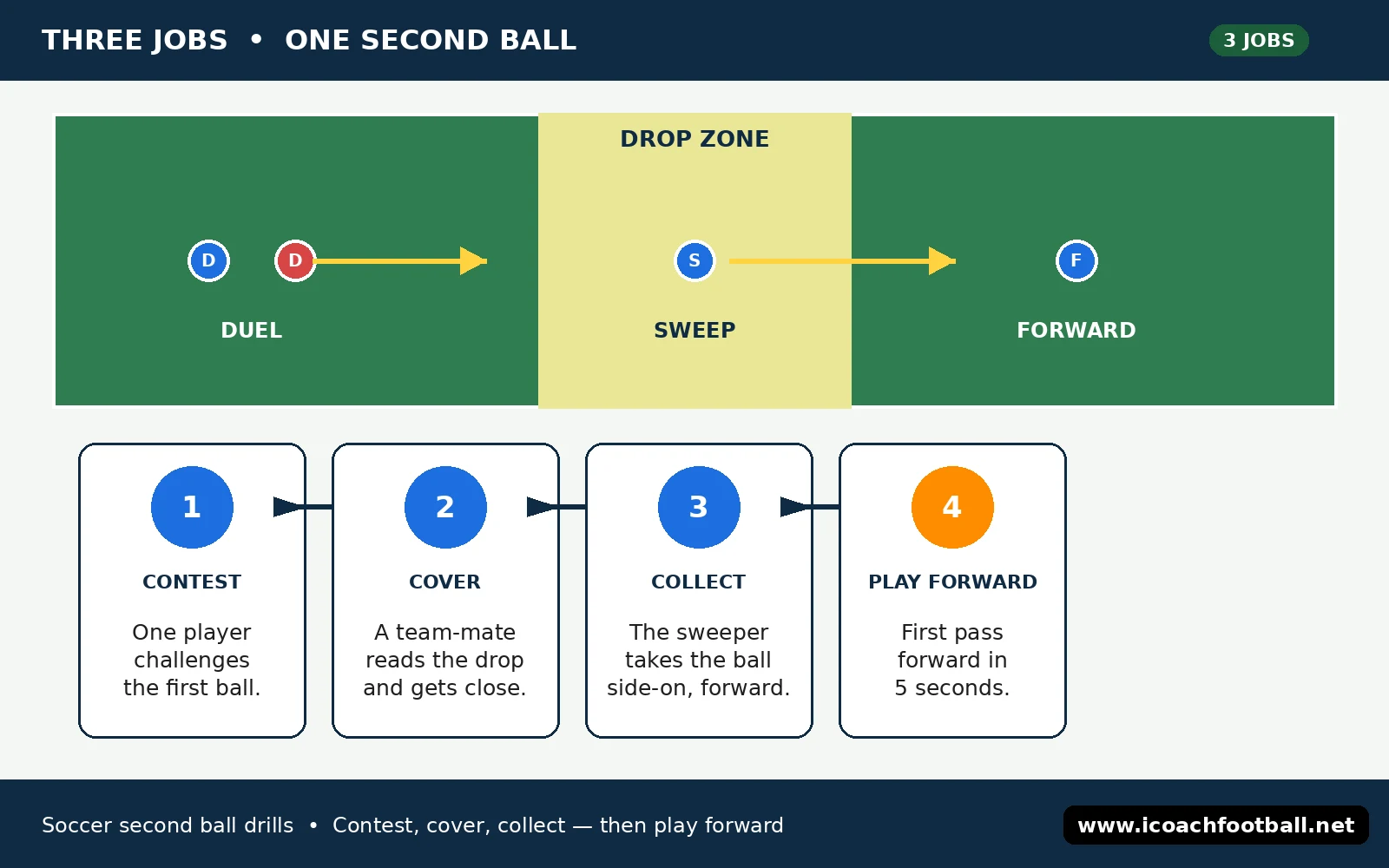
The one rule: three jobs, one drop
A second ball is decided before it lands. If nobody is assigned to the drop, both teams arrive late and the ball bounces to whoever reacts first.
- Contest. One player challenges the first ball, jumps or bodies up, and makes the opponent’s touch difficult. The contest player’s job is not always to win the header; it is to make the ball drop where the team expects it.
- Cover. A team-mate reads the flight, moves early toward the likely drop, and gets goal-side of the space. Cover means arriving as the ball lands, not after it bounces.
- Collect. The sweeper takes the ball side-on, on the front foot, facing forward. The first touch must go forward or sideways into space, never back into the duel.
- Play forward. The first pass after winning a second ball goes forward, within five seconds. A clearance is not a pass; the pass must find a team-mate facing forward.
- Shout the job. The cue is “Mine!”, “Drop!” or “Away!” before the ball lands. Silent teams lose second balls because two players go for the same duel and nobody covers the drop.
If your players all chase the first ball, fix the jobs first with these soccer scanning drills; reading the flight early is the same skill as scanning before receiving.
| What happens | Team does | First pass does |
|---|---|---|
| Long ball goes up | One player contests, one covers, one sweeps | Forward, within 5 seconds |
| Flick-on goes over the duel | Sweeper reads the flick and collects on the move | Wide to the winger, or forward to the striker |
| Clearance drops in midfield | Nearest midfielder wins the drop, partner offers forward | Through the line to a runner |
| Goal kick is contested | Midfield sets a 3v3, wide players stay wide | Wide, then forward, never back to the goalkeeper under pressure |
Drill 1 — Read the Drop
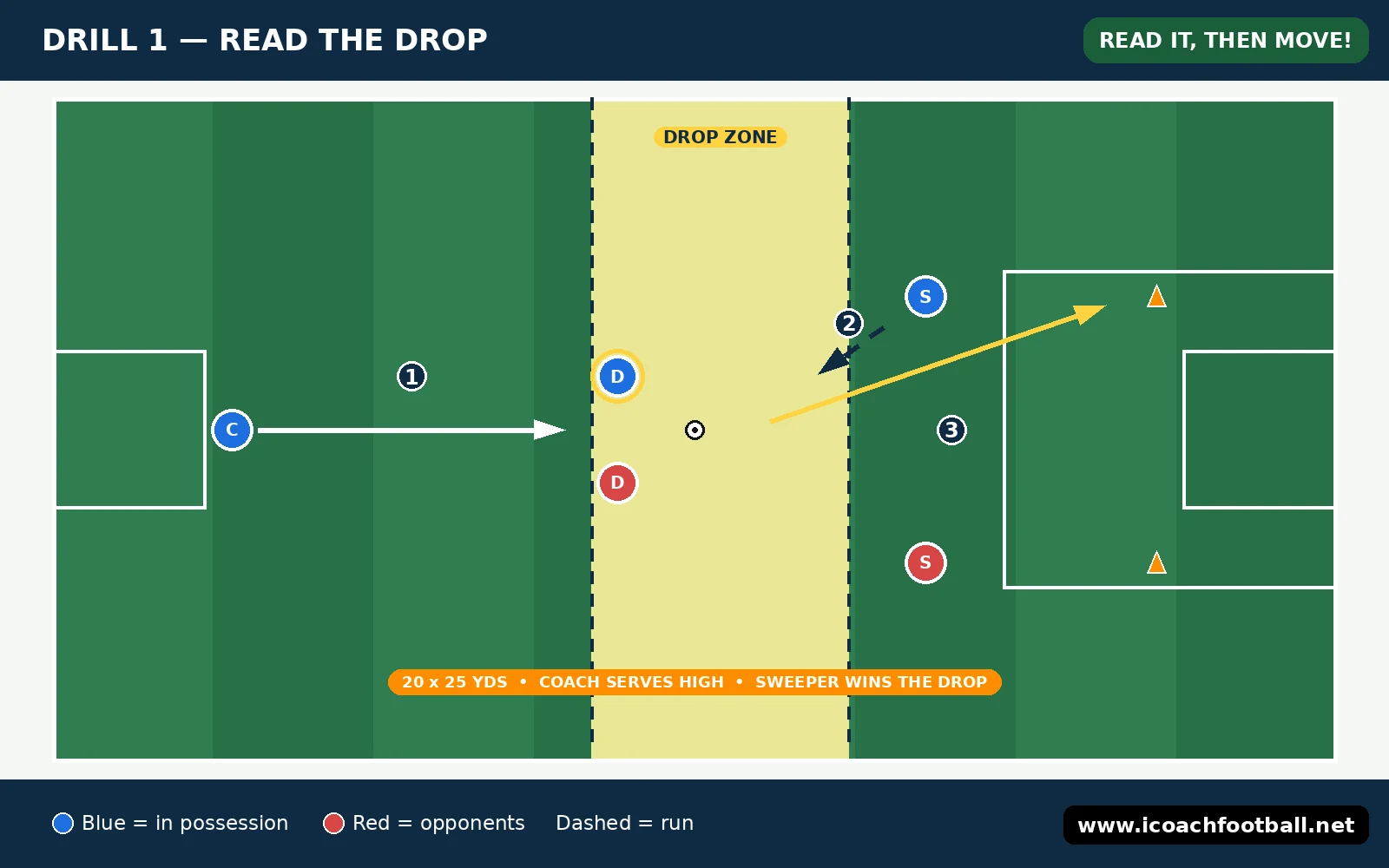
The starting point, in line with the FIFA Training Centre definition of an aerial duel: two players compete for a ball from above shoulder height, and the contest is won by first contact. The drill teaches everyone else to read where that contact sends the ball.
Setup:
- A 20 x 25 yard area with a shaded drop zone across the middle.
- A coach serving high balls from one end, one blue duellist and one red duellist in the drop zone, and one sweeper for each team behind the zone.
- Balls with the coach, and a target gate at each end for the sweeper’s forward pass.
How to Play:
- The coach serves a high ball into the drop zone, and both duellists step in to contest it.
- The sweepers read the flight while the ball is in the air and move toward the likely drop.
- The sweeper whose side wins the duel collects the loose ball side-on, facing forward.
- The sweeper plays a first-time forward pass through a target gate for 1 point.
- Rotate duellists and sweepers every four serves, then serve from the other end.
Coach’s note: The cue is “Read it, then move!” If a sweeper only moves after the ball bounces, freeze the rep. The read happens in the air; the bounce is too late.
Progressions: Serve the ball to different heights and depths, then let the duellist flick the ball on deliberately so the sweeper must read the flick, not just the drop.
Drill 2 — Flick and Sweep
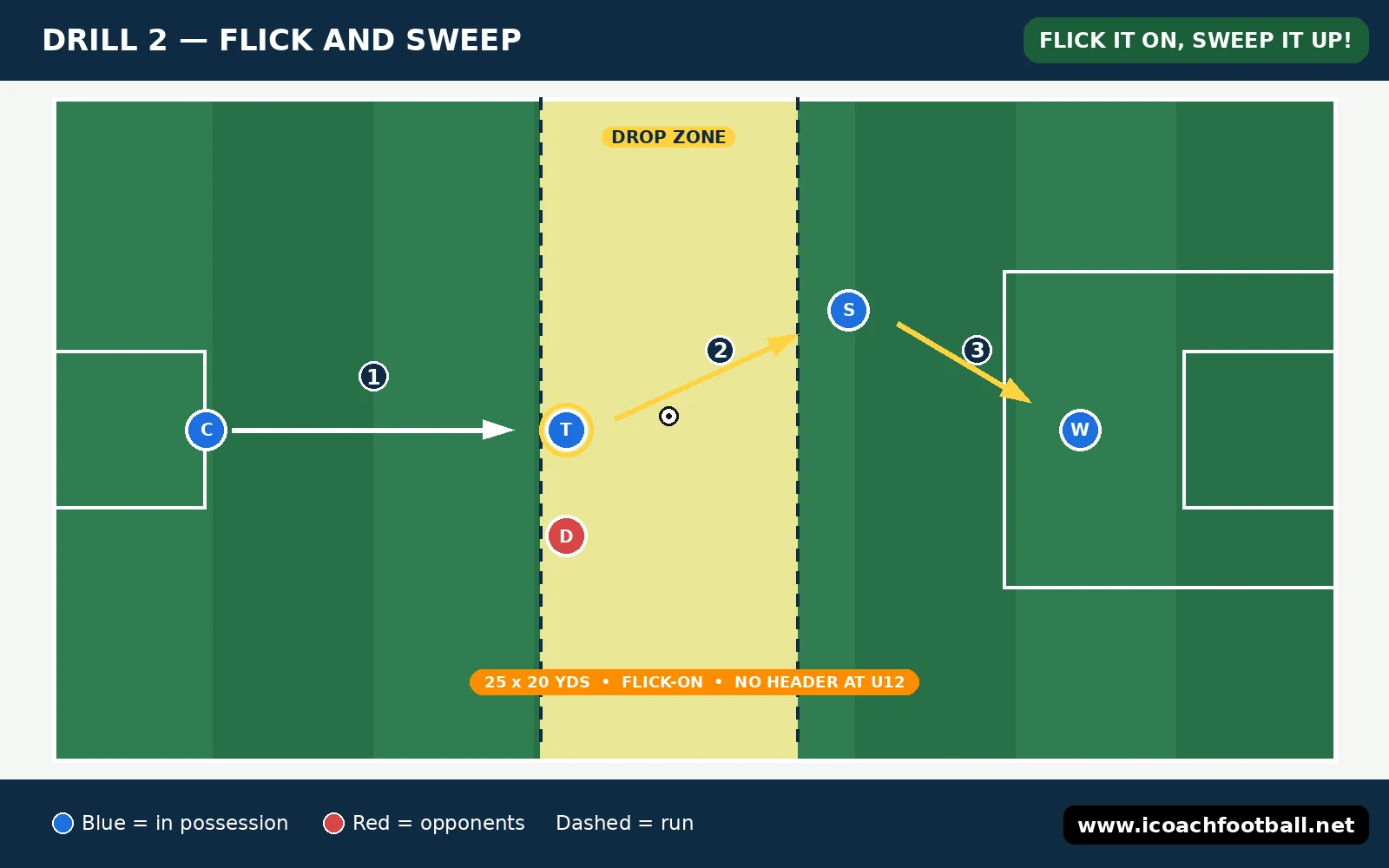
The flick-on game. A target player meets the long ball and flicks it on, and the sweeper must already be moving to the space behind the duel.
Setup:
- A 25 x 20 yard area with a shaded drop zone across the middle.
- A coach serving, a target player and a defender contesting in the zone, a sweeper behind the zone and a wide player near the far end.
- Balls with the coach. At U12, the flick is made with the chest, thigh or foot, with no headers; at U13–U14, headers are limited and a lightweight ball is used.
How to Play:
- The coach serves a high ball to the target player, who meets it with the defender tight behind.
- The target player flicks the ball on with the head, chest or foot, into the space behind the duel.
- The sweeper, already moving, collects the flick on the move, side-on and facing forward.
- The sweeper plays forward to the wide player, who receives and returns the ball to the coach.
- Rotate target, defender, sweeper and wide player every four serves.
Coach’s note: The cue is “Flick it on, sweep it up!” If the sweeper waits to see the flick before moving, the ball runs away. The sweeper moves on the target player’s body shape, not on the ball.
Progressions: The defender may win the first ball, then the sweeper must press the defender’s first touch and win the second ball instead. The flick-on timing is the same movement used in the counter-attack, trained in these soccer counter attack drills.
Drill 3 — The 5-Second Rule
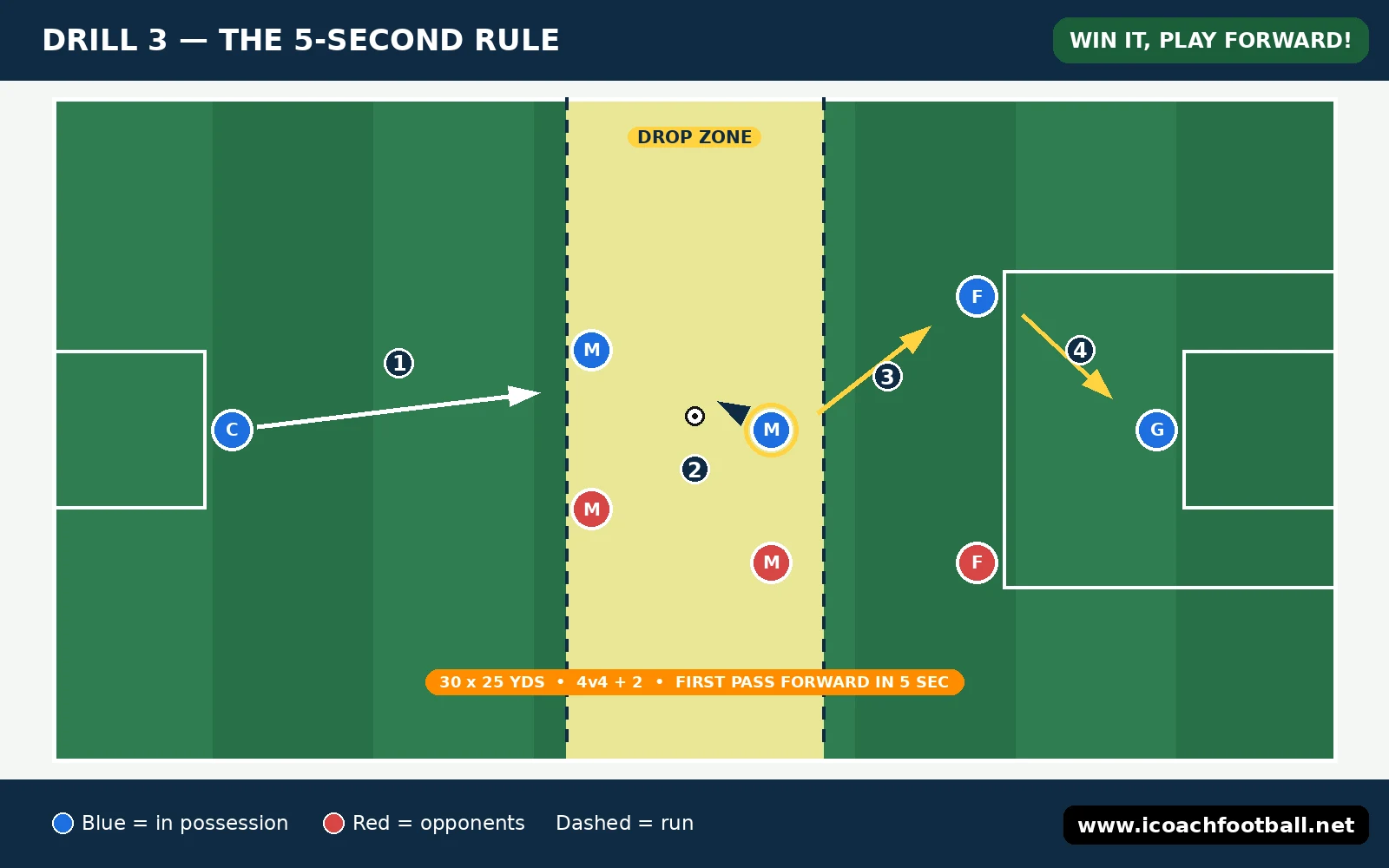
The habit drill, based on the UEFA coaching rule for the transition after a second ball: the first pass must be forward, it must be a pass and not just a clearance, and the decisions after it are the players’. The five-second limit makes that rule trainable.
Setup:
- A 30 x 25 yard area with a shaded drop zone across the middle and a mini-goal at each end.
- Two teams of 4 plus 2 neutral players, with the coach serving long balls from the side.
- Balls with the coach, and a 5-second count called aloud by the coach after every second ball is won.
How to Play:
- The coach serves a long ball into the drop zone, and both teams contest the first ball.
- The team that wins the drop must play its first pass forward within five seconds, counted aloud.
- A forward first pass earns the right to attack a mini-goal; a sideways or backward first pass gives the ball to the other team.
- If the ball goes out, the coach serves the next long ball immediately into the drop zone.
- Play four 3-minute blocks, keep a running score, and swap which team serves first each block.
Coach’s note: The cue is “Win it, play forward!” If a player wins the drop and turns back to safety, stop the rep. The forward pass is the point; safety is what loses the golden moment.
Progressions: The count drops to three seconds, then the neutral players may only play one touch, so the forward pass must be played first time.
Drill 4 — Goal-Kick Second Balls
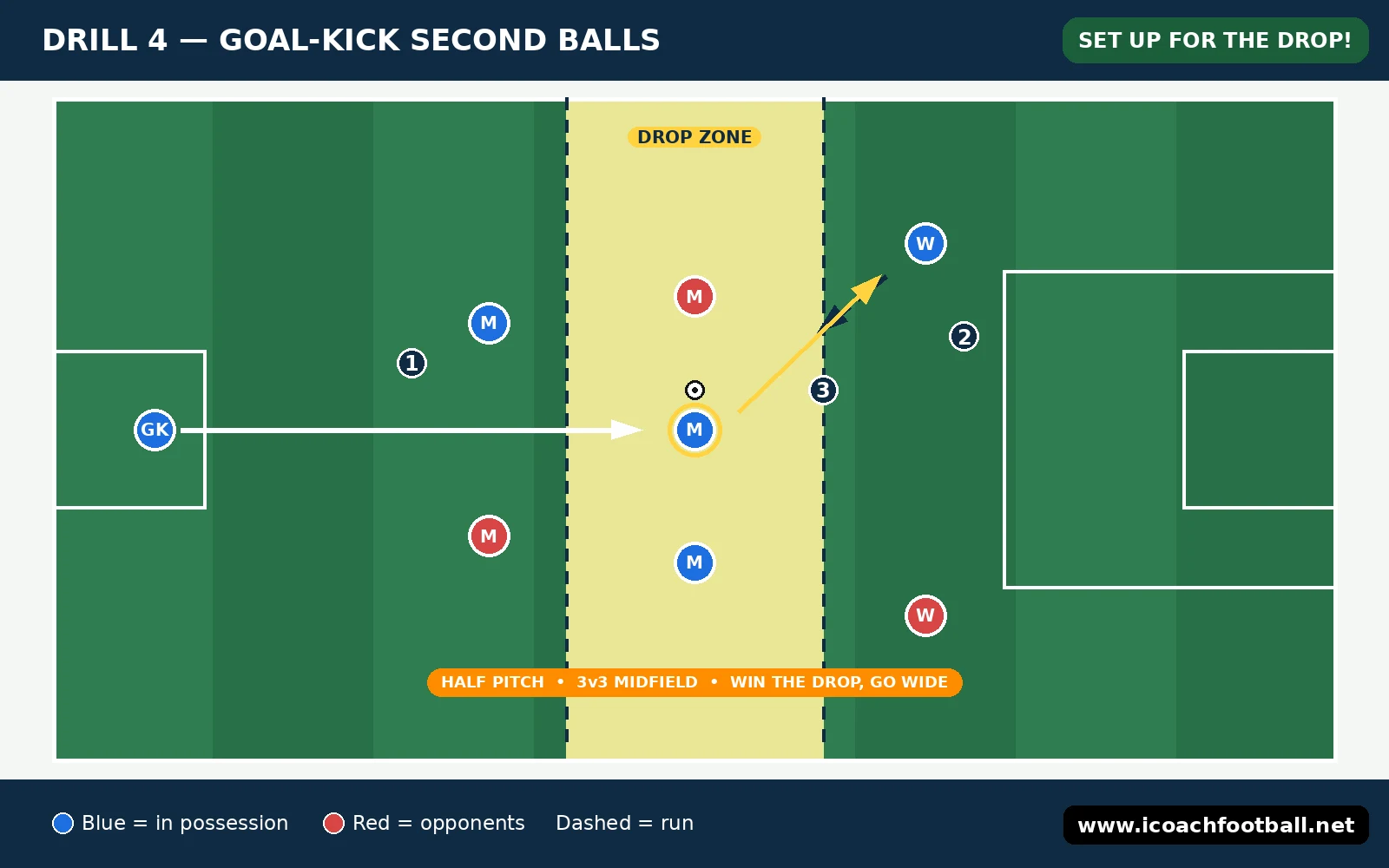
The match-realistic version. Every goal kick is a long ball, and the midfield must be set up for the drop before the goalkeeper kicks it.
Setup:
- Half pitch, with a full goal and goalkeeper at one end and two wide target zones at halfway.
- Three midfielders for each team in the middle third, with a wide player for each team on each touchline.
- Balls with the goalkeeper, and a 4-minute block clock.
How to Play:
- The goalkeeper takes a long goal kick into the middle third, and the three midfielders contest the first ball.
- The wide players hold their width and do not come inside before the ball drops.
- The team that wins the drop plays wide to its wide player within two passes.
- The wide player drives forward and plays into a target zone for 1 point, then the next goal kick starts.
- Rotate the midfield three every block, and alternate which goalkeeper kicks.
Coach’s note: The cue is “Set up for the drop!” If the midfield is flat and facing its own goal when the kick is taken, restart the rep. The shape is set before the kick, not after the ball lands.
Progressions: The goalkeeper may vary the kick to either side, then the midfield must shift as a unit so the sweeper is always on the kicking side. The midfield shape that wins these drops is the same compact shape trained in these football defensive transition drills.
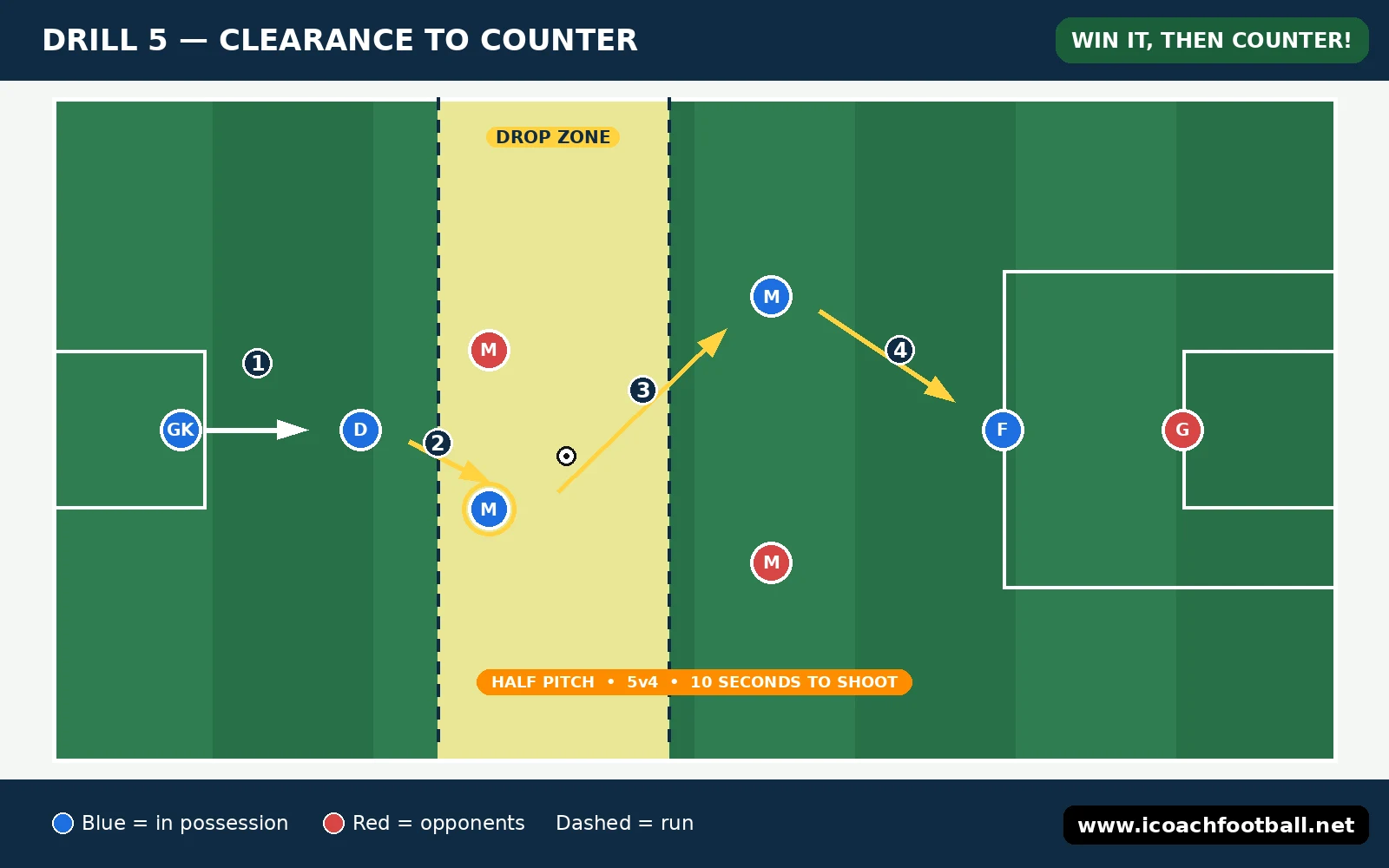
Drill 5 — Clearance to Counter
The defensive version. A clearance is not the end of defending; it is the start of the counter, if the midfield wins the second ball and plays forward in ten seconds.
Setup:
- Half pitch, with a full goal and goalkeeper at one end and a full goal at the other.
- A defender and goalkeeper clearing, three midfielders contesting the drop, and a forward waiting on the halfway line, against four opponents.
- Balls with the goalkeeper, and a 10-second count from the moment the second ball is won.
How to Play:
- The goalkeeper rolls the ball to the defender, who clears it long into the middle third.
- The midfielders contest the first ball, and the nearest midfielder wins the drop.
- The sweeper collects the ball and plays forward to a team-mate breaking into space.
- The team has ten seconds from winning the second ball to shoot at the far goal.
- If the opponents win the drop, they counter the other way on the same ten-second rule, and the next ball starts from the goalkeeper.
Coach’s note: The cue is “Win it, then counter!” If the team wins the drop and plays sideways to keep the ball, freeze play. The counter only exists for ten seconds, while the other team is still spread out from the clearance.
Progressions: The clearance must go to a named side, then the opponents may press the sweeper’s first touch, so the forward pass must be played first time. The ten-second finish is the same transition trained in the counter-press, in these counter-pressing soccer drills.
Drill 6 — The Second-Ball Game
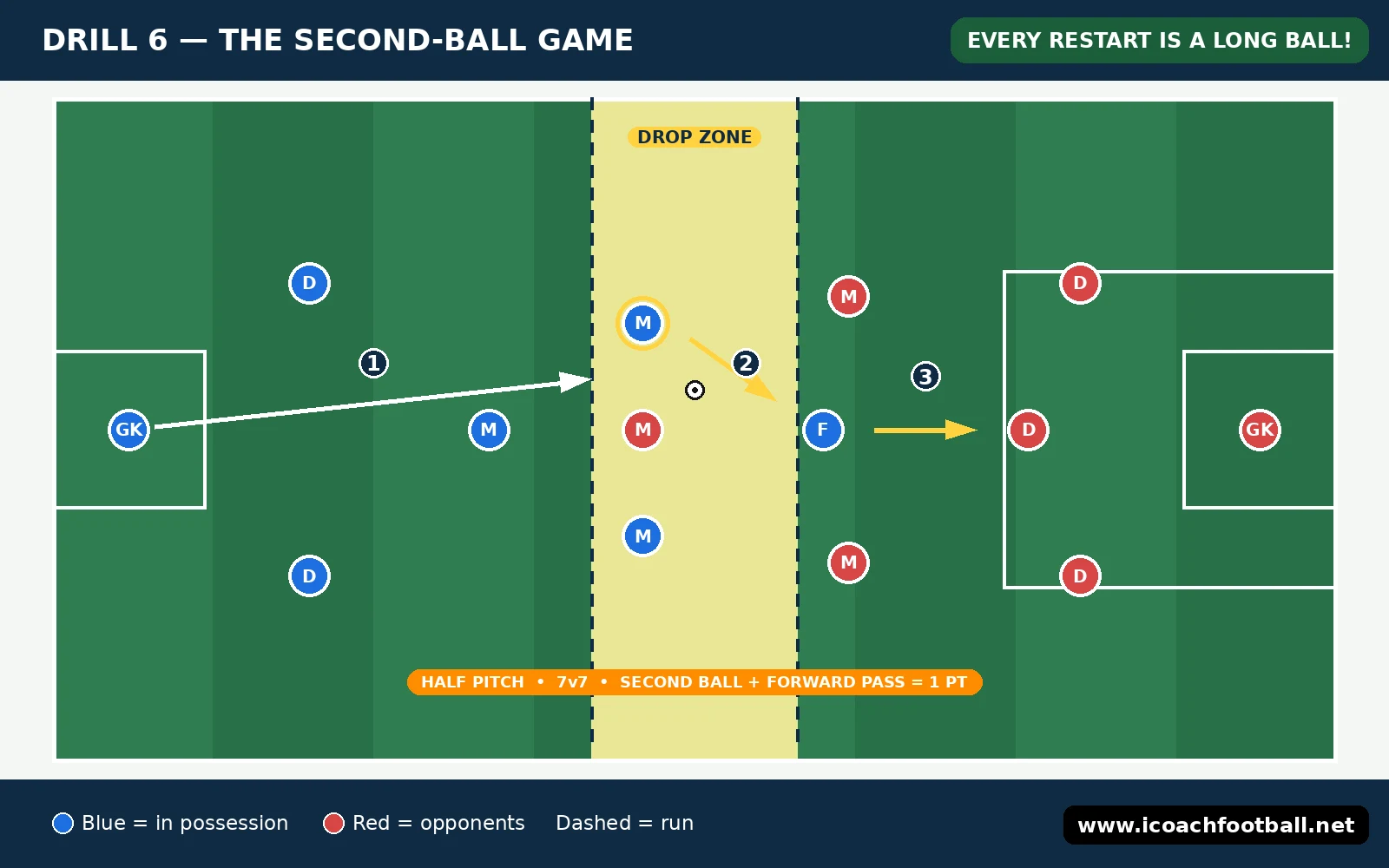
The real game. Every restart is a long ball, so every restart is a second-ball contest, and the score rewards winning the drop and playing forward, not just scoring.
Setup:
- Half pitch, with a full goal at each end and a goalkeeper in each goal.
- Two teams of 7, with a shaded drop zone across the middle third and balls starting with the coach.
- A point for winning a second ball and playing forward first, and a goal counts 1 point normally, 2 points if it follows a won second ball.
How to Play:
- The coach plays a long ball into the drop zone, and both teams contest the first ball.
- The team that wins the drop must play its first pass forward to earn the second-ball point.
- Once the forward pass is played, teams play freely and may finish in either goal.
- When the ball goes out, the coach serves the next long ball into the drop zone, with no throw-ins or short restarts.
- Play four 4-minute blocks, keep a running score, and swap which team contests first each block.
Coach’s note: The cue is “Every restart is a long ball!” If a team tries to play short from a restart, freeze play. The constraint forces the contest, the cover and the collect on every single restart.
Progressions: The drop zone narrows by 5 yards, then the first pass after winning the drop must be one touch, so the sweeper’s body shape has to be set before the ball arrives.
Coaching points
- “Read it, then move!” In Drill 1, the sweeper moves while the ball is in the air. Waiting for the bounce loses the drop.
- “Flick it on, sweep it up!” In Drill 2, the sweeper moves on the target player’s shape. The flick is read, not chased.
- “Win it, play forward!” In Drill 3, the first pass goes forward in five seconds. A clearance is not a pass.
- “Set up for the drop!” In Drill 4, the midfield shape is set before the goal kick. Flat midfields lose goal-kick second balls.
- “Win it, then counter!” In Drill 5, the counter lasts ten seconds. Sideways passes waste the moment the clearance created.
- “Every restart is a long ball!” In Drill 6, the constraint builds the habit. Once the drop is won, the next phase is playing forward at speed, trained in these soccer passing drills.
Common mistakes
| Mistake | Fix |
|---|---|
| Everyone chases the first ball | Drill 1 jobs; one contests, one covers, one sweeps |
| Sweeper moves after the bounce | Drill 1 cue “Read it, then move!”; no rep counts from a late start |
| First touch goes back into the duel | Drill 3 rule; first pass must go forward in 5 seconds |
| Midfield is flat at the goal kick | Drill 4 rule; shape set before the kick, sweeper on the kicking side |
| Clearance treated as the end of the play | Drill 5 rule; 10 seconds to shoot from the won second ball |
| No one shouts the job | Drill 1–2 calls; “Mine!”, “Drop!” or “Away!” before the ball lands |
Age adaptations
| Age | Change |
|---|---|
| U12 | Drills 1 and 2 only, no headers, flicks with chest, thigh or foot, coach serves from closer range, and celebrate the read before any finish |
| U13–U14 | Full six-drill menu with limited headers and a lightweight ball in Drill 2, passive contest in Drill 3, and the 5-second count called aloud |
| U15–U16 | Live contest in Drill 3, three-second count, and the clearance-to-counter ten-second rule enforced in Drill 5 |
| U17–U18 | Narrower drop zone in Drill 6, one-touch first pass after the drop, and no coach call on the forward-pass decision |
60-minute session plan
Run the six games as one session with this 60-minute plan, or take any two games for a 20-minute block.
| Block | Time | Drill |
|---|---|---|
| 1 | 10 minutes | Drill 1 — Read the Drop |
| 2 | 10 minutes | Drill 2 — Flick and Sweep |
| 3 | 10 minutes | Drill 3 — The 5-Second Rule |
| 4 | 10 minutes | Drill 4 — Goal-Kick Second Balls |
| 5 | 10 minutes | Drill 5 — Clearance to Counter |
| 6 | 10 minutes | Drill 6 — The Second-Ball Game |
Sources
These soccer second ball drills are based on, and in line with, the UEFA game-insights analysis of playing forward after second balls, in which a long-ball game produced 127 long passes at only 36% success, the decisive passages came from three consecutive long balls and second-ball battles, and the coaching focus was a rule that after winning possession the first pass must be forward, must be a pass and not just a clearance, with scanning, vision, touch and deception developed to exploit those moments, and with the FIFA Training Centre analysis of direct attacks in transition, in which 11 of 24 teams at the FIFA U-17 Women’s World Cup spent more time in direct attacks than in build-up, turnovers leading to quick vertical attacks rose by 1.75 per 60 minutes, and success depended on compact organisation before recovery, the quality of the first vertical pass, and the confidence to play forward immediately after winning the ball back.
FAQ
What is a second ball in soccer?
A second ball is the loose ball that drops after a long ball, clearance, goal kick or cross is contested in the air. The first ball is the ball in the air; the second ball is what happens when it comes down. Teams that set up for the drop win it far more often than teams that only contest the first ball.
How do you win second balls in soccer?
Give three players three jobs: one contests the first ball, one covers the likely drop, and one sweeps the ball up side-on and plays forward first. The sweeper moves while the ball is in the air, not after it bounces. Drill 1 trains the read, and Drill 3 adds the five-second forward-pass rule.
Should the first pass after winning a second ball go forward?
Yes, within five seconds, and it must be a pass to a team-mate facing forward, not just a clearance. UEFA’s coaching guidance for second-ball transitions uses exactly that rule, because the imbalance created by the long ball only lasts a few seconds. Drill 3 makes the rule trainable with a count called aloud.
Are second ball drills safe for youth players?
Yes, with the heading rules followed. At U12 there are no headers in these drills; flicks are made with the chest, thigh or foot. At U13–U14 headers are limited and a lightweight ball is used. The duel in Drill 1 is coached as body shape and timing, not as a collision, and the coach varies the serve height.
What is the difference between a first ball and a second ball?
The first ball is the long pass itself, usually in the air, contested by two players. The second ball is the loose ball after that contest, when the ball drops, bounces or is flicked on. Most goals from long balls come from the second ball, not the first, which is why these drills train the drop, the collect and the forward pass as one sequence.