Soccer Drills for Two Players: 6 Pairs Games That Build Passing, Movement and 1v1 Confidence

Quick answer
Two players and one ball are enough to train almost everything that matters in youth soccer: clean passing, a first touch that sets up the next action, movement after the pass, and beating a defender 1v1. This post gives you six pairs games, a 60-minute session plan, and the coaching points that make each one work.
Suitable for: U8–U14
Session snapshot
- Players: 2 per pair (whole squad works in pairs)
- Area: 20 x 15 yards per pair
- Duration: 60 minutes
- Focus: Passing, first touch, movement, 1v1
- Equipment: 1 ball per pair, 8 cones, 2 mini goals
Why pairs work
Pairs drills are a staple of youth football in England and of soccer training in the US — the same two-player games, because the game itself is built on two-player combinations. A pass and a run. A give-and-go. A 1v1 duel. When players work in pairs, nobody hides. Every player touches the ball every few seconds, and every repetition has a partner to read, not a cone to ignore.
Pairs work also solves the low-numbers session. Two players turn up early, four are late, and you still have a real session. The six games below run with two players, and they scale: run them side by side with ten pairs and you have a full squad session with no queues.
The drills are based on, and in line with, two FIFA Training Centre sessions: the grassroots session “Take them on”, which builds from a pairs passing exercise into 1v1, 2v1 and 3v2 games, and John Peacock’s “Passing and receiving”, which opens with pairs passing and moving to avoid congestion. See Sources at the end.
Six rules of pairs training

- One ball per pair, always. Sharing a ball between pairs halves the touches.
- Pass, then move. Never stand and watch your own pass.
- Call for it. “Turn”, “set”, “man on” — talk before the ball arrives.
- Two touches maximum in passing games. The first touch sets it up, the second moves it on.
- Swap roles every 2 minutes. Both players attack, both defend.
- Compete. First pair to 10 clean passes wins the round.
Drill 1 — Gate Passers
Two players pass through gates and move to a new gate after every pass. Passing accuracy and movement after the pass, trained together.
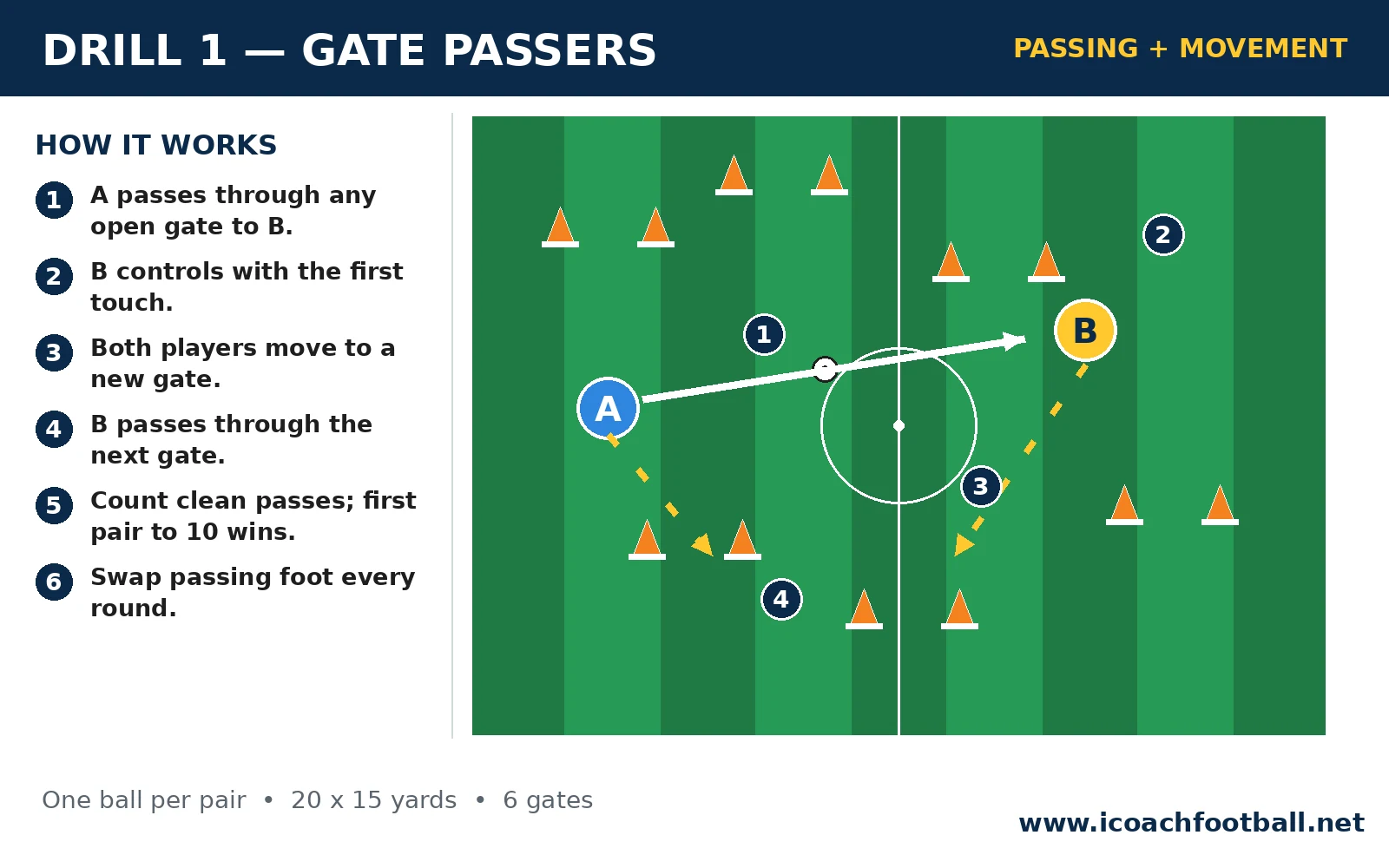
- Setup: 2 players, 1 ball. 20 x 15 yard area. 6 gates (two cones, 2 yards apart) scattered across the area.
How to play:
- A passes through any open gate to B.
- B controls with the first touch.
- Both players move to a new gate.
- B passes through the next gate.
- Count clean passes through gates; first pair to 10 wins.
- Swap passing foot every round.
Coach’s note: “Pass to the foot that is open, not to the player.”
Progressions: One-touch only; add a defender pair that blocks gates.
Drill 2 — One-Two Around the Cone
The classic give-and-go: pass, sprint around the cone, receive the return in stride. The run is the drill — the pass is only the trigger.
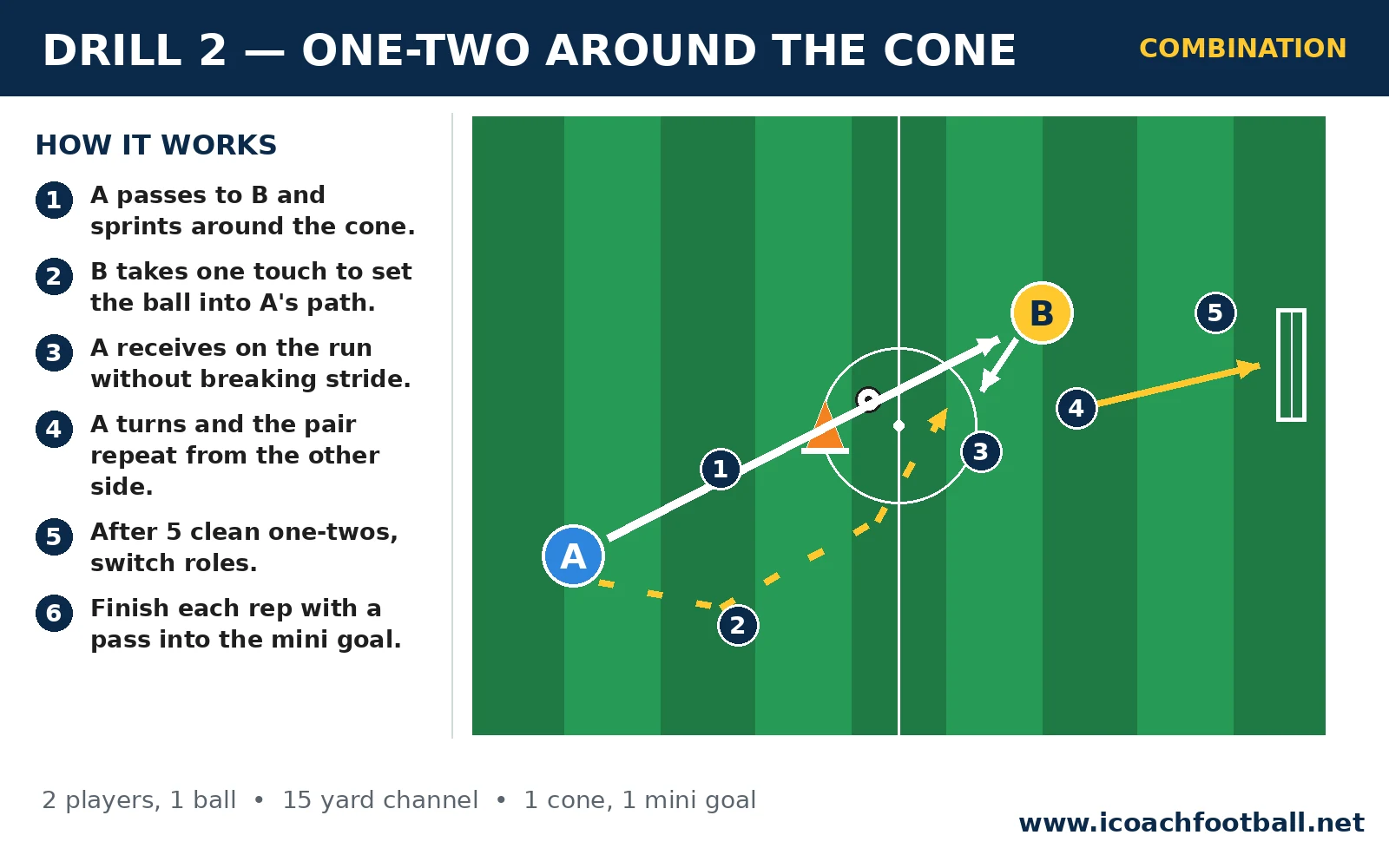

- Setup: 2 players, 1 ball. 15 yard channel. 1 cone as the “defender” between the pair and a mini goal.
How to play:
- A passes to B and sprints around the cone.
- B takes one touch to set the ball into A’s path.
- A receives on the run without breaking stride.
- A turns and the pair repeat from the other side.
- After 5 clean one-twos, switch roles.
- Finish each rep with a pass into the mini goal.
Coach’s note: “The pass is the trigger — run as soon as the ball leaves your foot.”
Progressions: B sets with one touch only; add a live defender who starts 5 yards behind.
Drill 3 — Turn and Go
Receive on the half-turn and play forward. This is the first touch that separates midfielders who keep the ball from midfielders who lose it.
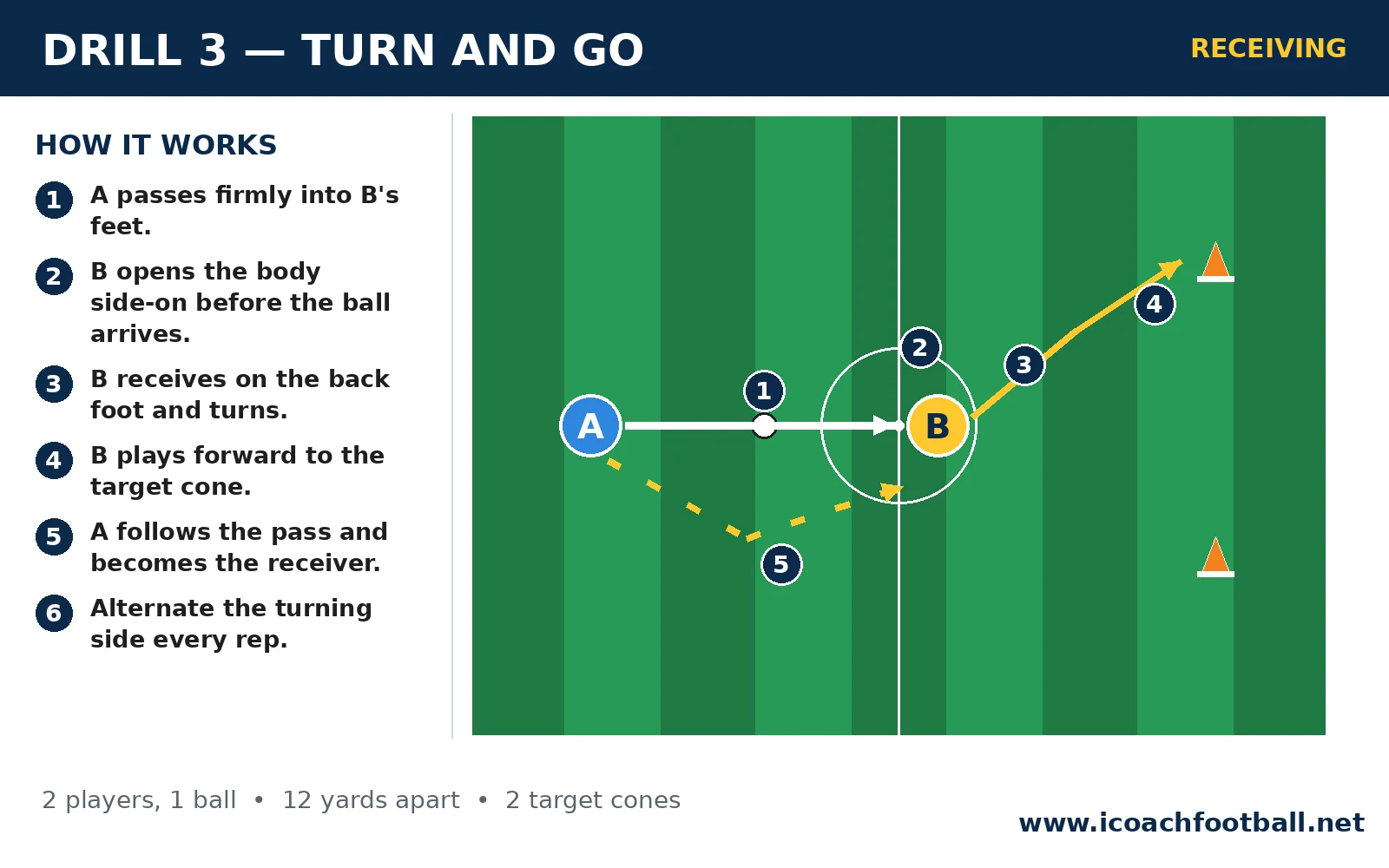
- Setup: 2 players, 1 ball. 12 yards apart. 2 target cones behind B.
How to play:
- A passes firmly into B’s feet.
- B opens the body side-on before the ball arrives.
- B receives on the back foot and turns.
- B plays forward to the target cone.
- A follows the pass and becomes the receiver.
- Alternate the turning side every rep.
Coach’s note: “Scan over the shoulder before the ball arrives — the turn is decided early.”
Progressions: A presses B after passing; B must turn away from pressure.
Drill 4 — 1v1 Duel
A straight duel in a small grid: beat the defender and score in 8 seconds, or lose the ball and defend your own goal. This is the drill from the FIFA “Take them on” session, cut down to two players.
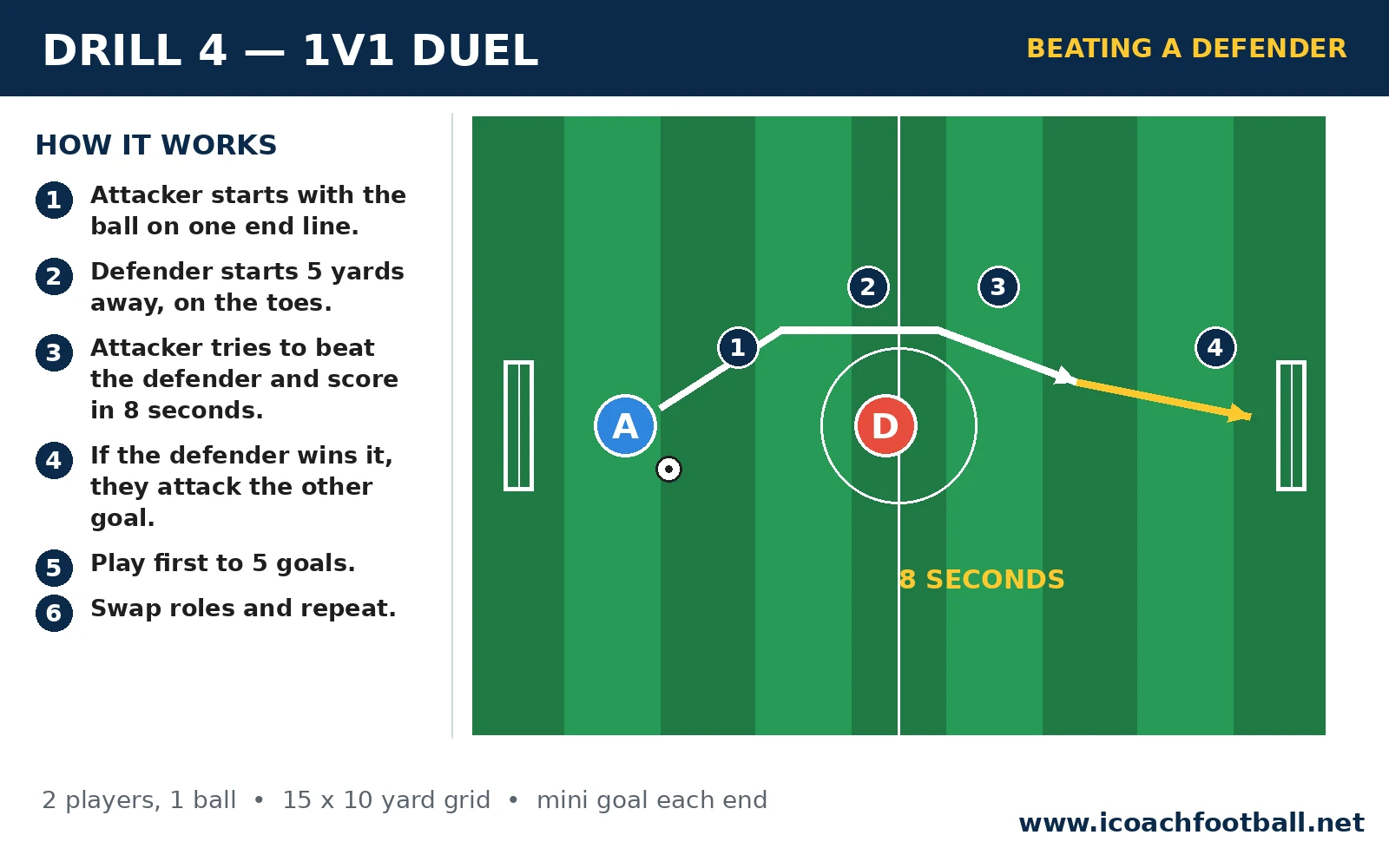
- Setup: 2 players, 1 ball. 15 x 10 yard grid. Mini goal at each end.
How to play:
- Attacker starts with the ball on one end line.
- Defender starts 5 yards away, on the toes.
- Attacker tries to beat the defender and score in 8 seconds.
- If the defender wins it, they attack the other goal.
- Play first to 5 goals.
- Swap roles and repeat.
Coach’s note: “Attack the defender’s front foot — the first step decides the duel.”
Progressions: Attacker must use a named move (scissors, step-over, Cruyff turn); limit to 6 seconds.
Drill 5 — Shield and Spin
One ball, one circle, one defender pressing. The attacker learns to protect the ball with the body, then spin out into space.
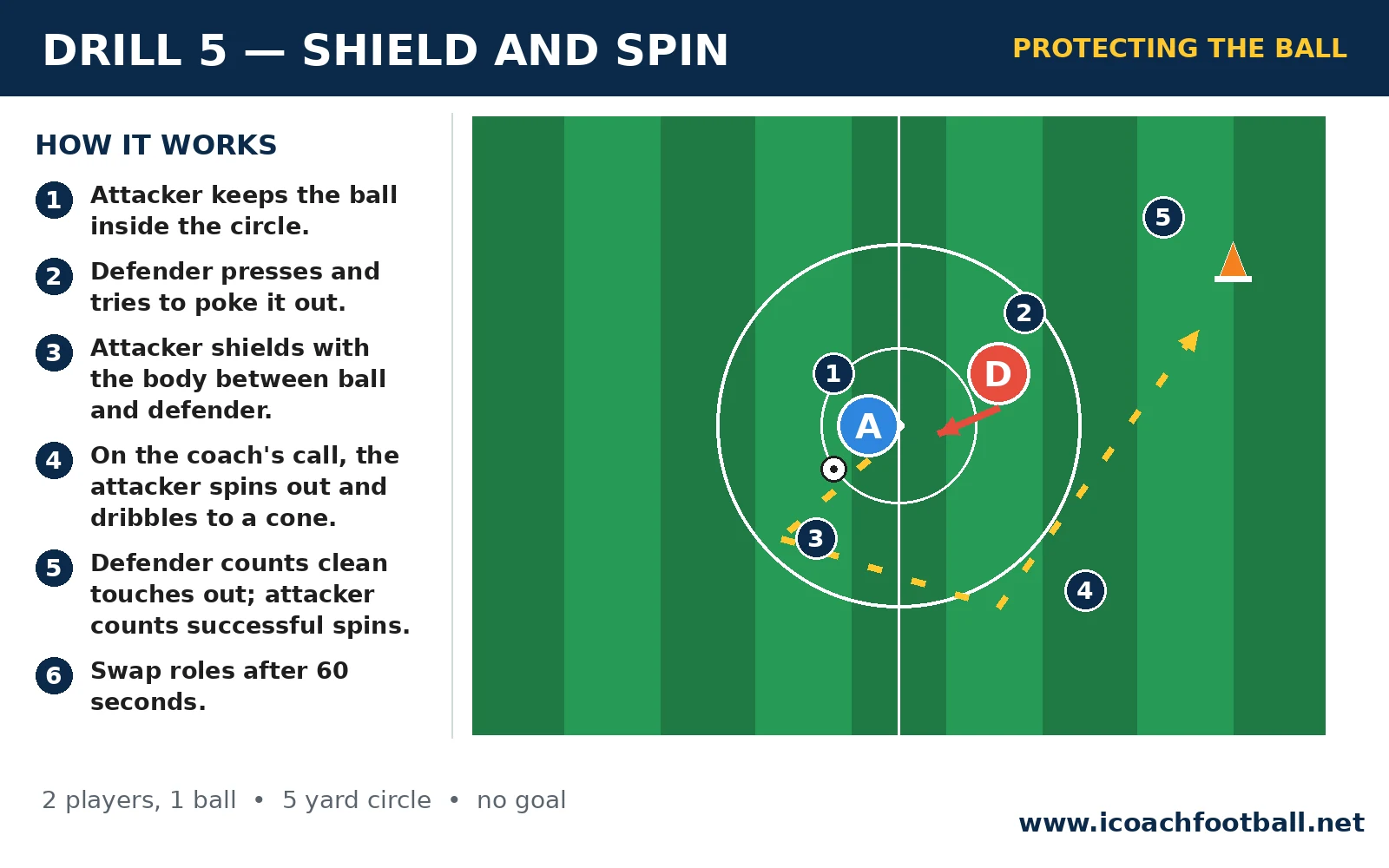
- Setup: 2 players, 1 ball. 5 yard circle. No goal.
How to play:
- Attacker keeps the ball inside the circle.
- Defender presses and tries to poke it out.
- Attacker shields with the body between ball and defender.
- On the coach’s call, the attacker spins out and dribbles to a cone.
- Defender counts clean touches out; attacker counts successful spins.
- Swap roles after 60 seconds.
Coach’s note: “Low centre of gravity, arm out for balance — never reach for the ball.”
Progressions: Shrink the circle to 3 yards; defender may win it and the roles flip live.
Drill 6 — Overlap and Finish
A dribbles inside, B overlaps outside at full pace, and the finish comes first time. The combination every full-back and winger needs — see our soccer drills for wing backs for the team version.

- Setup: 2 players, 1 ball. Half-pitch width channel. Mini goal or full goal. 2 cones marking the overlap lane.
How to play:
- A dribbles inside with the ball.
- B overlaps outside at full pace.
- A slips the pass into B’s path.
- B takes one touch and finishes first time.
- Both players jog back and swap roles.
- First pair to 5 clean finishes wins.
Coach’s note: “The overlap must be timed — go too early and the pass has nowhere to go.”
Progressions: Add a recovering defender; B must finish with the weak foot every third rep.
Coaching points: the four mistakes that kill pairs drills
| Mistake | What you see | Fix |
|---|---|---|
| Passing behind the receiver | Partner has to check back and the move dies | Pass to the front foot, into the run |
| Standing still after passing | The passer watches; the game stops | “Pass and move” — the run starts with the pass |
| Receiving square-on | The receiver can only play backwards | Open the body side-on before the ball arrives |
| Dribbling into the defender | The attacker runs at the defender’s chest | Attack the front foot, then explode past it |
Age adaptations
| Age | Change |
|---|---|
| U8–U10 | Shorter distances (8–10 yards), bigger gates, 2-minute rounds, no time limits on 1v1s |
| U11–U12 | Full distances, one-touch progressions, 8-second limit in Drill 4 |
| U13–U14 | Live defenders in Drills 2 and 6, weak-foot finishes, 6-second limit in Drill 4 |
60-minute session plan
| Time | Block | Drill |
|---|---|---|
| 0:00–0:05 | Warm-up | Gate Passers, easy pace |
| 0:05–0:13 | Passing | Drill 1 — Gate Passers |
| 0:13–0:23 | Combination | Drill 2 — One-Two Around the Cone |
| 0:23–0:31 | Receiving | Drill 3 — Turn and Go |
| 0:31–0:41 | 1v1 | Drill 4 — 1v1 Duel |
| 0:41–0:49 | Protecting | Drill 5 — Shield and Spin |
| 0:49–1:00 | Finishing game | Drill 6 — Overlap and Finish, then pairs combine into 2v2 soccer drills |
Keep building from here
Pairs work slots into almost any session. Use these games as the technical block inside the 60-minute plan, then open the pitch up: pairs become 2v2 soccer drills, and the same combinations grow into soccer 4v4 drills and soccer 5v5 drills. For squads of three, our soccer drills for 3 players no goalie keeps the same passing habits with an extra runner, and the rondo pairs game turns the same skills into a keep-away competition.
Build the individual skills next: soccer passing drills for weight and accuracy, soccer scanning drills so receivers check before the ball arrives, 1v1 finishing drills for the duel in Drill 4, and weak foot soccer drills so both feet can play the one-two. Forwards work on soccer drills for strikers, wide players on soccer drills for fullbacks, and central players on soccer drills for midfielders. Age-group versions of this session live in our soccer drills for U13, soccer drills for U14 and the U12 soccer practice plan, and the school-team version is soccer drills for middle school players. Coaches with bigger squads can run the same games as soccer drills for 12 players. Finish the week with soccer counter-attack drills, football defensive transition drills and the 1v1 to 4v4 transition drill — and restart the set-piece rotation with soccer throw-in drills. New to coaching? Start with soccer drills for beginners.
FAQ
What are the best soccer drills for two players?
The six in this post cover the full pair skill set: gate passing for accuracy and movement, the one-two for combinations, turn-and-go for receiving, a 1v1 duel for beating defenders, shield-and-spin for protecting the ball, and overlap-and-finish for scoring. Run them as the 60-minute plan above.
Can two players train on their own without a coach?
Yes. Pick three drills, work for 45 minutes, and keep score — first pair to 10 clean passes, first to 5 goals. A parent can supervise younger players and call the role swaps every 2 minutes.
How many touches should pairs drills use?
Two touches maximum in passing games: the first touch sets the ball up, the second moves it on. Give-and-gos and overlaps are one-touch by design. If a pair needs three touches, shorten the distance until two is comfortable.
What age are soccer drills for two players best for?
U8–U14. Younger players use shorter distances and bigger gates; U13–U14 add live defenders and weak-foot finishes. The same six games work across the whole range — only the distances and the pressure change.
Do pairs drills actually transfer to matches?
Yes. Passing, movement after the pass, receiving on the half-turn and 1v1 duels are the game in miniature. A player who has done a thousand one-twos with a partner recognises the moment in a match and plays it without thinking.
Sources
- FIFA Training Centre, “#20 Take them on” — grassroots session building from a pairs passing exercise into 1v1, 2v1 and 3v2 games.
- FIFA Training Centre, “John Peacock: Passing and receiving” — pairs passing and moving to avoid congestion, then possession games.