Soccer Drills for 9 Players: 8 Drills and a Complete 60-Minute Session
Quick answer: The best soccer drills for nine players include three-team passing exercises, a 5v4 rondo, 4v4 plus one neutral possession, 3v3 plus three support players, overload finishing and a 4v4 plus one four-goal game.
Nine players can initially appear difficult to organize because the group cannot be divided into two equal teams. However, the extra player is ideal for creating neutral-player games, overloads, support roles and transition practices.
This complete 60-minute soccer session is designed for exactly nine outfield players. No goalkeeper is required, and every exercise keeps all nine players active without long queues or extended waiting periods.
The session develops ball control, passing, receiving, possession, pressing, attacking width, transitions and competitive small-sided play. Coaches can adapt the field dimensions, touch limits and scoring conditions for youth, academy, amateur or senior players.
If attendance is lower, use our complete practice plans for six players, seven players or eight players.
Equipment and Setup
Players9 outfield players
GoalkeepersNone required
Session duration60 minutes
Recommended agesU9 to senior
Maximum area36 × 28 yards
EquipmentBalls, cones, bibs and four mini goals or cone gates
Complete 60-Minute Soccer Practice for 9 Players
| Time | Activity | Main objective |
|---|---|---|
| 0–7 minutes | Three-Team Gate Passing | Activation, scanning and passing accuracy |
| 7–14 minutes | Three-Triangle Combination Passing | Wall passes and third-player movement |
| 14–22 minutes | 5v4 Rondo | Possession and coordinated pressing |
| 22–30 minutes | 4v4 Plus One Central Neutral | Support angles and playing through pressure |
| 30–38 minutes | 3v3 Plus Three Support Players | Directional possession and transitions |
| 38–46 minutes | 4v3 Plus Two Wide Neutrals | Width, combinations and finishing |
| 46–53 minutes | 4v4 Plus One End-Zone Game | Penetration and movement beyond the ball |
| 53–60 minutes | 4v4 Plus One Four-Goal Game | Switching play, transitions and competition |
The neutral-player role is one of the most useful ways to organize an uneven group. The neutral supports whichever team has possession, creating a temporary overload and helping players find forward passing options. The FIFA Training Centre’s 4v4 plus one practice uses the same principle to help players break pressure and progress toward goal.
Drill 1: Three-Team Gate Passing
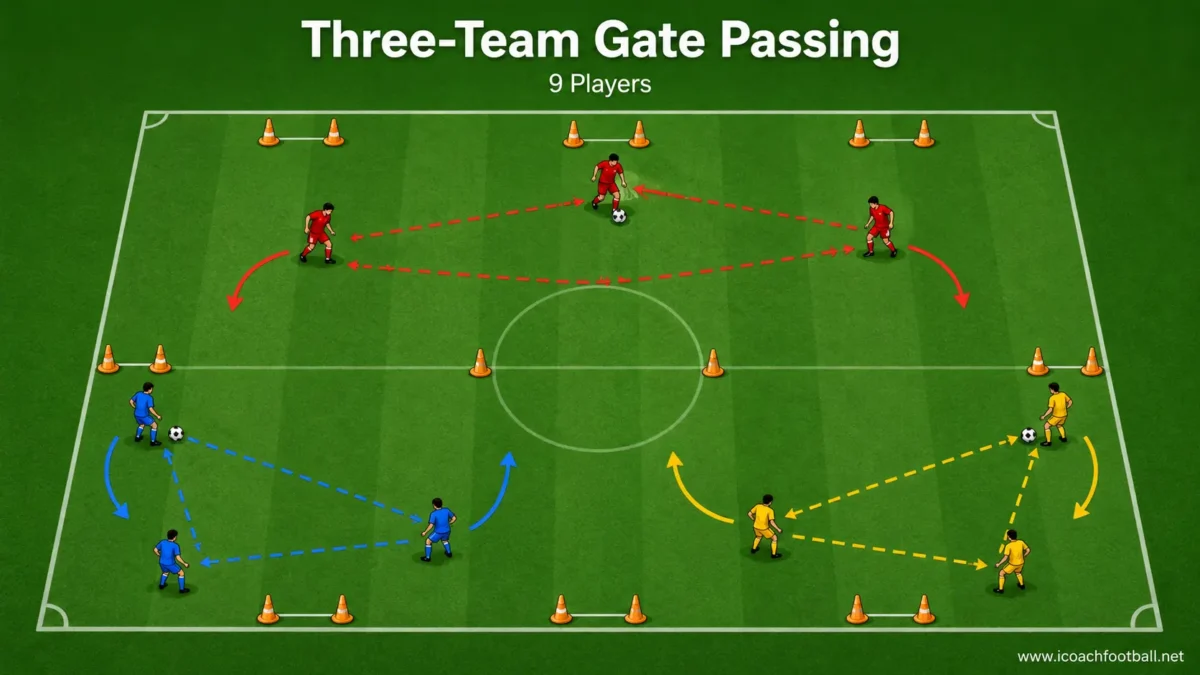
This technical warm-up divides the nine players into three groups of three. Players must pass, move and scan for open gates while sharing the area with the other two groups.
Setup
- Create a 24 × 24-yard square.
- Divide the players into three teams of three.
- Give each group one ball.
- Place nine two-yard cone gates around the area.
- Give each team a different bib color.
How to Play
- The player with the ball passes through an available gate to a teammate.
- The passer follows the ball and moves into a new supporting position.
- The receiving player must use a different gate for the next pass.
- Each successful pass through a gate earns one point.
- Play rounds of 45–60 seconds and challenge each team to improve its score.
Coach’s note: Players should scan before receiving and identify both an available teammate and an open gate. Encourage communication because several groups are operating in the same space.
Progressions: Limit players to two touches, require the weaker foot, introduce one-touch return passes or award a bonus point when all three teammates combine before using another gate.
Drill 2: Three-Triangle Combination Passing
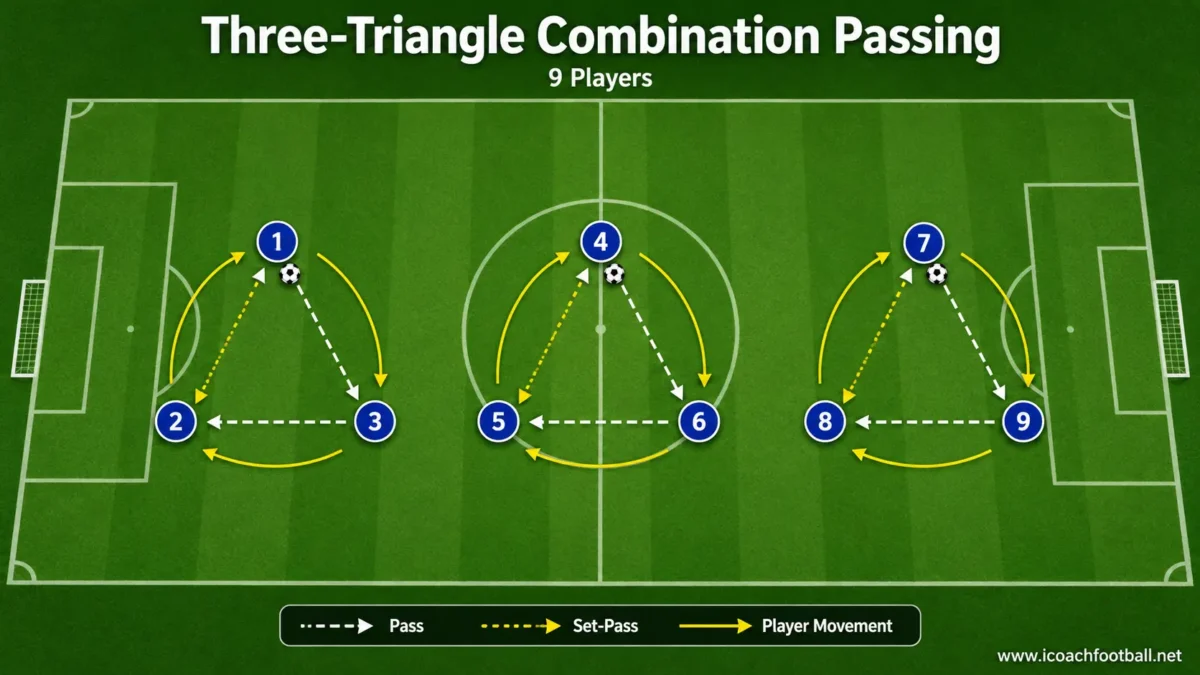
Three separate triangles give every player frequent repetitions while developing wall passes, receiving angles and third-player movement.
Setup
- Create three triangles with sides of approximately 10–12 yards.
- Place three players and one ball in each triangle.
- Position one player at each cone.
- Leave sufficient space between the three areas.
How to Play
- Player A passes to player B and moves forward.
- Player B sets the ball back with one touch.
- Player A passes forward to player C.
- Player A takes player B’s position.
- Player B moves to player C’s cone and the pattern continues.
- Change direction after two minutes so both feet are used.
Coach’s note: The set pass should travel into the path of the supporting player. Encourage players to adjust their body before receiving rather than standing flat behind the cone.
Progressions: Add an overlap, require one-touch play, use a disguised set pass or introduce a second ball when the players establish a consistent rhythm.
For more passing combinations, use these Y passing drills and third-player movements.
Drill 3: 5v4 Rondo
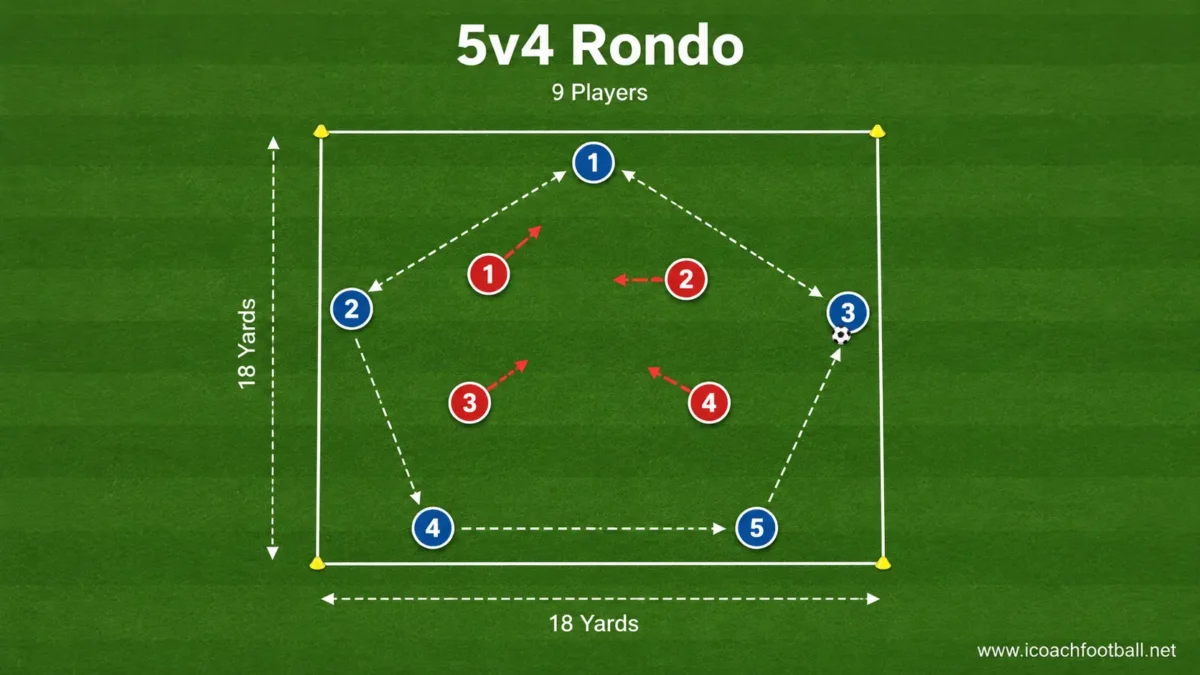
The 5v4 rondo provides only a small attacking advantage, making support angles, first-touch quality and quick decision-making especially important.
Setup
- Create an 18 × 18-yard square.
- Use five possession players and four defenders.
- The possession players may move inside the entire area.
- Keep spare balls beside the coach for immediate restarts.
- Use a larger area for younger or less experienced players.
How to Play
- The five attackers attempt to maintain possession against four defenders.
- Six consecutive passes earn one point.
- A pass that breaks through the defensive unit earns a bonus point.
- When the defenders regain possession, they attempt to complete three passes.
- After three defensive passes, the teams exchange roles.
- Rotate players regularly to balance the defensive workload.
Coach’s note: The possession team must create width and depth rather than surrounding the ball. Defenders should stay compact and press together instead of chasing individually.
Progressions: Limit attackers to two touches, reduce the area, award two points for a split pass or require an immediate counter-press after possession is lost.
Continue developing possession with our advanced rondo blueprint.
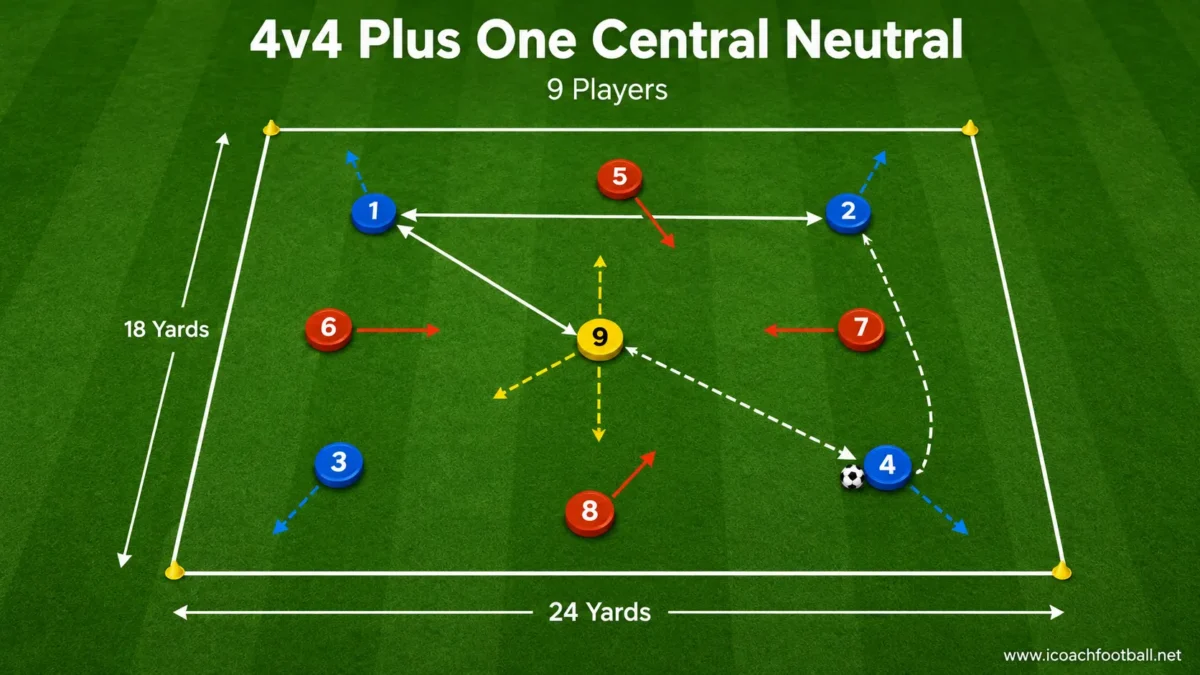
Drill 4: 4v4 Plus One Central Neutral
This is one of the most natural formats for nine players. The neutral supports the team in possession, creating a 5v4 overload and helping players connect through central areas.
Setup
- Create a 24 × 18-yard rectangle.
- Divide eight players into two teams of four.
- Use the ninth player as a central neutral.
- The neutral supports whichever team has possession.
- Place spare balls around the outside for quick restarts.
How to Play
- The two teams compete for possession inside the area.
- The neutral always supports the team with the ball.
- Five consecutive passes earn one point.
- A successful pass into the neutral followed by a forward pass earns a bonus point.
- When possession changes, the neutral immediately supports the new attacking team.
- Rotate the neutral every two minutes.
Coach’s note: The neutral should move between opponents and receive on the half-turn. The outside teammates must create different passing lines instead of standing level with one another.
Progressions: Limit the neutral to one touch, require the team to use the neutral before scoring or award two points for a third-player combination through the neutral.
Drill 5: 3v3 Plus Three Support Players
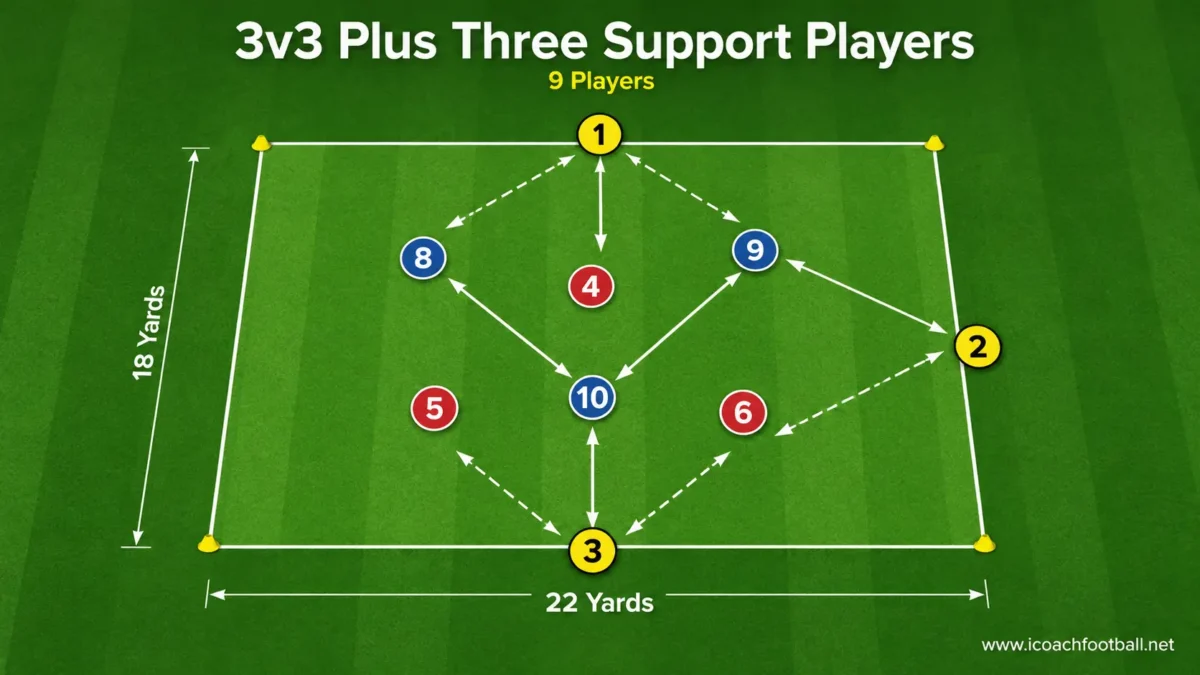
This directional possession game uses six players inside and three neutral support players around the outside. The team with the ball can create a 6v3 overload, but the touch limits keep the activity demanding.
Setup
- Create a 22 × 18-yard rectangle.
- Play 3v3 inside the area.
- Place one neutral on each end line.
- Place the third neutral along one touchline.
- All three neutrals support the team in possession.
How to Play
- A team scores by transferring the ball from one end neutral to the other.
- The side neutral may be used to escape pressure and switch direction.
- The ball must travel through at least one central teammate.
- When possession changes, the new team immediately uses the support players.
- Rotate the neutral players every two minutes.
Coach’s note: The three inside attackers should create width, depth and a central option. If all three move toward the ball, the defenders can protect the same area.
Progressions: Limit neutrals to one touch, make the inside players play two-touch or award a bonus point when the ball travels from end to end without returning to the starting neutral.
Drill 6: 4v3 Plus Two Wide Neutrals
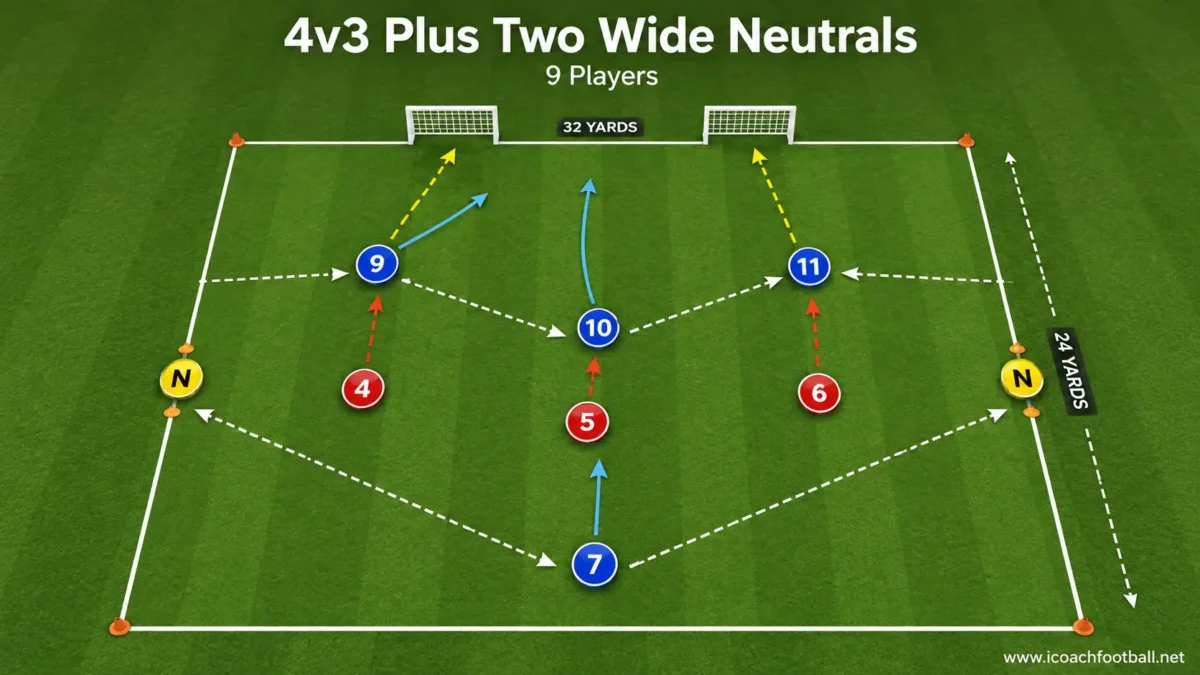
This attacking activity gives four central attackers two wide support players against three defenders. It develops width, forward combinations, crosses, cut-backs and finishing decisions.
Setup
- Create a 32 × 24-yard field.
- Place two mini goals on one end line.
- Position four attackers and three defenders inside the field.
- Place one neutral player on each touchline.
- The wide neutrals support the attacking team.
How to Play
- The four attackers combine against the three defenders.
- The attacking team may use either wide neutral player.
- The attackers attempt to score in either mini goal.
- If the defenders regain possession, they score by dribbling over the attackers’ starting line.
- Rotate attackers, defenders and neutrals regularly.
Coach’s note: The wide neutrals should stretch the defensive unit instead of moving too close to the ball. Central attackers should occupy different lines and time forward runs as the ball travels wide.
Progressions: Limit neutrals to one touch, require a cross or cut-back before scoring, allow one neutral to enter after passing or introduce a six-second finishing limit.
Drill 7: 4v4 Plus One End-Zone Game
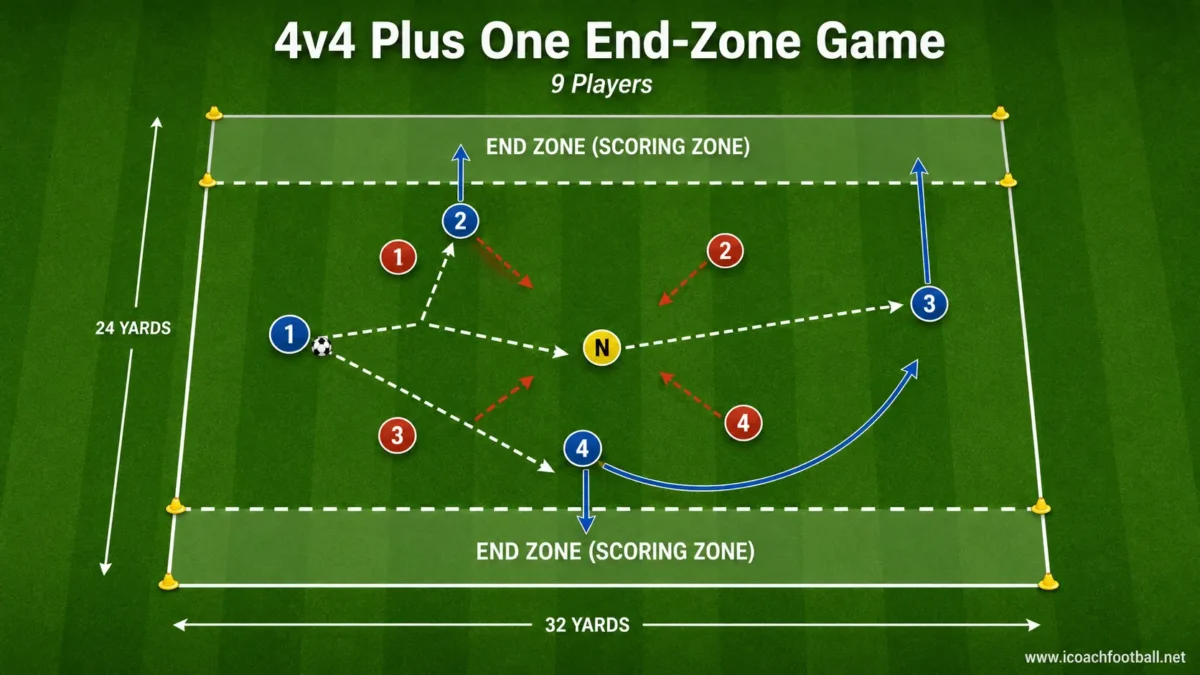
This directional game combines balanced 4v4 opposition with one attacking neutral. Players must circulate the ball, recognize when to penetrate and time runs into the scoring zone.
Setup
- Create a 32 × 24-yard field.
- Add a four-yard scoring zone at each end.
- Divide eight players into two teams of four.
- Use the ninth player as a neutral.
- The neutral supports whichever team has possession.
4v4-plus-one-end-zone-game.webp. Then delete this caption.How to Play
- Each team attacks the end zone opposite its starting position.
- The neutral supports the team with possession.
- A point is scored when a player receives a controlled pass inside the end zone.
- Players cannot wait permanently inside the scoring zone.
- After scoring, the same team immediately attacks in the opposite direction.
- Rotate the neutral after each round.
Coach’s note: The run into the end zone should begin as the passer gains control and looks forward. The neutral can support underneath the ball or help connect a third-player run.
Progressions: Require a one-touch finish inside the zone, limit the neutral to two touches or award two points when the score follows a third-player combination.
Drill 8: 4v4 Plus One Four-Goal Game
Finish the session with a competitive four-goal game. Each team attacks two mini goals, while the neutral creates a temporary 5v4 advantage for the team in possession.
Setup
- Create a 36 × 28-yard field.
- Place one mini goal in each corner.
- Divide eight players into two teams of four.
- Use the ninth player as a neutral.
- Each team attacks the two goals on the opposite end line.
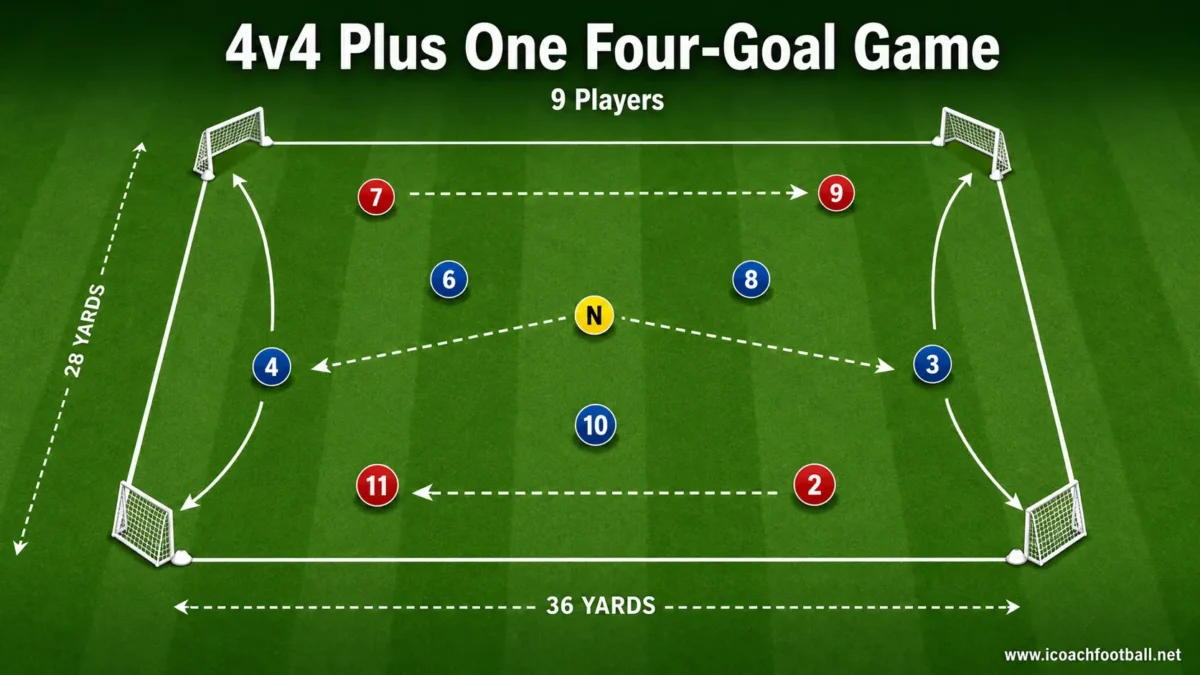
4v4-plus-one-four-goal-game.webp. Then delete this caption.How to Play
- Play 4v4 with the neutral supporting the team in possession.
- Each team may score in either of its two attacking goals.
- After a goal, the team that conceded restarts immediately.
- Rotate the neutral after every round.
- Play three rounds of approximately two minutes.
- Keep the total score to create a competitive finish.
Coach’s note: When defenders protect one goal, the attacking team should recycle possession through the neutral and switch toward the opposite side. Players away from the ball must move early to support the switch.
Progressions: Limit the neutral to two touches, require all four teammates to touch the ball before scoring or award a bonus goal for scoring within five seconds of regaining possession.
The Football Association’s four-goal practice guidance also explains how multiple attacking targets can encourage scanning, receiving with an open body and switching the point of attack.
Find more competitive practices in our small-sided soccer games library.
How to Adapt These Drills
For younger or beginner players: Increase the playing area, allow unlimited touches, widen the goals and give neutral players freedom to move wherever support is needed.
For advanced players: Reduce the area, introduce touch limits, add scoring deadlines and reward split passes, third-player movements, switches of play and immediate counter-pressing.
When you have one goalkeeper: Use the goalkeeper as a neutral target player or supporting player. Rotate the position when the player is not a specialist goalkeeper.
When you have no mini goals: Use two-cone gates. A goal counts when the ball is passed through a gate and controlled by a teammate on the opposite side.
Common Coaching Mistakes With Nine Players
- Leaving the ninth player inactive: Use the extra participant as a neutral, target, server or recovery player rather than making them wait.
- Keeping one player neutral all session: Rotate the neutral role so everyone experiences attacking and defending decisions.
- Making the overload too easy: Reduce the area or limit the neutral player’s touches when the attacking team keeps possession comfortably.
- Using an oversized field: Excessive space removes pressure and reduces the need for quick decisions.
- Adding too many restrictions: Begin with a simple version and introduce conditions only after the players understand the objective.
- Ignoring transitions: The neutral must immediately recognize which team to support after possession changes.
Frequently Asked Questions
What are the best soccer drills for nine players?
Effective options include three-team passing exercises, a 5v4 rondo, 4v4 plus one central neutral, 3v3 plus three support players, 4v3 plus two wide neutrals and a 4v4 plus one four-goal game.
How do you organize a soccer practice with nine players?
Use three groups of three for technical work, five-versus-four for overload activities and four-versus-four with one neutral player for possession and small-sided games.
Can I run a nine-player soccer session without a goalkeeper?
Yes. Use mini goals, cone gates, end zones and neutral players so all nine participants remain involved as outfield players.
What is the best game format for nine players?
Four-versus-four plus one neutral is the most natural game format. The neutral supports the team in possession and creates a temporary five-versus-four advantage.
How large should a field be for nine players?
Use approximately 18 × 18 yards for a 5v4 rondo, 24 × 18 yards for possession work and up to 36 × 28 yards for the final four-goal game.
How long should a nine-player soccer practice last?
A focused small-group session can last 45–60 minutes. The plan above uses eight activities covering passing, possession, overloads, finishing, transitions and competition.
How can I make these drills more difficult?
Reduce the playing area, add touch limits, restrict the neutral players, introduce scoring deadlines and reward forward passes, switches of play and immediate counter-pressing.
Continue the small-group series: Save this nine-player session and compare it with our complete plans for seven players and eight players.