Soccer Goalkeeper Communication Drills: 6 Games to Organise the Defence and Own the Box
Quick answer
A quiet goalkeeper costs goals. These six soccer goalkeeper communication drills teach your keeper to see the danger early, decide in one second and give one short call — so the defence moves before the ball arrives, not after it.
Suitable for: U11–U18
In soccer — football to most of the world — the goalkeeper is the only player who faces the whole game. Everyone else watches the ball; the keeper sees the ball, the line, the runners and the space behind them, all at once. That view is wasted if the keeper stays silent. A keeper who calls “KEEPER!” a second early turns a dangerous cross into a routine catch. A keeper who says nothing turns the same cross into a collision. These six games train the voice the way you train the hands: with reps, a small vocabulary and a clear rule — see it early, decide, call once.
Session snapshot
- Players: 10–14, plus goalkeepers
- Area: One penalty area and the final third
- Duration: 60 minutes
- Focus: Early calls, organising the line, set-piece assignments, back-pass information
- Age: U11–U18 (see Age adaptations)
The five calls — one word, one action
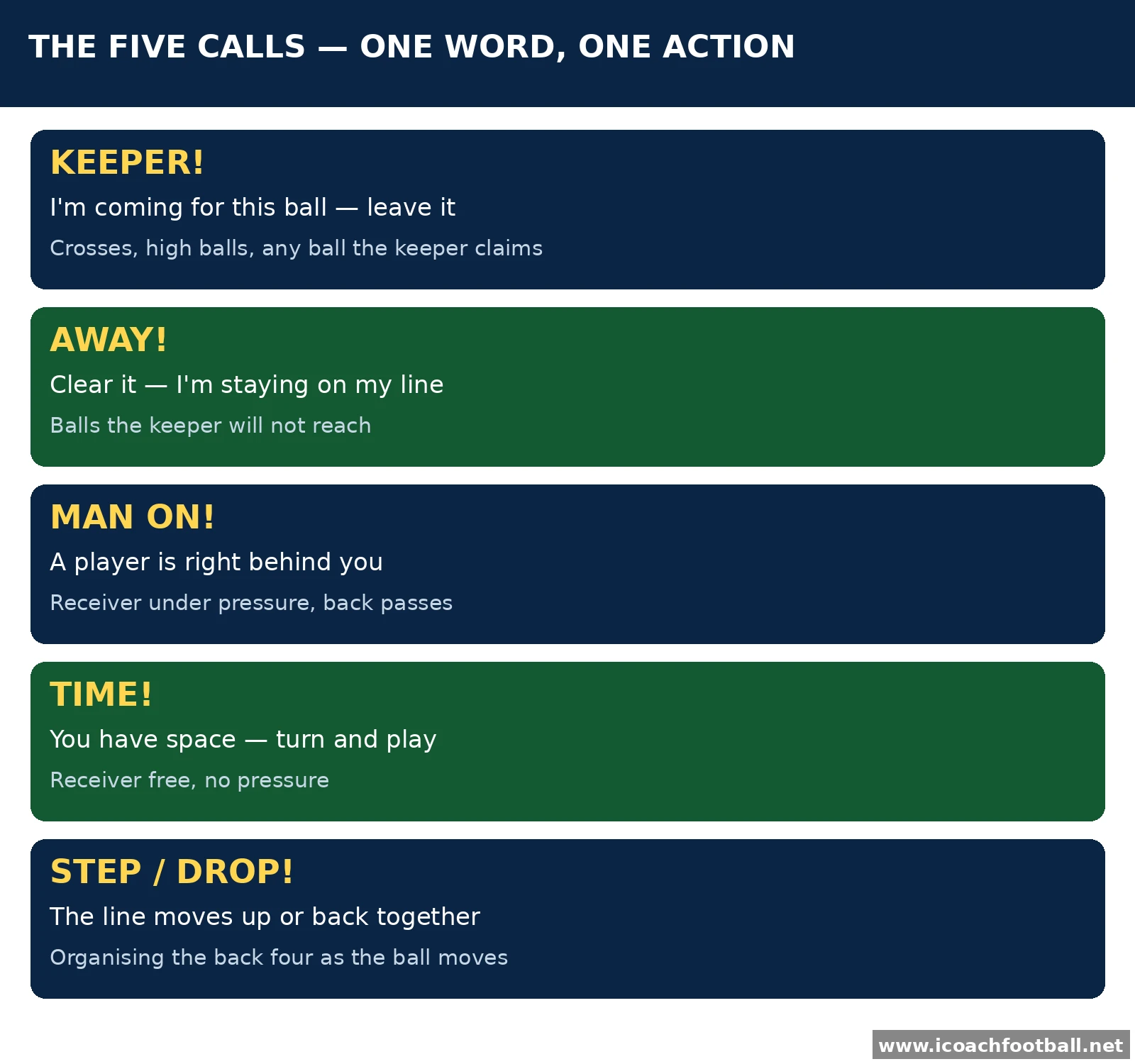
A keeper who shouts sentences is a keeper nobody listens to. Agree five calls before the session, and give every call exactly one meaning. The principle is in line with the FIFA Training Centre’s goalkeeping guidance: the keeper must be aware of team-mates’ positioning at all times and provide support through defensive organisation — and FIFA’s coaching guidance stresses that both verbal and non-verbal communication are crucial to a goalkeeper’s performance.
| Call | What it means | When to use it |
|---|---|---|
| KEEPER! | “I’m coming for this ball — leave it” | Crosses, high balls, any ball the keeper claims |
| AWAY! | “Clear it — I’m staying” | Balls the keeper will not reach |
| MAN ON! | “A player is right behind you” | Receiver under pressure, back passes |
| TIME! | “You have space — turn” | Receiver free, no pressure |
| STEP / DROP! | “The line moves up / back together” | Organising the back four as the ball moves |
Drill 1: Keeper or Away? — The Cross Call
Most box collisions happen because nobody said who owns the ball. This game makes the call mandatory: no call, no point.
Setup
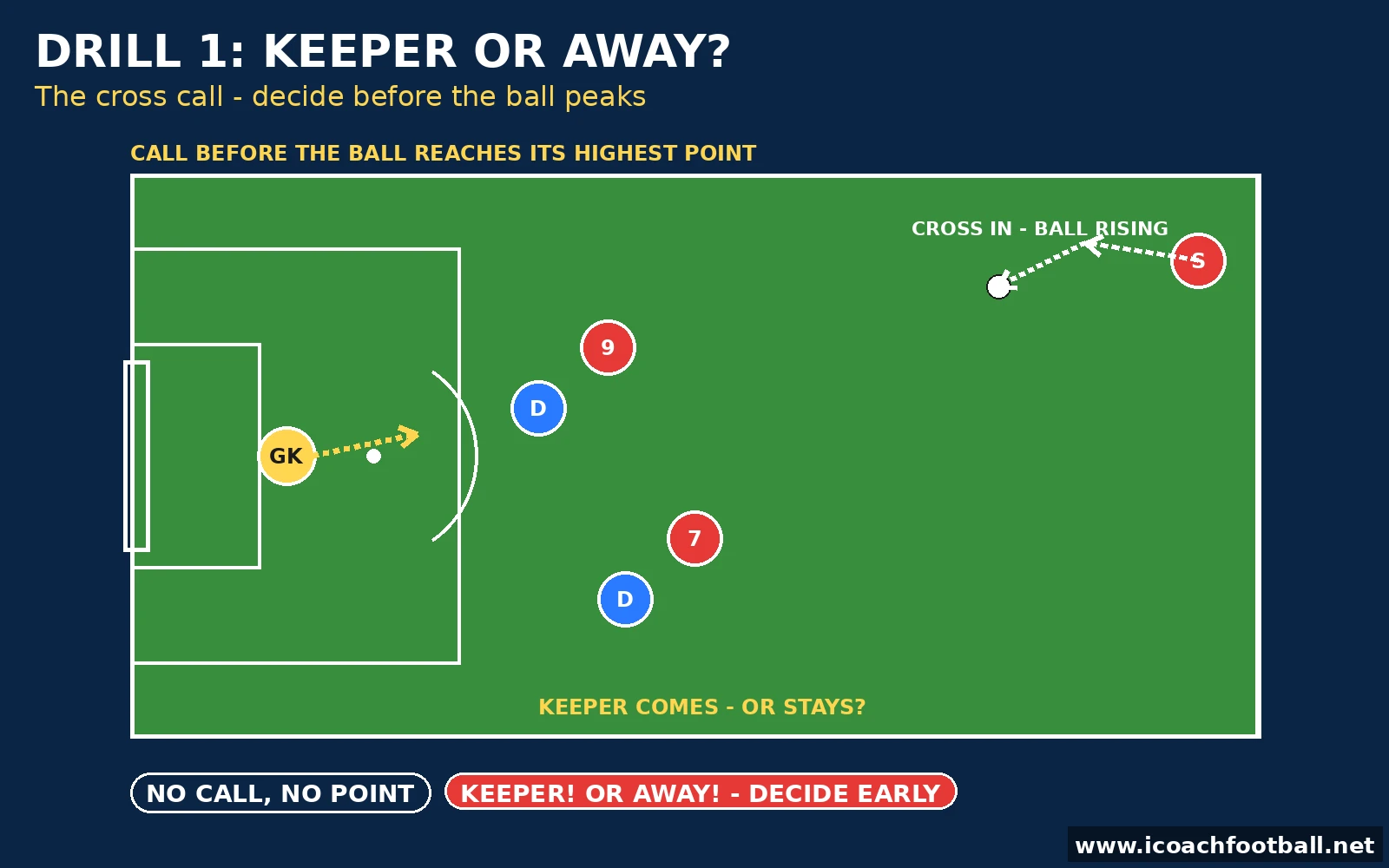
- One penalty area, 1 goalkeeper, 2 defenders, 2 attackers, 1 server wide, 1 ball
- Crosses served from the byline, alternating sides; 12 minutes
How to Play
- The server plays a cross into the penalty area from wide.
- Before the ball reaches its highest point, the keeper must call “KEEPER!” or “AWAY!”.
- On “KEEPER!”, the keeper claims the ball and the defenders clear a path — no defender touches it.
- On “AWAY!”, the nearest defender attacks the ball and clears it wide, while the keeper holds their line.
- If the keeper makes no call, or calls after the ball has started to drop, the rep does not count — even if the ball is caught.
Coach’s note: Watch the timing, not the volume. A loud call made too late is useless — the defenders have already committed. The call must come while the ball is still rising, which means the keeper decides on the server’s first touch, not on the flight. If the keeper keeps calling late, slow the serve down until the call is early, then add pace back. The claim itself is trained in our soccer goalkeeper cross handling drills — this drill trains the voice that makes the claim safe.
Progressions: Add a second attacker arriving at the far post, so the keeper must also call the mark; serve driven low crosses, so the decision must be faster.
Drill 2: Shift, Step, Drop — The Line Organiser
A back line that moves as four separate players is a back line full of gaps. This drill makes the keeper the conductor: the line moves only when the keeper says so.
Setup
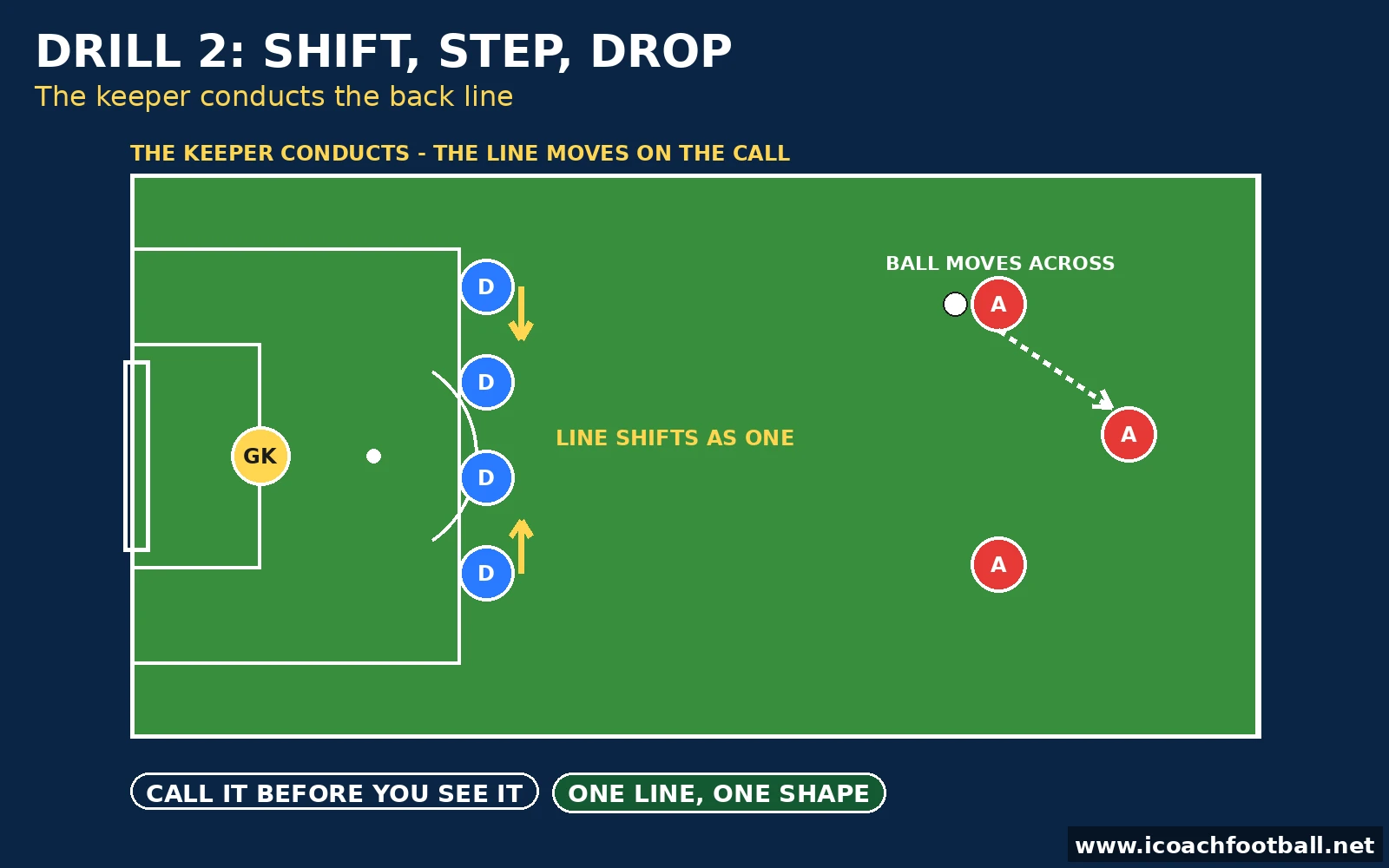
- Final third, 1 goalkeeper, 4 defenders in a line, 3 attackers passing the ball across the front, 1 ball
- Cones mark the line’s start position; 12 minutes
How to Play
- The attackers pass the ball across the front of the defence, left to right and back.
- As the ball moves, the keeper calls “SHIFT LEFT” or “SHIFT RIGHT” and the whole line slides together.
- When the ball is played backwards, the keeper calls “STEP UP” and the line pushes up as one.
- When an attacker turns to run in behind, the keeper calls “DROP” and the line retreats together.
- Freeze the play every 2 minutes and check the line: four players, one shape, no gaps wider than 8 yards.
Coach’s note: The most common failure is silence followed by a scramble — the keeper watches the ball, the line stays still, then someone panics and steps out alone. Teach the keeper to call before the line needs to move, not after. The cue phrase is “call it before you see it”: the keeper reads where the ball is going and calls the shift while the pass is still travelling. Use the defender’s name with the call — “Sam, shift left!” — because a name turns a shout into an instruction. This is the same organised shape trained in our soccer sweeper keeper drills, run from the keeper’s voice instead of the keeper’s feet.
Progressions: The attackers may play a through ball at any moment, so the call must be early enough to matter; remove one defender, so the line must stay connected with three.
Drill 3: Name Every Runner — Set-Piece Assignments
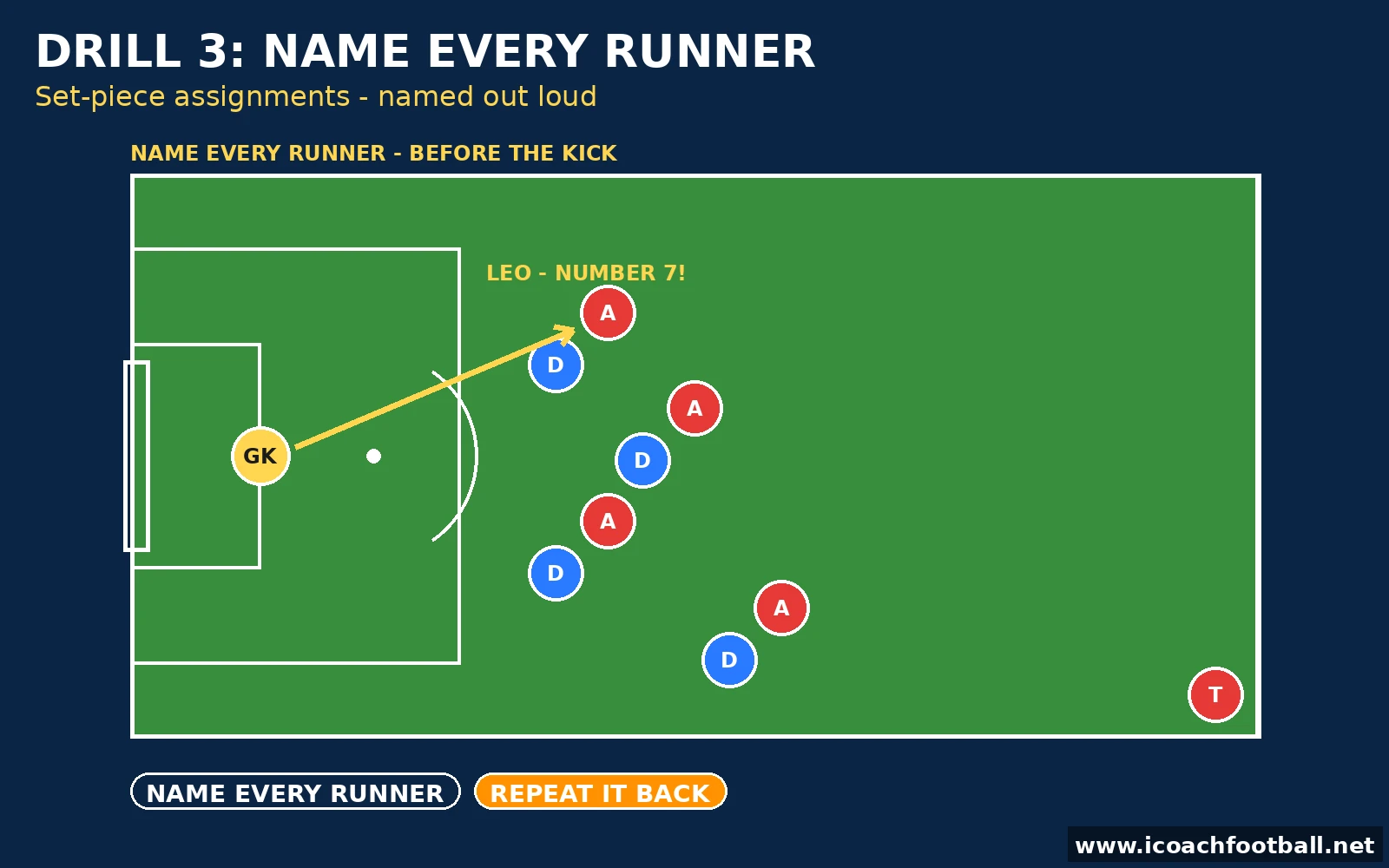
Corners are conceded when everyone assumes someone else has the dangerous runner. This drill ends that: before every kick, the keeper names every mark out loud. Watch the animation below the diagram: the keeper points and names each runner, the corner comes in, and the keeper calls “KEEPER!” and claims it.
Setup
- One penalty area, 1 goalkeeper, 5 defenders, 4 attackers, 1 corner taker, 1 ball
- Corners taken from both sides; 12 minutes
How to Play
- Before the corner is taken, the keeper points at each attacker and names the defender marking them: “Leo, number 7! Max, near post!”.
- The defenders repeat their assignment back — one word, one name — so the keeper hears it confirmed.
- The corner is taken. The keeper watches the flight and calls “KEEPER!” or “AWAY!” before the ball drops.
- On “KEEPER!”, the keeper claims the ball and the defenders protect the keeper’s space.
- On “AWAY!”, the nearest defender heads clear to the touchline, never back into the middle.
Coach’s note: The assignment is the drill, not the header. If the keeper mumbles the names, stop the corner and start again — a rushed assignment is worse than no assignment, because defenders think they know their man and don’t. Make the keeper name the runners while the attackers are still moving, because in a real game the runners swap positions to confuse markers. The goalkeeper’s starting position and claim are trained in our soccer goalkeeper cross handling drills; this drill adds the organisation that happens before the kick. For the full set-piece picture, pair this with our football defending set pieces drills.
Progressions: Attackers swap starting positions just before the kick, so defenders must track their man, not a spot; add a short-corner option, so the near-post defender must react and call for help.
Drill 4: Time or Man On? — The Back-Pass Call
A defender receiving a back pass cannot see what is behind them. The keeper can. This drill trains the two most useful words a keeper ever says to a team-mate.
Setup
- 20 x 15-yard grid in front of goal, 1 goalkeeper, 2 defenders, 1 pressing attacker, 1 ball
- The keeper starts with the ball; 10 minutes
How to Play
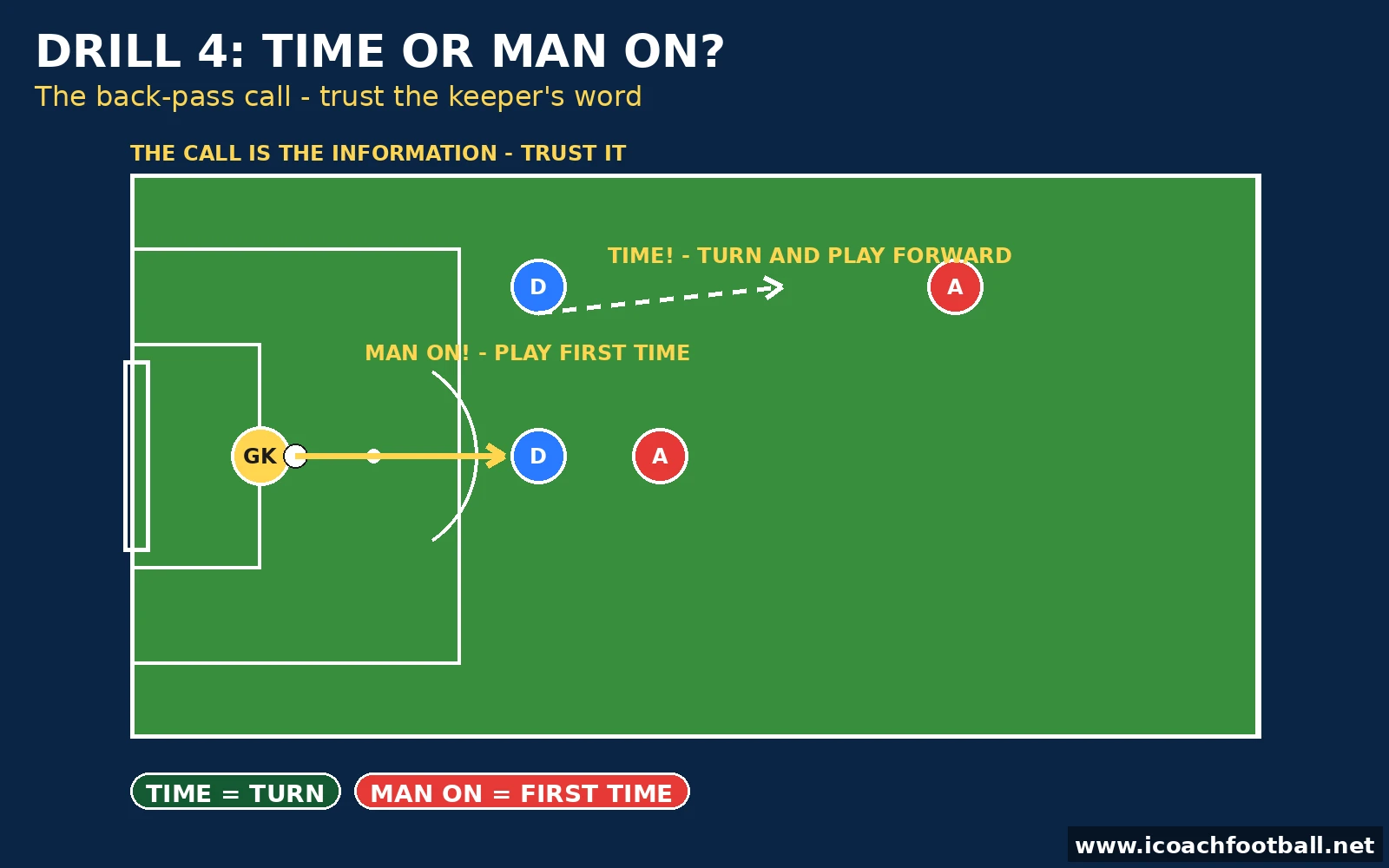
- The keeper plays a back pass to a defender, who receives with their back to the pressing attacker.
- As the ball travels, the keeper calls “TIME!” if the defender is free, or “MAN ON!” if the attacker is closing.
- On “TIME!”, the defender takes a touch and turns to play forward.
- On “MAN ON!”, the defender plays first time — back to the keeper or out wide — without turning into pressure.
- Rotate the receiver every 4 reps so both defenders learn to trust the call, not their own guess.
Coach’s note: The hardest habit to break is the defender who ignores the call and checks over their shoulder anyway — the half-second they lose is the half-second the press needs. Insist on trust: the keeper’s call is the information, and the defender acts on it without looking. If the keeper’s call is wrong, coach the keeper — never blame the defender for following it. The distribution that follows the call is trained in our goalkeeper distribution drills, where the keeper’s feet finish what the voice started.
Progressions: The attacker starts closer, so the call must come earlier; the keeper must also call the direction — “Man on, left!” — so the first touch goes away from pressure.
Drill 5: Runner! — The Blind-Side Call
The most dangerous runner is the one the defenders cannot see. Only the keeper sees the whole picture, so only the keeper can warn them.
Setup
- Final third, 1 goalkeeper, 3 defenders, 2 midfielders, 3 attackers, 1 ball
- Attackers start in front of the defence; one is the blind-side runner; 12 minutes
How to Play
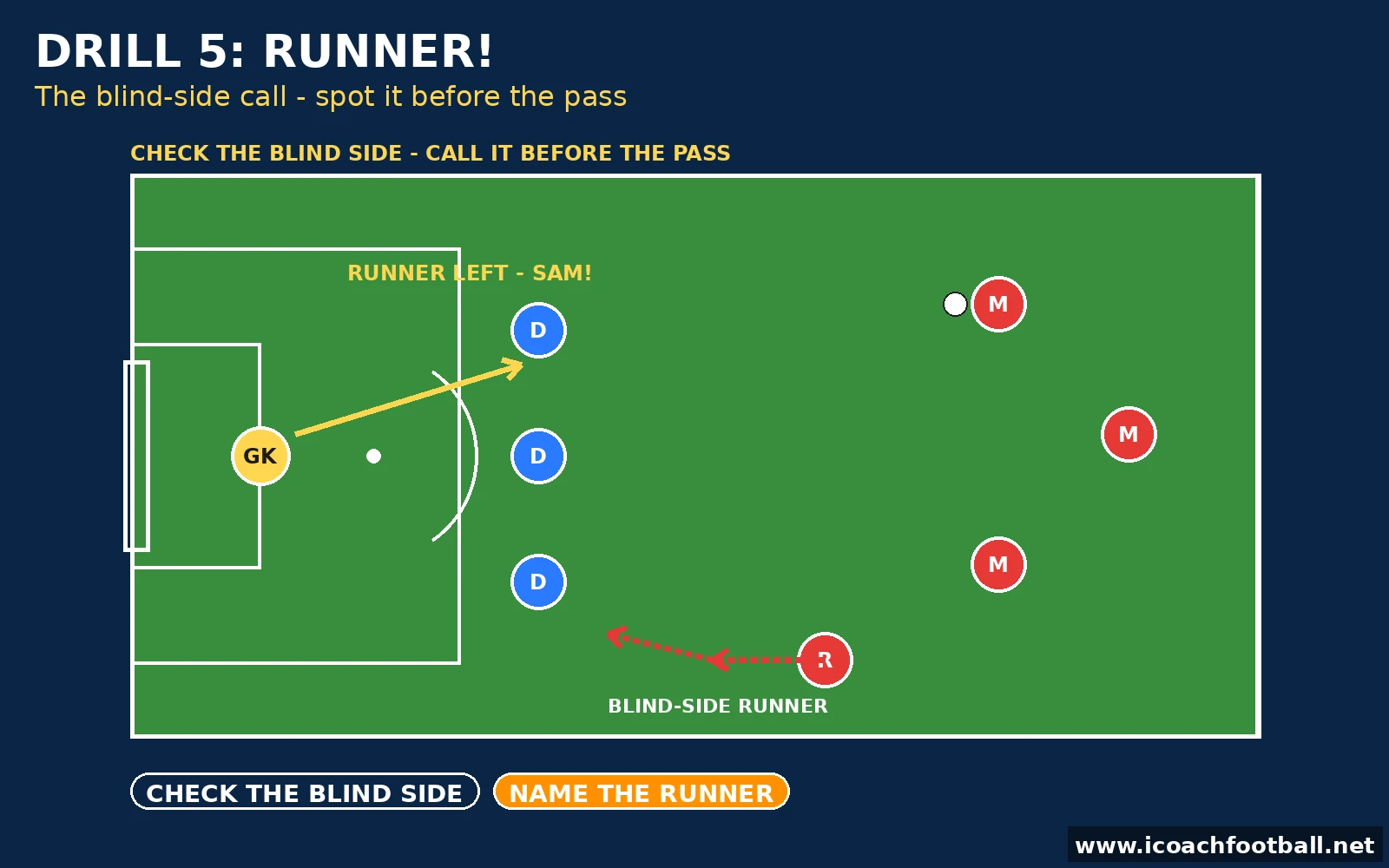
- The midfielders circulate the ball in front of the defence while the attackers hold their positions.
- On the coach’s signal, one attacker makes a blind-side run behind the defensive line.
- The keeper must spot the run and call “RUNNER LEFT!” or “RUNNER RIGHT!” — with the runner’s name — before the pass is played.
- The nearest defender drops to track the runner, and the rest of the line holds its shape.
- If the keeper calls after the pass is played, the attackers score unopposed and the rep is lost.
Coach’s note: Keepers love to call the run they can see and miss the one they can’t — the runner who starts behind a defender and curves away. Teach the keeper to scan the far side first, because the near-side runner is the defenders’ job. The cue phrase is “check the blind side”: a quick head-turn to the far post before every pass. When the call is right, praise the spot, not the volume — “You saw the runner early” teaches more than “Good shouting”. The duel that follows the call is trained in our soccer goalkeeper 1v1 drills, where the keeper reads the through ball and closes the space.
Progressions: Two runners go at once, so the keeper must name the dangerous one; the midfielders may play the through ball without a signal, so the keeper must read the passer’s body shape.
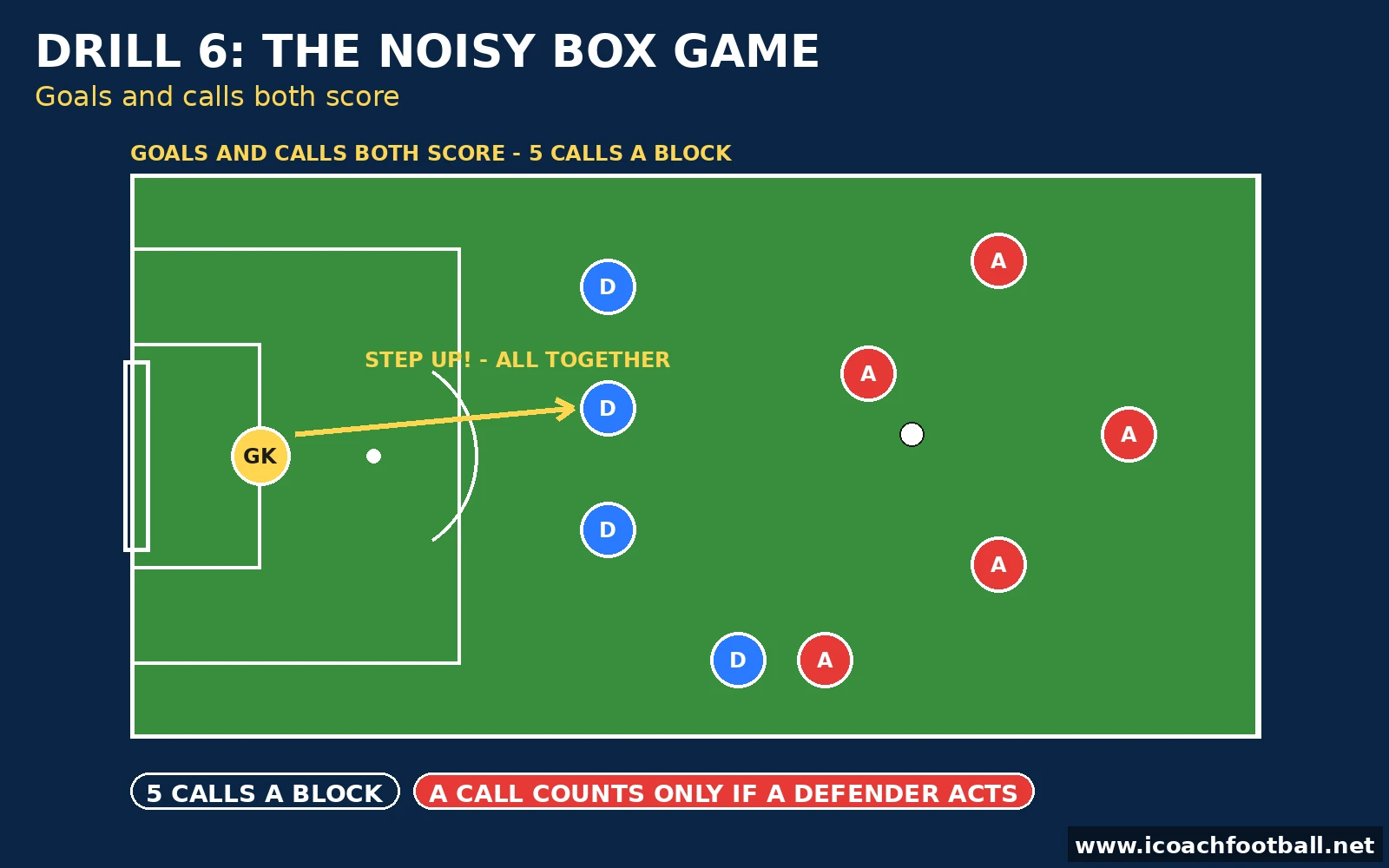
Drill 6: The Noisy Box Game
Calls that work in a quiet drill die in a noisy game. This game adds the noise — and scores the talking.
Setup
- Half a pitch, one full-size goal, 8v8, 1 ball; coach and spare players provide crowd noise
- Communication points are scored alongside goals; 18 minutes
How to Play
- Play 8v8 with a simple scoring rule: a goal counts 1 point, and every clear organising call from the keeper counts 1 point.
- The keeper must make at least five organising calls in each 6-minute block — a call only counts if a defender acts on it.
- The coach and the spare players shout from the touchline, so the keeper must project the call across the pitch.
- If the keeper’s call is wrong, the point is still scored — the habit matters more than perfection.
- Play three 6-minute blocks with a 1-minute break; the keeper changes teams each block.
Coach’s note: The first block is always quiet — keepers freeze when the noise starts, because they have never had to shout over a crowd. That is the point. Do not lower the noise; raise the standard instead, and praise the first keeper who gets a call through it. If a keeper goes a whole block without five calls, stop the game and ask the defenders what they needed to hear. The answer is usually the same: “Tell me where the runner is.” The habit of calling under pressure is the same one trained in our youth goalkeeper shot stopping drills — a keeper who talks through the save is a keeper who stays in the game.
Progressions: The keeper may only use the five agreed calls, so every word must earn its place; the coach removes one defender, so the keeper’s organisation has to cover the gap.
Coaching points
- Call before the ball arrives. Organisation happens in advance — a call made after the ball drops is a comment, not a command.
- One word, one action. Every call means exactly one thing, agreed before kick-off. If the meaning changes mid-game, defenders stop trusting it.
- Name plus information. “Sam, runner left!” beats “Watch out!” — a name tells a player the message is theirs, and the direction tells them what to do.
- Short, precise, forceful. FIFA’s goalkeeping guidance is clear: every verbal intervention should be short, precise and forceful — the keeper supervises team-mates by calling and gesturing, never by shouting sentences.
- Praise the early call, not the loud one. “You spotted the runner early” builds the habit; “Good shouting” builds noise.
- Trust the call. Defenders act on the keeper’s word without checking — and the coach corrects the keeper, never the defender who followed it.
Common mistakes
- Calling too late. The keeper decides on the ball’s flight instead of the server’s touch. Fix it with Drill 1 — slow the serve until the call is early, then add pace.
- Shouting without information. “Watch out!” and “Heads up!” tell nobody anything. Fix it with the five-call table — every call names the action.
- Naming no one. The keeper calls “Runner!” and three defenders look at each other. Fix it with Drill 3 — every call carries a name.
- Organising after the danger. The keeper watches the ball, the line stays still, then scrambles. Fix it with Drill 2 — call the shift while the pass is travelling.
- Silence under pressure. The keeper talks in drills and freezes in games. Fix it with Drill 6 — add the noise and score the calls.
Age adaptations
| Age group | How the drills change |
|---|---|
| U10–U12 | Use Drill 1 and Drill 4 only, with slow serves and no heading. Teach two calls only — “KEEPER!” and “AWAY!” — and let the keeper practise them until they are automatic. Keep the language the same every session so the words become habit. |
| U13–U15 | Add Drill 2 and Drill 3, with the full five-call vocabulary. Let the keeper assign marks at corners, but keep the attackers’ runs simple and the serves gentle. Praise the early call every time it happens. |
| U16–U18 | Full speed, live attackers, blind-side runners and crowd noise in every drill. The keeper must organise the wall at free kicks and call the line without the coach prompting. Add the directional detail — “Man on, left!” |
| Adults | Add the offside line to Drills 2 and 5, and let the keeper choose the calls themselves — the vocabulary is theirs to own. In Drill 6, the keeper also organises the press from the back, calling the trigger as well as the drop. |
60-minute session plan
| Block | Time | What to run |
|---|---|---|
| Warm-up | 0–8 min | Keeper-led rondo: the keeper calls “TIME!” or “MAN ON!” for every receiver |
| Drill 1 | 8–18 min | Keeper or Away? — the cross call, before the ball peaks |
| Drill 2 | 18–28 min | Shift, Step, Drop — the keeper conducts the back line |
| Drill 3 | 28–38 min | Name Every Runner — set-piece assignments, named out loud |
| Drill 4 | 38–46 min | Time or Man On? — the back-pass call |
| Drill 5 | 46–54 min | Runner! — the blind-side call |
| Game | 54–60 min | The Noisy Box Game — goals and calls both score (extend to 18 minutes if time allows) |
Sources
- FIFA Training Centre — “Goalkeeping”: the goalkeeper must be aware of their team-mates’ positioning at all times and look to provide support wherever possible, through defensive organisation, out-of-possession positioning and shot-stopping; goalkeepers’ defensive responsibilities include anticipating and taking up positions to defend dangerous zones whenever the team are out of possession, including when defending set plays. https://www.fifatrainingcentre.com/en/resources-tools/football-language/goalkeeping/index.php
- FIFA Training Centre — “Coaching tips 2” (Tip 7: Interactions): goalkeepers do not operate in isolation — they rely on interactions, and both verbal and non-verbal communication are crucial to a goalkeeper’s performance; train with team-mates and opponents so keepers get used to reading and reacting to tactical intentions. https://www.fifatrainingcentre.com/en/practice/futsal/coaching-tips/coaching-tips-using-game-logic-rules-structured-parameters-and-high-quality-interactions.php
FAQ
What should a goalkeeper shout during a game?
Five short calls cover almost everything: “KEEPER!” when claiming a ball, “AWAY!” when a defender should clear it, “MAN ON!” when a team-mate is under pressure, “TIME!” when they are free to turn, and “STEP!” or “DROP!” to move the line. Agree the words before kick-off, give each one exactly one meaning, and never change the meaning mid-game.
At what age should goalkeepers start learning communication?
As soon as they play in goal — U10 is not too early. Start with two calls only, “KEEPER!” and “AWAY!”, in a slow cross drill (Drill 1). The habit of calling early is easier to build at U10 than to fix at U15, when a quiet keeper has already learned to stay silent under pressure.
How do you coach a shy goalkeeper to talk?
Make the call part of the drill, not a personality test. In Drill 1, a rep only counts if the call is made — so the keeper must speak to succeed, and the focus is on the call, not on being loud. Praise the early call, never the volume, and never single a quiet keeper out in front of the group. The voice follows the reps.
What is the most important call a goalkeeper makes?
“KEEPER!” versus “AWAY!” — the claim call. It decides who owns every high ball into the box, and it prevents the collisions that happen when a keeper and a defender both go for the same ball. If a keeper learns only one thing about communication, it should be this: decide early, call once, and commit to the call.
Should the goalkeeper organise the wall at free kicks?
Yes — the keeper owns the wall. Before the kick, the keeper sets the number of players, lines the wall up with the ball and the goal, and names who covers the far post. The same naming habit from Drill 3 applies: point, name, confirm. A wall the keeper did not organise is a wall the keeper cannot trust.