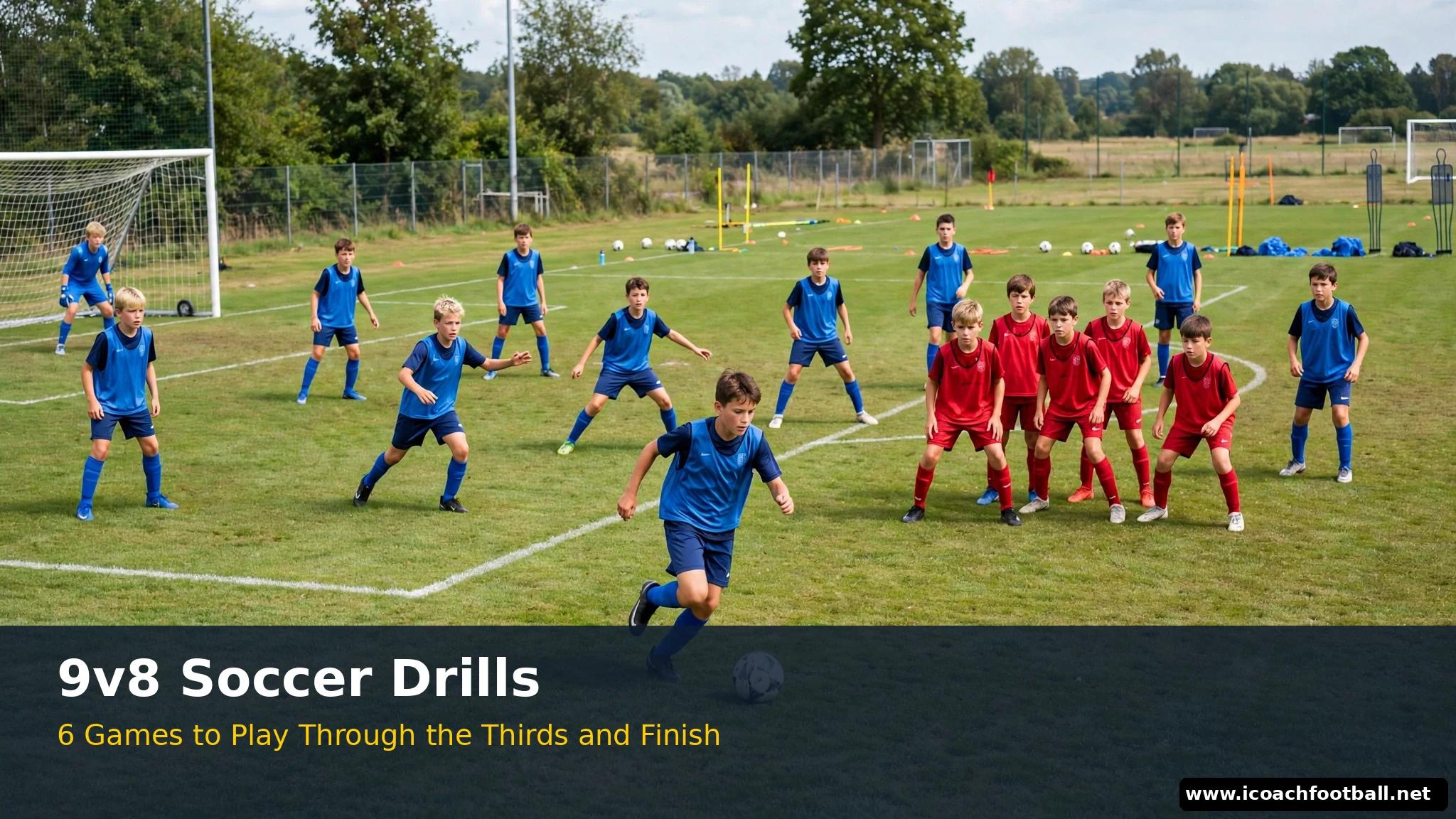
9v8 Soccer Drills: 6 Games to Play Through the Thirds and Finish
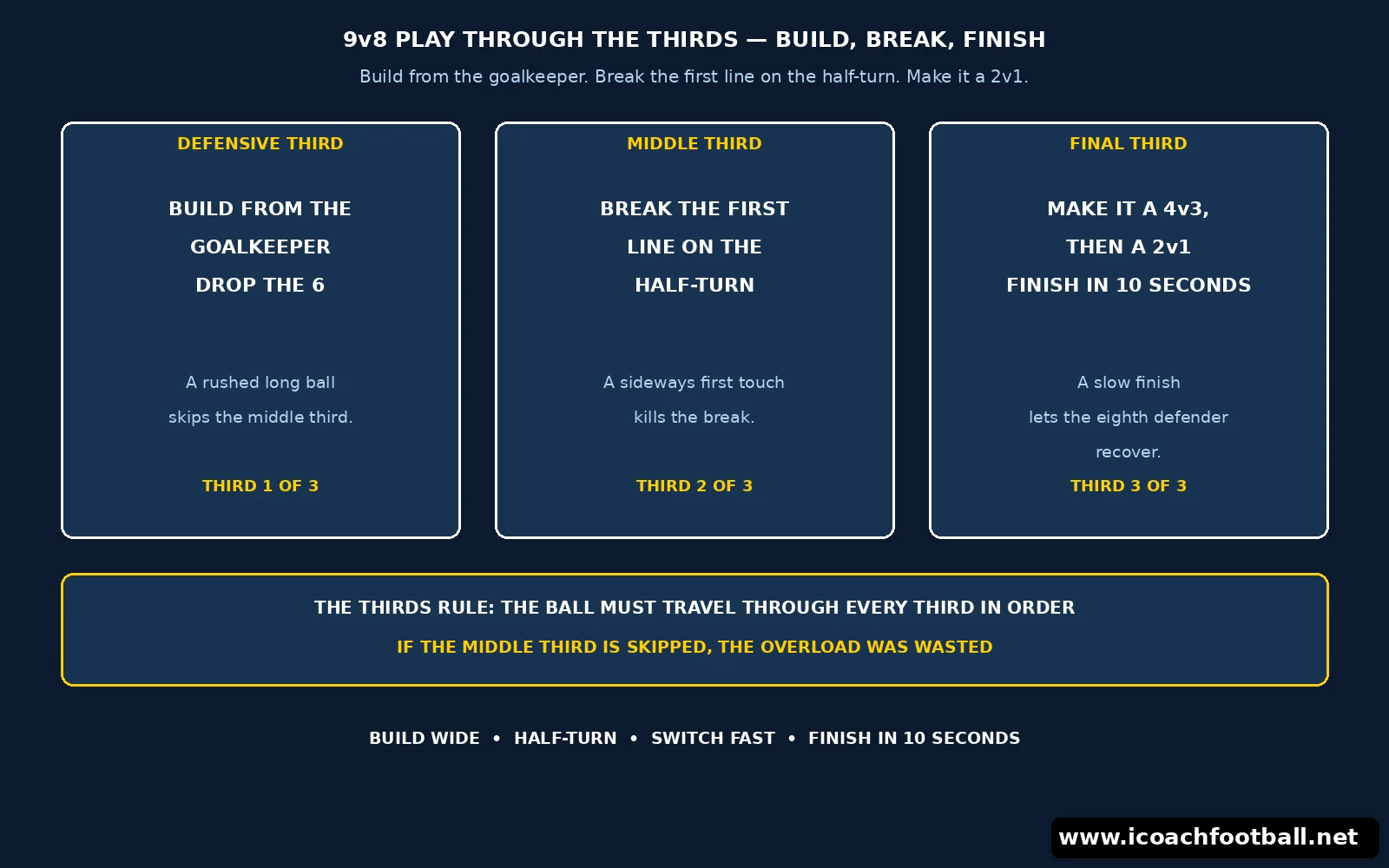
Quick answer: A 9v8 works when the nine attackers play through the thirds in order — build from the goalkeeper, break the first pressing line with a half-turn receiver, create a 4v3 in the final third, and turn it into a 2v1 before finishing. Stay wide, switch fast when the eight defenders shift, and shoot within 10 seconds of the final-third overload.
Nine attackers against eight defenders is a team-shape problem, not a finishing problem. The spare player is usually a centre-back who steps into midfield, or a striker who drops to make a box midfield, and most teams waste them by playing sideways across the back instead of forwards through the thirds.
The ball moves slowly, nobody receives on the half-turn between the lines, and the attack arrives in the final third with every defender already goal-side. The same build-up problem decides games in football at every level, and it is solved by a receiver who drops at the right moment, a switch that arrives before the block shifts, and a run that starts as the ball travels.
These six games teach that sequence. Each one starts with a 9v8, each one ends with a finish, and each one rewards the team that plays through the thirds first.
Session snapshot
- Players: 18–26 (9 attackers, 8 defenders, goalkeepers, plus rotation groups)
- Area: 60 x 40 to 70 x 44 yards, one full-size goal
- Duration: 60 minutes for all six games, or 20 minutes for any two
- Focus: Playing through the thirds, central and wide overloads, beating a mid-block, finishing as a team
- Equipment: Cones, bibs, balls, one full-size goal, two mini goals for Drill 6
- Age: U15–U19 (see age adaptations)
The one rule: play through the thirds, then make it a 2v1
A 9v8 gives the attacking team one spare player. That player is only useful if they help the ball travel through the thirds in order, and the final third is only useful if a 4v3 becomes a 2v1 in one area before the defence shifts across.
- Build from the goalkeeper. Every attack starts with the goalkeeper. A rushed long ball skips the middle third and hands the overload away.
- Break the first line on the half-turn. The number 6 or 8 drops, receives facing forward, and plays into a forward. A sideways first touch kills the break.
- Make it a 4v3, then a 2v1. Four attackers against three defenders must isolate one defender with two attackers. The spare player decides the finish.
- Finish fast once the 4v3 is made. Shoot within 10 seconds. A slow finish lets the eighth defender recover.
Start with 8v7 soccer drills if your players cannot yet carry through a free zone and make a 4v3; the 9v8 below adds an eighth defender and a full 1-3-4-2 team shape, so the build-up must go through the thirds, the overload must be created centrally or wide on purpose, and the finish must come from a rehearsed team pattern.
For the full-team version with a ninth defender and a 1-4-4-2 shape, try these 10v9 soccer drills.
| Eight defenders do this | Nine attackers do this |
|---|---|
| Press the first pass in twos | Build from the goalkeeper and drop the 6 on the half-turn |
| Set a compact mid-block | Invite pressure, then play through or around the press |
| Shift across to the ball side | Switch first time to the far-side spare player |
| Step out and mark the wing-back | Use a bounce pass and a third-man run to free the carrier |
Drill 1 — Play Through the Thirds
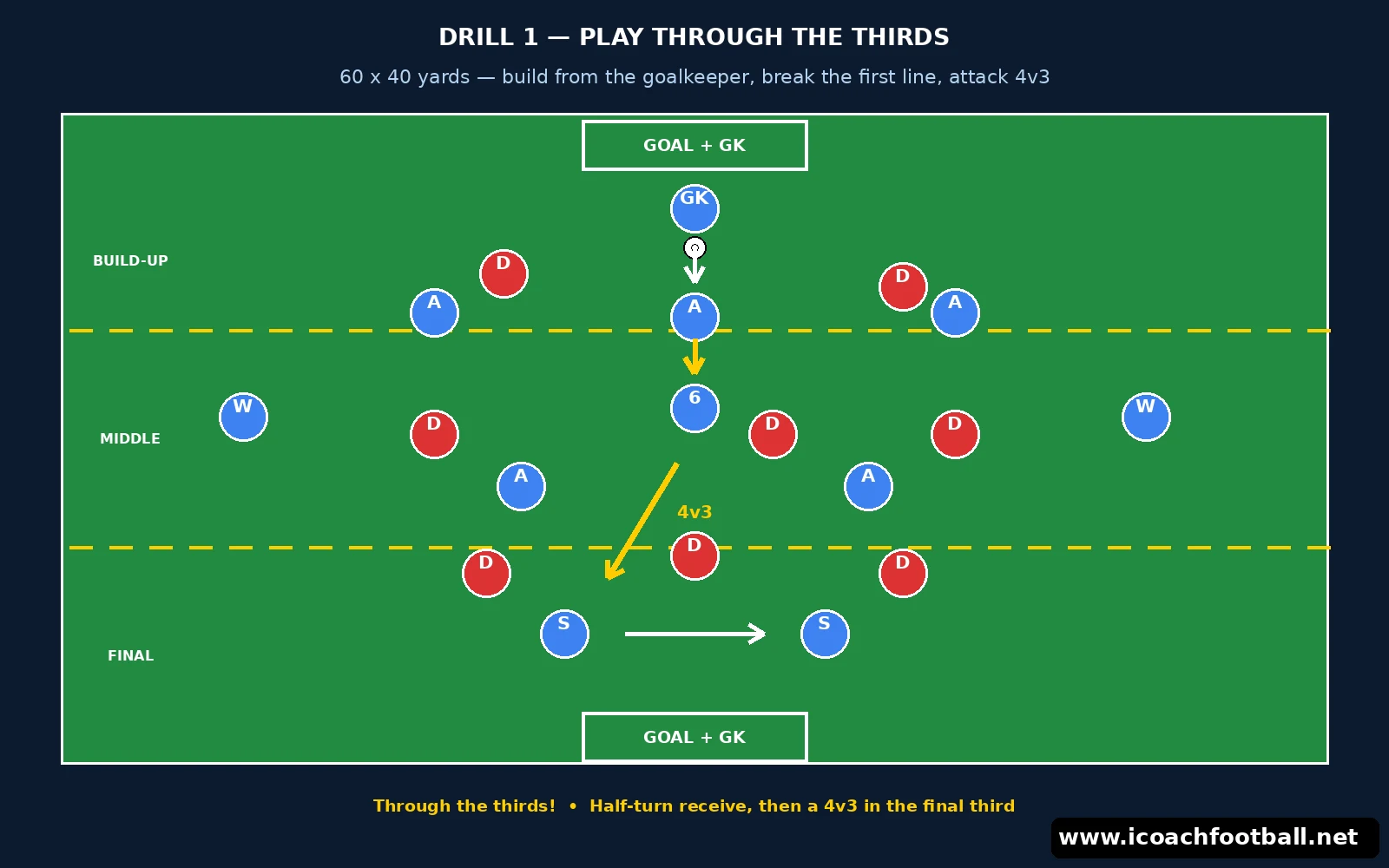
The starting point for every 9v8. Nine attackers build from the goalkeeper through three zones on a 60 x 40 yard pitch, and must progress zone by zone before they may finish.
Setup:
- One 60 x 40 yard pitch, split into three thirds, with a full-size goal at each end and a goalkeeper in each goal.
- Nine attackers in blue bibs in a 1-3-4-2 shape, eight defenders in red bibs in a 1-4-3-1 shape, one ball per rep.
- Spare balls behind both goals, and a coach on the touchline to restart play fast.
How to Play:
- The sequence always begins with the goalkeeper, who plays to a centre-back.
- The back three build with width, and the number 6 drops to receive on the half-turn.
- The 6 plays through the first pressing line into the middle third.
- The middle third must be entered by a pass or a dribble, not skipped with a long ball.
- The attackers create a 4v3 in the final third and isolate one defender in a 2v1.
- The attack finishes within 10 seconds of entering the final third, then play restarts from the other goalkeeper.
Coach’s note: The cue is “Through the thirds!” If the ball is played over the middle third, bring it back. The middle third is the drill.
Progressions: Limit the attackers to two touches in the first third, then require the final-third entry pass to reach a half-turn receiver.
Drill 2 — Build-Up Waves to 9v8
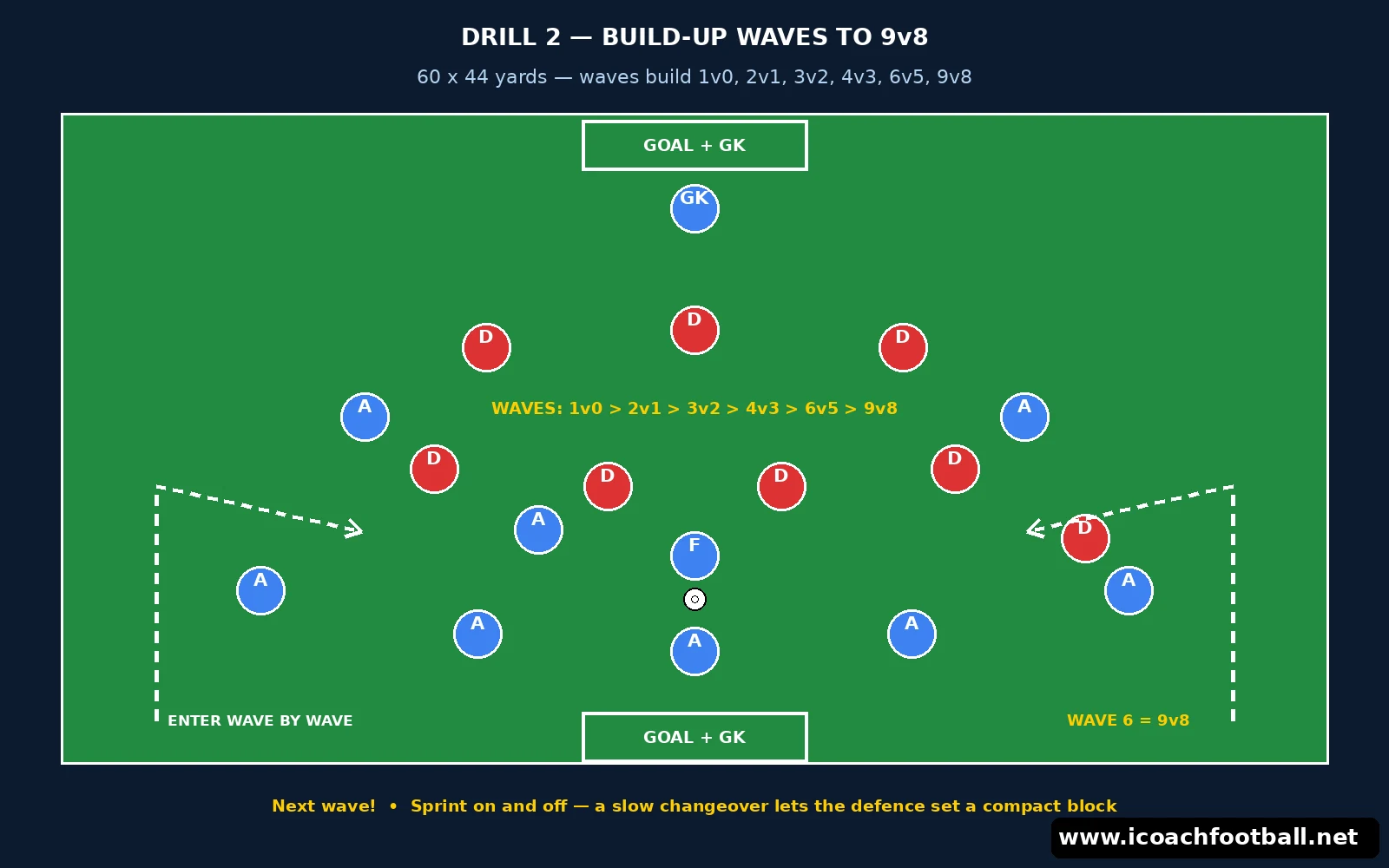
The overload builds wave by wave from the back. Each wave adds attackers and defenders, until the final wave is a full 9v8 that must play through the thirds and finish.
Setup:
- One 60 x 44 yard pitch, a full-size goal at each end with a goalkeeper in each goal.
- Two teams of eighteen, with players waiting in stations behind each goal and on both touchlines.
- One ball per wave, spare balls with the coach at the halfway line.
How to Play:
- Wave 1 is 1v0: the striker receives from the goalkeeper and shoots in two touches.
- Wave 2 is 2v1: two attackers enter, create a 2v1, and finish from the overload.
- Wave 3 is 3v2: a third attacker enters, and the ball must break the first line.
- Wave 4 is 4v3: the next attacker enters, and the spare player must be found between the lines.
- Wave 5 is 6v5: two more attackers enter, and the attack must switch to the far side.
- Wave 6 is 9v8: the final attackers enter, the full shape defends, and the attack must play through the thirds and finish.
Coach’s note: The cue is “Next wave!” Players must sprint on and off between waves. A slow changeover lets the defence set a compact block.
Progressions: Cut each wave to 8 seconds, then require the 9v8 wave to finish from a first-time shot.
Drill 3 — Central Overload: Step In and Drop Off
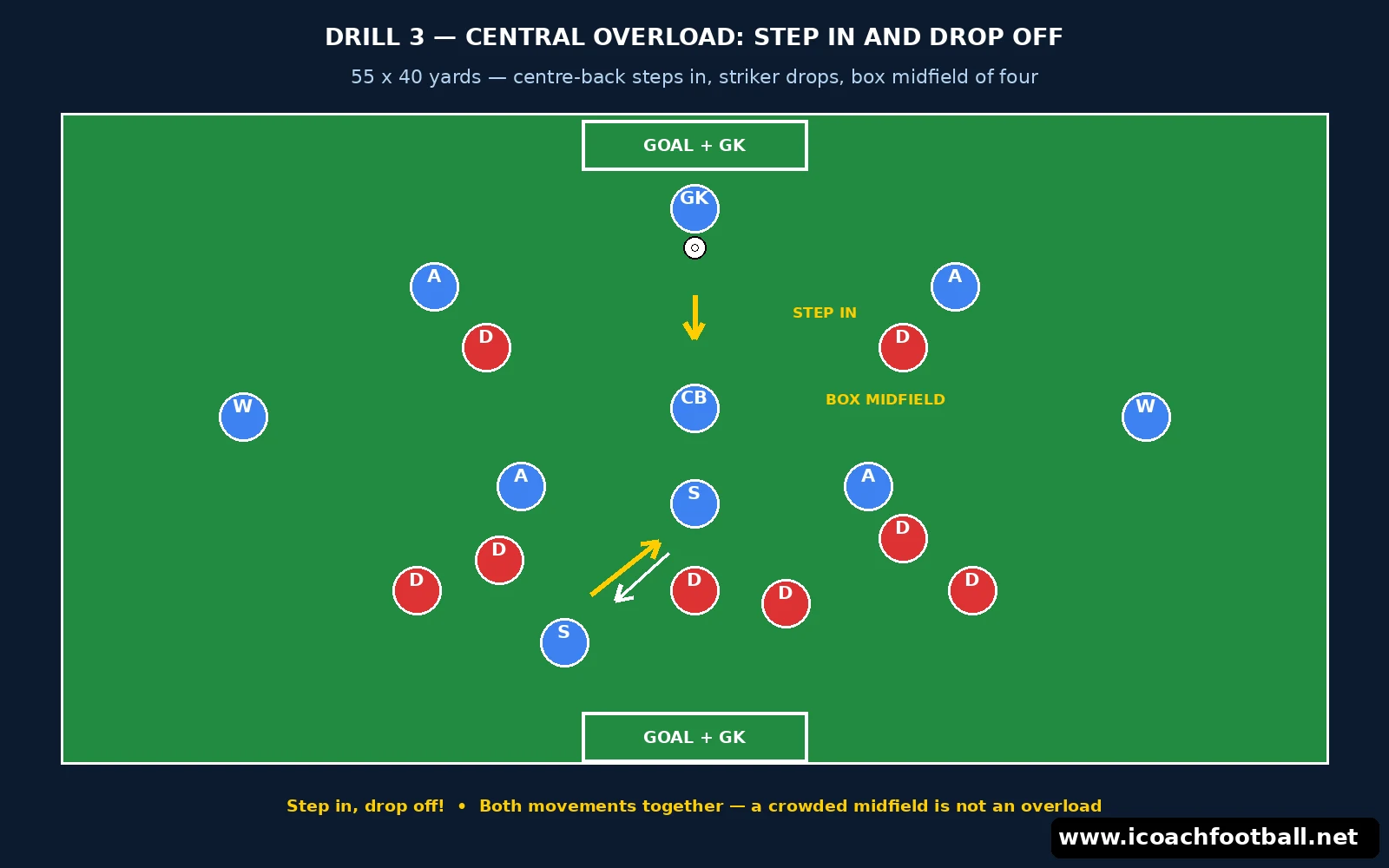
The eight defenders protect the centre. This game teaches the nine attackers to create a central overload on purpose: a centre-back steps into midfield, a striker drops to make a box midfield, and the ball goes through the middle.
Setup:
- One 55 x 40 yard pitch, a full-size goal at each end with a goalkeeper in each goal.
- Nine attackers in blue bibs in a 1-3-4-2 shape, eight defenders in red bibs protecting the central channel.
- One ball per rep, spare balls with the coach on the touchline.
How to Play:
- The ball starts with the goalkeeper, who plays to the middle centre-back.
- The middle centre-back steps into midfield with the ball, making it 4v3 centrally.
- A striker drops off the defensive line to make a box midfield of four.
- The dropped striker receives on the half-turn and plays into the other striker.
- The attackers combine in the centre, then play wide only when the centre is closed.
- The attack finishes from a central combination, or from a cutback after the wide switch.
Coach’s note: The cue is “Step in, drop off!” If the centre-back steps in without the striker dropping, the midfield is crowded, not overloaded. Both movements must happen together.
Progressions: The centre-back may only step in after two passes, then the dropped striker must receive with one touch.
Drill 4 — Wide Overload and the Switch
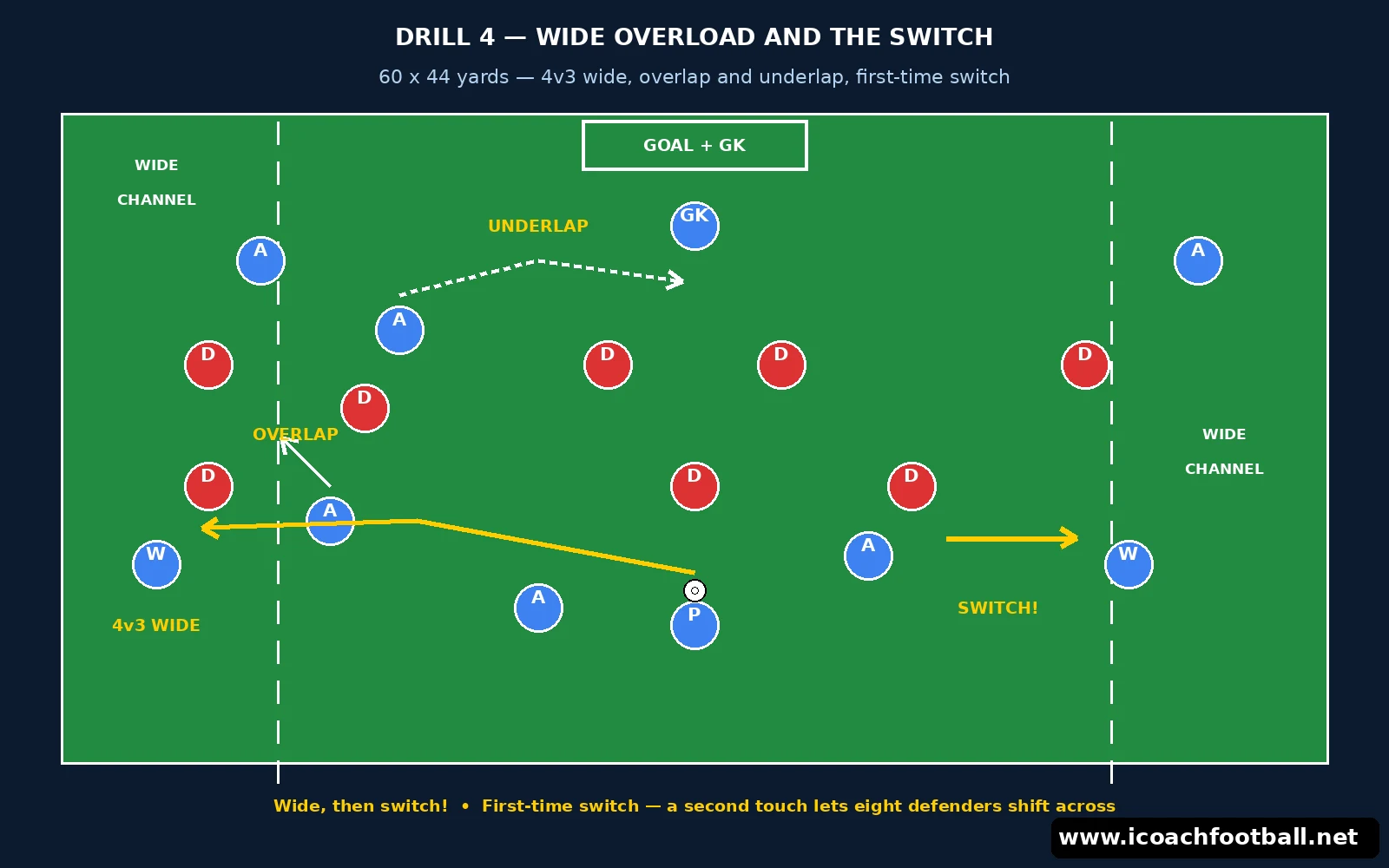
The eight defenders stay narrow and protect the centre. This game teaches the nine attackers to use the wing-backs, create a wide overload, and switch to the free side before the block can shift.
Setup:
- One 60 x 44 yard area, one full-size goal with a goalkeeper, cones marking two wide channels.
- Nine attackers in blue bibs, eight defenders in red bibs, one ball per rep.
- Spare balls with the coach on the touchline, and a wing-back starting in each wide channel.
How to Play:
- The ball starts with a pivot, who plays wide to the wing-back in the left channel.
- Three attackers join the wing-back at speed, making it 4v3 in the wide channel.
- The four attackers combine quickly, with one overlap and one underlap, to beat the three defenders.
- If the wide channel closes, the ball is switched first time to the far-side wing-back.
- The far-side wing-back drives forward and cuts the ball back low.
- Two runners arrive in the box, one at the near post and one at the penalty spot.
Coach’s note: The cue is “Wide, then switch!” The switch must be first time. A second touch on the ball side lets the eight defenders shift across.
Progressions: The switch must be played from the half-turn, then the far-side wing-back must finish the cutback with a first-time shot.
Drill 5 — Beat the Mid-Block
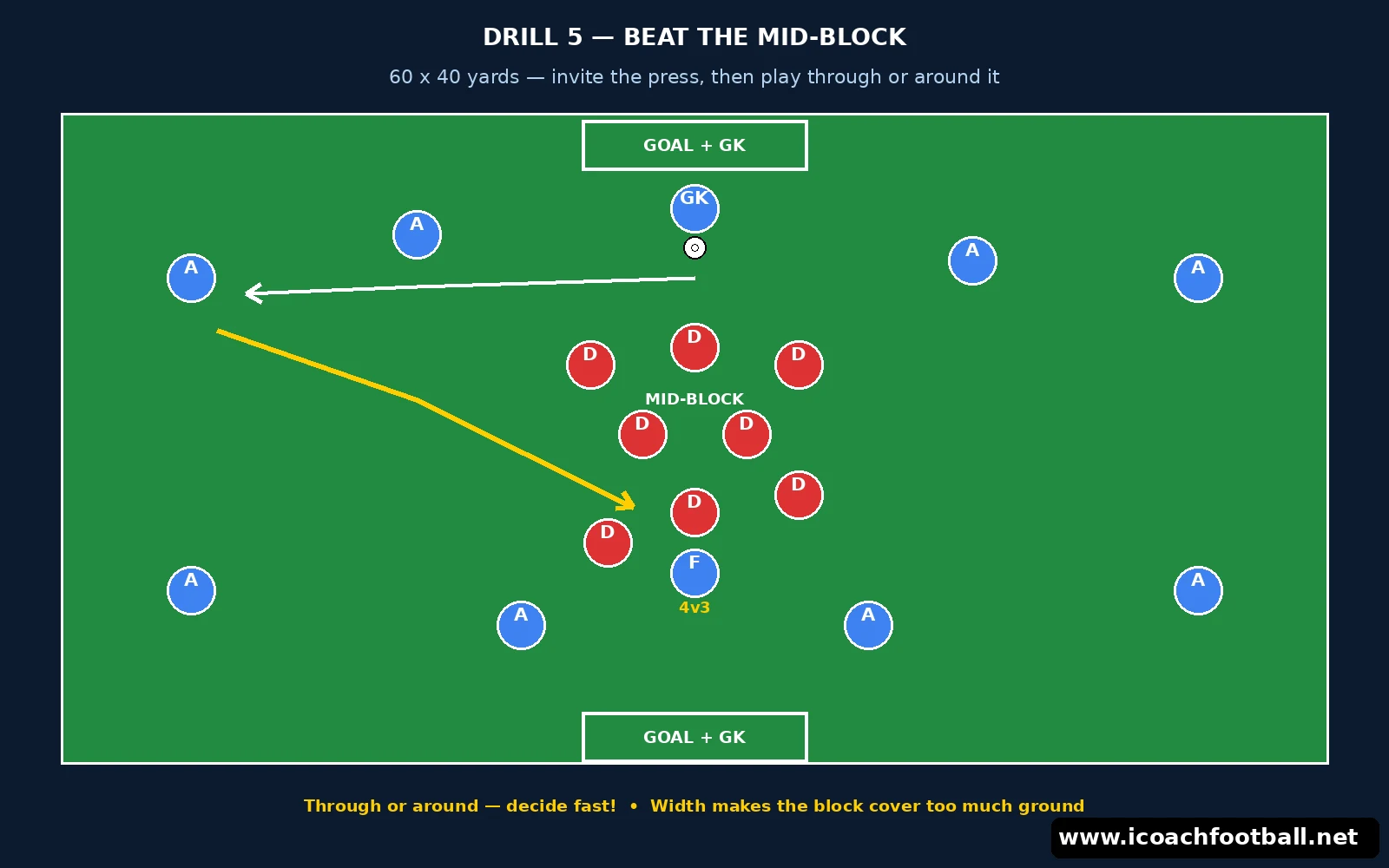
Eight defenders set a compact mid-block, protect the centre, and force play wide. Nine attackers must invite the press, decide whether to play through or around it, and break the block before it resets.
Setup:
- One 60 x 40 yard pitch, a full-size goal at each end with a goalkeeper in each goal.
- Nine attackers in blue bibs in a full team shape, eight defenders in red bibs in a compact 1-4-3-1 mid-block.
- One ball per rep, spare balls behind both goals, and a coach on the touchline to restart play fast.
How to Play:
- The eight defenders set a mid-block, with two forwards pressing and the rest covering inside spaces.
- The nine attackers build from the goalkeeper and invite the first pressing line forward.
- The ball moves side to side, and the defenders must shift across without leaving a central gap.
- The attackers play through the block with a line-breaking pass, or around it with a switch.
- If the block is broken, the attackers attack 4v3 in the final third at once.
- If the block wins the ball, the defenders counter to a mini goal within 6 seconds.
Coach’s note: The cue is “Through or around — decide fast!” If the attackers hesitate, the block resets. The decision must be made on the first touch.
Progressions: Limit the attackers to two touches in the middle third, then require the line-breaking pass to reach a half-turn receiver.
Drill 6 — Transition Control Game, Both Ways
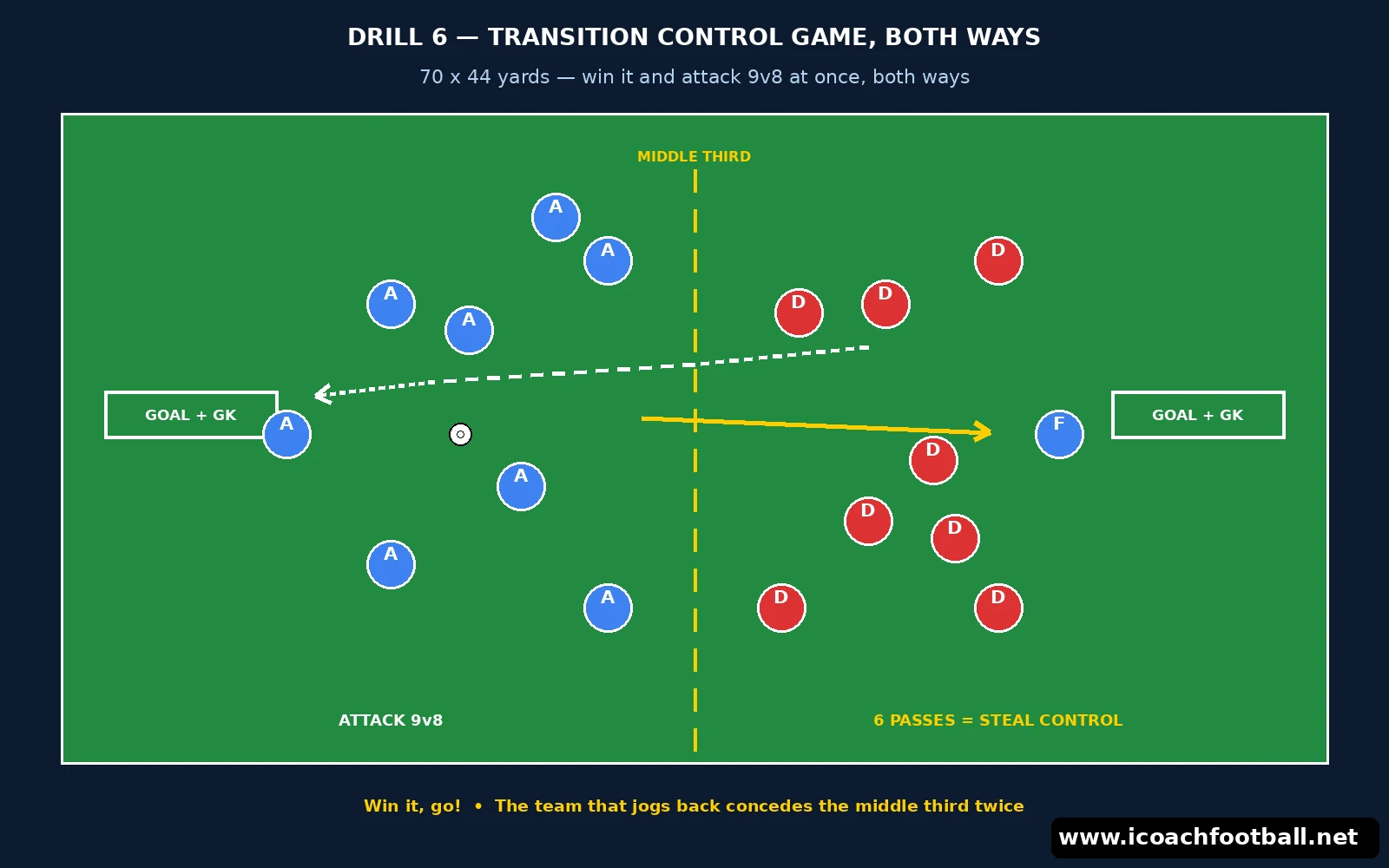
The overload runs both ways, and control is earned. Whichever team wins the ball attacks 9v8 at once, and the team that lost it must win it back or complete six passes to steal the spare player.
Setup:
- One 70 x 44 yard pitch, a full-size goal at each end with a goalkeeper in each goal, two mini goals on the halfway line.
- Two teams of eighteen, with nine attackers and eight defenders on the pitch at any time.
- Spare balls behind both goals, and a coach on each touchline to restart play fast.
How to Play:
- The coach plays the ball to the blue team, who build 9v8 against the red defenders.
- The blue team must play through the thirds and finish within 10 seconds of the 4v3.
- If the red team wins the ball, they attack the far goal 9v8 at once, with no reset.
- The team that lost the ball sprints back, and the middle third is the space they must protect.
- A goal from a 9v8 attack scores double, and a goal after stealing control with six passes scores triple.
- Play for 4 minutes, rest for 1 minute, then swap which team starts with the ball.
Coach’s note: The cue is “Win it, go!” The transition is the drill. A team that jogs back after losing the ball concedes the middle third twice in one rep.
Progressions: Cut the shot clock to 8 seconds, then require the counter-attack to finish in three passes or fewer.
Coaching points
- “Through the thirds!” The middle third only works if the ball travels through it. A long ball over it hands the overload away.
- “Half-turn!” The receiver between the lines must face forward. A sideways touch kills the break.
- “Step in, drop off!” The centre-back step and the striker drop must happen together in Drill 3.
- “Make it a 4v3, then a 2v1!” Four against three is the start, not the finish. Isolate one defender with two attackers.
- “Wide, then switch!” The wide overload in Drill 4 only works if the switch is first time.
- “Finish within 10 seconds!” Every 9v8 has a clock. Train the finish that follows with a 1v1 finishing drill.
- “Win it, go!” The counter-attack is decided in the first two seconds after winning the ball.
Common mistakes
| Mistake | Fix |
|---|---|
| Ball is played over the middle third | Restart the rep in Drill 1; the ball must enter the middle third by pass or dribble |
| Nobody receives on the half-turn | Freeze the shape and point at the receiver; restart with the goalkeeper playing to a centre-back |
| Centre-back steps in without the striker dropping | Both movements together in Drill 3; stop the rep and count them aloud |
| Attack stays 4v3 and never becomes a 2v1 | Overlap and underlap in Drills 3 and 4; no finish counts until a 2v1 is made |
| Switch arrives late | First-time switch in Drill 4; restart the rep if the ball side takes a second touch |
| Jogging back after losing the ball | Double points for a 9v8 goal, triple for a control-stealing counter in Drill 6 |
Age adaptations
| Age | Change |
|---|---|
| U13–U14 | Play 50 x 35 yards, no shot clock, and celebrate playing through the middle third before the finish |
| U15–U16 | Run the drills as written, with the 10-second clock in Drills 1, 2 and 6 and the thirds in Drill 1 |
| U17 | Add one-touch finishes in Drills 4 and 5, the 8-second clock in Drill 2, and full-pressure defending in Drill 5 |
| U18–U19 | Play Drill 6 on a 70 x 44 yard pitch, demand the pattern choice with no coach call in Drill 5, and score first-time finishes double |
How to run the 60 minutes
| Block | Time | Content |
|---|---|---|
| Warm-up | 0–5 min | Unopposed 9v8 shape passing: goalkeeper to centre-backs, half-turn receives, switches to the wing-backs |
| Drill 1 | 5–15 min | Play Through the Thirds, 60 x 40 yard pitch, zone by zone |
| Drill 2 | 15–23 min | Build-Up Waves to 9v8, sprint changes between waves |
| Drill 3 | 23–33 min | Central Overload, centre-back steps in, striker drops off |
| Drill 4 | 33–41 min | Wide Overload and the Switch, restart from both channels, one-touch cutback in the final 5 minutes |
| Drill 5 | 41–50 min | Beat the Mid-Block, compact block, line-breaking pass or switch |
| Drill 6 + game | 50–60 min | Transition Control Game, Both Ways, then an 11v11 game with double points for a goal from a 9v8 |
Use the full hour as the main practice phase in the 60-minute youth soccer session plan, or run Drills 1 and 3 only as a 20-minute build-up block.
From 9v8 to 11v11
When the thirds are played through and the team finishes from a 4v3, the same principle scales up: create the overload in one area, then move the ball to the spare player in another. The 7v6 soccer drills teach the smaller free-player decision between the lines, and switching play drills teach the long switch that opens the far side: use these switching play soccer drills once Drill 4 is clean, so the switch in a 9v8 arrives at full speed and on the correct foot.
Sources
These drills are based on, and in line with, the FIFA Training Centre session on creating and exploiting overloads, whose Part 3 is an 8v7 exercise that creates 4v3 overloads in the final third, and which stresses using the spare player at all times, creating 2v1s inside overloads, and the timing, weight and accuracy of the final pass; and with the FIFA Training Centre exercise on progressing through the thirds, which stresses breaking through the first pressing line as a unit, receiving on an open body shape, and deciding as a unit whether to play through or around the press. No FIFA approval, endorsement or affiliation is claimed.
FAQ
What age should players start 9v8 soccer drills?
From U15, on a 60 x 40 yard area with no shot clock. The full version, with the thirds, the wave game and the 10-second clock, lands best at U16–U17, when players can receive on the half-turn and play through a pressing line while moving the ball forwards quickly.
How are 9v8 soccer drills different from 8v7 drills?
A 7v6 and an 8v7 teach finding the free player and carrying through a free zone. A 9v8 adds an eighth defender and a full 1-3-4-2 team shape, so the build-up must go through the thirds in order, the overload must be created centrally or wide on purpose, and the finish must come from a rehearsed team pattern.
What size area should 9v8 soccer drills use?
Start at 60 x 40 yards, with a full-size goal at each end. Go larger, to 70 x 44 yards in Drill 6, to train full team shape and transitions, or smaller, to 50 x 35 yards, to force quicker combinations under pressure.
What if nobody receives on the half-turn?
Stop the rep, point at the receiver, and restart with the goalkeeper playing to a centre-back. Add a rule that no goal counts until a midfielder has received on the half-turn in the middle third, and use Drill 1 to force the receive before the attack starts.
Can I run 9v8 soccer drills with only eighteen players?
Yes. Nine attackers against eight defenders, with a goalkeeper, is the minimum group, and it is also the best group for Drills 1 and 3. Add a second group when numbers allow, and run both areas at once with a coach restarting each area.