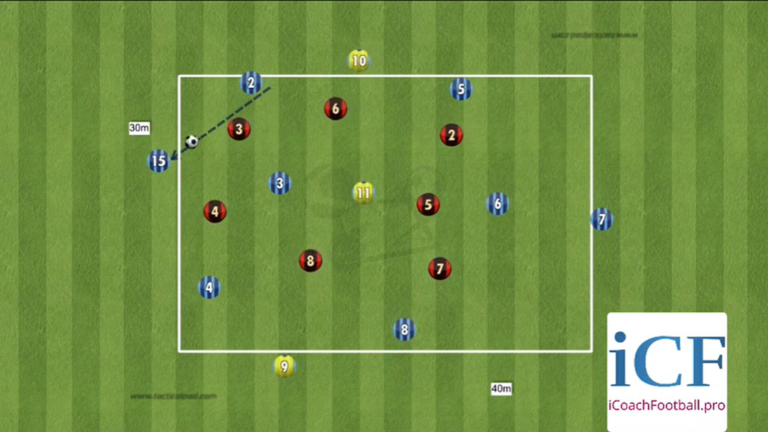
Soccer Practice Plans by Number of Players: 4 to 12 Players
Quick answer: Choose your soccer practice according to the number of players who attend. Use 2v2 with four players, 2v2 plus one neutral with five, 3v3 with six, 3v3 plus one with seven, 4v4 with eight, 4v4 plus one with nine, 5v5 with 10, 5v5 plus one with 11 and 6v6 with 12 players.
Player attendance can change quickly. A coach may prepare for 12 players and discover that only seven arrive, or begin with an even number before one player leaves early.
This soccer practice plan library helps you choose a complete session according to the exact number of available players. Every linked plan includes a structured 60-minute session, equipment guidance, coaching points, progressions, frequently asked questions and individual drill diagrams.
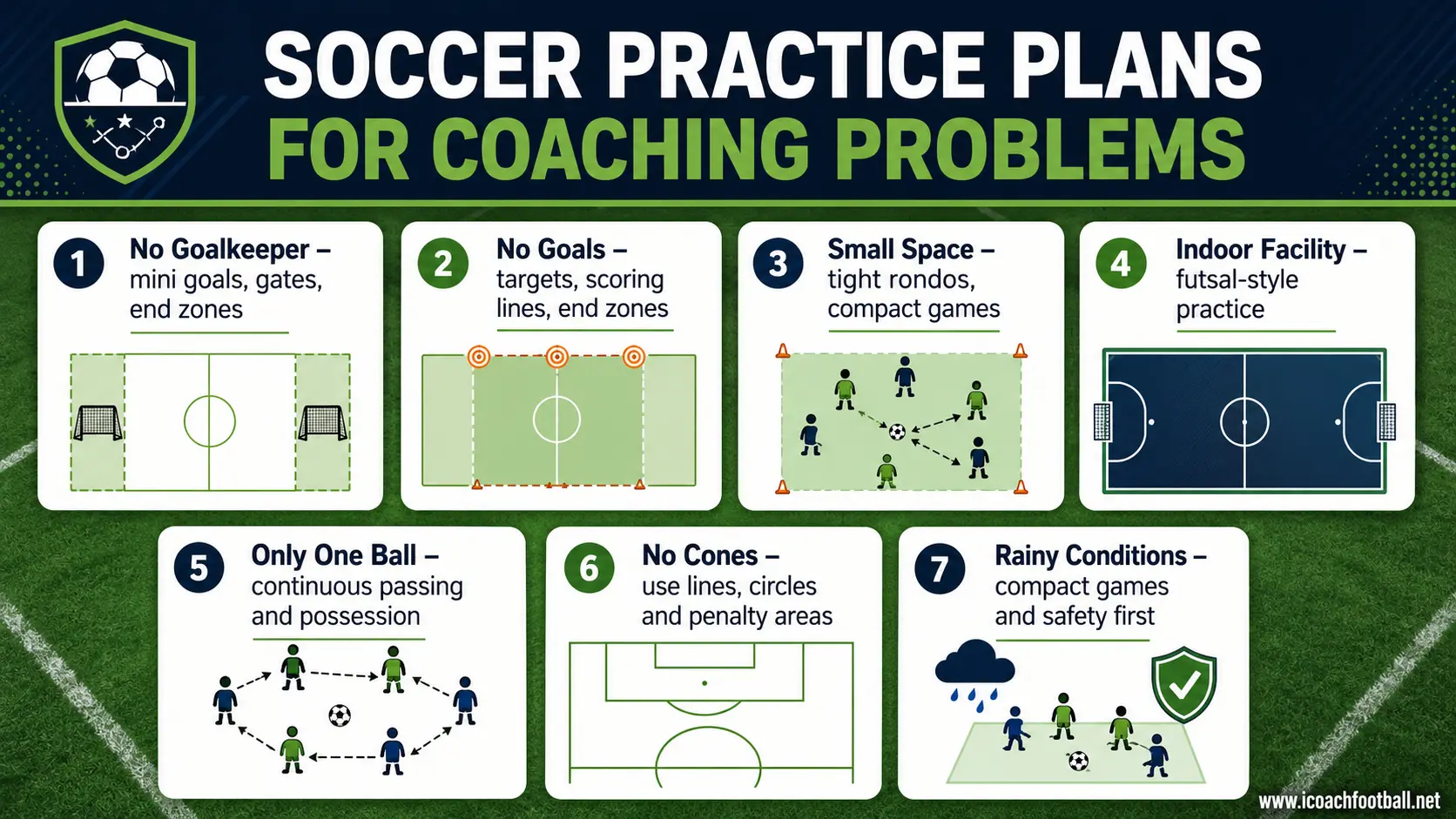
The player-number series covers groups from four to 12 players. The second part of this guide connects practice plans for common coaching problems, including no goalkeeper, no goals, no cones, one ball, limited space, indoor facilities and rainy weather.
Small-sided games make it possible to change team numbers, field dimensions, neutral-player roles and scoring conditions without removing realistic opposition or decision-making. The FIFA Training Centre’s small-sided game guidance explains how coaches can manipulate these variables to create different technical, tactical and physical outcomes.
Choose a Soccer Practice by Number of Players
4 players
Best formats: 2v2, 3v1 rondos, pairs and continuous 2v1 attacks.
5 players
Best formats: 4v1 rondos, 3v2 possession and 2v2 plus one neutral.
6 players
Best formats: 3v3, 4v2 rondos, three pairs and continuous overloads.
7 players
Best formats: 3v3 plus one neutral, 5v2 rondos and support-player games.
8 players
Best formats: 4v4, 5v3 rondos, two groups of four and four-goal games.
9 players
Best formats: 4v4 plus one neutral, 5v4 possession and three teams of three.
10 players
Best formats: 5v5, 6v4 rondos, five pairs and balanced transition games.
11 players
Best formats: 5v5 plus one neutral, 7v4 rondos and overload possession.
12 players
Best formats: 6v6, 8v4 rondos, three groups of four and balanced games.
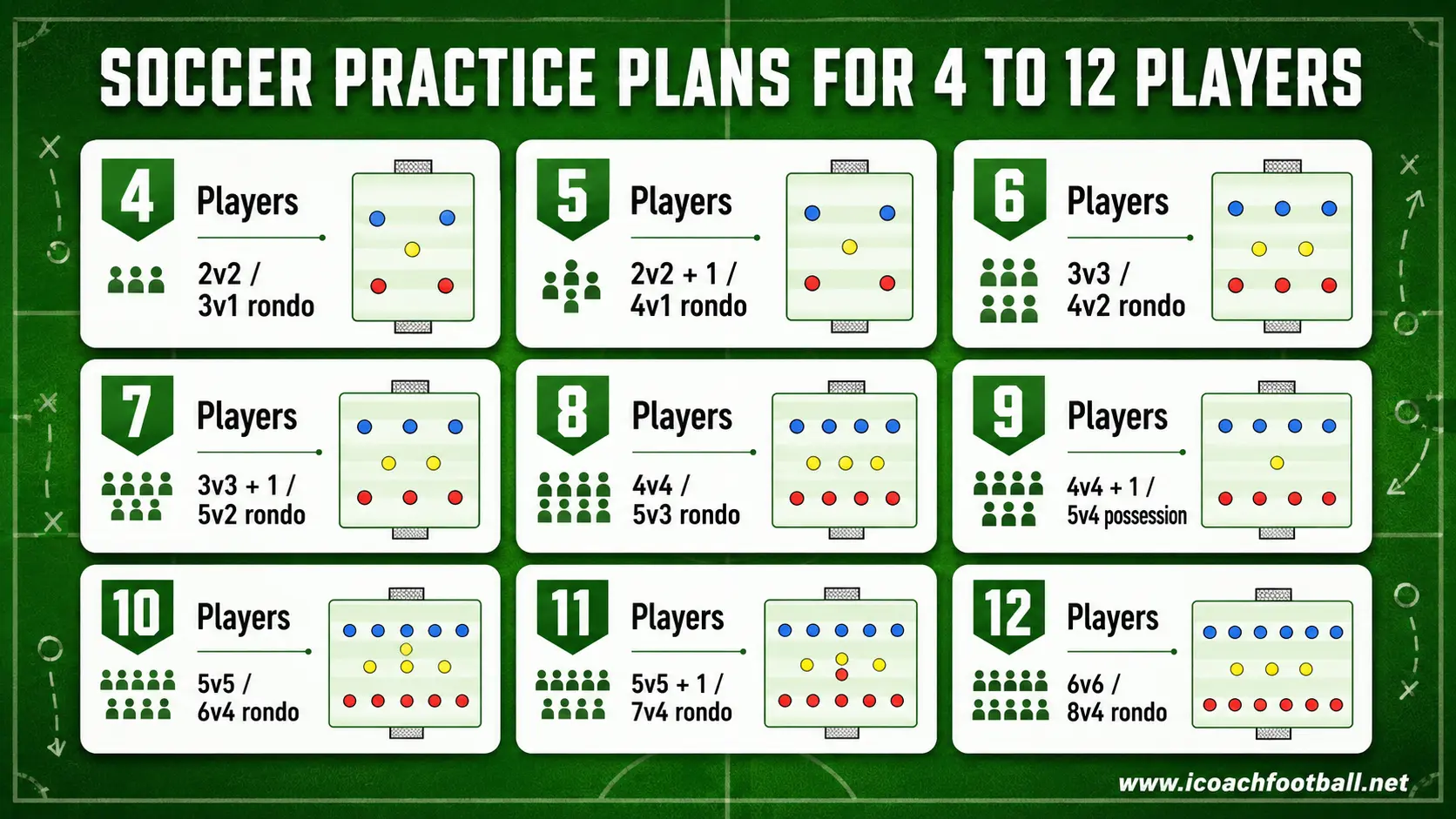
Soccer Practice Formats for 4 to 12 Players
| Players | Recommended format | Useful secondary format | Complete session |
|---|---|---|---|
| 4 | 2v2 | 3v1 rondo | View plan |
| 5 | 2v2 plus one | 4v1 rondo | View plan |
| 6 | 3v3 | 4v2 rondo | View plan |
| 7 | 3v3 plus one | 5v2 rondo | View plan |
| 8 | 4v4 | 5v3 rondo | View plan |
| 9 | 4v4 plus one | 5v4 possession | View plan |
| 10 | 5v5 | 6v4 rondo | View plan |
| 11 | 5v5 plus one | 7v4 rondo | View plan |
| 12 | 6v6 | 8v4 rondo | View plan |
How to Organize Even Player Numbers
Even attendance numbers make it easy to create two balanced teams. Four players become 2v2, six become 3v3, eight become 4v4, 10 become 5v5 and 12 become 6v6.
Balanced teams are useful when the main objective is competition, defending, transition reactions or realistic attacking and defensive decisions. They also make it easier to keep scores and organize short matches.
4 players: Use 2v2 for frequent duels, support decisions and transitions. Add a neutral only when a coach or extra player becomes available.
6 players: Use 3v3 to create width, depth and combination play while ensuring every participant remains heavily involved.
8 players: Use 4v4 for possession, four-goal games, end-zone games and introductory team-shape work.
10 or 12 players: Use 5v5 or 6v6 to introduce clearer positions, units, pressing responsibilities and attacking structures.
The Football Association’s 3v3 coaching guidance explains how small formats can increase player involvement and actions on the ball.
How to Organize Odd Player Numbers
Odd attendance numbers should not leave one player waiting outside the activity. Use the extra participant as a neutral, target, wall player, server, recovery defender or rotating goalkeeper.
A neutral player normally supports the team in possession. This creates a temporary overload and encourages the attacking team to recognize an extra passing option.
5 players: Play 2v2 plus one neutral, 3v2 possession or a 4v1 rondo.
7 players: Play 3v3 plus one neutral, 4v3 overloads or a 5v2 rondo.
9 players: Play 4v4 plus one neutral, divide the group into three teams of three or use 5v4 possession.
11 players: Play 5v5 plus one neutral, 5v4 plus two wide neutrals or a 7v4 rondo.
The FIFA Training Centre’s 3v3 plus one practice demonstrates how a neutral player can help a team build and progress through pressure.
Practice Plans for Limited Equipment and Difficult Conditions
No goalkeeper
Use mini goals, cone gates, targets and end zones while keeping every participant in an outfield role.
No goals
Use cone gates, target players, scoring lines and controlled receptions inside end zones.
Small training space
Use tight rondos, wall-player games, compact passing patterns and small four-goal matches.
Indoor facility
Use flat markers, sole-control movements, kick-in restarts and futsal-inspired games.
Only one ball
Use continuous passing, possession and transition activities with planned retrieval rules.
No cones
Use permanent touchlines, the centre circle, halfway line, penalty area and existing goals.
Rainy conditions
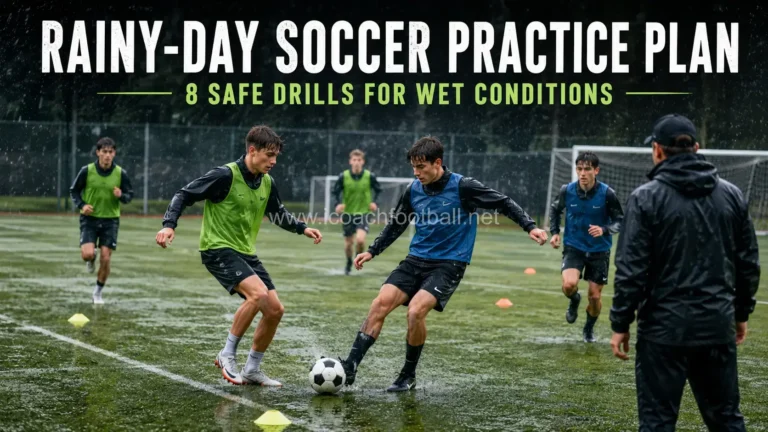
Use compact games, controlled movement and a clear safety procedure for deteriorating weather.
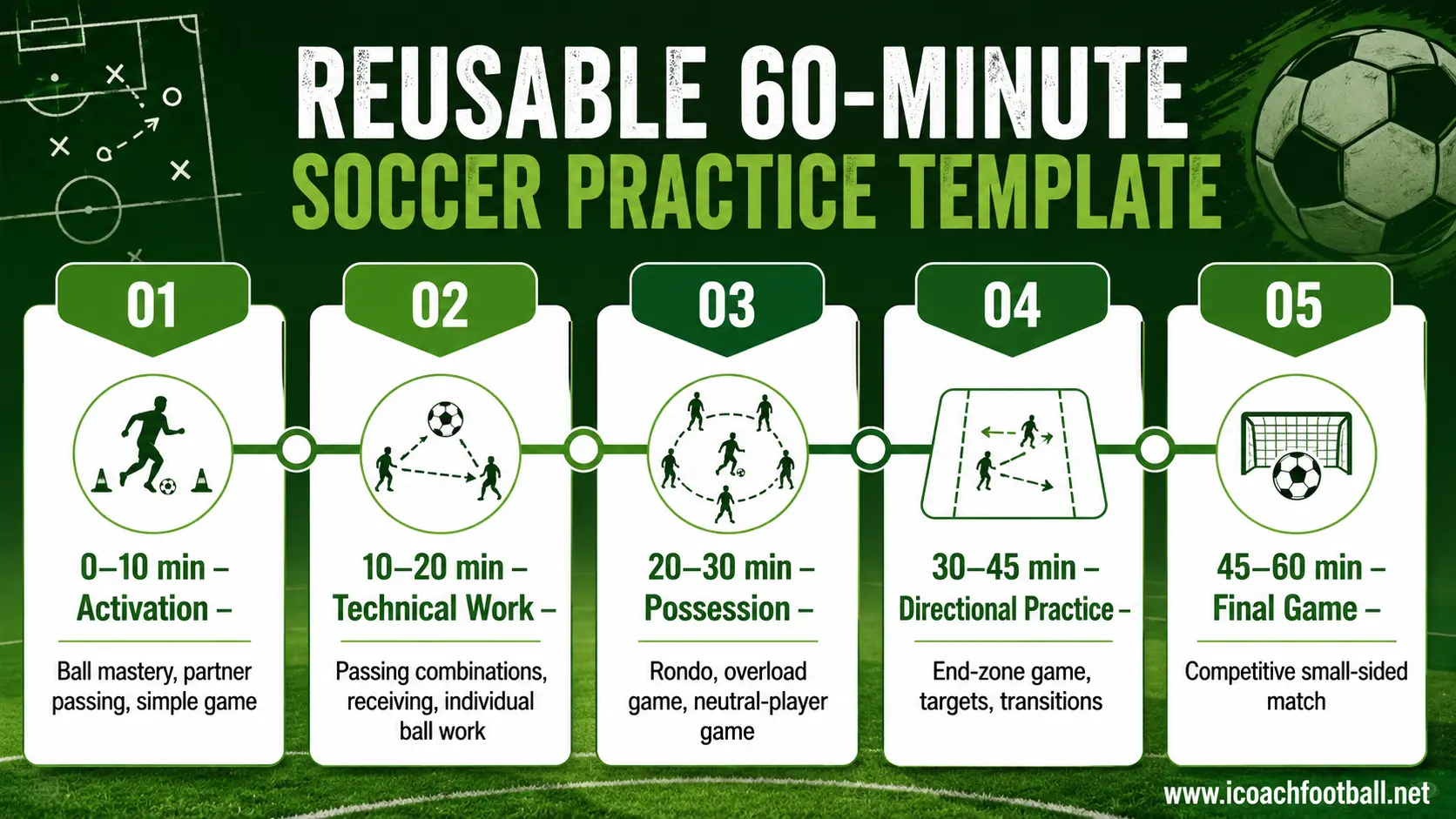
A Reusable 60-Minute Soccer Practice Structure
The individual exercises may change according to attendance, but a simple session structure can remain consistent.
| Time | Session phase | Suggested content |
|---|---|---|
| 0–10 minutes | Arrival activity and activation | Ball mastery, partner passing or a simple small-sided game |
| 10–20 minutes | Technical development | Passing combinations, receiving or individual ball work |
| 20–30 minutes | Possession under pressure | Rondo, overload possession or neutral-player game |
| 30–45 minutes | Directional practice | End-zone game, target-player activity or transition exercise |
| 45–60 minutes | Competitive game | Small-sided match with simple rules linked to the session objective |
FIFA’s Play-Practice-Play framework also places game-based activity at the beginning and end of training, with a focused learning period between those phases.
What to Do When Attendance Changes
One player arrives late: Convert an even-sided game into a plus-one neutral format. Rotate the neutral role every two or three minutes.
One player leaves early: Use a neutral, target player or recovery defender rather than forcing unequal teams without a clear purpose.
Several players are absent: Reduce the field dimensions and move to the closest player-number plan in this library.
More players arrive than expected: Create a second parallel activity, add neutral players or use rapid team rotations.
A goalkeeper is unavailable: Replace the main goals with mini goals, gates, targets or end-zone scoring.
How to Adjust the Field Size
The correct area depends on the age, ability, player numbers and objective of the exercise. Instead of using one fixed measurement for every group, observe how easily players can keep possession and create scoring opportunities.
- Increase the space when players cannot complete passes, continually lose control or have no time to scan.
- Reduce the space when possession is too easy, defenders cannot apply pressure or players avoid quick decisions.
- Make the field longer when the objective is forward passing, counterattacking or movement beyond defenders.
- Make the field wider when the objective is switching play, overlapping or stretching a compact defence.
- Use multiple goals or gates when you want players to scan and recognize different attacking targets.
Common Small-Group Coaching Mistakes
- Leaving the extra player inactive: Use odd players as neutrals, targets, servers or recovery defenders.
- Using a field that is too large: Small groups need reduced distances to maintain realistic pressure and interaction.
- Creating long queues: Use parallel stations, rondos and small-sided games that involve several players simultaneously.
- Using too many conditions: Begin with a simple game and add one restriction only when it supports the objective.
- Keeping one player neutral all session: Rotate the role so every participant experiences attacking and defending.
- Ignoring transitions: Players should react immediately whenever their team wins or loses possession.
- Stopping the game too frequently: Allow players time to identify problems and discover solutions before intervening.
- Using the same plan for every attendance number: Adjust the teams, field and rules according to the players who are actually present.
Frequently Asked Questions
How many players are needed for a soccer practice?
A useful soccer practice can be delivered with as few as four players. Reduce the playing area and use formats such as 2v2, rondos, overloads and continuous transition games.
What should I do with an odd number of soccer players?
Use the extra player as a neutral, target, wall player, server, recovery defender or rotating goalkeeper. The neutral should normally support the team in possession.
What is the best format for four to six players?
Use 2v2 with four players, 2v2 plus one neutral with five players and 3v3 with six players. Rondos and overload games provide useful alternatives.
What is the best format for seven to nine players?
Use 3v3 plus one with seven players, 4v4 with eight players and 4v4 plus one neutral with nine players.
What is the best format for 10 to 12 players?
Use 5v5 with 10 players, 5v5 plus one neutral with 11 players and 6v6 with 12 players.
Can I run soccer practice without a goalkeeper or goals?
Yes. Use mini goals, cone gates, scoring lines, target players and end zones to create directional games without a traditional goal or goalkeeper.
How long should a small-group soccer practice last?
A complete session can last approximately 60 minutes. A typical structure includes activation, technical practice, possession, directional play and a competitive final game.
Save this coaching hub: Return whenever attendance or equipment changes and choose the session that matches the players, space and resources available.