Soccer 6v6 Drills: 6 Games That Teach Shape, Width and Quick Combinations
Quick answer
Six is the smallest number that teaches real team shape. These six soccer 6v6 drills give your players a shape to hold, width to use and combinations to play — in one 60-minute session that ends in a proper game.
Suitable for: U9–U16
In soccer — football to most of the world — 6v6 is the bridge between small games and the full match. There are enough players for a shape, a midfield and a forward, but few enough that every player touches the ball constantly. The six games below build one idea on top of the next: shape first, then width, then pressing, then goals.
Session snapshot
- Players: 12–16 (two teams of six, plus two neutrals where noted)
- Area: 40 x 30 yards to half a pitch
- Duration: 60 minutes
- Focus: Holding the 2-2-1 shape, using the full width, quick combinations, six-second counter-press, scanning before receiving
- Age: U9–U16 (see Age adaptations)
The six 6v6 principles
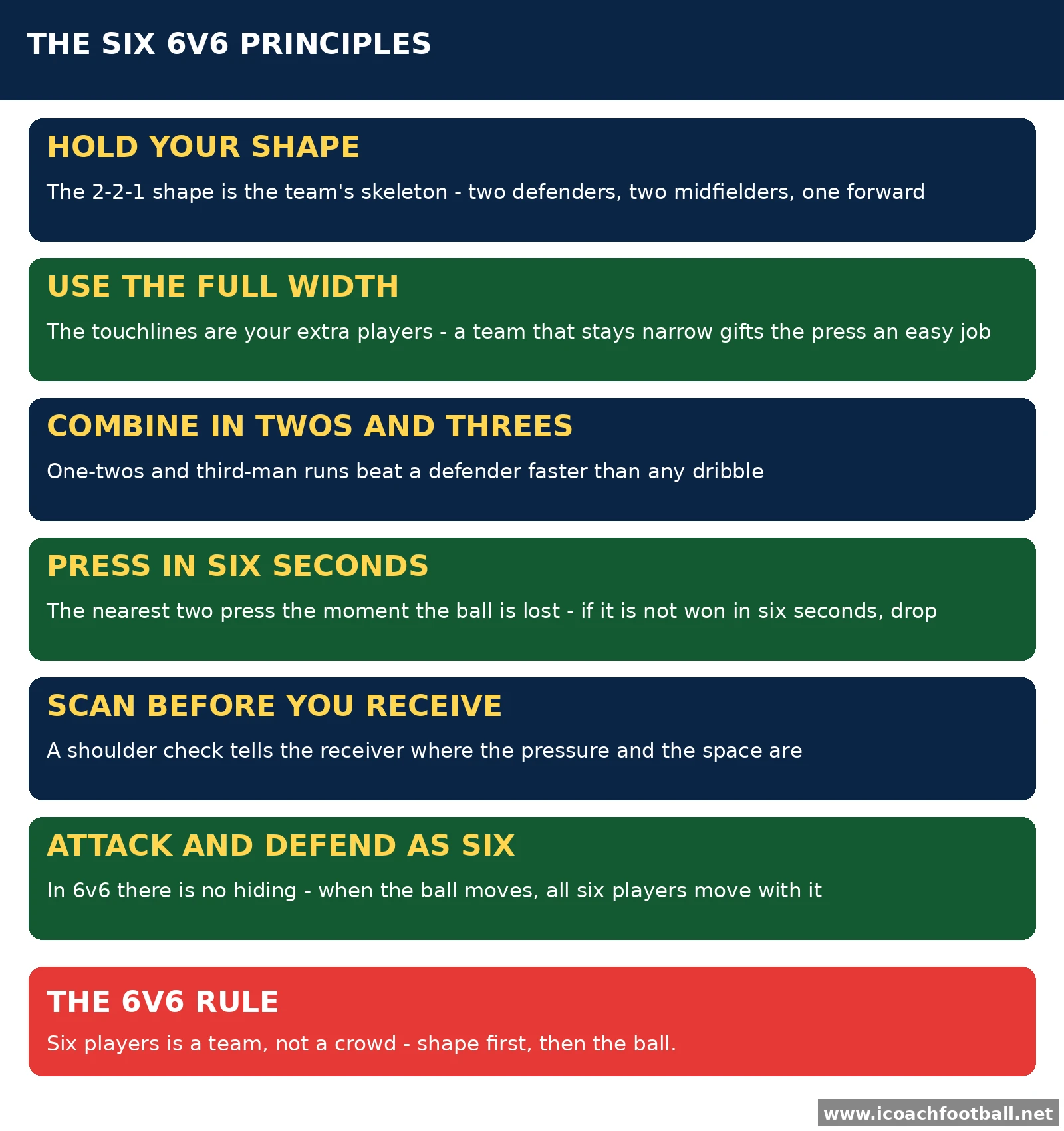
Every drill below is built on six principles. Teach them once, then repeat them in every game until the players say them back to you.
| Principle | What it means |
|---|---|
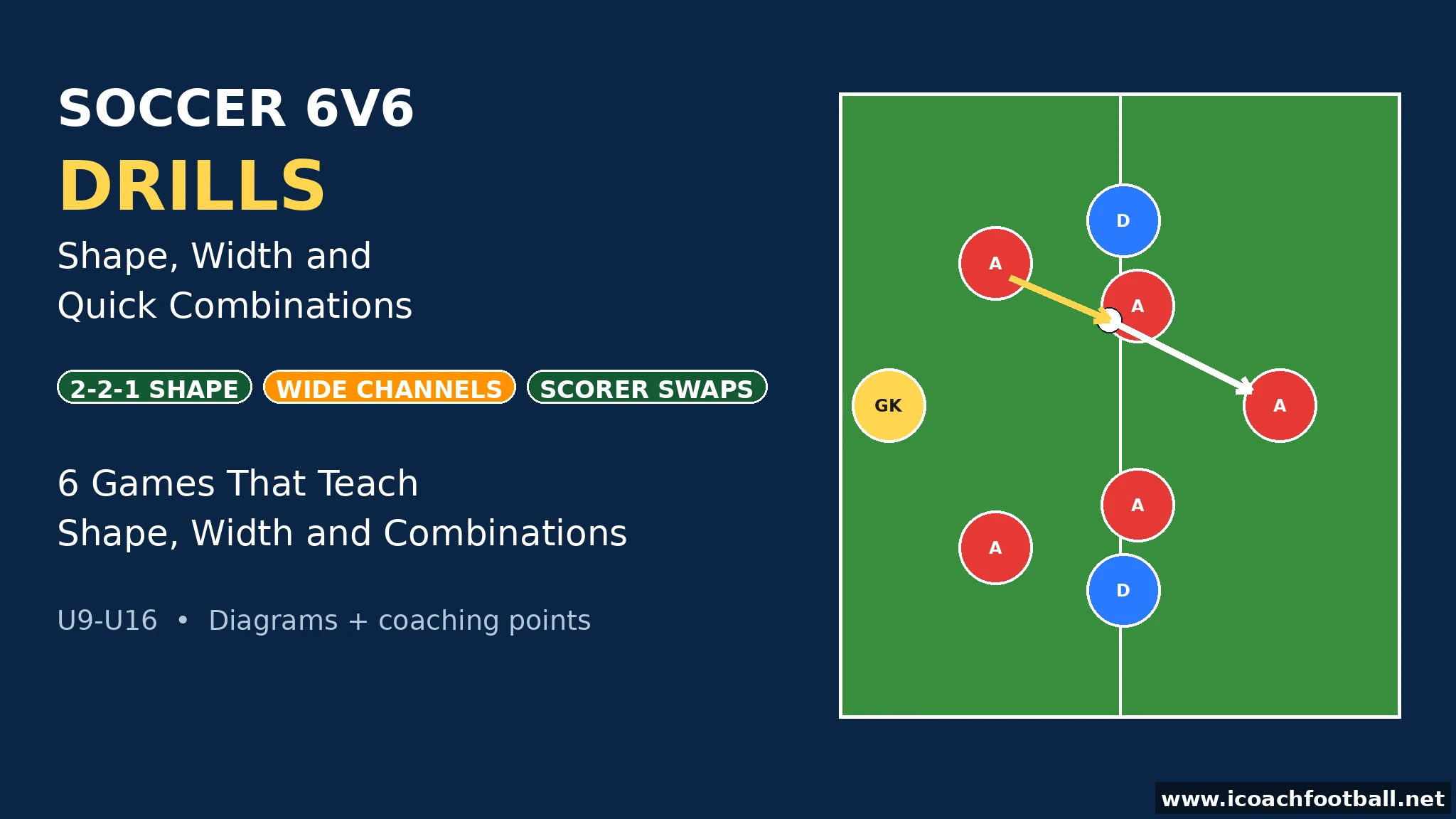
| Hold your shape | The 2-2-1 shape is the team’s skeleton — two defenders, two midfielders, one forward, and a keeper behind them |
| Use the full width | The touchlines are your extra players — a team that stays narrow gives the press an easy job |
| Combine in twos and threes | One-twos and third-man runs beat a defender faster than any dribble |
| Press in six seconds | The nearest two press the moment the ball is lost — if it is not won in six seconds, drop back into shape |
| Scan before you receive | A shoulder check tells the receiver where the pressure and the space are before the ball arrives |
| Attack and defend as six | In 6v6 there is no hiding — when the ball moves, all six players move with it |
Drill 1: 6v6+2 Progressing to Score
The FIFA Training Centre’s 6v6+2 game: a 2-2-2 shape across three zones, where a no. 6 drops in to create a 3v2 overload and the team progresses through the zones to score. The best opening drill for shape and build-up.
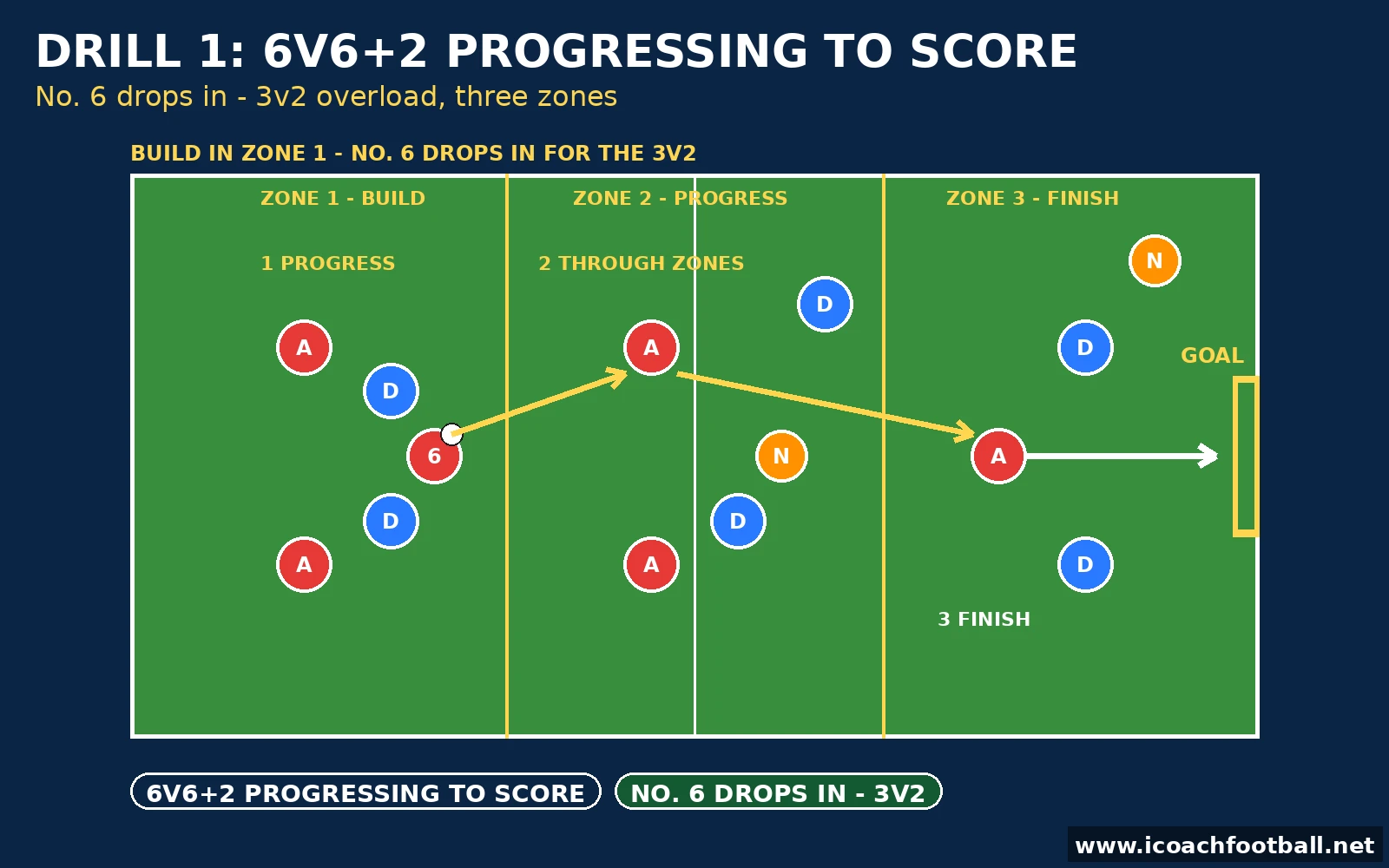
- Setup: 50 x 35 yard area split into three zones, 6v6 plus two neutral players, two full-size goals with keepers, one ball.
- How to play:
- The team in possession builds in the first zone in a 2-2-2 shape.
- The no. 6 drops into the first zone to create a 3v2 overload.
- The team must progress through the middle zone before it can attack the final zone.
- A goal only counts if the ball passed through all three zones in that attack.
- The neutrals always play with the team in possession.
- Coach’s note: Watch the no. 6 — if they stay high, the overload never happens; the cue is “drop in and make it three” every time the keeper has the ball.
- Progressions: The no. 6 must receive on the half turn; the middle zone must be crossed in two passes or fewer; remove one neutral so the overload is 6v6+1.
Drill 2: The 2-2-1 Shape Game
The shape drill. One team plays the 2-2-1 — keeper, two defenders, two midfielders, one forward — against a 1-3-1, and the lesson is who covers whom when the ball moves.
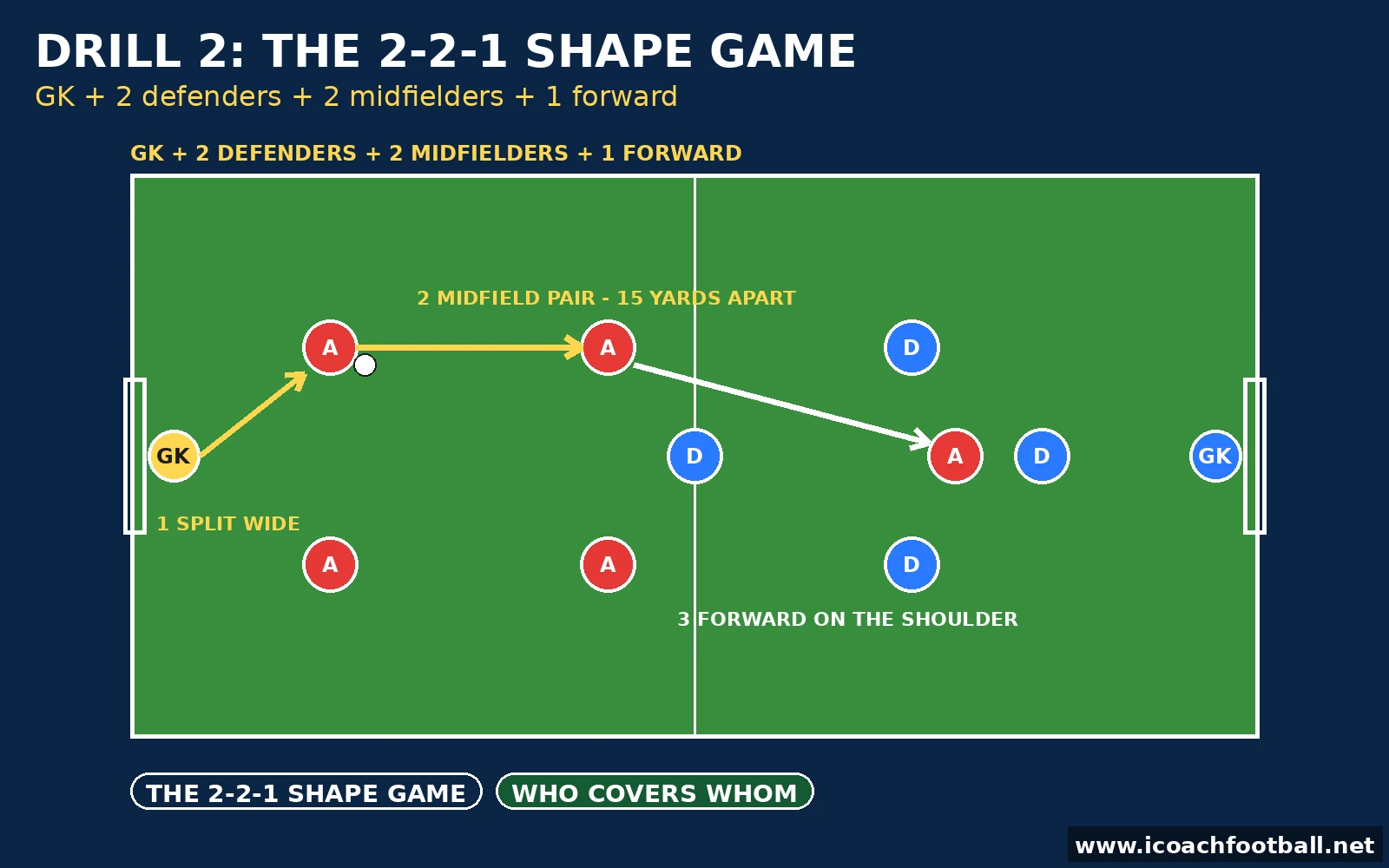
- Setup: 50 x 35 yards, two full-size goals with keepers, 6v6, one ball, cones marking a halfway line.
- How to play:
- The 2-2-1 team builds from the keeper, defenders splitting wide to the corners of the box.
- The two midfielders stay connected — no more than 15 yards apart, one high and one deep.
- The forward stays on the shoulder of the last defender, never dropping into the midfield.
- When the ball is lost, the nearest midfielder presses and the other drops to protect the defenders.
- Play 5-minute games, then swap which team holds the 2-2-1.
- Coach’s note: Freeze the game the first time the shape breaks and ask each player where they should be — the shape is the lesson, not the goal, so stop play to teach it.
- Progressions: The defenders may only pass forward through a midfielder; the forward must score from a cross or a cutback; the 1-3-1 team switches to a 2-2-1 too.
Drill 3: Wide Channels Game
A game that punishes narrow play. Two wide channels run the length of the pitch, and goals scored after a switch of play count double — so the weak side is always the answer.
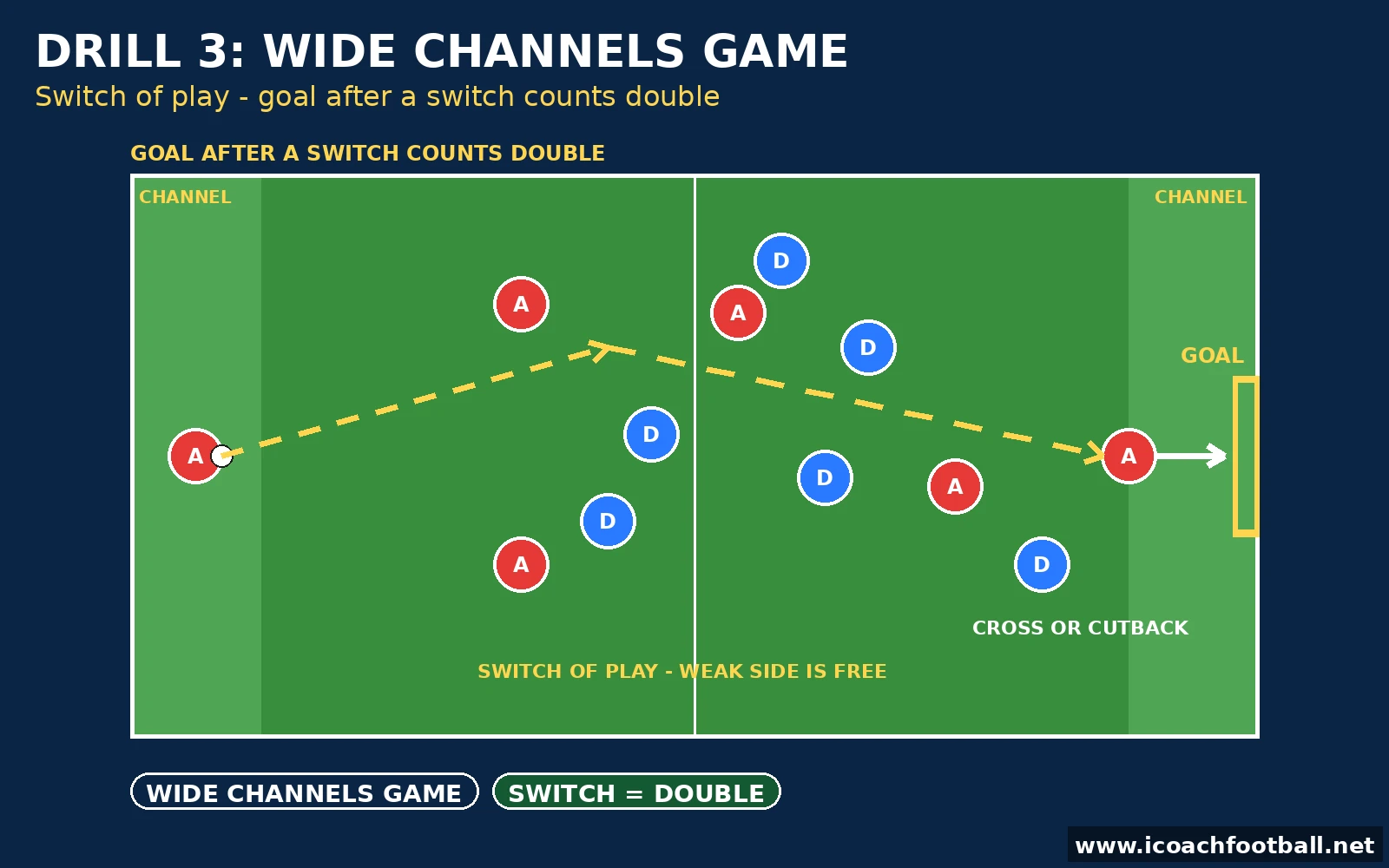
- Setup: 55 x 40 yard area with an 8-yard channel marked down each side, 6v6, two full-size goals with keepers, one ball.
- How to play:
- Play a normal 6v6 game, but the wide channels are free zones — only attackers may enter them.
- A winger receiving in a channel must cross or cut back within three seconds.
- A goal scored after a switch of play to the opposite channel counts double.
- If a team plays five passes without using a channel, the other team gets a free restart.
- Play 5-minute games, then rotate the wingers.
- Coach’s note: Shout “switch!” the moment the ball reaches a channel — the point is the pass across the pitch, not the cross itself, and teams that stay on one side get pressed into the corner.
- Progressions: Channels narrow to 6 yards; the switch must be played first time; a goal only counts if a channel player touched the ball in that attack.
Drill 4: Six-Second Win-It-Back
The counter-press in 6v6. The nearest two players press the instant the ball is lost, the rest drop into shape, and if the ball is not won in six seconds the team drops — our soccer tackling drills teach the individual duel, and this game teaches the team press.
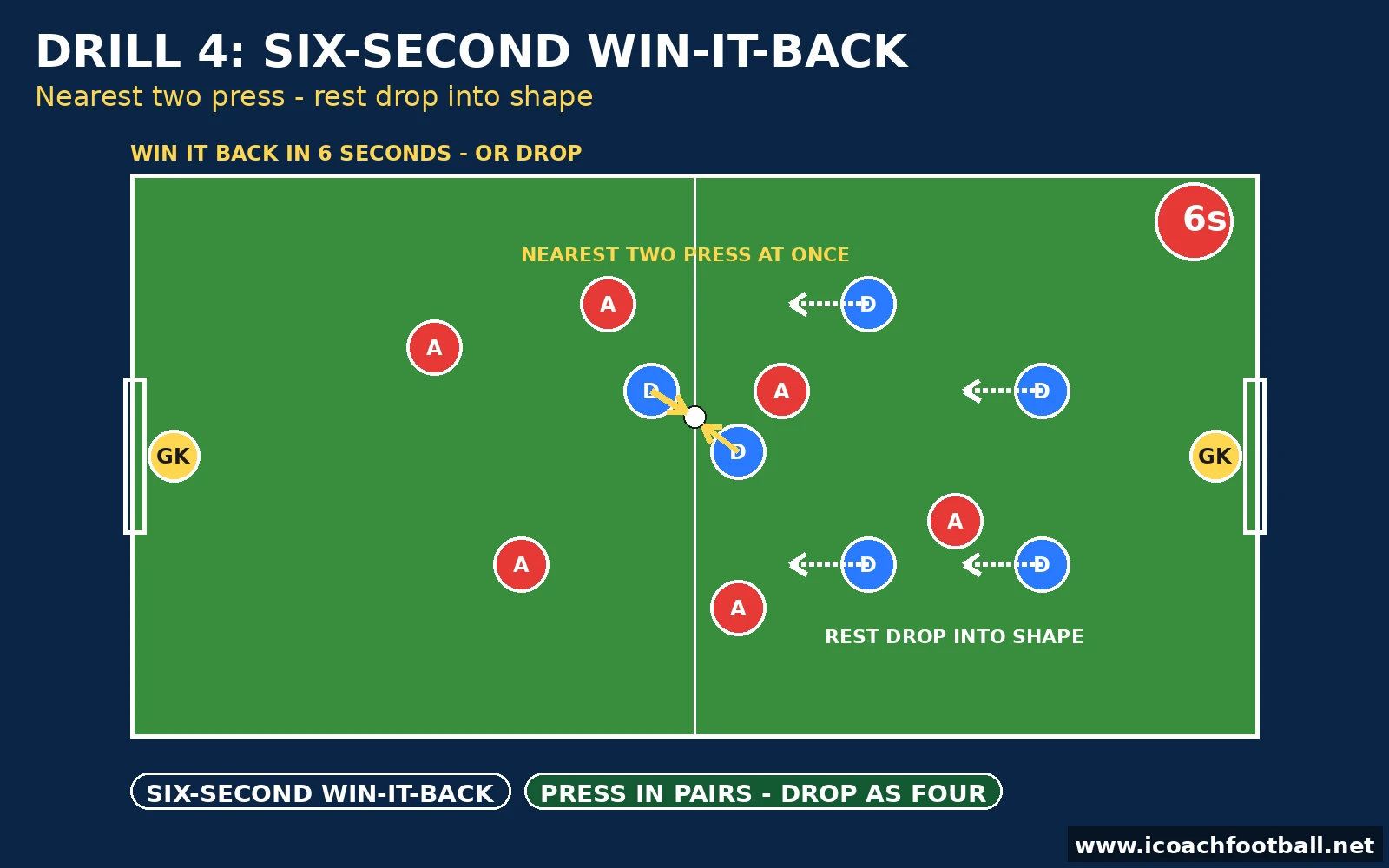
- Setup: 45 x 35 yards, two full-size goals with keepers, 6v6, one ball, a stopwatch or a loud six-second count.
- How to play:
- Play a normal 6v6 game to the big goals.
- The moment a team loses the ball, the nearest two players press immediately.
- The other four drop into the 2-2-1 shape behind the press.
- If the ball is won back within six seconds, the team attacks at once.
- If six seconds pass without winning it, the whole team drops into a compact shape.
- Coach’s note: Count the six seconds out loud — the count is the whole drill, and players start counting for themselves within two games.
- Progressions: The press must win the ball in four seconds; the pressing pair must force the ball to one side; a goal scored within ten seconds of winning it back counts double.
Drill 5: Four-Goal 6v6
Two mini-goals at each end instead of one big goal. Attackers can score at either goal, so defenders cannot guard one target — the game forces scanning, quick combinations and constant movement.
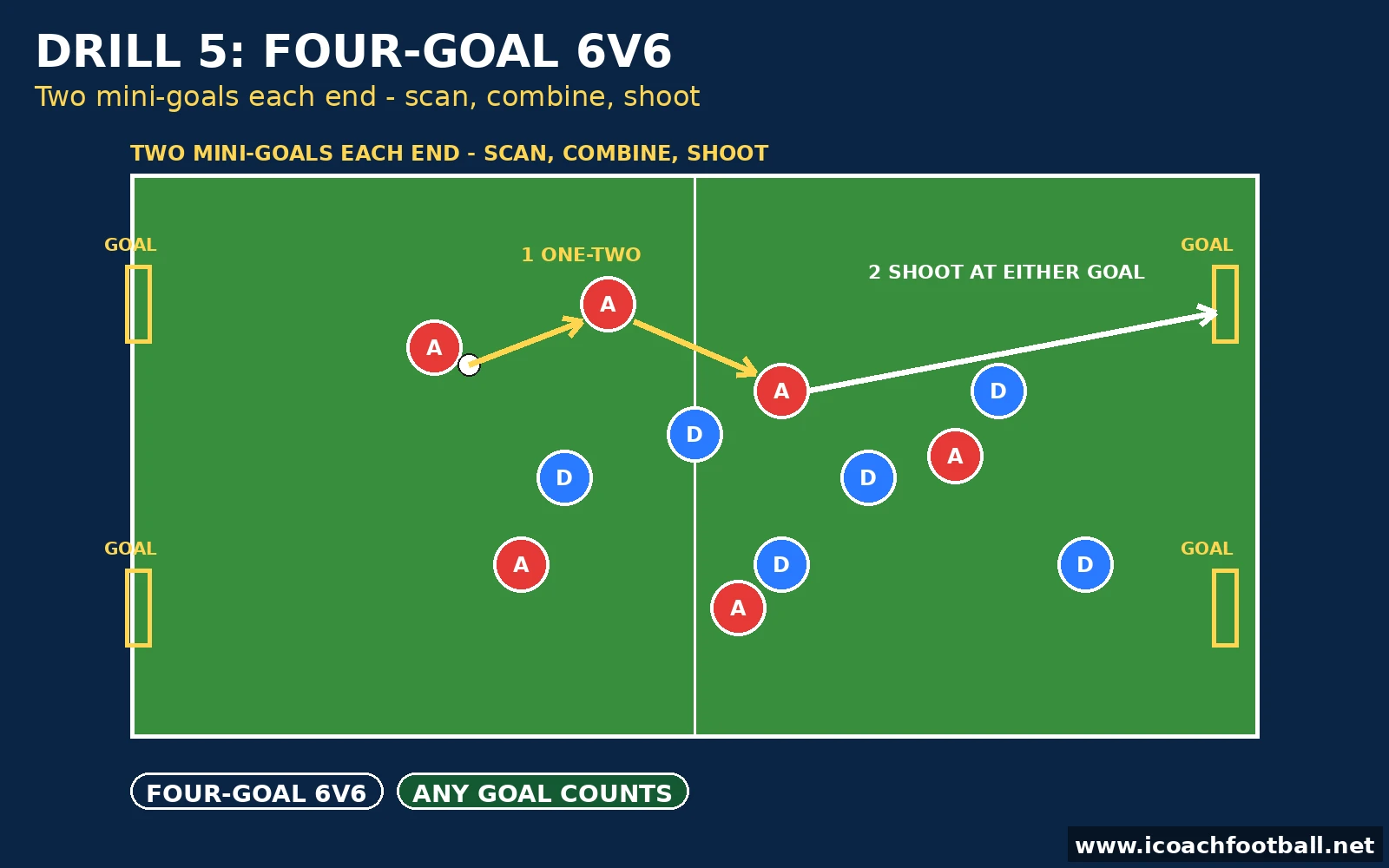
- Setup: 45 x 35 yards, four mini-goals — two at each end, 10 yards apart — 6v6, one ball, no keepers.
- How to play:
- Play a normal 6v6 game, attacking either of the two mini-goals at the far end.
- A goal only counts if the shot is taken after a one-two or a third-man combination.
- After every goal, the conceding team restarts from its own end.
- A player who receives with their back to goal must lay it off first time.
- Play 4-minute games, then swap ends.
- Coach’s note: Watch the receivers — if they never check their shoulder, they will keep choosing the wrong goal; the cue is “scan, then decide” before every first touch.
- Progressions: Goals must be scored first time; the combination must involve three players; one goal is worth double if the attack switched sides first.
Drill 6: The Scorer Swaps Game
The FIFA Training Centre’s self-balancing game: every time a player scores, they swap teams. A team that pulls ahead loses its scorer, so the game re-balances itself and nobody can hide.
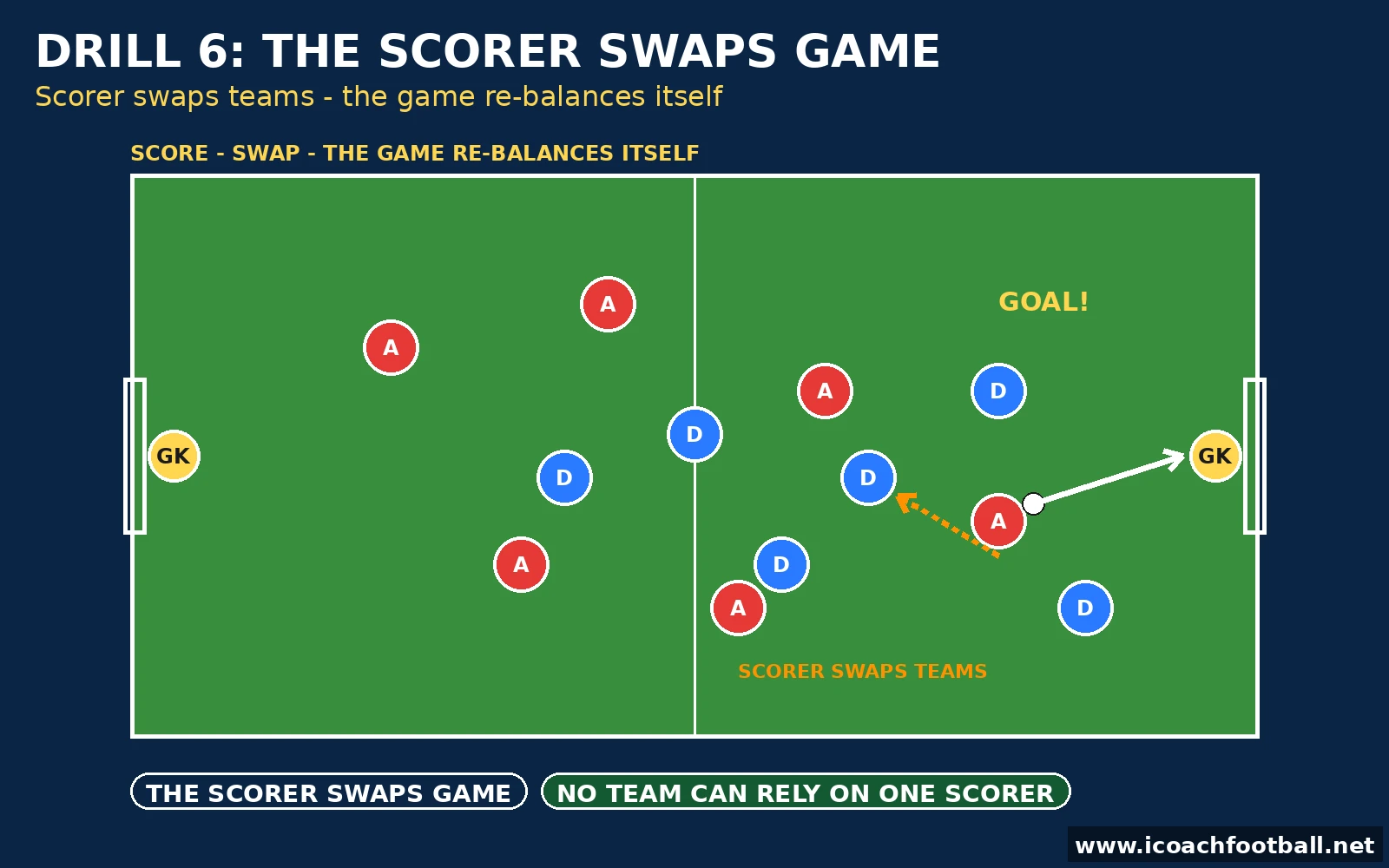
- Setup: 45 x 30 yards, two full-size goals with keepers, 6v6, one ball, bibs for one team.
- How to play:
- Play a normal 6v6 game to the big goals.
- Every time a player scores, they swap teams immediately — they take off the bib or put one on.
- The game restarts with a kick-off from the team that conceded.
- Play first to five goals, then swap the keepers and start again.
- The player who scores the fifth goal keeps the match ball — a small prize keeps the swap rule honest.
- Coach’s note: The swap is the lesson — a team that relies on one scorer loses them, so every player has to attack; watch for the quiet player who suddenly starts making runs.
- Progressions: The scorer swaps and the assister swaps too; goals only count from inside the final third; the swap happens after every two goals instead of one.
Coaching points
- Shape before skill: A team with a shape beats a team with better players and no shape — our 5v5 soccer formations guide shows where the 2-2-1 comes from.
- Passing is the tool, shape is the plan: Clean passing alone does not build an attack — our soccer passing drills build the technique, and this session builds what to do with it.
- Possession with a purpose: Keep the ball to move the defence, not to hide from it — our soccer possession drills teach the keep-ball habits this session turns into attacks.
- Scan before you receive: A player who checks over their shoulder knows where the pressure and the space are before the ball arrives — our soccer scanning drills teach that shoulder check.
- Switch play to break the press: When one side is crowded, the far side is empty — our switching play drills teach the pass that moves the whole game.
- Test it smaller first: Run these ideas at 4v4, then step up to 6v6 — our soccer 4v4 drills, soccer 3v3 drills and 2v2 soccer drills are the ladder this session sits on top of.
Common mistakes
- Forwards dropping into midfield: The forward who drops to get the ball leaves nobody to pass to — coach them to stay on the last defender’s shoulder and trust the midfield to find them.
- Midfielders standing level: Two midfielders side by side give the passer one flat option — one high, one deep, 15 yards apart, so the ball can always go forward.
- Narrow play: A team that never uses the channels lets six defenders guard 30 yards of pitch — the wide channels game punishes it until width becomes a habit.
- Pressing alone: One player chasing the ball while five watch is not a press — the six-second rule only works when the nearest two go together and the rest drop.
Age adaptations
| Age | Area | Touches | What changes |
|---|---|---|---|
| U9–U11 | 35 x 25 yards | Three touches | No pass count in Drill 1, channels are 10 yards wide in Drill 3, six seconds becomes eight in Drill 4 |
| U12–U14 | 45 x 35 yards | Two touches | Full zone rules in Drill 1, live defenders everywhere, scorer swaps after every goal in Drill 6 |
| U15–U16 | 50 x 35 yards | One or two touches | Smaller areas, four-second press in Drill 4, goals must be scored first time in Drill 5 |
60-minute session plan
| Block | Minutes | What to run |
|---|---|---|
| Warm-up | 0–10 | Drill 2, the 2-2-1 shape game, walking pace then half speed |
| Build-up | 10–20 | Drill 1, 6v6+2 progressing to score |
| Width | 20–30 | Drill 3, wide channels game |
| Pressing | 30–40 | Drill 4, six-second win-it-back |
| Goals | 40–50 | Drill 5, four-goal 6v6 |
| Match-real finish | 50–60 | Drill 6, the scorer swaps game |
For a full guide to building the hour around these blocks, see our 60-minute session plan.
FAQ
What is the best formation for 6v6 soccer?
The 2-2-1: a keeper, two defenders, two midfielders and one forward. It gives the team width at the back, a pair in midfield and a striker to aim at — and it is the shape every drill in this session is built on.
How do you teach shape to young players in 6v6?
Give each player one job and one zone first. Freeze the game the first time the shape breaks, show each player where they should be, and restart — two or three freezes in the first game teach more than a whole session of talking.
What age should 6v6 drills start?
U9 is the right time. Younger players can play the same games with bigger areas, more touches and wider channels, but the habits — hold the shape, use the width, press together — need players who can read the game.
How do you stop a 6v6 game from turning into a bunch?
Give the ball a destination. Wide channels, a switch-of-play bonus and a pass count before shooting all pull players apart — a team with somewhere to go stops chasing the ball.
Why does my team lose the ball every time they try to build from the back?
Usually because the no. 6 never drops in. Without that extra player the build-up is 2v2 at the back and the press wins — coach the drop-in first, then the forward pass.
Sources
- FIFA Training Centre — “6v6 plus 2 small-sided game: Progressing to score” (a 6v6+2 game in a 2-2-2 shape across three zones, where a no. 6 drops in to create a 3v2 overload and the team progresses through the zones to score). Drill 1 in this post is based on that game.
- FIFA Training Centre — “Different game scenarios” (a 6v6 game application in which the scorer swaps teams, so the game re-balances itself after every goal). Drill 6 in this post is based on that game.