Soccer Tackling Drills: 6 Games to Win the Ball Cleanly and Safely
Quick answer
Most tackles are lost before contact — the defender arrives off balance, too fast, or too late. These six soccer tackling drills teach the block tackle, the poke tackle and the timing to use them, so your players win the ball cleanly instead of giving away fouls.
Suitable for: U10–U18
In soccer — football to most of the world — tackling is the last skill in the defending chain, not the first. A defender who has already delayed the attacker, shown them one way and waited for the bad touch wins the ball with a short, controlled challenge. A defender who dives in wins nothing but a foul. These six games train tackling as a decision first and a contact second: arrive under control, stay on your feet, and strike the ball — not the player — at the exact moment the attacker gives you a chance.
Session snapshot
- Players: 10–16
- Area: One half of a pitch, grids 15 x 15 to 30 x 20 yards
- Duration: 60 minutes
- Focus: Block tackle, poke tackle, shoulder challenge, tackle timing, recovery tackling
- Age: U10–U18 (see Age adaptations)
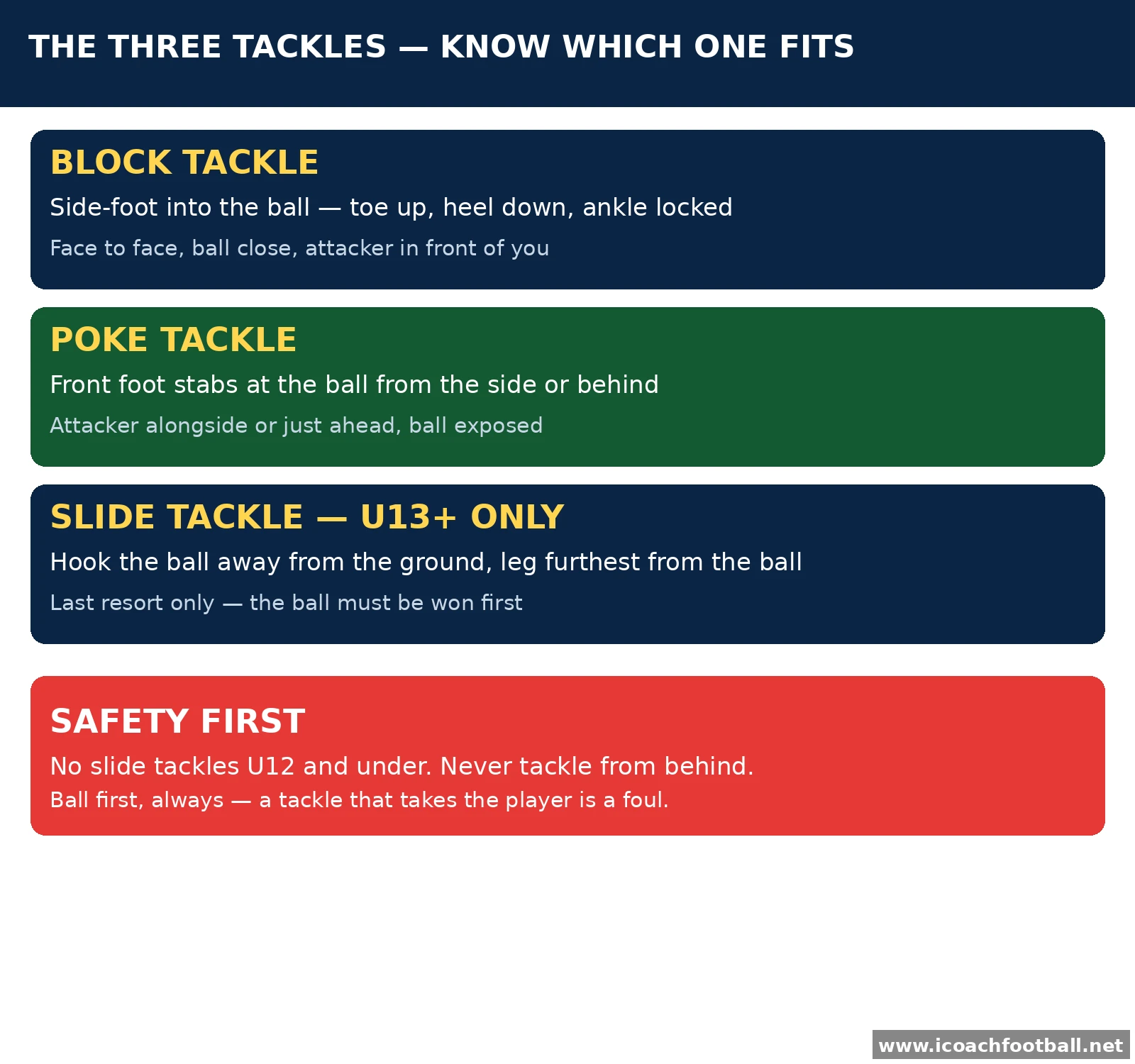
The three tackles — and when to use each
Teach the names before the contact. A player who knows which tackle fits the moment stops lunging at every ball. The approach is in line with the FIFA Training Centre’s zonal defending methodology: stay on your feet as long as possible, apply the direct-delay-deny principles, and only step across to win the ball when the moment is right.
| Tackle | What it is | When to use it |
|---|---|---|
| Block tackle | Side-foot into the ball, toe up, heel down, ankle locked, weight driving through | Face to face, ball close, attacker in front of you |
| Poke tackle | Front foot stabs at the ball from the side or behind | Attacker is alongside or just ahead, ball exposed |
| Slide tackle | Hook the ball away from the ground, leg furthest from the ball | Last resort, U13 and older only, ball must be won first |
Safety first: no slide tackles at U12 and under — teach the block and poke only. Never tackle from behind, and never teach the scissor tackle. A tackle that wins the ball first is legal; a tackle that takes the player first is a foul, whatever the intent.
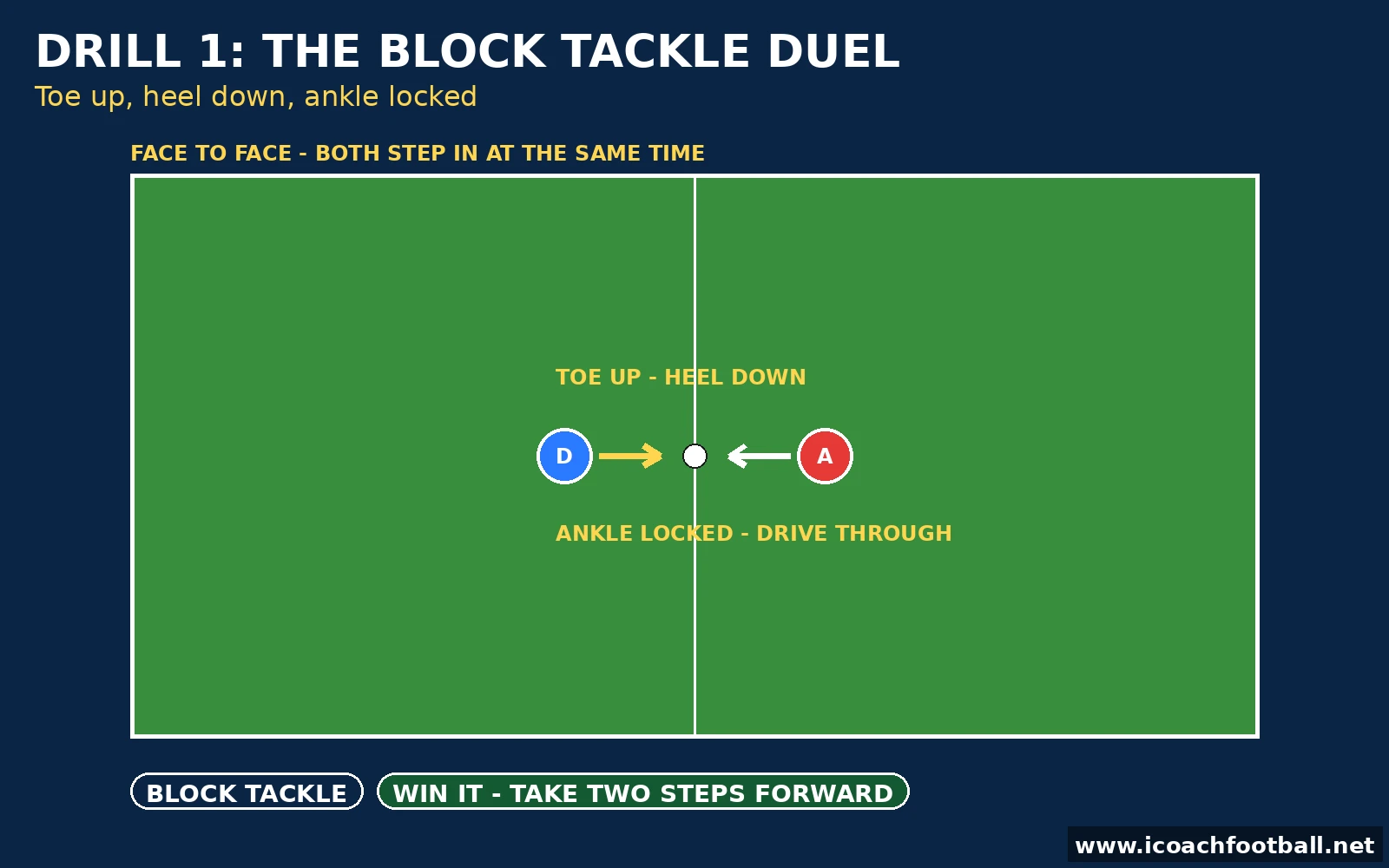
Drill 1: The Block Tackle Duel
The block tackle is the tackle everything else is built on. This duel teaches the shape — toe up, heel down, ankle locked — until it is automatic.
Setup
- Pairs facing each other, one ball between them on a cone line, 10 x 10-yard grid per pair
- 10 minutes
How to Play
- Two players stand a yard either side of the ball, tackling foot beside it.
- On your signal, both step in and block tackle at the same time.
- The player who drives their weight through the ball wins it and takes two steps forward.
- Reset and repeat, alternating the starting foot.
- After 4 reps, move the players two yards back so they must step into the tackle.
Coach’s note: Watch the ankle, not the effort. A loose ankle folds on contact and the ball goes nowhere — the cue is “toe up, heel down, ankle locked”. The tackling foot plants beside the ball, the knee drives forward and the weight follows the foot through the ball, like a firm side-foot pass. If the ball squirts sideways, the foot was not square to it. Slow the drill down until the shape is right, then add the step-in. This is the same technique England Football Learning uses in its tackling session — good contact with the ball, made under control.
Progressions: One player passes the ball in and the other must close down and block tackle on the first touch; play to three wins, loser does five press-ups.
Drill 2: Poke and Go
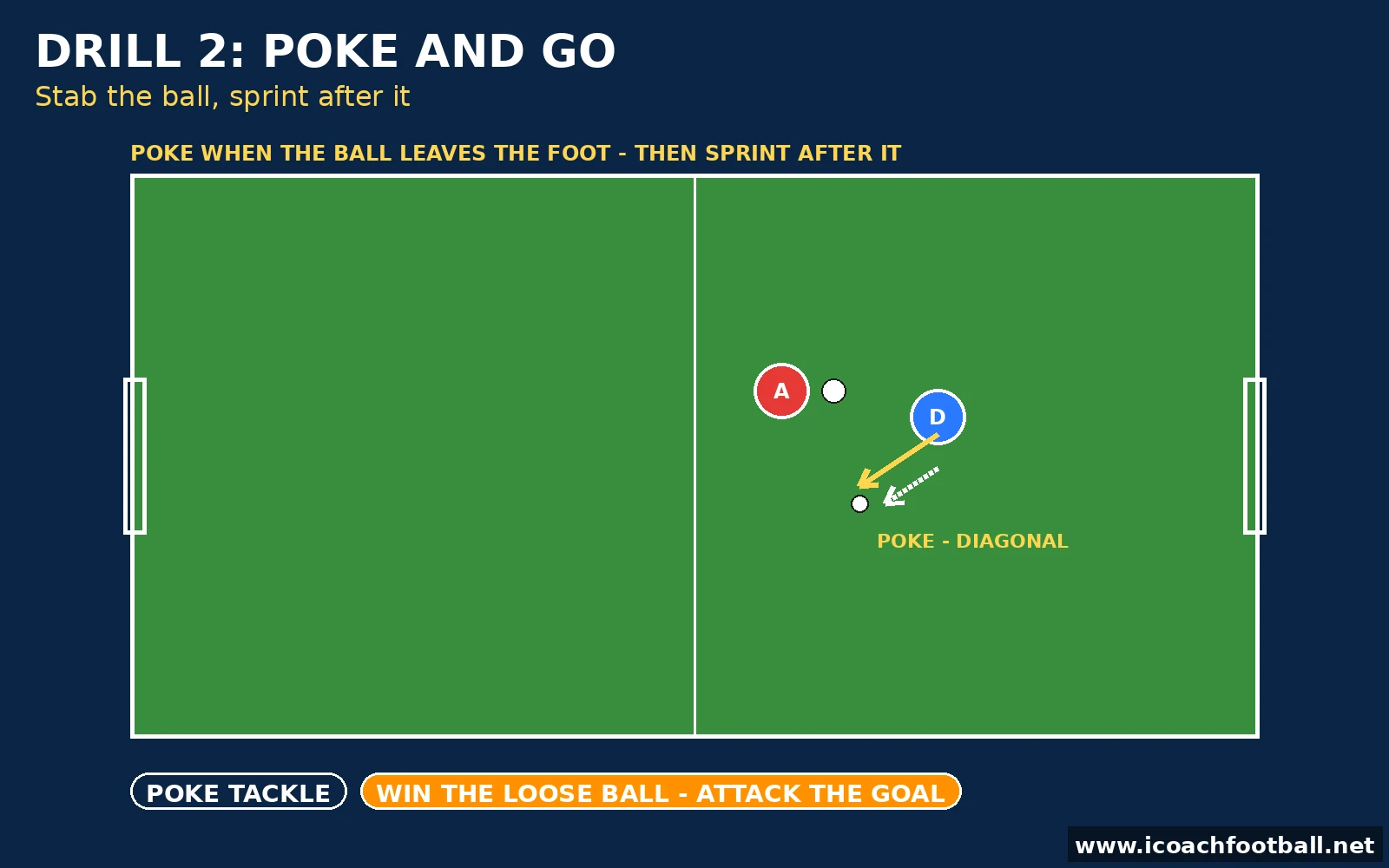
The poke tackle wins the ball when the attacker is already past you — but only if the defender recovers fast enough to use it. This game trains the stab and the sprint after it.
Setup
- 20 x 15-yard grid, 1 attacker, 1 defender, 1 mini-goal each end, 1 ball
- 10 minutes
How to Play
- The attacker dribbles at the defender, who jockeys and stays goal-side.
- When the attacker takes a touch past the defender, the defender pokes at the ball with the front foot.
- The poke must be diagonal, across the attacker’s path, so the ball goes to space the defender can reach.
- Whoever wins the loose ball attacks the mini-goal at that end.
- Rotate roles every 4 reps so both players practise the poke and the recovery.
Coach’s note: The mistake is the lunge — a defender who throws a leg at the ball from two yards away is beaten twice. The poke only works from touching distance, with the weight on the back foot and the front foot free to stab. Teach the trigger: poke when the ball leaves the attacker’s foot, never while it is under it. If the poke misses, the defender must sprint back goal-side in two steps, not stand and watch. The recovery after a missed tackle is trained in full in Drill 5.
Progressions: The attacker may use a skill move, so the defender must wait for the touch, not the feint; shrink the grid to 15 x 12 yards, so the poke must be faster.
Drill 3: Shoulder to Shoulder
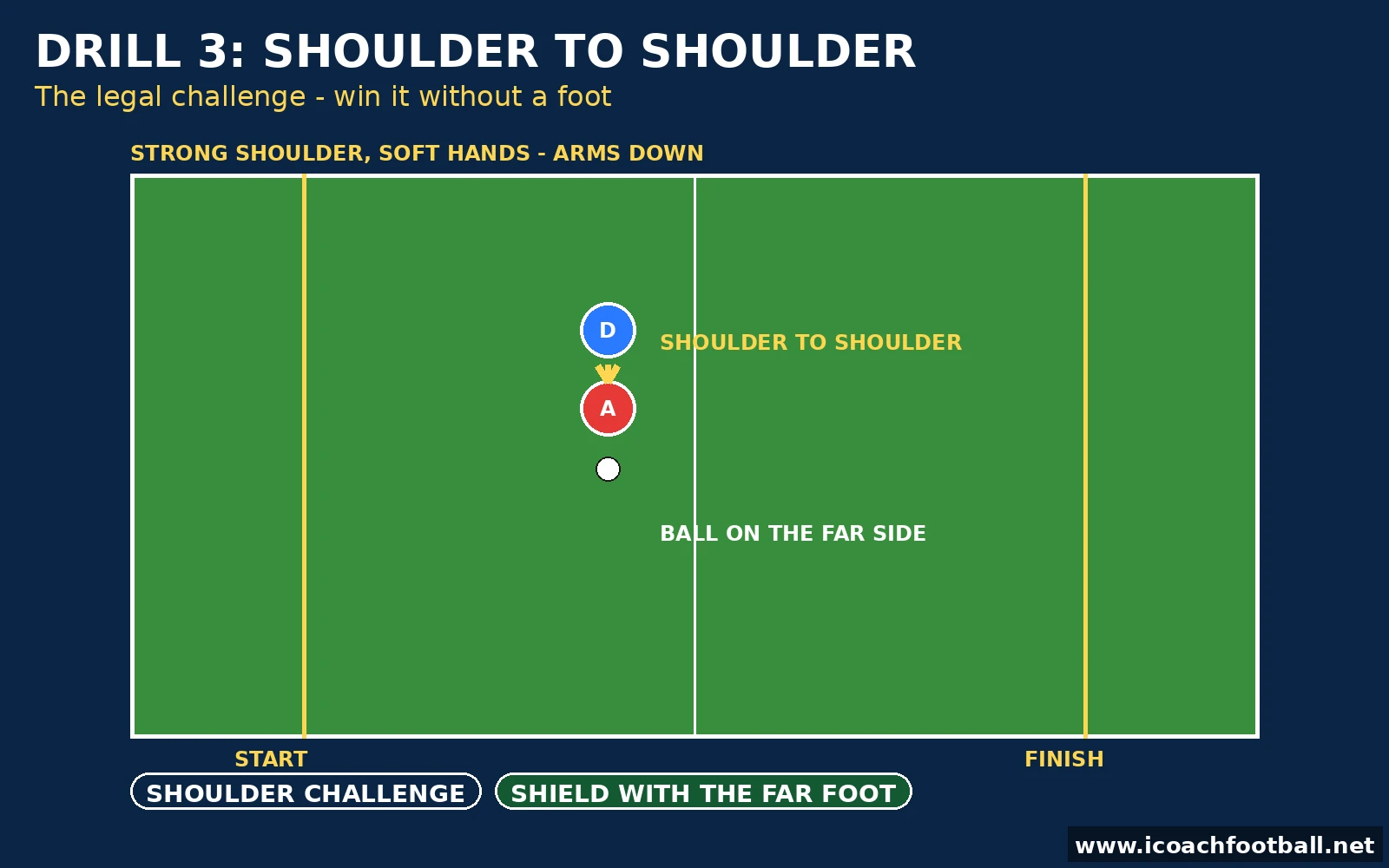
Some balls are won without a foot at all. This game teaches the legal shoulder challenge — and the strength to hold the attacker off the ball.
Setup
- 15-yard channel with a start line and a finish line, pairs side by side, 1 ball per pair
- 10 minutes
How to Play
- Two players walk side by side down the channel, shoulder to shoulder, one dribbling the ball.
- The defender uses shoulder and hip to push the dribbler off balance and steal the ball.
- The dribbler shields the ball with the foot furthest from the defender.
- Swap roles at the finish line and walk back.
- Build to a jog, then a run, over the 10 minutes.
Coach’s note: The challenge is legal only shoulder to shoulder, with the arms down — a push with the hands or a charge from behind is a foul. Teach the stance first: knees bent, low centre of gravity, weight on the balls of the feet. The cue phrase is “strong shoulder, soft hands”. If a player keeps getting pushed off the ball, check their shielding foot: the ball must be on the far side, protected by the body, not between the two players. This drill is the foundation for every wide-area duel — the same strength that wins the shoulder battle is what holds the attacker up in our soccer defending 2v1 drills.
Progressions: The dribbler must reach the finish line to score; the defender scores by winning the ball and reaching the start line.
Drill 4: Tackle or Jockey?
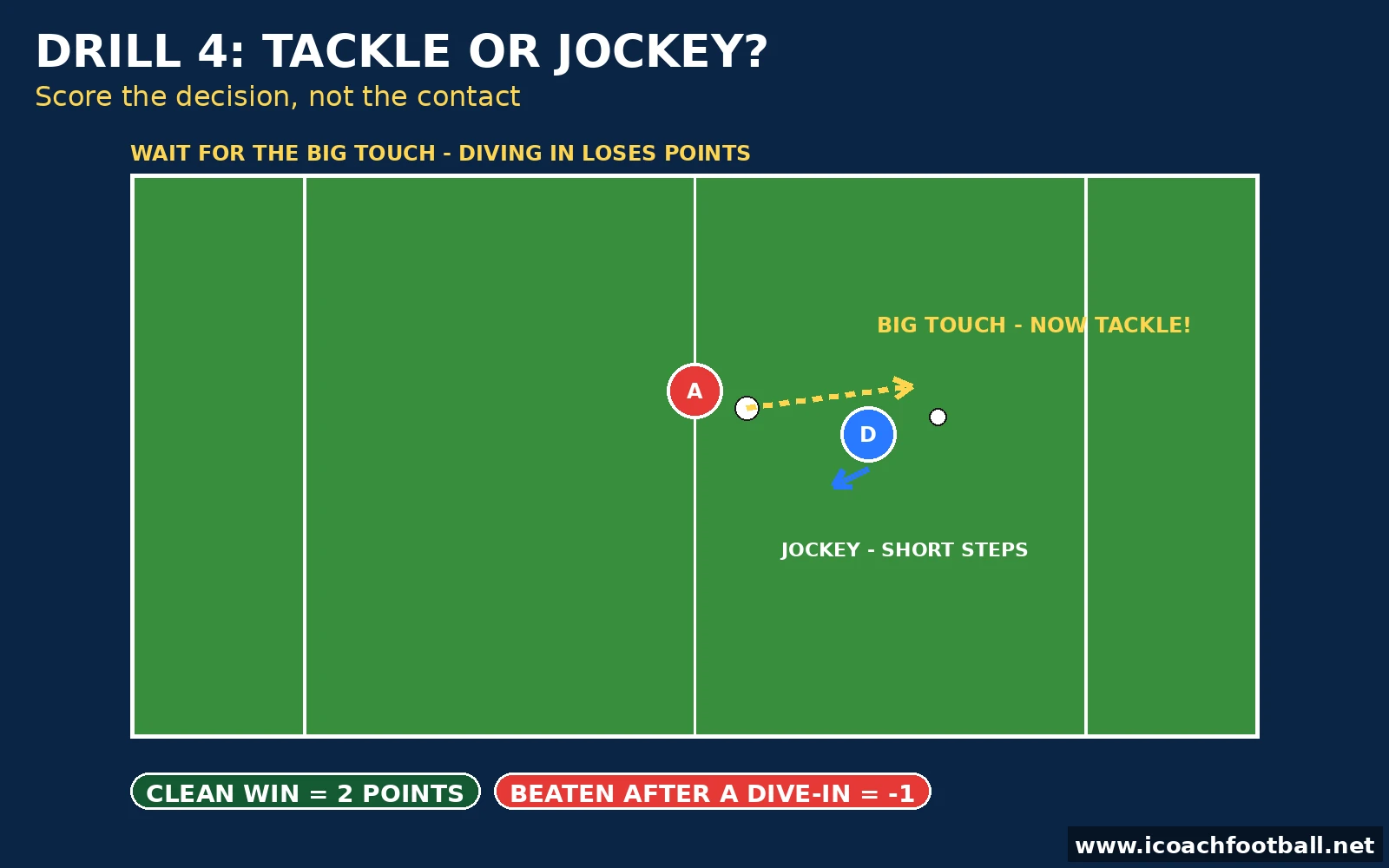
The best tacklers tackle least. This game scores the decision, not the contact — tackle at the right moment and win, dive in early and lose.
Setup
- 20 x 15-yard grid with a line at each end, 1 attacker, 1 defender, 1 ball
- 12 minutes
How to Play
- The attacker tries to stop the ball on the defender’s line; the defender tries to win it.
- The defender starts by jockeying — side-on, goal-side, short steps — and may only tackle when the attacker’s touch gets big.
- If the defender wins the ball cleanly, they score 2 points.
- If the defender dives in and is beaten, the attacker scores 2 points and the defender loses 1.
- Swap roles every 3 reps; first to 10 points wins.
Coach’s note: The scoring does the coaching here — players who dive in lose points fast, so they learn patience without a lecture. Watch for the trigger moments: a heavy first touch, the ball bouncing, the attacker looking down at the ball. Those are the moments to step in. The cue phrase is “wait for the big touch”. The jockeying shape that makes this work is trained in our 1v1 defending drills jockeying post — this drill adds the decision of when the delay ends.
Progressions: The attacker gets two touches maximum, so the bad touch comes sooner; add a second attacker, so the defender must choose which duel to win.
Drill 5: The Recovery Tackle
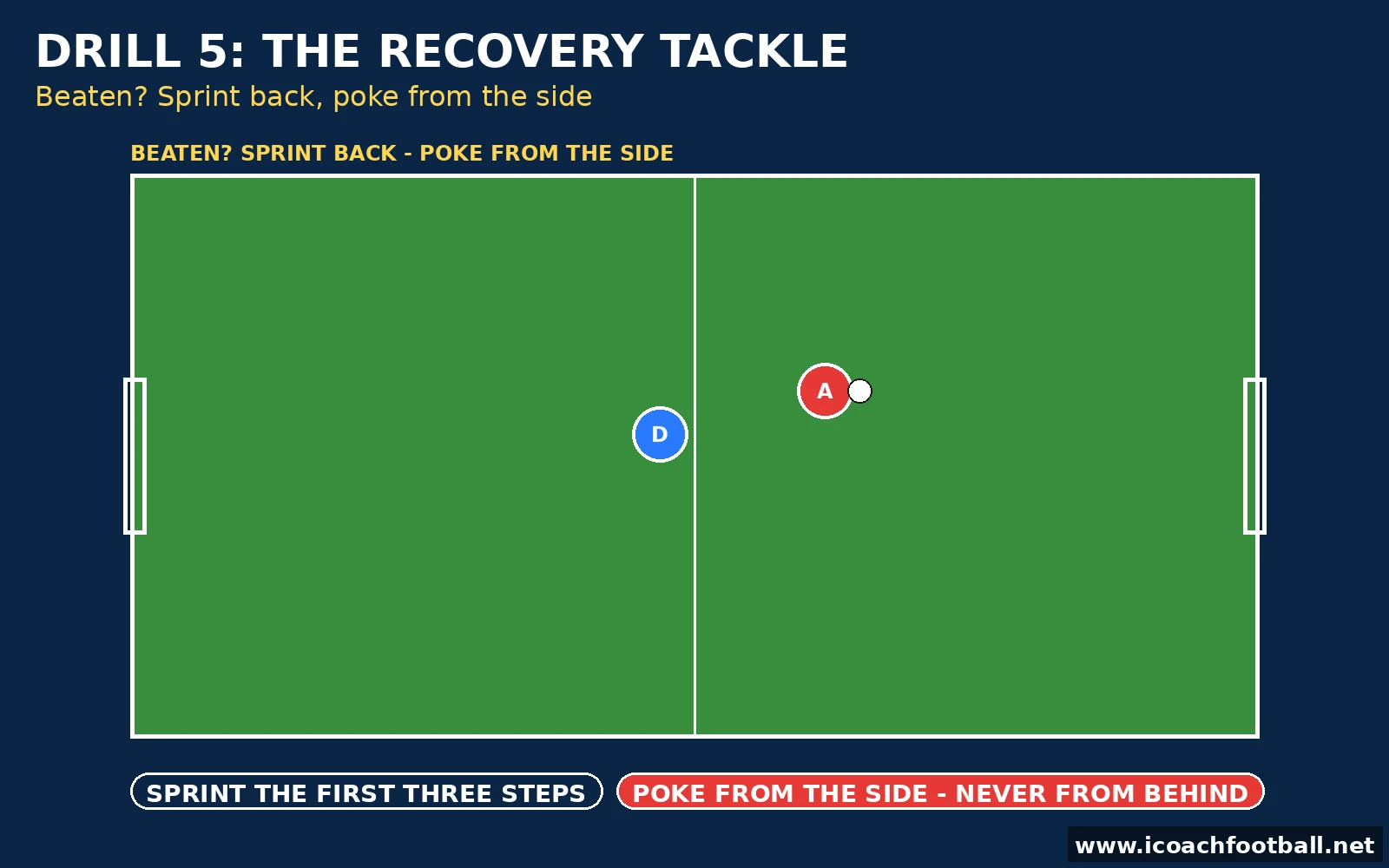
Being beaten is not the end of the duel — it is the start of the recovery. This game trains the sprint back and the poke tackle from behind the attacker. Watch the animation below the diagram: the attacker beats the defender, the defender recovers at full pace, and the poke tackle wins the ball from the side as the attacker shoots.
Setup
- 30 x 20-yard grid with a goal at each end, 1 attacker, 1 defender, 1 ball
- 12 minutes
How to Play
- The attacker receives a pass and takes on the defender 1v1.
- The defender jockeys and tries to win the ball — but the attacker is allowed one skill move to get past.
- Once beaten, the defender sprints to recover goal-side of the attacker.
- As the attacker shapes to shoot, the defender pokes the ball away from the side with the front foot.
- If the tackle wins the ball, the defender scores 2 points; if the attacker scores, the defender loses 1.
Coach’s note: The recovery run is the drill, not the tackle. A defender who jogs back after being beaten never gets close enough to poke — the cue is “sprint the first three steps, then read the ball”. The poke must come from the side, never from directly behind, or it is a foul. And the timing is everything: poke as the attacker plants their standing foot to shoot, when the ball is furthest from their body. If the defender keeps arriving too late, move the starting positions closer together until the recovery is possible, then stretch them again. The same recovery sprint is what saves goals in our football defensive transition drills, where the first three steps back decide whether the counter-attack is stopped.
Progressions: The attacker starts closer to goal, so the recovery must be faster; the defender must win the ball and then play out to a target player to score.
Drill 6: The Win-It-Back Game
Tackling learned in isolation dies in a game. This conditioned game scores clean tackles alongside goals, so the habit survives contact with real opponents.
Setup
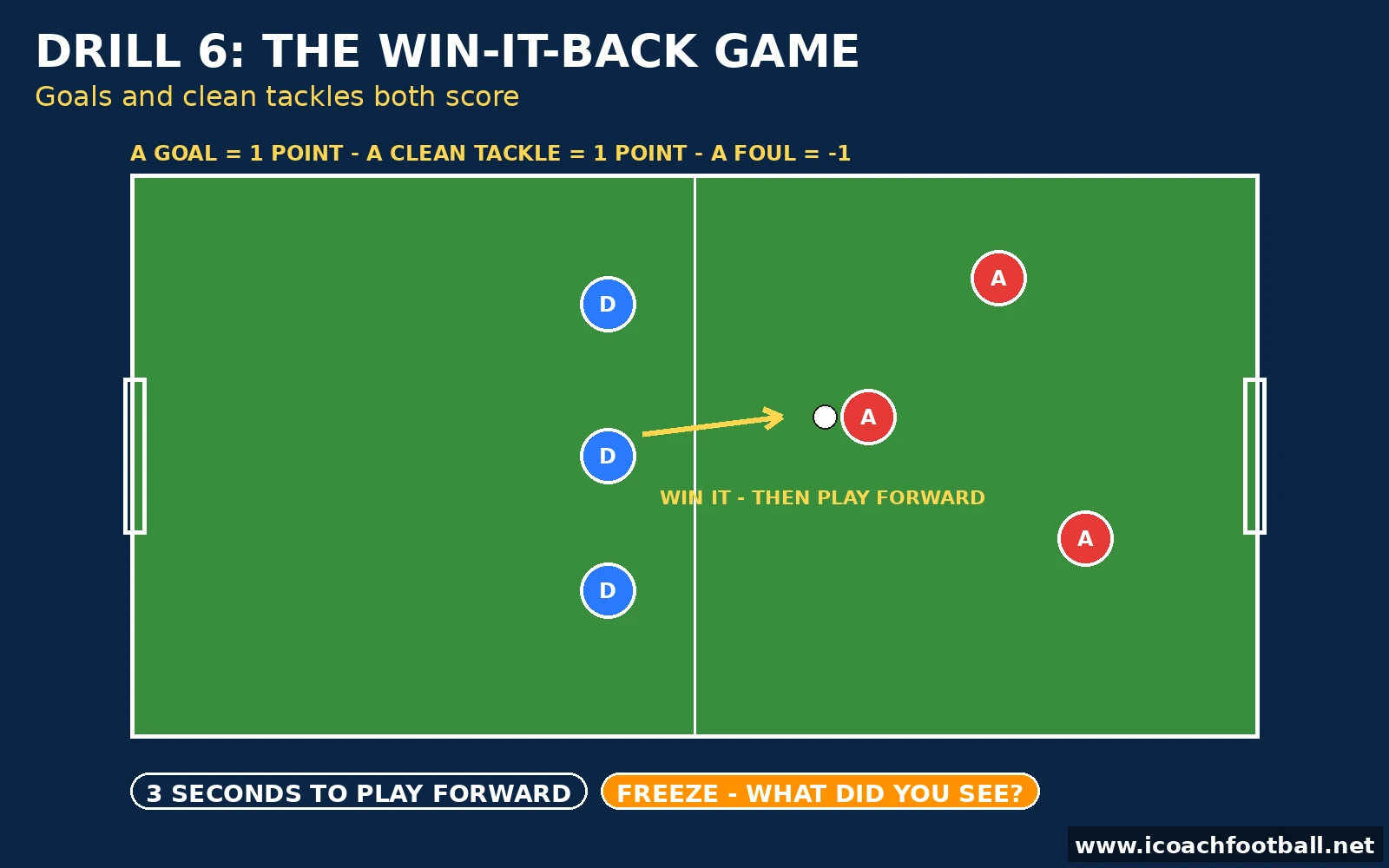
- Half a pitch, one full-size goal, 3v3 plus goalkeepers, 1 ball
- 16 minutes
How to Play
- Play 3v3 with a simple scoring rule: a goal counts 1 point, a clean tackle that wins possession counts 1 point.
- A tackle only counts if the ball is won first — a foul costs the team 1 point.
- After every tackle, the winning team must play forward within three seconds, or the point is lost.
- The coach freezes play every 4 minutes and asks one defender: “What did you see before you tackled?”
- Play four 4-minute blocks with a 1-minute break; rotate the goalkeepers each block.
Coach’s note: The three-second rule is the point of the game — a tackle that wins the ball and then gives it straight back is a wasted tackle. The freeze-frame question is the coaching: if the defender can name the trigger (big touch, back to goal, ball bouncing), the timing will come. If they cannot, they are guessing, and the fouls will follow. This is counter-pressing in miniature — the same win-it-back instinct trained in our counter-pressing soccer drills, scored one tackle at a time.
Progressions: Remove the goalkeepers, so every tackle must end with a pass to a target; play 4v4, so the tackle must be chosen, not chased.
Coaching points
- Arrive under control. Close down fast, slow down early, set your feet. A tackle made at full sprint is a foul waiting to happen.
- Stay on your feet. The block and the poke are made standing up. Go to ground only when the ball is there to be won — and only at U13 and older.
- Ball first, always. If you cannot see the ball clearly, you cannot tackle it. Win the ball, then worry about where it goes.
- Wait for the trigger. A big touch, a bouncing ball, the attacker looking down — those are the moments. Tackling a player in full control of the ball is a coin flip you usually lose.
- Win it, then use it. A tackle is the start of the attack, not the end of the defence. Play forward within three seconds.
- Recover when beaten. The first three steps back decide whether you get a second chance. Jog back and the duel is over.
Common mistakes
- Diving in. The defender lunges at the ball from two yards away and is beaten twice. Fix it with Drill 4 — the scoring punishes the dive-in.
- Tackling from behind. The defender reaches around the attacker and takes the player first. Fix it with Drill 5 — the poke must come from the side, never from directly behind.
- A loose ankle. The block tackle folds on contact and the ball goes nowhere. Fix it with Drill 1 — “toe up, heel down, ankle locked” until it is automatic.
- Sliding too young. U12s copying slide tackles they see on television. Fix it with the safety rule — block and poke only until U13, and coach the parents too.
- Winning it and losing it. The tackle is clean, then the ball is given straight back. Fix it with Drill 6 — play forward within three seconds or the point is lost.
Age adaptations
| Age group | How the drills change |
|---|---|
| U10–U12 | Drills 1, 2 and 3 only, at walking and jogging pace. Block and poke tackles only — no slide tackles, no shoulder charges at full speed. Teach the shape before the contact, and keep the pairs matched for size. |
| U13–U15 | Add Drill 4 and Drill 5, with the slide tackle introduced only in Drill 5 and only when the ball is clearly there to be won. Start scoring the decision, not the contact. |
| U16–U18 | Full speed, live attackers, slide tackles allowed when ball-first. Add the second attacker in Drill 4 and the 4v4 progression in Drill 6. The defender must also call the tackle — “Mine!” — so team-mates hold their shape. |
| Adults | Add the offside line to Drill 5, and let defenders choose the tackle type themselves. In Drill 6, add the foul rule from the Laws — a tackle from behind is a free kick and a card risk, so the cost is real. |
60-minute session plan
| Block | Time | What to run |
|---|---|---|
| Warm-up | 0–8 min | Shoulder-to-shoulder walking duels (Drill 3 at walking pace), then light jogging |
| Drill 1 | 8–18 min | The Block Tackle Duel — toe up, heel down, ankle locked |
| Drill 2 | 18–26 min | Poke and Go — the stab and the sprint after it |
| Drill 3 | 26–34 min | Shoulder to Shoulder — the legal challenge |
| Drill 4 | 34–44 min | Tackle or Jockey? — score the decision, not the contact |
| Drill 5 | 44–54 min | The Recovery Tackle — sprint back, poke from the side |
| Game | 54–60 min | The Win-It-Back Game — clean tackles score (extend to 16 minutes if time allows) |
Sources
- FIFA Training Centre — “Building the foundations of collective defending”: individual defending begins with the direct, delay and deny principles — apply immediate pressure, delay the attacker once close, force attackers onto their weaker foot, stay on your feet as long as possible, and step across using hips and arms to force the attacker off the ball. https://www.fifatrainingcentre.com/en/practice/talent-coach-programme/zonal-defending/zonal-defending-1.php
- England Football Learning — “Tackling session: small-sided duel”: a 15×15-yard diamond duel where defenders win the ball by tackling cleanly and counter quickly; coaching focus on making good contact with the ball when tackling and using the STEP framework to adjust space, task, equipment and players. https://learn.englandfootball.com/sessions/resources/2023/Tackling-session-small-sided-duel
FAQ
When should a defender tackle, and when should they jockey?
Tackle when the attacker gives you a trigger: a heavy touch, a bouncing ball, the ball out in front of their body, or the attacker looking down at the ball. Jockey when the attacker is in full control — stay goal-side, side-on, and wait. Drill 4 trains exactly this decision: tackle at the right moment and win, dive in early and lose.
What is the correct technique for a block tackle?
Plant the non-tackling foot beside the ball, toe up and heel down on the tackling foot, ankle locked, knee driving forward and body weight following the foot through the ball — like a firm side-foot pass. The contact is through the centre of the ball, never a swing at it. Drill 1 builds this shape until it is automatic.
Are slide tackles safe for youth players?
Not before U13. Young players lack the timing and body control to slide safely, and most youth slide tackles win the player before the ball. Teach the block tackle and the poke tackle first, introduce the slide only at U13 and older, and only when the ball is clearly there to be won with the leg furthest from the ball.
How do you coach a player who dives in too much?
Score the decision, not the tackle. In Drill 4, a clean win is 2 points and being beaten after a dive-in costs a point — players who lunge learn patience fast, because the score punishes it. Off the pitch, ask “What did you see before you tackled?” — if they cannot name the trigger, they were guessing.
What is a poke tackle, and when should players use it?
A poke tackle is a short stab at the ball with the front foot, used when the attacker is alongside or just ahead and the ball is exposed — typically after a recovery run or when the attacker takes a touch past you. The weight stays on the back foot, the poke is diagonal across the attacker’s path, and the defender must sprint after the loose ball. Drill 2 and Drill 5 train it.