Elite Small-Sided Games for Football Conditioning [PDF]
Quick answer: Small-sided games (SSGs) in football conditioning replace traditional running by using the ball to build match-specific fitness. By manipulating pitch size, player numbers, and work-to-rest ratios, coaches can target aerobic endurance, anaerobic power, and repeated sprint ability while simultaneously improving tactical decision-making.
For decades, football fitness meant running laps around the pitch without a ball. Today, elite coaches understand that the most effective way to build match-day stamina is through small-sided games in football conditioning.
SSGs replicate the exact physical, technical, and tactical demands players will face in a 90-minute match. Whether you are managing a youth academy or a senior squad, integrating the ball into your fitness regime ensures your players are building stamina while improving their first touch, spatial awareness, and decision-making.
Below, we break down the science of SSG periodization and share three elite-level conditioning formats. You can also download our complete Small-Sided Games in Football Conditioning PDF at the bottom of this masterclass to take these sessions to your training ground.
The Science of SSG Conditioning: Aerobic vs. Anaerobic
To get the most out of your training sessions, you must understand how different game formats trigger different physical adaptations. You cannot simply throw players into a 5v5 and expect perfect conditioning.
Aerobic Conditioning (Large Spaces, More Players): Formats like 7v7 or 8v8 on a larger pitch (e.g., 60×40 yards) require longer, sustained running. This builds the cardiovascular base needed to last a full 90 minutes.
Anaerobic Power (Small Spaces, Fewer Players): Formats like 3v3 or 4v4 in tight spaces (e.g., 30×20 yards) force rapid accelerations, decelerations, and high-intensity changes of direction. This replicates the explosive actions needed to break lines and press aggressively.
Repeated Sprint Ability (Transition Games): Adding directional constraints or transitional rules forces players to sprint back and forth continuously, mimicking the physical cost of a counter-attack.
3 Variables You Must Manipulate
To control the exact physical load of your small-sided games, you must become a master of tweaking three key variables:
| Variable | How to Adjust It | Physical Result |
|---|---|---|
| Pitch Dimensions | Increase the area per player (e.g., 100m² to 200m² per player). | Increases total distance covered and peak sprint speeds. |
| Touch Limits | Restrict players to 1 or 2 touches. | Dramatically increases game speed, heart rate, and mental fatigue. |
| Work-to-Rest Ratio | Change a 10-minute game to 4 sets of 2 minutes (with 1 min rest). | Shifts the focus from sustained aerobic endurance to explosive anaerobic power. |
3 Essential SSG Conditioning Drills
Here is a sneak peek at three high-intensity drills featured in our downloadable PDF. These are designed to push your players into the critical heart-rate zones required for elite fitness.
1. 3v3+2 High-Intensity Transition (Anaerobic Focus)
This drill creates constant physical overload by forcing the defending team to press relentlessly to win the ball back.
Setup
- Create a 25 × 20-yard grid.
- Play 3v3 inside the grid, with 2 neutral players (jokers) on the outside edges.
- Work/Rest: 6 sets of 90 seconds work, with 90 seconds of rest (1:1 ratio).
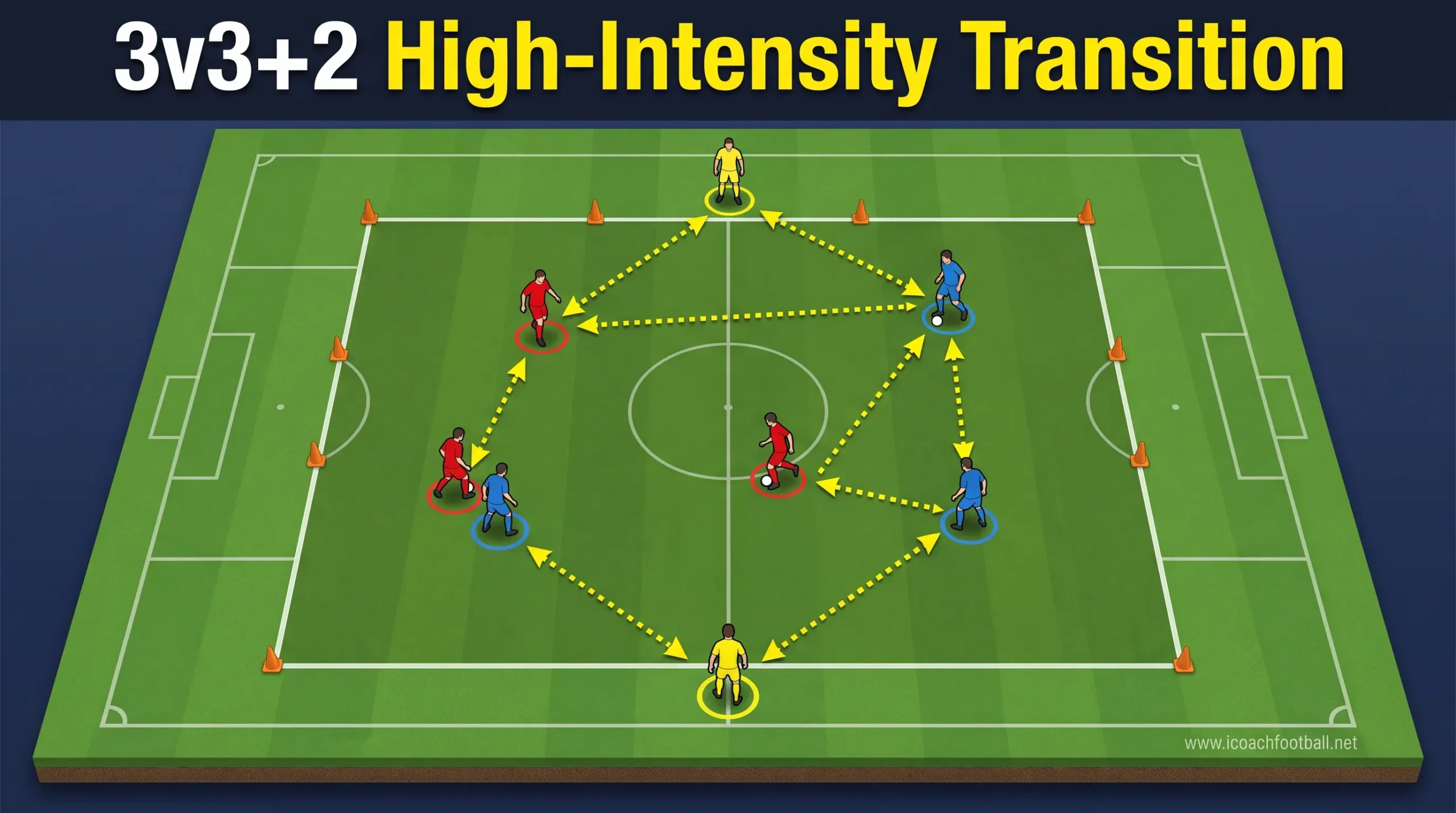
Why it works: The attacking team always has a 5v3 numerical advantage. This forces the 3 defenders to work at absolute maximum anaerobic capacity to press the ball. Because the work interval is only 90 seconds, the intensity must remain at 100%.
2. 6v6 Possession to Target Zones (Aerobic Focus)
Designed for mid-week training, this larger format builds sustained cardiovascular endurance while focusing on breaking defensive lines.
Setup
- Create a 50 × 40-yard grid.
- Mark a 5-yard “target zone” at each end of the pitch.
- Teams score by successfully passing to a teammate who is making a dynamic run into the opponent’s target zone.
- Work/Rest: 3 sets of 6 minutes work, with 2 minutes of rest.
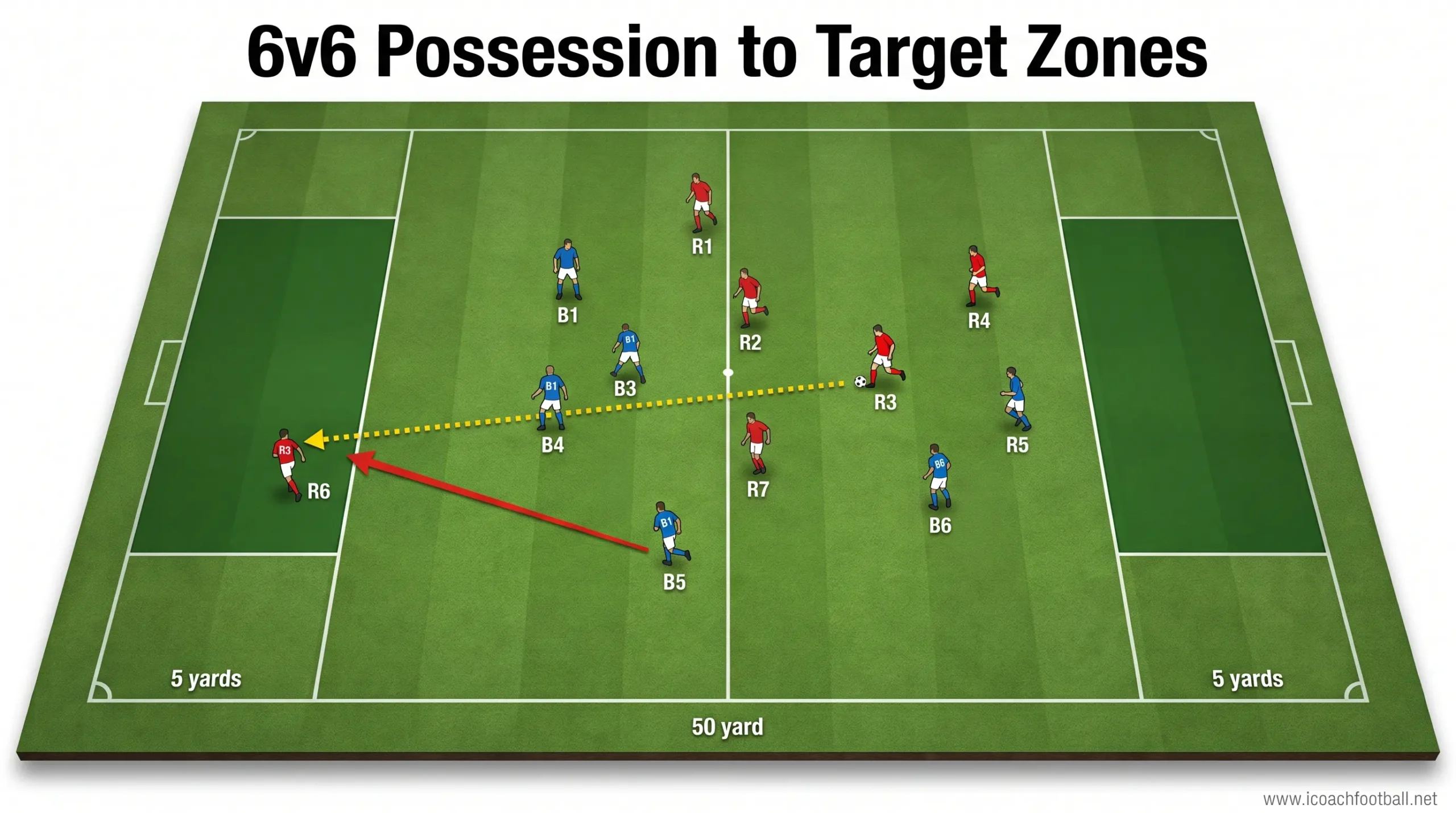
Why it works: The larger pitch size allows players to open up their strides, increasing total distance covered. The target zones force continuous off-the-ball movement, ensuring the heart rate remains consistently elevated in the aerobic training zone (75-85% max HR).
3. 4v4 to Four Mini-Goals (Repeated Sprint Ability)
This multi-directional game creates chaotic transitions, forcing players to react and sprint continuously.
Setup
- Create a 35 × 35-yard square grid.
- Place one mini-goal on each of the four sides of the square.
- Each team defends two adjacent goals and attacks the other two.
- Work/Rest: 5 sets of 3 minutes work, with 90 seconds of rest.
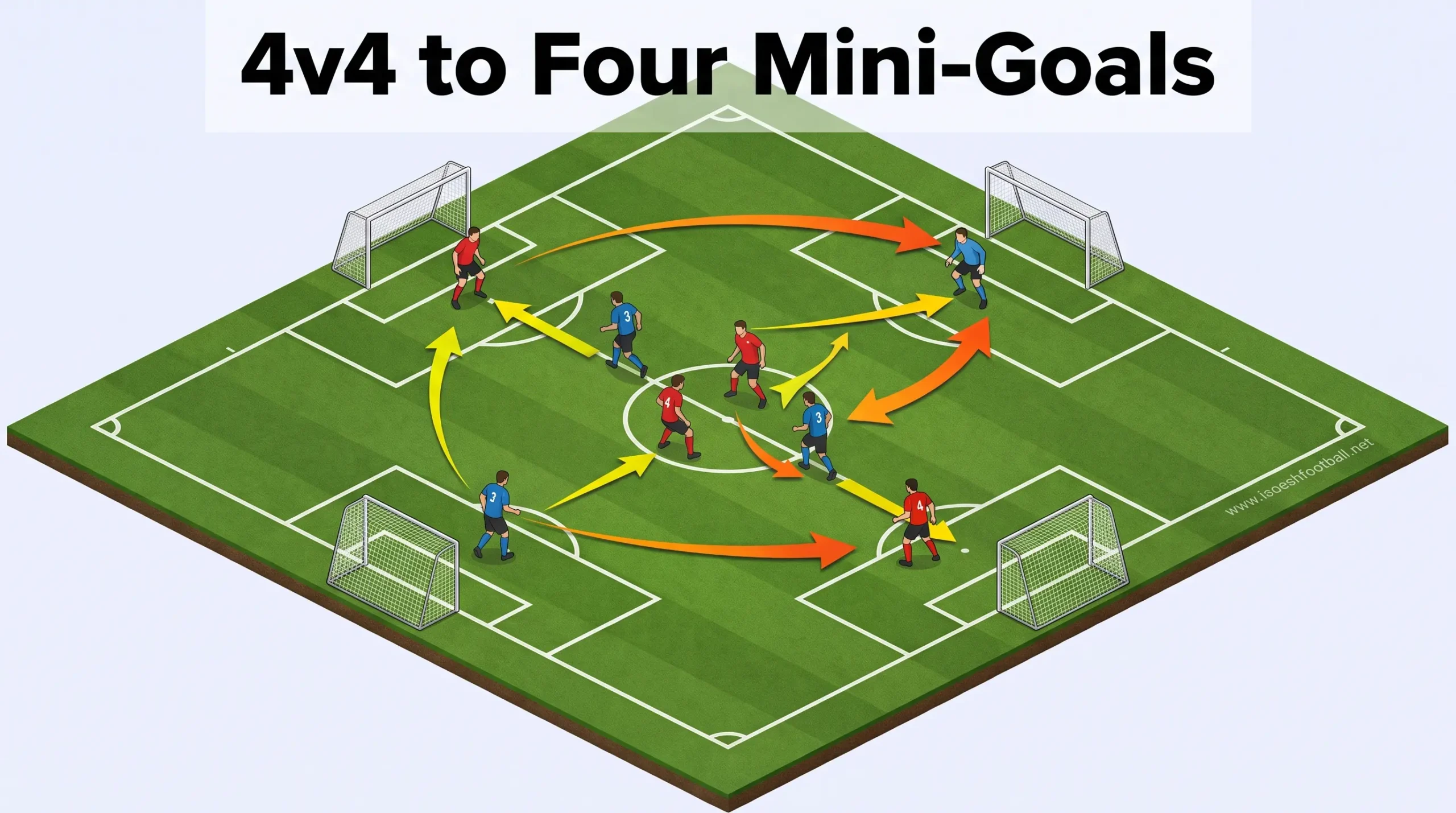
Why it works: Defending two goals stretches the defensive block, creating gaps that attackers must sprint to exploit. The moment possession changes, players must immediately sprint to transition their defensive shape, perfectly training Repeated Sprint Ability (RSA).
Coach’s note: When using SSGs for fitness, always keep a supply of footballs around the edge of the pitch. If the ball goes out of bounds, throw a new one in immediately. If the ball stops rolling, the heart rate drops, and the fitness benefit is lost.
Download the Small-Sided Games Conditioning PDF
Ready to integrate these concepts into your weekly training microcycle? We have compiled a comprehensive, printable guide featuring fully illustrated SSG formats, exact pitch dimensions, and periodized work-to-rest ratios.
The Ultimate SSG Conditioning Handbook
Stop running laps and start training at game speed. Click below to download the complete tactical workbook.
📥 Download the SSG PDF NowFrequently Asked Questions
Why are small-sided games better than running without the ball?
Small-sided games are superior because they train the cardiovascular system while simultaneously developing technical skills, tactical awareness, and spatial processing. They replicate the exact stop-start, multi-directional movements of a real football match, which traditional straight-line running cannot do.
How long should a small-sided conditioning game last?
The duration depends on your physical objective. To build aerobic endurance, use larger formats (6v6 to 8v8) for continuous blocks of 5 to 8 minutes. For anaerobic power, use smaller formats (3v3 or 4v4) for intense, explosive blocks of 1 to 3 minutes, followed by equal rest.
What is the ideal pitch size for a 4v4 small-sided game?
For standard physical conditioning, a pitch size of 30 × 20 yards to 40 × 30 yards is ideal for a 4v4. Making the pitch smaller will increase tackles and changes of direction, while making it larger will increase sprint distance and peak velocity.
Continue your coaching education: For a deeper dive into managing physical loads throughout the season, check out our complete Soccer Periodization & Fitness Training Guides and integrate these SSGs into our structured soccer practice plans.
The purpose of this writing is to offer the reader some valuable information on how to make the best use of small sided games.
Small sided games are technical-tactical exercises presented in the form of matches appropriately modified by coaches (or athletic trainers) based on the specific objective.
As the writer is an athletic trainer, I want to talk to you about how important it is to use this operational means to improve the athlete’s physical qualities. The literature suggests that, compared to traditional 11v11 matches, the use of SSGs allows obtaining similar or even higher values in relation to heart rate (HR), blood lactate concentration, as well as distance travelled.
The physiological responses of the internal load parameters, in young footballers as in adult footballers, can be produced differently between the different SSG formats, also and above all, based on the specific variables that can influence the SSGs.
The major small-sided games variables are:
✔️ The dimensions of the playing field
✔️ The number of players involved
✔️ Changes to the rules of the game
✔️ The presence of goalkeepers during exercises
✔️ The method of execution
✔️ The encouragement of the technical staff
In organizing the programming of the different exercises with the SSGs in the different micro-cycles, the first important factor to determine which is the most functional SSG format is to classify and identify the field dimensions of the different formats.
| 1vs1 | 2vs2 | 3vs3 | 4vs4 | 5vs5 | 6vs6 | 7vs7 | 8vs8 | |
| Small | 4×12 | 8×16 | 12×20 | 16×24 | 20×28 | 24×32 | 28×36 | 32×40 |
| Medium | 5×15 | 10×20 | 15×25 | 20×30 | 25×35 | 30×40 | 35×45 | 40×50 |
| Great | 6×18 | 12×24 | 18×30 | 24×36 | 30×42 | 36×48 | 42×54 | 48×60 |
In small sided games, the size of the field used and the number of players involved determine the training intensity and consequently the energy expenditure.
Small sided games from 1v1 to 4v4 allow you to reach a peak heart rate equal to 90% of your max HR; in formats that use a greater number of players, intensities between 80% and 90% of max HR are achieved.

Weekly periodization of small sided games.
▶️ Monday: this day is kept free
▶️ Tuesday:
✔️ 4v4, 5v5, 6v6 number of players involved in the exercises
✔️ The field size must be medium
✔️ C. 60-75% of maximum heart rate
✔️ Blood lactate 3-6 mmol/L
▶️ Wednesday:
✔️ 2v2, 3v3, 4v4 number of players involved in the exercises
✔️ The field size must be small
✔️ C. 80-90% of maximum heart rate
✔️ Blood lactate 7-10 mmol/L
▶️ Thursday:
✔️ 5v5, 6v6, 7v7 number of players involved in the drills
✔️ The field size must be large
✔️ C. > 90% of maximum heart rate
✔️ Blood lactate 6-12 mmol/L
▶️ Friday:
✔️ 1v1, 2v2, 3v3, 4v4 number of players involved in the drills
✔️ The field size must be medium
-✔️ C. > 85% of maximum heart rate
✔️ Blood lactate 6-8 mmol/L
▶️ Saturday:
✔️ 4v4, 5v5, 6v6 number of players involved in the exercises
-✔️ The field size must be medium
✔️ C. 60-75% of maximum heart rate
✔️ Blood lactate 3-6 mmol/L
Image Credit: http://new.ebitemp.it/attivita/68
Football Specific Conditioning Drills & Benefits
Using football drills like small sided games and possession sessions for conditioning has considerable benefits in:
- Passing
- Dribbling
- Shooting
- Movement patterns
- Technical skills
- Tactical skills
- And most importantly……
Motivation
How often do you see clubs carrying out pre-season sessions, in-season sessions and general fitness sessions without a ball?
You know yourself that doing continuous running, intervals, circuits can and does get a little boring. The sessions in this item have been designed to improve your players endurance (lactate threshold, VO2 max and anaerobic capacity).
Motivating your players by using small sided games is the most effective technique available to improve player’s fitness levels for football.
Motivation of a player is improved when football and competition are involved. Also, more similar movement types and patterns in soccer drills may also lead to a greater transfer to match specific fitness.
Enhanced movement efficiency is particularly a key for unorthodox forms of locomotion, such as side and backwards movements, which are frequently used in football drills.