The Constraints-Led Approach: Designing Rules That Teach (Not Just Drills)

Stop stopping the game every 30 seconds to lecture your players.
If you find yourself constantly shouting instructions like “Pass wide!” or “Press him!”, you are doing the thinking for your players. In a match, they won’t hear you. They need to solve problems themselves.
This is where the Constraints-Led Approach (CLA) changes everything. Instead of telling players what to do, you design a game where the rules (constraints) force them to figure it out.
In our [Link to Pillar Post: The Science of Small Sided Games], we talked about the physical load of games. Now, we dive into the psychology: how to manipulate space, rules, and numbers to “hack” your players’ decision-making and game intelligence.
What is the Constraints-Led Approach?
The CLA is based on the science of Ecological Dynamics. It sounds complex, but it’s simple: Behavior emerges from the environment.
If you want players to play fast, don’t just say “play fast.” Change the environment so playing slow is impossible.
- Traditional Coaching: “Drill the skill” in lines (Isolated).
- CLA Coaching: “Design the game” to bring out the skill (Integrated).
By manipulating three types of constraints, you guide players toward the solution without saying a word:
- Task Constraints: Rules, goals, equipment (e.g., “2 touch limit”).
- Environmental Constraints: Pitch size, surface (e.g., “Narrow pitch”).
- Performer Constraints: Physical fatigue, mix of ability levels (e.g., “Tired defenders vs fresh attackers”).
3 “Magic Constraints” to Fix Common Problems
Here are three practical examples of how to use rules to fix tactical issues instantly.
1. The Problem: “My Team Plays Too Narrow”
The Fix: The “Zone 14” Prohibition
- The Constraint: Mark out the central channel (Zone 14).
- The Rule: “You cannot pass forward through the central zone. You must bypass it using the wings.”
- The Result: Players naturally start looking wide and overlapping without you shouting “Get wide!”
2. The Problem: “My Strikers Are Lazy Pressing”
The Fix: The “Double Points” Trigger
- The Constraint: Reward system.
- The Rule: “If you win the ball back in the attacking half and score, the goal counts double.”
- The Result: Your strikers will sprint to press because the reward system incentivizes the risk.
3. The Problem: “My Midfielders Don’t Scan”
The Fix: The “Color Call”
- The Constraint: Cognitive overload.
- The Rule: The coach holds up a colored cone (Red or Blue) every 10 seconds. Before receiving a pass, a player must shout the color the coach is holding.
- The Result: Players are forced to lift their heads and scan the environment before the ball arrives.
Visualizing the Constraints
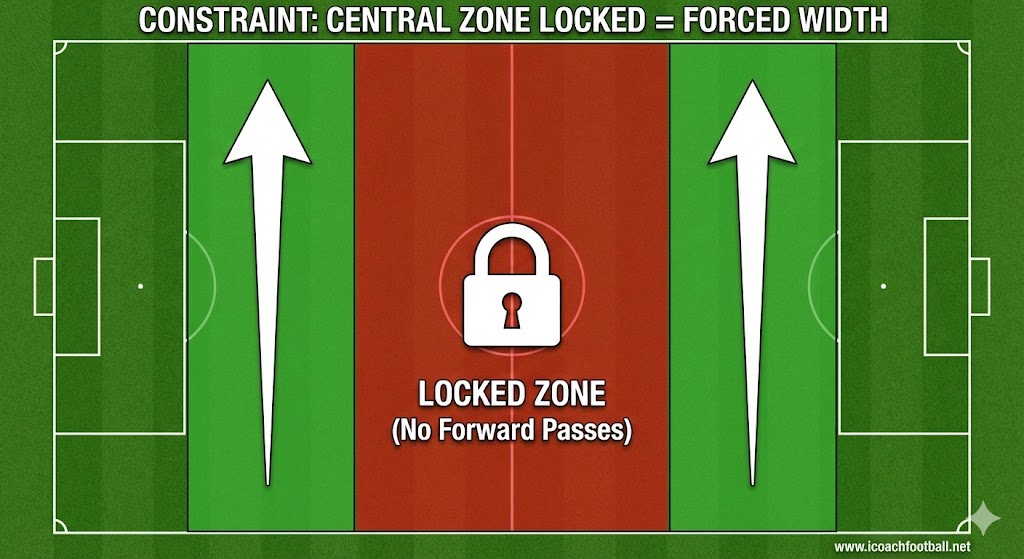
- Description for your Designer/TacticalPad:
- Visual: A standard soccer pitch diagram.
- Action: Draw 3 vertical zones. The middle zone is shaded Red with a “Lock” icon. The two wide zones are Green with arrows moving forward.
- Label: “Constraint: Central Zone Locked = Forced Width.”
How to Design Your Own Constraint-Led Game
Designing a Constraint-Led Training Session
A step-by-step guide to building a drill that teaches itself using the CLA method.
Step 1: Identify the Problem Be specific. Don’t say “we need to attack better.” Say “we are struggling to break the lines against a low block.”
Step 2: Define the Solution What behavior do you want to see? Example: “I want my #8 making runs behind the defense.”
Step 3: Create the Constraint Add a rule that rewards this behavior. Example: “A goal only counts if it is assisted by a pass into the ‘End Zone’.” This forces the run behind.
Step 4: Observe and Adapt (Don’t Stop It!) Let them play. If they fail at first, wait. Let them figure out the solution. Only step in if the constraint is too hard or too easy.
Coach’s Corner: Troubleshooting the CLA
Does this mean I never coach or stop the play?
You still coach, but you become a “Guide on the Side” rather than a “Sage on the Stage.” Ask questions like “Why did you choose that pass?” instead of giving answers.
Can I use constraints with young players (U8-U10)?
Yes! It is actually better for them. Kids learn through play. Simple constraints like “Goals must be scored inside the box” teach them effectively without boring lectures.
What if the constraint isn’t working?
Change it. If the game is too messy, simplify the rule. If it’s too easy, reduce the space or touch limit. You are the architect of the session.
The Final Whistle
The Constraints-Led Approach is the secret weapon of elite coaches. It builds players who are adaptable, intelligent, and independent. Next time you plan a session, don’t just write down a drill—write down a rule that changes the game.
Ready to see this in action?
- The 2v2 Anaerobic Drill (Uses constraints for intensity)
- The 4v4 Rondo (Uses positional constraints)