Soccer Drills for Strikers: 6 Games That Teach Movement, Timing and Clinical Finishing
Quick answer
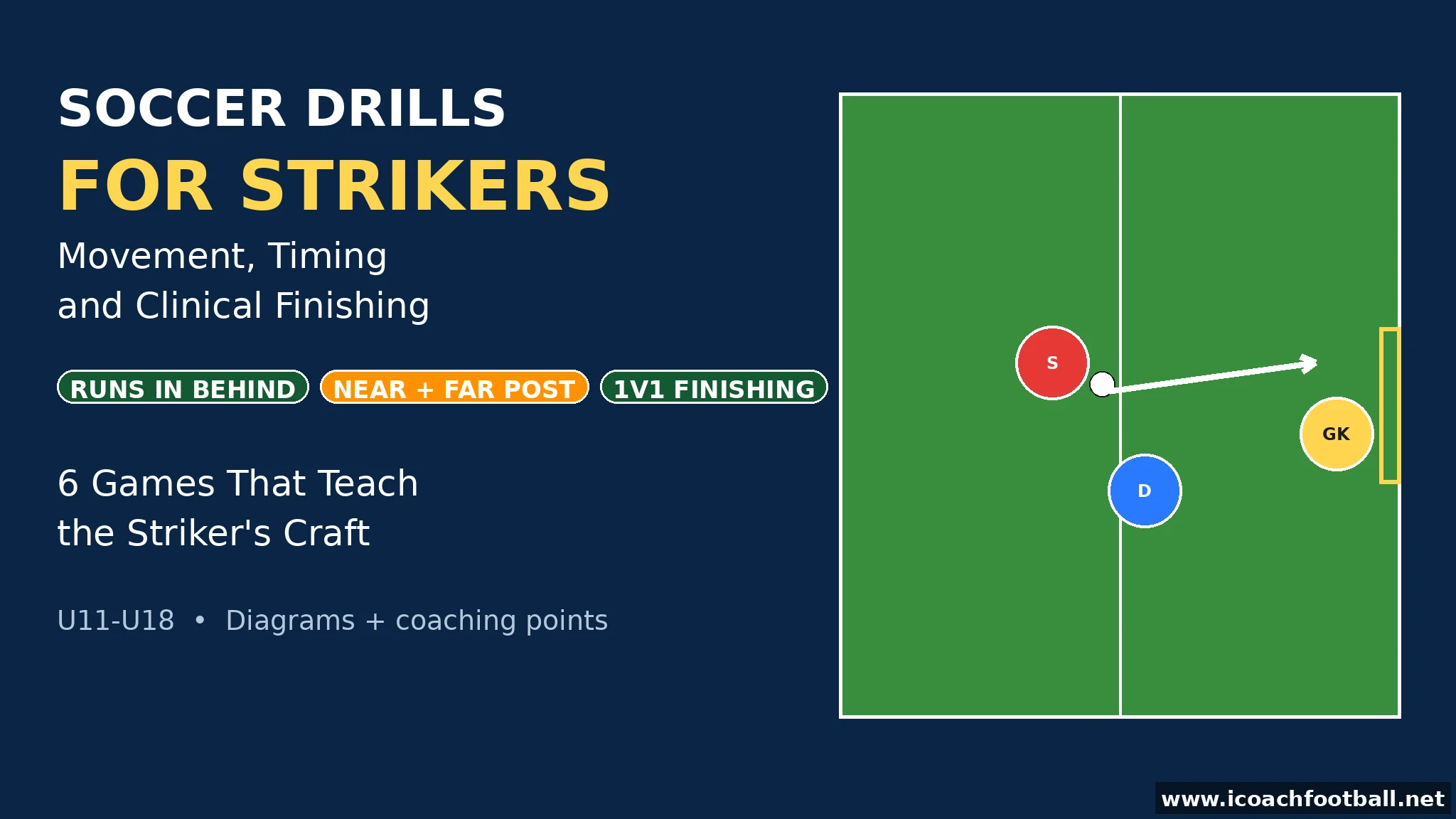
Strikers score because of what they do before the ball arrives. These six soccer drills for strikers teach the movement that creates chances — the timed run in behind, the near- and far-post run, the turn from back to goal — and the calm finish that follows.
Suitable for: U11–U18
In soccer — football to most of the world — the difference between a forward and a striker is movement. A forward waits for the ball; a striker arrives where the ball is about to be. The six games below fit into one 60-minute session plan, and follow the progression the FIFA Training Centre uses in its attacking sessions: movement first, then the finish, then the game. Each drill isolates one piece of striker play.
Session snapshot
- Players: 8–16
- Area: Third of a pitch to 40 x 30 yards
- Duration: 60 minutes
- Focus: Runs in behind, near- and far-post movement, back-to-goal play, lay-offs, 1v1 finishing, calm placement
- Age: U11–U18 (see Age adaptations)
The five striker rules
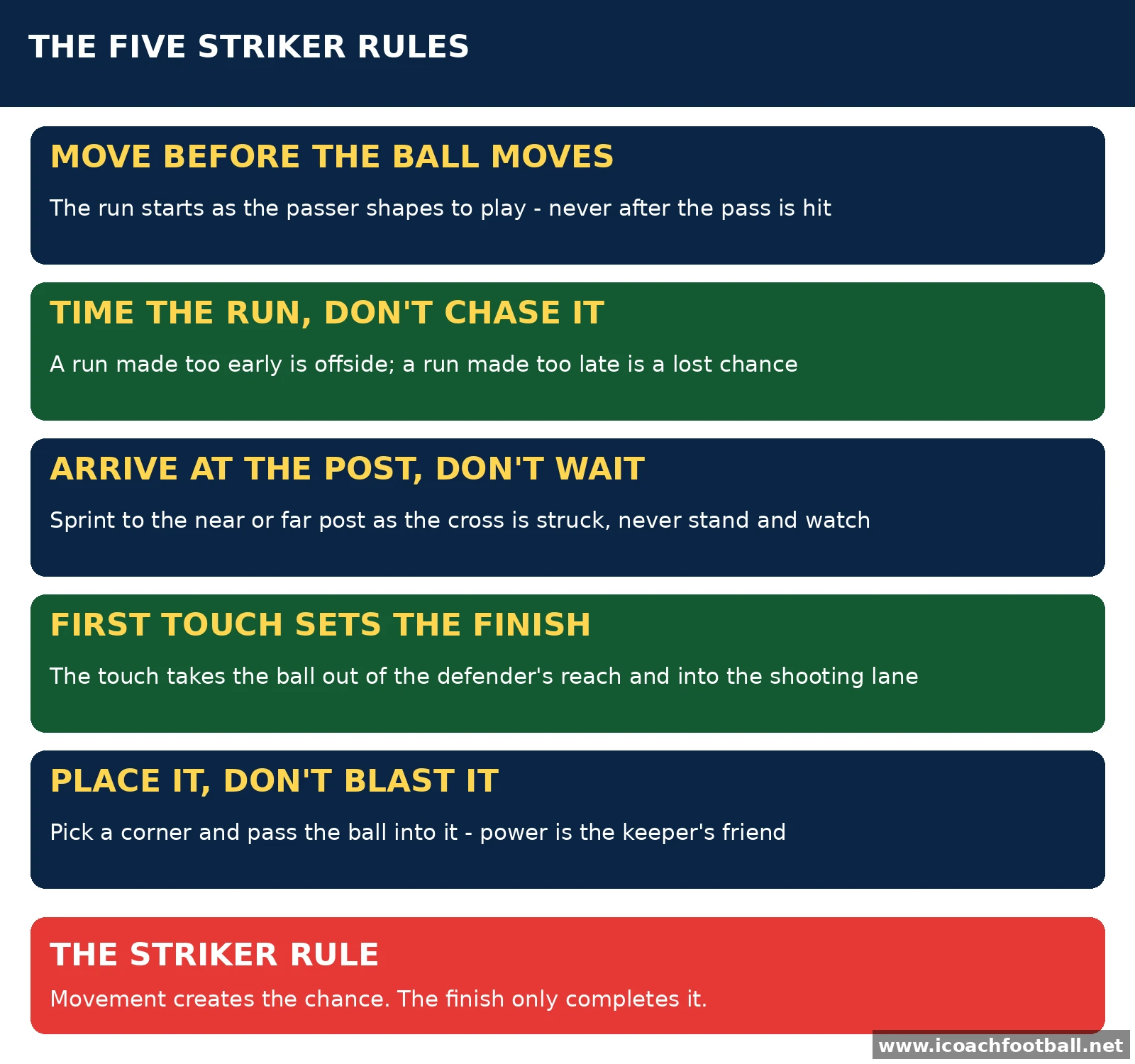
Every drill below is built on five rules. Teach them once, then repeat them in every game until the players say them back to you.
| Rule | What it means |
|---|---|
| Move before the ball moves | The run starts as the passer shapes to play — never after the pass is hit |
| Time the run, don’t chase it | A run made too early is offside; a run made too late is a lost chance |
| Arrive at the post, don’t wait there | Sprint to the near or far post as the cross is struck, never stand and watch |
| First touch sets the finish | The touch takes the ball out of the defender’s reach and into the shooting lane |
| Place it, don’t blast it | Pick a corner and pass the ball into it — power is the keeper’s friend |
Drill 1: The Timed Run
One passer, one striker, one defender, one goal. The striker holds level with the defender, bursts as the pass is played, and finishes first time — the exact timing the FIFA Training Centre’s movement sessions train.
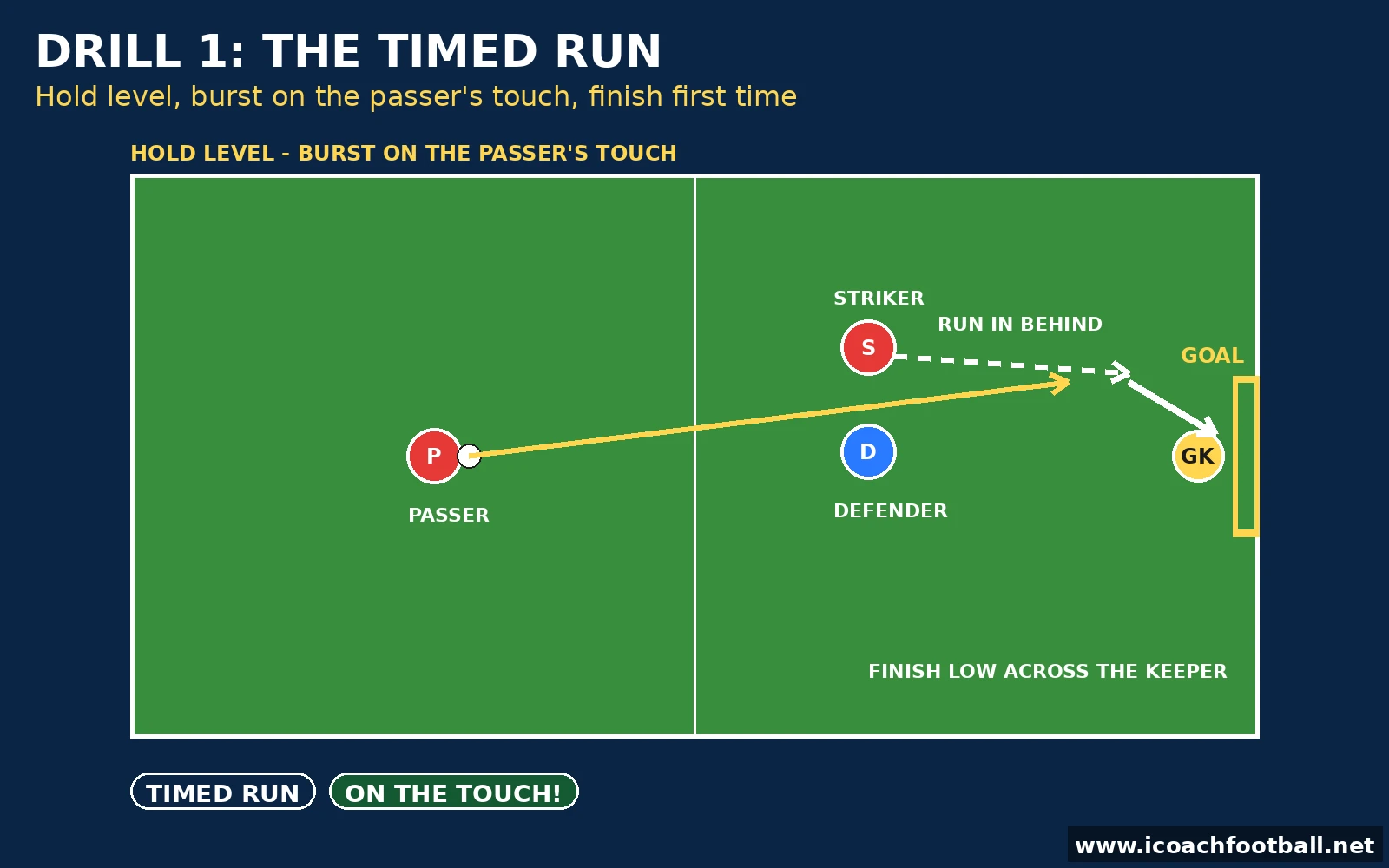
- Setup: Half a pitch, 40 x 30 yard channel, one full-size goal with a keeper, a passer 25 yards from goal, a striker level with a defender on the edge of the box, balls at the passer.
- How to play:
- The striker holds level with the defender, on their toes, side-on to goal.
- The passer takes one touch to set the ball.
- As the passer strikes it, the striker bursts in behind the defender.
- The striker meets the ball in stride, one touch to control.
- Finish first time, low, across the keeper to the far post.
- Coach’s note: Shout “on the touch!” — the run starts when the passer touches the ball, not when the pass leaves their foot, and that half-second is the whole drill.
- Progressions: Defender starts passive, then live; the pass must be played first time; the striker finishes with their weak foot.
Drill 2: Near Post, Far Post
Two strikers attack every cross — one sprints to the near post, one to the far post. The cross is only as good as the runs that meet it.
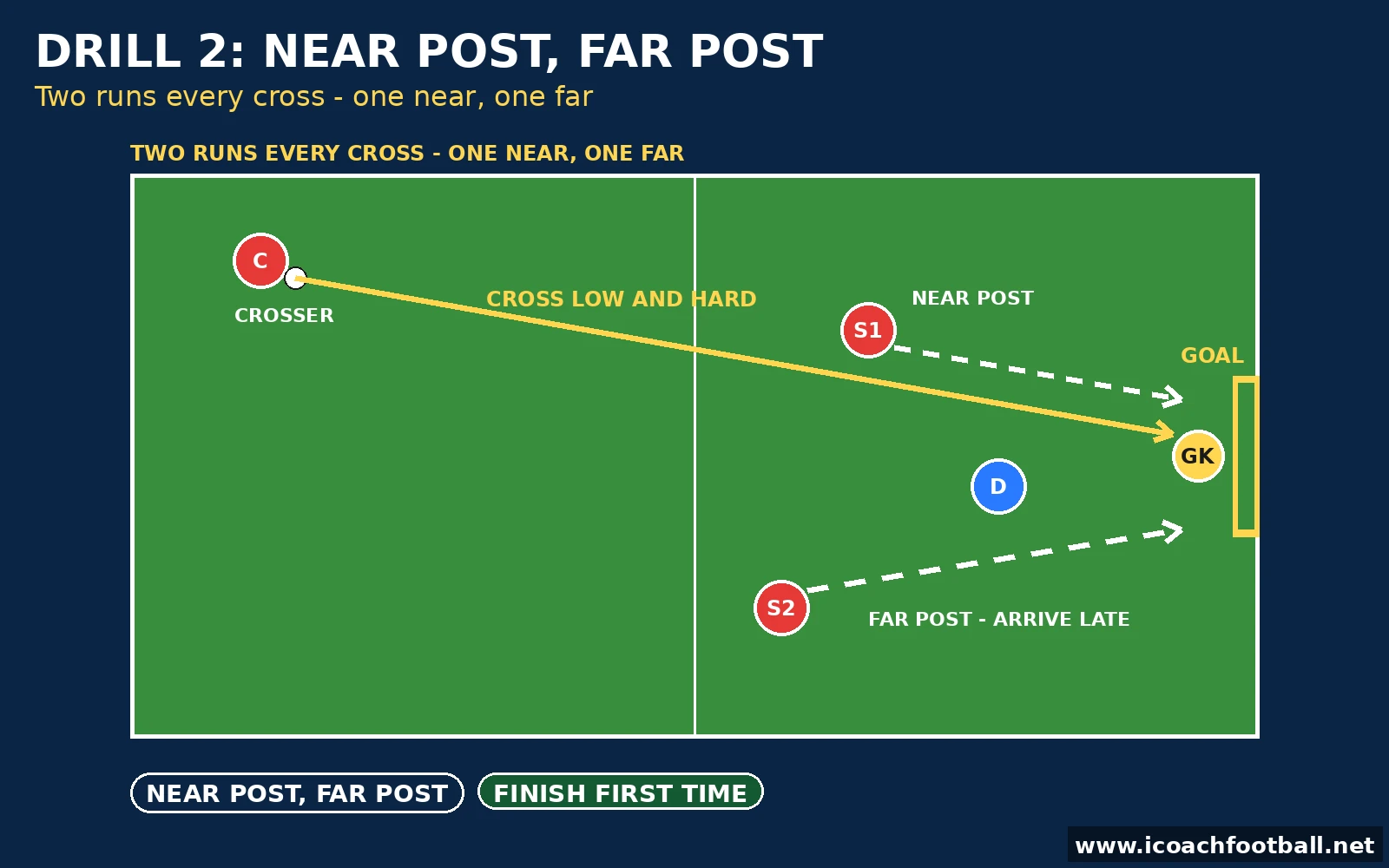
- Setup: One full-size goal with a keeper, a crosser wide on the left 25 yards from the byline, two strikers on the penalty spot, one defender, balls at the crosser.
- How to play:
- The crosser drives towards the byline with the ball.
- The near-post striker sprints across the defender to the front post.
- The far-post striker holds their run, then arrives at the back post.
- The crosser delivers low and hard across the six-yard box.
- A striker finishes first time; if the cross is cut out, the next pair goes.
- Coach’s note: The far-post run is the one coaches forget — the near-post striker drags the defenders with them, and the goal at the back post is usually empty.
- Progressions: Crosses alternate left and right; the far-post striker must finish first time; add a second defender so the runs must be disguised.
Drill 3: Back to Goal
The striker receives with a defender tight on their back, protects the ball, turns, and finishes. This is the hardest yard in football — and the one that wins tight games.
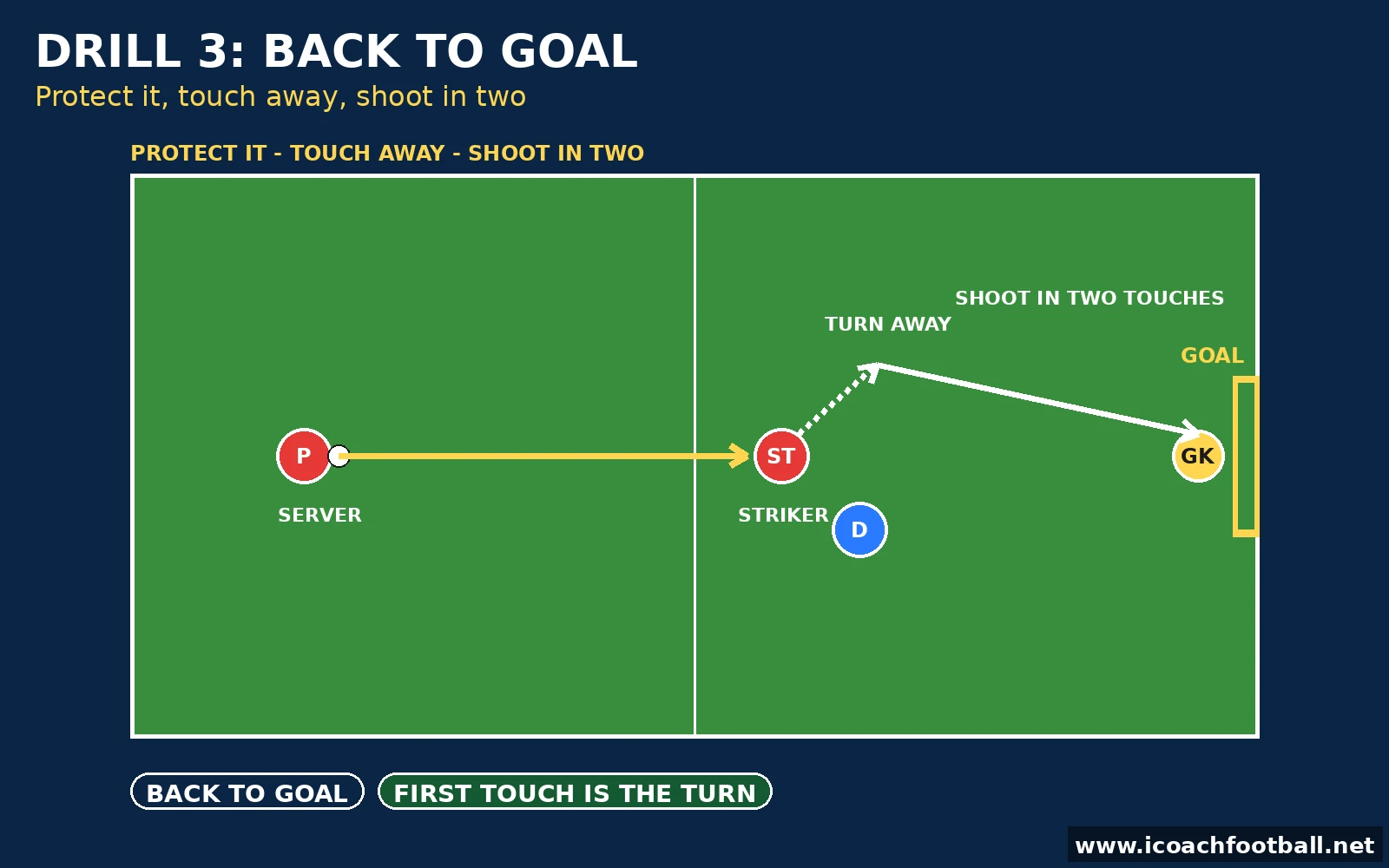
- Setup: 20 x 15 yard box in front of goal, a server 15 yards out, a striker on the penalty spot with a defender tight behind, one ball.
- How to play:
- The server plays a firm pass into the striker’s feet.
- The striker receives side-on, arm across the defender to protect the ball.
- The striker takes one touch away from the defender to open the shooting lane.
- The striker turns and shoots within two touches.
- Swap roles after every rep, then rotate the server.
- Coach’s note: The first touch is the turn — if the touch goes backwards, the defender wins; if it goes sideways into space, the striker is already shooting.
- Progressions: Defender starts passive, then fully live; the striker must finish with one touch; the server plays the ball in the air.
Drill 4: The Lay-Off and Third Man
The striker drops short, lays the ball off, and spins in behind while a third man runs into the space. Three passes, one finish — the combination every top team uses.
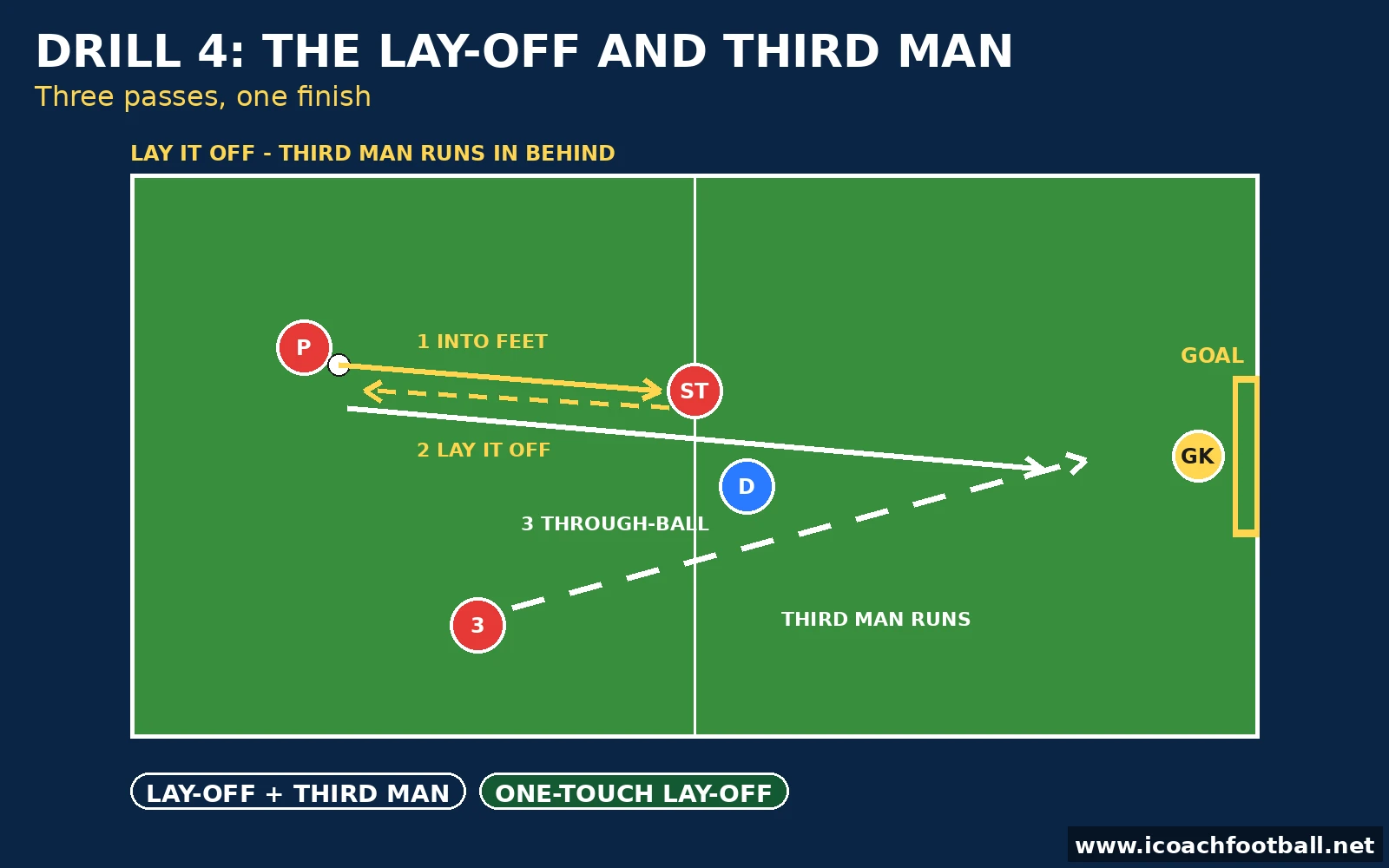
- Setup: 30 x 25 yard zone in front of goal, a passer 30 yards out, a striker 20 yards out with a defender behind, a third man 25 yards out on the opposite side, one ball.
- How to play:
- The passer plays into the striker’s feet.
- The striker lays the ball off first time to the passer.
- The passer plays a through-ball into the channel for the third man.
- The third man runs in behind and finishes first time.
- Rotate roles after every rep so every player tries each job.
- Coach’s note: The lay-off is the trigger — the third man starts their run the moment the striker shapes to lay it off, not when the through-ball is played.
- Progressions: The striker spins in behind instead of the third man; the lay-off must be one touch; the defender is live and can intercept.
Drill 5: Beat the Keeper
A straight 1v1 against the keeper, from 18 yards out, with one rule: placement beats power. The striker who slows down and picks a corner scores more than the one who blasts it.
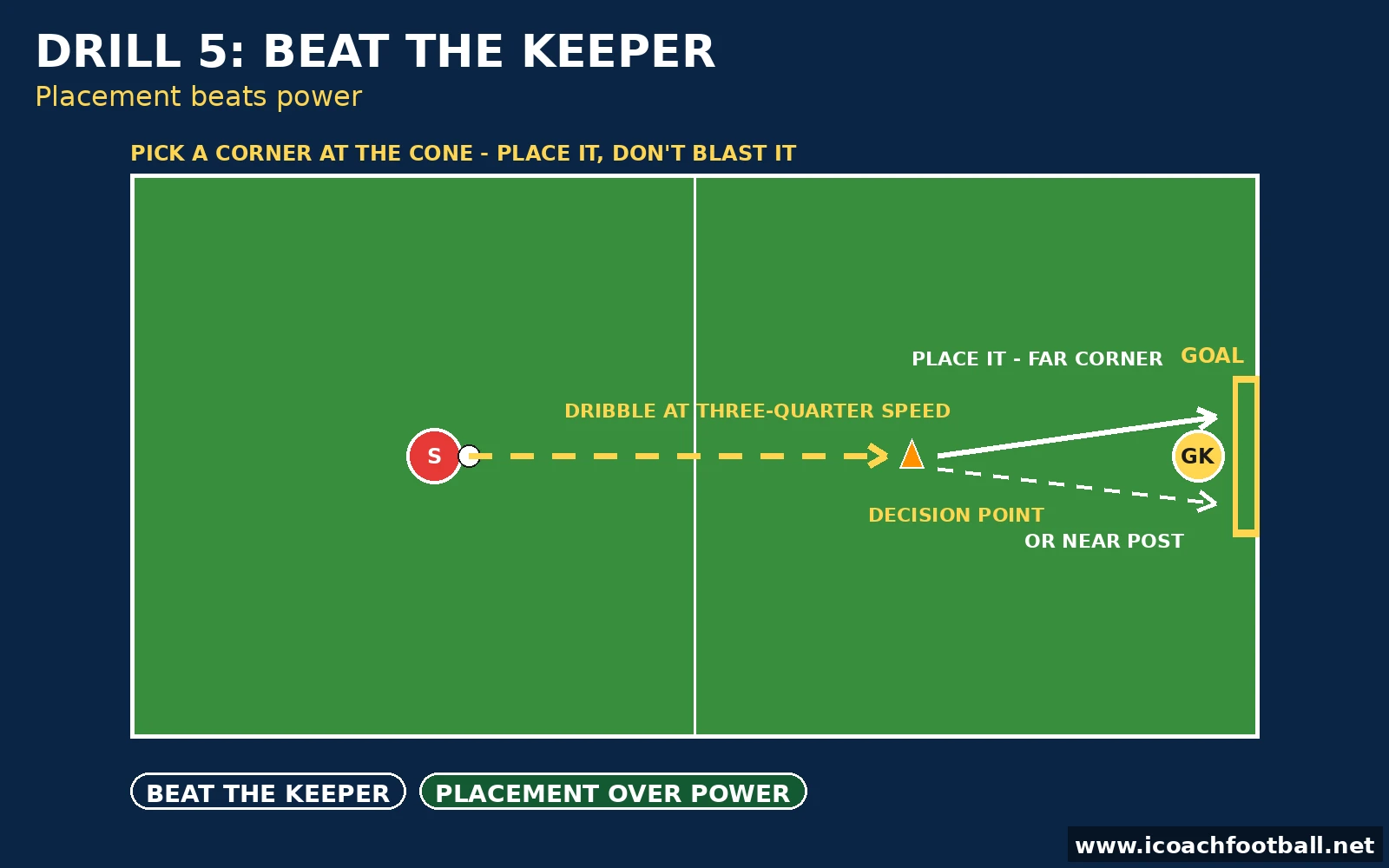
- Setup: One full-size goal with a keeper, a striker 18 yards out with a ball, a cone 12 yards out marking the decision point, balls behind the striker.
- How to play:
- The striker dribbles at the keeper at three-quarter speed.
- At the cone, the striker takes one look at the keeper’s position.
- The striker picks a corner — low, across the keeper, into the far side.
- The finish is placed, not blasted — the ball must stay on the ground.
- Rotate the keeper every five reps so everyone faces the pressure.
- Coach’s note: Shout “pick a corner!” at the cone — the decision is made before the shot, and a striker who decides late usually hits the keeper.
- Progressions: The keeper starts off their line and can rush out; the striker must finish with their weak foot; a recovering defender chases from behind.
Drill 6: The Striker’s Game
The match-real finish: a small-sided game where a goal only counts if a striker movement made it — a run in behind or a near-post run. Movement stops being a drill and becomes a habit.
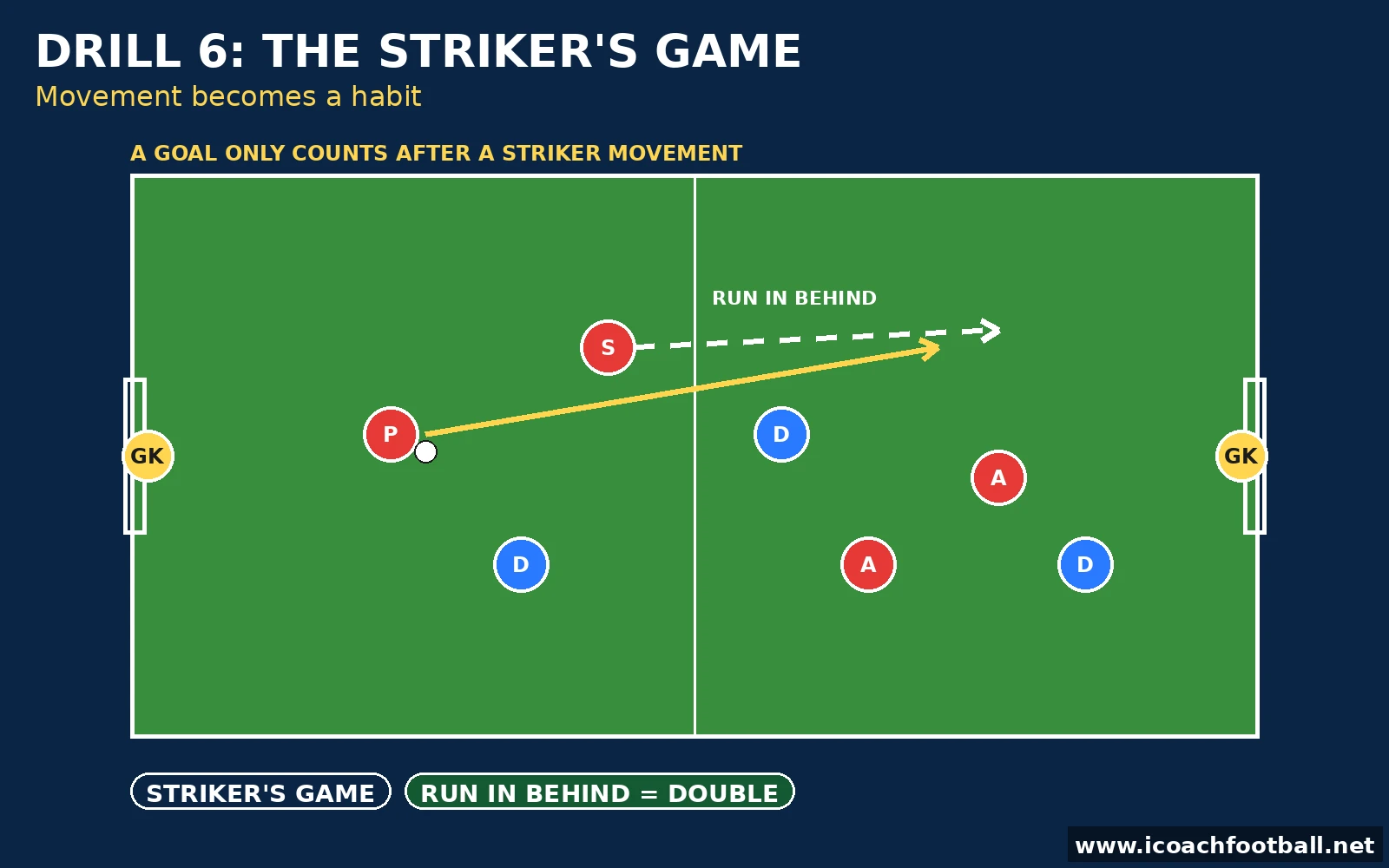
- Setup: 40 x 30 yards, 2 full-size goals with keepers, 5v5, one ball, bibs for one team.
- How to play:
- Play a normal small-sided game to the big goals.
- A goal only counts if it came from a striker movement — a run in behind or a near-post run.
- A goal scored first time after a run in behind counts double.
- Keepers restart play quickly after every goal.
- Play 5-minute games, then rotate keepers.
- Coach’s note: The moment a team scores from a static cross with no run, wave it off and ask “who moved?” — that question is the whole drill.
- Progressions: Goals only count first time; the striker must finish with one touch; every player must make a run in behind before their team can score.
Coaching points
- The run is the skill, the finish is the reward: A striker who moves well gets five chances a game — a striker who only shoots well gets one. See our 1v1 finishing drills for the session that turns those chances into goals.
- Scan before you run: A striker who checks over their shoulder knows where the defender and the space are — our soccer scanning drills teach that shoulder check.
- The cutback is the easiest goal in the game: A low ball pulled back across the six-yard box beats a high cross every time — our soccer cutback drills teach the wide player when to pull it back.
- Drop deep, then go in behind: A striker who drops short to link play must spin and run the moment the ball is laid off — work on football playing between the lines drills to make the drop and the run one movement.
- Finish with both feet: Half of a striker’s chances fall to their weaker foot — see our weak foot soccer drills for a full session on the weaker side.
- Pair this with a shooting day: Follow this session with our 7 soccer shooting drills for a second finishing day built on pure technique.
Common mistakes
- Running too early: The striker who sprints before the pass is played gets caught offside or arrives before the ball — coach the hold, then the burst on the passer’s touch.
- Standing at the post: Strikers who wait at the near post get marked — the run has to arrive as the cross arrives, not before it.
- Turning into the defender: A back-to-goal striker who turns towards the defender loses the ball — coach the touch away from pressure, into the shooting lane.
- Blasting the 1v1: Power feels good and misses often — the keeper saves the hard shot at them, and the placed shot into the corner beats them.
Age adaptations
| Age | Area | Touches | What changes |
|---|---|---|---|
| U11–U12 | 30 x 20 yards | Two-touch finish | No offside in Drill 1, defender passive in Drill 3, small goals in Drill 6 |
| U13–U15 | 40 x 30 yards | One-touch finish in Drills 2 and 4 | Offside live in Drill 1, live defender in Drill 3, decision point in Drill 5 |
| U16–U18 | Full third of a pitch | First-time finish | Full-speed runs, recovering defenders, keepers free to rush out in Drill 5 |
60-minute session plan
| Block | Minutes | What to run |
|---|---|---|
| Warm-up | 0–10 | Drill 1, the timed run, walking pace then half speed |
| Crosses | 10–20 | Drill 2, near post, far post |
| Back to goal | 20–30 | Drill 3, back to goal turn and finish |
| Combinations | 30–40 | Drill 4, the lay-off and third man |
| 1v1 finishing | 40–50 | Drill 5, beat the keeper |
| Match-real finish | 50–60 | Drill 6, the striker’s game |
FAQ
What are the best soccer drills for strikers?
The timed run in behind, near- and far-post movement from crosses, back-to-goal turns, lay-offs with a third-man run, and 1v1s against the keeper. One session covering all five beats five separate shooting drills, because strikers score from movement first.
How do you teach a striker to time runs in behind?
Start the run on the passer’s touch, not on the pass. Set up Drill 1 and shout “on the touch!” until the striker bursts as the passer touches the ball — that half-second is the difference between onside and offside.
What age should strikers start learning movement?
U11 is the right time to coach it properly. Younger players can play the same games with no offside and passive defenders, but the timing, the shoulder check and the decision at the cone need a player who can read the game.
How do I stop my striker from standing still in the box?
Make movement the way to score. In Drill 6 a goal only counts after a striker movement, so standing still scores nothing. Praise the run even when the finish misses — the run is the behaviour you are building.
Should strikers practise finishing with their weak foot?
Yes — half of a striker’s chances fall to the weaker foot. Build one weak-foot finish into every drill in this session, and run our weak foot soccer drills as a separate session once a week.
Sources
- FIFA Training Centre — “Movement to attack the space in behind” (FIFA Talent Coach Claudio García: perfectly weighted passes combined with well-timed runs in behind, attackers timing their run to latch onto the pass without breaking stride, decoy runs across the defender). The timed run and the lay-off and third-man drills in this post are based on that session.
- FIFA Training Centre — “Creating chances and finishing” (FIFA Technical Expert Jonas Urias: close-range finishing scenarios, first-time finishes, placing shots either side of the goalkeeper, creating chances from a range of areas). The near-post/far-post movement and the beat-the-keeper drills in this post are in line with that session.