Football Half-Turn Drills: 6 Games to Receive Open and Play Forward
Quick answer: Receiving on the half-turn means standing side-on before the ball arrives, so you can see the passer and the space ahead at the same time. Scan twice, open your hips to about 45 degrees, let the ball run across your body, and take it on your back foot into space. One open touch forward beats two touches and a turn.
Suitable for: U11–U18
Most midfielders receive square-on. They face the passer, their back is to the space they want to attack, and by the time they turn, the defender is on them.
The half-turn fixes the problem before the ball arrives. The receiver checks their shoulder, opens their body, and already knows whether to turn or set the ball back. Coaches in the US run the same games as soccer drills, and the habit is identical: picture first, body open, first touch forward.
These six football half-turn drills build that habit in order: the back-foot touch, the FIFA passing circuit, the scan decision, pressure in a rondo, playing out centrally, and a game that only rewards forward play.
Session snapshot
- Players: 8–18 (pairs and threes for Drills 1–3, groups of 6–8 for Drills 4–5, two teams for Drill 6)
- Area: 15 x 15 yards for Drills 1–3, 20 x 15 yards for Drill 5, 40 x 30 yards for Drill 6
- Duration: 60 minutes (20-minute version: Drills 1 and 2 only)
- Focus: Scanning, open body shape, back-foot first touch, turn-or-set decision, playing forward under pressure
- Equipment: 10–12 balls, 16 cones, 4 mannequins or poles, bibs, 2 mini-goals for Drill 5, 2 goals for Drill 6
- Age: U11–U18 (see age adaptations)
The one rule: picture first, then open
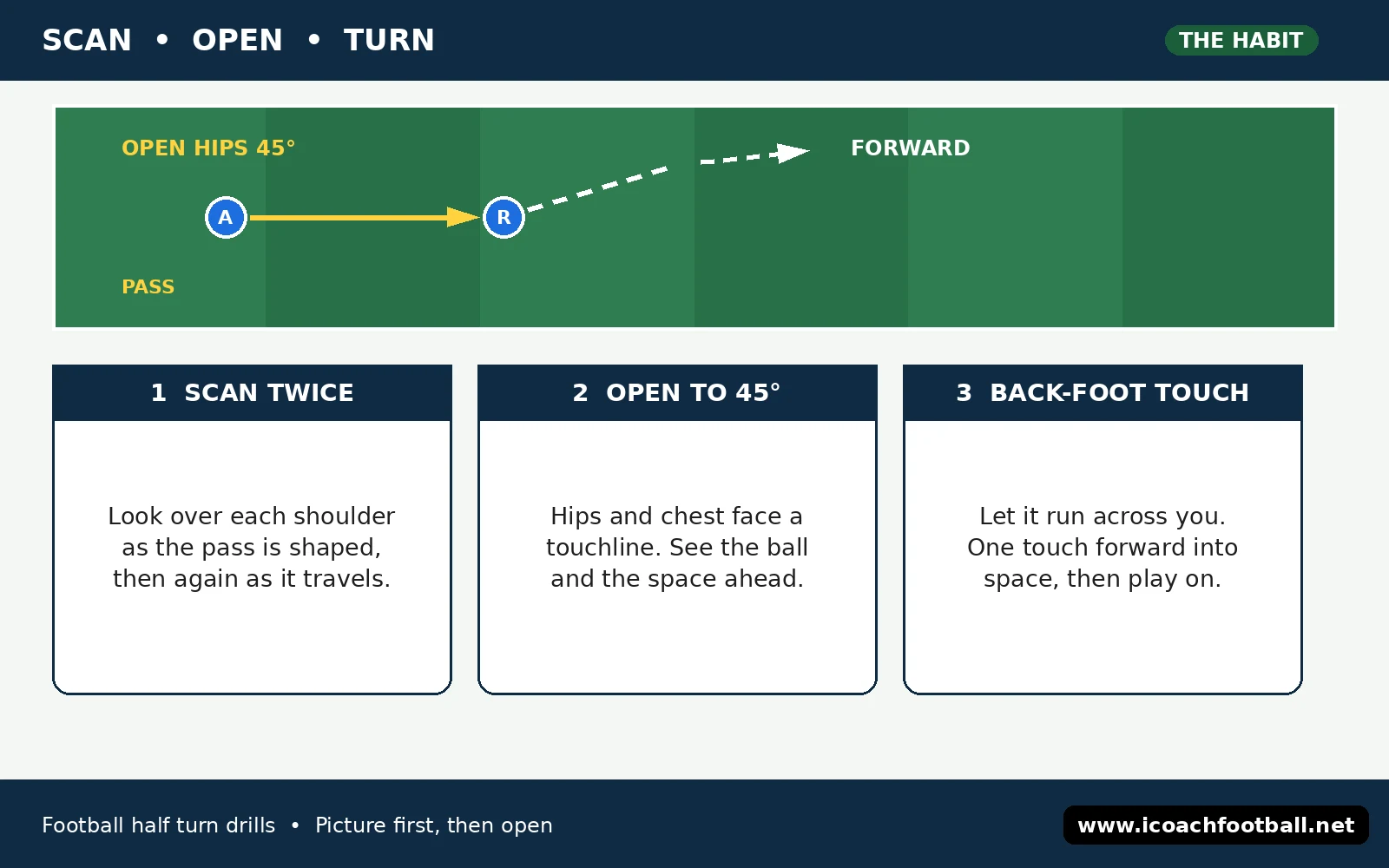
A half-turn is decided before the ball arrives, not after it. The scan gives the picture, the body shape keeps the picture, and the back-foot touch turns the picture into a forward pass.
- Scan twice. Look over one shoulder as the passer shapes to play, and again as the ball travels. The second look catches a defender who has moved.
- Open to 45 degrees. Hips and chest face a touchline, not the passer and not the goal. From side-on, both the ball and the space ahead stay in view.
- Receive on the back foot. The foot furthest from the passer takes the ball across the body. The touch moves forward, into space, in the same movement as the turn.
- Decide on the scan, not on the touch. If the space behind is open, turn. If a defender is tight, set the ball back first time. Never decide after stopping the ball dead.
If your players only stare at the ball, fix the scan first with these soccer scanning drills; the half-turn below only works when the picture is taken before the ball arrives.
| Scan shows | Receiver does | First touch does |
|---|---|---|
| Space behind is open, no defender tight | Turn on the half-turn | Back foot, across the body, forward into space |
| Defender tight on the shoulder | Set it back first time | One touch back to the passer, then spin away |
| Defender on one side only | Open away from the defender | Back foot to the open side, play to the free player |
Drill 1 — Back-Foot Gate
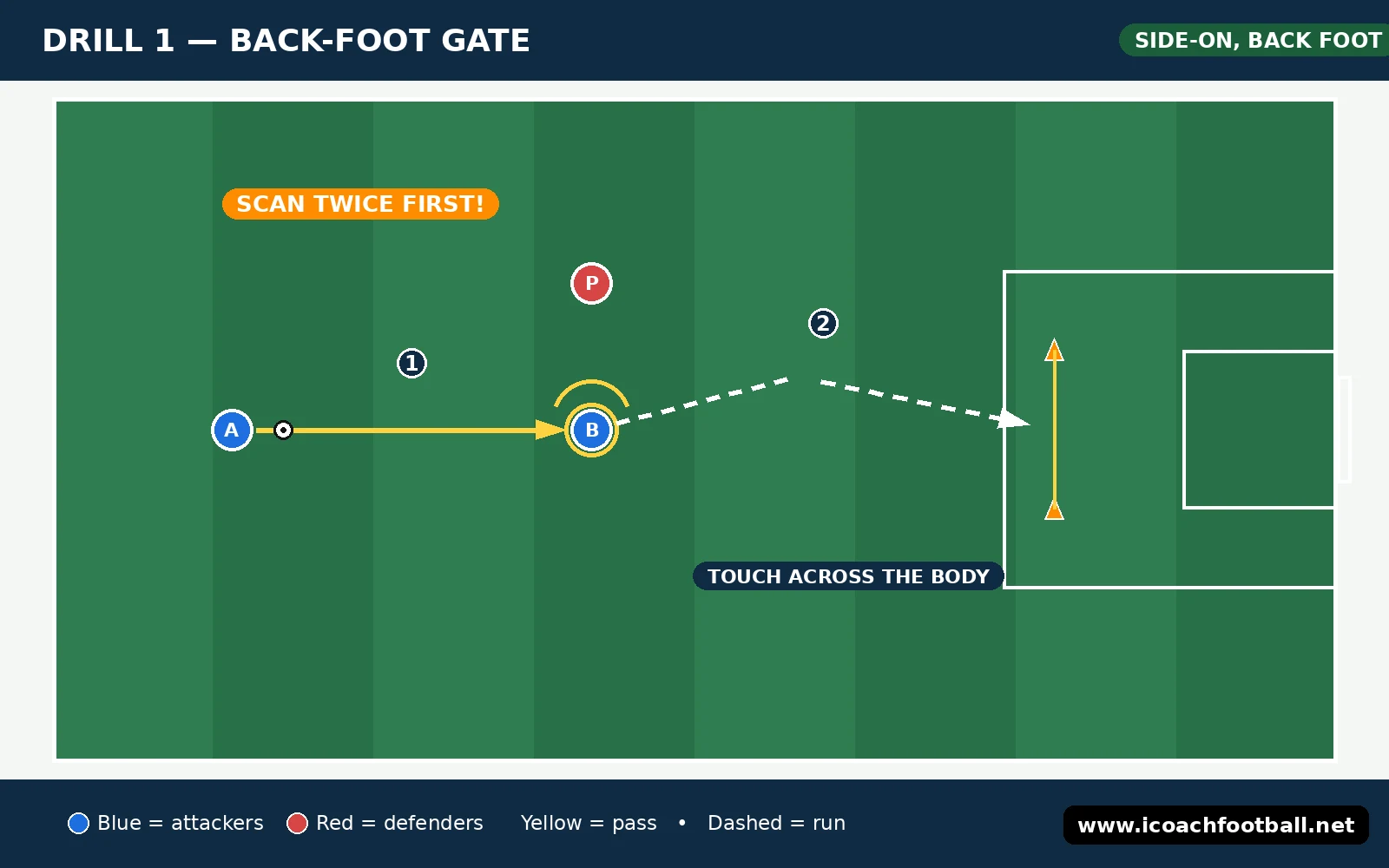
The blocked-practice start: one passer, one receiver, and the same open touch through a gate, 8 times from each side.
Setup:
- One passer 12 yards from the receiver, with a 3-yard gate 8 yards beyond the receiver.
- Receiver starts side-on, with a passive shadow defender 2 yards behind them.
- Balls with the passer, and a cone marking the receiver’s starting spot.
How to Play:
- The receiver scans over both shoulders as the passer shapes to play.
- The receiver checks 2 yards away from the shadow defender, then shows at an angle.
- The passer plays a firm pass along the ground to the receiver’s back foot.
- The receiver lets the ball run across their body and takes it on the back foot.
- The receiver dribbles through the gate in one movement, then jogs back and repeats from the other side.
Coach’s note: The cue is “Side-on, back foot!” If the receiver stands square, stop the rep. The body shape is the drill, not the pass.
Progressions: The shadow defender may step in if the receiver stops the ball dead, then the receiver must play first time through the gate.
Drill 2 — The FIFA Half-Turn Circuit
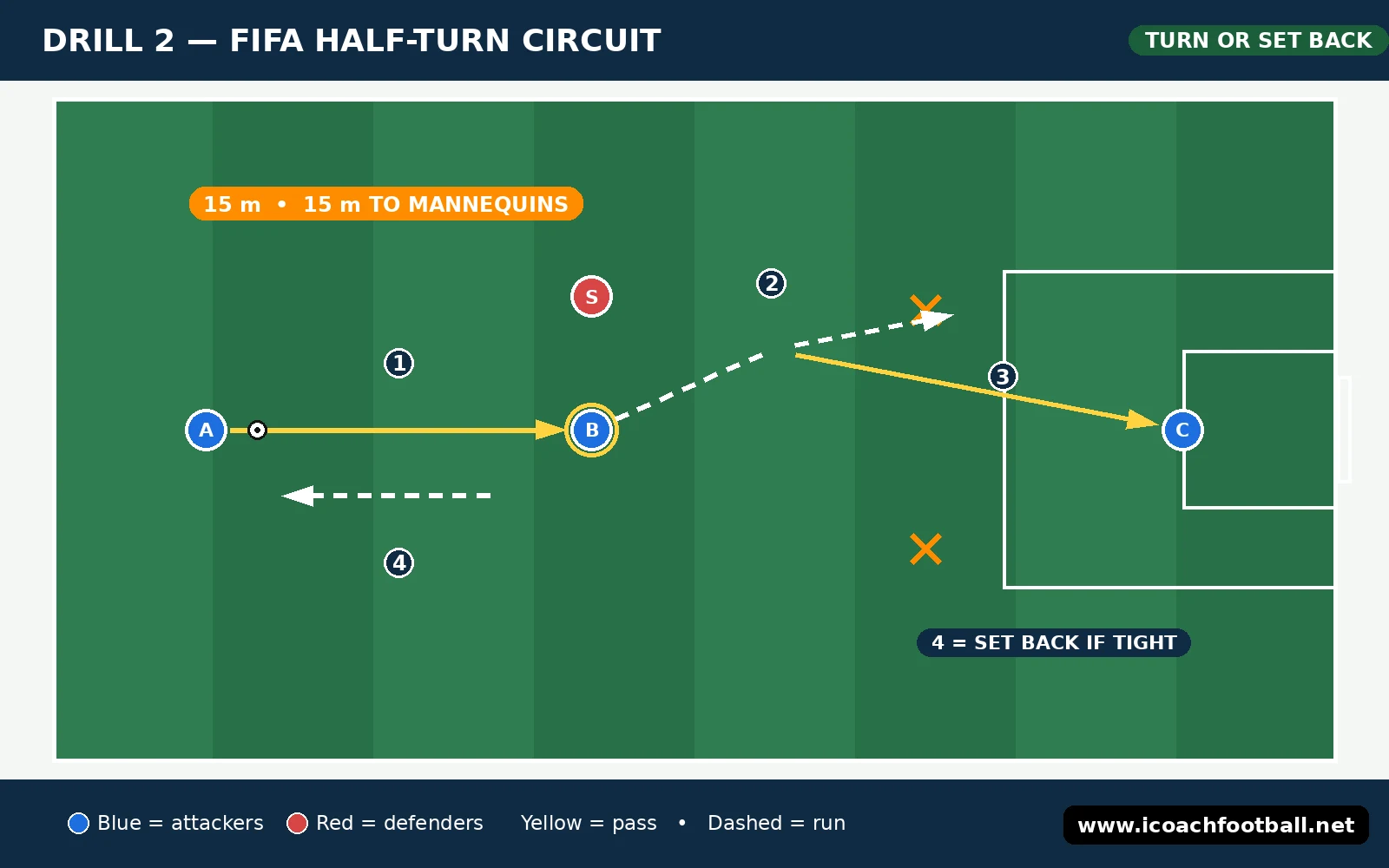
The three-player circuit, based on the FIFA Training Centre passing circuit for midfielders receiving on the half-turn: drop, scan, turn or set back, and play beyond the press.
Setup:
- Two cones 15 metres apart, with two mannequins a further 15 metres away, one either side of the far cone.
- Player A at the near cone with the ball, Player B in the middle, Player C waiting behind a mannequin.
- A shadow presser starts behind B and may step in on every second rep.
How to Play:
- Player A plays a firm pass to B’s back foot as B drops to receive.
- Player B scans before the pass and opens side-on as the ball travels.
- Player B decides from the scan: turn on the half-turn, or set the ball back to A.
- If B turns, B plays beyond either mannequin to C in one or two touches.
- Players rotate after every action: A and B follow their passes, and C dribbles back to A’s cone.
Coach’s note: The cue is “Decide on the scan!” A turn chosen after the first touch is too late. The shadow presser must not shadow every rep, so B reads real pressure.
Progressions: The shadow presser becomes live and may win the ball, then A may play direct to C if B is tightly marked, and B peels off for a one-two with C.
Drill 3 — Scan and Turn
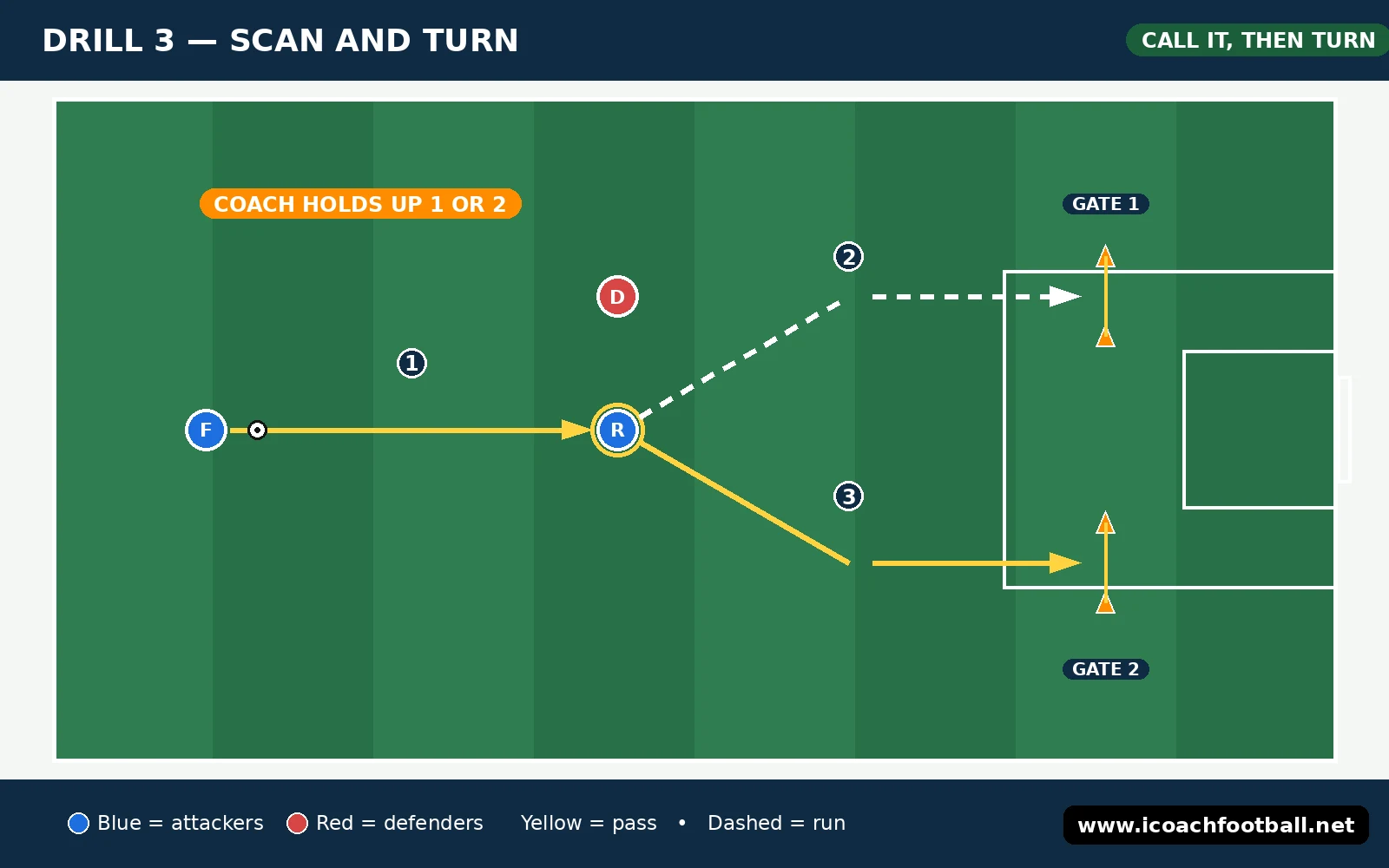
The decision drill. A signal behind the receiver chooses the exit, and the receiver must call it before turning.
Setup:
- A 15 x 15 yard square, with a feeder on one side and two 3-yard exit gates on the far side.
- Receiver in the centre, with a coach standing behind them holding up one or two fingers.
- Balls with the feeder, and a passive defender 3 yards behind the receiver.
How to Play:
- The feeder plays the ball in as the receiver scans over their shoulder.
- The receiver calls out the coach’s number before the ball arrives.
- One finger means turn left through the left gate, and two fingers mean turn right.
- The receiver opens side-on, takes the ball on the back foot, and exits through the called gate.
- The receiver passes to the feeder on the far side, and the next receiver enters at once.
Coach’s note: The cue is “Call it, then turn!” If the receiver turns before calling the number, the scan never happened. No call means no turn.
Progressions: The signal becomes a colour for a direction, then the passive defender may step in and the receiver must set the ball back instead of turning.
Drill 4 — Half-Turn Rondo
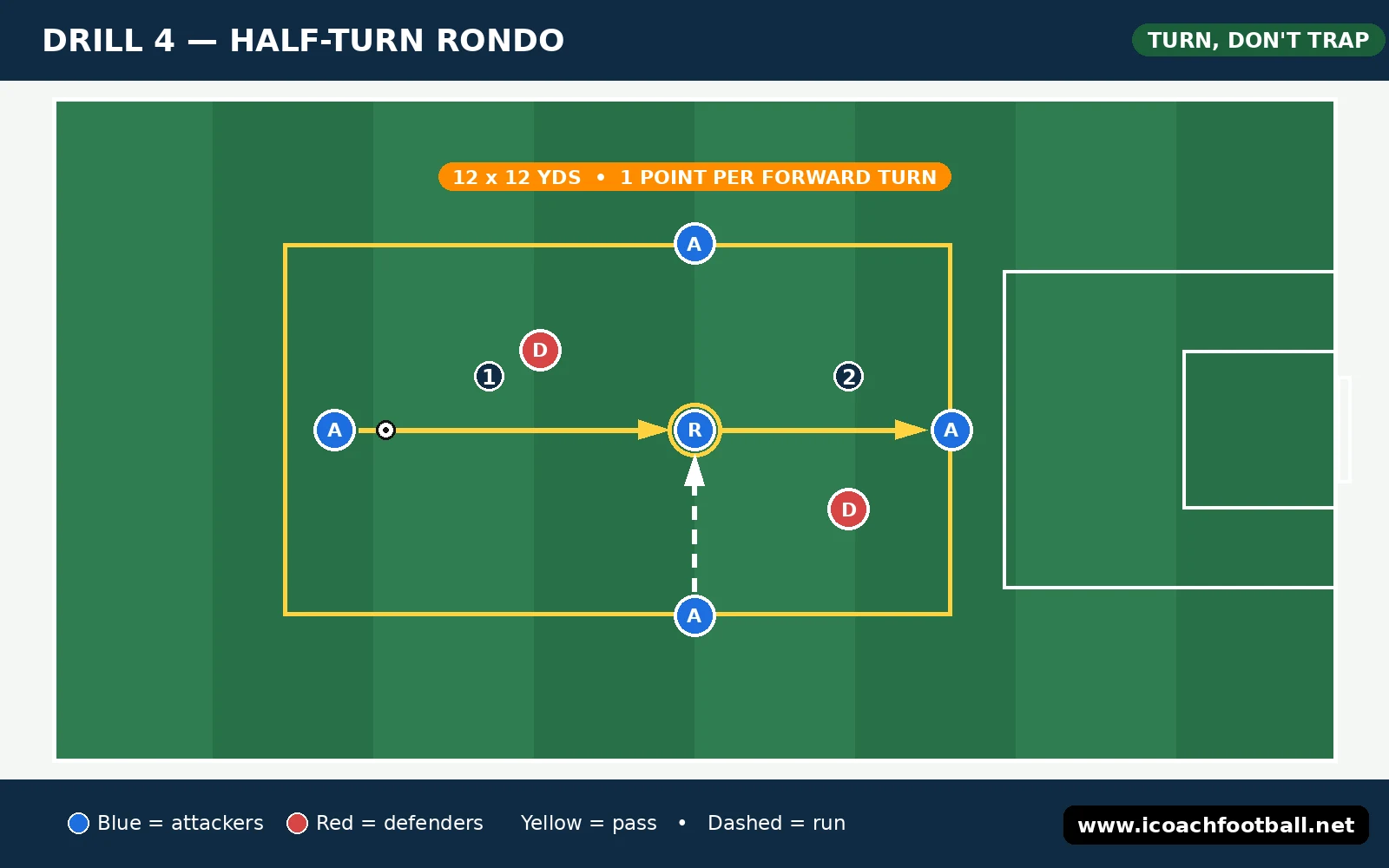
The pressure test. The central receiver only scores by receiving open and playing forward, not by keeping the ball safe.
Setup:
- A 12 x 12 yard rondo box, with four attackers on the outside and two defenders inside.
- One central receiver in a different bib, with a ball supply on the side.
- Balls with the outside attackers, and a 2-minute block clock.
How to Play:
- The outside attackers keep possession in two touches, and the defenders press to win it.
- A pass into the central receiver must be received on the half-turn.
- The receiver takes one open touch and plays forward to a different outside attacker.
- A successful half-turn receive and forward pass scores 1 point for the attackers.
- Rotate the central receiver every 90 seconds, and swap the defenders every block.
Coach’s note: The cue is “Turn, don’t trap!” A receiver who stops the ball and passes back scores nothing. The point is only for a forward touch.
Progressions: The receiver is limited to one touch, then a defender may mark the receiver and the outside attackers must find the free side.
Drill 5 — Playing Out Centrally
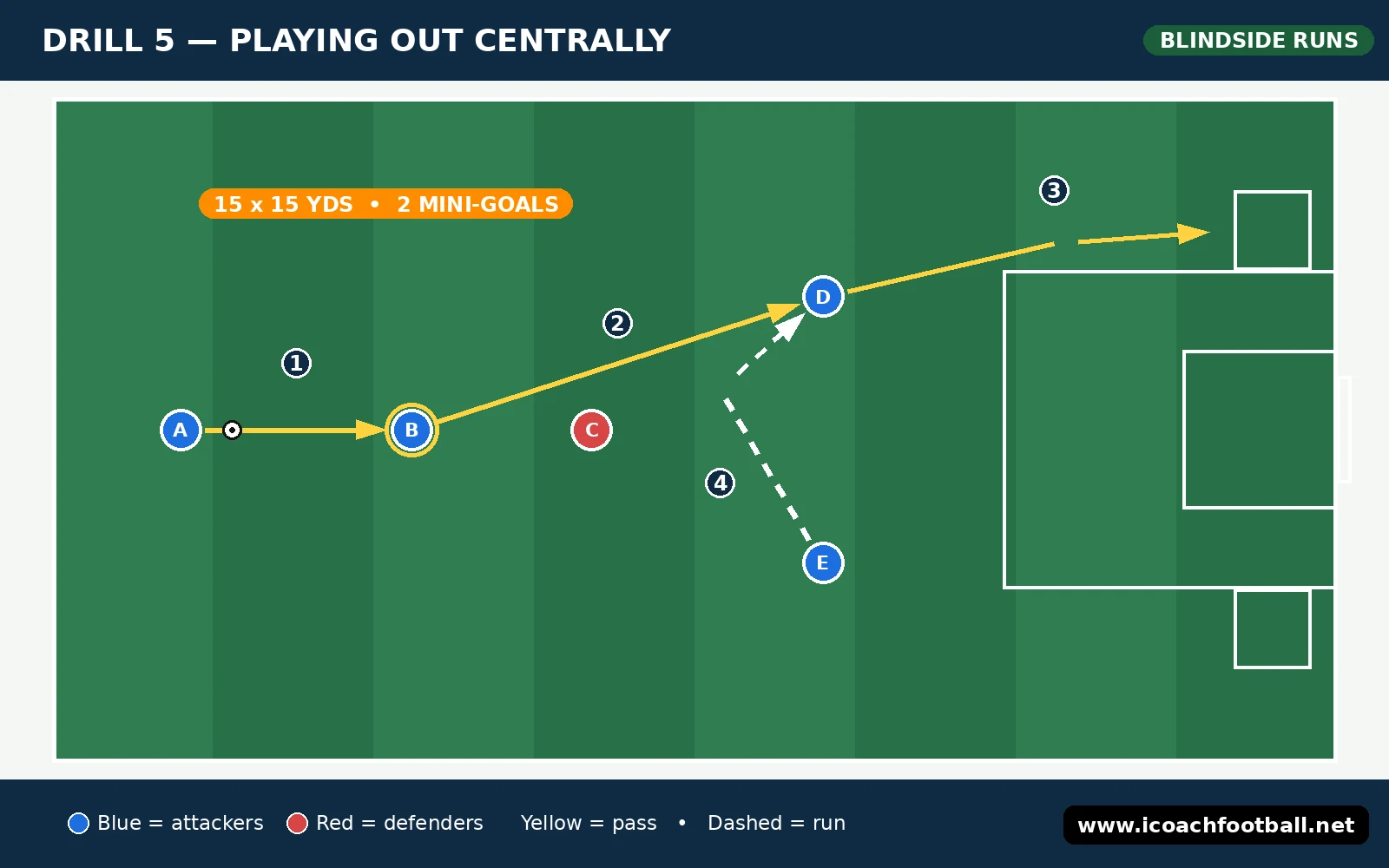
The functional drill, in line with the FIFA Training Centre session on playing out centrally: the centre-back receives open, the midfielders make blindside runs, and the ball goes forward through the middle.
Setup:
- A 15 x 15 yard area, with two mini-goals on the far side, one in each corner.
- Centre-back B receives from starter A, with a striker C screening between two cones.
- Two midfielders D and E start ahead of B, with a second defender added in the progression.
How to Play:
- Starter A passes to centre-back B, who receives on the half-turn between the cones.
- Centre-back B scans and passes either side of striker C to a midfielder.
- Midfielders D and E time blindside runs and receive on the half-turn themselves.
- The receiving midfielder plays forward at speed and finishes into the far mini-goal.
- Players rotate clockwise after every rep, so each player receives as the centre-back and as a midfielder.
Coach’s note: The cue is “Blindside, then forward!” A midfielder who runs too early is marked. The run starts as B’s first touch goes forward, not before it.
Progressions: Add the second defender for a 2v1 finish, then let C press with no restrictions and shrink the area to 12 x 12 yards.
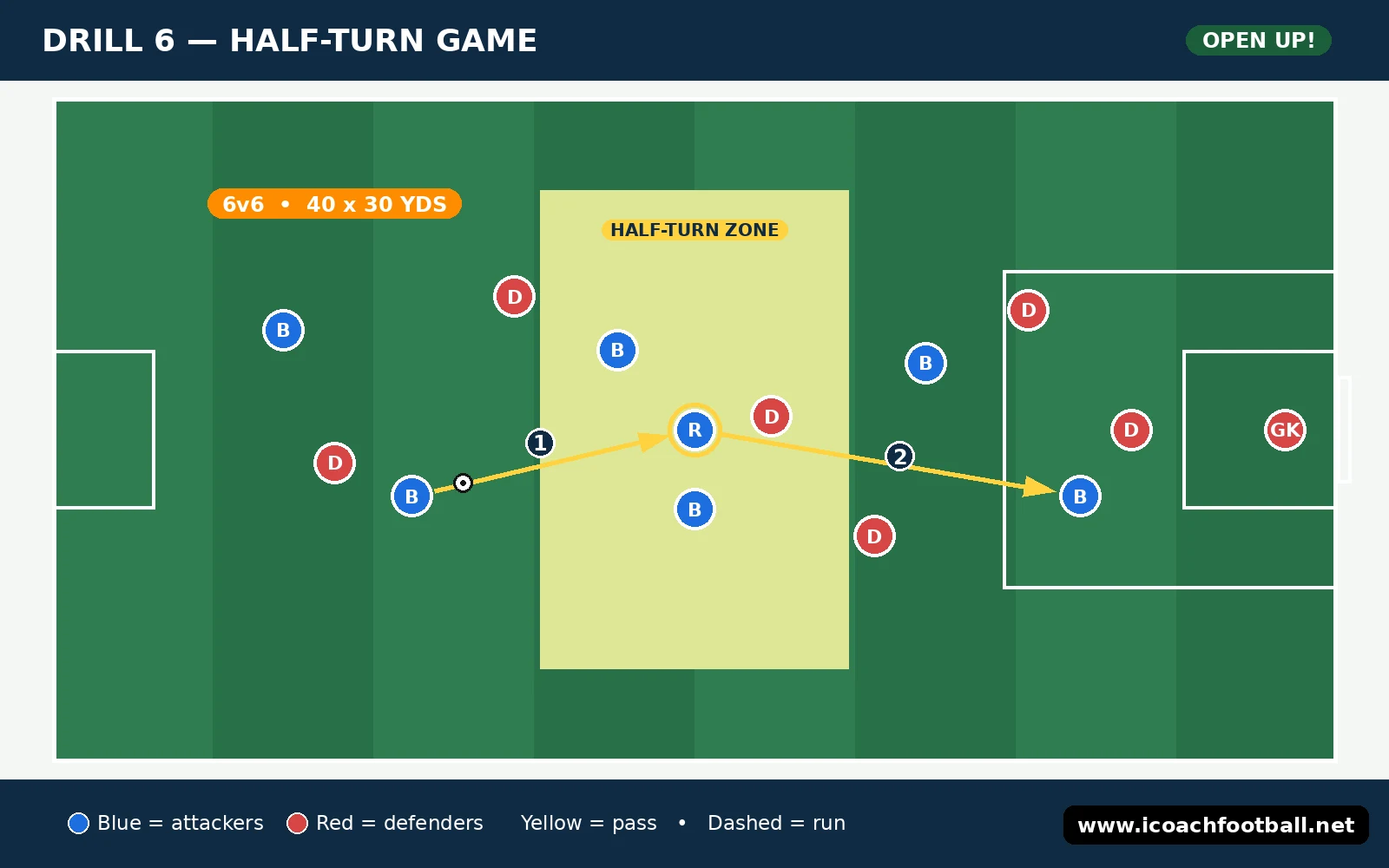
Drill 6 — Half-Turn Game
The conditioned game. Only goals that follow a half-turn receive count double, so midfielders must open up every time they receive.
Setup:
- Area 40 x 30 yards, with a goal at each end, a goalkeeper in each goal, and a shaded central zone.
- Two teams of 6, with balls starting with the coach on the halfway line.
- A point is scored only when a central player receives on the half-turn and plays forward.
How to Play:
- The coach plays the ball in, and teams keep possession with no touch limit.
- A goal scored after a half-turn receive in the central zone scores 2 points.
- Any other goal scores 1 point, and a goal after a square receive scores no bonus.
- After a goal, the other team restarts from their goalkeeper, and play builds through the middle.
- Play four 4-minute blocks, keep a running score, and swap the central-zone players every block.
Coach’s note: The cue is “Open up or no bonus!” Freeze any team that builds only sideways. The game must reward the forward touch, not just the finish.
Progressions: Goals only count if the half-turn pass breaks a line, then the central zone narrows and the touch limit drops to two.
Coaching points
- “Side-on, back foot!” Open hips to 45 degrees and let the ball run across the body. A square receiver can only play backwards.
- “Call it, then turn!” The scan in Drill 3 must be spoken before the turn. A silent scan is a guess.
- “Decide on the scan!” Turn when space is open, and set it back when pressure is tight. The FIFA circuit in Drill 2 trains both answers.
- “Turn, don’t trap!” In Drill 4, a stopped ball scores nothing. The first touch must move forward.
- “Blindside, then forward!” In Drill 5, midfielders run behind the press, not in front of it. Time the run to B’s forward touch.
- “Open up or no bonus!” In Drill 6, no half-turn receive means no double points. The constraint builds the habit, and the forward pass it creates is the same pass trained in these soccer passing drills.
Common mistakes
| Mistake | Fix |
|---|---|
| Receiver stands square to the passer | Drill 1 cue “Side-on, back foot!”; no rep counts from a square start |
| Scan happens after the first touch | Drill 3 call-out rule; no call means no turn, and the rep restarts |
| First touch stops the ball dead in front | Back-foot touch across the body in Drills 1–2; ball must move forward on the touch |
| Receiver turns into the defender | Open away from pressure; if tight, set it back first time in Drill 2 |
| Run starts before the pass is played | Drill 5 cue “Blindside, then forward!”; run on B’s forward touch, not before it |
| Game becomes sideways possession | Freeze Drill 6 and restart; only a half-turn receive earns the bonus |
Age adaptations
| Age | Change |
|---|---|
| U11–U12 | Drills 1 and 3 only, unopposed, no live defender, and celebrate the open shape before any finish |
| U13–U14 | Full six-drill menu with a passive shadow in Drills 2–3 and runs from both sides in Drills 1–2 |
| U15–U16 | Live presser in Drill 2, one-touch limit in Drill 4, and the line-break rule in Drill 6 |
| U17–U18 | No coach call in Drill 3, smaller areas in Drill 5, and weaker-foot turns demanded in Drills 1–2 |
60-minute session plan
Run the six games as one session with this 60-minute plan, or take any two games for a 20-minute block.
| Block | Time | Drill |
|---|---|---|
| 1 | 10 minutes | Drill 1 — Back-Foot Gate |
| 2 | 10 minutes | Drill 2 — The FIFA Half-Turn Circuit |
| 3 | 10 minutes | Drill 3 — Scan and Turn |
| 4 | 10 minutes | Drill 4 — Half-Turn Rondo |
| 5 | 10 minutes | Drill 5 — Playing Out Centrally |
| 6 | 10 minutes | Drill 6 — Half-Turn Game |
Once the turn is clean, use the spare-player decision from these 3v2 soccer drills to teach what the receiver does next: the half-turn creates the free player, and the next pass must find them at once.
Sources
These football half-turn drills are based on, and in line with, the FIFA Training Centre passing circuit for midfielders receiving on the half-turn, which trains scanning over the shoulder, proper body position, receiving on the back foot, and the decision to turn or pass backwards when heavily pressed, and with the FIFA Training Centre session on playing out centrally, in which the centre-back receives on the half-turn and scans for midfielders in space, and the midfielders time blindside runs, adjust their body position, and play forward with speed.
FAQ
What does receiving on the half-turn mean in football?
It means standing side-on, with hips open to about 45 degrees, before the ball arrives. The receiver can see the passer and the space ahead, takes the ball on the back foot across the body, and plays forward in one movement instead of turning after a stop.
How do you teach a player to receive on the half-turn?
Start unopposed with the back-foot gate in Drill 1, then add the scan decision in Drill 3. Coach two cues only at first: “Side-on, back foot!” and “Call it, then turn!” Add pressure only when the open shape is automatic.
Should a player always turn on the half-turn?
No. Turn when the scan shows open space behind. When a defender is tight on the shoulder, set the ball back first time and spin away. Drill 2 trains both answers, and the choice is made on the scan, not on the touch.
What is the back foot in a half-turn receive?
The back foot is the foot furthest from the passer. Letting the ball run across the body to that foot turns the receiver forward in the same movement as the touch, instead of stopping the ball and turning in a second movement.
At what age should half-turn drills start?
Introduce the open shape from U11 with Drills 1 and 3, unopposed and with no live defender. Expect the turn-or-set decision under pressure from U13–U14, and demand it at match speed, on both feet, from U15 up. The same session works in soccer at every age, because the scan and the body shape do not change.