2v2 Soccer Drills: 6 Games That Teach Pairs to Combine and Defend Together
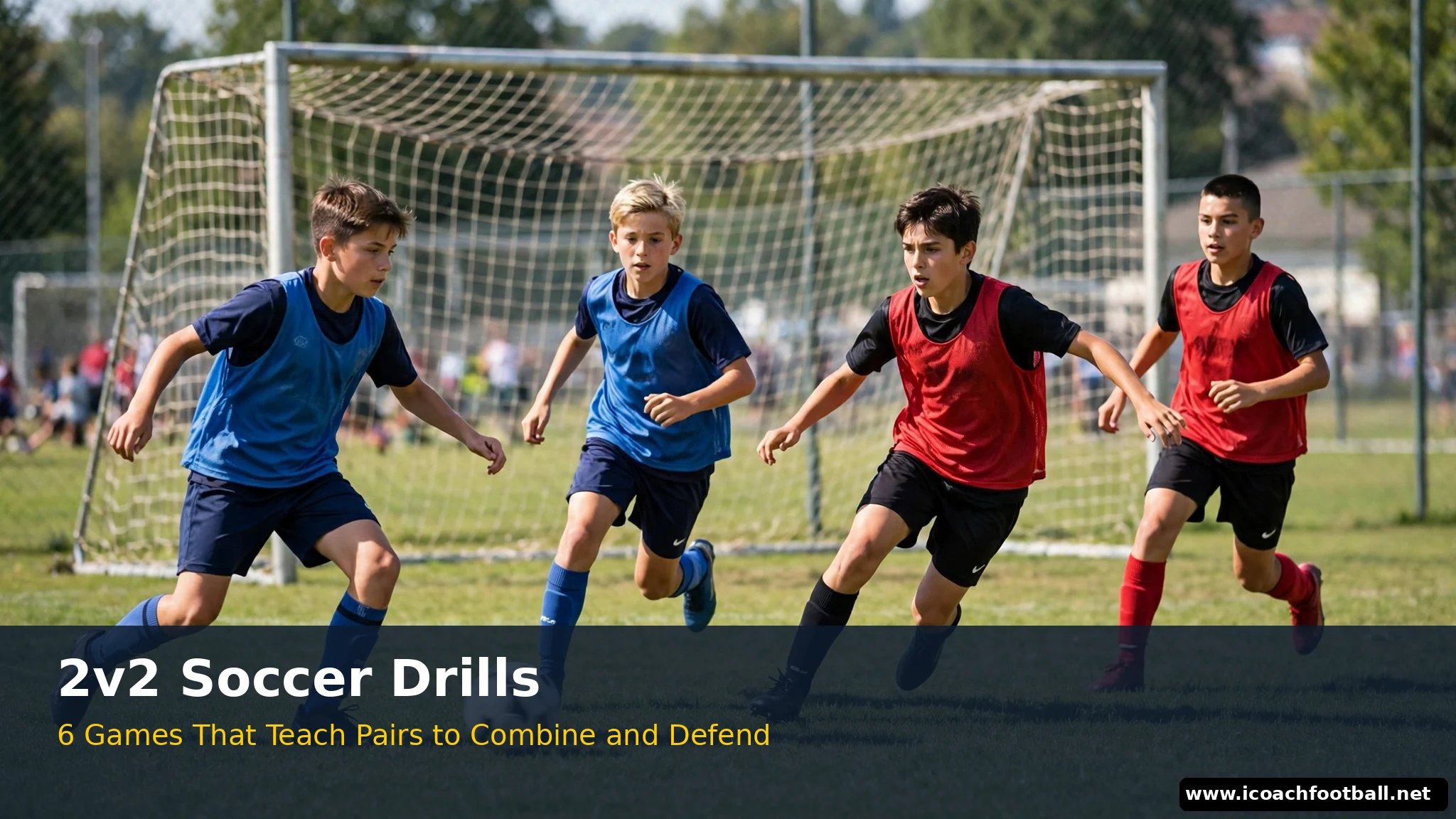
Quick answer: A 2v2 works when the pair stays connected: the ball carrier commits a defender, the partner offers one clear option, and the pair defends as pressure plus cover. Combine to create a 1v1, or defend together to force the ball wide and win it back.
Most 2v2 games collapse into two 1v1s. One player dribbles alone, the partner watches, and the defenders pick them off one at a time.
The pair is the point. Two attackers must move as one — one commits, one offers — and two defenders must do the same, one presses while the other covers. Coaches in the UK run the same games as football drills, and the pair decisions are identical.
These six games teach both sides of the pair. Each one is short, each one restarts fast, and each one ends with a finish or a counter-attack.
- Players: 4–16 (pairs, plus neutrals where shown)
- Area: 15 x 10 to 30 x 20 yards, mini goals or one full-size goal
- Duration: 60 minutes for all six games, or 20 minutes for any two
- Focus: Pair combinations, 1v1 creation, pressure-and-cover defending, transitions
- Equipment: Cones, bibs, balls, four mini goals, one full-size goal for Drill 3
- Age: U9–U18 (see age adaptations)
The one rule: stay connected, then commit one defender
A 2v2 is not two players sharing a pitch. It is a pair that stays close enough to combine and far enough apart to stretch two defenders.
- Stay connected. The partner stays within one pass of the ball carrier, on a clear angle. A partner 20 yards away is not an option.
- Commit one defender. The ball carrier drives at the nearest defender. A defender who is committed cannot cover both attackers.
- Offer one option. The partner shows for the give-and-go, the overlap, or the run in behind — one run, timed to the dribble.
- Defend as a pair. The nearest defender presses. The second defender covers behind and blocks the pass to the partner.
If the pair cannot combine, the ball carrier must still dribble. Start with 2v1 soccer drills if your players cannot yet create a 2v1 with a spare player; the 2v2 below adds a second defender who punishes a slow decision.
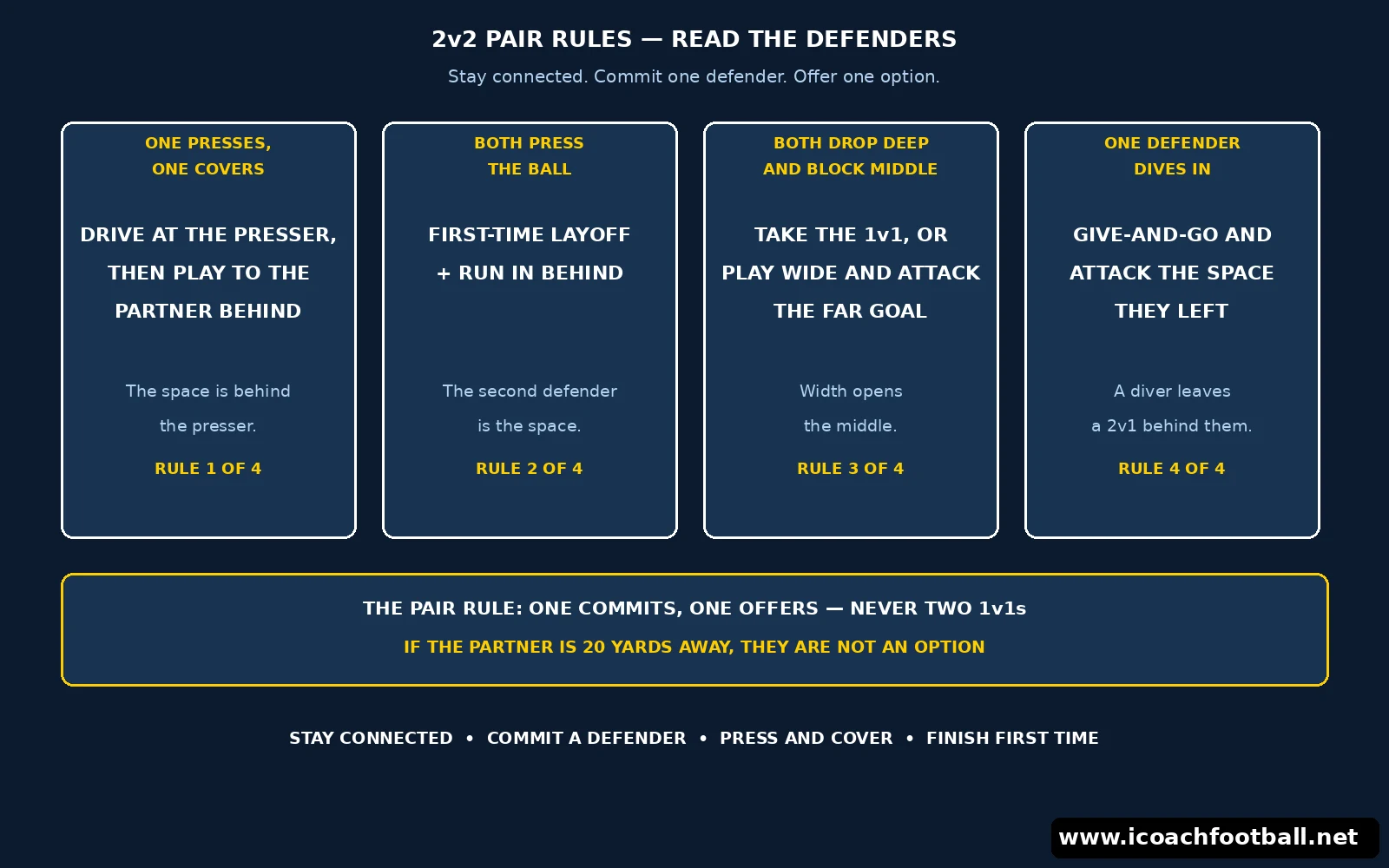
| Defender does this | Pair does this |
|---|---|
| One presses, one covers | Drive at the presser, then play to the partner in the space behind |
| Both press the ball carrier | First-time layoff, then run in behind the second defender |
| Both drop deep and block the middle | Take the 1v1, or play wide and attack the far goal |
| One defender dives in | Beat them with the give-and-go and attack the space they left |
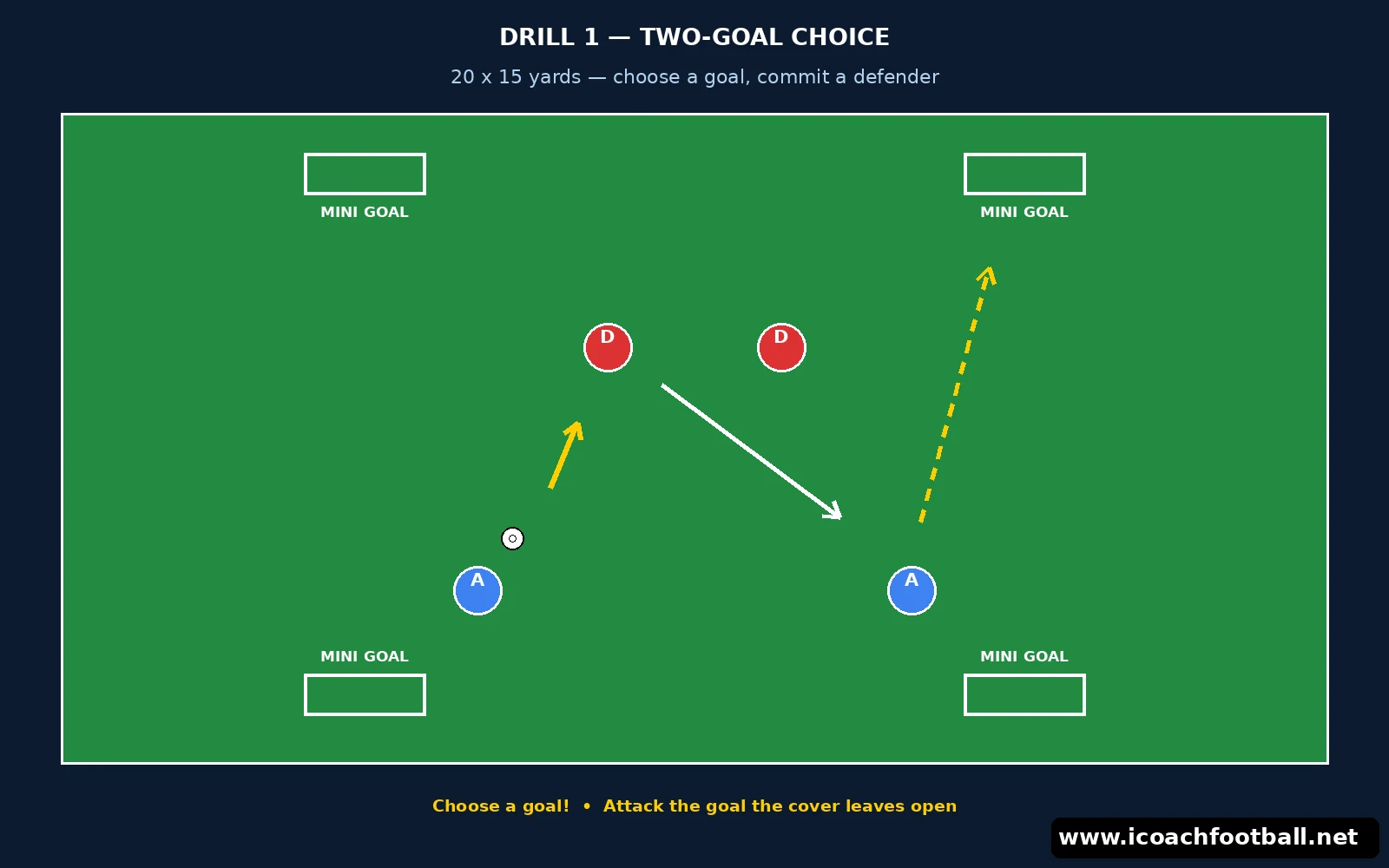
Drill 1 — Two-Goal Choice
The starting point for every 2v2. Two attackers face two defenders and two goals, so every attack must choose a goal and commit a defender first.
Setup:
- One 20 x 15 yard area, two mini goals on each end line.
- Two attackers in blue bibs, starting on the far line.
- Two defenders in red bibs, starting on the edge of the area.
- One ball per pair, spare balls behind the goals.
How to Play:
- The ball carrier dribbles forward and attacks the nearest defender.
- The partner stays wide on the far side and offers a clear passing angle.
- The pair attacks the goal the covering defender leaves open.
- A goal counts only after both attackers have touched the ball.
- After each finish, the next pair enters at once from the far line.
Coach’s note: The cue is “Choose a goal!” If the pair passes sideways with no goal in mind, stop the rep and point at the open goal.
Progressions: One-touch finishes only, then require the pair to switch goals mid-attack on the coach’s call.
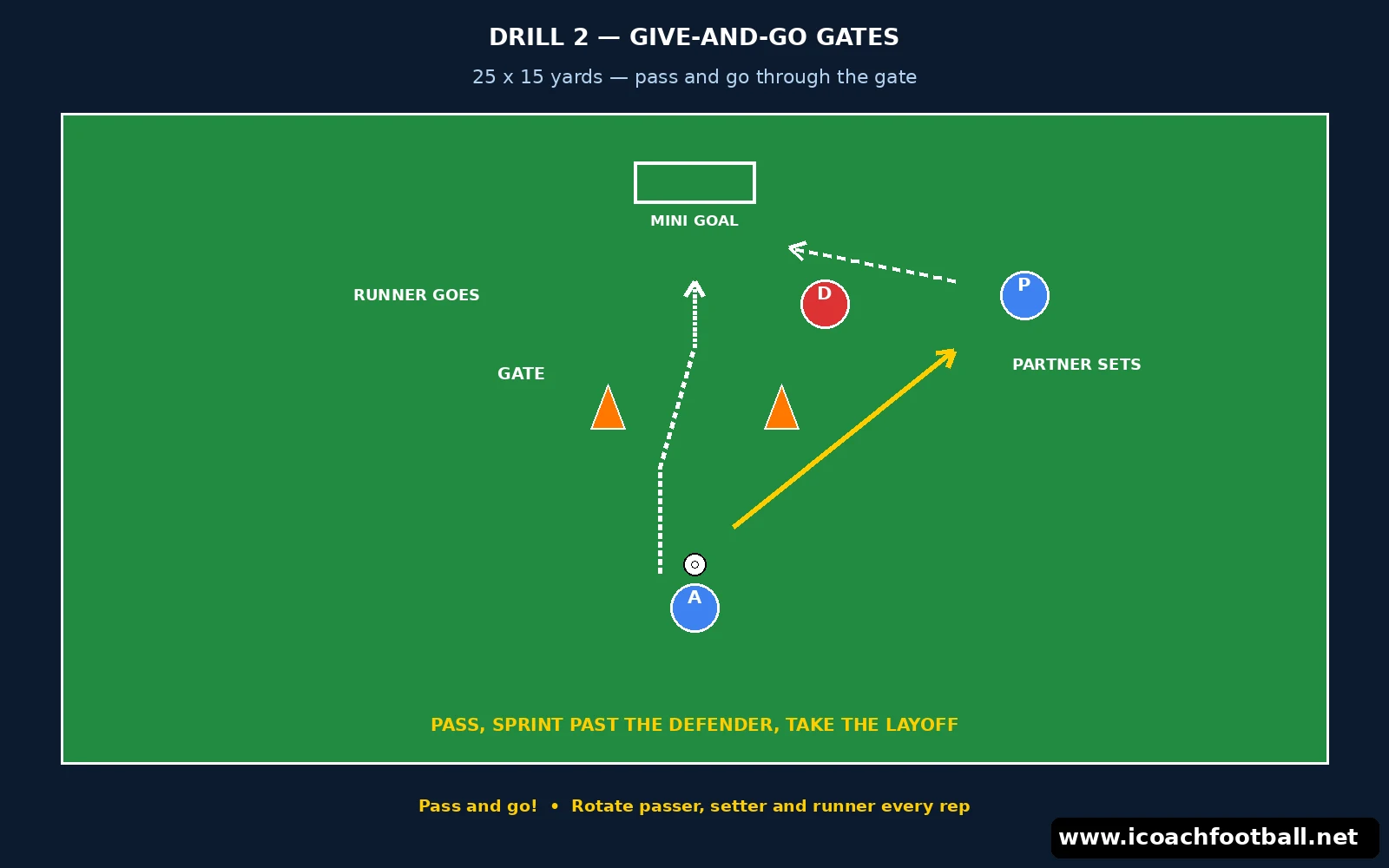
Drill 2 — Give-and-Go Gates
This game isolates the combination that unlocks a 2v2: the wall pass played at speed, with the passer sprinting past the defender for the return.
Setup:
- One 25 x 15 yard area with a gate of two cones in the middle.
- One ball carrier, one partner, one passive defender at the gate to start.
- Pairs work in threes and rotate roles after every rep.
How to Play:
- The ball carrier passes to the partner, who stands beyond the gate.
- The ball carrier sprints past the defender the moment the pass leaves their foot.
- The partner lays the ball back first time, into the space beyond the gate.
- The ball carrier receives at full speed and finishes in the mini goal.
- Rotate roles so each player passes, sets, and runs in every set of three.
Coach’s note: The cue is “Pass and go!” A passer who stands and watches has turned a give-and-go into a standing pass.
Progressions: The defender becomes live after the first pass, then the gate is narrowed to force a firmer layoff.
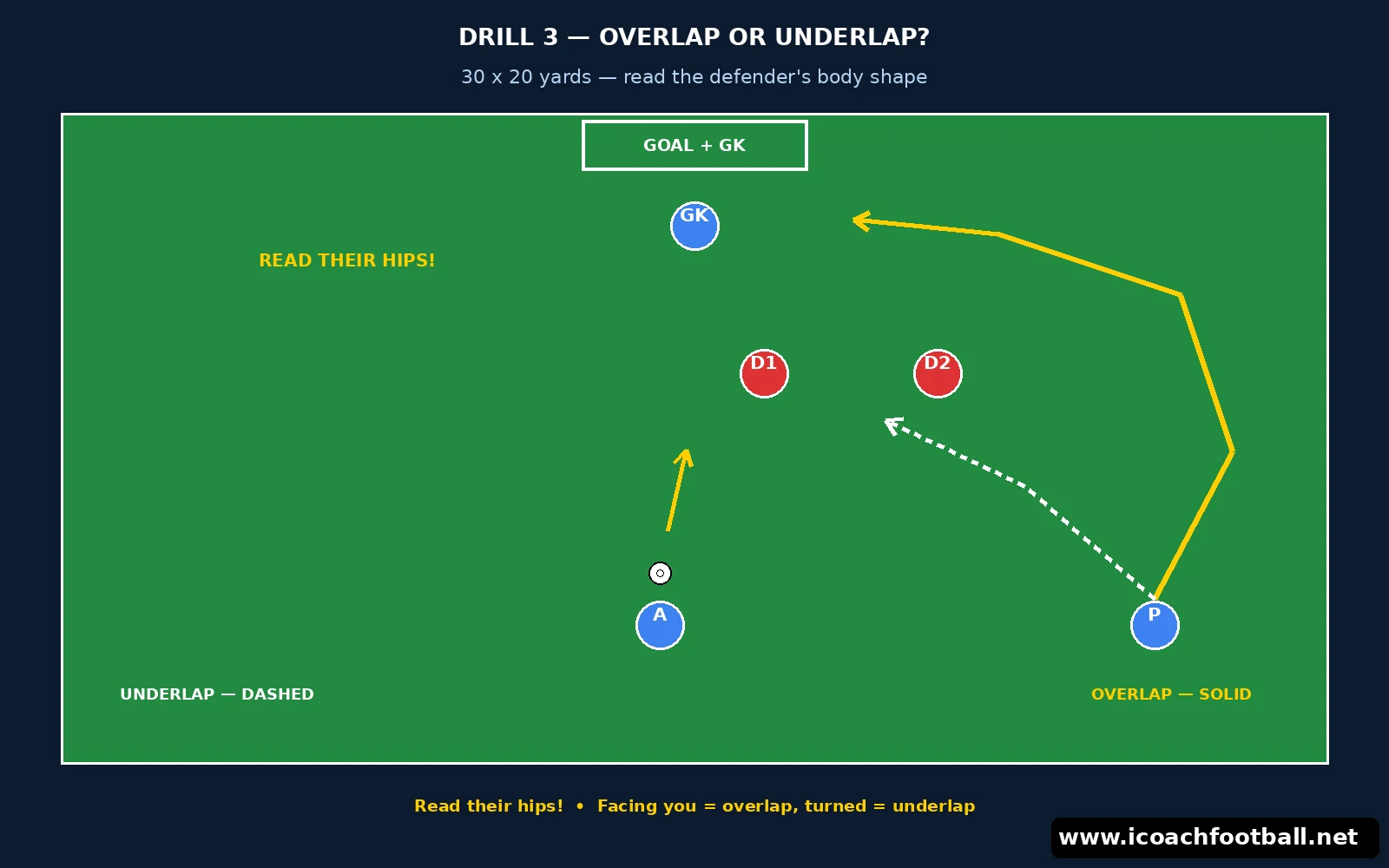
Drill 3 — Overlap or Underlap?
The hardest pair decision: when the partner runs outside the ball carrier, and when they cut inside instead.
Setup:
- One 30 x 20 yard area, one full-size goal with a goalkeeper.
- One ball carrier, one partner, two defenders, one goalkeeper.
- One ball per rep, spare balls with the coach on the touchline.
How to Play:
- The ball carrier drives down the centre-right channel towards the first defender.
- The partner reads the defender’s body shape as the ball carrier approaches.
- If the defender faces the ball carrier, the partner arcs outside for the overlap.
- If the defender turns to track the partner, the partner cuts inside for the underlap.
- The ball carrier plays the partner in stride, and the partner shoots first time.
- Swap sides after every four reps so both feet and both runs are practised.
Coach’s note: The cue is “Read their hips!” A defender facing the ball cannot see the overlap. A defender turned sideways has already lost the underlap.
Progressions: The partner must call “over” or “under” before the run starts, then decide silently with no call at all.
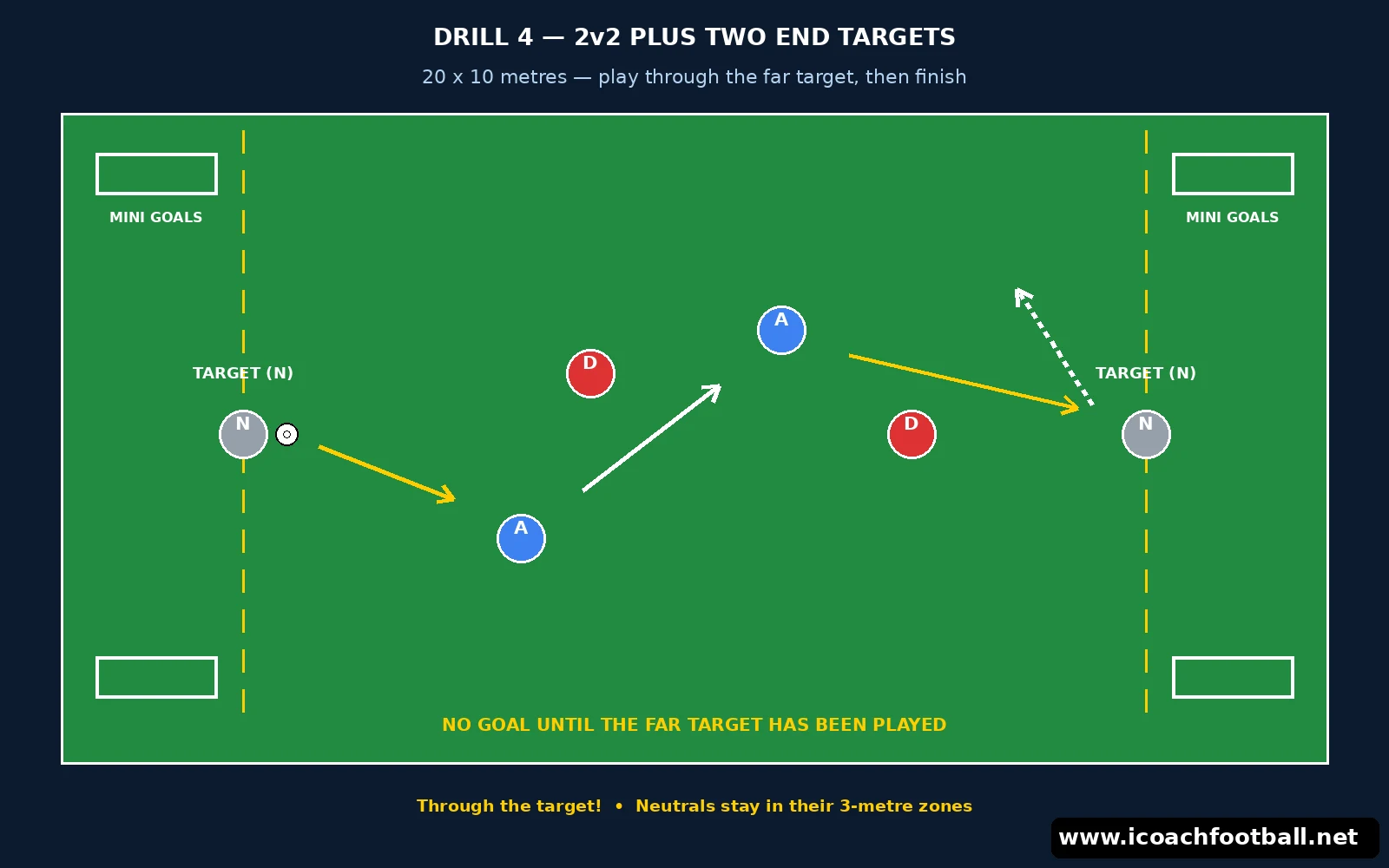
Drill 4 — 2v2 Plus Two End Targets
A pair game with a target at each end. The pair must play through the far target, take the return, and finish — while the defending pair tries to win it and do the same.
Setup:
- One 20 x 10 metre area with a 3-metre zone at each end.
- Two mini goals at each end of the area, inside the end zones.
- Two attackers, two defenders, and one neutral target player in each end zone.
- One ball per rep, spare balls with the coach at the side.
How to Play:
- The neutral player in one end zone starts with the ball and passes to an attacker.
- The attackers combine to play through the two defenders towards the far end.
- The pair must play the ball into the far neutral player before they can score.
- The far neutral returns the ball first time, and the pair finishes in either mini goal.
- If the defenders win the ball, the roles swap at once and they attack the other end.
- Rotate the neutral players every 3 minutes so every player plays every role.
Coach’s note: The cue is “Through the target!” A pair that shoots before reaching the target has skipped the combination the game exists to teach.
Progressions: Limit the neutral players to one touch, then require the pair to reach the target with no more than three passes.
Drill 5 — Defend in Pairs: Pressure and Cover
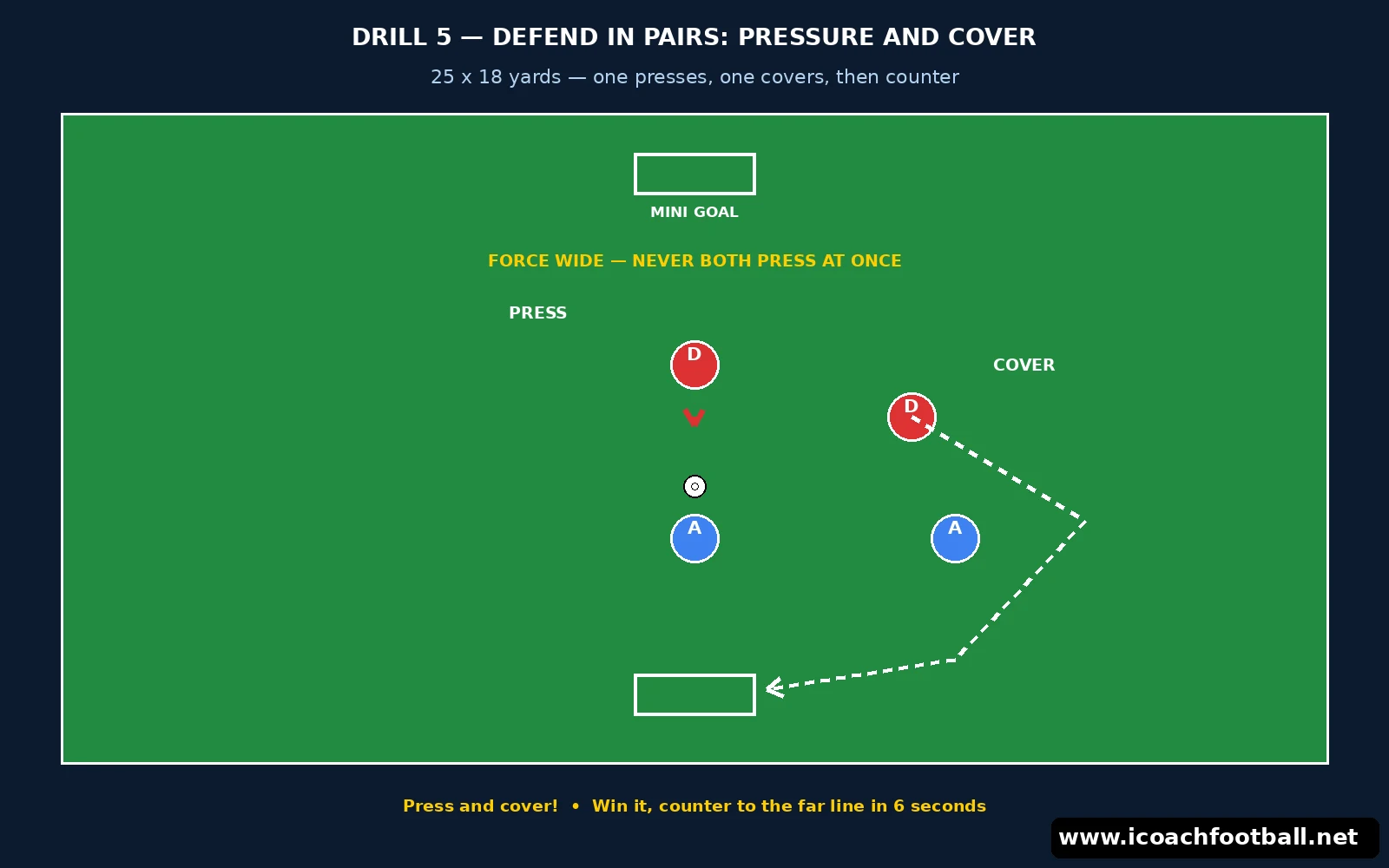
A 2v2 is won by the defending pair as often as by the attackers. This game teaches the nearest defender to press and the second defender to cover, then counter at once.
Setup:
- One 25 x 18 yard area with a mini goal on each end line.
- Two defenders in red bibs start in the middle, two attackers in blue bibs on the far line.
- The defending pair scores by winning the ball and dribbling over the far line within 6 seconds.
How to Play:
- The attackers start with the ball and attack the mini goal.
- The nearest defender presses the ball carrier and forces them towards the touchline.
- The second defender drops behind and covers the pass to the partner.
- The defending pair stays compact and forces the ball wide, never letting both defenders press at once.
- If the defenders win the ball, they counter to the far line at once.
- Swap pairs every three reps so every player presses and covers.
Coach’s note: The cue is “Press and cover!” If both defenders chase the ball, the partner is free. One presses, one covers, every time.
Progressions: The presser may only press when the ball carrier takes a heavy touch, then the covering defender must call the press.
Drill 6 — Flying 2v2 Ladder
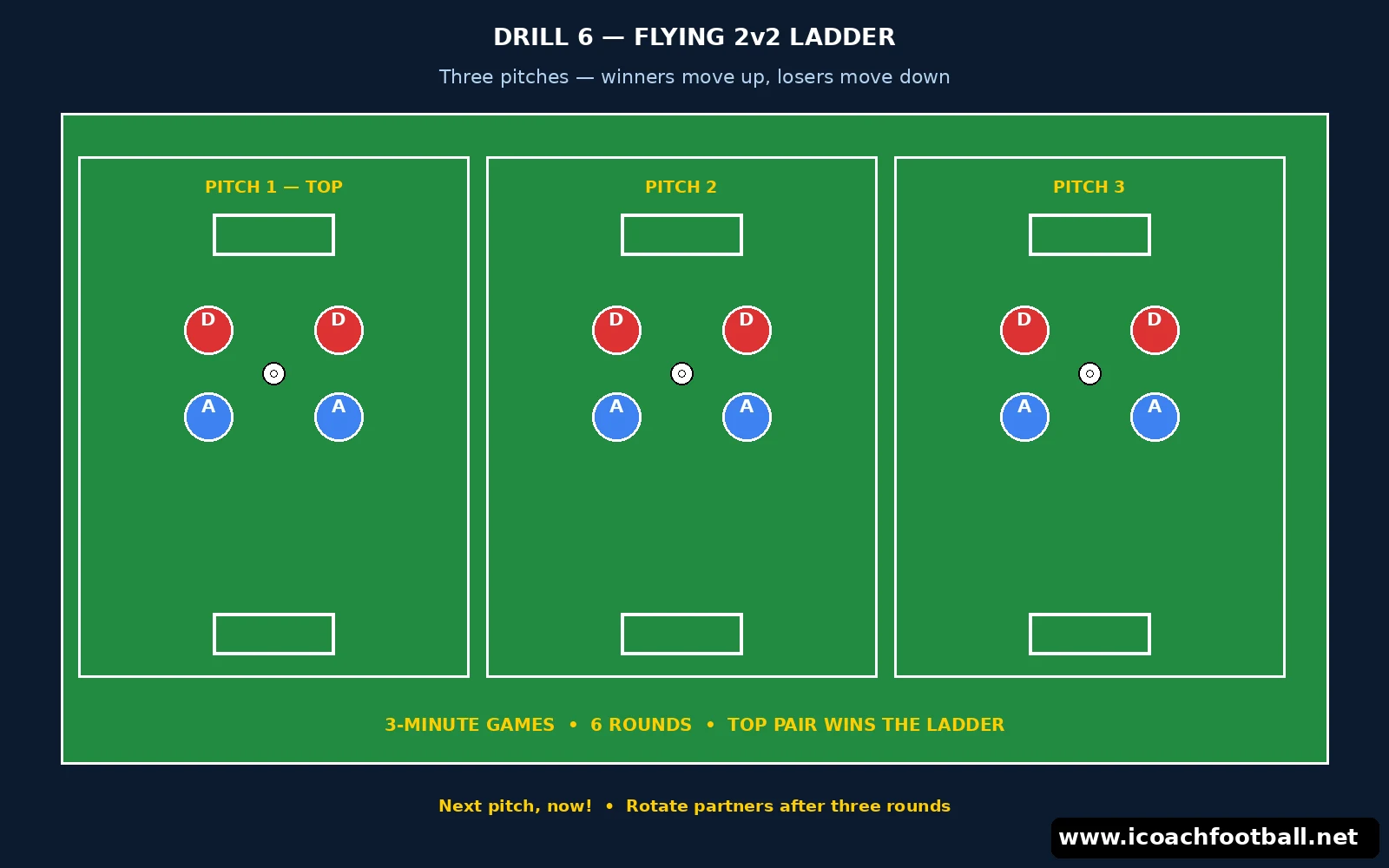
Short 2v2 matches on small pitches, with pairs moving up or down a ladder after every game. Every pair plays, every game matters, and no pair waits long.
Setup:
- Three or four pitches, each 20 x 15 yards, with a mini goal on each end line.
- Pairs ranked on a ladder, with the top pair on Pitch 1 and the rest below.
- One ball per pitch, spare balls with the coach in the middle.
How to Play:
- Pairs play 3-minute 2v2 games on their pitch.
- The winning pair moves up one pitch, the losing pair moves down one pitch.
- On a draw, both pairs stay, and the pair that scored first keeps the higher pitch.
- The coach restarts every pitch at the same whistle, with a new ball played in.
- Play six rounds, then crown the pair that finishes on Pitch 1.
- Rotate partners after three rounds so every player pairs with someone new.
Coach’s note: The cue is “Next pitch, now!” The value is in the tempo and the fresh opponents. If pairs linger to argue a goal, the ladder — and the fitness benefit — stalls.
Progressions: Winners must win by two goals to move up, or each round adds a condition, such as a goal only counting after a give-and-go.
Coaching points
- “Stay connected!” The partner must be one pass away, on a clear angle. Distance kills a 2v2 faster than any defender.
- “Commit them, then pass!” The dribble creates the combination. A pass played before the defender moves is a pass into a 2v2.
- “Pass and go!” The passer sprints past the defender at once. Give-and-gos are runs first and passes second.
- “Read their hips!” Overlap when the defender faces the ball, underlap when they turn. The run is decided by the defender, not by habit.
- “Press and cover!” One defender presses, one covers. Two pressers leave the partner free, and the pair is beaten.
- Finish the isolated 1v1. When the combination leaves one attacker alone against the goalkeeper, train that finish with a 1v1 finishing drill.
Common mistakes
| Mistake | Fix |
|---|---|
| Two 1v1s instead of a pair | Require both attackers to touch the ball before a goal counts |
| Partner too far from the ball | Stay within one pass, on a clear angle, at all times |
| Pass played before a defender commits | Drive at the defender first, then pass to the partner |
| Both defenders press the ball | Nearest presses, second covers; coach the cover in Drill 5 |
| Give-and-go passer stands still | Sprint past the defender the moment the pass leaves the foot |
| Pair shoots before reaching the target | No goal counts until the far target has been played (Drill 4) |
Age adaptations
| Age | Change |
|---|---|
| U9–U10 | Play 20 x 15 yards or smaller, no time limits, and celebrate the combination before the finish |
| U11–U12 | Run the drills as written, with the target rule in Drill 4 and pressure-and-cover in Drill 5 |
| U13–U14 | Add one-touch finishes in Drills 2 and 3, the 6-second counter in Drill 5, and offside-style timing in Drill 4 |
| U15–U18 | Play Drill 6 on a 25 x 18 yard pitch, demand the overlap/underlap decision with no coach call, and score first-time finishes double |
How to run the 60 minutes
| Block | Time | Content |
|---|---|---|
| Warm-up | 0–5 min | Unopposed pair passing in twos, give-and-goes across the area |
| Drill 1 | 5–13 min | Two-Goal Choice, both attackers must touch the ball before a goal |
| Drill 2 | 13–23 min | Give-and-Go Gates, rotate all three roles every rep |
| Drill 3 | 23–33 min | Overlap or Underlap, both sides, no coach call in the final 5 minutes |
| Drill 4 | 33–41 min | 2v2 Plus Two End Targets, animated sequence shown before the first rep |
| Drill 5 | 41–50 min | Defend in Pairs, swap pressing and covering roles every three reps |
| Drill 6 + game | 50–60 min | Flying 2v2 Ladder, then a 4v4 game with double points for a goal from a pair combination |
Use the same six games as a 20-minute block by running Drills 1 and 6 only, or slot the full hour into the 60-minute youth soccer session plan as the main practice phase.
From 2v2 to 3v2
When pairs combine cleanly and defend together, add a third attacker. The extra player creates a spare-player decision on top of the pair work: the ball carrier must now choose which of two teammates is free. For that next step, use these 3v2 soccer drills after Drill 4 is clean, and teach the defending pair in Drill 5 to delay until the recovering player arrives. For the defending side of the pair, use these 1v1 defending drills to sharpen the presser’s jockeying before the cover arrives.
Sources
These drills are based on, and in line with, the FIFA Training Centre session on creating and exploiting overloads, which stresses creating 2v1s as quickly as possible, driving forward with the ball, and using overlaps and underlaps to penetrate; and with the FIFA Training Centre’s 2v2 plus 2 small-sided game, which trains two small-sided players defending in coordination, using a neutral target player at each end, and combining to play through the opposition before finishing.
What age should players start 2v2 soccer drills?
From U9, on a small area with no time limit. The full version, with target rules, pressure-and-cover defending and timed counters, lands best at U11–U12, when players can hold a pair shape while dribbling.
How are 2v2 soccer drills different from 2v1 drills?
A 2v1 teaches one decision against one defender. A 2v2 adds a second defender, so the pair must also defend together, read the covering defender, and choose between the give-and-go, the overlap and the 1v1.
What size area should 2v2 soccer drills use?
Start at 20 x 15 yards for U11 players, with mini goals. Go smaller, to 15 x 10 yards, to force quicker combinations, or larger, to 30 x 20 yards, to reward driving at defenders and running in behind.
What if one player dominates every 2v2?
Require both attackers to touch the ball before a goal counts, rotate partners every few rounds in the ladder, and give the quieter player the ball-carrier role for a full set of reps.
Can I run 2v2 soccer drills with only four players?
Yes. Two attackers against two defenders is the minimum group, and it is also the best group: every player is involved in every rep, and roles rotate every few minutes. Add a second pair when numbers allow, and run both pitches at once.