Coaching Soccer Pressing Triggers: A Practical Guide
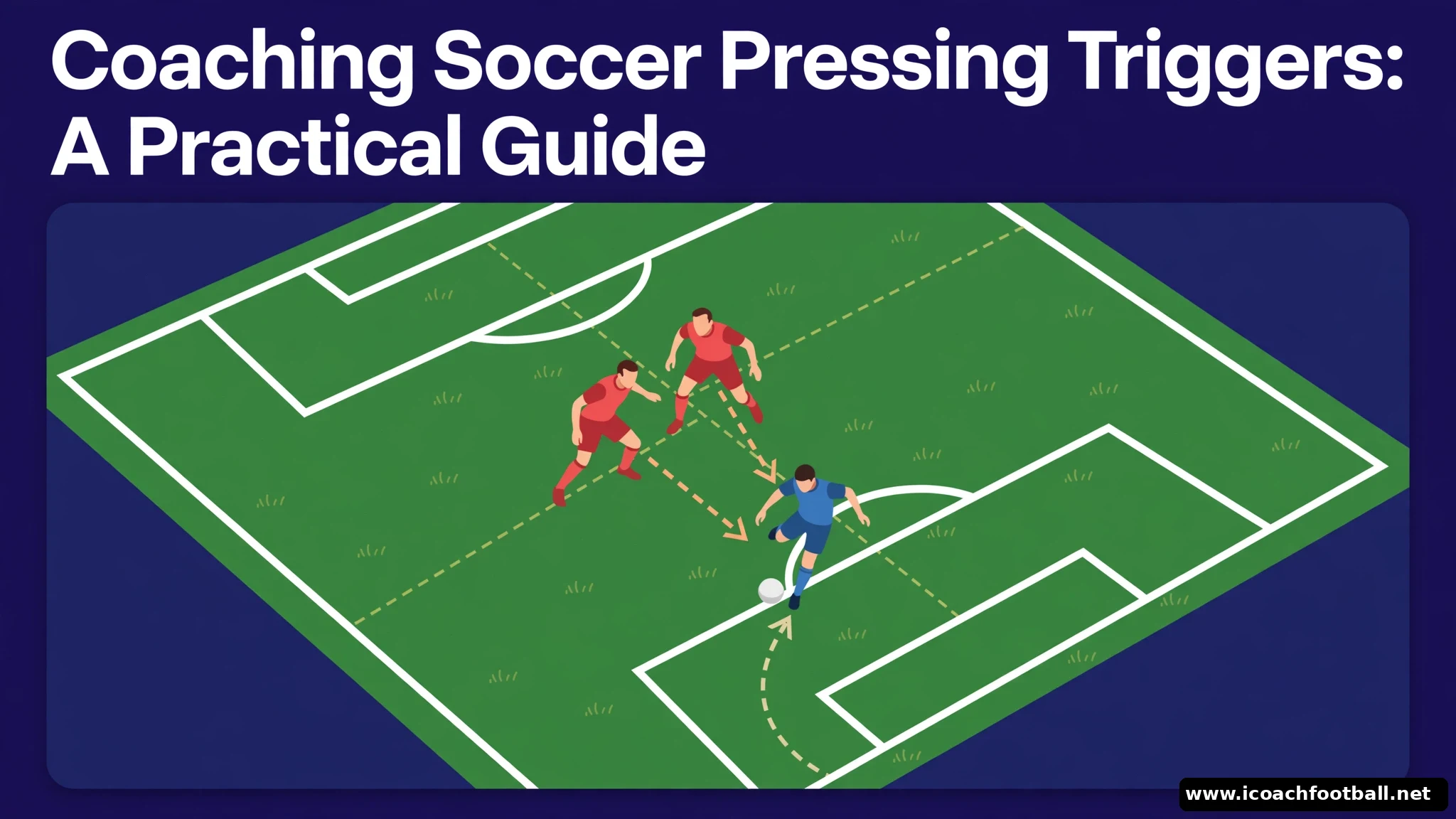
Quick answer: A pressing trigger is the shared signal that tells the whole team to press at once. Teach two or three triggers — the back pass, the heavy touch and the sideline trap — and drill them until every player jumps on the same picture, not on a shout from the bench.
Most failed presses are not a fitness problem. They are a timing problem: one player jumps, the rest stay, and the presser is played around.
A pressing trigger fixes that. It is a moment of opposition weakness the whole team recognises — a back pass, a heavy first touch, a receiver facing his own goal — and it tells everyone to go together. The same idea drives pressing in football at every level, because the pictures do not change, only the speed.
These six drills teach the triggers in order: recognising them, trapping the back pass, hunting the heavy touch, using the touchline, pressing a player with his back to play, and a live game where the team may only press on a trigger. Every drill states the setup, the trigger and the scoring, so a coach can run it from the diagram and steps alone.
Session snapshot
- Players: 12–16 (Drill 6 uses 7v7 plus goalkeepers)
- Area: 30 x 20 yards for the small games, rising to one half for Drill 6
- Duration: 60 minutes (45-minute version: Drills 1, 2 and 6 only)
- Focus: Trigger recognition, curved pressing runs, cutting passing lanes, compact cover, team timing
- Equipment: 8–10 balls, 16 cones, bibs, 4 mini goals, 1 full-size or age-appropriate goal
- Age: U11–U16 (one trigger at a time for younger groups — see age adaptations)
| Time | Activity | Main objective |
|---|---|---|
| 0–8 min | Drill 1 | Name and spot the triggers |
| 8–18 min | Drill 2 | Trap the back pass |
| 18–28 min | Drill 3 | Hunt the heavy touch |
| 28–38 min | Drill 4 | Use the touchline as a defender |
| 38–52 min | Drill 5 | Press the back-to-goal receiver |
| 52–60 min | Drill 6 | Live game, press on triggers only |
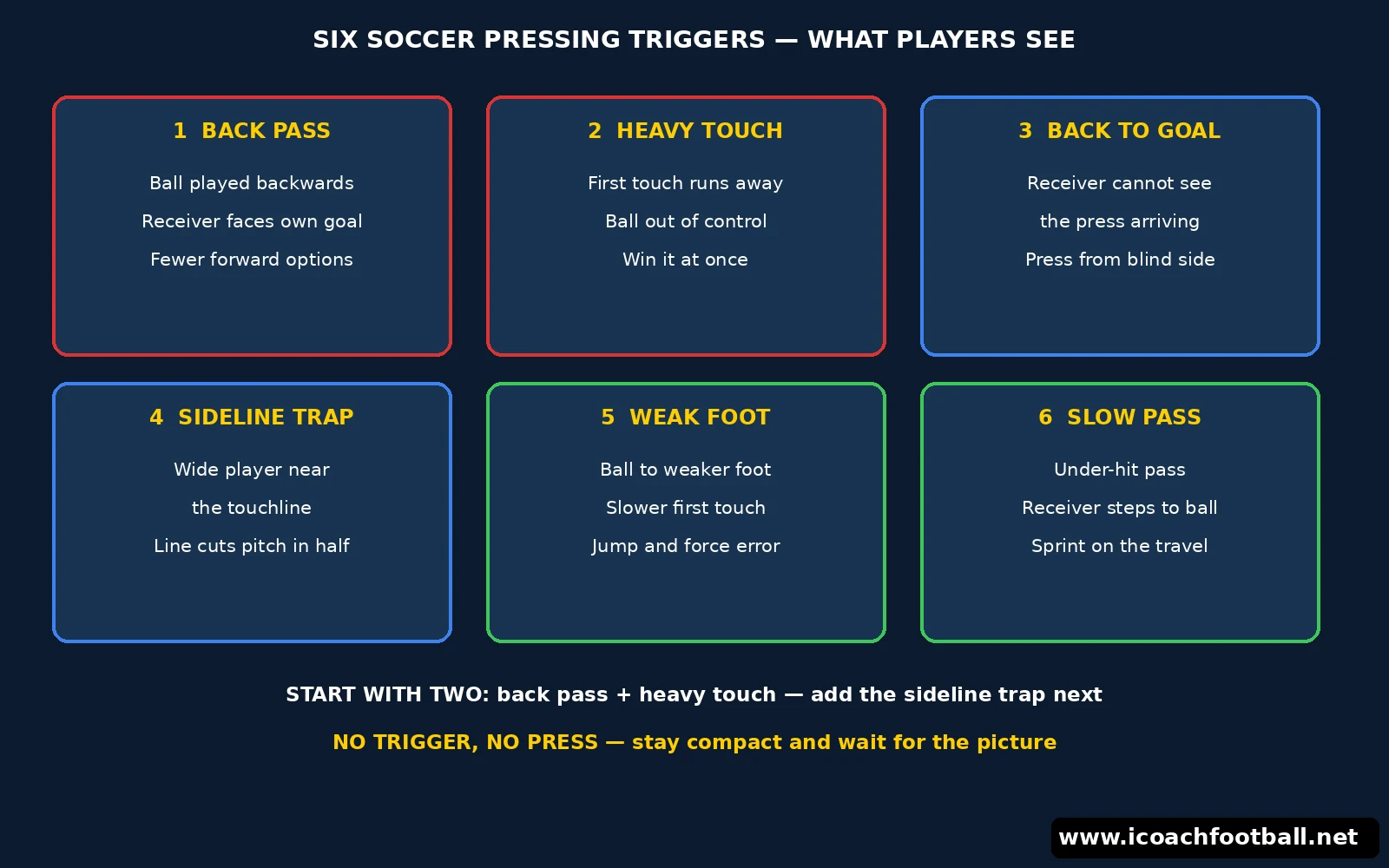
The six triggers every team should name
| Trigger | What the players see | Why it is weak |
|---|---|---|
| Back pass | Ball played backwards to a defender or goalkeeper | Receiver faces own goal, with fewer forward options |
| Heavy touch | First touch runs away from the receiver | Ball is briefly out of control and can be won |
| Back to goal | Receiver takes the ball facing his own goal | He cannot see the press arriving |
| Sideline trap | Ball played to a wide player near the touchline | The line cuts the pitch in half; escape routes shrink |
| Weak foot | Ball played to the receiver’s weaker foot | First touch is slower and less secure |
| Slow pass | Under-hit pass across the back line | Receiver must step towards the ball and loses momentum |
- Pick two or three. A team that tries to press on six triggers presses on none. Start with the back pass and the heavy touch, then add the sideline trap.
- Give them short names. “Back pass, go!” and “Heavy touch, go!” are calls players will actually use in a game. Long phrases die on the pitch.
- The trigger is the whistle. Nobody waits for the coach to shout. When the picture appears, the nearest player goes and the rest jump with him.
- No trigger, no press. If none of the named pictures appears, the team stays compact and patient. Pressing everything for 90 minutes is a fitness programme most youth teams do not have.
- Cue: “See it, call it, go together!” If one player presses alone, stop the game and ask the team what picture they missed.

Drill 1 — Spot the Trigger
A recognition game. Players learn the pictures before they are asked to press at full speed.
- Setup: 30 x 20 yards, 4v4 plus 2 neutrals on the outside. One ball, cones for the area, bibs for one team.
How to Play:
- One team keeps possession with the neutrals, aiming for 8 passes.
- The defending team holds a compact shape and does not press yet.
- The coach calls out a trigger — “Back pass!”, “Heavy touch!” — as soon as it happens.
- On the call, the nearest defender presses and the rest jump to cut the nearest lanes.
- Win the ball and the pressing team scores 2 points; get played around and the possession team scores 1.
Coach’s note: Be the commentator first. Call every trigger out loud so players connect the picture to the action. Then go quiet and let the players make the call themselves.
Progressions: Remove the coach’s calls, then limit the possession team to two touches so triggers appear more often.
Drill 2 — The Back-Pass Trap
The most reliable trigger in the game, isolated. Sprint while the ball travels backwards, arrive on a curved run.
- Setup: 40 x 30 yards, 5v5. A halfway line of cones across the middle. Balls with the coach on the halfway line.
How to Play:
- The coach plays a ball to one team, which builds from its own half.
- The defending team stays compact until a back pass is played.
- The moment the ball goes backwards, the nearest forward sprints on a curved run to the receiver.
- The curved run blocks the pass back to the goalkeeper and shows the receiver wide.
- The second forward cuts the lane to the other defender; win the ball in the attacking half to score 3 points.
Coach’s note: The cue is “Sprint on the travel!” The presser must move while the ball is moving, not after it arrives. A straight run lets the receiver turn; a curved run takes the return pass away. This back-pass trap is in line with the FIFA Training Centre session on preventing progression through central areas, linked at the end of this post.
Progressions: Start the ball with the goalkeeper, then remove the halfway line so the trap must be read in open play.
Drill 3 — Heavy Touch Hunt
A rondo where a heavy touch changes everyone’s job in an instant.
- Setup: 15 x 15 yard square, 4v2 in the middle with 2 neutrals on the outside. One ball, 4 cones, bibs for the defenders.
How to Play:
- Four attackers keep the ball with the neutrals, two defenders press inside.
- The defenders hold their shape until an attacker takes a heavy touch.
- On the heavy touch, both defenders jump at once — one to the ball, one to cut the escape pass.
- Win the ball and the defenders score 2 points and swap in two attackers.
- Play 6 rounds of 90 seconds, rotating who starts as defender.
Coach’s note: The cue is “Touch is heavy — go!” A heavy touch is the easiest trigger for young players to see, because the ball itself tells them. Freeze any defender who jumps before the touch; patience is part of the skill.
Progressions: Play 5v3, then play the rondo with a one-touch limit on the attackers so every loose touch becomes a trigger.
Drill 4 — The Sideline Trap
The touchline is an extra defender. Force play wide, then trap it there.
- Setup: 35 x 25 yards, 4v4. Two channels marked with cones down each side. One ball, mini goals at each end.
How to Play:
- Teams play 4v4, scoring in the mini goals, with no pressing until the ball enters a wide channel.
- A pass into the wide channel is the trigger: the nearest defender jumps to the receiver at once.
- The second defender cuts the pass back inside, forcing the ball carrier towards the touchline.
- The rest of the team shifts across and gets compact, protecting the centre.
- Win the ball in the channel and score in a mini goal within 5 seconds for 3 points.
Coach’s note: The cue is “Wide is the trap!” Show the carrier the line, never the middle. The first defender’s body shape does the work: side-on, arched run, blocking the inside pass.
Progressions: Widen the channels so the trap must be set from further away, then play without channels so players must read the touchline themselves.
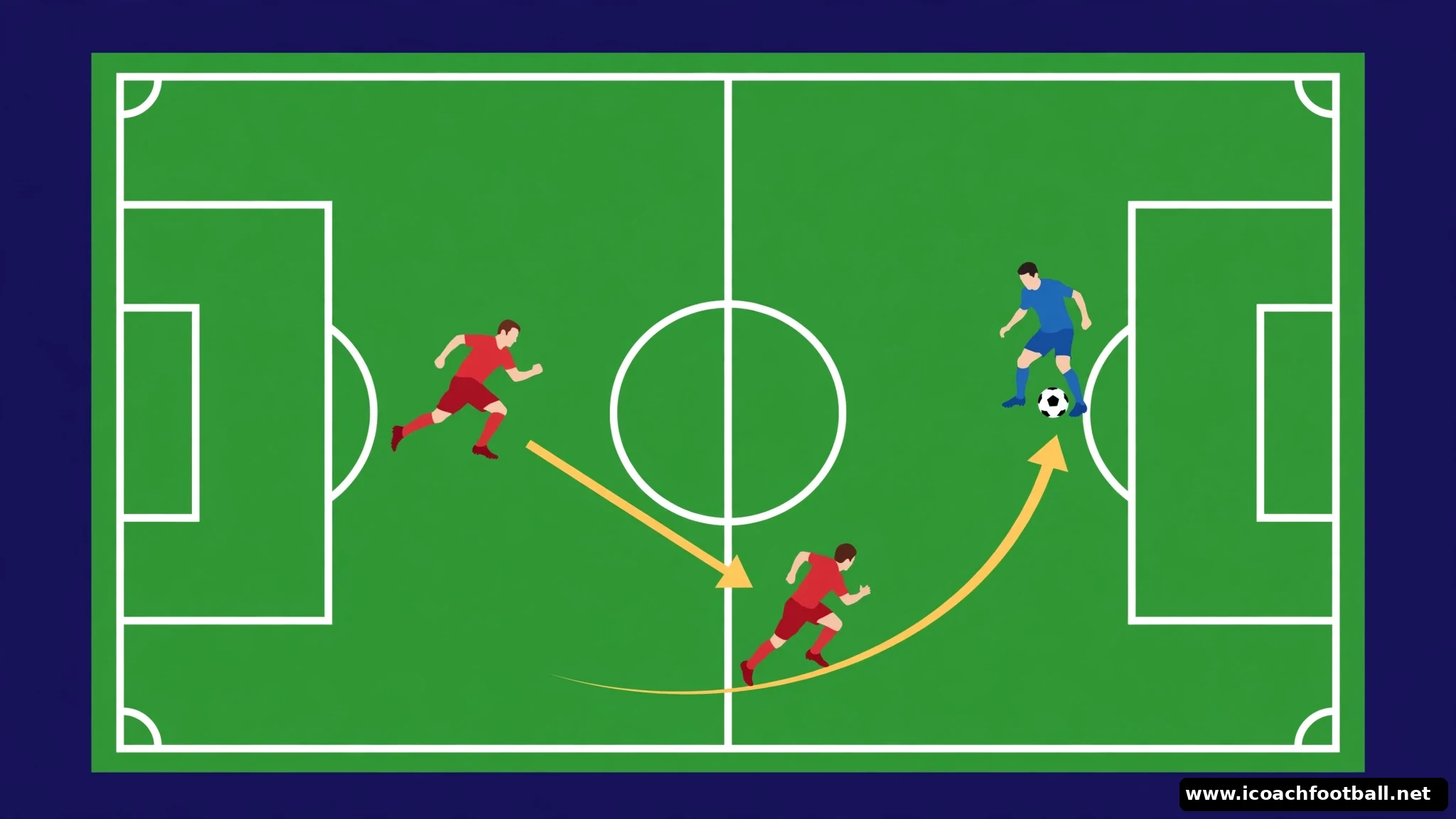
Drill 5 — Back to Goal
For the receiver who cannot see the press. Jump from his blind side and cut the way back.
- Setup: 30 x 25 yards, 4v4 plus a target player at each end. Balls with the coach on the halfway line.
How to Play:
- The coach plays a ball into a midfielder who receives with his back to the opposition goal.
- The back pass into that player is the trigger: the nearest defender presses from the blind side at once.
- The second defender steps up to cut the lay-off pass back to the player who played it in.
- The pressing team wins the ball if the receiver is forced to play backwards or loses it under pressure.
- After 6 presses, swap the teams and repeat from the other side.
Coach’s note: Ask “What did he see?” at every freeze. A player with his back to goal sees nothing behind him, so the press must arrive fast and quiet. Our pressing rondo trains the same blind-side jump in a smaller space, linked below.
Progressions: Let the receiver turn if the press is slow, so a late jump is punished at once, then play 5v5 with a free target player.
Drill 6 — The Trigger Game
The live test. A full game where the team may only press when a named trigger appears.
- Setup: 7v7 plus goalkeepers, one half, 50 x 35 yards. One full-size goal and two mini goals. Balls with the coach behind each goal.
How to Play:
- Play a normal game, with the coach feeding a new ball quickly after every goal or dead ball.
- The team out of possession may press only on its two named triggers: the back pass and the heavy touch.
- With no trigger, the team drops into a compact mid-block and stays patient.
- Win the ball on a trigger and score, and the goal counts double.
- Play 3 spells of 6 minutes, with a 2-minute break to name the best-timed press and the trigger the team missed most.
Coach’s note: Praise the press the team did not make as loudly as the one it did. Discipline is the skill: a team that jumps at everything is beaten by one pass. Our gegenpress plan builds the same trigger discipline into a full team shape, linked below.
Progressions: Add the sideline trap as a third trigger, then let the players choose their own two triggers before each spell.
Coaching points that decide the press
- Nearest player goes first. The first defender sets the angle and the timing. Everyone else reads off that run.
- Arrive on a curved run. A curved run blocks the return pass and shows the carrier one way. A straight run lets him play through.
- Cut the lane, not just the ball. The second defender’s job is the escape pass. A press that wins the ball but leaves the lane open has failed.
- Stay compact behind the press. The players behind the first two must shift and protect the centre. If the press is beaten, the shape behind it decides the next five seconds.
- Talk early. The player with the best view calls the trigger: “Back pass!” or “Heavy touch!” The presser cannot see everything.
Common mistakes — and the fix
- Pressing alone. Fix: no press counts unless a second player cuts a lane; freeze and show the shape.
- Pressing every ball. Fix: name two triggers only, and score the team for staying compact when no trigger appears.
- Straight runs at the ball. Fix: set a cone the presser must run around, forcing the curved approach.
- Jumping before the trigger. Fix: defenders hold until the picture appears; a jump on a good first touch is a foul or a beaten press.
- No call from behind. Fix: the player furthest from the ball makes the call in Drill 1 until the habit spreads.
Age adaptations
- U11–U12: One trigger only — the heavy touch. Small areas, Drills 1 and 3, praise recognition and effort, not tackles won.
- U13–U14: Two triggers — back pass and heavy touch. Full six-drill menu with the sideline trap introduced in Drill 4 only.
- U15–U16: Three triggers, full trigger game with players choosing their own triggers, and the curved-run detail in Drill 2 coached hard.
A 45-minute session plan
| Time | Activity | Main objective |
|---|---|---|
| 0–8 min | Drill 1 | Spot the triggers, call them out |
| 8–20 min | Drill 2 | Back-pass trap, curved run |
| 20–32 min | Drill 4 | Sideline trap, show the line |
| 32–45 min | Drill 6 | Live trigger game, press on triggers only |
Frequently Asked Questions
What is a pressing trigger in soccer?
It is a moment of opposition weakness — a back pass, a heavy touch, a receiver facing his own goal — that the whole team recognises as the signal to press together, rather than one player jumping alone.
What are the most common pressing triggers?
The back pass, the heavy first touch, a receiver with his back to goal, a pass into the sideline trap, a pass to the weaker foot and a slow pass across the back line. Start with two or three and add more only when the first ones are automatic.
How many pressing triggers should a youth team use?
Two or three at most. Young players who try to press on every trigger press on none. One trigger — the heavy touch — is a complete pressing curriculum for a U11 team.
When should a team not press?
When no named trigger appears, or when the team is outnumbered and the ball carrier faces forward with space. Then the team should stay compact, protect the centre and wait for the next trigger.
How do you teach players to recognise pressing triggers?
Name them, show them in small games, call them out loud as they happen, then go quiet and let the players make the call. Drills 1 and 3 in this post build recognition before full-speed pressing is asked for.
Sources and further reading
- FIFA Training Centre, Preventing progression through central areas (Claudio García and Lina Arana): coordinated pressing to shut off central lanes, curved pressing runs, forcing play wide with the touchline as an extra defender, and switching mindset the moment possession is lost. The drills in this post are based on and in line with that session’s principles; nothing here is claimed as approved by or affiliated with FIFA.
- FIFA Training Centre, Preparing and executing counter-pressing (Anne Pochert): reacting quickly after losing possession, pressing the ball carrier at once and closing passing lanes if the first press fails. The trigger game follows the same immediate-reaction and lane-cutting principles.
- For the full team shape behind the press, see our gegenpress plan, and for the rondo version of the blind-side jump, see our pressing rondo, linked in the drills above. For more on winning the ball back immediately, see our counter-pressing drills.