U12 Soccer Practice Plan: 8 Drills for Player Development
Quick answer: A complete U12 practice should develop scanning, receiving, passing combinations, positional support, overload decisions and transitions. Begin with technical activation, use progressive possession games and finish with a competitive 6v6 or 7v7 match.
U12 players are approaching a stage where technical quality and tactical understanding must develop together. They can begin identifying space between lines, supporting from different heights and recognizing transition moments more consistently.
This 65-minute session follows a game-related progression from scanning and combination work into positional rondos, directional possession, build-up and a final match.
The coach should adapt the challenge to the players. A smaller area creates faster decisions, while a larger area can improve success and technical confidence.
For sessions organized around exact attendance, use our soccer practice plans by number of players. Related age-group sessions include U11 Soccer Practice Plan and U13 Soccer Practice Plan.
Equipment and Setup
PlayersApproximately 12–16 players
Session duration65 minutes
Recommended ageU12
Maximum areaMaximum 48 × 34 yards
Ball sizeSize 3 for U6–U8, size 4 for U9–U14 and size 5 for U15–U16; follow local competition rules
EquipmentSize 4 balls, cones, bibs, mini goals and larger goals when available
Complete 65 minutes Session
| Time | Activity | Main objective |
|---|---|---|
| 0–8 minutes | Scan-and-Receive Activation | Scanning, first touch and movement |
| 8–16 minutes | Diamond Third-Player Combination | Combination play and timing |
| 16–24 minutes | 6v3 Positional Rondo | Possession, central support and pressing |
| 24–32 minutes | 3v3 Plus Two Directional Neutrals | Progression and support angles |
| 32–40 minutes | 4v3 Overload to Goal | Attacking structure and defensive delay |
| 40–49 minutes | 5v5 Build Through Three Zones | Build-up, progression and compact defending |
| 49–57 minutes | 5v5 Four-Goal Transition Game | Transition, width and switching play |
| 57–65 minutes | 6v6 or 7v7 Development Match | Game application and decision-making |
Age-Appropriate Coaching Priorities
Scan early and repeatedly: Players should gather information before the ball arrives and while it travels.
Create different lines of support: Width, depth and central connections should appear together.
Use progressive complexity: Begin with a clear problem, then add opposition or direction.
Connect possession to purpose: Keeping the ball should help the team progress or create a chance.
Balance challenge and success: The practice should be difficult enough to demand decisions without becoming chaotic.
FIFA’s Global-Analytical-Global model begins with a game, moves into focused technical learning and finishes with game application. Read FIFA Ages 8–12: Global-Analytical-Global Model.
Drill 1: Scan-and-Receive Activation
Players receive from multiple directions while checking visual information.
Setup
- Create two 16 × 16-yard squares.
- Place four outside servers and two or three receivers inside each.
- Use two balls per square.
- Rotate roles every 90 seconds.
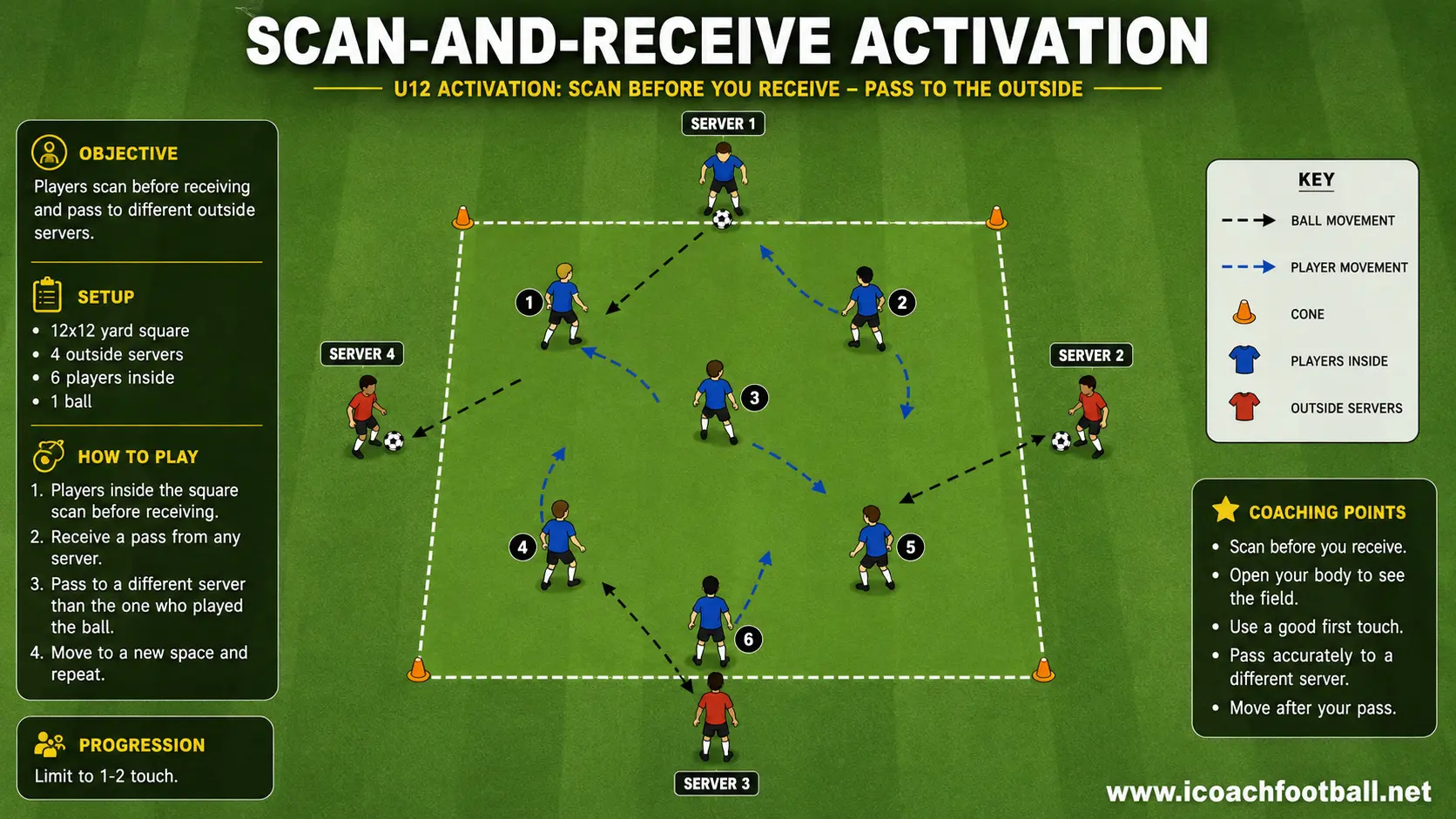
How to Play
- Receivers scan and call a visible number or color before receiving.
- Control across the body and pass to a different server.
- Move to a new line immediately.
- Use both feet.
- Increase speed gradually.
Coach’s note: The scan must influence the receiving action. Encourage players to open toward the next option rather than simply naming a color.
Progressions: Add passive pressure, use one-touch returns or require the receiver to combine with another central player.
Drill 2: Diamond Third-Player Combination
A diamond pattern connects a set pass with a third-player movement.
Setup
- Create two diamonds 18 yards long.
- Use six to eight players per group.
- Position players at each point.
- Use one ball per group.
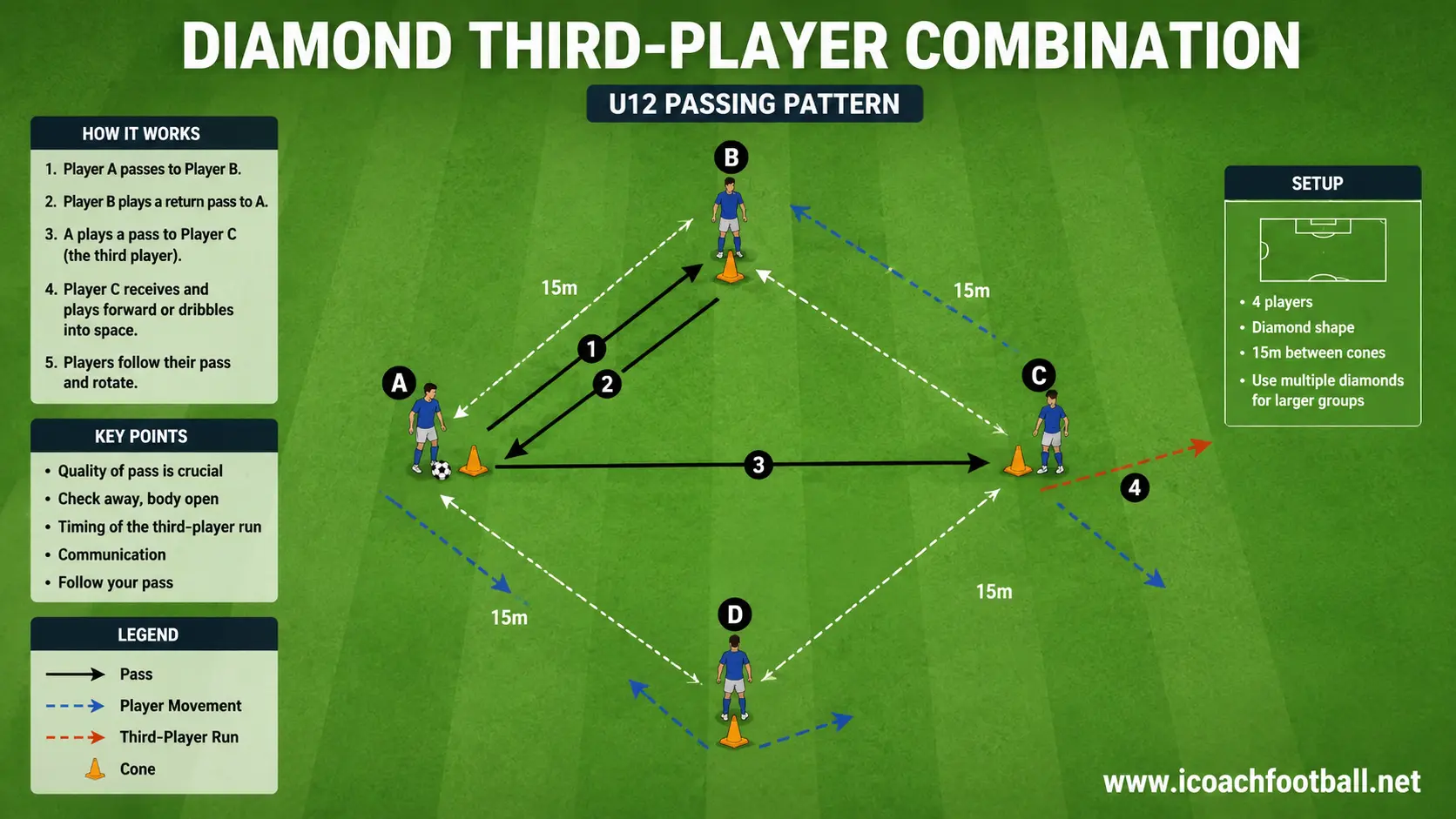
How to Play
- Player A passes into B.
- B sets to C.
- C plays forward to D making a timed movement.
- Players follow the ball.
- Change direction and side.
Coach’s note: The timing of D’s movement should respond to the set pass. C must receive with a body shape that allows forward play.
Progressions: Add a defender, allow B to turn or play the final pass first time.
Drill 3: 6v3 Positional Rondo
Six attackers use outside and central positions against three defenders.
Setup
- Create an 18 × 18-yard square.
- Use four outside players and two central attackers.
- Add three defenders.
- Rotate roles every two minutes.
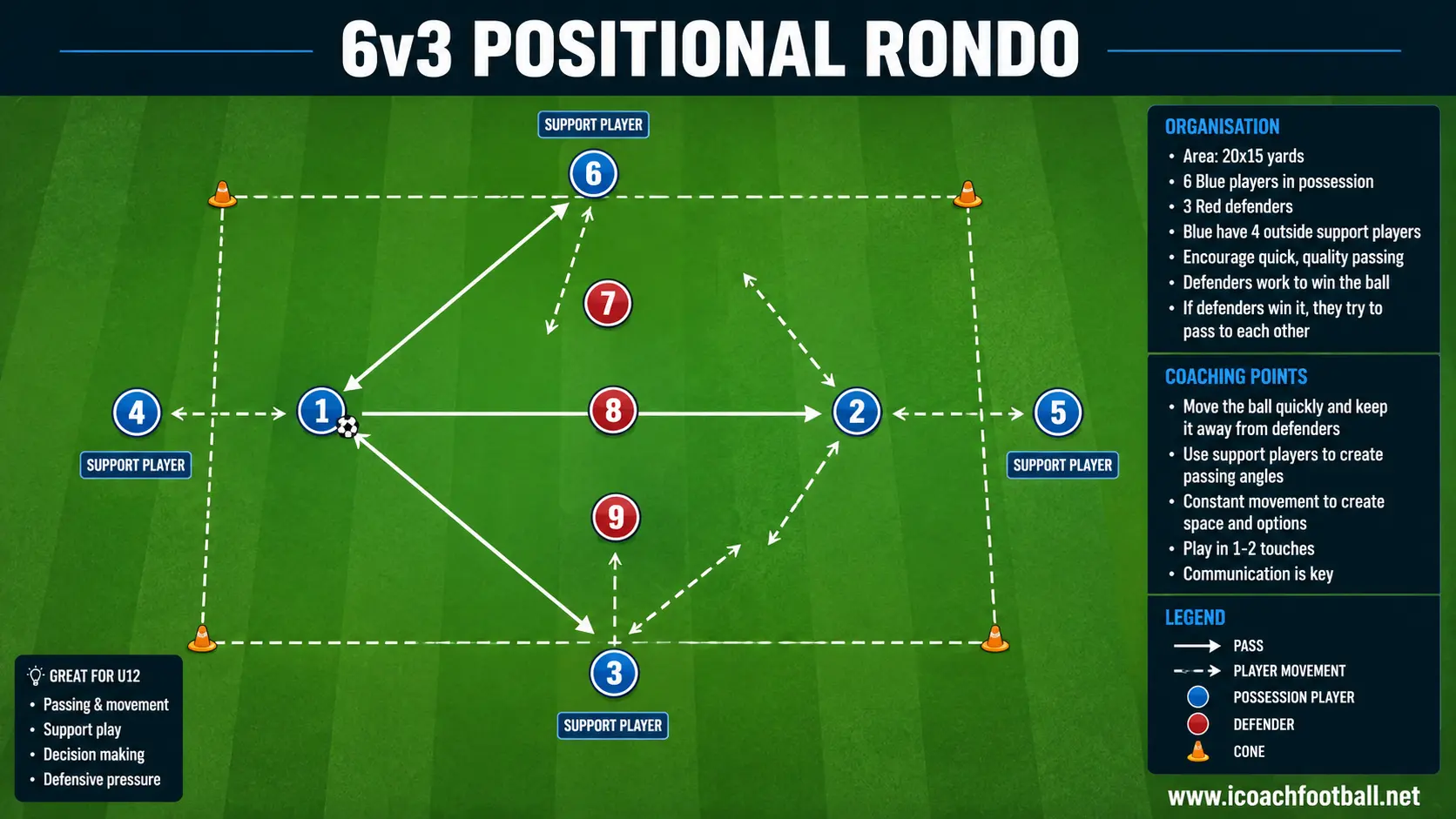
How to Play
- Attackers keep possession.
- Six passes earn a point.
- A pass from outside to central and out to a different side earns a bonus.
- Defenders score by completing two passes after regaining.
- Restart quickly.
Coach’s note: Central attackers should occupy different spaces and avoid standing on the same line. Defenders should press with cover.
Progressions: Use two touches outside, one touch inside or add directional target gates.
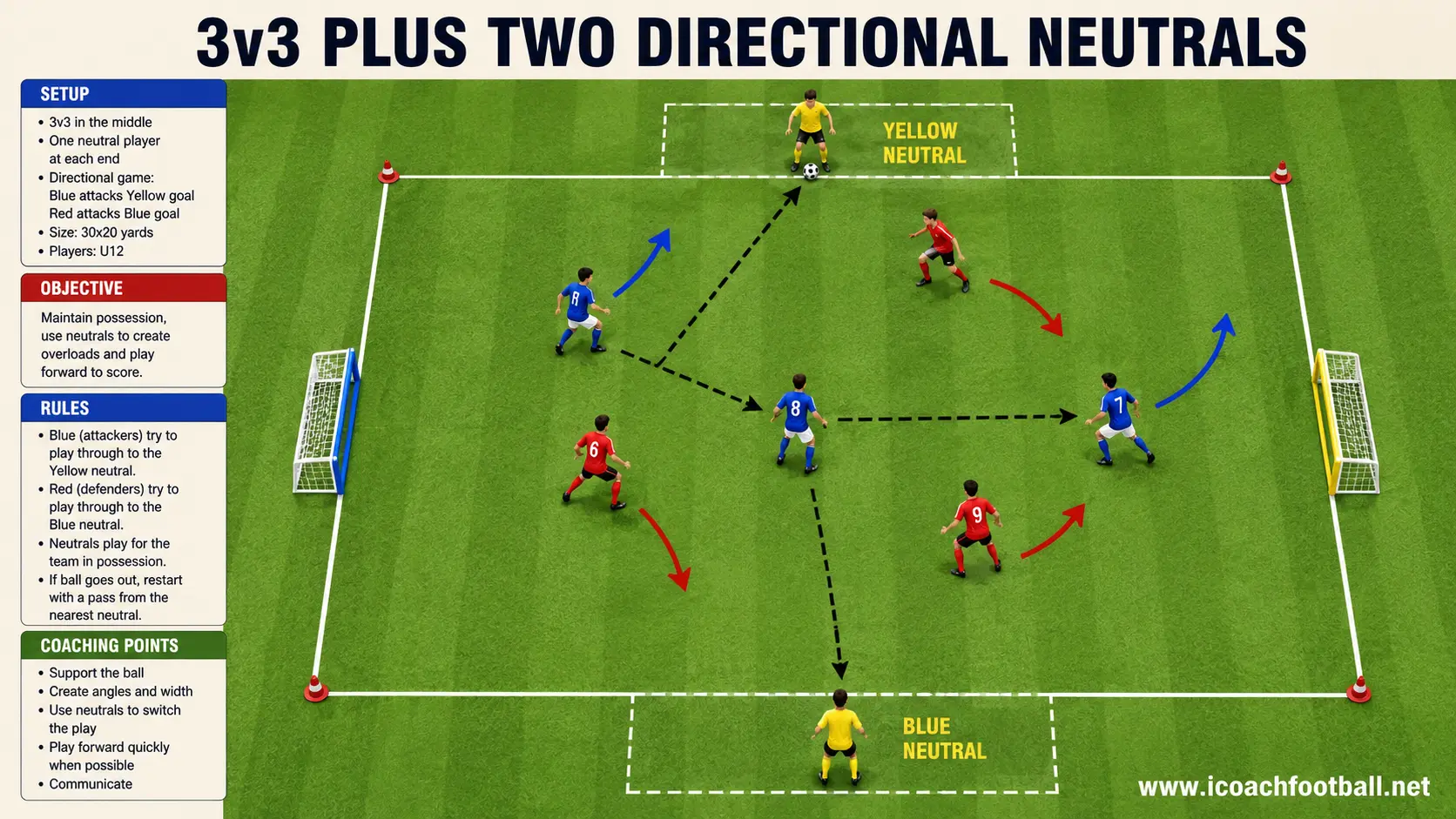
Drill 4: 3v3 Plus Two Directional Neutrals
Two end neutrals provide direction while central players compete in a 3v3.
Setup
- Create a 24 × 18-yard rectangle.
- Play 3v3 inside.
- Place one neutral behind each end line.
- Neutrals support possession.
- Rotate neutrals regularly.
How to Play
- Score by transferring the ball from one neutral to the other.
- The receiving neutral restarts in the opposite direction.
- Central players react immediately to turnovers.
- Targets have two touches.
- Play continuous rounds.
Coach’s note: Players should create a clear player underneath, one between defenders and one beyond the ball.
Progressions: Make neutrals one-touch, add side neutrals or require a third-player combination before scoring.
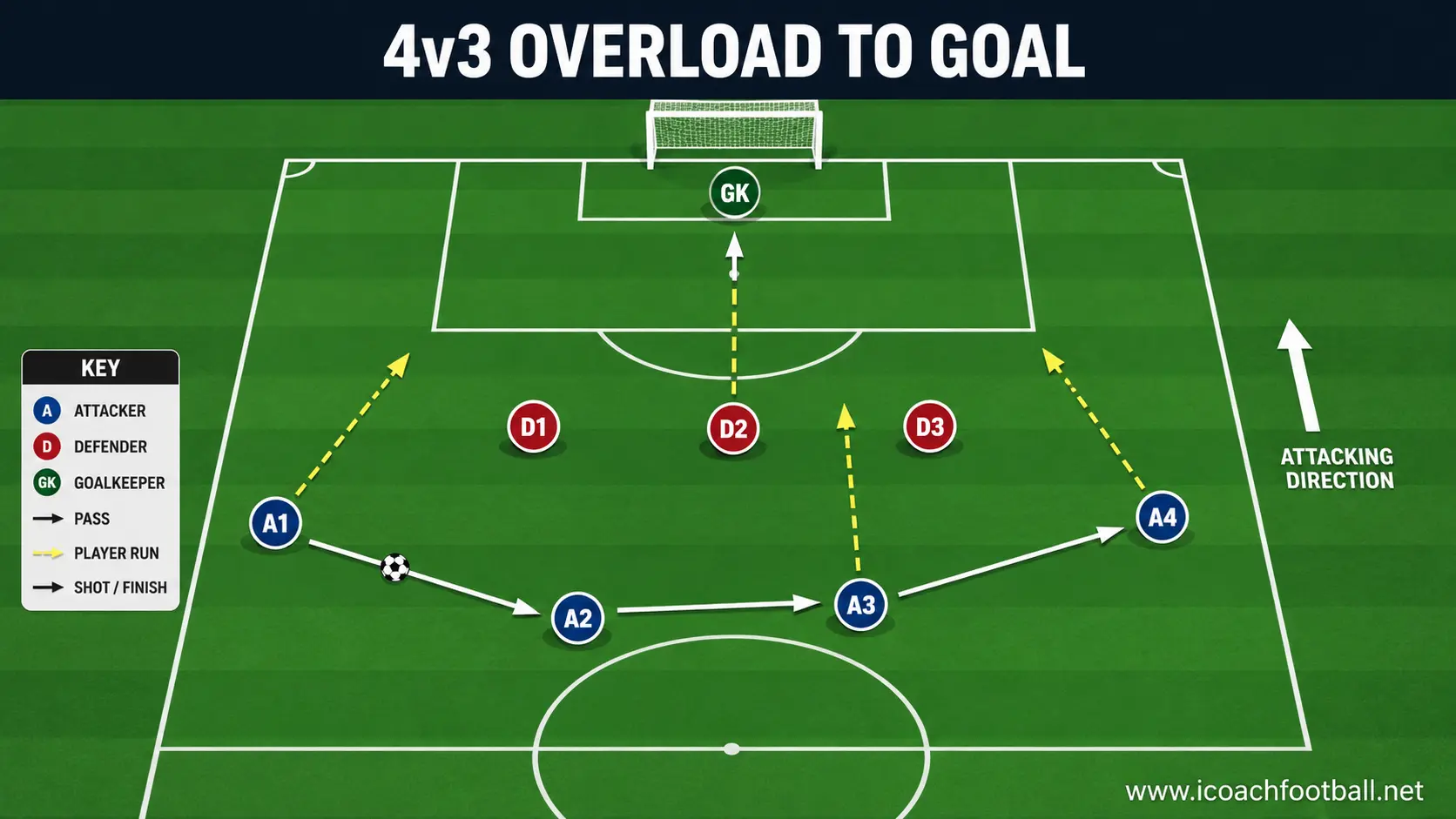
Drill 5: 4v3 Overload to Goal
Four attackers build against three defenders and finish in a goal or two mini goals.
Setup
- Create a 36 × 26-yard field.
- Use four attackers and three defenders.
- Place one goal or two mini goals at the end.
- Mark a counter line for defenders.
How to Play
- Attackers begin from the back.
- Create and use the overload to finish.
- Defenders counter over the start line after winning.
- Rotate roles.
- Use quick restarts.
Coach’s note: Attackers should provide width, depth and a central link. Defenders should delay until support arrives.
Progressions: Add a recovery defender, require a wide combination or impose a scoring time target.
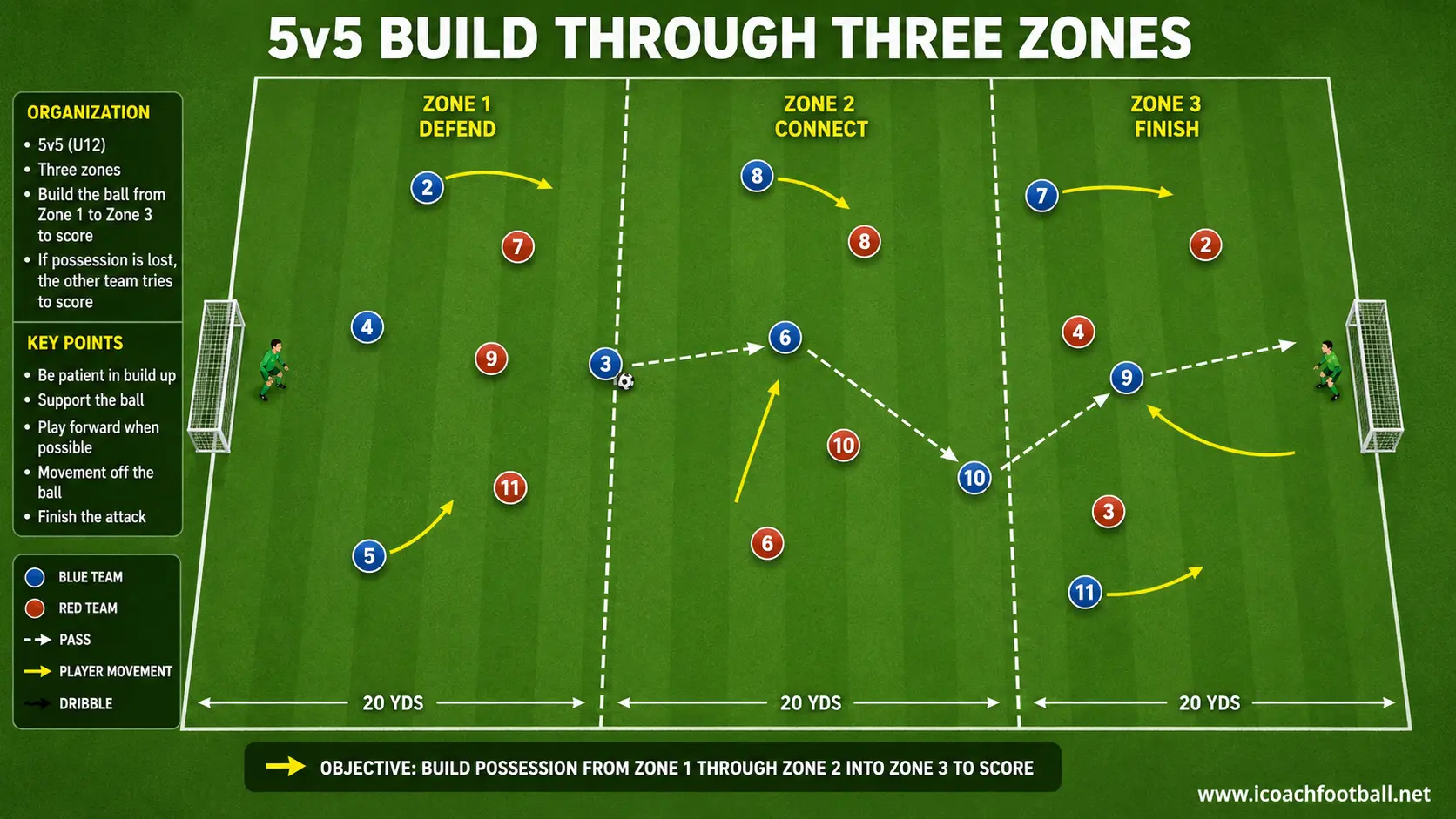
Drill 6: 5v5 Build Through Three Zones
The field is divided into thirds to help players recognize support across lines.
Setup
- Create a 42 × 30-yard field.
- Mark three horizontal zones.
- Play 5v5.
- Use mini goals or target players at each end.
- Allow free movement after the first progression.
How to Play
- Teams build from their defensive zone.
- At least one pass must connect into the middle zone before scoring.
- Players may move between zones.
- On a turnover, transition immediately.
- Use quick restarts.
Coach’s note: The zones are visual guides, not fixed cages. Encourage players to move to support the next phase.
Progressions: Require a third-player run into the final zone, remove zone rules after several minutes or add goalkeepers.
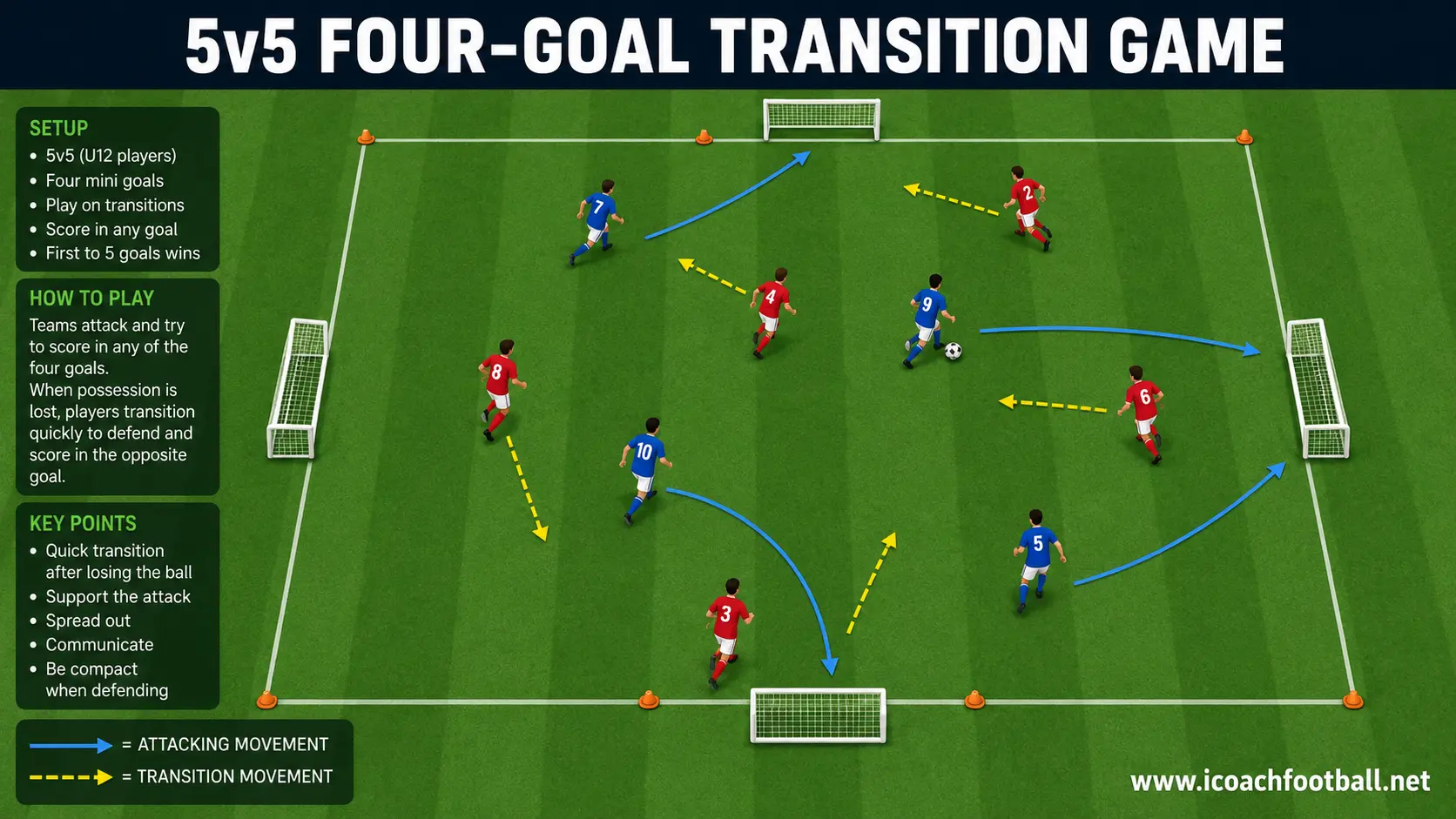
Drill 7: 5v5 Four-Goal Transition Game
Four goals give the team in possession different attacking options after regaining.
Setup
- Create a 40 × 30-yard field.
- Place one mini goal in each corner.
- Play 5v5.
- Keep spare balls around the outside.
How to Play
- Teams score in either attacking goal.
- A goal within seven seconds of regaining counts double.
- Restart immediately.
- Use two short rounds.
- Keep a total score.
Coach’s note: The first action after a regain should move away from pressure, but players should not force a forward pass when the route is closed.
Progressions: Remove the time bonus, require a switch or add one neutral player.
Drill 8: 6v6 or 7v7 Development Match
The final match applies scanning, progression and transition principles.
Setup
- Create a 48 × 34-yard field.
- Play 6v6 or 7v7.
- Use goals, mini goals or end zones.
- Include goalkeepers when available.
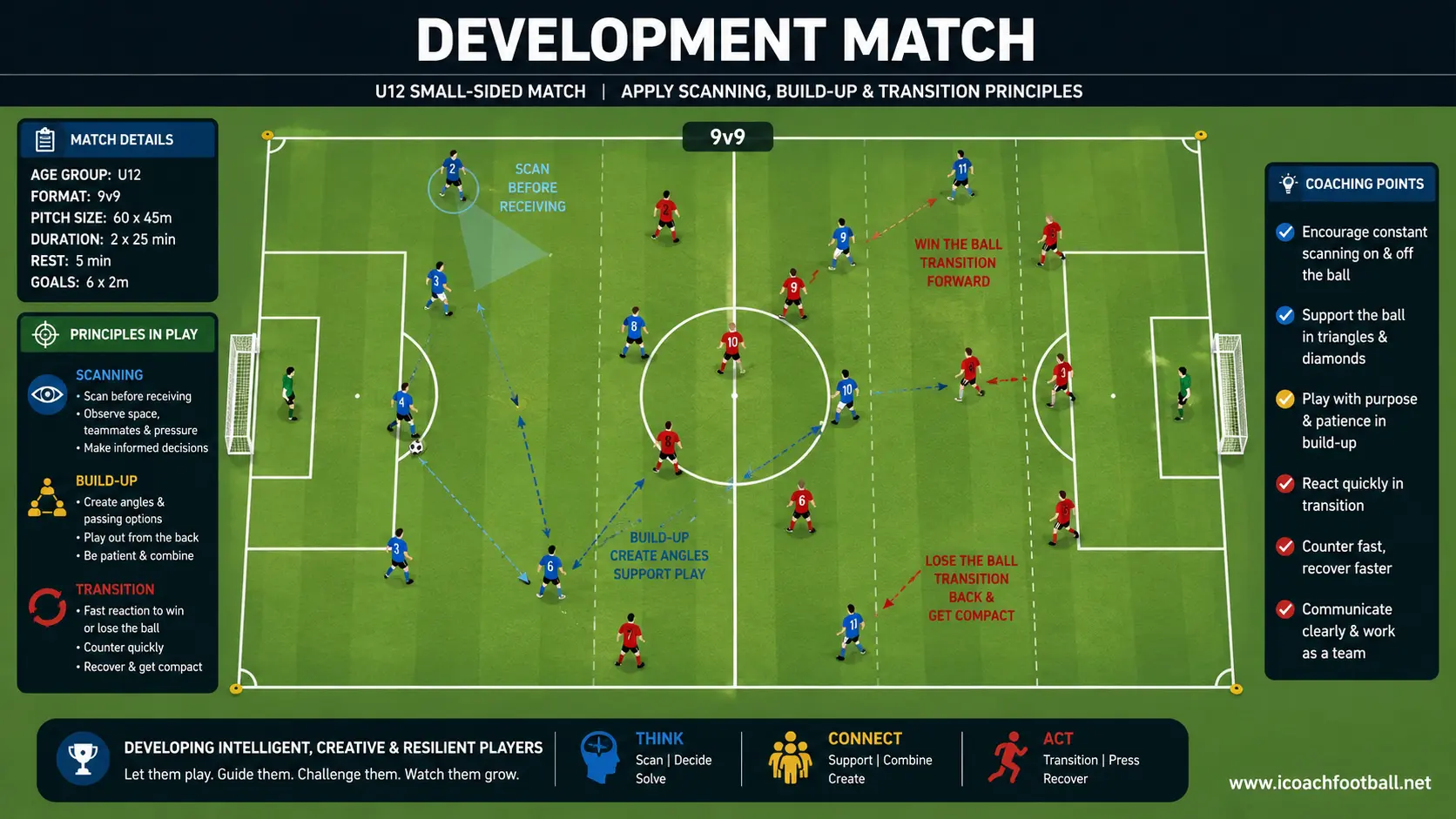
How to Play
- Play normal soccer.
- Award a bonus for a goal created through a third-player combination or controlled build-up.
- Use two rounds.
- Coach between rounds.
- Allow rolling substitutions.
Coach’s note: Keep the game realistic and avoid adding several conditions. Observe whether the session theme appears naturally.
Progressions: Remove bonuses, change the field shape or use a high-regain scoring reward.
How to Adapt the Session
For 12 players: Use 6v6 and rotate neutral or target roles.
For 16 players: Play 7v7 plus goalkeepers or use two parallel games.
For a developing group: Increase space and simplify zone or touch rules.
For an advanced group: Reduce space and add a coordinated pressing target.
Common Coaching Mistakes
- Using positional zones as fixed restrictions for the entire practice.
- Teaching scanning without linking it to the next action.
- Rewarding possession totals with no progression objective.
- Adding touch limits to every activity.
- Stopping the final match repeatedly.
- Expecting all players to develop physically and tactically at the same rate.
Frequently Asked Questions
How long should a U12 soccer practice last?
A focused U12 session can last approximately 60–70 minutes depending on intensity and training frequency.
What should U12 players work on?
Develop scanning, receiving, combination play, possession with purpose, build-up, pressing and transition decisions.
What game format is useful for U12?
6v6, 7v7 and 9v9 can be useful, supported by smaller games that increase involvement.
Should U12 players learn positional play?
Yes, through flexible relationships such as width, depth, central support and movement between lines rather than rigid fixed positions.
How can I teach scanning at U12?
Give players useful information to find before receiving and connect the scan to the next pass, turn or dribble.
Are zone games effective for U12?
Zones can help players recognize field areas, but players should still move and solve problems rather than remain fixed.
Should U12 training include pressing?
Yes. Introduce coordinated pressure, cover and balance through small-sided games.
Continue the age-group series: Compare this session with U11 Soccer Practice Plan and U13 Soccer Practice Plan and use the player-number practice-plan hub when attendance changes.