Double Triangle Passing Pattern: 3 Elite Variations for Possession
If you want to play like Man City or Barcelona, you must master the triangle.
The Double Triangle Passing Pattern is one of the most effective exercises for teaching “Positional Play” (Juego de Posición). Unlike linear drills, this pattern forces players to operate at different heights and angles, simulating the real connection between Center Backs, Midfielders, and Strikers.
In this guide, we break down 3 Essential Variations that will teach your team to break lines, play one-touch football, and dominate possession.
📋 Drill Profile: Quick Stats
| Category | Details |
| Drill Name | Double Triangle (The Hourglass) |
| Age Group | U12 – Pro |
| Players | 6-8 Players per Grid |
| Grid Size | 20×15 Yards (Adjust for age) |
| Focus | Breaking Lines, Third Man Runs, Rhythm |
| Intensity | High (Cognitive & Physical) |
🎥 Watch the Pattern in Action
Before we break down the specific variations, watch how the timing, weight of the pass, and body shape come together in real-time.
Notice: Pay close attention to how the central players (the pivots) constantly scan over their shoulders before receiving the ball.
🏗️ Setup for Double Triangle Patterns
This setup creates two connected triangles, often resembling a diamond or an hourglass.
- The Shape: Place 4 cones in a Diamond shape (Top, Bottom, Left, Right). Place 2 extra cones inside to create the “internal” passing lanes.
- The Positions:
- Player A (Start): Represents the Center Back.
- Players B & C (Wide): Represent the Full Backs or Wide Midfielders.
- Player D (Top): Represents the Striker or #10.
- Players E & F (Central): The Pivot players (#6 and #8).
- Rotation: Follow your pass to the next cone (A -> B -> E -> D…).
Variation 1: The “Up-Back-Through” (Breaking the Line)
This is the fundamental pattern to break a defensive line using a pivot.
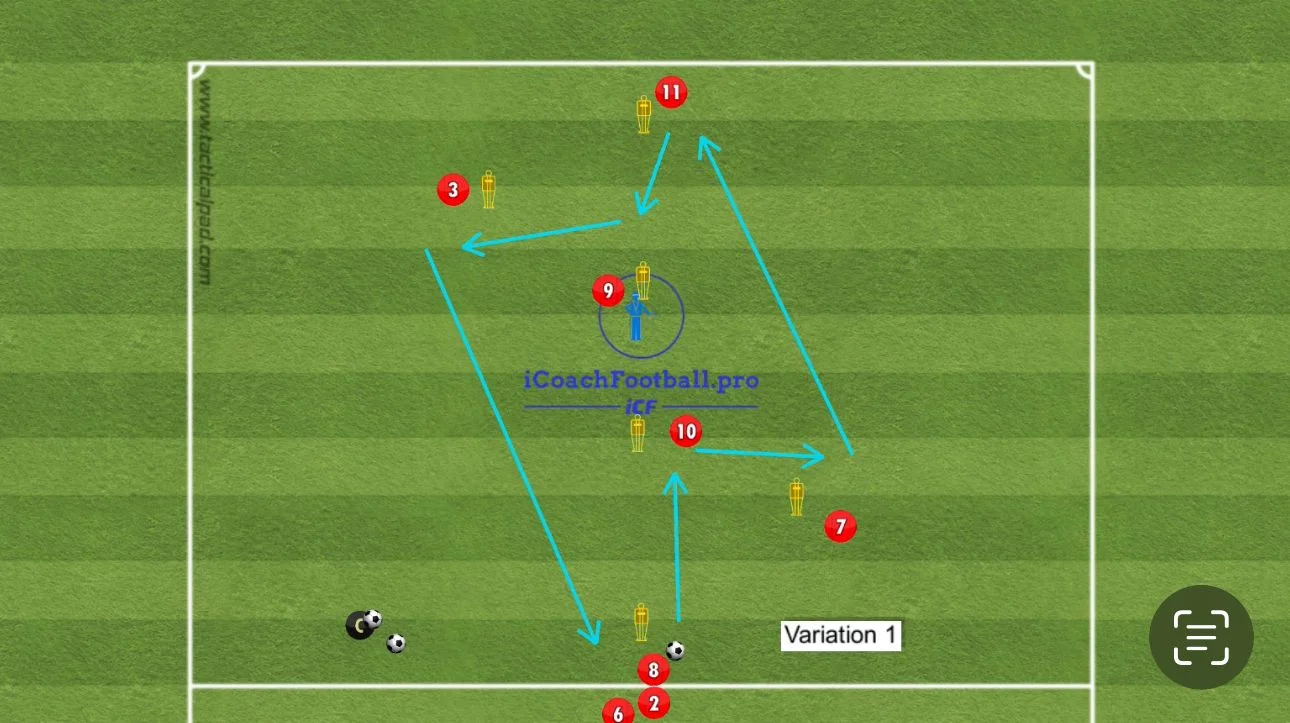
The Pattern:
- Player A passes diagonally to the Central Pivot (Player E).
- Player E sets the ball back (1-touch) to the Wide Player (Player B).
- Player B plays a through ball to the Top Player (Player D).
- Repeat on the opposite side coming back.
Coaching Points:
- The Set: The “Bounce pass” from the pivot must be soft and to the correct foot (safe side) of the wide player.
- Timing: The wide player (B) must not move too early, or they will kill the angle. Wait for the pivot to receive.
Variation 2: The “Third Man” Run (Advanced)
Introduces the concept of passing to a player you cannot see by using a connector.
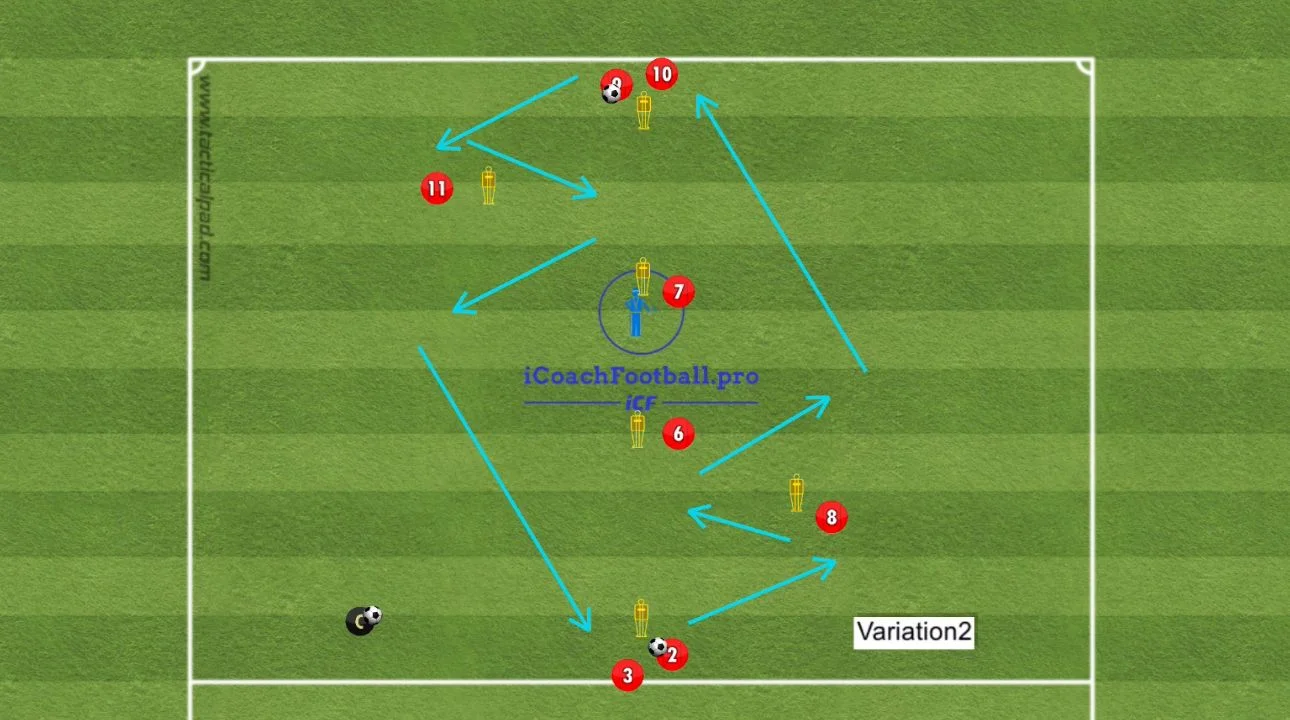
The Pattern:
- Player A passes to the Wide Player (B).
- Player B plays into the Top Striker (D) who checks deep.
- Player D lays it off 1-touch to the Central Pivot (E), who is making a forward run (The Third Man).
- Player E drives out or passes to the start of the next group.
Coaching Points:
- Visual Cues: The Pivot (E) must read the body language of the Striker (D). As soon as D checks to the ball, E must sprint to support underneath.
- Tempo: Fast-Slow-Fast. The entry pass is crisp, the set is slow/controlled, the third man run is explosive.
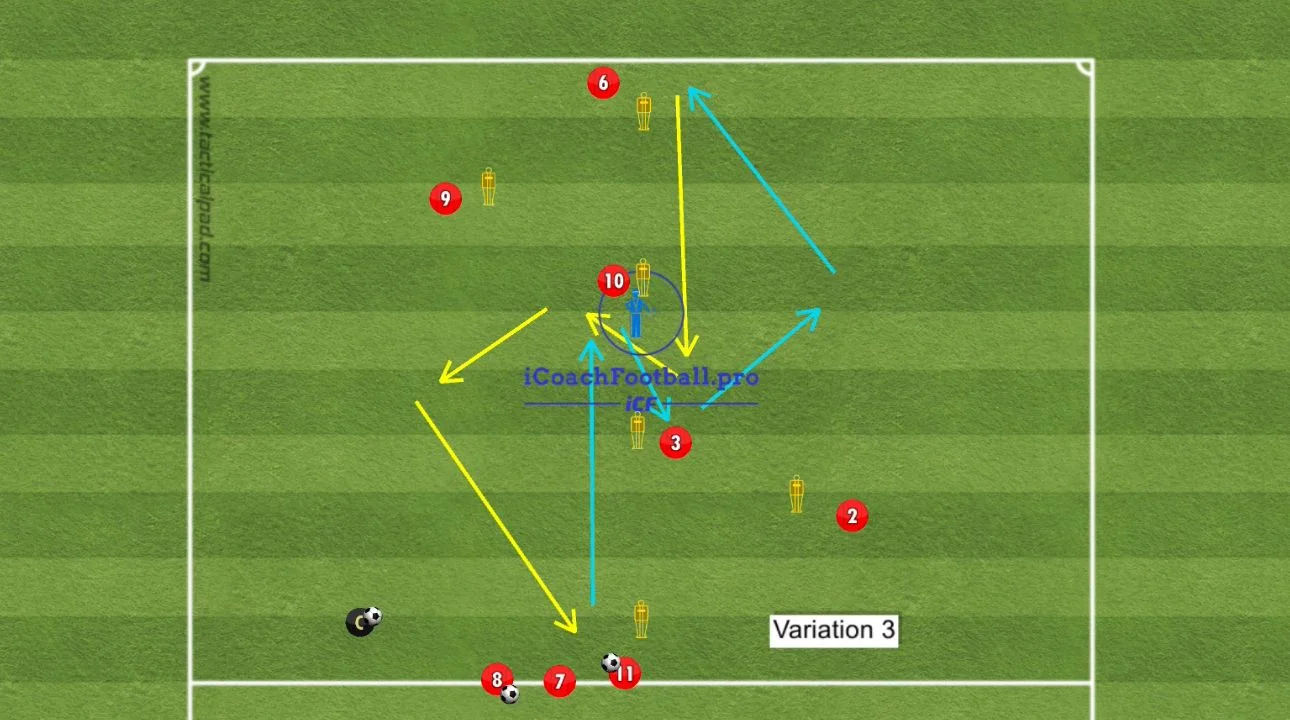
Variation 3: The Double Wall Pass (Tiki-Taka)
High-speed combination play.
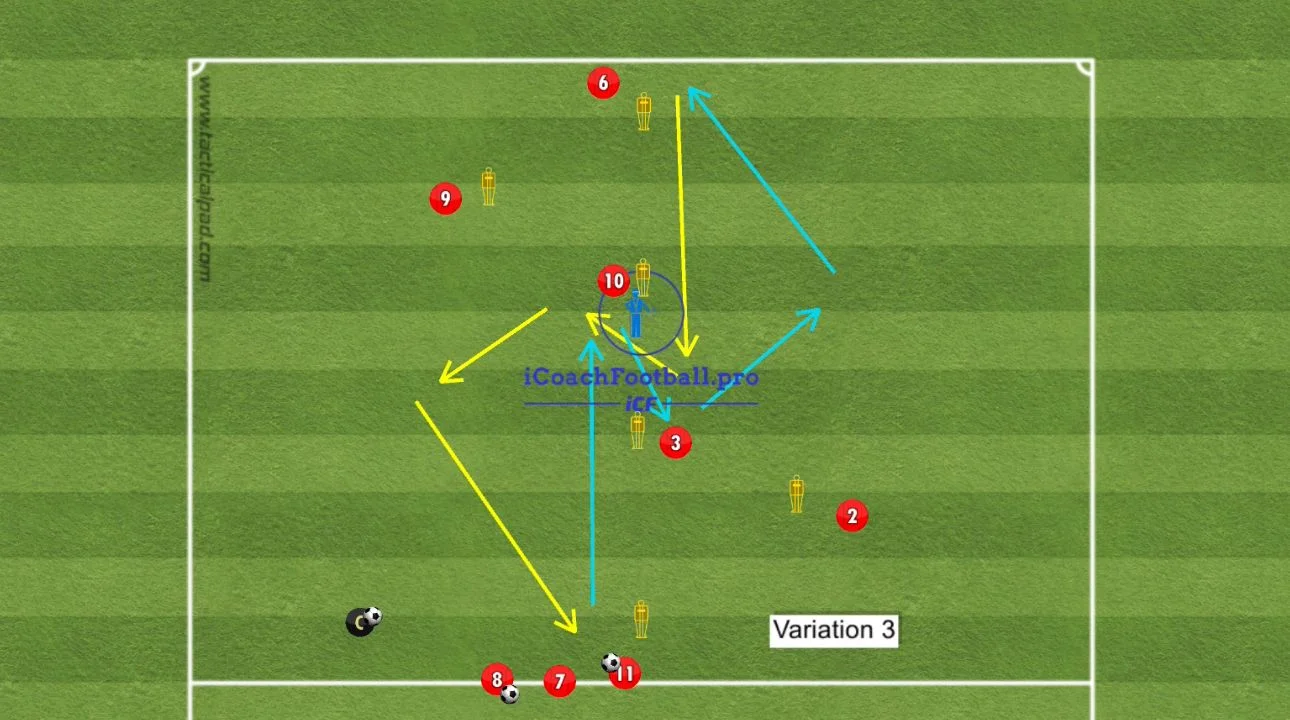
The Pattern:
- Player A plays a 1-2 (Wall Pass) with the Central Pivot (E).
- Player A then drives forward and plays a second 1-2 with the Wide Player (B).
- The ball is finally released to the Top Player (D).
Coaching Points:
- One-Touch Only: This variation demands 1-touch passing.
- Movement: Players must constantly be on their toes (“Active Feet”). If you stand flat-footed, the rhythm dies.
💡 Coach’s Note: Common Mistakes to Fix
1. The “Lazy Pass”
- Problem: Players passing to the cone, not the player.
- Fix: Demand “Pass to the future.” Pass where the player is running to, not where they are standing.
2. Closed Body Shape
- Problem: Receiving with hips facing the passer (back to goal).
- Fix: Shout “Open Up!” Players must receive on the back foot so they can see the next target before the ball arrives.
3. Running in Straight Lines
- Problem: Players running directly at the ball.
- Fix: Teach “Arcing Runs.” Curve the run to keep the passing lane open and create a better angle.
Double Triangle Passing Pattern FAQ
Why is the Double Triangle better than a standard Rondo?
While Rondos are excellent for keeping possession, the Double Triangle is directional. It teaches players specifically how to move the ball forward from defense to attack, simulating match progression.
Can I use this for a match warm-up?
Yes. Variation 1 is perfect for a match warm-up. It gets players moving, touching the ball, and mentally dialed in without causing fatigue.
What positions is this drill for?
This is specifically designed for Midfielders (CM/CDM/CAM) and Center Backs. It trains the specific geometric relationships found in a 4-3-3 or 4-2-3-1 formation.