Soccer Overlap and Underlap Drills: 6 Games to Create the 2v1 Wide
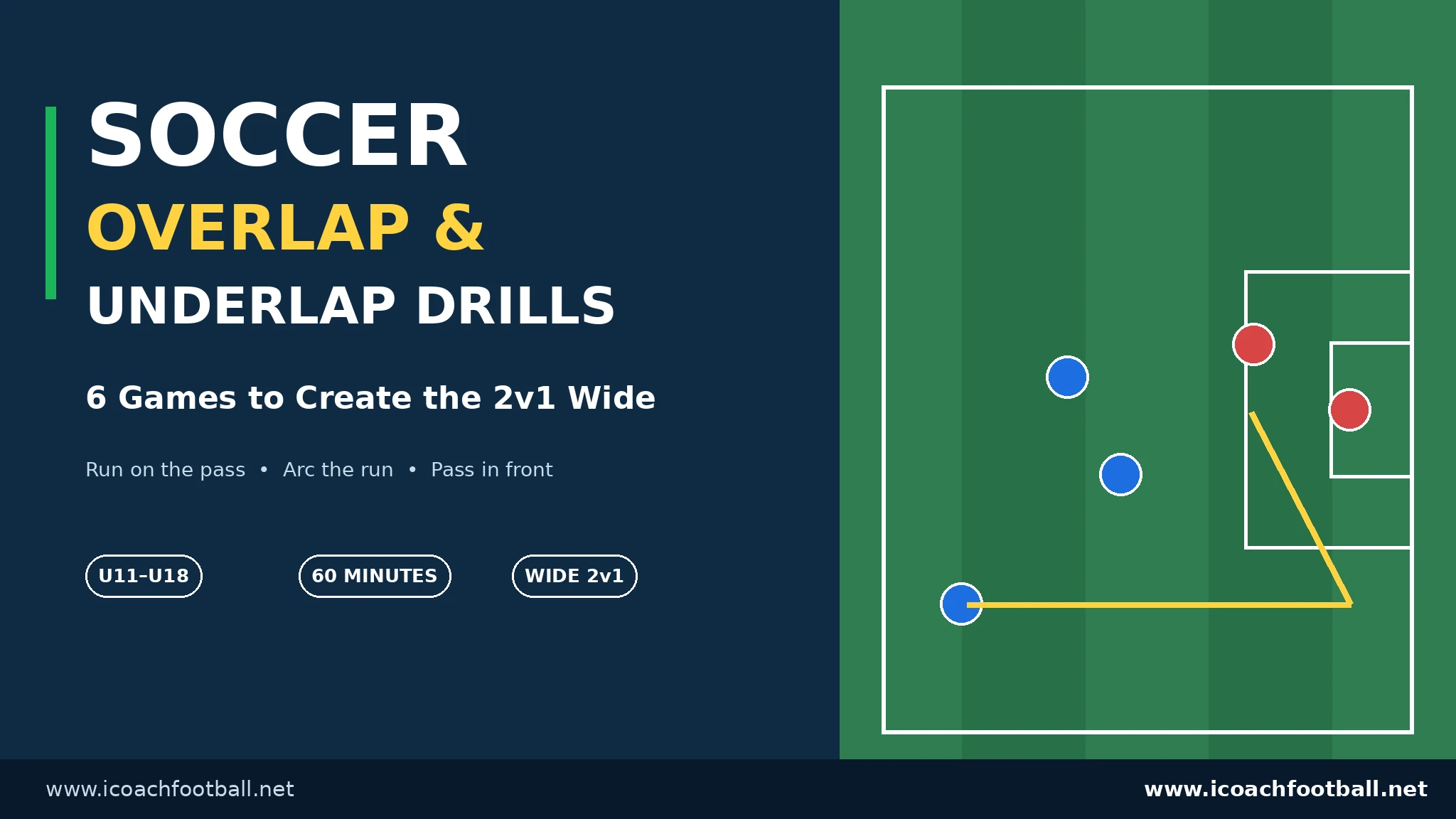
Quick answer: An overlap is a run around the outside of the ball carrier. An underlap is a run inside the ball carrier, into the half-space. The run starts the moment the ball carrier’s pass leaves their foot, the runner arcs wide or cuts inside at full sprint, and the ball is played into space in front of the runner – never to their feet while they wait.
Suitable for: U11–U18
A 1v1 wide is hard to win. The defender shows the winger outside, the touchline does the rest of the defending, and the attack dies in the corner.
A second runner changes the maths. One defender cannot mark the ball carrier and the runner at the same time, so one of them is always free. The same wide combination works in football at every level, because the defender’s dilemma – follow the runner or stay with the ball – does not change.
These six soccer overlap and underlap drills teach the full choice: run outside for the cross, run inside for the shot, or run as a decoy so the ball carrier can drive inside alone. Each drill ends with a cross, a cutback or a shot, and each one can be run from the diagram and steps alone.
Session snapshot
- Players: 12–18 (pairs and threes for Drills 1–3, groups of 6–8 for Drills 4–5, two teams for Drill 6)
- Area: One half pitch; finishing drills use the penalty area plus 20 yards beyond it; game 50 x 35 yards with wide channels
- Duration: 60 minutes (45-minute version: Drills 1, 3 and 6 only)
- Focus: Overlap and underlap timing, arced runs, the 2v1 wide decision, crossing and cutback finishes
- Equipment: 10–12 balls, 16 cones, bibs, 1 full-size or age-appropriate goal, 2 mini-goals for Drill 6
- Age: U11–U18 (see age adaptations)
The one rule: run on the pass, not after it
An overlap or underlap only works if three things happen in order. The ball carrier must drive inside to drag the defender in, the runner must start on the pass, and the return pass must be played into space in front of the runner.
- Drive inside first. A runner who goes before the ball carrier moves gives the defender time to pass them on. The ball carrier cuts infield, the defender follows, and the outside or inside lane opens.
- Arc the run. A straight sprint runs into the defender’s shoulder. An arced run stays behind the ball carrier until the last moment, then bursts into the open lane at full pace.
- Pass in front, at pace. A pass to feet stops the runner dead. Play the ball 3–4 yards ahead of the runner, firm and along the ground, so they meet it at full sprint.
Start with this wide game if your crossing delivery is not yet reliable; the overlap below creates the same wide 2v1, and it adds the decision that turns a cross into a choice between the byline and the half-space.
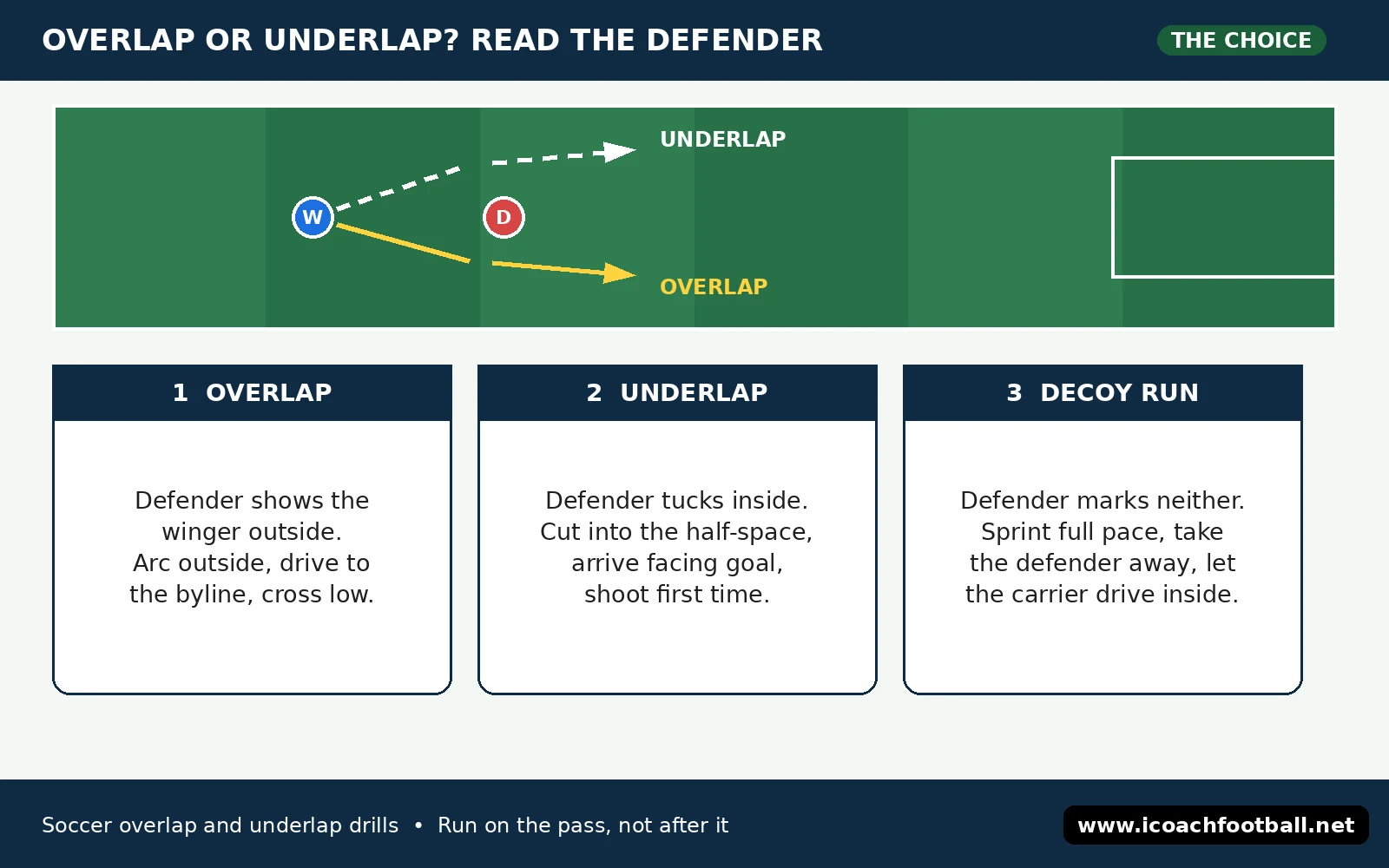
| Defender does | Runner does | Ball carrier does |
|---|---|---|
| Shows the winger outside, stays wide | Overlap outside, to the byline | Play in front of the runner for a cross or cutback |
| Tucks inside to protect the half-space | Underlap inside, into the half-space | Play in front of the runner for a shot or a through ball |
| Stays and waits, marking neither | Run as a decoy, full sprint, no ball | Drive inside and shoot, or switch play |
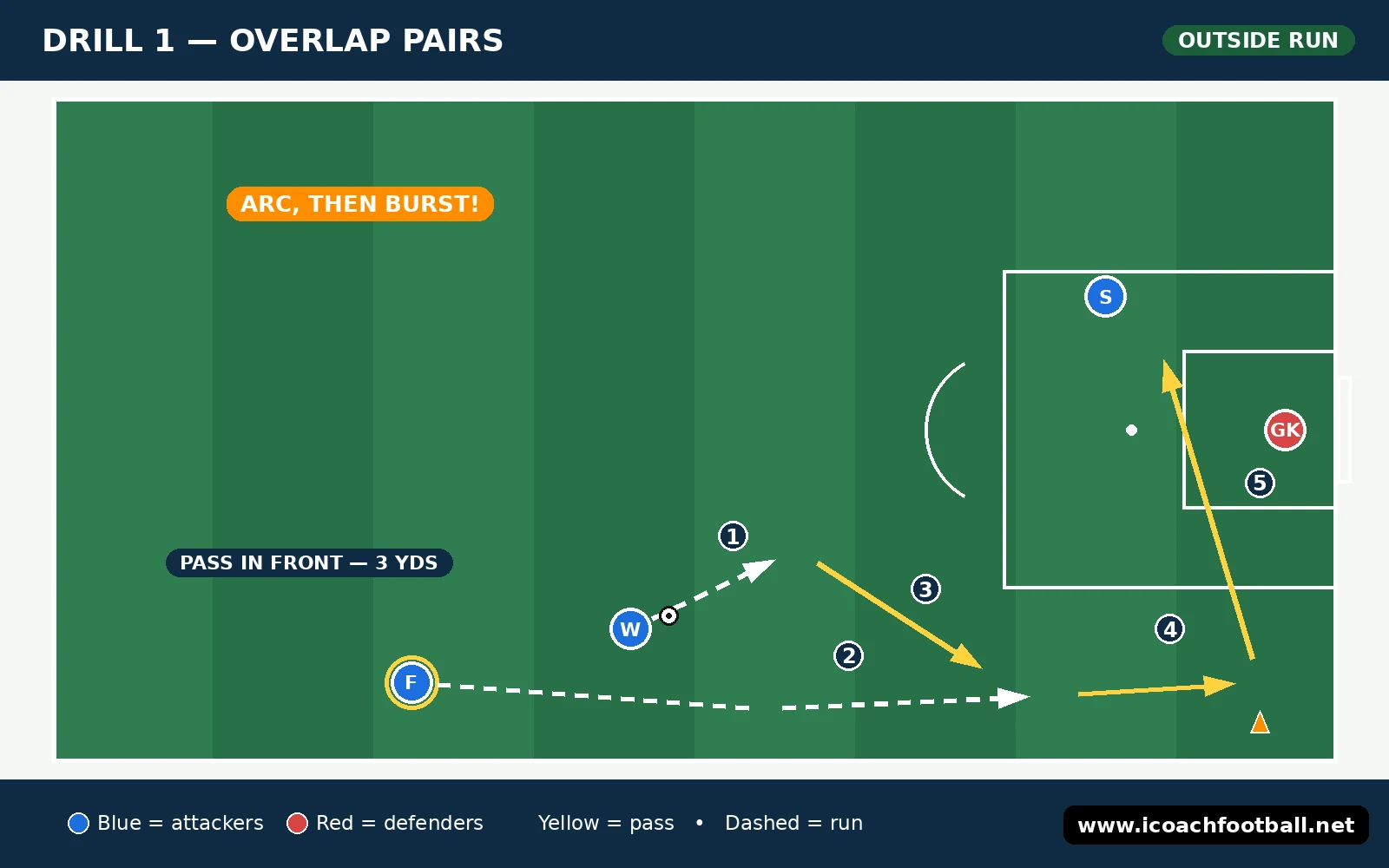
Drill 1 — Overlap Pairs
The blocked-practice start: one winger, one full-back, and the same arced overlap 10 times from each side.
Setup:
- One goal, with a goalkeeper, and a winger wide on the right, 30 yards from goal.
- Full-back starts 10 yards behind the winger, on the same touchline.
- Balls with the winger, and a cone 6 yards from the byline marking the crossing line.
How to Play:
- The winger dribbles infield at speed, towards the defender’s inside shoulder.
- The full-back starts the arced run the moment the winger’s first touch goes inside.
- The winger plays a firm pass 3 yards in front of the full-back, into the outside lane.
- The full-back meets the ball at full sprint and drives to the crossing line.
- The full-back crosses low or cuts the ball back, and the winger attacks the far post for the finish.
Coach’s note: The cue is “Arc, then burst!” If the full-back runs straight, the defender sees them early. The arc hides the run until it is too late to track.
Progressions: The full-back must cross first time, then the winger must finish with the weaker foot at the far post.
Drill 2 — Underlap Pairs
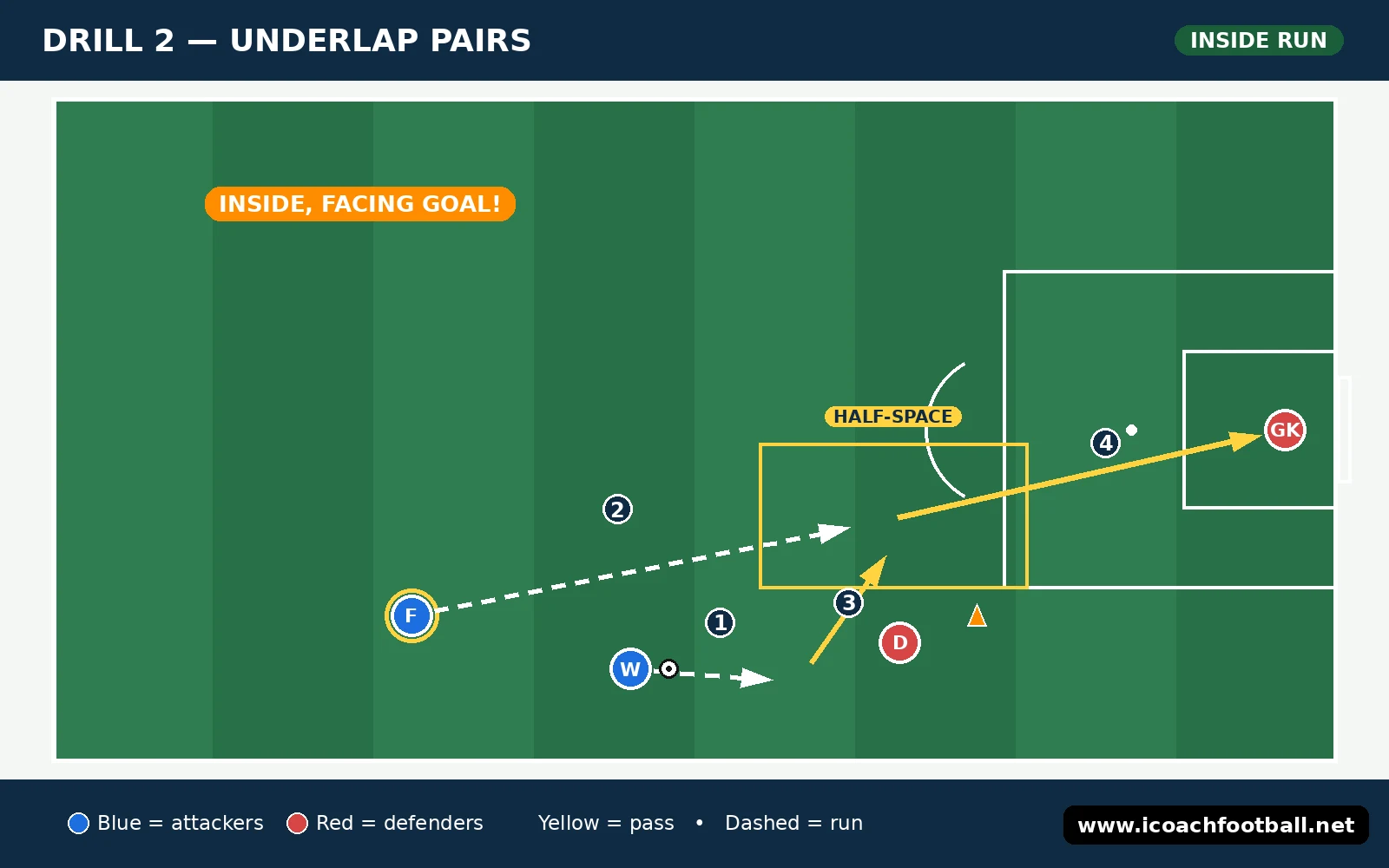
The inside run. The same pair, but the runner cuts between the winger and the centre, into the half-space the defender has left.
Setup:
- One goal, with a goalkeeper, and a winger wide on the right, 30 yards from goal.
- Full-back starts 10 yards behind the winger, with a cone marking the half-space lane 8 yards infield.
- Balls with the winger, and a mannequin or cone 15 yards from goal marking the defender’s tucked-in position.
How to Play:
- The winger receives wide and takes a positive first touch down the touchline.
- The full-back starts the underlap the moment the winger’s touch goes forward.
- The full-back sprints inside the winger, through the half-space lane, at full pace.
- The winger plays a firm pass 3 yards in front of the full-back, into the half-space.
- The full-back shoots first time or plays a through ball to a striker attacking the near post.
Coach’s note: The cue is “Inside, facing goal!” An underlapper who receives sideways has to turn. Arrive facing the goal, and the shot is already set up.
Progressions: The underlapper must shoot first time, then the winger must hold wide as a decoy and never receive the ball.
Drill 3 — Overlap or Underlap? Read the Defender
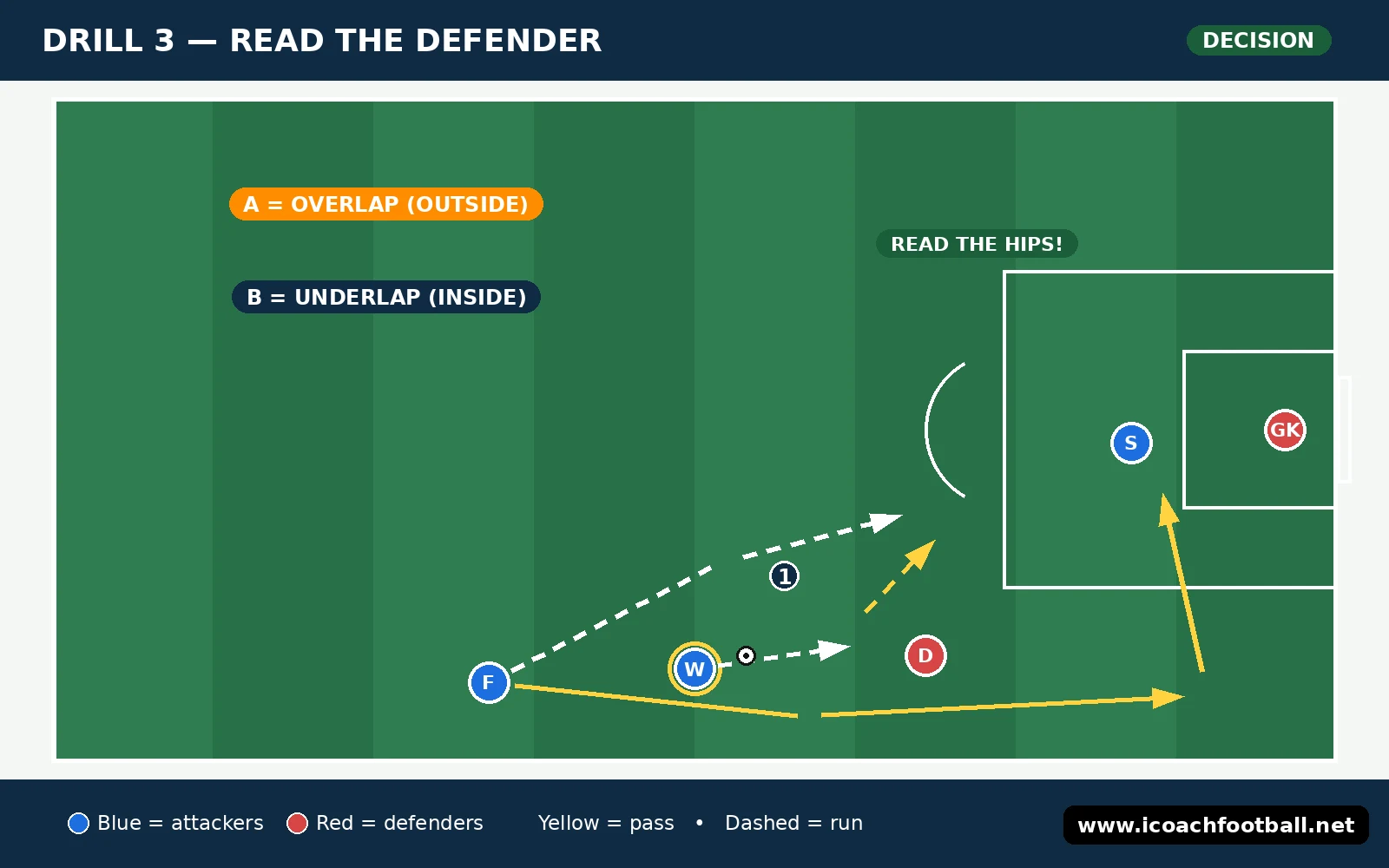
The decision drill. One live defender chooses the lane, and the runner must read the defender’s body shape before committing.
Setup:
- One goal, with a goalkeeper, a winger wide on the right, and one defender in the channel.
- Full-back starts 10 yards behind the winger, free to choose either lane.
- Balls with a feeder 35 yards from goal, and a striker waiting on the penalty spot.
How to Play:
- The feeder plays the winger into space down the right touchline, 1v1 against the defender.
- The winger drives at the defender and reads the defender’s hips and feet.
- If the defender shows the winger outside, the full-back overlaps to the byline for a cross.
- If the defender tucks inside, the full-back underlaps into the half-space for a shot.
- The striker attacks both deliveries on every rep, so the finish is ready for either run.
Coach’s note: The cue is “Read the hips!” Open hips give the outside away. A defender turned infield gives the half-space away. Teach the read, not a fixed pattern.
Progressions: The defender starts live and may tackle, then the winger must beat the defender with one move before the runner commits.
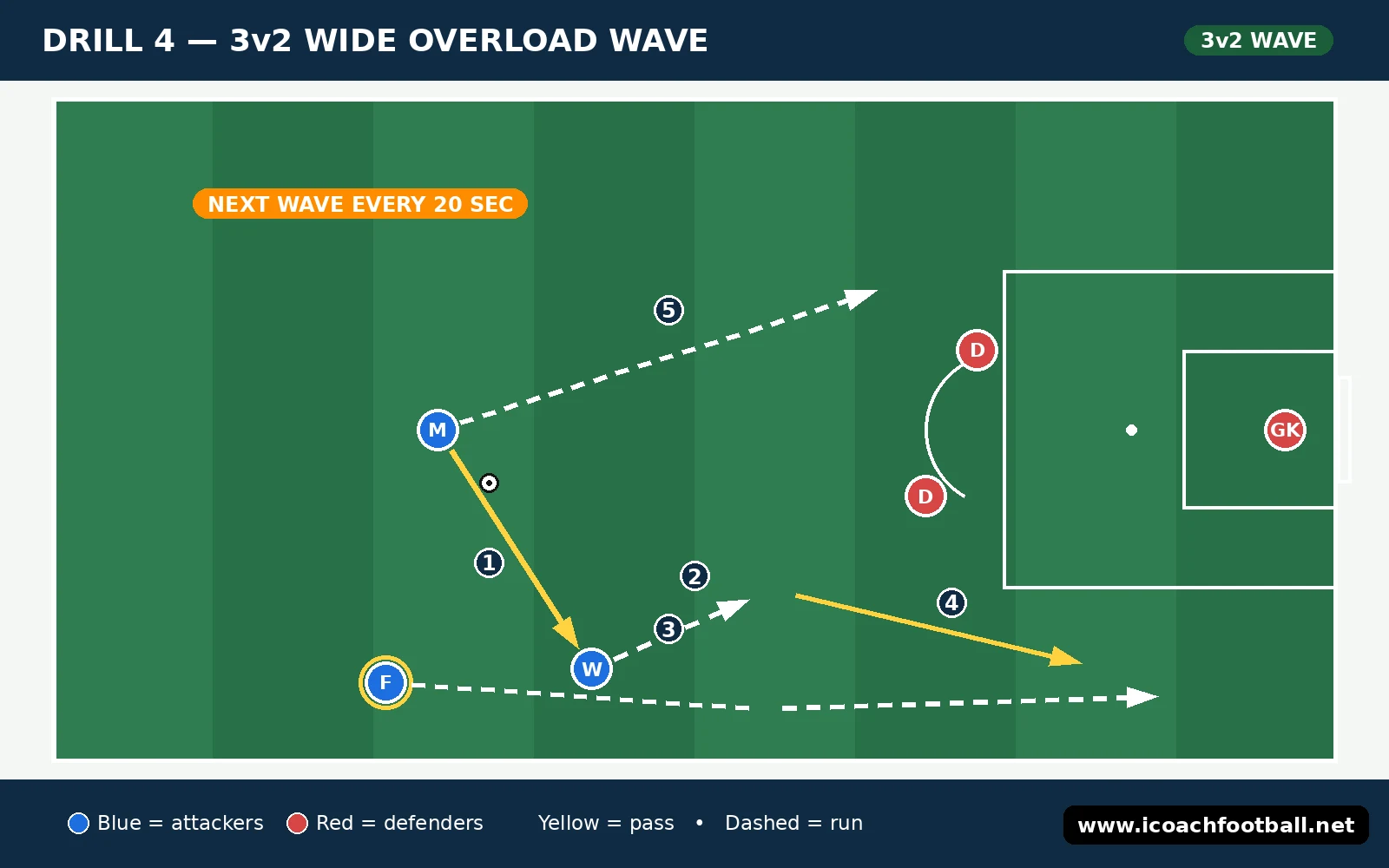
Drill 4 — 3v2 Wide Overload Wave
The opposed wave. A winger, a full-back and a midfielder against two defenders, with new waves arriving every 20 seconds.
Setup:
- One goal, with a goalkeeper, in a 40 x 30 yard area ending at the penalty area.
- Three attackers start 35 yards from goal, two defenders start on the edge of the box.
- Balls with the coach on the halfway line, and the next wave waiting behind the attackers.
How to Play:
- The coach plays the ball to the midfielder, who passes wide to the winger.
- The winger drives infield, dragging the wide defender inside with them.
- The full-back reads the defender and chooses the overlap or the underlap.
- The midfielder makes a delayed run to the edge of the box for any cutback or clearance.
- The wave ends with a cross, a cutback or a shot, and the next wave starts at once.
Coach’s note: The cue is “Wave, wave, wave!” Slow waves teach slow decisions. The runner must commit while the defender is still turning.
Progressions: The defenders may start 5 yards higher, then the attackers must finish within 8 seconds of the coach’s pass.
Drill 5 — Double Overlap Circuit
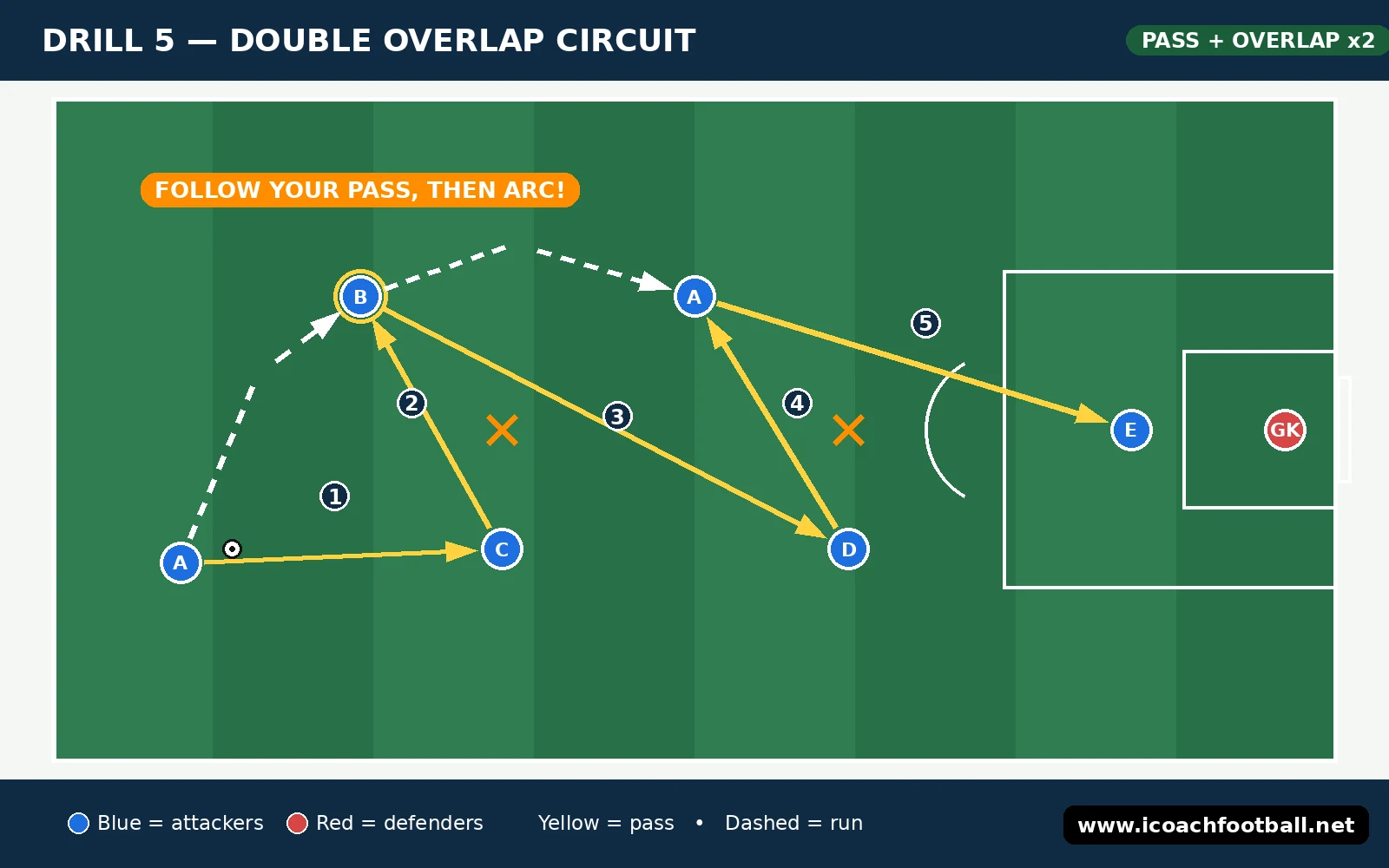
The passing circuit, in line with the FIFA Training Centre overload session: two overlaps in one sequence, with layoffs that set the timing.
Setup:
- A 25 x 15 yard circuit with two poles in the centre, 10 yards from each end.
- Six players: two at each end, one at each pole, with balls at one end.
- One goal, with a goalkeeper, at the far end of the circuit for the final finish.
How to Play:
- Player A passes into the pole player, who lays the ball off to Player B.
- Player A follows the pass and overlaps Player B on the outside.
- Player B passes into the second pole player, who lays the ball off for Player A.
- Player B crosses over and makes a second overlap on the opposite side.
- The sequence ends with a pass to the end player, who finishes first time on goal.
Coach’s note: The cue is “Follow your pass, then arc!” Players who stand and watch break the circuit. Every pass is followed by a run, and every run is arced.
Progressions: The two overlaps must happen without a second touch, then add a passive defender at each pole who may block the layoff.
Drill 6 — Overlap-Only Channel Game
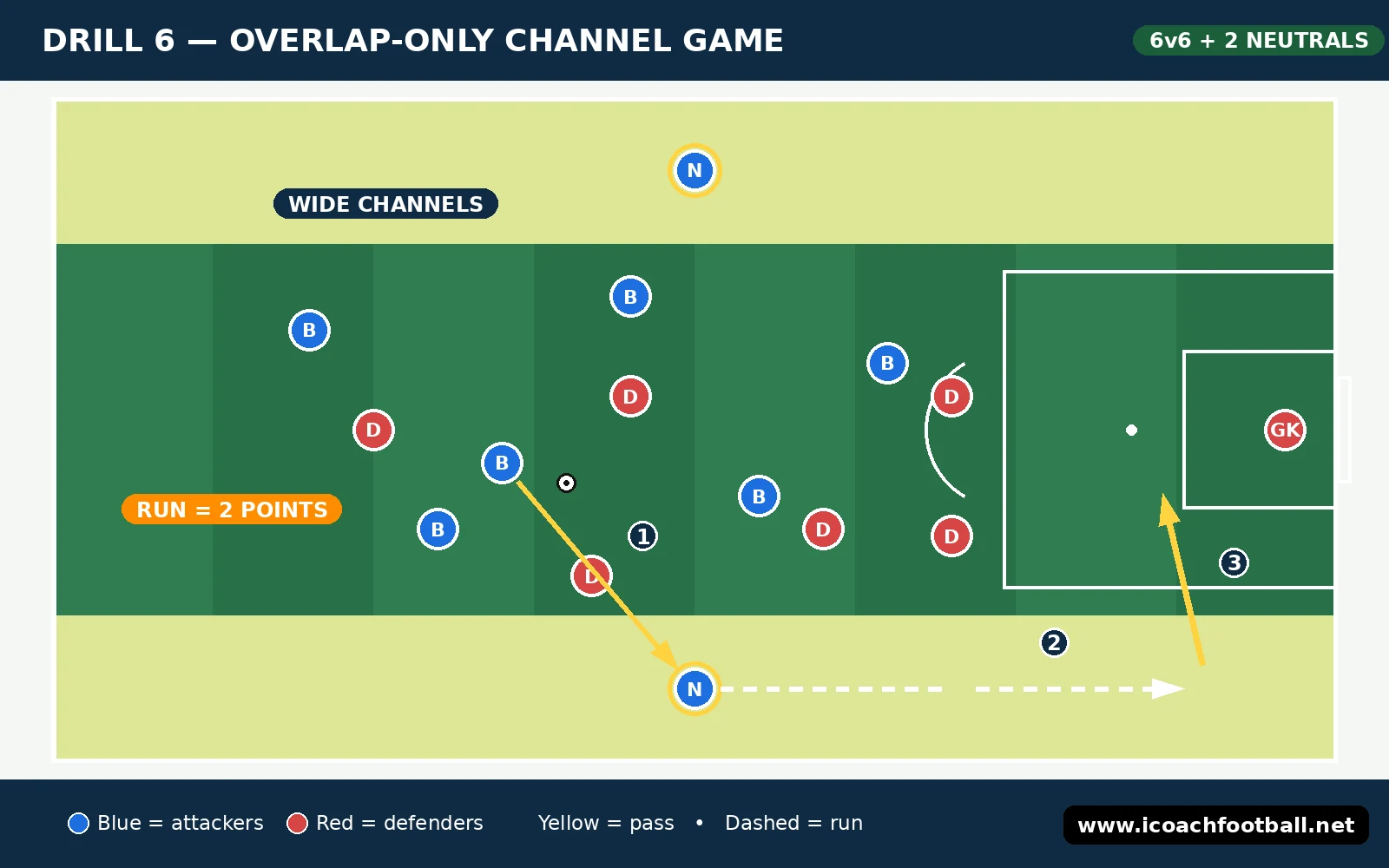
The conditioned game. Only goals that follow an overlap or underlap count double, so every attack must find a wide runner.
Setup:
- Area 50 x 35 yards, with a goal at each end, a goalkeeper in each goal, and 8-yard wide channels on both touchlines.
- Two teams of 6, plus 2 neutral wide players, one in each channel.
- Balls start with the coach on the halfway line, thrown or passed in to restart play.
How to Play:
- The coach plays the ball in, and teams keep possession with no touch limit.
- A team may only shoot after a wide runner has overlapped or underlapped a teammate.
- The neutral wide players stay in their channels and combine with whichever team has the ball.
- A goal after an overlap or underlap scores 2 points, and any other goal scores 1 point.
- After a goal, the other team restarts, and the neutral players swap channels every 4 minutes.
Coach’s note: The cue is “Wide run or no shot!” Freeze any team that shoots without a wide run. The game must teach the habit, not just the finish.
Progressions: Goals only count if finished first time from a wide delivery, then the neutral players may leave their channel after playing the run.
Coaching points
- “Arc, then burst!” Hide the run behind the ball carrier, then sprint into the open lane. A straight run is seen early and tracked.
- “Run on the pass!” The runner starts when the pass leaves the ball carrier’s foot. A runner who waits for the pass arrives late and receives to feet.
- “Read the hips!” The defender’s body shape chooses the run in Drill 3. Open hips give the byline away; a tucked-in defender gives the half-space away.
- “Pass in front, at pace!” Play the ball 3–4 yards ahead of the runner, firm and along the ground, so they meet it at full sprint.
- “Inside, facing goal!” In Drill 2, the underlapper must arrive facing the goal. Train the finish with a 1v1 finishing drill.
- “Wide run or no shot!” In Drill 6, no wide run means no shot. The constraint builds the habit, and the cutback finish it creates is the same finish practised in these soccer cutback drills.
Common mistakes
| Mistake | Fix |
|---|---|
| Runner starts after the pass, not on it | Drill 1 cue “Arc, then burst!”; no run counts if it starts late |
| Runner sprints straight and gets tracked | Arc behind the ball carrier in Drills 1–2; stay hidden until the burst |
| Pass played to feet, runner stops dead | Pass 3–4 yards in front in every drill; a pass to feet ends the rep |
| Same run every time, defender reads it | Drill 3 decision: overlap or underlap from the defender’s hips, never from habit |
| Ball carrier never drives inside | No run until the ball carrier’s first touch goes infield; freeze Drill 4 and restart |
| Game becomes long-ball shooting | Freeze Drill 6 and restart from the coach; every shot needs a wide run first |
Age adaptations
| Age | Change |
|---|---|
| U11–U12 | Drills 1, 2 and 6 only, unopposed runs, mini-goals, and no live defender in Drill 3 |
| U13–U14 | Full six-drill menu with a passive defender in Drill 3 and runs from both sides in Drills 1–2 |
| U15–U16 | Live defender in Drill 3, 8-second clock in Drill 4, and first-time finishes only in Drill 6 |
| U17–U18 | No coach call in Drill 5, weaker-foot crosses in Drills 1 and 5, and 2 points only for first-time finishes in Drill 6 |
60-minute session plan
Run the six games as one session with this 60-minute plan, or take any two games for a 20-minute block.
| Block | Time | Drill |
|---|---|---|
| 1 | 10 minutes | Drill 1 — Overlap Pairs |
| 2 | 10 minutes | Drill 2 — Underlap Pairs |
| 3 | 10 minutes | Drill 3 — Overlap or Underlap? Read the Defender |
| 4 | 10 minutes | Drill 4 — 3v2 Wide Overload Wave |
| 5 | 10 minutes | Drill 5 — Double Overlap Circuit |
| 6 | 10 minutes | Drill 6 — Overlap-Only Channel Game |
For the switch that creates the wide 1v1 in Drill 4, use the same attract-and-switch idea as this switching play game, where drawing the defence to one side opens the far-side winger.
Sources
These soccer overlap and underlap drills are based on the overload principles in the FIFA Training Centre session on creating and exploiting overloads, which stresses creating 2v1s as quickly as possible, driving forward with the ball, and using overlaps and underlaps to penetrate the defence, with arced runs and firm layoffs setting the timing in its passing circuit, and in line with the FIFA Training Centre exercise on the pass and overlapping run, which trains the one-two, the checked decoy run, and the overlapping run in behind to receive and finish first time.
What is an overlap in soccer?
An overlap is a run by a teammate around the outside of the ball carrier, into the space ahead of them. The ball carrier drives inside to drag the defender in, the runner arcs outside at full sprint, and the ball is played in front of the runner for a cross or cutback.
What is an underlap in soccer?
An underlap is a run inside the ball carrier, between the winger and the centre of the pitch. The runner cuts into the half-space the defender has left, receives facing goal, and shoots first time or plays a through ball.
How do you decide between an overlap and an underlap?
Read the defender. If the defender shows the winger outside and stays wide, overlap to the byline. If the defender tucks inside to protect the half-space, underlap inside. If the defender waits and marks neither, use the run as a decoy and let the ball carrier drive inside.
When should the overlapping run start?
The run starts the moment the ball carrier’s pass leaves their foot – or, in Drill 1, the moment the winger’s first touch goes inside. A runner who starts after the pass arrives late, receives to feet, and loses the advantage.
Can younger teams practise overlap and underlap drills?
Yes, from U11 up, starting with the unopposed pairs in Drills 1 and 2 on mini-goals. Add a live defender and the decision in Drill 3 only from U13-U14, and keep every return pass firm, low and in front of the runner.