Futsal Drills for Footballers: A Winter Skills Programme
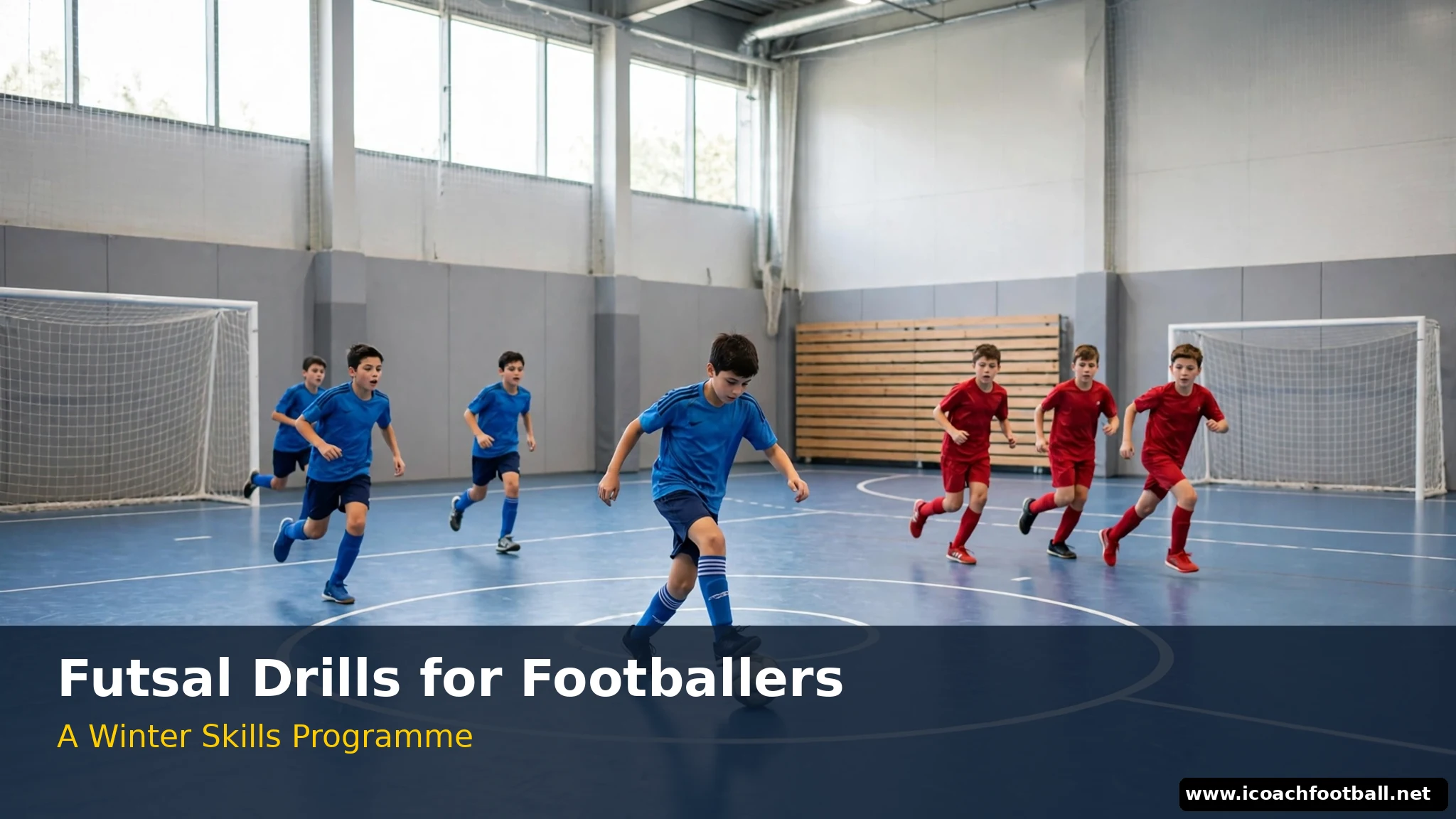
Quick answer: Use six futsal drills in this order: sole control, diamond passing, shielding and turning, playing the pivot, 4-0 rotation, then a 3v3 kick-in game. Keep every touch on the floor, receive with the sole, and restart in under four seconds.
Futsal is not indoor football with a smaller ball. It is a faster game, on a hard court, with no offside and no time to take a second touch.
That pressure is the point. Players get far more touches, in far less space, than in a grass game. In the US the same winter work is usually called soccer futsal training, and the drills below transfer straight back to grass: quicker first touch, calmer shielding, and faster decisions.
When the grass pitch is unplayable, switch to these winter football training session plans.
Players: 8–12 (plus goalkeepers for Drills 4–6)
Area: Sports hall or futsal court, half court for most drills
Duration: 60 minutes (see session plan)
Focus: Sole control, pivot play, rotation, fast restarts
Equipment: Futsal balls (size 3 for younger players, size 4 from U13), cones, bibs, two futsal goals
Age: U10–U19 (see age adaptations)
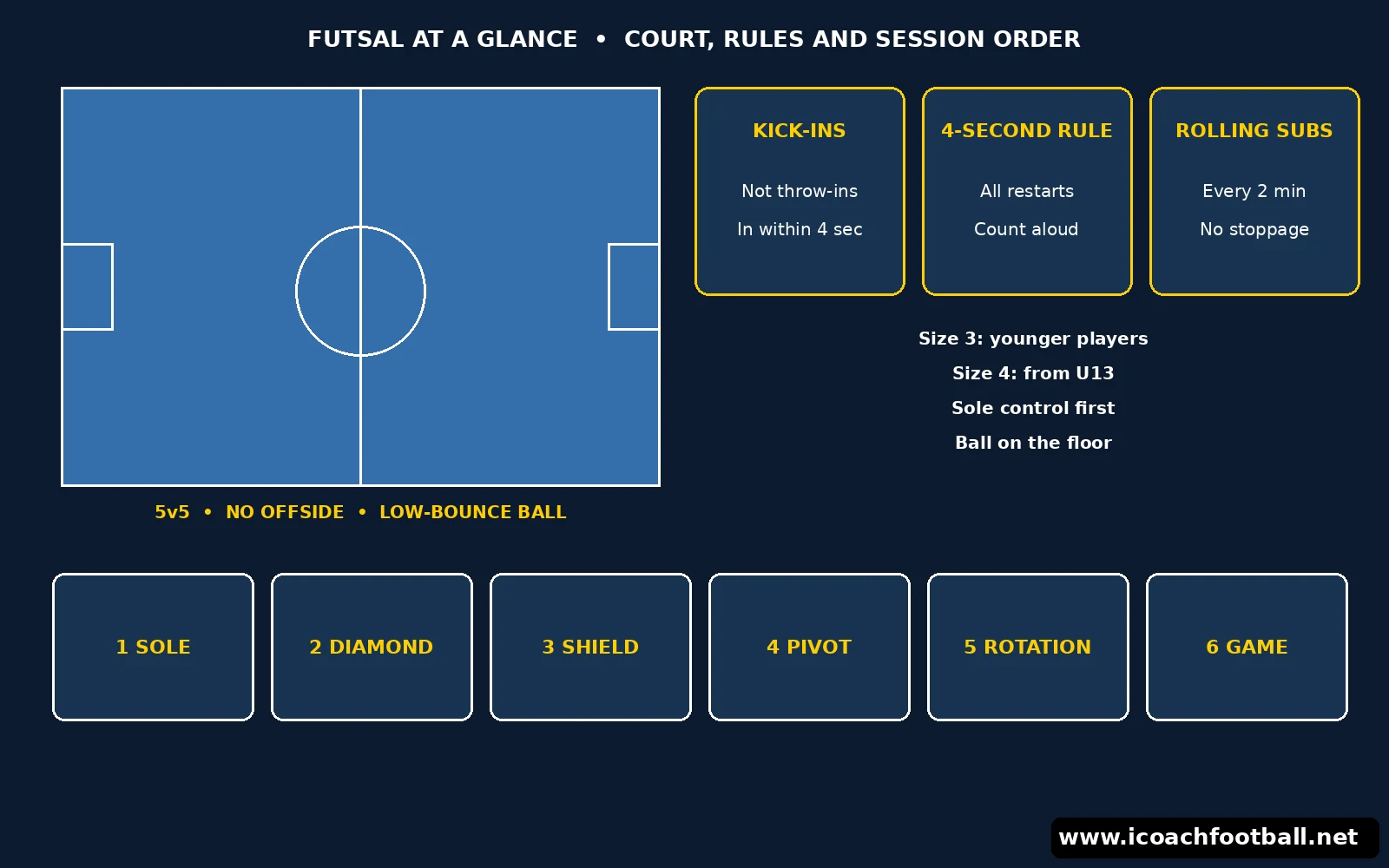
Futsal rules that change the drills
| 5v5, including the goalkeeper | Every drill ends 4v4 or 3v3 plus goalkeepers, so rotations stay realistic |
| Kick-ins, not throw-ins | The ball is placed on the line and played in with the foot, within 4 seconds |
| 4-second restarts | Corners, kick-ins, free kicks and goalkeeper distribution all restart fast |
| No offside | Attackers can stay high, so pivot and second-post runs matter more |
| Rolling substitutions | Rotate players every 2 minutes without stopping the game |
Why futsal sharpens grass players
- More touches: A player touches the ball far more often in 20 minutes of futsal than in a full grass game.
- Sole control: The low-bounce ball rewards receiving with the sole and keeping it on the floor.
- Faster scanning: The court is small, so players must look before they receive, not after.
- Pivot habits: Back-to-goal shielding and lay-offs transfer directly to holding up play on grass.
- Cue: “Sole it, scan, play.” Shout it in every drill until players do it without thinking.
Drill 1 — Sole-Roll Traffic
Sole control first. Every later drill fails if players chase a bouncing ball.
Setup:
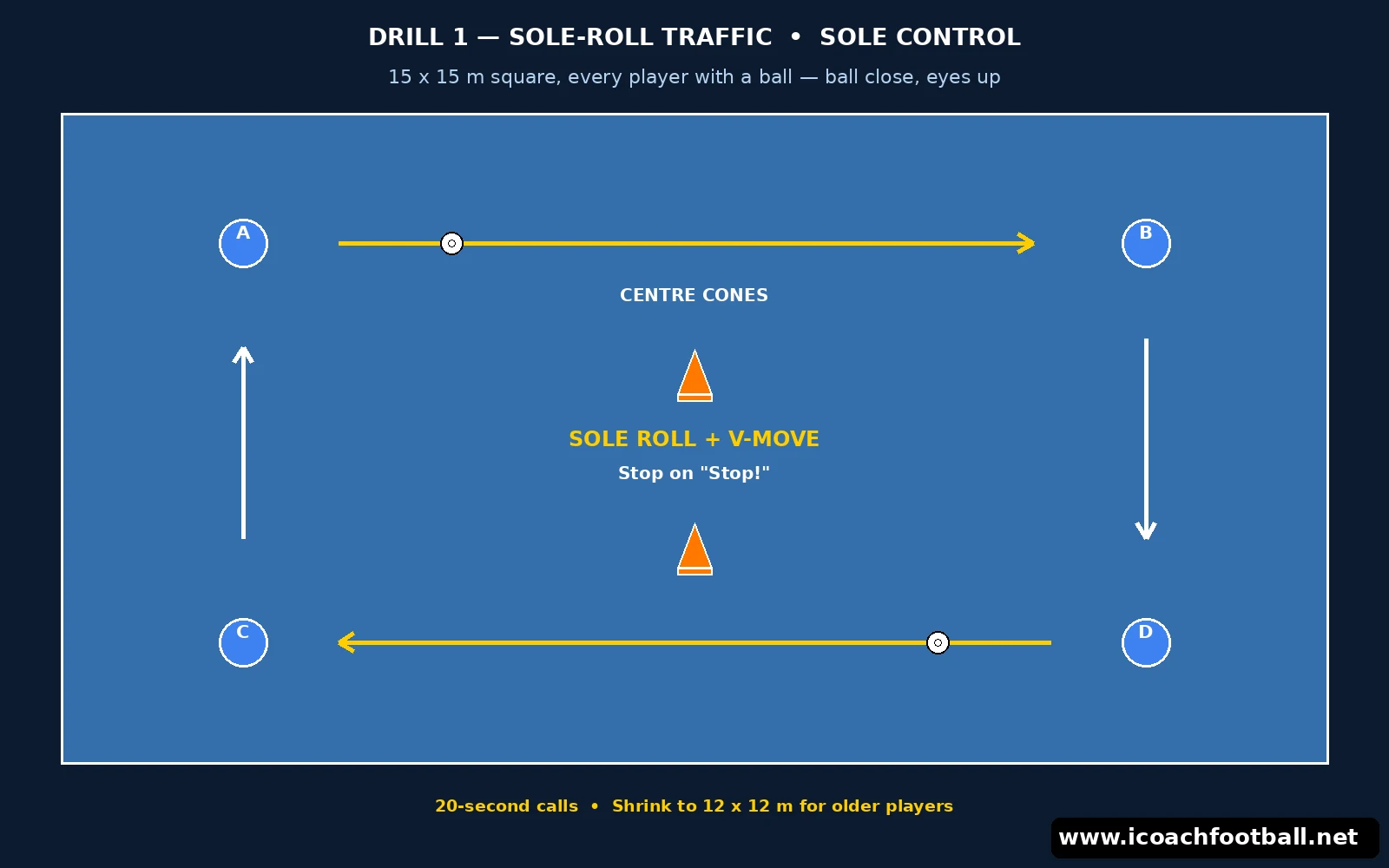
- One 15 x 15 metre square, marked with cones.
- Every player with a futsal ball, inside the square.
- Two cones in the middle as a “traffic island” to dribble around.
- Coach on the outside, calling changes every 20 seconds.
How to Play:
- Players dribble inside the square, keeping the ball within one step.
- Players stop the ball dead with the sole on the coach’s call of “Stop!”
- Players roll the ball sideways with the sole, then push it forward with the inside of the same foot.
- Players make a V-move: pull back with the sole, then push away at a new angle.
- Players change direction around the centre cones, using the sole to turn.
Coach’s note: Heads stay up between touches. The cue is “Ball close, eyes up!” A player staring at the ball will collide, and that is the lesson.
Progressions: Add a second ball per pair to pass, or shrink the square to 12 x 12 metres for older players.
Drill 2 — Diamond Pass and Rotate
Pass, follow, rotate. The pattern teaches the movement futsal demands after every pass.
Setup:
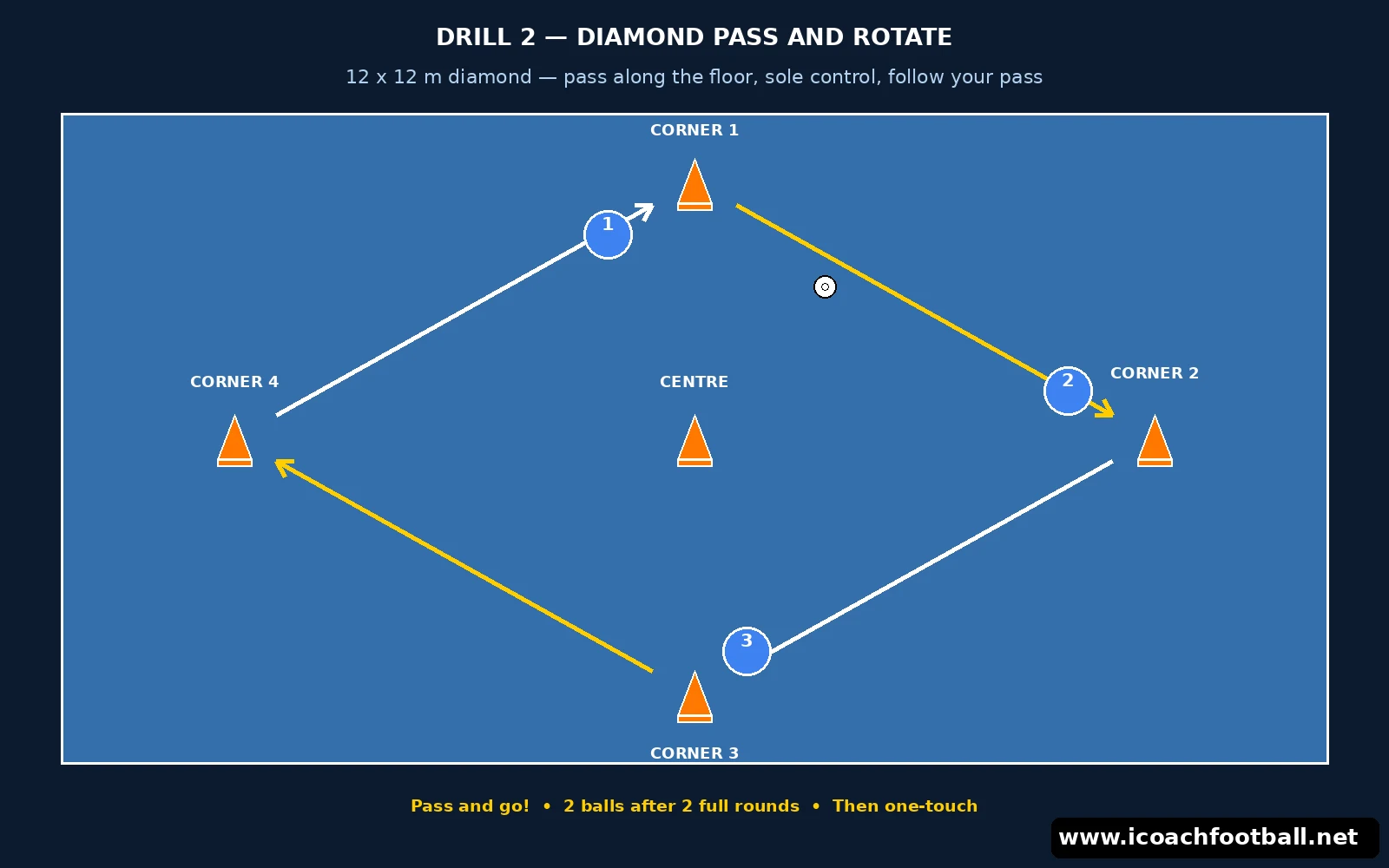
- One 12 x 12 metre diamond, with a cone at each corner and one in the centre.
- Four players on the outside cones, one ball, plus one spare player at a corner.
- Players work in groups of 5, with a second diamond if numbers allow.
How to Play:
- The player with the ball passes firmly along the floor to the next corner.
- The receiver controls with the sole and shifts the ball to the other side of the cone in the same touch.
- The passer follows the pass and takes the receiver’s cone.
- The receiver passes to the next corner and follows in the same way.
- After two full rounds, add a second ball so two passes travel at once.
Coach’s note: The pass must be firm enough to reach the cone without bouncing. The cue is “Pass and go!” Standing still after a pass is the mistake this drill removes.
Progressions: Receive with the far foot, play one-touch, or add a bounce pass off the centre cone before passing on.
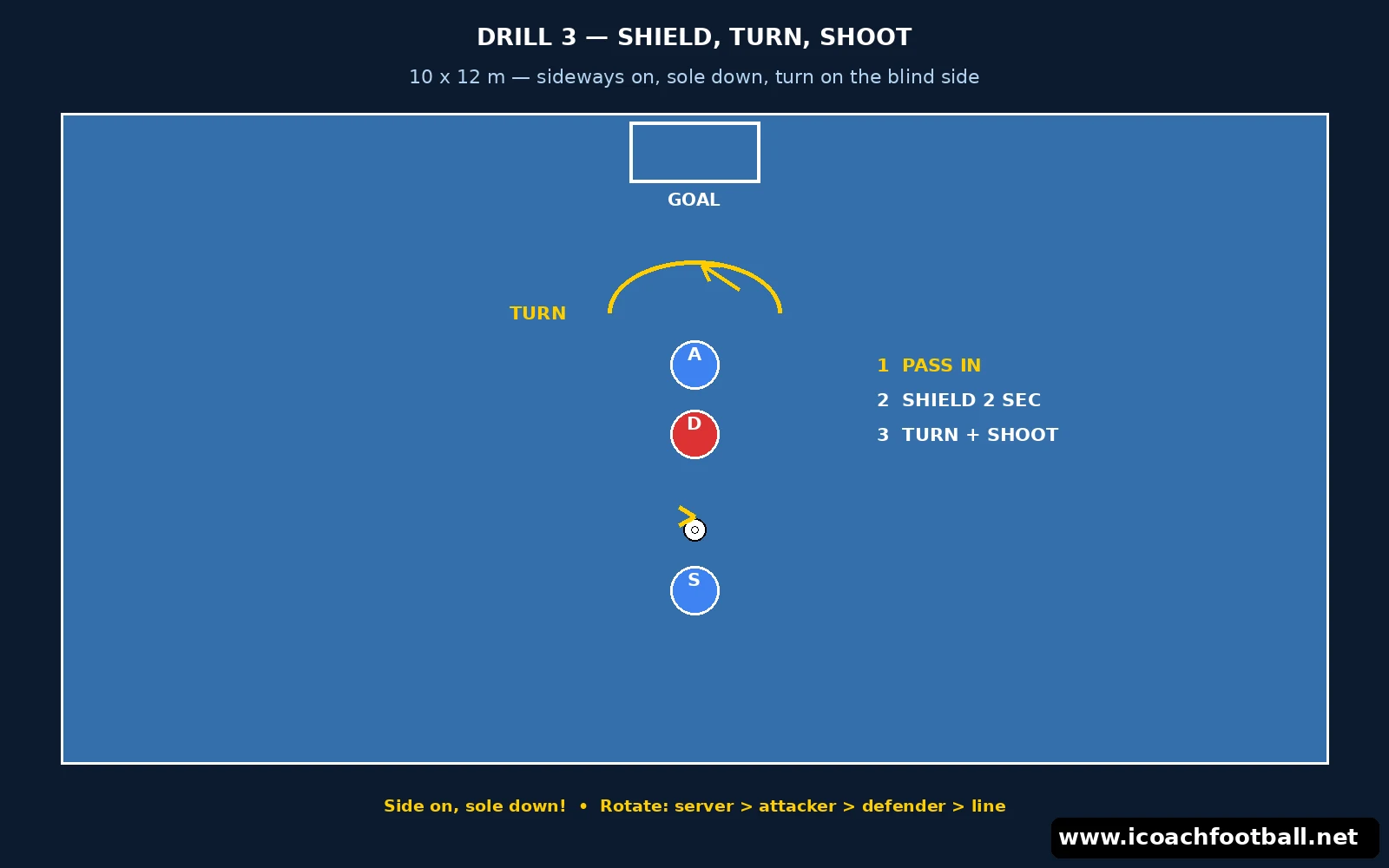
Drill 3 — Shield, Turn, Shoot
Back to goal, defender tight, one chance to turn or lay off. This is pivot play in miniature.
Setup:
- One 10 x 12 metre grid, with a futsal goal at one end and a server 10 metres out.
- One attacker, one defender, one goalkeeper, with the rest in two lines behind the server.
- Balls with the server, so every rep starts cleanly.
How to Play:
- The server passes firmly into the attacker, who checks away and then comes short to receive.
- The attacker controls with the sole, sideways on, shielding the ball from the defender.
- The attacker holds for two seconds, feeling where the defender’s weight is.
- The attacker turns on the defender’s blind side and shoots low, or lays off to the server.
- Attacker, defender and server rotate: server becomes attacker, attacker becomes defender, defender joins the line.
Coach’s note: Sideways body shape is everything. The cue is “Side on, sole down!” A square, chest-to-ball receiver gets the ball taken every time.
Progressions: Add a second defender for a 2v1 lay-off, or limit the attacker to two touches before the shot.
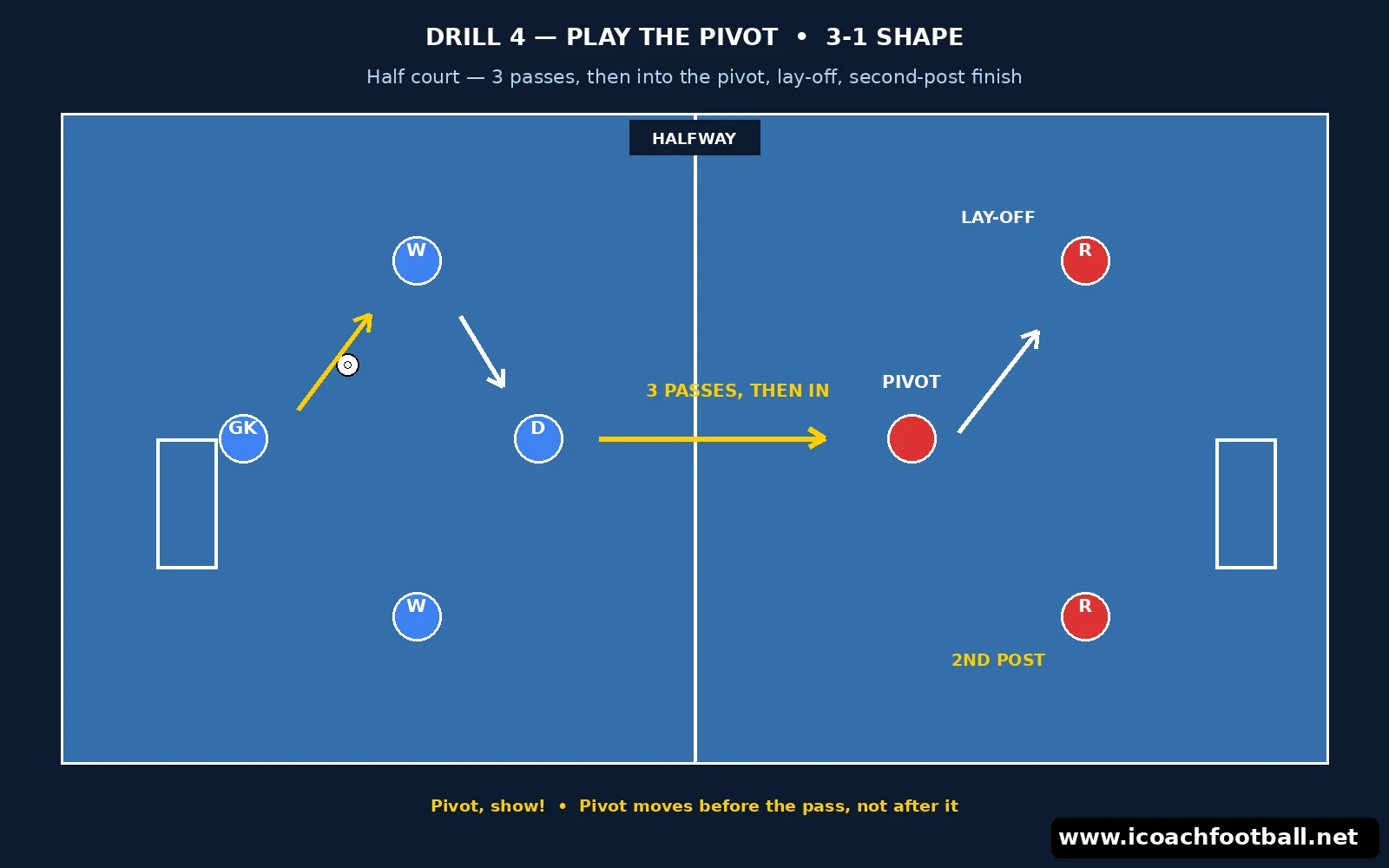
Drill 4 — Play the Pivot
The 3-1 shape in action: three players build, one pivot holds, runners attack the second post.
Setup:
- Half a futsal court, with goals at each end and a goalkeeper in each.
- One team in a 3-1 shape: goalkeeper, two wide players, one deep player, and a pivot high up.
- One defending team in the same shape, pressing in their own half.
- The halfway line marked clearly, so the pivot’s zone is obvious.
How to Play:
- The goalkeeper plays out short to a wide player inside the defensive half.
- The three deep players complete three passes before playing forward.
- A wide player passes firmly into the pivot’s feet.
- The pivot shields with the sole, holds, and lays off to a runner.
- The runner finishes first time at the second post, or the pivot spins and shoots.
Coach’s note: The pivot must move before the pass, not after it. The cue is “Pivot, show!” If the pivot stands still, the pass goes to a marked player.
Progressions: Allow the pivot to leave the zone once, or let a defender join the pivot to make it 4v4 in one half.
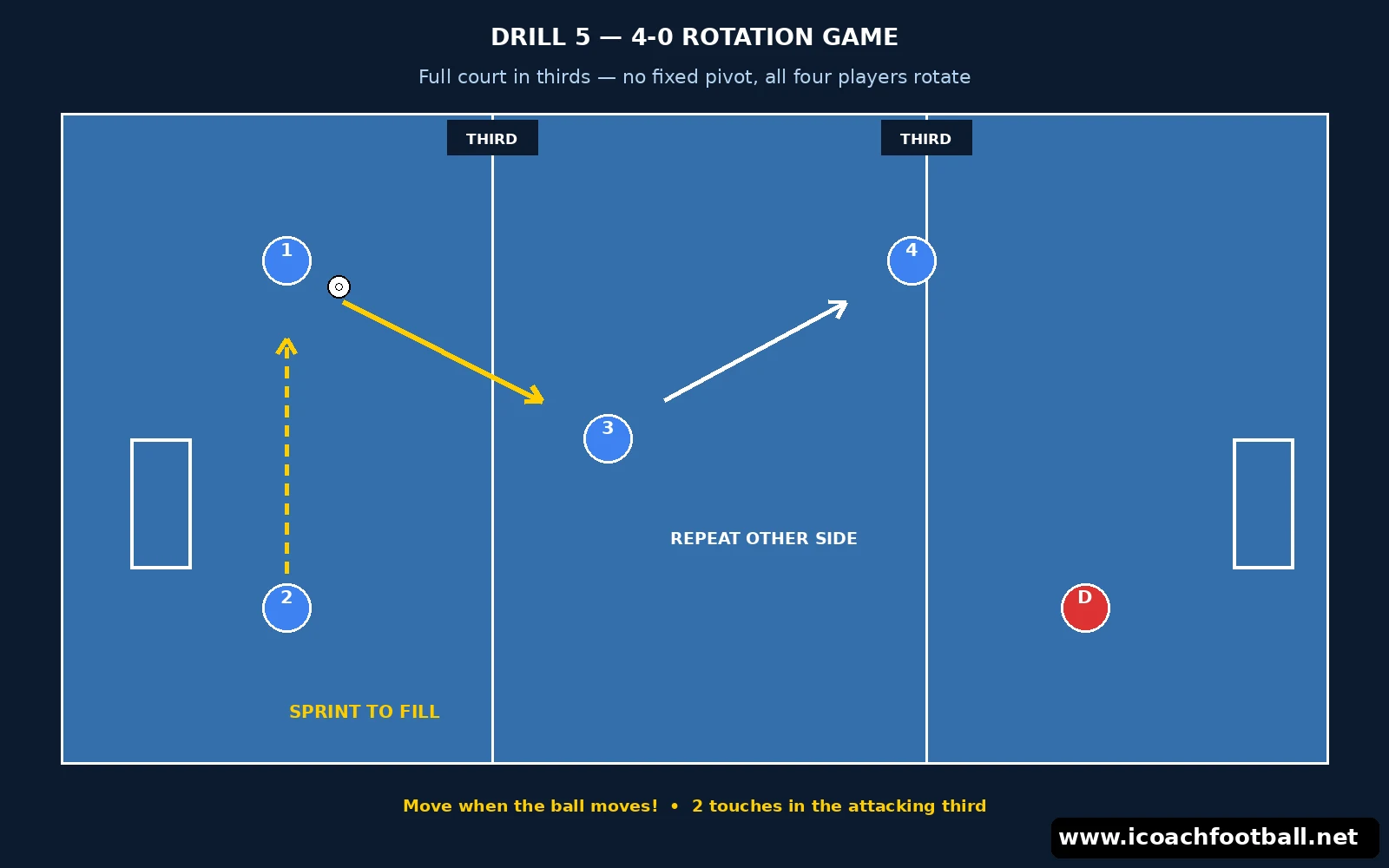
Drill 5 — 4-0 Rotation Game
No fixed pivot. All four players rotate, so the defence never gets a player to mark.
Setup:
- Full futsal court, 4v4 plus goalkeepers, with bibs for one team.
- The court split into thirds with flat cones on the touchlines.
- Two balls with the coach, to restart instantly after a goal or a ball out.
How to Play:
- The team in possession keeps all four players moving in a line across the court.
- The ball-side player dribbles at the defender, and the far-side player sprints to the opposite side.
- The player who passes sprints to fill the space the runner left.
- The next player receives, and the rotation runs again from the other side.
- If a rotation cannot reach the pivot zone, the team plays parallel and starts again.
Coach’s note: Rotation without a pass is just running. The cue is “Move when the ball moves!” Players who rotate late arrive after the passing lane has closed.
Progressions: Limit the team to two touches in the attacking third, or award a point for every completed rotation that ends in a shot.
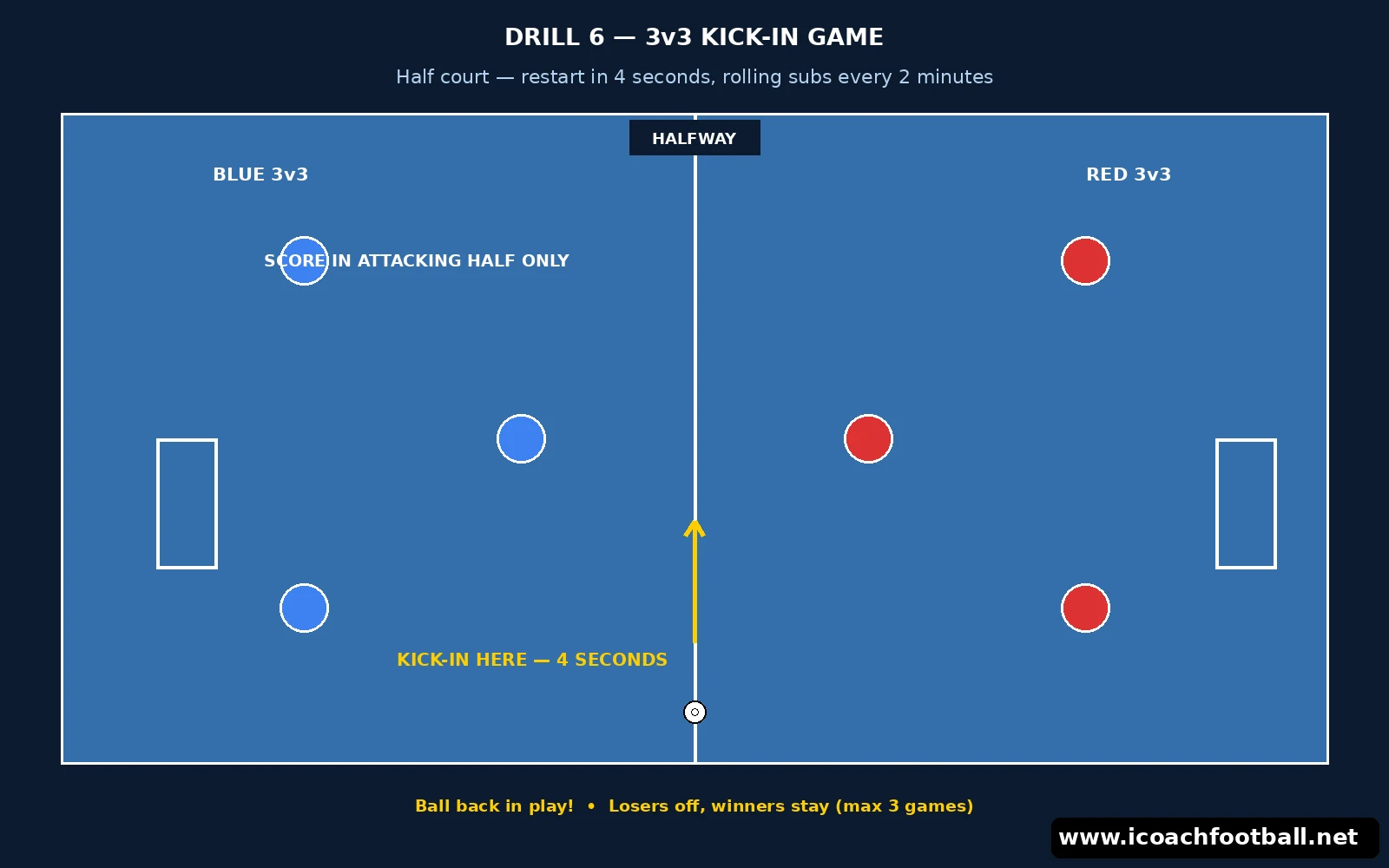
Drill 6 — 3v3 Kick-In Game
A real futsal game, conditioned so every restart teaches speed and shape.
Setup:
- Half a futsal court, 3v3 plus goalkeepers, with two spare teams waiting off court.
- Goals at each end, balls behind each goal for instant restarts.
- A 2-minute timer, with rolling substitutions on the coach’s whistle.
How to Play:
- The game starts with a kick-in from the touchline, played in within 4 seconds.
- Teams score only from inside the attacking half, with a low, first-time or second-touch finish.
- When the ball goes out, the nearest player restarts it at once, with no waiting for a set taker.
- After 2 minutes, the losing team leaves and the waiting team enters.
- The winning team stays on, up to three games in a row, then rotates out.
Coach’s note: Count restarts aloud: “Four, three, two, one!” The cue is “Ball back in play!” Slow restarts waste the best coaching moment in futsal.
Progressions: Play 4v4, require three passes before a shot, or add a flying goalkeeper for the last 30 seconds of each game.
60-minute session plan
| 0–8 min | Warm-up | Drill 1 — Sole-Roll Traffic |
| 8–18 min | Technique | Drill 2 — Diamond Pass and Rotate |
| 18–30 min | Technique | Drill 3 — Shield, Turn, Shoot |
| 30–42 min | Tactics | Drill 4 — Play the Pivot |
| 42–52 min | Tactics | Drill 5 — 4-0 Rotation Game |
| 52–60 min | Game | Drill 6 — 3v3 Kick-In Game |
Coaching points that make futsal work
- Ball on the floor: Ban bouncing passes in Drills 1–3. A ball in the air is a lost ball on a hard court.
- Sole first: Every receive starts with the sole. Insist on it for two full sessions before relaxing the rule.
- Short, sharp sets: Run drills in 2-minute bursts with 30 seconds of coaching between them. Futsal intensity drops fast when sets drag.
- Coach the restart: Stop the game once to fix a slow kick-in, then let the rest flow. Restarts are where futsal games are won.
- Use the walls only as walls: Do not let players bounce passes off a sports-hall wall unless the rules allow it. The court lines are the boundary.
Common mistakes — and the fix
- Dribbling with the toe: Fix: sole rolls only in Drill 1 until the habit sticks. Toe pokes send the low-bounce ball skidding away.
- Receiving square-on: Fix: sideways body shape in Drill 3, with the defender told to press hard. Square receivers lose the ball.
- Standing after a pass: Fix: Drill 2’s follow-your-pass rule, enforced every rep. Futsal punishes static players at once.
- Shooting from distance: Fix: Drill 6’s attacking-half rule. Futsal goals come from close range, after a lay-off or a second-post run.
- Slow restarts: Fix: count every restart aloud. Four seconds feels generous until players hear it counted.
Age adaptations
- U10–U11: Use a size 3 futsal ball, a smaller court, and Drills 1, 2 and 6 only. Keep the pivot idea as “hold and pass back”, with no fixed positions.
- U12–U13: Add Drill 3 with light pressure, and Drill 4 with the pivot staying in one zone. Keep games to 2 minutes, with frequent rotations.
- U14–U16: Run the full programme, including 4-0 rotation. Introduce the flying goalkeeper in Drill 6, and start coaching accumulated-foul awareness in games.
- U17–U19: Add a pressing trigger to Drill 5, such as pressing on a back pass. Use full-court 4v4 games, and video one rotation to review with players.
FIFA Training Centre, Futsal practice library: FIFA Training Centre futsal practices — The pivot and rotation drills in this post are in line with the FIFA Training Centre futsal practices on playing out under pressure and using the pivot; no approval or affiliation is claimed.
The FA, Futsal arrival activity (The Boot Room): The FA’s foundation-phase futsal approach — The small-sided arrival game and ball-control emphasis are in line with The FA’s foundation-phase futsal approach; no approval or affiliation is claimed. For hall and small-space versions of these ideas, see our indoor soccer drills for kids and our soccer drills for small spaces.
What size futsal ball should youth players use?
Use a size 3 ball for younger players and a size 4 ball from U13. Both are low-bounce, so the ball stays on the floor and sole control works.
How is futsal different from indoor soccer?
Futsal uses kick-ins instead of throw-ins, 4-second restarts, no offside, and a low-bounce ball on a marked court. Indoor soccer rules vary by venue, so futsal drills transfer more cleanly to the grass game.
Can futsal drills be run without a futsal court?
Yes. Mark a court with cones on any hard, flat surface, use flat cones for goals if needed, and keep the same restart rules. Our indoor soccer drills and small-space drills show how to adapt the same ideas to a hall or playground.
How many players do I need for futsal drills?
Drills 1 and 2 work with 5 or more players. Drills 4 and 5 need 8 plus goalkeepers for the full shape, but both can be run half-court with 6 players and one goal.
Do futsal drills help grass football?
Yes, when the transfer is coached. Name the grass habit after each drill: sole control becomes first touch, pivot shielding becomes holding up play, and fast restarts become quick free kicks.