Football Cool-Down Routine: Stretches Every Team Should Do
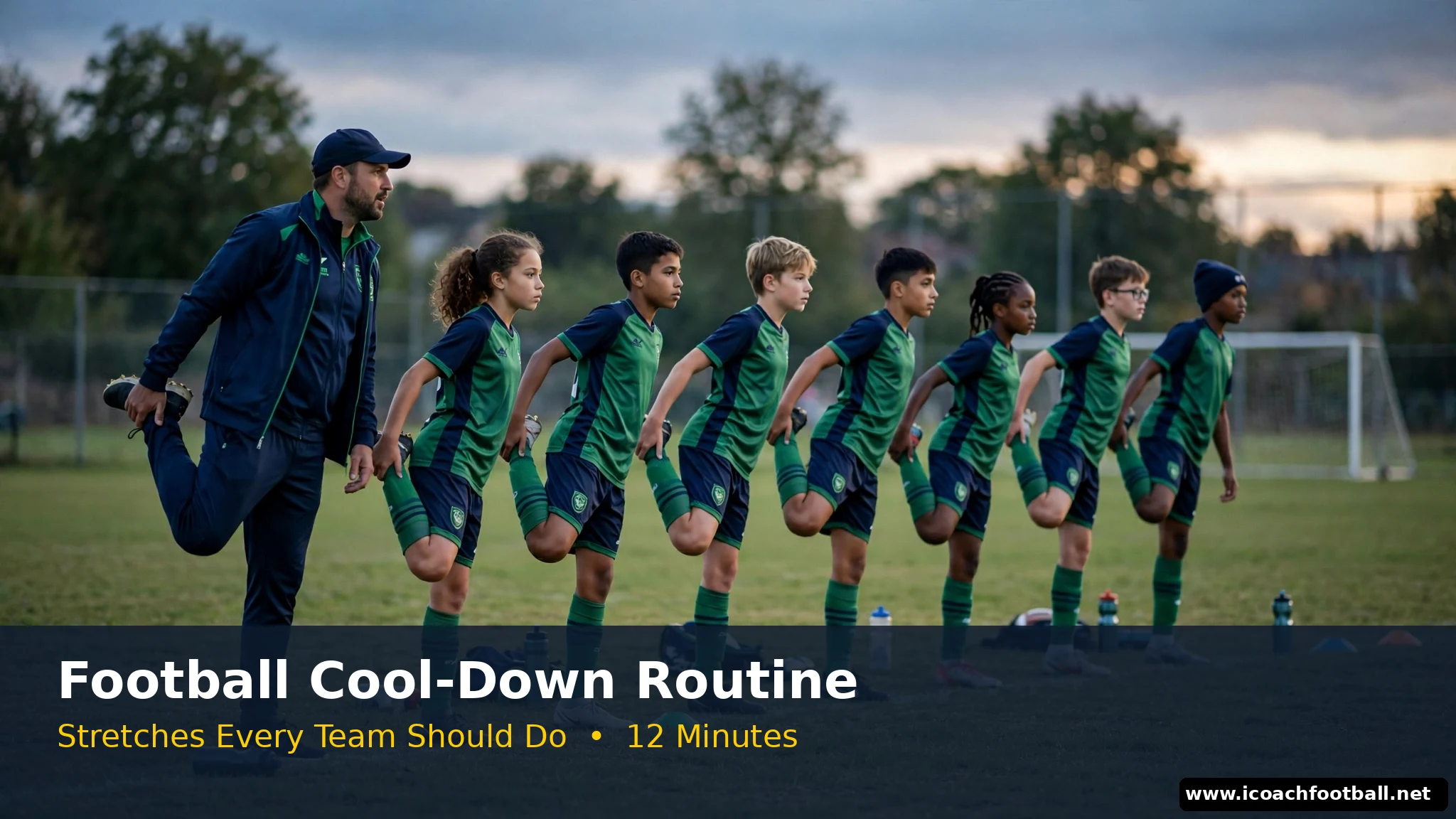
Quick answer: Cool down for 12 minutes in this order: 2 minutes jogging then walking, 2 minutes of slow passing, 3 minutes of standing stretches, 3 minutes of ground stretches, and 2 minutes of breathing and a short debrief. Hold each stretch for 15–20 seconds, to a gentle pull, never pain. Do it after every session and match, before players leave the pitch.
Most cool-downs fail for a simple reason. The whistle goes, players scatter, and the last 12 minutes never happen.
This routine fixes that by giving the cool-down a shape players can learn. The same five phases run after every session, in the same order, at the same pace. The routine works for soccer and football teams alike, because heart rate, breathing and tight legs behave the same way in both.
Session snapshot
- Players: Whole squad, together (pairs for Phase 3, own space for Phase 4)
- Area: Centre circle or a 20 x 20 yard area; no goals needed
- Duration: 12 minutes (5-minute version below)
- Focus: Gradual heart-rate drop, gentle stretching, breathing, team debrief
- Equipment: 6–8 balls for Phase 2, cones to mark the area, water bottles at the edge
- Age: U9–adult (see age adaptations; younger players need shorter holds and more guidance)
Routine overview
| Time | Phase | Main objective |
|---|---|---|
| 0–2 min | Phase 1 | Ease down: jog, then walk |
| 2–4 min | Phase 2 | Slow passing circle, keep moving |
| 4–7 min | Phase 3 | Standing stretches: quad, calf, hamstring |
| 7–10 min | Phase 4 | Ground stretches: glute, groin, hip flexor |
| 10–12 min | Phase 5 | Breathe, drink, debrief |
What a cool-down does — and does not do
- It does: bring heart rate, breathing and blood pressure down gradually, as NHS Inform advises for a 5–10 minute cool-down. It gives players a calm, repeatable end to the session.
- It does not: guarantee fewer injuries or no soreness tomorrow. Gentle stretching after exercise is for gradual relaxation and flexibility, in the NHS wording. Do not promise players it will flush out soreness or prevent injury.
- Cue: “Talking pace only.” If a player cannot talk in full sentences, the ease-down is too fast.
- Safety: Stop any stretch that causes sharp pain. Players with an injury, a medical condition or a recent illness need individual advice, not the team routine. Keep players warm: add a layer if it is cold, and do not let them stand still in wet kit.

Phase 1 — Ease-Down Jog and Walk
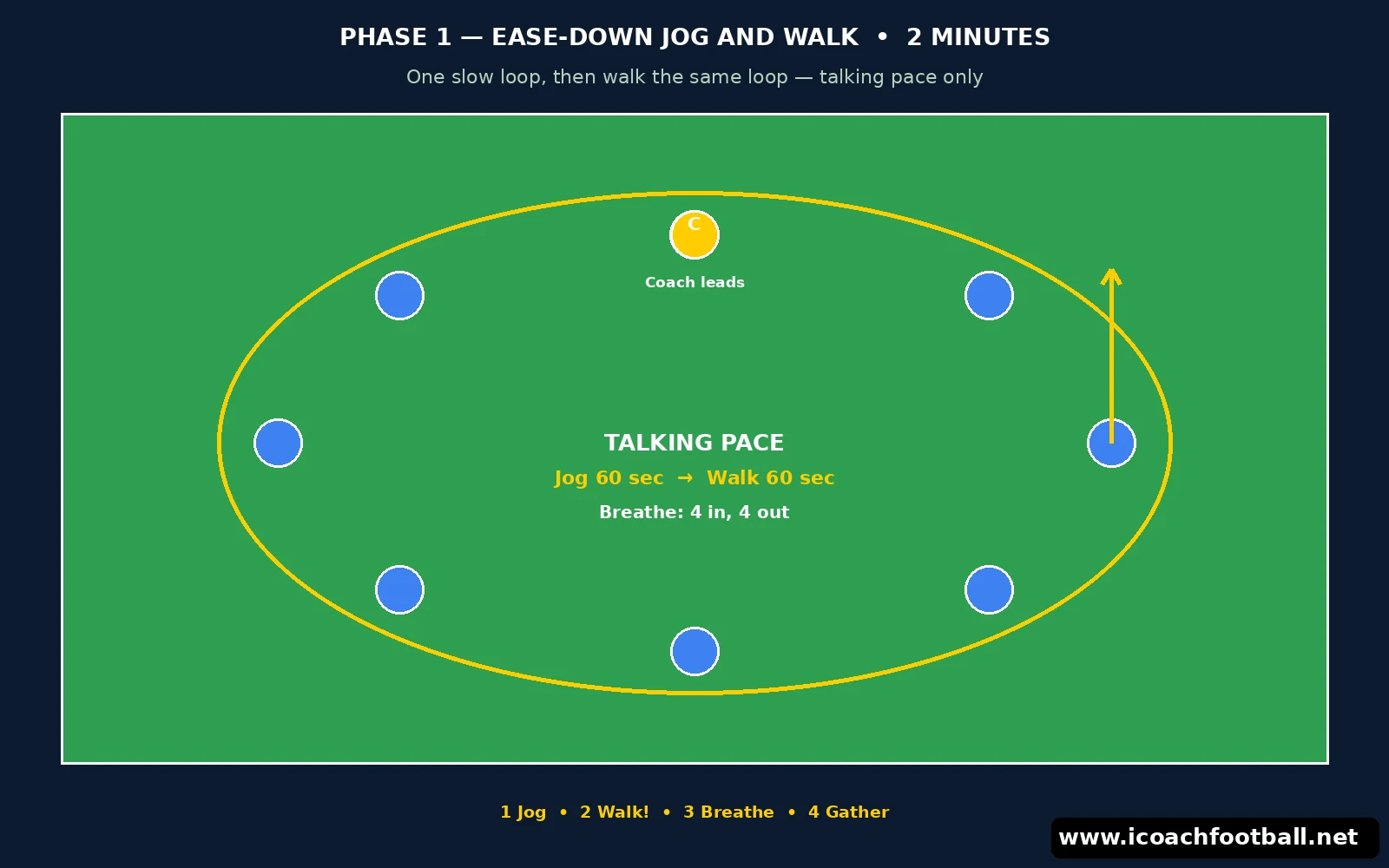
The slow landing: one loop at talking pace, then walking, until breathing settles.
Setup:
- Whole squad in one group, on the pitch, in the centre-circle area.
- One cone loop, about 30 yards across, marked before the session ends.
- No balls. Water bottles stay at the edge, for Phase 5.
- Coach jogs at the front for the first loop, then drops to the back.
- Players stay in a loose group, side by side, not in a single file.
How to Play:
- Players jog one slow loop of the cones, at talking pace, for 60 seconds.
- The coach calls “Walk!” and the group walks the same loop for 60 seconds.
- Players breathe in through the nose and out through the mouth, on the coach’s count of four in, four out.
- The coach asks one question as they walk: “What worked well today?”
- Players gather in the marked area, still walking on the spot, ready for Phase 2.
Coach’s note: The jog must feel easy. The cue is “Slower than you think!” Players who sprint the first loop have missed the point of the phase.
Progressions: After a hard match, walk only, with no jog. After a light session, add arm circles and shoulder rolls to the walk.
Phase 2 — Slow Passing Circle
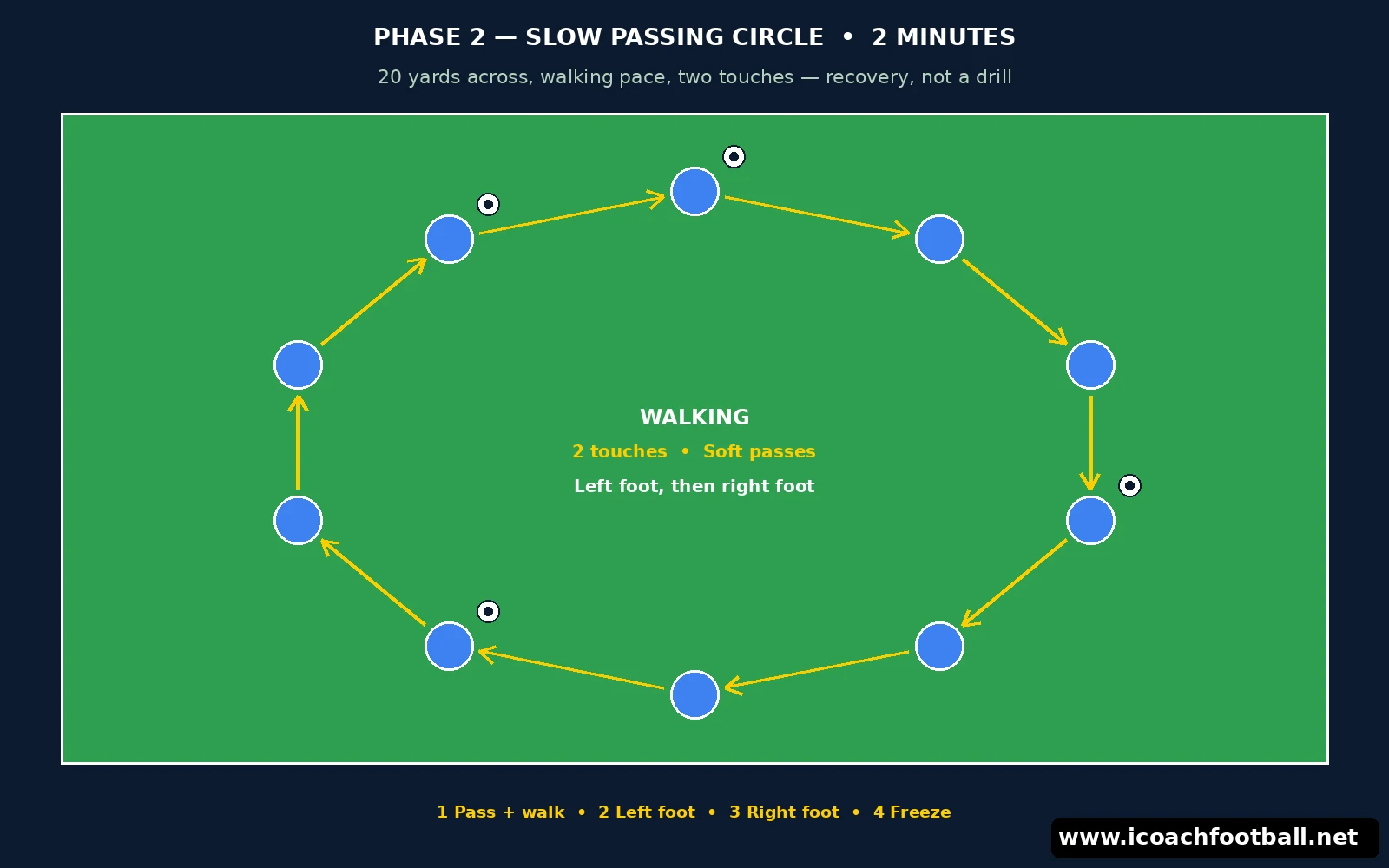
Light ball work at walking pace, so players keep moving without raising heart rate again.
Setup:
- Players in a circle, 20 yards across, one ball between every 4 players.
- One touch or two touches only, passes along the ground.
- No defender, no pressure, no scoring. The circle does not move.
- Coach stands outside the circle and calls the pass type.
- Players who have no ball walk slowly inside the circle, then rejoin it.
How to Play:
- Players pass along the ground, two touches, while walking slowly around the circle.
- The coach calls “Left foot only!” for 30 seconds, then “Right foot only!”
- Players add a sole roll before each pass, keeping the ball close.
- The coach calls “Freeze!” and players stop, ball under foot, for one slow breath.
- Play resumes at walking pace for 30 seconds, then balls are collected to the edge.
Coach’s note: This phase is recovery, not a drill. The cue is “Walking feet, soft passes!” Any player sprinting after a loose ball needs to be slowed down, not praised.
Progressions: Add a thigh control before the pass, then a chest control. Never add a race, a defender or a sprint in this phase.
Phase 3 — Standing Stretches
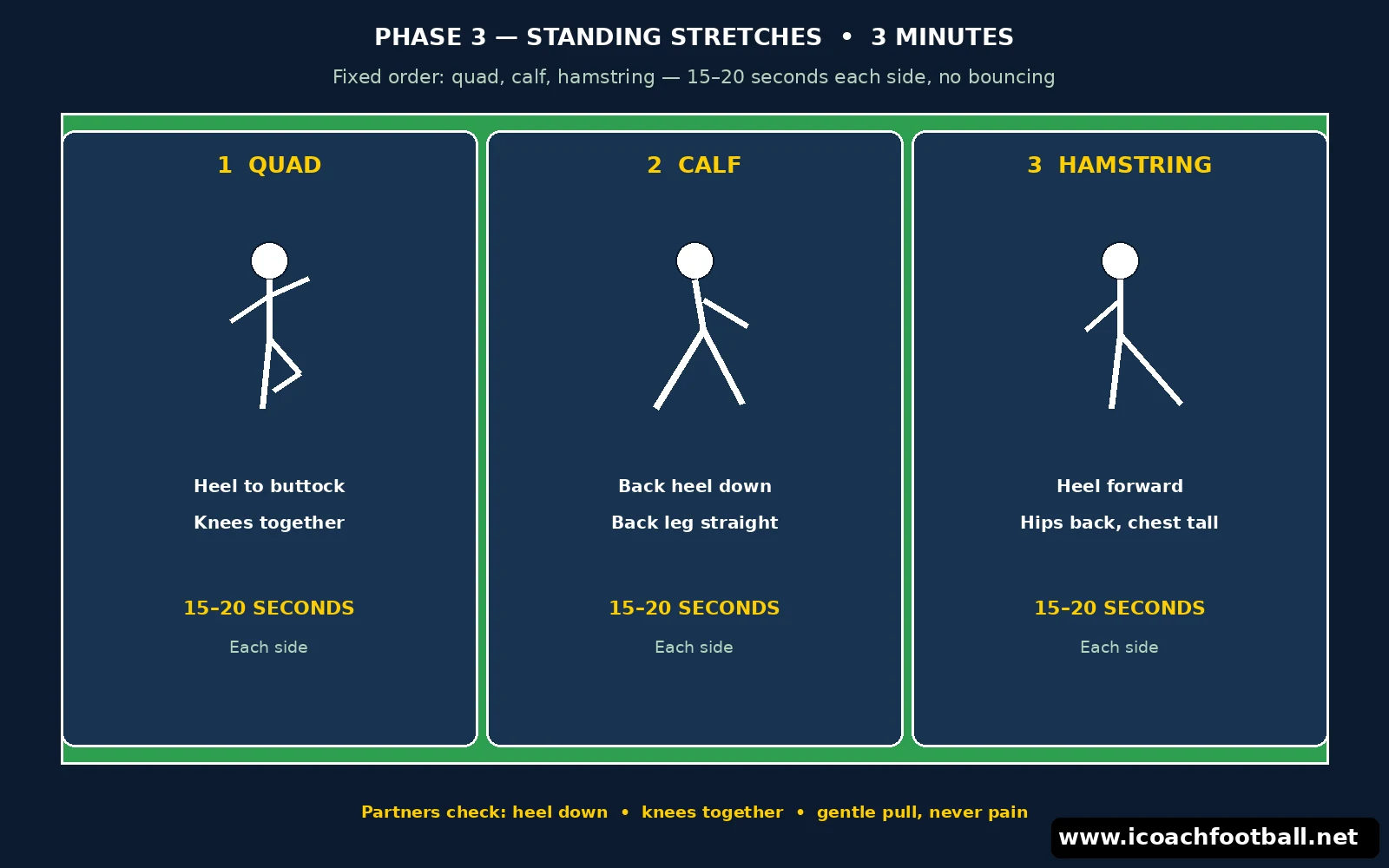
Three standing stretches, both sides, held still. No bouncing, no forcing range.
Setup:
- Players in pairs, facing each other, one arm’s length apart, for balance.
- Each pair has a cone as its spot, so the group stays spread out.
- No equipment. Coach demonstrates each stretch first, then counts the hold.
- Players face the coach, so every player can copy the shape.
- Stretch order is fixed: quad, calf, hamstring. Same order every session.
How to Play:
- Quad stretch: stand on one leg, pull the other heel towards the buttock, knees together. Hold 15–20 seconds, then swap legs.
- Calf stretch: step one foot forward, back leg straight, back heel on the ground, lean forward gently. Hold 15–20 seconds, then swap legs.
- Standing hamstring stretch: heel forward, knee straight, hips back, chest tall. Hold 15–20 seconds, then swap legs.
- Partners check each other: heel down in the calf stretch, knees together in the quad stretch.
- Players shake out both legs, take two slow breaths, and sit down for Phase 4.
Coach’s note: A stretch should feel like a gentle pull, never pain. The cue is “Gentle pull, breathe out!” Bouncing, grabbing a team-mate for balance, or forcing the heel closer all mean the stretch is too hard.
Progressions: Older players hold each stretch for 20–30 seconds. Younger players hold for 10–15 seconds, with the coach counting aloud.
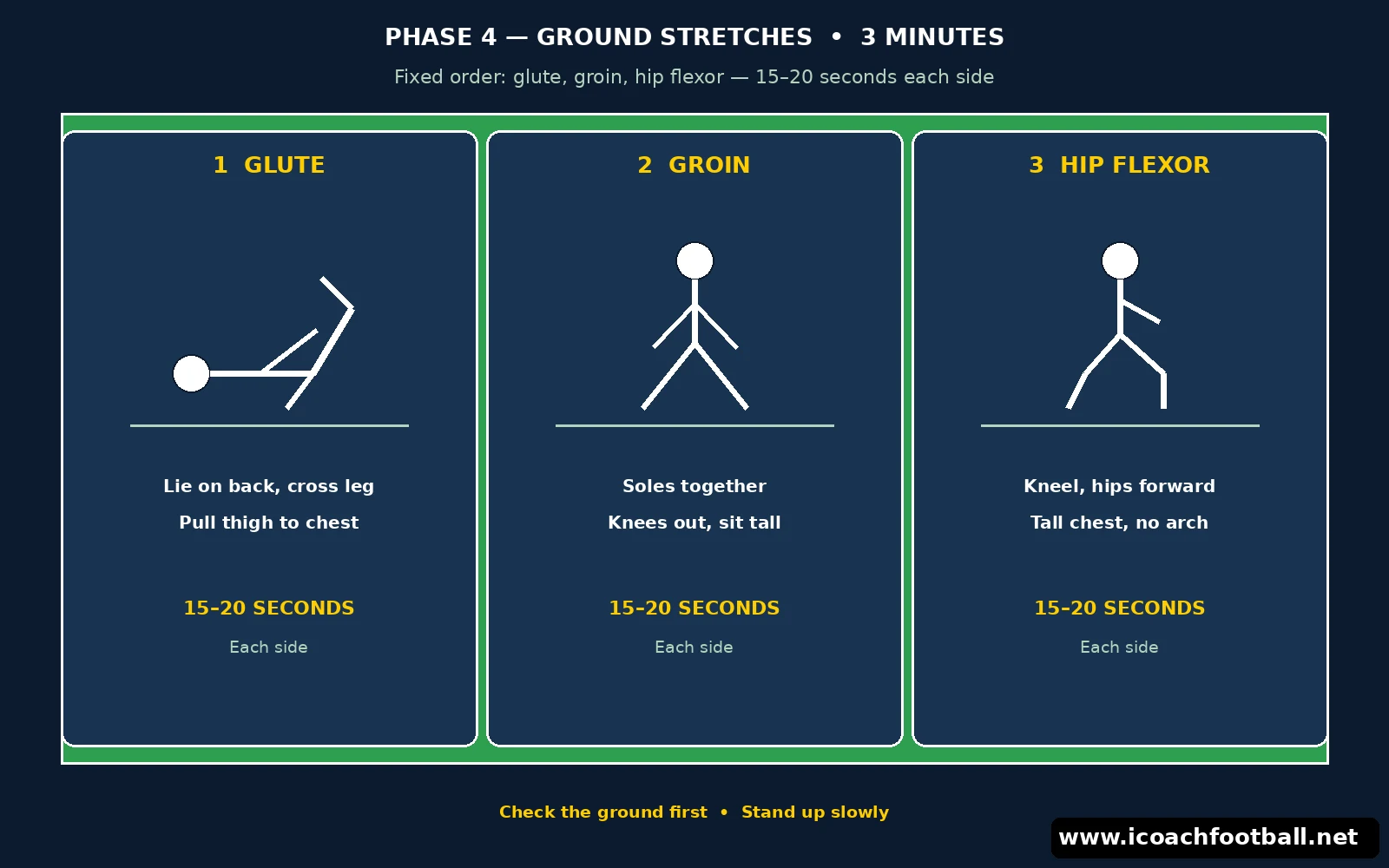
Phase 4 — Ground Stretches
Three ground stretches, in the same fixed order, with players seated or kneeling.
Setup:
- Each player has own space, about 2 yards from the next player, in rows facing the coach.
- Ground is checked first: no stones, no wet patches, no kit in the way.
- No equipment. Players sit, then kneel, in the order below.
- Coach demonstrates from the front, then walks the rows.
- Stretch order is fixed: glute, groin, hip flexor. Same order every session.
How to Play:
- Glute stretch: lie on the back, knees up, cross one leg over the other thigh, pull the lower thigh towards the chest. Hold 15–20 seconds, then swap legs.
- Groin stretch: sit tall, soles of the feet together, knees out, hands on ankles, gentle press down with the elbows. Hold 15–20 seconds.
- Hip flexor stretch: kneel on one knee, front foot flat, hips forward, chest tall, back knee on the ground. Hold 15–20 seconds, then swap legs.
- Players lie flat for 10 seconds, arms by their sides, breathing slowly.
- Players stand up slowly, one row at a time, ready for Phase 5.
Coach’s note: Watch the lower back in the hip flexor stretch. The cue is “Tall chest, hips forward!” If the back arches, the stretch has gone too far.
Progressions: Add a gentle lower-back twist, lying on the back, knees to one side, for older players only. Keep younger players on the three stretches above.
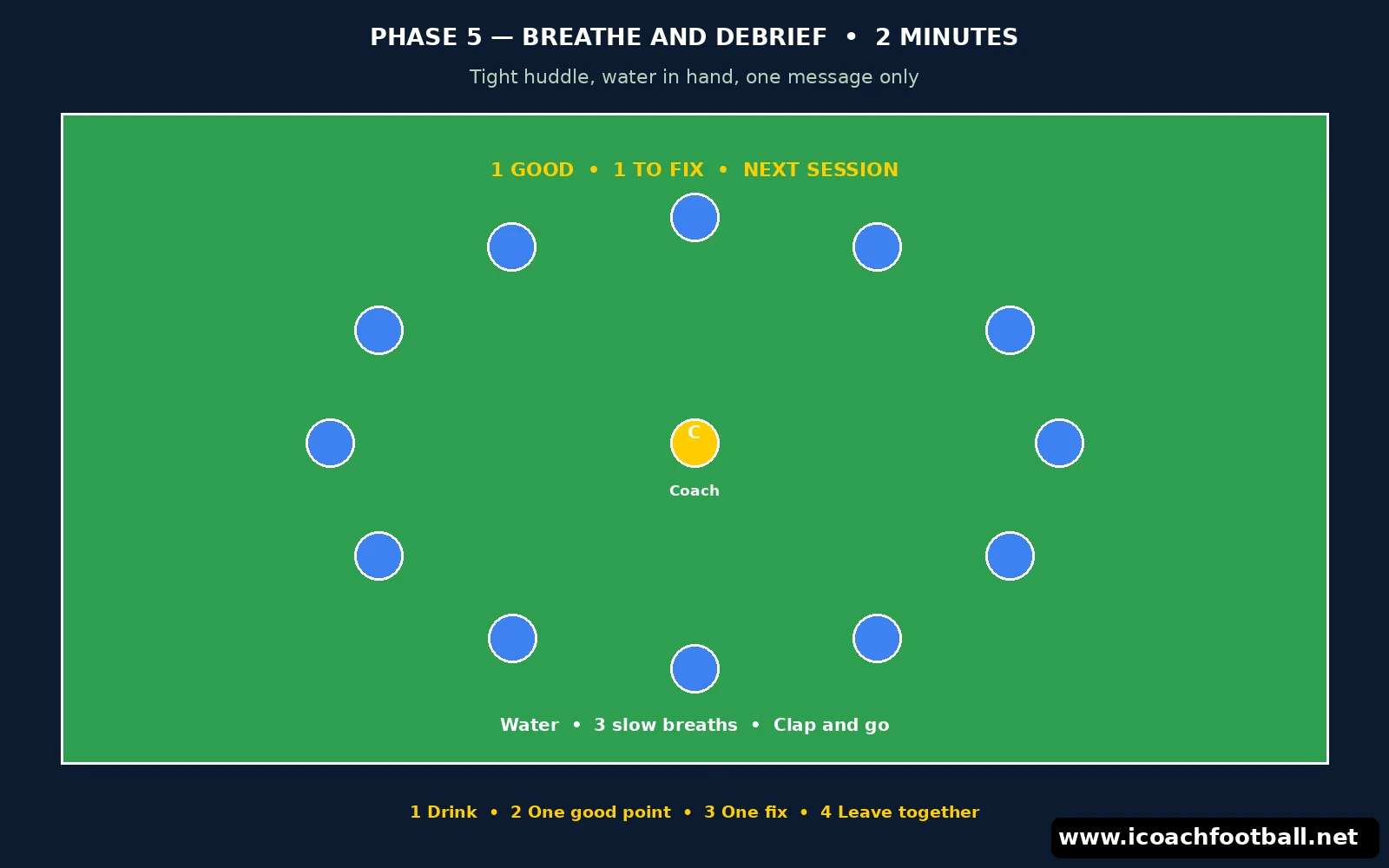
Phase 5 — Breathe and Debrief
Two minutes that close the session: water, breathing, and one clear message.
Setup:
- Players in a tight huddle, standing, water bottles in hand.
- Coach stands in the huddle, not outside it.
- No balls, no cones to collect yet. Kit stays where it is.
- One message only. Two messages are forgotten; one is remembered.
- Players leave from the huddle, not from the stretch rows.
How to Play:
- Players drink water, in small sips, while the coach counts three slow breaths.
- The coach names one thing the team did well, in one sentence.
- The coach names one thing to work on next session, in one sentence.
- The coach gives the next session time and place, and any kit reminder.
- Players clap once, collect kit and cones, and leave together.
Coach’s note: Keep it short and specific. The cue is “One good, one to fix, then go!” A long speech after a cool-down undoes the calm the routine has built.
Progressions: Let a different player lead the three breaths each session. After a match, add 30 seconds for players to thank the opposition and officials before the huddle.
Coaching points that make the routine stick
- Same order, every time. Players learn the routine once, then run it without instruction. Changing the order each session wastes the habit.
- Coach joins in. A coach who stretches with the group sets the standard. A coach who checks a phone while players stretch sets a different one.
- Talking pace is the test. If players cannot talk, the ease-down is too hard. Slow it down, every time, without exception.
- Gentle pull, never pain. That NHS wording is the rule for every stretch in this routine. Pain means stop, not push further.
- Before they leave. A cool-down that happens after players have dressed and left is not a cool-down. Run it on the pitch, straight after the whistle.
Common mistakes — and the fix
- Skipping it when time is short. Fix: use the 5-minute version below, not no version. Five minutes, in order, beats a skipped routine.
- Sprinting the ease-down jog. Fix: coach leads the first loop at talking pace, and calls “Walk!” after 60 seconds, whatever the group wants to do.
- Bouncing in stretches. Fix: hold still, count aloud, and stop any player who bounces. Bouncing is not stretching.
- Stretching cold, hard muscles. Fix: never start with stretches. Phases 1 and 2 come first, so muscles are warm and heart rate has already fallen.
- A long debrief. Fix: one good point, one fix, next session details. Then stop. Save the team talk for the next session.
Age adaptations
- U9–U11: Shorten every hold to 10–15 seconds, coach counts aloud, and keep Phase 2 as a fun walking game. No ground stretches on cold, wet ground; do the standing three twice instead.
- U12–U14: Full routine, with the coach demonstrating every stretch. Add partner checks in Phase 3, and let players lead one stretch each, in rotation.
- U15–U17: Full routine, holds of 20–30 seconds, and the lower-back twist in Phase 4. Players run Phases 1–4 themselves; the coach leads only the debrief.
- Adults: Full routine, with individual additions after the huddle for players with known tight areas. Our hamstring injury prevention drills build the strength work that stretching alone cannot do.
If you only have 5 minutes
| Time | Do this | Skip this |
|---|---|---|
| 0–2 min | Walk one loop, breathing slowly | The jog in Phase 1 |
| 2–4 min | Calf stretch and quad stretch, both sides | Phase 2 and Phase 4 |
| 4–5 min | One slow breath, one message, water | The full debrief |
FAQ
How long should a football cool-down last?
Twelve minutes for the full routine in this post, and 5–10 minutes as a minimum. NHS Inform describes a cool-down of 5 to 10 minutes, including stretches.
How long should you hold each stretch in a cool-down?
Hold each stretch for 15–20 seconds, following the NHS post-exercise routine. Hold to a gentle pull, never pain, and do not bounce.
Should players stretch before or after training?
After training, for static stretches. Dynamic movement belongs in the warm-up, before training. Static holds belong in the cool-down, after the ease-down jog and walk.
What stretches should footballers do after a match?
Calf, quad, hamstring, glute, groin and hip flexor stretches, in that order. Those six cover the muscles football uses most: running, kicking, turning and jumping.
Do cool-downs prevent injury or soreness?
A cool-down brings heart rate and breathing down gradually and supports flexibility. It does not guarantee fewer injuries or no soreness. Strength, load management and warm-ups matter more for injury risk than stretching alone.
Sources and further reading
- NHS, How to stretch after exercising: a 5-minute post-workout routine to gradually relax, improve flexibility and slow heart rate, with gentle stretches held for 15 to 20 seconds, including buttock, hamstring, inner thigh, calf and thigh stretches. The holds and stretch order in this routine are in line with that guidance; no approval or affiliation is claimed.
- NHS Inform, Warm up and cool down activities: a cool-down should take 5 to 10 minutes, including stretches, starting by slowing the activity down, then stretching, holding each stretch for 10 to 15 seconds. The 12-minute structure here extends that 5–10 minute shape with a team debrief; no approval or affiliation is claimed.
- For the other end of the session, see our soccer warm-up drills, and for strength work that supports the muscles stretched here, see our injury prevention and mobility guide, linked above.



