Training Load in Soccer: The Complete Guide to Injury Prevention (GPS & sRPE)
What is Training Load in Soccer?
Training Load is the quantitative measurement of the physical work performed by a player (“External Load”) and the physiological stress that work places on their body (“Internal Load”). By monitoring these numbers, coaches can manage fatigue, optimize fitness, and significantly reduce the risk of soft-tissue injuries.
“Load Management” is the buzzword of modern football. Whether you are managing a Champions League team with full GPS tracking or a U19 regional team with a stopwatch, the biological principle is the same: Spikes in load cause injuries.
“The reliability of this method is backed by extensive science. Foundational research led by Dr. Franco Impellizzeri published in Medicine & Science in Sports & Exercise confirmed that sRPE provides a valid quantification of internal load that correlates strongly with heart rate data.”
Most coaches make the mistake of looking only at the “Work” (Distance ran). But to prevent injuries, you must understand the relationship between what the player did and how the player felt.
This guide will explain the science of Internal vs. External Load, why even coaches with expensive GPS systems must still track sRPE, and how to use our Free Training Load Calculator to find the injury prevention “Sweet Spot.”
The Two Sides of the Coin: Internal vs. External Load
To get a complete picture of player fitness, you cannot just look at one metric. You need two data streams.
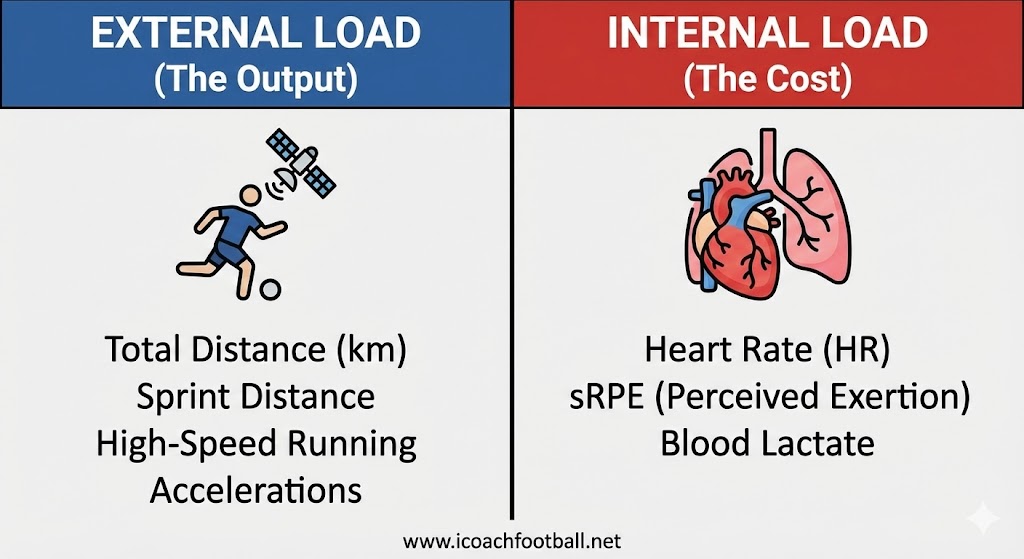
1. External Load (The “Output”)
This is objective data. It measures the mechanical work done by the body.
- For GPS Users: Total Distance (km), High-Speed Running (>19.8km/h), Sprint Distance, Accelerations/Decelerations.
- For Non-GPS Users: Total Duration (Minutes) and Drill Dimensions.
- What it tells you: “The player ran 10km today.”
2. Internal Load (The “Cost”)
This is subjective/physiological data. It measures the stress placed on the cardiovascular and muscular systems to achieve that work.
- Metrics: Heart Rate (HR), Blood Lactate, sRPE (Session Rating of Perceived Exertion).
- What it tells you: “That 10km run felt exhausting (RPE 9/10).”
⚠️ Why GPS Coaches Need sRPE:
A player might run the exact same distance (External Load) on Tuesday and Thursday.
- Tuesday: They are fresh. RPE is 4/10.
- Thursday: They are stressed and didn’t sleep. RPE is 8/10.
If you only look at your GPS laptop, you miss this red flag. You must track Internal Load to catch fatigue before it becomes an injury.
The sRPE Method: The Universal Metric
Whether you have a $50,000 budget or $0, the sRPE Method remains the gold standard for tracking Internal Load. It relies on a simple formula:
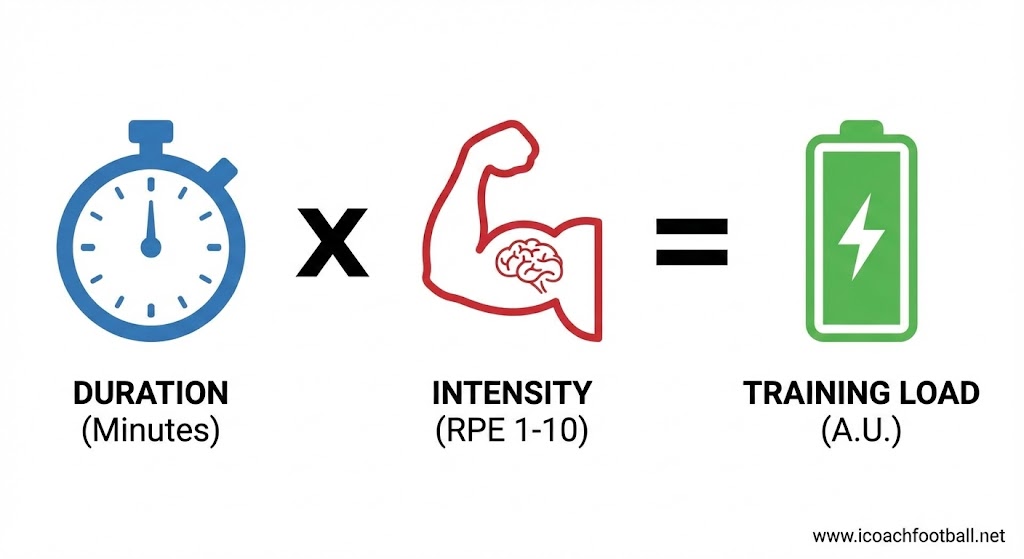
Step 1: Determine Duration
How long was the active training? (Exclude the coach’s long speeches!). Let’s say 90 minutes.
Step 2: Determine Intensity (RPE)
10-30 minutes after training, ask your players to rate the session on a scale of 1 to 10.
- 1: Resting (Sitting on the couch)
- 3-4: Moderate (Jogging / Technical work)
- 5-6: Hard (Small Sided Games)
- 8-9: Very Hard (Match intensity)
- 10: Maximal (Exhaustion)
Step 3: The Calculation
That “630” is your Training Load for the day.
🚀 Stop doing the math manually:
We have built a free tool that calculates this for your entire squad instantly.
👉 Click here to use the Training Load Calculator
The “Sweet Spot”: Acute:Chronic Workload Ratio (ACWR)
Calculating the daily load is useless if you don’t know what to do with the number. This is where the Acute:Chronic Workload Ratio (ACWR) comes in. This is the “Magic Number” of injury prevention.
It compares two things:
- Acute Load (Fatigue): How much work did you do this week? (Last 7 days).
- Chronic Load (Fitness): How much work have you averaged over the last month? (Last 28 days).
The Formula
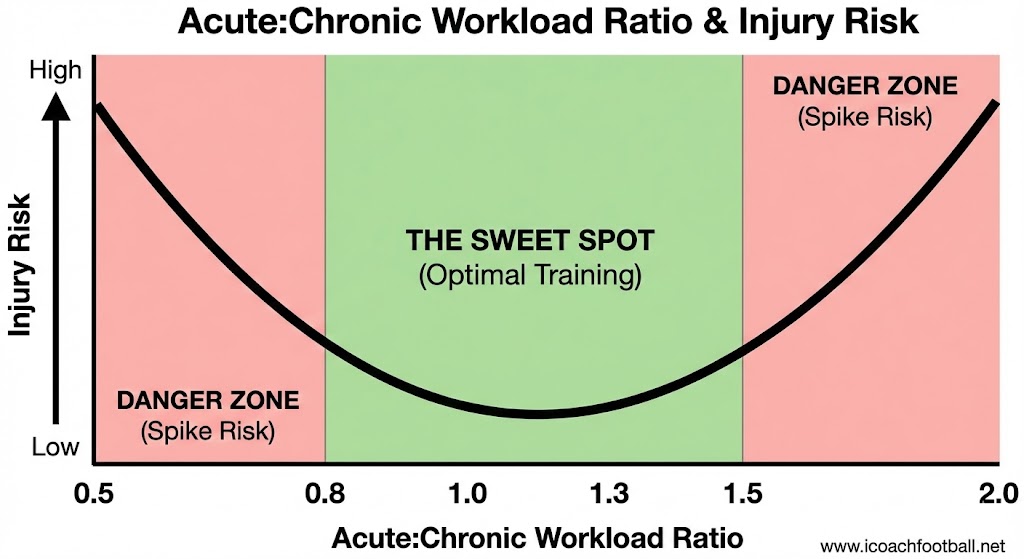
“This specific ratio was popularized by the research of Dr. Tim Gabbett. His studies on the ‘Training-Injury Prevention Paradox‘ demonstrated that high training loads are not the problem; the problem is getting there too fast. Maintaining a ratio between 0.8 and 1.3 is proven to maximize fitness while minimizing injury risk.”
Interpreting the Score (The Injury Zones)
- The Danger Zone (< 0.8): Undertraining.If your score is low, your players are losing fitness. They are not prepared for the demands of the match.
- The Sweet Spot (0.8 – 1.3): Optimal Training.This is where you want to live. You are pushing the players enough to gain fitness, but not enough to break them.
- The Danger Zone (> 1.5): The “Spike”.This is the “Red Zone.” If you increase training load by more than 50% compared to what the players are used to, injury risk increases by 2-4x.
3 Rules for Periodization using Load
- Respect MD-2 (Match Day Minus 2): This should usually be your lowest load day (Speed/Reaction). Aim for an RPE of 3-4 and short duration (60 mins). Load ~200-300 units.
- Load the Midweek (MD-3 or MD-4): To maintain Chronic Load (Fitness), you need one “Hard” day a week. Aim for RPE 7-8. Load ~600-700 units.
- Monitor the Individuals: Your center-midfielder might have a load of 800, while your goalkeeper has 200 for the same session. You cannot train them identically.
“Knowing the load number is only half the battle; you also need to know which day to schedule it. To see exactly how to map these high and low days into your weekly schedule, read our step-by-step guide on Structuring the Perfect Weekly Microcycle.”
Frequently Asked Questions (FAQ)
What is a good training load for soccer players?
A typical professional training week ranges between 2000 and 3000 arbitrary units (sRPE). A single high-intensity session usually falls between 600-800 units (e.g., 90 mins x RPE 8).
How do you calculate training load without GPS?
Use the sRPE method. Multiply the session duration (minutes) by the player’s perceived intensity (scale 1-10). For example, 60 minutes x Intensity 5 = 300 Load Units.
What is the Acute:Chronic Workload Ratio?
It is a formula that compares fatigue (this week’s load) against fitness (average of last 4 weeks). A ratio between 0.8 and 1.3 is considered the ‘Sweet Spot’ for injury prevention.
Can I track training load for youth players?
Yes, but be careful during growth spurts. Youth players (U13-U15) are more susceptible to overuse injuries (like Osgood-Schlatter). Keep their ACWR strictly between 0.8 and 1.2.
Conclusion
Training Load is not just numbers on a spreadsheet; it is the most powerful tool you have to keep your best players on the pitch. You don’t need expensive technology. You need consistency, the RPE scale, and a calculator.
Ready to start tracking?
Don’t waste time with Excel formulas. Use our specialized tool designed for soccer coaches.
👉 GO TO THE TRAINING LOAD CALCULATOR